• 검색 결과가 없습니다.

Lumbar Spine Kinematics during Anterior and Posterior Pelvic Tilting in Supine and Prone Positions

N/A
N/A
Protected

Academic year: 2021

Share "Lumbar Spine Kinematics during Anterior and Posterior Pelvic Tilting in Supine and Prone Positions"

Copied!
6
0
0

로드 중.... (전체 텍스트 보기)

전체 글

(1)

Tilting in Supine and Prone Positions

The Journal of Korean Society of Physical Therapy

So-Hyun Park, PT, PhD; Goon-Chang Yuk, PT, PhD, COMT

1

; Sang-Ho Ahn, MD, PhD

2

; Dong-gyu Lee, MD

3

; Jin-Ho Choi, PT, PhD

4

; Hyun-Ju, Oh, PT, PhD

5

; Kwan-Yong Park PT, MS

6

Medical Devices Clinical Trial Center of Yeungnam University Hospital;

1

Department of Physical Therapy, Yeungnam University Medical Center;

2

Department of Physical Medicine and Rehabilitation, College of Medicine, Yeungnam University & Biomedical Engineering Institute, Yeungnam University;

3

Department of Physical Medicine and Rehabilitation, College of Medicine, Yeungnam University;

4

Department of Physical Therapy, Daegu Haany University;

5

Department of Physical Therapy, Daegu Science University;

6

Department of Physical Therapy, Konkuk University Chungju Hospital

Purpose: The pelvic tilting exercise is a well recognized rehabilitation maneuver. However, little information is available on  the changes of lumbar segmental motion during pelvic tilting. This study was conducted to measure the kinematics of the  pelvic tilting exercise on the supine and prone positions via fluoroscopy.

Methods: A total of 10 female subjects were enrolled. During anterior, neutral, and posterior pelvic tilting, radiographs  were  taken in  each exercise via  fluoroscopy  (ARCADIS Orbic, Siemens, USA).  Images were  sent to  the picture  archiving  communication  system (PACS),  and  the  digitized  images  were analyzed  using LabVIEW  software (National  Instruments,  USA). Lumbosacral lordosis and the intervertebral body angle, intervertebral disc angle, and intervertebral displacement  were analyzed. 

Results: The  results  of  lumbar  kinematic  analysis  during  three  tilting  postures  in  the  supine  and  prone  positions  demonstrated that lumbosacral lordosis and the intervertebral body angle and  intervertebral disc angle were significantly  higher when the pelvis was tilted anteriorly (p>0.05). However, there was no significant difference between anterior and  neutral tilting in the intervertebral disc angle at the L3/4 level in the prone position (p>0.05), and there was no significant  difference among tilting positions in intervertebral body displacement in the prone  position (p>0.05).

Conclusion: This study  provides  scientific  evidence about the  pelvic tilting exercise  in lumbosacral segmental motion. 

Depending on the pelvic tilting exercise, kinematic changes were demonstrated in both positions, especially in the supine  position. It is suggested that the supine position is effective for mobility, but it should be used carefully for the LBP (Low  back pain) patient with hypermobility.  

Keywords: Pelvic tilting, Lumbar kinematics, Fluoroscopy Received: November 10, 2011

Revised: November 25, 2011 Accepted: November 25, 2011

Corresponding author: Kwan-Yong Park, [email protected]

I. Introduction

Both anterior and posterior pelvic rotation while lying down are common positions in which pelvic movements are assessed and utilized in the rehabilitation setting.

1

The patients recognize their painless range of motion during the pelvic tilting exercise, and they have confidence in new movement. Therefore, the

pelvic tilt can be done in several different positions as a starting position, and it is an essential motor control skill for lumbar stability.

2

Pelvic tilts are often recommended to develop support for

the low back, abdominals, sacroiliac joints, and adjacent

structures. The posterior pelvic tilt is believed to reduce lumbar

lordosis, and the anterior pelvic tilt increases lumbar lordosis.

3

(2)

During posterior pelvic tilting, both the lower fibers of the rectus abdominals and the gluteals are worked, and reduced lumbar lordosis from posterior pelvic tilting is reported to have some advantages. It facilitates the supply of metabolites to the posterior annulus fibrosus,

4,5

reduces the load on apophyseal joint surfaces,

5,6

and relieves the posterior annulus fibrosus from compressive stress.

7,8

It may also activate the abdominal muscles, relieve paraspinal muscle spasm, and improve lumbopelvic control.

9

The anterior pelvic tilt is actually a quite normal postural position. However, excessive anterior pelvic tilting beyond the “normal” range is a result of weakness in the abdominal muscles and tightness in the iliopsoas.

3

The pelvic tilting exercise is performed in various non- weight bearing and weight bearing positions.

10

In the early stage of LBP (Low Back Pain) management, the prone or supine position is preferred, which are non-weight bearing positions. In particular, the prone position forms a closer kinematic chain than the supine position. The recommended position for the pelvic posterior tilting exercise is with slight knee and hip flexion in the supine position, which facilitates easy performance in the acute stage, and then the patient is trained in the sitting and standing positions.

9

Previous study regarding pelvic tilting assessed the relationships between pelvic tilting and lumbar lordosis or muscle contraction while standing.

3,11

Although the pelvic tilting exercise is an accepted rehabilitation maneuver to check the range of painlessness, few studies have examined the relationship between the pelvic tilt and kinematics.

3,12,13

It is difficult to determine segmental movement during motion due to limitations in measuring equipment, but fluoroscopy can measure intersegmental motion during movement with low radiation. The purpose of this study was to evaluate the kinematic changes of the lumbar spine according to anterior, neutral, and posterior pelvic tilting in healthy subjects using fluoroscopy.

II. Methods

1. Subjects

Ten healthy female college students without neurological or musculoskeletal disease volunteered for this study. The exclusion criteria included previous spinal problems and current medical

treatment for spinal pain and pregnancy.

The principal objectives and radiologic risks of this study were explained to each subject, and they signed an informed consent form before the study. This protocol was conducted in accordance with the ethical standards of the Declaration of Helsinki.

2. Procedure

Subjects were instructed on how to perform the pelvic tilt by one physical therapist. For the anterior pelvic tilt, subjects were instructed to rotate the pelvis anteriorly. For the neutral spine position, the pelvis was in a comfortable, relaxed position. For the posterior pelvic tilt, subjects were instructed to rotate the pelvis posteriorly, so that the lumbar spine became flat. First, the subject performed the pelvic tilting exercise in the supine position with relaxed 30° hip flexion and 75° knee flexion, and then they performed the pelvic tilting exercise in the prone position. Subjects practiced each pelvic tilting exercise three times in preparation.

3. Data acquisition and analysis

After practice, the x-ray tube was pointed at each subject's lumbar spine from L3 to the superior end plate of the sacrum in the sagittal plane, and the radiographs were taken during each exercise via fluoroscopy (ARCADIS Orbic, Siemens, USA).

Images were sent to the picture archiving communication system (PACS), and the digitized images were analyzed using LabVIEW software (National Instruments, USA).

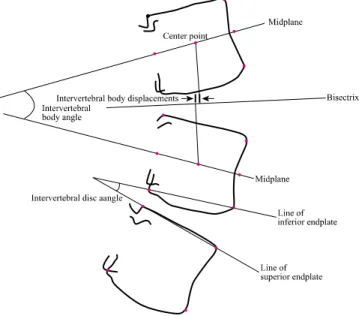
For kinematic analysis, lumbosacral lordosis, and the

intervertebral body angle, and intervertebral body displacement

were analyzed based on previous study (Figure 1).

14-16

Lumbosacral

lordosis was defined as the angle between the midplane lines of

L3 and the superior end plate of the sacrum. The intervertebral

body angle was defined as the angle between adjacent midplane

lines. The intervertebral disc angle was defined as the angle

between the line of the adjacent cephalic vertebral inferior end

plate and the adjacent caudal vertebral superior end plate. The

angle was counted as positive if the wedge opened ventrally. The

intervertebral body displacement was defined as the distance

between the perpendicular projections of the vertebral body

center points to the bisectrix. When the center point of the

cranial vertebra was positioned more anteriorly than the caudal

vertebra, it was expressed as a positive value. To account for

(3)

Mean±SD (n=10)

Age (years) 21.7±3.1

Weight (kg) 52.1±3.3

Height (cm) 157.4±1.9

Table 1. General characteristics variations in magnification and stature, the intervertebral body

displacement was divided by the mean depth (mean of superior endplate and inferior endplate) of the cranial vertebra.

17

Figure 1. Measurement of intervertebral body angle, intervertebral disc angle, and displacement. The intervertebral body angle was defined as the angle between adjacent midplane lines. The intervertebral disc angle was defined as the angle between the line of the adjacent cephalic vertebral inferior end plate and the adjacent caudal vertebral superior end plate. The intervertebral body displacement was defined as the distance between the perpendicular projections of the vertebral body center points to the bisectrix.

4. Statistical analysis

All data are expressed as mean±standard error. Comparisons among the three exercises regarding lumbosacral lordosis, intervertebral body angle, intervertebral disc angle, and intervertebral body displacement were analyzed via repeated measures of one-factor analysis. PASW 18.0 for Windows was used throughout, and statistical significance was accepted for p-values of <0.05.

III. Results

Table 1 indicates demographic data of the subjects. All participants tended to be similar in age, weight, and height.

The results of lumbar kinematic analysis during three tilting postures in the supine and prone positions demonstrated that

lumbosacral lordosis and the intervertebral body angle and intervertebral disc angle were significantly higher when the pelvis was tilted anteriorly. This trend was predominantly demonstrated at the caudal level. Regarding lumbosacral lordosis and the intervertebral body angle and intervertebral disc angle in the supine position, the mean value was highest in anterior tilting and lowest in posterior tilting, and there were significant differences between anterior, neutral, and posterior tilting (p<0.05)(Figure 2A, 2C, 2E, 2G).

In regard to lumbosacral lordosis and the intervertebral body angle and intervertebral disc angle in the prone position, the mean value was highest in anterior tilting and lowest in posterior tilting. There were significant differences among anterior, neutral, and posterior tilting in lumbosacral lordosis and the intervertebral body angle (p<0.05)(Figure 2B, 2D). In terms of the intervertebral disc angle in the prone position, the mean value was highest in anterior tilting, followed by neutral and posterior tilting at L4/5 and L5/S1. However there was no significant difference between anterior and neutral tiling at the L3/4 level (p>0.05)(Figure 2F). In terms of the intervertebral body displacement in the prone position, the mean value was highest in anterior tilting, but there was no significant difference among the tilting positions (p>0.05)(Figure 2H).

IV. Discussion

The pelvic tilting exercise is a well accepted rehabilitation maneuver,

18

but little information is available on changes of lumbar segmental motion during pelvic tilting.

3,12,13

In this study, significant kinematic changes among three tilting postures were found in lumbosacral lordosis and the intervertebral body angle and intervertebral disc angle in the prone and supine positions.

Although a significant difference was found among the three

tilting positions in intervertebral body displacement in the

(4)

Figure 2. Results of lumbar spine kinematics depending on anterior, neutral, and posterior tilting in supine

and prone positions

(5)

supine position, no significant difference was found between the postures in the intervertebral body displacement in the prone position.

Physiological lumbar lordosis has a protective effect on the structures through an equal distributing force across the spinal column, and it is correlated to whole sagittal alignments.

19,20

Decreased lumbar lordosis is found in LBP patients

21

and the elderly,

22

and greater lordosis is demonstrated in a person with weakness of the abdominal muscles.

23

In this study, lordosis was greater in anterior pelvic tilting, followed by neutral and posterior pelvic tilting in both positions. The difference between anterior and neutral tilting was 18.3° in the supine position and 11.5° in the prone position. The difference between neutral and posterior tilting was 25.4° in the supine position and 21° in the prone position. Levine et al.

12

reported that adopting a maximal anterior pelvic tilt increased lumbar lordosis by an average of 10.8°, and adopting a maximal posterior pelvic tilt decreased lumbar lordosis by an average of 9° in the standing position.

Differences from the previous study may be due to individual variables

12

and the postures. The results of this study support the idea that pelvic tilting affects lumbar lordosis.

In our study, the intervertebral body and disc angle de- monstrated the same trends, and they were increased during anterior tilting and decreased during posterior tilting. In addition, the caudal level demonstrated a greater intervertebral body and disc angle than the cephalic level during anterior, neutral, and posterior tilting, except the intervertebral disc angle at L4/5 during posterior tilting in the supine position. The vertebral body and intervertebral space are a trapezoidal shape and different in size.

24

The posterior height of the intervertebral disc is less than its anterior height, and the anterior height of the vertebral body at L5 was higher than its posterior height. These properties affected the intervertebral body angle and intervertebral disc angle.

25

In our study, the lumbar spine was flattened, which decreased the intervertebral disc angle during posterior tilting in both the supine and prone positions. This permitted more spaces in the posterior intervertebral region, and the stress or compression of nerves may be decreased, and disc pain could be reduced.

26

The intervertebral disc angle during posterior tilting in the supine position demonstrated that the L4/5 level was lowest, which means the inferior endplate of L4 is parallel to the superior endplate of the L5 level. On the other hand, the intervertebral angle at L5/S1 was greatest in supine

position but not as much as in the prone position. De Carvalho

17

et al. reported lumbar spine and pelvic posture between standing and sitting. They found that the intervertebral disc angle was decreased at all lumbar levels, except between L5/S1, when lordosis is flattened by sitting. Another study suggested that the L5/S1 joint was not significantly affected by the pelvic tilt in a standing position

3

. The results of previous studies were different from our study because of different postures.

The greater displacement of the intervertebral body chages instant axis of motion and is ineffective for loading distribution.

24

In our study, the intervertebral displacement was significantly higher during anterior tilting, followed by neutral and posterior tilting, in supine position, but there was no significant difference between the three tilting motions in the prone position. Frobin et al.

16

also demonstrated that di- splacement decreases in extension and increases in flexion, and the amount of displacement is close to zero. The anterior tilting in the supine position showed greater displacement than that in the prone position. Thus, the pelvic tilting exercise in the supine position is not recommended for patients with hypermobility, and the prone position is safer than the supine position for those patients

Limitations of the study were that only healthy young women participated in the study, and the small sample size and muscle contribution were not considered. Further studies will be required to analyze weight bearing conditions, such as sitting and standing, or functional posture on pelvic tilting.

This study provides scientific evidence about the pelvic tilting exercise in lumbosacral segmental motion. Depending on the pelvic tilting exercise, kinematic changes were demonstrated in both positions, especially in the supine position. It is suggested that the supine position is effective for mobility, but it should be used carefully for the LBP patient with hypermobility.

In addition, the prone position is more stable for patients with hypermobility.

Author Contributions

Research design: Yuk GC, Park SH

Acquisition of data: Yuk GC, Park SH, Oh HJ

Analysis and interpretation of data: Yuk GC, Park SH, Lee DG,

Choi JH

(6)

Drafting of the manuscript: Park SH, Yuk GC Research supervision: KY Park, SH Ahn

Acknowledgements

This work was supported by a grant of the Korea Healthcare Technology R&D Project, Ministry of Health, Welfare &

Family Affairs, Republic of Korea (A084177).

References

1. El-Hamalawy FA. A newly developed exercise program for treatment of mechanical low back pain associated with accentuated lumbar lordosis. Journal of American Science.

2011;7(8):58-70.

2. Norris CM. An exercise programme to enhance lumbar stabilisation. Physiotherapy. 1995;81(2):8138-145.

3. Delisle A, Gagnon M, Sicard C. Effect of pelvic tilt on lumbar spine geometry. IEEE Trans Rehabil Eng. 1997;5(4):360-6.

4. Adams MA, Hutton WC. The effect of posture on the fluid content of lumbar intervertebral discs. Spine (Phila Pa 1976).

1983;8(6):665-71.

5. Adams MA, Hutton WC. The effect of posture on diffusion into lumbar intervertebral discs. J Anat. 1986;147:121-34.

6. Adams MA, Hutton WC. The effect of posture on the role of the apophyseal joints in resisting intervertebral compressive forces. J Bone Joint Surg Br. 1980;62(3):358-62.

7. Adams MA, McNally DS, Wagstaff J et al. Abnormal stress concentrations in lumbar intervertebral discs following damage to the vertebral bodies: A cause of disc failure? Eur Spine J.

1993;1(4):214-21.

8. Adams MA, McNally DS, Chinn H et al. Posture and the compressive strength of the lumbar spine. Clinical Biomech- anics. 1993;9(1):5-14.

9. Richardson C, Jull G, Hodges P et al. Therapeutic exercise for spinal segmental stabilization in low back pain. New York, Churchill Livingstone, 1999: 105-144.

10. Monfort-Panego M, Vera-Garcia FJ, Sanchez-Zuriaga D et al.

Electromyographic studies in abdominal exercises: A literature synthesis. J Manipulative Physiol Ther. 2009;32(3):232-44.

11. Youdas JW, Garrett TR, Egan KS et al. Lumbar lordosis and pelvic inclination in adults with chronic low back pain. Phys Ther. 2000;80(3):261-75.

12. Levine D, Whittle MW. The effects of pelvic movement on lumbar lordosis in the standing position. J Orthop Sports Phys Ther. 1996;24(3):130-5.

13. Day JW, Smidt GL, Lehmann T. Effect of pelvic tilt on standing posture. Phys Ther. 1984;64(4):510-6.

14. Yuk GC, Park SH, Kim CS. Kinematics analysis of lumbar spine during breathing in lying position. J Kor Soc Phys Ther.

2011;23(5):15-21.

15. Teyhen DS, Flynn TW, Bovik AC et al. A new technique for digital fluoroscopic video assessment of sagittal plane lumbar spine motion. Spine (Phila Pa 1976). 2005;30(14):E406-13.

16. Frobin W, Brinckmann P, Leivseth G et al. Precision measurement of segmental motion from flexion-extension radiographs of the lumbar spine. Clin Biomech (Bristol, Avon).

1996;11(8):457-65.

17. De Carvalho DE, Soave D, Ross K et al. Lumbar spine and pelvic posture between standing and sitting: A radiologic investigation including reliability and repeatability of the lumbar lordosis measure. J Manipulative Physiol Ther.

2010;33(1):48-55.

18. McGill SM. Low back exercises: Evidence for improving exercise regimens. Phys Ther. 1998;78(7):754-65.

19. Roussouly P, Nnadi C. Sagittal plane deformity: An overview of interpretation and management. Eur Spine J.19(11):

1824-36.

20. Le Huec JC, Aunoble S, Philippe L et al. Pelvic parameters:

Origin and significance. Eur Spine J. 20 Suppl 5:564-71.

21. Chaléat-Valayer E, Mac-Thiong, J.M., Paquet, J., Bert- honnaud, E., Siani, F, Roussouly, P. Sagittal spino-pelvic alignment in chronic low back pain. Eur Spine J. 2011:Epub ahead of print.

22. Takeda N, Kobayashi T, Atsuta Y et al. Changes in the sagittal spinal alignment of the elderly without vertebral fractures: A minimum 10-year longitudinal study. J Orthop Sci. 2009;

14(6):748-53.

23. Neuman D. Kinesiology of the musculoskeletal system USA, Mosby, 2002: 311-384.

24. Bogduk N. Clinical anatomy of the lumbar spine and sacrum.

Edinburgh, Churchill Livingstone, 2005:1-31.

25. Masharawi Y, Salame K, Mirovsky Y et al. Vertebral body shape variation in the thoracic and lumbar spine: Characterization of its asymmetry and wedging. Clin Anat. 2008;21(1):46-54.

26. Adams MA, May S, Freeman BJ et al. Effects of backward bending on lumbar intervertebral discs. Relevance to physical therapy treatments for low back pain. Spine (Phila Pa 1976).

2000;25(4):431-7; discussion 8.

수치

Figure 1. Measurement of intervertebral body angle,  intervertebral disc angle, and displacement
Figure 2. Results of lumbar spine kinematics depending on anterior, neutral, and posterior tilting in supine  and prone positions

참조

관련 문서