• 검색 결과가 없습니다.

Staple-line Reinforcement after Laparoscopic Sleeve Gastrectomy: Personal Experience at a Single Center JMBS

N/A
N/A
Protected

Academic year: 2021

Share "Staple-line Reinforcement after Laparoscopic Sleeve Gastrectomy: Personal Experience at a Single Center JMBS"

Copied!
5
0
0

로드 중.... (전체 텍스트 보기)

전체 글

(1)

ORIGINAL ARTICLE

JMBS Journal of Metabolic and Bariatric Surgery J Metab Bariatr Surg 2014;3(1):17-21

Received: May 12, 2014, Revised: May 29, 2014, Accepted: June 11, 2014,

Corresponding author: Yong Jin Kim, 59 Daesagwan-ro, Yongsan-gu, Seoul 140-743, Korea Department of Surgery, Soonchunhyang University Seoul Hospital Tel: 82-2-709-9479, Fax: 82-2-795-1687, E-mail: [email protected]

Staple-line Reinforcement after Laparoscopic Sleeve Gastrectomy:

Personal Experience at a Single Center

Department of Surgery, Soonchunhyang University College of Medicine, Seoul, Korea

Yoon Young Choi, Yong Jin Kim, Kyung Yul Hur

Purpose: The usefulness of reinforcement of staple-line during laparoscopic sleeve gastrectomy (LSG) is still controversial.

We review our experience of LSG to check it. Materials and Methods: Eighty one patients who were performed LSG between April 2009 and August 2010 enrolled in this study. The patients were divided into two groups; nonreinforcement of staple-line group and reinforcement of staple-line group. We started reinforcement of staple-line from 31st patients because we experienced three cases of staple-line related complications. Results: The demographics of each group had no difference.

There were three staple-line related complication(one case of leak and 2 cases of kinking) in nonreinforcement group, but no staple-line related complication in reinforcement group (P=0.048). There was no bleeding and no stenosis in both group. The operation time was longer in nonreinforcement group than reinforcement group (129 min. vs 103 min., P=0.027). Also, the number of patients who needed medication for reflux symptom were 6 (20%) in nonreinforcement group and 2 (3.9%) in reinforcement group (P=0.019). Conclusion: Routine reinforcement of the staple-line may decrease the staple-line related complications. A well-designed prospective study with longer follow up would be necessary to elucidate the efficacy and usefulness of the staple-line reinforcement during LSG.

Key Words: Sleeve gastrectomy, Morbid obesity, Reinforcement

INTRODUCTION

Obesity is associated with many chronic disease, consequently increased morbidity, and decreased quality of life and life expectancy [1,2]. Bariatric surgery has been considered as the most effective treatment for sustained weight loss in morbid obesity patients [3,4]. As surgical technique and equipment has been improved, periope- rative morbidity was significantly decreased, so, the attention have been increased in the surgical treatment of morbid obesity [5,6].

Laparoscopic sleeve gastrectomy (LSG) is originally

considered as a bridge procedure for biliopancreatic diversion bypass (BPD) or duodenal switch (DS). Because early results [7,8] and even long term results [9] were acceptably good in weight loss for morbid obesity, and it is an easier and safer technique with a shorter learning curve compare to gastric bypass surgery, LSG become in- creasingly favored as a stand alone bariatric procedure.

Since long staple-line retained after LSG and the high

internal pressure created with vertical tubulization of the

stomach [10], leak sometimes happened after LSG. Rein-

forcement could be an option to decrease staple-line

related complications such as leak and kinking, however,

(2)

Table 1. Obesity related comorbidities of both group Reinforcement

P-value No (n=30) Yes (n=51)

Type 2 diabetes 9 (30%) 14 (27%) 0.804

Hypertension 11 (37%) 10 (20%) 0.093

Hyperlipidemia 14 (47%) 19 (37%) 0.405

Sleep apnea 2 (7%) 8 (16%) 0.233

Arthritis 10 (33%) 9 (18%) 0.108

its effective value is still controversial. Some authors reported it did not decrease the rate of leaks [11], another authors reported buttressing the stapler line reduced the blood loss but did not decrease the leak [12], and the other authors staple-line reinforcement was important for preventing leak [13]. We review our experience of LSG for morbid obesity patients to check about it.

MATERIALS AND METHODS

1. Patients

This study was approved by the Institutional Review Board for human investigation of Soonchunhyang Univer- sity Hospital (SCHUH 2014-04-021). Retrospective review of medical records of patients who were performed LSG for morbid obesity from April 2009 to August 2010 was performed. There were 81 patients (21 male patients and 60 female patients) with a mean age of 34 years (20-57 years). Indication for LSG followed guide line of 2005 Asian-Pacific Bariatric Surgery Group (APBSG) consensus meeting; 1) obese patients with their BMI >37, 2) obese patients with their BMI>32 in the presence of diabetes or two significant obesity related co-morbidities, 3) have been unable to lose or maintain weight loss by dietary or medical measures, 4) age of patient>18 years and <65 years. Before operation, all patients had consultant to dietitian and experienced two weeks of high protein diet.

The patients divided into two groups; reinforcement of staple-line group and nonreinforcement of staple-line group. We started reinforcement of staple-line from April 2010, 31st patients, because we experienced one case of leak and two cases of kinking.

2. Operative procedure

Low weight molecular heparin was used to prevent deep vein thrombosis twelve hours before operation routinely.

In general anesthesia, the patient positioned to reverse- Trendelenberg position. LSG was performed using five ports; one 12 mm trocar, two 11 mm trocar, and two 5 mm trocar (ENDOPATH, XCEL

TM

, Bladeless Trocar, Ethicon Endo-Surgery, Cincinnati, OH, USA). The great omentum was divided using Harmonic scalpel (Ethicon Endo- Sur- gery, Cincinnatti, OH, USA) from 4 cm above pyloric ring to

esophago-gastric junction (EGJ). To divided posterior wall of the stomach, dissection was performed until identify the left cruse of diaphragm muscle. 34 Fr of bougie was inserted till duodenum to guide the plane; the stomach was resected from greater curvature to EGJ using endoscopic stapler (ECHELON ENDOPATH

TM

Staplers 45 mm, Ethicon Endo-Surgery, Cincinnati, OH, USA). No reinforcement of the staple-line was implemented in initial 30 patients, and reinforcement of the staple-line (continuous oversewing with absorbable monofilament) was performed with the absorbable clip made of a biocompatible polydioxanone polymer (Lapra-Ty; Ethicon Endosurgery, Cincinnati, OH, USA) in subsequent patients. All patients underwent routine intraoperative leak test using methylene blue and air.

On postoperative day (POD) 1, upper gastrointestinal (GI) series with water absorbable contrast (Gastrografin) was implemented to identify whether there is leak, kinking, and stenosis or not; if the study was fine, started on sips of water and the diet advanced.

RESULTS

Table 1 showed the obesity related comorbidities of both group. There was 9 patients (30%) who had diabetes in nonreinforcement group, and 14 patients (27%) in rein- forcement group. Also, hypertension (37% vs 20%, P=

0.093), hyperlipidemia (47% vs 37%, P=0.405), sleep apnea (7% vs 16%, P=0.233), and arthritis (33% vs 18%, P=0.108) showed no statistical difference between two group.

As Table 2 showed, the mean age of each group was

similar (34.6 years in nonreinforcement group and 34.3

years in reinforcement group), and the ratio of sex had no

difference in both group (11 male 19 female patients in

(3)

Table 3. Postoperative outcomes of each group Reinforcement

P-value No (n=30) Yes (n=51)

Operation time, min.±SD 129±59 103±24 0.027 Hospital stay, days±SD 5.4±14.5 1.7±0.8 <0.01 Complication 9 (30%) 3 (5.8%) 0.003 Staple-line complication 3 (10%) 0 (0%) 0.048

Bleeding 0 0 NS

Wound complication 0 (0%) 1 (1.9%) 0.44 Reflux 6 (20%) 2 (3.9%) 0.019 Table 2. Demographic features of both group

Reinforcement

P-value No (n=30) Yes (n=51)

Duration 2009,4-2010,3 2010,4-2010,8

Mean age, years±SD 34.6±9.7 34.3±9.1 0.941

Male:Female 11:19 10:41 0.117

Mean weight, kg±SD 110±21.6 108±21.8 0.567 Mean BMI, kg/m

2

±SD 38.9±5.2 39.6±5.9 0.748

nonreinforcement group and 10 male, 41 female patients in reinforcement group). Also, there were no differences in preoperative mean weight and BMI (110 kg and 38.9 kg/m

2

in nonreinforcement group and 108 kg, 39.6 kg/m

2

in reinforcement group).

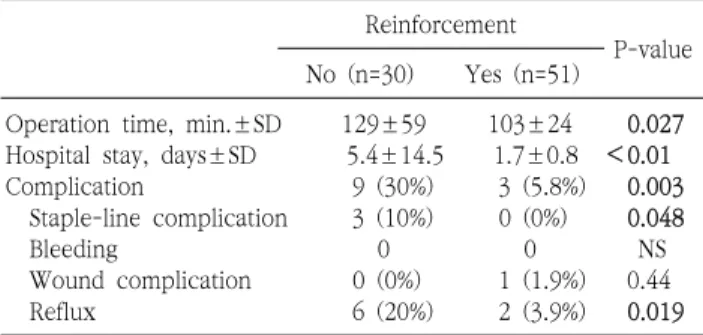
Table 3 showed postoperative outcomes of each group.

The operation time of nonreinforcement group was longer than reinforcement group (129 min. vs 103 min., P=0.027), and hospital stay was longer in nonreinforcement group than reinforcement group (5.4 days vs 1.7 days, P<0.01).

Total twelve complications were detected after sleeve gastrectomy (30% in nonreinforcement group and 5.8% in reinforcement group, P=0.003). In detail of complications, there were 3 staple-line complications (one case of staple-line leak and 2 cases of kinking) in nonreinforce- ment group, and no staple-line complication in reinforce- ment group (P=0.048). No bleeding and no stenosis were observed in each group, but 1 case of wound hematoma was occurred in reinforcement group (0% vs 1.9%, P=0.44).

The number of patients who needed medication for reflux were 6 (20%) in nonreinforcement group and 2 (3.9%) in reinforcement group, this result had a statistical signifi- cance (P=0.019).

DISCUSSION

LSG have received attention as a stand alone bariatric procedure because of its safety and effectiveness [14]. The mechanism of weight loss after LSG is known as followings;

1) restrict the gastric capacity and passage of food through the stomach, 2) reduce the appetite-inducing peptide hormone, ghrelin, which was mainly deriving from the gastric fundus resected after LSG.

The leakage is one of the most common and unwanted complication after LSG. The incidence of leak after LSG have been reported 0.8-7% [11,15-17]. The etiologies of the leaks have been divided into mechanical and ischemic causes. In general, ischemic leaks are known to occur 5-7 days after operation, so if the leaks occurred within 48 hrs after operation, it may be mechanical leaks which are results of intraluminal pressure exceeds the strength of the tissue and the staple line [11]. The staple-line could be vulnerable because it had long staple-line and the high internal pressure created with vertical tubulization of the stomach after LSG [10].

Numerous studies have reported buttressed staple-lines using commercial products such as bovine pericardial strips or absorbable polymer membranes were helpful to prevent leak or hemorrhage [18-20], however, it was also known that such materials were expensive [21-23].

Kinking, the anatomical changes in the angle of His and

EGJ area is one of the staple-line related complications

after LSG. Kinking might be associated with retention of

the fundus, and it may play an important role in the

postoperative sleeve emptying [24]. In our series, there

were two cases of kinking; 1) a 48-year-old man was

suffered from nausea and vomiting just after LSG. Upper GI

series (Fig. 1A) showed that the anatomical angle was

changed. Fortunately, after several days of conservative

treatment, the symptom was gradually improved but the

diet advancement was slow compared to other patients. 2)

A 26- years-old male was also suffered from nausea and

vomiting after surgery and in upper GI series, there was

kinking (Fig. 1B). He discharged at POD #4, however he

readmitted at POD # 7 and needed another 1 week of

admission for conservative treatment. The two patients did

(4)

Fig. 1. The findings of upper gastro- intestinal series of the patients who suffered from nausea and vomiting just after sleeve gastrectomy. (A) the anatomical changes in the angle of His and GEJ area; (B) the anatomical changes in the angle of His and GEJ area with fundal dilatation.

not need any intervention or medication after they overcame the initial symptom. In our study, there was no staple-line bleeding or postoperative bleeding, so we couldn’t identify that reinforcement of the staple-line have an advantage for decrease bleeding. However there was one leak and 2 cases of kinking without bleeding in nonreinforcement group, and it had statistical significance (P=0.048). So reinforcement with continuous oversewing of staple-line had an advantage in the aspect of decrease the staple-line related complications.

Reflux also has been one of the most common com- plication after LSG, so some authors have suggested that other procedure may be better than LSG to patient who already have esophageal reflux in endoscopy before operation [25]. Sometimes severe reflux may need remedial conversed operation such as mini-gastric bypass [26] or re-sleeve gastrectomy with hiatal hernia repair [27].

The reflux after LSG increased during the first postoperative year, but disappeared thereafter [28].

However, the cause of reflux complication after LSG is still not clear. Keidar et al. [24] have reported the reflux might be occurred because of not only the degree of fundal dilatation, but the presence of a relative narrowing distal to it, also, the size of gastric tube and oversewing the staple line did not seem to affect the rate of reflux.

According to our data, the patients who needed medication (proton pump inhibitors) for reflux symptom were more frequently observed in nonreinforcement

group than reinforcement group (P=0.019). We can’t explain this outcome exactly because there was no definite narrowing or stasis in upper GI series, however, the reflux symptom seemed have some relationship to reinforcement or learning curve. To identify a link between reflux and its causes, well designed study with large number of case will be needed.

The operative time and hospital stay was longer in nonreinforcement group. There was one case of leak in nonreinforcement group; he discharged at POD#82, so it affected long hospital stay. Except that leak case, mean hospital stay was 2.76 days. In operation time, the learning curve might be related longer operation time in nonrein- forcement group. Also the first case of LSG took 300 minutes, and in one patient who was performed combined operation for uterine myoma, the operation time took 340 minutes. Except that two cases, the mean operation time was 115.71 minutes. In our experience, the reinforcement with continuous oversewing using the Lapra-Ty clip needed only additional 10 minutes. So, reinforcement of staple-line is not time consuming procedure.

CONCLUSION

We recommend to perform reinforcement of the staple-

line routinely during LSG because it had some advantages

of reducing staple-line related complications. However, a

well-designed prospective study with long term follow up

(5)

is needed to confirm its effectiveness.

ACKNOWLEDGMENTS

This research was supported by the Soonchunhyang University Research Fund.

REFERENCES

1. World Health Organization. Global strategy on diet, physical ac- tivity, and health. 57th World Health Assembly resolution. WHA 57.15. Geneva, Switzerland: World Health Organization, 2004.

2. Calle EE, Thun MJ, Petrelli JM, Rodriguez C, Heath CW Jr.

Body-mass index and mortality in a prospective cohort of U.S.

adults. N Engl J Med 1999;341:1097-105.

3. Gastrointestinal surgery for severe obesity: National Institutes of Health Consensus Development Conference Statement. Am J Clin Nutr 1992;55 (2 Suppl):615S-9S.

4. Buchwald H, Avidor Y, Braunwald E, et al. Bariatric surgery: a sys- tematic review and meta-analysis. JAMA 2004;292:1724-37.

5. Nguyen NT, Goldman C, Rosenquist CJ, et al. Laparoscopic versus open gastric bypass: a randomized study of outcomes, quality of life, and costs. Ann Surg 2001;234:279-89.

6. Pope GD, Birkmeyer JD, Finlayson SR. National trends in uti- lization and in-hospital outcomes of bariatric surgery. J Gastrointest Surg 2002;6:855-60.

7. Arias E, Martínez PR, Ka Ming Li V, Szomstein S, Rosenthal RJ.

Mid-term follow-up after sleeve gastrectomy as a final approach for morbid obesity. Obes Surg 2009;19:544-8.

8. Menenakos E, Stamou KM, Albanopoulos K, Papailiou J, Theodorou D, Leandros E. Laparoscopic sleeve gastrectomy per- formed with intent to treat morbid obesity: a prospective sin- gle-center study of 261 patients with a median follow-up of 1 year. Obes Surg 2010;20:276-82.

9. Himpens J, Dobbeleir J, Peeters G. Long-term results of laparo- scopic sleeve gastrectomy for obesity. Ann Surg 2010;252:319- 24.

10. Baltasar A, Bou R, Bengochea M, Serra C, Cipagauta L. Use of a Roux limb to correct esophagogastric junction fistulas after sleeve gastrectomy. Obes Surg 2007;17:1408-10.

11. Chen B, Kiriakopoulos A, Tsakayannis D, Wachtel MS, Linos D, Frezza EE. Reinforcement does not necessarily reduce the rate of staple line leaks after sleeve gastrectomy. A review of the liter- ature and clinical experiences. Obes Surg 2009;19:166-72.

12. Dapri G, Cadière GB, Himpens J. Reinforcing the staple line dur- ing laparoscopic sleeve gastrectomy: prospective randomized clinical study comparing three different techniques. Obes Surg 2010;20:462-7.

13. Ser KH, Lee WJ, Lee YC, Chen JC, Su YH, Chen SC. Experience in laparoscopic sleeve gastrectomy for morbidly obese Taiwanese:

staple-line reinforcement is important for preventing leakage.

Surg Endosc 2010;24:2253-9.

14. Roa PE, Kaidar-Person O, Pinto D, Cho M, Szomstein S, Rosenthal RJ. Laparoscopic sleeve gastrectomy as treatment for morbid obesity: technique and short-term outcome. Obes Surg 2006;16:

1323-6.

15. Frezza EE, Reddy S, Gee LL, Wachtel MS. Complications after sleeve gastrectomy for morbid obesity. Obes Surg 2009;19:684-7.

16. Lee CM, Cirangle PT, Jossart GH. 218 Laparoscopic vertical sleeve gastrectomy for morbid obesity: a report of a five-year experi- ence with 750 patients. Gastroenterology 2008;134 Suppl 1:A- 844.

17. Stroh C, Birk D, Flade-Kuthe R, et al; Bariatric Surgery Working Group. A nationwide survey on bariatric surgery in Germany-- results 2005-2007. Obes Surg 2009;19:105-12.

18. Arnold W, Shikora SA. A comparison of burst pressure between buttressed versus non-buttressed staple-lines in an animal model.

Obes Surg 2005;15:164-71.

19. Downey DM, Harre JG, Dolan JP. Increased burst pressure in gas- trointestinal staple-lines using reinforcement with a bio- prosthetic material. Obes Surg 2005;15:1379-83.

20. Angrisani L, Lorenzo M, Borrelli V, Ciannella M, Bassi UA, Scarano P. The use of bovine pericardial strips on linear stapler to reduce extraluminal bleeding during laparoscopic gastric bypass: pro- spective randomized clinical trial. Obes Surg 2004;14:1198-202.

21. Consten EC, Gagner M. Staple-line reinforcement techniques with different buttressing materials used for laparoscopic gastro- intestinal surgery: a new strategy to diminish perioperative complications. Surg Technol Int 2004;13:59-63.

22. Consten EC, Gagner M, Pomp A, Inabnet WB. Decreased bleeding after laparoscopic sleeve gastrectomy with or without duodenal switch for morbid obesity using a stapled buttressed absorbable polymer membrane. Obes Surg 2004;14:1360-6.

23. Rubin M, Yehoshua RT, Stein M, et al. Laparoscopic sleeve gas- trectomy with minimal morbidity. Early results in 120 morbidly obese patients. Obes Surg 2008;18:1567-70.

24. Keidar A, Appelbaum L, Schweiger C, Elazary R, Baltasar A.

Dilated upper sleeve can be associated with severe postoperative gastroesophageal dysmotility and reflux. Obes Surg 2010;20:

140-7.

25. Bohdjalian A, Langer FB, Shakeri-Leidenmühler S, et al. Sleeve gastrectomy as sole and definitive bariatric procedure: 5-year re- sults for weight loss and ghrelin. Obes Surg 2010;20:535-40.

26. Makarewicz W, Kaska L, Kobiela J, et al. Wernicke's syndrome af- ter sleeve gastrectomy. Obes Surg 2007;17:704-6.

27. Parikh M, Gagner M. Laparoscopic hiatal hernia repair and repeat sleeve gastrectomy for gastroesophageal reflux disease after duo- denal switch. Surg Obes Relat Dis 2008;4:73-5.

28. Weiner RA, Weiner S, Pomhoff I, Jacobi C, Makarewicz W,

Weigand G. Laparoscopic sleeve gastrectomy--influence of

sleeve size and resected gastric volume. Obes Surg 2007;17:1297-

305.

수치

Table  1.  Obesity  related  comorbidities  of  both  group Reinforcement P-value No  (n=30) Yes  (n=51) Type  2  diabetes   9  (30%) 14  (27%) 0.804 Hypertension 11  (37%) 10  (20%) 0.093 Hyperlipidemia 14  (47%) 19  (37%) 0.405 Sleep  apnea   2  (7%)   8
Table 3 showed postoperative outcomes of each group.
Fig.  1.  The  findings  of  upper  gastro- gastro-intestinal  series  of  the  patients  who suffered  from  nausea  and  vomiting  just  after  sleeve  gastrectomy

참조

관련 문서

In maxilla, arch perimeters and intermolar widths of crowded group were significantly smaller than normal occlusion group but intercanine width of crowded

The clinical outcome and complication for treating proximal femoral shaft fracture were compared and analyzed through the group treated with closed

2-7(a) Comparison of Stream line(Bare Hull, bottom stern view)... 2-7(b) Comparison of Stream line(BF1,

The 24hr proteinuria level were increased in kidney with cyclosporine-A group but significantly decreased in iNOS inhibitor and green tea polyphenol group..

There was no significant difference between the groups in problems of eating habits, but the obesity group considered overeating as a problem while the normal

„ Group-spatial reuse: different parts of the program access the same cache line.... „ Generally takes

The change in active oxygen was decreased after exercise in the exercise group than in the control group, and there was a statistically significant

In the control group, lifestyle-related factors were significantly different only in blood glucose (p <.01) and there was no significant difference in