Original Article
J
The Effects of Whole Body Vibration Exercise on Jump
Performance and Quadriceps Muscle Activation in Soccer Player
Je-Ho Kim
Department of Physical Therapy, Graduate School, Sehan University, Dangjin, Korea
Purpose: The purpose of this study was to determine the influence of WBV exercise on CMJ and quadriceps muscle activation according to different frequency of vibration in soccer player and also to find effective frequency for leading appropriate treatment reaction.
Methods: Thirty three subjects were randomly divided into three groups: the three groups are WBV group using 20 Hz frequency, WBV group using 30 Hz frequency and squat exercise group according to training method. The exercise program was conducted for six weeks.
Subjects were measured on CMJ and quadriceps muscle activation.
Results: Significant difference in CMJ was observed in the group I, II compared with the group III (p< 0.05). Results of post-hoc, showed a significant difference in CMJ in on group I, II compared with the group III, but no a statistically significant difference between group I and II. Significant difference in quadriceps muscle activation was observed in the group I, II compared with the group III (p< 0.05, p< 0.01). Results of post-hoc, significant difference in quadriceps muscle activation in on group I, II compared with the group III and sig- nificant difference between group I and group II.
Conclusion: This research intervened WBV for soccer players and compared the differences of CMJ and quadriceps muscle activation; as a result of the effective frequency for improving performance, there is a significant difference in CMJ and quadriceps muscle activation of WBV group with comparison of control group; and it was proved that WBV is effective using 30 Hz frequency for improving quadri- ceps muscle activation.
Keywords: Whole body vibration exercise, Jump, Muscle activity, Soccer player
INTRODUCTION
Jump performance is an ability to move vertically center of mass with the stationary position using muscular strength generated by muscle contraction, and the high jump performance is crucial fac- tor to influence outcome of soccer game.1 Vertical jump is a repre- sentative test of functional performance, which is evaluate the func- tion of lower extremity is needed interaction of various system, such as recruitment of motor unit, stability of joints, muscular strength, neuromuscular coordination.2 Also, it is needed to activate of body and pelvis area and also tight and tibia area muscle in order to rep- resent high level motion and it is shown correlation relative to verti- cal jump especially for lower extremity muscular strength. More- over, it is represented high muscle activation when vertical jump for
rectus femoris, vastus medialis, vastus lateralis, gluteus muscle and gastrocnemius muscle.3,4 When vertical jump, the muscle conducts through stretch-shortening cycle which making concentric contrac- tion with accumulation of elastic energy after eccentric contrac- tion.5
The represented training method based on stretch-shortening cycle is plyometric training, which previous researches were report- ed effective for improvement physical ability, such as muscular strength, vertical jump, quick reaction, and so on, and also for pre- vention of injuries.6-8 However, plyometric training, which is con- sisted on various jump motion and fast motion of a change of direc- tion, is needed adequate physical conditions, so there is a strong presumption that it is possible to damage muscle and bone system, such as ligaments and tendon, transferring too much load to joints
pISSN 1229-0475 eISSN 2287-156X
JKPT
Received May 26, 2015 Revised Jun 17, 2015 Accepted Jun 18, 2015
Corresponding author Je-Ho Kim E-mail [email protected]
Copylight © 2015 The Korea Society of Physical Therapy
This is an Open Access article distribute under the terms of the Creative Commons Attribution Non-commercial License (Http:// creativecommons.org/license/by-nc/3.0.) which permits unrestricted non-commercial use, distribution,and reproduction in any medium, provided the original work is properly cited.
http://dx.doi.org/10.18857/jkpt.2015.27.3.129
Je-Ho Kim
JKPT The Journal of Korean Physical Therapy
if the condition is not sufficient.9
Recently, in order to solve the problem of plyometric training, whole body vibration (WBV), which is a safe exercise method with low intensity, has been introduced; can improve recovery of dam- aged muscle and bones; and is an effective exercise for performance improvement of patients and athletes with limitation of move- ment.10-12 Mechanism of WBC is stimulate primary ending of mus- cle spindle with mechanical vibration for muscle, and it is induced the more strong output of alpha motor neuron due to increasing ac- tivity of Ia afferent fibers and also contraction of strong muscle with increasing recruitment of motor unit.13
It is shown by Armstrong et al.14 significant improvement of height of vertical jump after intervention of WBV for 90 subjects and it is resulted by Jordan et al.15 significant improvement of mus- cle activation for quadriceps muscle compared to control group with the result of acute effect of WBV after intervened WBV for one week using 30 Hz frequency to 24 athletes. Roelants et al.16 was re- ported the significant improvement of muscle activation of rectus femoris, vastus medialis, vastus lateralis and gastrocnemius muscle after intervention of WBV using 35 Hz frequency when each differ- ent squat exercises compared to control group. Also, after interven- tion of WBV for eight weeks to healthy adults using 20 Hz, it can be shown sufficient improvement of balance ability, so it is reported that WBV, which stimulates mechanoreceptor of joints, can im- prove balance ability,17 and also of pain relief of delayed onset muscle soreness after reinforcement exercise of muscular strength.18
Like the above research, WBV is known to be effect, but because it is relatively new method of exercise, it is limited for the research about strengthen, duration, frequency, position, and so on, of vibra- tion for leading appropriate reaction. Therefore, the purpose of re- search is to investigate the effect influenced to jump performance and quadriceps muscle activation in soccer players with a squatting positon and also to find effective frequency for leading appropriate treatment reaction.
METHODS
1. Subject of research
In this research, the research contents and purpose are sufficiently explained to the subjects and it was conducted for subjects who write agreement of participation. The subjects of this research were
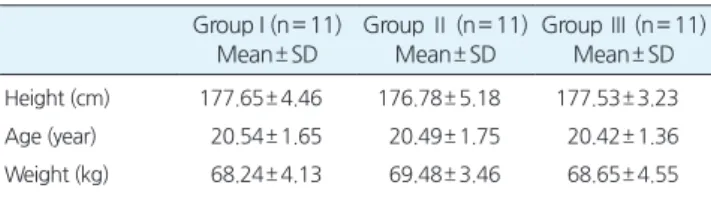
selected 33 soccer players of S university in Jeollanam-Do, and the specific standard of selection is the following (Table 1):
1) A player who do not have medical history in their lower extremity relate to orthopedic surgery
2) A player who do not have any other internal and external disease 3) A player who can do complete weight support
4) A player who do not have motor abnormality and parenthesis
2. Research procedure
The purpose of this research is investigated the effect of jump per- formance and quadriceps muscle activation in soccer player identi- fied the effective vibration frequency leading appropriate remedial reaction with WBV during 6 weeks. The subjects are university soc- cer players; the pre-test is executed for vertical jump and quadriceps muscle activation; and they were divided into three groups and trained. The three groups, which each group have 11 members, are WBV group using 20 Hz frequency (Group I), WBV group using 30 Hz frequency (Group II) and squat exercise group (Group III) ac- cording to training method. After 6 weeks, another tests were con- ducted with similar method to pre-test.
1) WBV
The participants planted with 8.4 cm between inner heels of both foot and make their foot narrow with standard distance from rota- tional axis with a 9 degree relative to valgus angle of great toe. In in- dependent standing position, the squat position was set the previous research of Roelants et al.16 as basis and the exercise was intervened in a position of high squat (high squat knee angle 125°, hip angle 140°) and low squat (low squat knee and hip angle 90°). Using the protocol proposed by van Nes et al.19 WBV was conducted during 6 weeks with every 5 weeks for 20 minutes per a day. For one set, four times of WBV was intervened for 45 seconds, which has two set of high squat and two set of low squat position and also have 1 minute break time between sets. Group I and Group II were applies 20 Hz
Table 1. General characteristic of subjects Group I (n= 11)
Mean± SD
Group Ⅱ (n= 11) Mean± SD
Group Ⅲ (n= 11) Mean± SD Height (cm) 177.65± 4.46 176.78± 5.18 177.53± 3.23
Age (year) 20.54± 1.65 20.49± 1.75 20.42± 1.36
Weight (kg) 68.24± 4.13 69.48± 3.46 68.65± 4.55
Group I, whole body vibration using 20 ㎐; Group II, whole body vibration using 30 ㎐; Group III, control.
and 30 Hz, respectively.
2) False WBV
Group III, which is control group, was applied same situation rela- tive to WBV group except the vibration.
3. Measurement
1) Surface electromyogram system
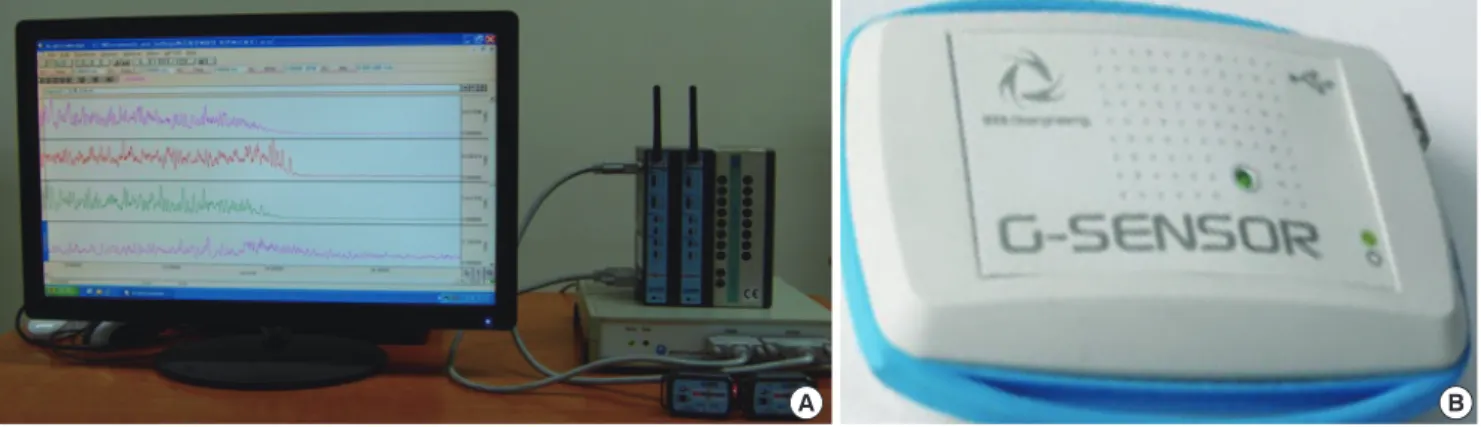
In order to measure lower extremity muscle activation, MP100 sur- face electromyogram system (Biopac System Inc., Santa Barbara, CA, USA) was used and the data transferred to digital signals was processed using Acqknowledge 3.91 software in personal computer.
For minimizing skin resistance for surface electromyogram signal, the hair of attaching parts were eliminated, rubbed with fine sand- paper for 3-4 times due to getting rid of corneum, and cleaned the skin with sterilization alcohol cotton. The adherence muscle is at- tached to rectus femoris (RF), vastus lateralis (VL) and vastus medi- alis (VM) and positive and negative electrodes are adhered with a parallel direction to muscular fibers of muscle belly of each muscle.
Sampling rate was set 1,024 Hz, in order to minimize noise, a notch filter and a band pass filter were set 60 Hz and 30-450 Hz, respec- tively, and the collected signal was processed with RMS (Figure 1 A).
2) Normalization of muscle activation
In this research, in order to standardize the muscle activation, % ref- erence value contraction (%RVC) method was used, which is a method to standardize based on reference voluntary contraction (RVC) relative to muscle contraction of specific motion. During maintaining 5 seconds a low squatting posture, after it was mea- sured muscle activation of measuring muscle, RVC value was calcu-
lated with analyzing signals with 3 seconds excluding first 1 second and last 1 second and also %RVC value was do with comparing muscle activation value measured during vertical jump. The muscle activation data was used a mean value of acquired results of 3 mea- surements.
3) Measurement of jump performance
In order to measure jump performance, G-jump (BTS, Italy) was used. The G-sensor was fixed in 5th spinal puncture of subjects and it was detected the G-sensor value every 2,004 Hz for position, di- rection, and velocity when jump. These data was analysis using G- studio software inside personal computer. The protocol was counter movement jump (CMJ) and the data was used mean values of 3 measurements (Figure 1B).
4. Data analysis
The measured data was statistically processed using SPSS 19.0; in order to verify normality between three groups, one-way ANOVA was conducted; and it was analyzed using ANCOVA in order to verify the difference of jump performance and quadriceps muscle activation according to each group of method of exercise. Post-hoc comparison was also executed using Bonferroni comparison meth- od. Statistical significance level was α= 0.05.
RESULTS
1. Comparison of jump performance between groups
As a result of comparison of jump performance, before and after in- tervene for each group, there was a significant improvement on CMJ jump for group I and group II relative to group III (p< 0.05).
Figure 1. (A) Surface EMG, (B) G-jump.
A B
Je-Ho Kim
JKPT The Journal of Korean Physical Therapy
The result of post-hoc comparison showed statistically significant differences for group I and II relative to group III but no a statisti- cally significant difference between group I and group II (Table 2).
2. Comparison of quadriceps muscle activation between groups As a result of comparison of quadriceps muscle activation, before and after intervene for each group, there was a significant improve- ment on quadriceps muscle activation for group I and group II rela- tive to group III (p< 0.05, p< 0.01). The result of post-hoc compari- son showed statistically significant differences for group I and II rel- ative to group III and also there was a statistically significant differ- ence between group I and group II (Table 3).
DISCUSSION
WBV is a safe and comfortable exercise with low intensity, which is an exercise method to improve physical function, such as muscular strength, balance, bone density, and so on, and used for various area and diseases recently. This research has purposes of the effect of WBV influenced to jump performance and quadriceps muscle acti- vation of soccer player and also identification of effective frequency
to improve performance, and conducted several tests. As results of the research, there was significant improvement on jump perfor- mance and quadriceps muscle activation after intervention WBV and also post-hoc comparison result showed that 30 Hz frequency is effective for improvement of quadriceps muscle activation.
Cochrane et al.20 showed that significant difference of jump per- formance for between a warming up group using bicycles and a hot poultice and a group with WBV for 8 subject with 26 Hz frequency and also on significant improvement of jump performance of a group using 35-40 Hz WBV relative to false WBV group and resis- tive exercise group, by Delecluse et al.21 conducted for 67 young adult females during 12 weeks.
WBV can give vibration stimulation with amplitude and fre- quency modulation to muscle; can stimulate muscle spindle in muscle; can improve activation of alpha motor neuron with increas- ing inputs of Ia afferent fibers; can reinforce circuits of tonic vibra- tion reflex and lead muscle hypertrophy; and can improve jump performance due to increasing reaction of neuromuscular system.22
In this research, with comparison between group I and II which are intervened WBV and control group which is intervened false WBV, there is significant difference in jump performance, and the
Table 2. Comparison of jump performance between groups (Unit: cm)
Group I (n= 11) Group Ⅱ (n= 11) Group Ⅲ (n= 11)
F p Post-Hoc
Pre Post Pre Post Pre Post
CMJ 46.72± 4.92 50.95± 3.77 44.43± 3.69 51.37± 4.60 44.28± 4.26 47.13± 3.70 3.36 0.048* Ⅲ< Ⅰ
Ⅲ< Ⅱ Group I, whole body vibration using 20 ㎐; Group II, whole body vibration using 30 ㎐; Group III, control.
*p< 0.05.
CMJ, counter movement jump.
Table 3. Comparison of quadriceps muscle activation between groups (Unit: %RVC)
Group I (n= 11) Group Ⅱ (n= 11) Group Ⅲ (n= 11)
F p Post-Hoc
Pre Post Pre Post Pre Post
RF 11.74± 1.92 22.67± 4.01 12.01± 1.69 26.64± 3.84 11.95± 1.26 19.28± 3.70 11.28 0.046* Ⅲ< Ⅰ
Ⅲ< Ⅱ
Ⅰ< Ⅱ
VM 20.78± 2.46 37.56± 4.73 20.48± 2.78 41.31± 5.01 20.53± 2.39 32.28± 4.94 19.49 < 0.001† Ⅲ< Ⅰ
Ⅲ< Ⅱ
Ⅰ< Ⅱ
VL 27.56± 2.13 48.84± 5,87 27.38± .36 52.04± 6.17 27.49± 2.55 42.56± 5.73 23.15 < 0.001† Ⅲ< Ⅰ
Ⅲ< Ⅱ
Ⅰ< Ⅱ Group I, whole body vibration using 20 ㎐; Group II, whole body vibration using 30 ㎐; Group III, control.
*p< 0.05, †p< 0.01.
RF, rectus femoris; VM, vastus medialis; VL, vastus lateralis.
similar result of improvement of jump performance to the existing research can support that WBV is necessary for athletes to improve jump performance though there are differences of frequency of vi- bration stimulation and intervene period.
Turner et al.23 showed the significant improvement of jump height at intensity of 40 Hz compared to 0 Hz, 30 Hz, and 35 Hz af- ter 30 seconds intervention with straight standing position for healthy adult males. In a WBV research of meta-analysis related to chronic effect by Manimmanakorn et al.24 there is no significant differences in jump performance according to frequencies over 30 Hz for 15 different papers.
This research also has no significant differences between group I using 20 Hz and group II using 30 Hz in a result of post-hoc com- parison. Ritzmann et al.25 said that it is effective for warm-up due to leading acute effects with short time because neuromuscular system can apply effectively in high frequency, which the higher frequency have, the gather muscle activation is shown. Under 20 Hz frequency, muscular relaxation is leaded and over 50 Hz frequency, muscular fatigues can be leaded, so it is necessary to select the frequency ac- cording to the purpose of exercise.26 Also, it can be thought that there is no significant difference of jump performance according to frequency due to adaptive reaction of neuromuscular system with more than 6 weeks intervention.
In order to improve jump performance, it is needed to be high muscle activation for surrounding muscles, such as pelvis, femur, tibia, and so on, and there is high correlation of muscular strength of rectus femoris, vastus medialis, vastus lateralis, and so on.3,4
Jacobs et al.12 showed significant differences in extention torque of knee joint of 20 adults, which maintaining a position of knee joint of 170 degree angle during 5 minutes and using 26 Hz fre- quency, compared to bicycles training group. Reyes et al.27 showed significant improvement in gastrocnemius muscle, biceps femoris muscle, and gluteus muscle activation of 16 baseball players, which intervening WBV, maintaining various positions, and using 30 Hz frequency, compared to bicycles training group. However, there is no significant difference in muscle activation of vastus lateralis and vastus medialis between with WBV and without WBV for 58 adults using 16 Hz frequency, bending a knee joint of 60 degree.28
In this research, comparing between group I and II with inter- vening WBV and control group with false WBV intervention, it is shown the significant difference o leg muscle activation and it is
concluded that WBV is effective for improving muscle activation, and also Seo and Kim29 said that it is necessary to use frequency more than 20 Hz for improving muscle activation.
Kim30 showed that it is effective for increasing leg muscle activa- tion for a group with intervening WBV using 30 Hz vibration fre- quency as a result of intervention of WBV using 10 Hz and 30 Hz vibration frequency for stroke patients. Similar to this, in this re- search, there are significant differences in increasing leg muscle ac- tivation in comparison between group I using 20 Hz frequency and group II using 30 Hz frequency as a result of post-hoc comparison.
Thirty Hz frequency can affect positively in human body due to increasing exercise function, energy metabolism and blood flow rate by attentively increasing of growth hormone,31 the action po- tential can be increased and fatigability can be decreased by increas- ing excitability of alpha motor neuron and contractible protein sen- sitivity with increasing inputs of afferent fibers for muscle activa- tion.32 Lienhard et al.28 suggested that the various change of position considering the physical capability of subjects can be effectively ap- plied muscle activation due to observation of significant increasing for leg muscle activation improvement with a position with bending 60 degree, as a result of WBV intervention using 16 Hz for position of knee joint with bending 60 degree and comfortability standing position.
This research intervened WBV for soccer players and compared the differences of jump performance and quadriceps muscle activa- tion; as a result of the effective frequency for improving perfor- mance, there is a significant difference in jump performance and quadriceps muscle activation of WBV group with comparison of control group; and it was proved that WBV is effective using 30 Hz frequency for improving quadriceps muscle activation as a result of post-hoc comparison.
The limitation of this research has regional constraints and small number of subjects, so it would be hard to generalize to all soccer players and it is needed to conduct additional research about effect of WBV with various frequency modulation and also with the vari- ous position.
ACKNOWLEDGEMENTS
The Research has been conducted by the Research Grant of Sehan University in 2015.
Je-Ho Kim
JKPT The Journal of Korean Physical Therapy
REFERENCES
1. Garstecki MA, Latin RW, Cuppett MM. Comparison of selected physi- cal fitness and performance variables between NCAA Division I and II football players. J Strength Cond Res. 2004;18(2):292-7.
2. Buchanan AS, Docherty CL, Schrader J. Functional performance testing in participants with functional ankle instability and in a healthy control group. J Athl Train. 2008;43(4):342-6.
3. Cheng KB. The relationship between joint strength and standing vertical jump performance. J ApplBiomech. 2008;24(3):224-33.
4. Russell P, Croce RV, Swartz EE, et al. Knee-muscle activation during landing: development and gender comparisons. Med Sci Sports Exerc.
2007;39(1):159-70.
5. Jakobsen MD, Sundstrup E, Randers MB, et al. The effect of strength training, recreational soccer and running exercise on stretch-shortening cycle muscle performance during countermovement jumping. Hum Mov Sci. 2012;31(4):970-86.
6. Carvalho A, Mourao P, Abade E. Effects of strength training combined with specific plyometric exercises on body composition, vertical jump, height and lower limb strength development in elite male handball play- ers: a case study. J Hum Kinet. 2014;41:125-32.
7. Ronnestad BR, Kvamme NH, Sunde A, et al. Short-term effects of strength and plyometric training on sprint and jump performance in professional soccer players J Strength Cond Res. 2008;22(3):773-80.
8. Twist C, Eston R. The effects of exercise-induced muscle damage on maximal intensity intermittent exercise performance. Eur J Appl Physiol.
2005;94(5-6):652-8.
9. Jensen RL, Ebben WP. Quantifying plyometric intensity via rate of force development, knee joint, and ground reaction forces. J Strength Cond Res. 2007;21(3):763-7.
10. Mikhael M, Orr R, Fiatarone Singh MA. The effect of whole body vibra- tion in older adults: A systematic review of the literature. Maturitas.
2010;66(2):150-7.
11. Ebersbach G, Edler D, Kaufhold O, et al. Whole body vibration versus conventional physiotherapy to improve balance and gait in parkinson’s disease. Arch Phys Med Rehabil. 2008;89(3):399-403.
12. Jacobs PL, Burns P. Acute enhancement of lower-extremity dynamic strength and flexibility with whole-body vibration. J Strength Cond Res.
2009;23(1):51-7.
13. Shinohara M. Effects of prolonged vibration on motor unit activity and motor performance. Med Sci Sports Exerc. 2005;37(12):2120-5.
14. Armstrong WJ, Grinnell DC, Warren GS. The acute effect of whole- body vibration on the vertical jump height. J Strength Cond Res. 2010;
24(10):2835-9.
15. Jordan M, Norris S, Smith D, et al. Acute effects of whole-body vibration on peak isometric torque, muscle twitch torque and voluntary muscle activation of the knee extension. Scand J Med Sci Sports. 2010;20(3):
535-40.
16. Roelants M, Verschueren SM, Delecluse C, et al. Whole body vibration induced increase in leg muscle activity during different squat exercises. J Strength Cond Res. 2006;20(1):124-9.
17. Hiroshige K, Mahbub MH, Harada N. Effects of whole-body vibration on postural balance and proprioception in healthy young and elderly subjects: a randomized cross-over study. J Sports Med Phys Fitness.
2014;54(2):216-24.
18. Kim ES, Kim MW, Cho YM. The effect of vibration training pre-eccen- tric exercise on delayed onset muscle soreness of triceps surae. J Kor Aca Ind Coop Soc. 2011;12(12):5789-96.
19. van Nes IJ, Latour H, Schils F, et al. Long term effects of 6week whole body vibration on balance recovery and activities of daily living in the post acute phase of stroke: a randomized, controlled trial. Stroke. 2006;
37(9):2331-5.
20. Cochrane DJ, Stannard SR, Sarqeant AJ, et al. The rate of muscle temper- ature increase during acute whole body vibration exercise. Eur J Appl Physiol. 2008;103(4):441-8.
21. Delecluse C, Roelants M, Verschuren S. Strength increase after whole body vibration compared with resistance training. Med Sci Sports Exerc.
2003;35(6):1033-41.
22. Mischi M, Cardinale M. The effects of a 28㎐ vibration on arm muscle ac- tivity during isometric exercise. Med Sci Sports Exerc. 2009;41(3):645-53.
23. Turner AP, Sanderson M, Attwood LA. The acute of different frequen- cies of whole body vibration on countermovement jump performance. J Strength Cond Res. 2011;25(6):1592-7.
24. Manimmanakorn N, Hamlin MJ, Ross JJ, et al. Long term effect of whole body vibration training on jump height: meta analysis. J Strength Cond Res. 2014;28(6):1739-50.
25. Ritzmann R, Gollhofer A, Kramer A. The influence of vibration type, frequency, body position and additional load on the neuromuscular ac- tivity during whole body vibration. Eur J Appl Physiol. 2013;113(1):1-11.
26. Prisby RD, Lafage-Proust MH, Malaval L, et al. Effects of whole body vi- bration on the skeleton and other organ system in man and animal model: what we know and what we need to know. Ageing Res Rew.
2008;7(4):319-29.
27. Reyes GF, Dickin DC, Crusat NJ, et al. Whole body vibration effects on the muscle activity of upper and lower body muscles during the baseball swing in recreational baseball hitters. Sports Biomech. 2011;10(4):280-93.
28. Lienhard K, Vienneau J, Friesenbichler B et al. The effect of whole body vibration on muscle activity in active and inactive subjects. Int J Sports Med. 2015;11.
29. Seo HJ, Kim JH. Analysis of muslcle activation related to postural stabili- ty according to different frequency of whole body vibration during quiet standing. J Kor Phys Ther. 2013;25(5):316-21.
30. Kim JH. The effects of whole body vibration exercise on balance and lower extremity muscle activity in stroke patients. J Kor Phys Ther. 2013;
25(5):316-21.
31. Cardinale M, Soiza RL, Leiper JB, et al. Hormonal responses to a single session of whole body vibration exercise in older individuals. Br J Sports Med. 2010;44(4):284-8.
32. Hodgson M, Docherty D, Robbins D. Post-activation potentiation: un- derlying physiology and implications for motor performance. Sports Med. 2005;35(7):585-95.