• 검색 결과가 없습니다.

JSUJournal of Surgical Ultrasound

N/A
N/A
Protected

Academic year: 2021

Share "JSUJournal of Surgical Ultrasound"

Copied!
5
0
0

로드 중.... (전체 텍스트 보기)

전체 글

(1)

The Cause of Abnormal Skin Findings after Ultrasound-Guided Injection of Cyanoacrylate Glue in an Animal Model

Soo Yeon Chung, Sungsin Cho, Jin Hyun Joh

Department of Surgery, Kyung Hee University Hospital at Gangdong, Kyung Hee University School of Medicine, Seoul, Korea

Received October 25, 2020 Revised November 11, 2020 Accepted November 15, 2020

Purpose: Cyanoacrylate closure has been recently introduced as a non-thermal method for the treatment of varicose veins. An abnormal skin finding can be an extremely worrisome complication after a cyanoacrylate closure. This study aimed at identifying if joint move- ment could be a possible cause for this reaction using a pig model.

Methods: The pigs were administered general anesthesia and monitored by a veterinarian.

After aseptic preparation, the cyanoacrylate glue was injected into the leg vein through a de- livery catheter, or into the ear vein through a 22G needle. The pigs were divided into 2 groups according to the involvement of the joints, with the injected glue. Ten days after the glue was injected, the veins were harvested, and pathologic findings were analysed.

Results: We obtained 6 vein specimens with the surrounding tissue. Both the groups, involv- ing the joint, and not involving the joint included one leg vein and 2 ear veins. The patho- logic finding in the group not involving the joint showed that inflammatory cells (mainly lymphocytes) infiltrated the vein wall. In the group involving the joints, the same in- flammatory cells infiltrated both the vein wall and surrounding tissue.

Conclusion: In this animal study, the injected glue triggered an inflammatory reaction.

When the glue was injected across a joint, an inflammatory reaction developed in the vein wall as well as the surrounding tissue. It may be assumed that cyanoacrylate glue injected during closure of the vein can result in an abnormal skin finding if there is an active move- ment of the joint involved.

Keywords: Varicose veins, Cyanoacrylates, Inflammation, Lymphocyte, Pathology Correspondence to:

Jin Hyun Joh

Department of Surgery, Kyung Hee University Hospital at Gangdong, Kyung Hee University School of Medicine, 892 Dongnam-ro, Gangdong-gu, Seoul 05278, Korea Tel.: +82-2-440-6261

Fax: +82-2-440-6296 E-mail: [email protected]

INTRODUCTION

Cyanoacrylate closure (CAC) using the VenaSeal Closure System (Medtronic, Dublin, Ireland) as the nonthermal, nontumescent (NTNT) therapy is an accepted treatment for saphenous vein reflux. The first human feasibility trial re- ported a 94.7% closure rate at 12 months that remained un- changed at 36 months.(1,2) The European Sapheon Closure System Observational Prospective (eSCOPE) trial showed a closure rate of 90% at 12 months.(3) The VeClose trial was

a multicenter, prospective, randomized controlled trial comparing CAC with radiofrequency ablation (RFA) for the treatment of great saphenous vein (GSV) reflux. The target vein closure rate after CAC in the VeClose study was 97.2%

at 12 months and 95.3% at 24 months, respectively.(4,5) The CAC achieves occlusion of the target vein without thermal damage to the vein. Therefore, it has been asso- ciated with fewer adverse events, less postprocedural pain, and a more rapid return to normal activity than conven- tional thermal ablation such as RFA and endovenous laser

JSU

Journal of Surgical Ultrasound J Surg Ultrasound 2020;7:42-46

https://doi.org/10.46268/jsu.2020.7.2.42

(2)

Fig. 1. Procedure details. (A) After access of superficial vein in the hindlimb, cyanoacrylate glue was injected using 5F delivery catheter.

(B) For the injection of glue into the ear vein, direct injection was done using 3 ml syringe and 21-gauge angiocath.

Fig. 2. After injecting the glue, ultrasound imaging confirmed the complete occlusion of vein (arrows) and acoustic shadowing below the glue (dotted arrows).

therapy (EVLT).(4) However, CAC causes a local in- flammatory reaction in the vein wall and surrounding tissue.(6) The inflammatory reaction was accompanied by abnormal skin findings such as erythema, itching, pain, edema, and tenderness over the treated vein area.

Until now, the exact cause of abnormal skin findings has not been reported. A recent report indicates that these ab- normal skin findings occur more frequently after treatment of GSV.(7,8) Anatomically, GSV crosses the knee joint and is involved in knee joint movement. Therefore, the aim of this study was to evaluate the effect of active movement on the development of abnormal skin findings after a CAC procedure.

METHODS

All animal procedures were done in accordance with our institutional guidelines for animal research. We selected the ear veins and superficial hindlimb veins of the pigs to evaluate the effect of active movement on the development of abnormal skin findings. Because the hindlimb vein crosses the hindlimb joint of a pig, it is similar to the human GSV. Ear veins were chosen due to the active movement of the pig ear, and because of the vein prominence as a result of thin skin on the ear. The Institutional Animal Care and Use Committee (IACUC) approved all experimental proce- dures (Approval No. MIC-IACUC-2017-01).

The pigs were administered general anesthesia and monitored by a veterinarian. The hindlimb from the mid-thigh to toe was prepped with Betadine solution.

Sterile technique was observed throughout the entire procedure. Under ultrasound guidance, the superficial vein

of the hindlimb was located to determine a site for access.

After aseptic preparation, the cyanoacrylate glue was in-

jected into the vein of the leg though a delivery catheter, or

into the vein of the ear through a 22G needle. We divided

the pigs into 2 groups according to the joint involvement

with the injected glue. Ten days after the glue injection, the

veins were harvested and pathologic findings were

obtained. After selecting an access site, ultrasound guid-

ance access was used to access the SEV with a 21-gauge

needle from a 5F Micro Introducer Kit. A 0.018 In guidewire

was advanced into the vein and access was confirmed with

ultrasound. Then, a 7F introducer sheath coupled with a 5F

glue-delivery catheter was inserted into the vein. With

compression of the vein proximal to the tip of the catheter,

two 0.1 ml aliquots of cyanoacrylate were delivered 1 cm

apart with additional hand compression at the treated seg-

ment for 3 minutes. Subsequent 0.1 ml aliquots were deliv-

(3)

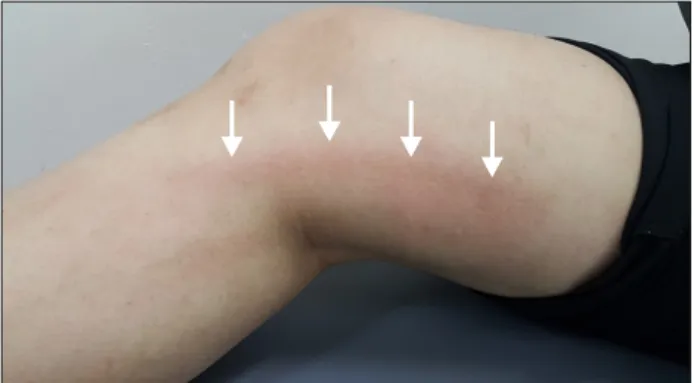
Fig. 3. Typical feature of abnormal skin change in joint-involvement group. Along the vein injected glue, erythematous change was observed (arrows).

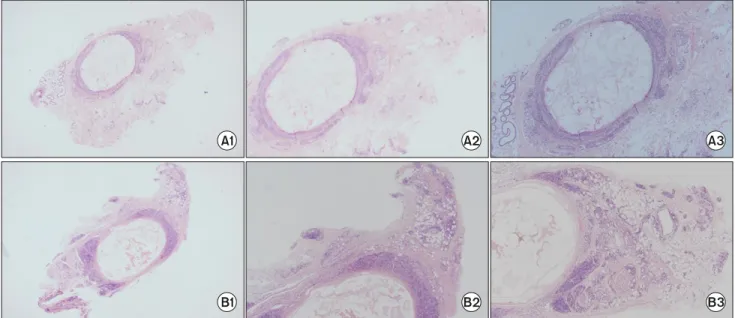
Fig. 4. Pathologic finding. The lymphocyte infiltration was seen mainly within the vein wall (A1, 2, 3) in the joint non-involvement group. But, in the joint involvement group, the lymphocytic infiltration was seen both in vein wall and surrounding tissue (B1, 2, 3).

ered at 3 cm intervals along the target treatment vein and compression with the ultrasound probe and free hand was performed for 30 seconds at each treated segment. For the ear vein, we used a 3 ml syringe and 21-gauge angiocath for injection of glue (Fig. 1). After injecting the glue and com- pressing the vein, ultrasound confirmed the occlusion of vein (Fig. 2).

We divided the pigs into 2 groups according to the joint involvement with the injected glue. For the joint-involve- ment group, glue was injected into the vein across the hin- dlimb joint or ear joint. We used ultrasound to confirm that the injected glue crossed the joint. For the joint non-in- volvement group, glue was injected with compression of the vein before the joint. Ten days after injection of glue, the veins were harvested and pathologic findings were obtained.

RESULTS

We investigated the injection sites to evaluate the occur- rence of abnormal skin changes 10 days after glue injection.

In one ear vein from the joint-involvement group, abnormal skin change was observed. Along the glue-injected vein, er-

ythematous change was observed (Fig. 3).

We obtained 6 vein specimens including surrounding tissue (2 leg veins and 4 ear veins). Microscopic findings showed complete occlusion of venous lumen. The lumen was filled with a mixture of glue and red blood cells.

Lymphocytic infiltration was observed throughout the vein

wall. The pathologic findings in the joint non-involvement

group showed that the inflammatory cells, mainly lympho-

cytes, infiltrated the vein wall. In the joint involvement

group, the same inflammatory cells infiltrated the vein wall

as well as surrounding tissue (Fig. 4).

(4)

Fig. 5. Typical finding of the patient with phlebitis reaction after cyanoacrylate closure. The inflammatory change such as erythema, pain, and induration was seen along the course of treated saphenous vein (arrows).

DISCUSSION

Microscopic examination confirmed the presence of cy- anoacrylate in the lumen of the vessels with deposition of thrombus. The occlusion of venous lumen was achieved by the injection of glue and thrombus instead of the coapta- tion of vein wall. Inflammation of varying intensity was ob- served throughout the glue-injected veins. Inflammatory changes were confined to the vein wall in the area without active movement. However, these changes were seen in the vein walls as well as the perivascular soft tissues with active movement.

When cyanoacrylate glue contacts anionic substances within the body such as blood cells, endothelium, or plas- ma, the adhesive begins to polymerize.(9) This process caused the treated veins to become completely occluded.

Min et al. (6) revealed histological findings that the lumen was dilated by coalescing, arborizing clear spaces with en- trapped lytic erythrocytes. Microscopic images in our study demonstrated the same findings.

This polymerization damages the vascular intima, in- duces immunological responses, and triggers an acute in- flammatory reaction in the wall.(10,11) Inflammation is a complex process of the body’s response to foreign materials. In the acute phase, cells of the immune system migrate to the site of exposure of foreign materials in a carefully orchestrated sequence of events that is mediated

by cytokines and acute phase proteins.(12) Persistent in- flammation as a result of prolonged exposure to foreign materials can lead to the chronic phase. In chronic in- flammation, the primary immune cells are macrophages and T lymphocytes.(13) The microscopic image showed the accumulation of lymphocytes within the veins and sur- rounding tissue in response to the cyanoacrylate.

Physical stimuli are an important cause of inflam- mation.(14) The combined stimuli of cyanoacrylate and physical movement can exaggerate the inflammation process. Therefore, an inflammation reaction can develop within the vein as well as the surrounding tissue. Typically, the phlebitis-like reaction after cyanoacrylate closure for saphenous vein insufficiency can develop along the treated vein (Fig. 5).

The most common complication of CAC is an abnormal skin findings, reported at a rate of 11.4%-20%.(15,16) This abnormal skin findings clinically presented with erythema, edema, pruritus, and tenderness, and was unresponsive to non-steroidal anti-inflammatory drugs (NSAID). It was suggested as a type IV delayed hypersensitivity reaction due to a foreign material, rather than localized in- flammation, and was alleviated by antihistamines and ste- roids in over 85% of patients.(7) Type IV hypersensitivity, also known as delayed-type hypersensitivity, is a T-cell mediated immune response. Microscopic findings in our study demonstrated that most of the cells accumulated within the vein and surrounding tissue were lymphocytes.

After approximately one month, the response progresses to a granulomatous process with foreign body giant cells and fibrosis.(17,18) Novotny et al .(19) reported a histo- pathological examination of vein samples from six patients who had undergone great saphenous vein sealing with Histoacryl and Lipiodol to treat chronic venous in- sufficiency of the superficial venous system. Histologic findings showed that the lumen of the dilated vessel was fil- led with granulation tissue with a pronounced giant cell re- action centered on the non-staining foreign material.

However, Jones et al .(8) obtained the vein specimen from

the patient with persistent hypersensitivity reaction at 200

(5)

days after treatment. Immunohistochemical stain showed that most of the mononuclear cells were T lymphocytes, and most of these were of the T4 subset.

In conclusion, injected glue initiated an inflammatory reaction. If glue was injected across the joint, the in- flammatory reaction developed in the vein wall as well as the surrounding tissue. It may be assumed that the injected glue on active movement can be a cause of abnormal skin findings after cyanoacrylate closure.

CONFLICTS OF INTEREST

None.

ACKNOWLEDGMENTS

This animal study was performed by the support of

‘Covidien Center for Innovation’.

REFERENCES

1. Almeida JI, Javier JJ, Mackay E, Bautista C, Proebstle TM. First human use of cyanoacrylate adhesive for treatment of saphe- nous vein incompetence. J Vasc Surg Venous Lymphat Disord 2013;1:174-80.

2. Almeida JI, Javier JJ, Mackay EG, BautistaC, Cher DJ, Proebstle TM. Thirty-sixth-month follow-up of first-in-human use of cyanoacrylate adhesive for treatment of saphenous vein incompetence. J Vasc Surg Venous Lymphat Disord 2017;5:

658-66.

3. Proebstle TM, Alm J, Dimitri S, Rasmussen L, Whiteley M, Lawson J, et al. The European multicenter cohort study on cy- anoacrylate embolization of refluxing great saphenous veins. J Vasc Surg Venous Lymphat Disord 2015;3:2-7.

4. Morrison N, Gibson K, Vasquez M, Weiss R, Cher D, Madsen M, et al. VeClose trial 12-month outcomes of cyanoacrylate closure versus radiofrequency ablation for incompetent great saphenous veins. J Vasc Surg Venous Lymphat Disord 2017;5:321-30.

5. Gibson K, Morrison N, Kolluri R, Vasquez M, Weiss R, Cher D, et al. Twenty-four month results from a randomized trial of

cyanoacrylate closure versus radiofrequency ablation for the treatment of incompetent great saphenous veins. J Vasc Surg Venous Lymphat Disord 2018;6:606-13.

6. Min RJ, Almeida JI, McLean DJ, Madsen M, Raabe R. Novel vein closure procedure using a proprietary cyanoacrylate adhesive:

30-day swine model results. Phlebology 2012;27:398-403.

7. Park I, Jeong MH, Park CJ, Park WI, Park DW, Joh JH. Clinical features and management of "Phlebitis-like abnormal re- action" after cyanoacrylate closure for the treatment of in- competent saphenous veins. Ann Vasc Surg 2019;55:239-45.

8. Jones AD, Boyle EM, Woltjer R, Jundt JP, Williams AN.

Persistent type IV hypersensitivity after cyanoacrylate closure of the great saphenous vein. J Vasc Surg Cases Innov Tech 20195:372-4.

9. Lam YL, De Maeseneer M, Lawson J, De Borst GJ, Boersma D.

Expert review on the VenaSeal

system for endovenous cya- no-acrylate adhesive ablation of incompetent saphenous trunks in patients with varicose veins. Expert Rev Med Devices 2017;14:755-62.

10. Levrier O, Mekkaoui C, Rolland PH, Murphy K, Cabrol P, Moulin G, et al. Efficacy and low vascular toxicity ofemboliza- tion with radical versus anionic polymerization of n-bu- tyl-2-cyanoacrylate (NBCA). An experimental study in the swine. J Neuroradiol 2003;30:95-102.

11. Pollak JS, White RI Jr. The use of cyanoacrylate adhesives in peripheral embolization. J Vasc Interv Radiol 2001;12:907-13.

12. Germolec DR, Shipkowski KA, Frawley RP, Evans E. Markers of inflammation. Methods Mol Biol 2018;1803:57-79.

13. Sakai Y, Kobayashi M. Lymphocyte 'homing' and chronic inflammation. Pathol Int 201565:344-54.

14. Germolec DR, Frawley RP, Evans E. Markers of inflammation.

Methods Mol Biol 2010;598:53-73.

15. Almeida JI, Javier JJ, Mackay EG, Bautista C, Cher DJ, Proebstle TM. Two-year follow-up of first human use of cyanoacrylate adhesive for treatment of saphenous vein incompetence.

Phlebology 2015;30:397-404.

16. Morrison N, Gibson K, McEnroe S, Goldman M, King T, Weiss R, et al. Randomized trial comparing cyanoacrylate emboliza- tion andradiofrequency ablation for incompetent great saphe- nous veins (VeClose). J Vasc Surg 2015;61:985-94.

17. Vinters HV, Galil KA, Lundie MJ, Kaufmann JC. The histotox- icity of cyanoacrylates. A selective review. Neuroradiology 1985;27:279-91.

18. Spiegel SM, Viñuela F, Goldwasser JM, Fox AJ, Pelz DM.

Adjusting the polymerization time of isobutyl-2 cyanoacrylate.

AJNR Am J Neuroradiol 1986;7:109-12.

19. Novotny K, Campr V. Histopathological changes to the vas-

cular wall after treatment of great saphenous veins using

n-butyl-2-cyanoacrylate. Vasa 2019;48:399-404.

수치

Fig. 1. Procedure details. (A) After  access of superficial vein in the  hindlimb, cyanoacrylate glue was  injected using 5F delivery catheter
Fig. 4. Pathologic finding. The lymphocyte infiltration was seen mainly within the vein wall (A1, 2, 3) in the joint non-involvement group
Fig. 5. Typical finding of the patient with phlebitis reaction after  cyanoacrylate closure

참조

관련 문서

1 John Owen, Justification by Faith Alone, in The Works of John Owen, ed. John Bolt, trans. Scott Clark, "Do This and Live: Christ's Active Obedience as the

The concentration of the dissolved metal as well as that of the adsorbed to solid particles depends mainly on the concentration of the metal in the inflow water

As well as improving the health, safety and welfare of workers, organizations may eliminate job stress makes good business and financial sense.. As a

As a result of the study, it was confirmed that only human resource competency had a positive(+) effect on the intercompany cooperation method of IT SMEs,

ƒ Monosaccharide may be present in the form of Monosaccharide may be present in the form of a linear or ring structure. ƒ In solution it is in the form of

- The standard enthalpy of an overall reaction is the sum of the standard enthalpies of the individual reactions into which a reaction may be divided - - The individual steps

In this paper, it was examined whether there is a possibility that the medical institution might be mistaken as a specialized hospital designated by the Ministry of Health

This study aims to analyse the relations between stress and eating habits of adolescents as it was assumed that adolescents need lots of nutrients and eating habits