• 검색 결과가 없습니다.

A 69-year-old Woman with Anomalous Origin of Left Coronary Artery from the Pulmonary Artery: Surgical Repair Using a Trap-door Flap

N/A
N/A
Protected

Academic year: 2021

Share "A 69-year-old Woman with Anomalous Origin of Left Coronary Artery from the Pulmonary Artery: Surgical Repair Using a Trap-door Flap"

Copied!
3
0
0

로드 중.... (전체 텍스트 보기)

전체 글

(1)

Korean J Thorac Cardiovasc Surg 2011;44:358-360 □ Case Report □ http://dx.doi.org/10.5090/kjtcs.2011.44.5.358 ISSN: 2233-601X (Print) ISSN: 2093-6516 (Online)

− 358 −

*Department of Thoracic and Cardiovascular Surgery, Asan Medical Center

**Department of Thoracic and Cardiovascular Surgery, Dongsan Medical Center, Keimyung University Received: May 24, 2011, Revised: July 2, 2011, Accepted: July 3, 2011

Corresponding author: Cheol Hyun Chung, Department of Thoracic and Cardiovascular Surgery, Asan Medical Center, 388-1, Poongnap-dong, Songpa-gu, Seoul 138-736, Korea

(Tel) 82-2-3010-3580 (Fax) 82-2-3010-6966 (E-mail) [email protected]

C

The Korean Society for Thoracic and Cardiovascular Surgery. 2011. All right reserved.

CC

This is an open access article distributed under the terms of the Creative Commons Attribution Non-Commercial License (http://creative- commons.org/licenses/by-nc/3.0) which permits unrestricted non-commercial use, distribution, and reproduction in any medium, provided the original work is properly cited.

A 69-year-old Woman with Anomalous Origin of Left Coronary Artery from the Pulmonary Artery:

Surgical Repair Using a Trap-door Flap

Ju Yong Lim, M.D.*, Cheol Hyun Chung, M.D.*, Dae Sung Ma, M.D.*, Seung Hyun Lee, M.D.**

We present a patient with anomalous origin of the left coronary artery from the pulmonary artery (ALCAPA), which was diagnosed and corrected in her 60 s. The patient is the oldest documented survivor of ALCAPA who under- went a surgical repair. ALCAPA should be corrected surgically to restore the dual coronary system at any age and this case shows that the surgical procedure may be performed safely even in an elderly patient.

Key words: 1. Coronary artery pathology 2. ALCAPA syndrome

CASE REPORT

Anomalous origin of the left coronary artery from the pul- monary artery (ALCAPA), a rare congenital anomaly, is rare- ly identified in adulthood because the majority of untreated patients die in their infancy or early childhood [1]. A 69-year-old woman with ALCAPA presented with angina pectoris. She had already been diagnosed with ALCAPA six years prior to presenting with chest pain, but had refused to have surgery. With the recurring symptom, she underwent surgical repair with a trap-door flap, described in this report.

Here, we report a successful surgical repair of ALCAPA at an old age.

A 69-year-old female without risk factors for coronary atherosclerotic disease was admitted for chest pain. Six years prior, she had been hospitalized for chest pain. At that time, a treadmill exercise test demonstrated an ST segment change at stage 2. With suspected angina pectoris, cardiac catheter-

ization was performed, which showed a dilated right coronary artery (RCA) with abundant collaterals supplying the left cor- onary system and the retrograde left coronary artery (LCA) flow draining into the main pulmonary artery (MPA), which confirmed the ALCAPA. The left ventricular (LV) function and dimensions were of normal values on transthoracic echo- cardiography (TTE). The patient refused surgery because the symptom was relieved by medicating with isosorbide dinitrate and carvedilol. However, she suffered from chest pain again while jogging six years after the diagnosis. At the most re- cent admission, she presented with aggravated chest pain.

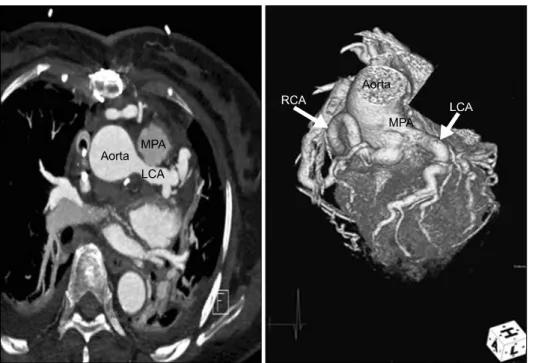
However, coronary angiography showed no other athero- sclerotic coronary lesions except for the known ALCAPA, and LV function was still preserved on TTE. As the LCA or- iginated from the posterior side of the MPA 4 mm apart from the aorta on heart computed tomography (CT) (Fig. 1), direct coronary transfer using a trap-door flap was planned.

Cardiopulmonary bypass with aortobicaval cannulation and

(2)

ALCAPA

− 359 −

Fig. 2. The posterior sinus of the main pulmonary artery, including the left coronary artery (LCA), was exci- sed. The LCA was transferred to the aorta with a trap-door flap. RCA=

Right coronary artery, MPA=Main pul- monary artery; PV=Pulmonary valve.

Fig. 1. Preoperative CT angiogram shows the normally originating dilated tortuous right coronary artery (RCA) and the abnormal ori- gin of the left coronary artery (LCA) from the main pulmonary ar- tery (MPA).

moderate hypothermia (24

o

C) was established. Both the aorta and the pulmonary artery were cross-clamped and antegrade cold blood cardioplegic arrest was performed. With transverse incision of the MPA, most of the posterior sinus of the MPA, including the LCA, was excised and reimplanted to the trap-door flap incision created just above the left coronary si- nus of the aorta (Fig. 2). The posterior wall of the MPA was reconstructed with bovine pericardium. Total cardiopulmonary bypass time was 135 minutes and aorta cross-clamp time was

83 minutes. Vital signs were stable at the intensive care unit without any inotropic agents and the patient was transferred to the general ward on postoperative day 3. The postoperative TTE and coronary CT scan showed successful coronary trans- fer (Fig. 3). The patient was discharged on postoperative day 9 with aspirin 100mg and has been doing well on follow-up without chest pain for 7 months.

DISCUSSION

As few patients with ALCAPA survive past childhood without surgical repair [2], untreated ALCAPA in the elderly is very rare. In this case, the patient lived asymptomatically with ALCAPA for over 6 decades, and her LV function was well-preserved. Because of the risks of cardiac surgery at old age, conservative medical management may be preferable to surgery. Two patients with ALCAPA whose age was over 70 have been reported, and they did not undergo surgical repair because of their age [3,4]. As in our case, the patient had re- mained in good health while on medication for six years.

However, she had to undergo surgical repair because of re-

curring chest pain. This may suggest that medical manage-

ment may not be the best treatment option even for older

adult patients with ALCAPA. Coronary transfer using a

trap-door flap has been reported to be a useful method in

adults, as it minimizes anastomotic tension and distortion

[5,6]. We performed a successful LCA transfer using this

translocation technique in our patient.

(3)

Ju Yong Lim, et al

− 360 −

Fig. 3. Postoperative CT shows suc- cessful translocation of the left coro- nary artery (LCA) to the ascending aorta. RCA=Right coronary artery;

MPA=Main pulmonary artery.

ALCAPA presenting at old age should be treated with sur- gical repair, thus creating a dual coronary system to restore LV function. Trap-door coronary transfer is a feasible method with good results in adult ALCAPA.

REFERENCES

1. Wesselhoeft H, Fawcett JS, Johnson AL. Anomalous origin of the left coronary artery from the pulmonary trunk. Its clinical spectrum, pathology, and pathophysiology, based on a review of 140 cases with seven further cases. Circulation 1968;38:403-25.

2. Singh TP, Carli MF, Sullivan NM, Leonen MF, Morrow WR. Myocardial flow reserve in long-term survivors of re-

pair of anomalous left coronary artery from pulmonary artery. J Am Coll Cardiol 1997;30:547-53.

3. Fierens C, Budts W, Denef B, Van De Werf F. A 72 year old woman with ALCAPA. Heart 2000;83:E2.

4. D Bianco L, Bagato F, Daliento L. Woman, 70 years of age, affected by ALCAPA without surgical repair. J Cardiovasc Med (Hagerstown) 2009;10:174-7.

5. Takeuchi S, Imamura H, Katsumoto K, et al. New surgical method for repair of anomalous left coroanry artery from pulmonary artery. J Thorac Cardiovasc Surg 1979;78:7-11.

6. Ando M, Mee RB, Duncan BW, Drummond-Webb JJ,

Seshadri SG, Igor Mesia CI. Creation of a dual-coronary

system for anomalous origin of the left coronary artery from

the pulmonary artery utilizing the trapdoor flap method. Eur

J Cardiothorac Surg 2002;22:576-81.

수치

Fig. 2. The posterior sinus of the  main pulmonary artery, including the  left coronary artery (LCA), was  exci-sed
Fig. 3. Postoperative CT shows suc- suc-cessful translocation of the left  coro-nary artery (LCA) to the ascending  aorta

참조

관련 문서

Especially, it was theoretically predicted that x-axis and y-axis polarization states can be obtained with a right-handed TR film and a left-handed

The locations of aneurysms were middle cerebral artery in 15 patients, cerebral artery in 15 patients, cerebral artery in 15 patients, cerebral artery in

- the right side : to move deoxygenated blood that is loaded with carbon dioxide from the body to the lungs - the left side : to receive oxygenated blood that has.. had most

82 year-old female patient with traffic accident, (A,B,C) Initial x-rays show open fracture of left distal femur(AO 33-C3, Gustilo-Anderson II) with patella

Pilot Confirm runway 09 left for landing. ATC gives you further instructions to turn right heading 310. On the radar display, there was an area to avoid which requires a

Table 2. Schatzker and Lambert assessment --- 18.. A), B) Preoperative anteroposterior and lateral radiograph of the left knee of a sixty-two-year-old man who

activation(electroencephalolgram: left alpha wave, right alpha wave, left sensory motor rhythm, right sensory motor rhythm, right mid-beta wave, left attention concentration

In the lower extremity balance, the change in left unilateral clerk showed a statistically significant difference as the exercise group increased post-test