Introduction
Cement retained implant restorations have several advantages over screw retained ones. First, it is easier to achieve passive fit. Second, they are more aesthetic and easier to apply occlusal force in longitudinal direction.
1It can be difficult to remove residual ce- ment underneath the subgingival margin of restora- tion. However, excess cement causing periimplantitis should be removed.
Several cementation techniques using abutment replica have been introduced to remove excess ce- ment, making it possible to properly retain restora- tion while minimizing residual cement.
2Materials such as polyvinyl siloxane impression, bite material,
and acrylic resin have been used.
3-5Technique for fabricating replica with resin block using computer aided design/computer aided manufacturing (CAD/
CAM) is also possible.
6However, these techniques are complicated. They require additional cost and equipment.
In this case report, a procedure to simply and quickly fabricate abutment replica at chairside is de- scribed.
7It uses hot melt adhesive material (HMA), a thermoplastic material consisting of ethylene vinyl acetate copolymer, wax, resins, pigment, and other components.
8Dentist can make a flexible model to fabricate temporary restorations using an electric glue gun.
9Because HMA has good flow, good strength, and good flexibility, it can be applied to narrow areas
*Correspondence to: Jung-Jin Lee
Fellowship, Department of Prosthodontics, School of Dentistry and Institute of Oral Bio-Science, Chonbuk National University, 567, Baekje-daero, Deokjin-gu, Jeonju, 54896, Republic of Korea
Tel: +82-63-250-2050, Fax: +82-63-250-2218, E-mail: [email protected] Received: August 8, 2016/Last Revision: August 23, 2016/Accepted: August 25, 2016
a technique for fabricating abutment replica with hot melt adhesive material to minimize residual cement in implant restoration: a case report
Chi-Won Seo, A-Reum Han, Jae-Min Seo, Jung-Jin Lee*
Department of Prosthodontics and Institute of Oral Bio-Science, School of Dentistry, Chonbuk National University, Jeonju, Republic of Korea
Removal of excess cement is important to prevent biological complication in cementation of implant restoration with subgingival margin. It can be difficult to completely remove excess cement. Several techniques have been introduced to minimize excess cement using abutment replica. In this case report, a simple method for making abutment replica with hot melt adhesive material in dental office was described. This technique is simple and effective because it can be used for pre-fabricated or custom abutment without additional laboratory procedure. In addition, it can minimize excess cement after cementation of implant restoration. (J Dent Rehabil Appl Sci 2016;32(3):240-5)
Key words: implant; cement; periimplatitis, subgingival margin
Copyright© 2016 The Korean Academy of Stomatognathic Function and Occlusion.
It is identical to Creative Commons Non-Commercial License.
cc
ISSN 2384-4353 eISSN 2384-4272
such as the incisal edge without causing fracture.
Case Report
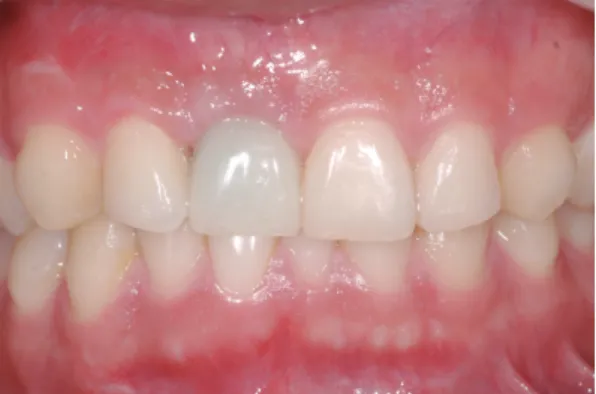
A 22-year-old male patient with discoloration and gingival recession of the maxillary right central in- cisor received endodontic treatment due to injury nine years ago. He presented at the Department of Prosthodontics, Chonbuk National University Hos- pital. Maxillary right central incisor showed grade II mobility (according to the Miller classification). The 5 mm of periodontal pocket depth was measured at distal surface. Half of his palatal surface of teeth was destroyed (Fig. 1). Cone-beam computed tomog- raphy (CBCT) was taken to evaluate bone height and width. Considering the age and sex of the patient, the tooth with poor prognosis was extracted and im- plant placement was determined.
After 3 months for tooth extraction, guided bone regeneration (GBR) was performed with xenograft material (Bio-Oss
®, Geistlich, Wilhusen, Switzerland),
titanium mesh (T4 Neo tatinium mesh, Neobiotec, Seoul, Korea), and collagen membrane (Genoss Co., Ltd., Suwon, Korea) to obtain wide alveolar bone. At 7 months post GBR surgery, implant fixture (Super- line 3.6 × 12 mm, Dentium Co., Seoul, Korea) was placed. Good initial stability was observed. After 6 months, the second surgery was carried out. Since good osseointegration was observed, provisional restoration was connected with 20 Ncm. Interdental papilla was stably maintained for 3 months (Fig. 2).
For duplicating the emergence profile of provisional restoration, custom impression coping was fabricated with pick-up type impression coping (DPU4011HL, Dentium Co., Seoul, Korea). Final impression was taken with polyvinyl siloxane (Aquasil XLV/Mono- phase, Dentsply Caulk, Milford, USA). Working cast was fabricated with type IV dental stone (Fuijirock EP, GC, Tokyo, Japan). Zirconia custom abutment with titanium insert (RaphaBio, Seoul, Korea) and veneered zirconia restoration was fabricated with CAD/CAM.
A
Fig. 1. Initial examination. (A) Right maxillary central incisor showing discoloration, (B) Destroyed palatal surface.
B
Fig. 2. Soft tissue around implant was well maintained
for 3 months after connecting provision restoration.
For fabricating the abutment replica with HMA, a thin layer of petroleum jelly (Vaseline, Unilever, London, UK) was applied to the inner surface of the zirconia crown using a microbrush (Microbrush International, Grafton, USA). The HMA (GS1085, Okong, Incheon, Korea) was filled inside of the res- toration using an electronic glue gun (G250, Okong, Incheon, Korea). Dowel pin (Twin pin, World D&D Co., Seoul, Korea) was placed into the HMA and the replica was immersed into water to determine the space for cement after shrinkage (Fig. 3A). If any defect was found on the surface of HMA abutment replica in this stage, a small amount of HMA could be used re-fill the restoration and re-seat the replica.
After HMA was cooled, any excess HMA present in the margin of the abutment replica was trimmed with a knife (Fig. 3B). After that, the custom abut- ment was connected to the implant for 30 Ncm with
electric torque wrench (iSD 900, NSK Inc., Kanuma, Japan). The occlusal contact of the restoration was adjusted using a conventional procedure. After 10 minutes, screw was re-tighten
10and screw hole was filled with cotton pellet and composite resin (Filtek z250, 3M EPSE AG, Seefeld, Germany). The inner surface of the restoration was cleaned with airborne particle abrasion. Resin cement (RelyX ultimate clicker, 3M EPSE AG) was applied along the margin with minimum amount.
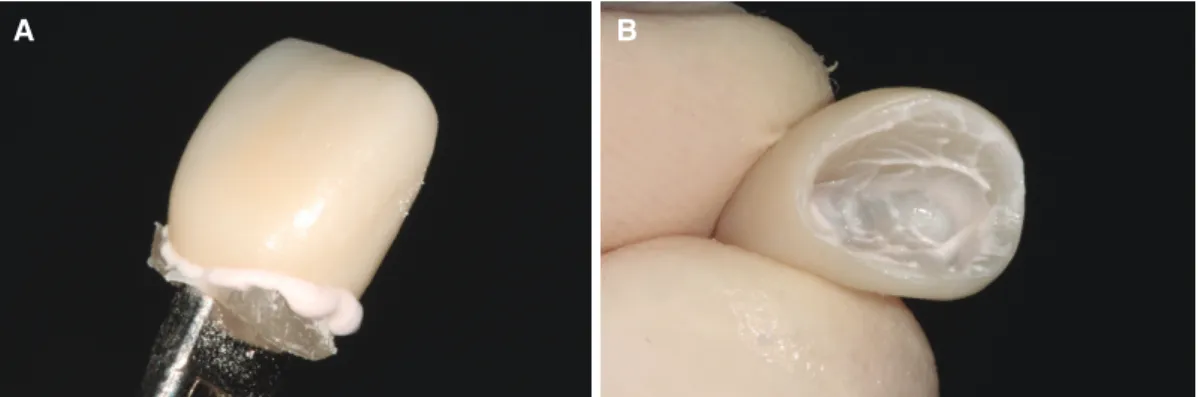
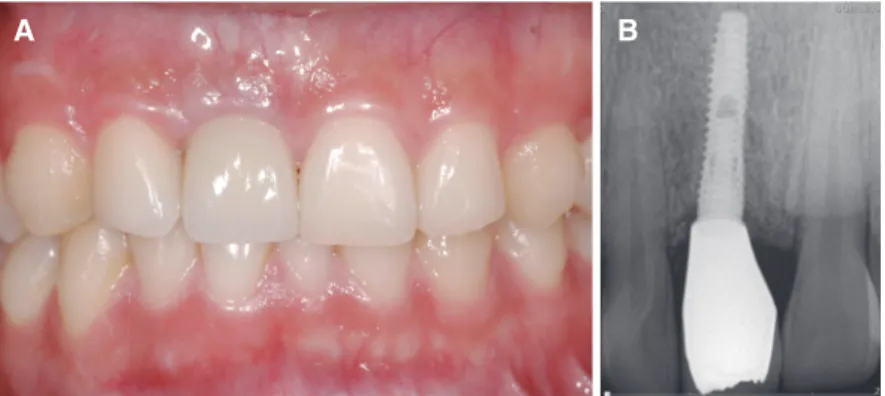
11The HMA abutment rep- lica was seated to the restoration with a light pressure (Fig. 4A). Any excess cement around the margin was wiped and the abutment replica was immediately pulled off. After confirming that the cement has been evenly applied to the inner surface of the restoration (Fig. 4B), the restoration was seated on the abutment within the oral cavity. Any cement flowing outside was removed after the cement was hardened (Fig. 5).
A
Fig. 3. (A) Fill the restoration with melted HMA and place the dowel pin, (B) Zirconia custom abutment (right) and hot melt adhesive material replica (left).
B
A
Fig. 4. (A) Apply cement, seat abutment replica, and wipe off excess cement, (B) Remove replica from seating and confirm that the cement has coated the inside.
B
Patient instruction for cleaning was conducted. At re-call check appointments after 1, 3, 6 months, no exudation or pus discharge was observed. The pa- tient was satisfied with the esthetics and function of the prostheses.
Discussion
Restoration with subgingival margin is widely used for aesthetics in anterior area. Since the emergence profile of anterior implant prostheses is rapidly wid- ened, it is highly likely for cement to retain between the abutment and gingival.
12However, complete removal of excess cement is difficult. Undetected ce- ment might cause periimplantitis. The risk of unde- tected excess cement is well known.
13In the process of removing cement with a plastic or titanium instru- ment, scratch can occur on the implant abutment, which can accelerate plaque and bacterial deposi- tion.
14Even though cement with water-solubility or radiopacity is used, it is difficult to find cement that is thinly remained on the surface of the abutment or gingiva.
15Factors that can determine the amount of excess cement include the amount of cement used, viscosity and flowability of the cement, margin loca- tion, ability to remove unset cement, abutment mate- rial, and abutment shape.
15To minimize excess cement and obtain proper retention, using abutment replica is effective.
2Abut-
ment replica can be fabricated by duplicating the abutment with resin or polyvinyl siloxane material.
This case report introduced a technique to fabricate abutment replica with HMA at chairside. As excess cement can be removed before seating the restora- tion to abutment, the remained cement can be mini- mized after cementation. However, this technique has a limitation. Because even shrinkage of HMA cannot be controlled, uniform and precious space for cement cannot be obtained. Nonetheless, this simple technique can be used for cementation of implant restoration with subgingival margin to minimize ex- cess cement. Since it needs no additional laboratory procedure, it is quick and effective.
Conclusion
In this case report, the abutment replica was sim- ply fabricated with hot melt adhesive material to minimize the excess cement of anterior implant prosthesis in dental office. Since the excess cement is harmful to the peri-implant tissue, the biologic com- plication can be reduced for using this technique.
Acknowledgments
The authors thank the dental laboratory of Chon- buk National University Hospital, Byeong-Yong Ko, for technical assistance.
A
Fig. 5. (A) Zirconia crown was cemented with resin cement, (B) Periapcal radiograph. No cement remaining was observed.
B
ORCID
Chi-Won Seo http://orcid.org/ 0000-0003-0745-8199 A-Reum Han http://orcid.org/ 0000-0002-9432-7244 Jae-Min Seo http://orcid.org/ 0000-0001-5095-4046 Jung-Jin Lee http://orcid.org/ 0000-0002-7381-5230
References
1. Hebel KS, Gajjar RC. Cement-retained versus screw-retained implant restorations: achieving op- timal occlusion and esthetics in implant dentistry. J Prosthet Dent 1997;77:28-35.
2. Liang T, Hu X, Zhu L, Pan X, Zhou Y, Liu J. Com- parative in vitro study of cementing techniques for implant-supported restorations. J Prosthet Dent 2016;116:59-66.
3. Chee WW, Duncan J, Afshar M, Moshaverinia A.
Evaluation of the amount of excess cement around the margins of cement-retained dental implant restorations: the effect of the cement application method. J Prosthet Dent 2013;109:216-21.
4. Wadhwani C, Piñeyro A. Technique for controlling the cement for an implant crown. J Prosthet Dent 2009;102:57-8.
5. Galván G, Kois JC, Chaiyabutr Y, Kois D. Cement- ed implant restoration: a technique for minimizing adverse biologic consequences. J Prosthet Dent 2015;114:482-5.
6. Lee JH, Park IS, Sohn DS. A digital approach to fabricating an abutment replica to control cement volume in a cement-retained implant prosthesis. J Prosthet Dent 2016;116:25-8.
7. Rayyan MM, Makarem HA. A modified technique for preventing excess cement around implant sup-
ported restoration margins. J Prosthet Dent 2016 Jul 23. doi:10.1016/j.prosdent.2016.04.007. [Epub ahead of print]
8. Li W, Bouzidi L, Narine SS. Current research and development status and prospect of hot-melt ad- hesives: a review. Ind Eng Chem Res 2008;47:7524- 32.
9. Dimashkieh MR, Rayyan MR. Chairside technique for expediting indirect interim restorations. J Pros- thet Dent 2016;115:510-1.
10. Siamos G, Winkler S, Boberick KG. Relationship between implant preload and screw loosening on implant-supported prostheses. J Oral Implantol 2002;28:67-73.
11. Wadhwani C, Goodwin S. Chung KH. Cementing an implant crown: a novel measurement system us- ing computational fluid dynamics approach. Clin Implant Dent Relat Res 2016;18:97-106.
12. Hermann JS, Buser D, Schenk RK, Schoolfield JD, Cochran DL. Biologic width around one- and two- piece titanium implants. Clin Oral Implants Res 2001;12:559-71.
13. Gapski R, Neugeboren N, Pomeranz AZ, Reissner MW. Endosseous implant failure influenced by crown cementation: a clinical case report. Int J Oral Maxillofac Implants 2008;23:943-6.
14. Pauletto N, Lahiffe BJ, Walton JN. Complications associated with excess cement around crowns on osseointegrated implants: a clinical report. Int J Oral Maxillofac Implants 1999;14:865-8.
15. Wadhwani C, Rapoport D, La Rosa S, Hess T,
Kretschmar S. Radiographic detection and charac-
teristic patterns of residual excess cement associ-
ated with cement-retained implant restorations: a
clinical report. J Prosthet Dent 2012;107:151-7.
*교신저자: 이정진
(54896)전주 덕진구 백제대로 567 전북대학교 치의학전문대학원 보철학교실 및 구강생체과학연구소 Tel: 063-250-2050|Fax: 063-250-2218|E-mail: [email protected]
접수일: 2016년 8월 8일|수정일: 2016년 8월 23일|채택일: 2016년 8월 25일
임플란트 보철 합착 시 잔여 시멘트 최소화를 위해 열가소성 접착제를 이용한 복제 지대주 제작 방법: 증례보고