INTRODUCTION
Even though esophageal cancer is a common malignancy of elderly patients in Korea, treatment results for these patients are not satisfactory. Patients with metastatic or recurrent eso- phageal cancer have a particularly poor prognosis owing to their overall medical condition. Palliative surgery to relieve dysphagia results in high morbidity (1). Endoscopic balloon dilation/stent insertion or intraluminal radiotherapy also help to relieve dysphagia with less morbidity than surgery, but the median duration of survival after these treatments is only 3-6 months, which is comparable to that of patients with untreated advanced esophageal cancer (2, 3). For these reasons, chemotherapy has become the primary modality for treating metastatic or unresectable recurrent esophageal cancer, both to relieve symptoms and to prolong life, where possible.
Combination chemotherapy with 5-fluorouracil (5-FU) and cisplatin has been widely used in esophageal cancer, with reported response rates of 35-40% (4). Pre-operative treatment with this regimen was tolerated reasonably well in random- ized trials (5, 6), but the median duration of response was generally short, the median survival was only 6-10 months, and efficacy was limited in metastatic disease (7). Paclitaxel, an agent with broad antitumor activity, is one of the most active agents against esophageal cancer, showing response
rates in the 30 to 40% when used alone (8) and of 38-48%
in combination therapy with cisplatin (9, 10). Given that esophageal cancers respond poorly to other regimens, it is worthwhile to examine the responses of previously treated metastatic or recurrent esophageal cancers to paclitaxel/cis- platin combination chemotherapy. In this study, we evalu- ated the efficacy and tolerability of biweekly paclitaxel and cisplatin for these patients.
MATERIALS AND METHODS Patients
Patients with metastatic or unresectable esophageal cancer recurring after previous treatments (chemotherapy, radiation therapy, or surgery) were eligible to participate in this study.
The clinical stage of each cancer was evaluated using a com- plete medical history, physical examination, complete blood count, clinical chemistry, chest radiography, computed tomog- raphy of the chest and upper abdomen, and gastrofiberscopy with biopsy. A whole-body bone scan was also performed for cases showing any symptoms suggestive of bony involvement, including abnormalities in serum calcium or alkaline phos- phatase levels. Clinical stages for all patients were based on
Sang-Hee Cho, Ik-Joo Chung, Sang-Yun Song*, Deok-Hwan Yang, Jeong-Rae Byun, Yeo-Kyeoung Kim, Je-Jung Lee, Kook-Joo Na*, Hyeoung-Joon Kim
Department of Internal Medicine and Chest Surgery*, Chonnam National University Medical School, Gwangju, Korea
Address for correspondence Ik-Joo Chung, M.D.
Department of Internal Medicine, Chonnam National University Hwasun Hospital, 160 Ilsimri, Hwasun-eup, Hwasun-gun, Jeollanam-do 519-809, Korea Tel : +82.61-379-7633, Fax : +82.61-379-7628 E-mail : [email protected]
618
Bi-weekly Chemotherapy of Paclitaxel and Cisplatin in Patients with Metastatic or Recurrent Esophageal Cancer
Although various combinations of chemotherapy regimens have been tried for patients with esophageal cancer, their duration of survival is extremely poor. In this study, we investigated the safety and clinical efficacy of paclitaxel and cisplatin chemother- apy in metastatic or recurrent esophageal cancer. 32 patients enrolled in this study and the median age was 60 yr. Of all the 32, 28 patients (88%) had been treated previously, 22 of them with chemotherapy or radiation therapy. All patients in the study received biweekly paclitaxel (90 mg/m2) followed by cisplatin (50 mg/m2). One patient (3%) responded completely, and 12 patients (38%) showed a partial response;
in 9 patients (28%) the disease remained stable, and in 10 patients (31%) it pro- gressed. The objective response rate was 41%. The median duration of response was 4.8 months, and the median overall survival in all patients was 7 months. The 1-yr and 2-yr survival rates were 28.1% and 7.1%, respectively. Grade 3 or 4 of neutropenia and anemia were observed in 6 (19%) and 5 (16%) patients, respec- tively. The major non-hematologic toxicity was fatigue, but most of them could man- ageable. In conclusion, biweekly paclitaxel and cisplatin is effective in patients with metastatic or recurrent esophageal cancer.
Key Words : Esophageal Neoplasms; Drug Therapy, Combination; Paclitaxel; Cisplatin
Received : 23 September 2004 Accepted : 21 January 2005
the revised American Joint Committee (AJC) system. Further eligibility requirements were as follows: voluntary informed consent in writing; age <75 yr; Eastern Cooperative Oncology Group (ECOG) performance status ≤2; life expectancy >12 weeks; and adequate hematological, renal, and hepatic func- tion (WBC ≥3,000/ L, granulocytes ≥1,500/ L, platelets
≥100,000/ L, total bilirubin <1.3 mg/dL, and creatinine clearance >60 mL/min). Exclusion criteria were: pre-existing neurotoxicity >WHO criteria grade 1, active infection, other serious underlying medical conditions that would impair the ability of the patient to receive the planned treatment, or in- adequate calorie and fluid intake.
Treatment protocol and dose modification
Paclitaxel (90 mg/m2) and cisplatin (50 mg/m2) were admin- istrated by intravenous (i.v.) infusion every 2 weeks. Thirty minutes prior to the paclitaxel infusion, each patient received 20 mg dexamethasone, 50 mg ranitidine, and 5 mg chlor- pheniramine maleate i.v., to prevent hypersensitivity reac- tions. After prehydration with at least 1 L of normal saline, the calculated dose of paclitaxel, diluted in 500 mL of nor- mal saline, was infused over 3 hr. The calculated dose of cis- platin was then administered over 3 hr, followed by posthy- dration with 3 L of normal saline over 24 hr. Ondansetron (8 mg, i.v.) was routinely given. Patients received further cycles of chemotherapy only when the absolute neutrophil count was ≥1,000/ L and platelets ≥150,000/ L. The paclitaxel dose was reduced to 75% of the original dose in subsequent courses if one of the followings occurred: grade 3 neutropenia with infection; grade 4 neutropenia; grade 3 thrombocytopenia with bleeding that required platelet trans- fusion; and over grade 3 sensory neurotoxicity. In cases of fatigue or asthenia above grade 3, treatment was postponed for 1 week and restarted when the patient had recovered to below grade 2. After three courses of chemotherapy, progres- sive patients were excluded. Patients showing disease regres- sion received additional courses of chemotherapy, up to a max- imum of eight courses.
Treatment assessment
The clinical restaging procedure included all the studies that had shown abnormal findings prior to treatment. To evalu- ate toxicity, a physical examination, complete blood count, and blood chemistry were performed at the 8th to 12th day after chemotherapy. To evaluate responses, CT scans of the chest and abdomen, with ultrasonography and endoscopy when appropriate, were repeated after the third and sixth cycles and after the discontinuation of therapy. Responses were eval- uated using WHO criteria. A complete response was defined as the complete disappearance of all clinical evidence of dis- ease, persisting for more than 4 weeks. A partial response was defined as a decrease by at least 50% reduction in the sum
of the products of the largest perpendicular diameters in all measurable lesions, including esophageal wall thickness or at least a 30% reduction of the largest diameters in uni-dimen- sional disease (evaluable disease) for at least 4 weeks, with no evidence of progression or of the development of new lesions.
Progressive disease was defined as an increase in a previous lesion by more than 25%, or the development of any new lesion. Stable disease was defined as any change in the previous lesion that did not fit into either the partial response or pro- gressive disease categories. DeMeester symptom scores (11) were used by patients to rate their swallowing symptoms on a scale of 0-3 at the beginning of chemotherapy and the best relief during chemotherapy. The scoring system is defined as follows; 0=no dysphagia, 1=mild, i.e. with solids, requiring modification of diet to soft foods, 2=moderate, i.e. difficulty with soft foods, predominantly liquid diet, 3=severe, i.e. ob- structed, needing medical intervention for dilatation or bolus obstruction. Toxicities were evaluated according to the National Cancer Institute Common Toxicity Criteria (NCI-CTC).
Statistical methods
Overall survival was measured from the date when the treat- ment began to the date of death, or of the most recent follow- up visit. The duration of response was measured from the date that the response was noted to the date that progression was confirmed, or to the last visit without progression. The time to progression was measured from the date the treatment began to the date of progression, or to the last visit without progression. The statistical analysis was performed using SPSS software (SPSS, Chicago, IL, U.S.A.). All survival data were updated to June 2004. Median survival times and survival curves were estimated using the method of Kaplan and Meier and were compared using a log-rank test. A value of p=0.05 (two-sided) was considered the limit of significance.
RESULTS Patient characteristics
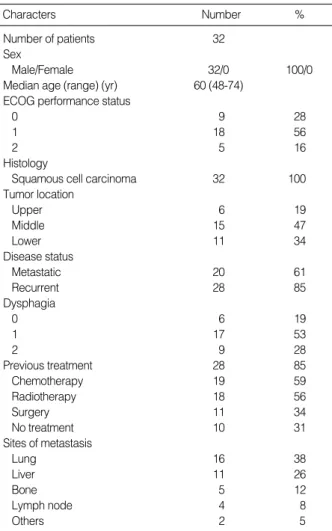
Between April 1999 and June 2003, 38 eligible patients with esophageal cancer were enrolled. Of these 38 patients, 6 patients were ineligible: 3 patients had follow-up loss after one cycle of chemotherapy, 2 patients were dropped out because of economic condition and one patient had double primary tumor (esophageal and lung cancer). Therefore, 32 patients were eligible for analysis. Patient characteristics are present- ed in Table 1. All the patients were male and had confirmed squamous cell carcinoma. Their median age was 60 yr (range 48-74 yr). As indicated in Table 1, 28 patients (88%) had been treated previously. Ten patients (31%) had received nei- ther chemotherapy nor radiotherapy; either metastatic disease was found at diagnosis or they had relapsed after receiving
only surgery. Nineteen patients (59%) had received chemother- apy with 5-FU and cisplatin, 18 patients (56%) had received radiation therapy with or without concurrent chemotherapy.
Twenty patients (63%) had metastatic lesions. The predom- inant metastatic sites were the lung, liver, bone, and lymph nodes. All patients evaluated for this study received at least two cycles of chemotherapy.
Chemotherapy delivery
The median number of cycles received was five, with a range of from two to eight cycles; 151 treatment cycles were deliv- ered in total. Of the 32 patients, 26 pateints (81%) received more than three cycles of chemotherapy, and 13 patients (41%) received more than six cycles. No patients had any further treatment after this combination chemotherapy. The median interval between cycles was 19 days (range, 13-36 days), owing to delayed hematologic recovery and asthenia. The planned and achieved dose intensities for cisplatin were 25 mg/m2/week and 19.2 mg/m2/week, respectively; for paclitaxel, they were 45 mg/m2/week and 33.5 mg/m2/week, respectively.
Efficacy
Among the 32 patients, 28 patients had measurable dis- ease and 4 patients had evaluable disease. One patient (3%) showed a complete response (CR), 12 (38%) had partial res- ponses (PR), 9 (28%) had stable disease (SD), and in 10 patients (31%) the disease progressed (PD) (Table 2). The objective response was 41%. The CR patient still had stable disease after three cycles of chemotherapy, but reached CR after six cycles. Seven partial responses were seen among the 10 che- motherapy- or radiotherapy-naive patients, and 6 of 22 patients previously treated with chemotherapy or radiotherapy respond- ed either completely (one patient) or partially (five patients).
The objective response among naive patients was significantly higher than among the others (p=0.049, two-sided Fisher’s exact test). Follow-up dysphagia scores were available for 29 patients. 11 patients (34%) had an improvement of at least one grade in dysphagia score after treatment and 12 patients (37%) showed no change of swallowing difficulty. Only 6 patients (19%) had a progression of dysphagia. For responders, the median duration of response was 4.5 months (range, 1.0- 49.2 months), and the median time to progression for all patients was 5.0 months (range, 1.3-52.6 months).
Safety
The main hematologic toxicities observed were anemia and neutropenia. Over grade 3 of neutropenia and anemia were observed in 6 (19%) and 5 (16%) patients, respectively.
Thrombocytopenia was rare. Neutropenic infection developed in 2 patients (6%) with pneumonia, who recovered after treat- ment with antibiotics. Grade 1 or 2 sensory neurotoxicity was observed in 10 patients (50%); sensory neurotoxicity over grades 3 did not occur. The major non-hematologic toxicity was fatigue, which spontaneously resolved after 1 or 2 weeks of rest. One patient developed grade 3 hepatotoxicity after six cycles of chemotherapy. Therapy was stopped, and the patient recovered spontaneously after 2 months. There was no treat- ment-related mortality. There were no significant differences in hematologic or non-hematologic toxicities between chemo- therapy- or radiotherapy-naive patients and the others (Fig. 1).
Characters Number %
Number of patients 32
Sex
Male/Female 32/0 100/0
Median age (range) (yr) 60 (48-74) ECOG performance status
0 9 28
1 18 56
2 5 16
Histology
Squamous cell carcinoma 32 100
Tumor location
Upper 6 19
Middle 15 47
Lower 11 34
Disease status
Metastatic 20 61
Recurrent 28 85
Dysphagia
0 6 19
1 17 53
2 9 28
Previous treatment 28 85
Chemotherapy 19 59
Radiotherapy 18 56
Surgery 11 34
No treatment 10 31
Sites of metastasis
Lung 16 38
Liver 11 26
Bone 5 12
Lymph node 4 8
Others 2 5
Table 1.Patient characteristics
All patients (n=32) Results
Patients without previous chemotherapy or radiotherapy
(n=10)
Patients with previous chemotherapy or radiotherapy
(n=22)
CR 1 (3%) 0 1 (4%)
PR 12 (38%) 7 (70%) 5 (23%)
CR+PR 13 (41%) 7 (70%) 6 (27%)
SD 9 (28%) 2 (20%) 7 (32%)
PD 10 (31%) 1 (10%) 9 (41%)
Table 2.Results of treatment
Survival
The median overall survival time of all patients was 7 mon- ths (95% CI, 5.13-8.87). The median overall survival time of responding patients was 10 months (95% CI, 4.95-15.05;
range, 5-51 months) compared with 5 months (95% CI 3.85- 6.15, range 2-20 months) for non-responding patients. This increased survival time was significant (p=0.0069). The 1-yr and 2-yr survival rates of all patients were 28.1% and 7.1%, respectively (Fig. 2).
DISCUSSION
Esophageal cancer is one of the most difficult malignancies to manage, with early extension into adventitia or through the esophageal wall, and regional lymph node involvement by the time of diagnosis. Despite treatment with aggressive surgical resection, the overall 5-yr survival rate is only 20%, and the majority of patients relapse both locoregionally as
well as at distant sites (12, 13). To overcome this poor prog- nosis, multimodal treatment is playing an increasingly impor- tant role in the management of esophageal cancer. Currently available preoperative chemoradiation therapy, followed by surgery, achieves a complete response in 20-40% of patients, with a 5-yr survival of 25-35% (14, 15). However, half of all patients are unresectable or metastatic at presentation, and 65-75% relapse after surgical resection. The effect of chemo- therapy on survival in patients with metastasis or relapsed disease is unclear, owing to a lack of randomized phase III trials comparing chemotherapy to best supportive care. Never- theless, chemotherapy would be warranted if it led to pallia- tion of symptoms and/or to prolongation of life.
Reduced tolerance to toxic chemotherapy regimens in pa- tients with metastatic or recurrent esophageal cancer is the result of larger tumor burdens, older ages, and comorbidities attributable to tobacco use and alcohol consumption. Hence, different chemotherapy regimens are needed for these patients.
Bleiberg et al. (7) reported a response rate of 35% in metastatic esophageal cancer to combination chemotherapy with 5-flu- orouracil and cisplatin. In spite of this response rate, this regi- men is not the standard treatment for metastatic esophageal cancer, owing to a high incidence of treatment-related deaths (16%).
Recently, several new agents such as paclitaxel, irinotecan, and vinorelbine have shown promising activity in the treat- ment of refractory or metastatic esophageal cancer (8, 16, 17). Petrasch et al. (18) treated 24 patients with cisplatin (50 mg/m2) and paclitaxel (90 mg/m2), administered biweekly.
Patients in that study had metastatic or relapsed disease after surgery, without previous chemotherapy. They had a response rate of 40%, and a median of 8 months progression-free sur- vival. Even though the response rates of Petrasch’s and our report were similar, the progression-free survival is different (8 months vs. 5 month, respectively). It may be originated from the low achieved dose intensity in this study. Van der Gaast et al. (19) used higher doses (60 mg/m2cisplatin, 180 mg/m2paclitaxel). Using the same high doses, Polee et al.
100 90 80 70 60 50 40 30 20 10 0
Neutropenia Anemia
ThrombocytopeniaNausea/vomiting
Fatigue DiarrheaNeuropathy
NCI-CTC Toxicity (Gr 0-2)
Fig. 1.NCI-CTC toxicities compared treatment naive and previous treated patients.
Fig. 2.Kaplan-Meier survival curve for responding (n=13) and non- responding patients (n=19) (p=0.0069).
100 90 80 70 60 50 40 30 20 10 0
Neutropenia Anemia
ThrombocytopeniaNausea/vomiting
Fatigue DiarrheaNeuropathy NCI-CTC Toxicity (Gr 3-4)
Total
% of treatment naive group
% of previous treatment group
Cumulative survival
1.0
0.8
0.6
0.4
0.2
0.0
0.00 10.00 20.00 30.00 40.00 50.00 60.00 Months
p=0.0069
Median: 10 months
Non-responder (n=19) Responder (n=13)
Median: 5 months . .
. .
(20) reported a 43% response rate, but 31% of patients showed grade 3 or 4 neutropenia, and 63% had grade 1 or 2 sensory neurotoxicity.
In this study, 28 patients (88%) had been treated previously, 22 (69%) of those with chemotherapy or radiotherapy. The overall response rate was 41%, comparable to that seen by Polee et al. with higher doses of paclitaxel and cisplatin. The objective response was higher in chemoradiotherapy-naive patients (70%) than in others (27%), and this combination chemotherapy dose may be satisfactory for these patients.
Responders to chemotherapy also had a significant survival benefit compared with non-responders, showing the effective- ness of chemotherapy for metastatic or recurrent esophageal cancer.
Although squamous cell carcinomas have become increas- ingly less common over the past two decades and now account for approximately 40% of all esophageal malignances report- ed, all of our patients had confirmed squamous cell carcinoma and this result showed the high activity of combination thera- py for tumors of this histology (21, 22). Considering the poor medical condition usually associated with previously treated patients, this regimen was fairly well tolerated. Although 6 patients (19%) developed grade 3 or 4 neutropenia, serious infections were not observed. Sensory neurotoxicity was seen in 16 patients (50%), all with grade 1 or 2. It seems to be associated with dose reduction as toxicity grading, and there was no severe sensory neurotoxicity including motor weak- ness. No significant differences were noted in hematologic or non-hematologic toxicities between chemoradiotherapy- naive patients and the others.
At the point of the aim of palliative therapy, the improve- ment of dysphagia via tumor regression is important. In this study, 11 patients (34%) showed the improvement of dys- phagia. 12 patients (37%) had no change of dysphagia, but 5 patients of them showed no dysphagia (score 0) at the begin- ning of treatment and maintained normal swallowing dur- ing treatment. Remainder of them also maintained as a state of solid intake (score 1).
In conclusion, a biweekly schedule of paclitaxel and cis- platin at the dose used in this study is not only effective and well tolerated in metastatic or recurrent esophageal cancer patients, especially in chemotherapy- or radiotherapy-naive patients, but also effective in improvement of dysphagia.
Although moderate effects were shown in patients that had been treated previously with chemotherapy or radiotherapy, further study of other, perhaps higher, doses of paclitaxel or cisplatin may be needed to improve responses in these patients.
REFERENCES
1. Siersema PD, Dees J, van Blankenstein M. Palliation of malignant dysphagia from oesophageal cancer. Scand J Gastroenterol 1998;
225: 75-84.
2. Knyrim K, Wagner HJ, Bethge N, Keymling M, Vakil N. A controlled trial of an expansile metal stent for palliation of esophageal obstruc- tion due to inoperable cancer. N Engl J Med 1993; 329: 1302-7.
3. Low DE, Pagliero KM. Prospective randomized clinical trial compar- ing brachytherapy and laser photoablation for palliation of esophageal cancer. J Thorac Cardiovasc Surg 1992; 104: 173-8.
4. Enzinger PC, Ilson DH, Kelsen DP. Chemotherapy in esophageal cancer. Semin Oncol 1999; 26: 12-20.
5. Kelson DP, Ginsberg R, Pajak TF, Sheahan DG, Gunderson L, Mor- timer J, Estes N, Haller DG, Ajani J, Kocha W, Minsky BD, Roth JA.
Chemotherapy followed by surgery compared with surgery alone for localized esophageal cancer. N Engl J Med 1998; 339: 1979-84.
6. Hayashi K, Ando N, Watanabe H, Hayashi K, Ando N, Watanabe H, Ide H, Nagai K, Aoyama N, Takiyama W, Ishida K, Isono K, Maku- uchi H, Imamura M, Shinoda M, Ikeuchi S, Kabuto T, Yamana H, Fukuda H. Phase II evaluation of protracted infusion of cisplatin and 5-fluorouracil in advanced squamous cell carcinoma of the esophagus:
a Japan Esophageal Oncology Group (JEOG) Trial (JCOG9407).
Jpn J Clin Oncol 2001; 31: 419-23.
7. Bleiberg H, Conroy T, Paillot B, Lacave AJ, Blijham G, Jacob JH, Bedenne L, Namer M, De Besi P, Gay F, Collete L, Sahmoud T. Ran- domized phase II study of cisplatin and 5-fluorouracil versus cisplatin alone in advanced squamous cell esophageal cancer. Eur J Cancer 1997; 33: 1216-20.
8. Ajani JA, Ilson DH, Daugherty K, Pazdur R, Lynch PM, Kelsen DP.
Activity of taxol in patients with squamous cell carcinoma and adeno- carcinoma of the esophagus. J Natl Cancer Inst 1994; 86: 1086-91.
9. Kelsen DP, Ginsberg R, Bains M, Cooper J, Arquette M, Forastiere A, Ilson D. A phase II trial of paclitaxel and cisplatin in patients with locally advanced metastatic esophageal cancer: a preliminary report.
Semin Oncol 1997; 24 (Suppl 19): 77-81.
10. Ilson DH, Ajani J, Ahalla K, Forastiere A, Huang Y, Patel P, Martin L, Donegan J, Pazdur R, Reed C, Kelsen DP. Phase II trial of pacli- taxel, fluorouracil and cisplatin in patients with advanced carcinoma of the esophagus. J Clin Oncol 1998; 16: 1826-34.
11. Johnson LF, Demeester TR. Twenty-four pH monitoring of the dis- tal esophagus. A quantitative measure of gastroesophageal reflux.
Am J Gastroenterol 1974; 62: 325-32.
12. Millikan KW, Silverstein J, Hart V, Blair K, Bines S, Roberts J, Doolas A. A 15-year review of esophagectomy for carcinoma of the esopha- gus and cardia. Arch Surg 1995; 130: 617-24.
13. Kim MO, Hong ES, Chai JY, Leem JM, You IY, Kim WD, Park WY, Kim ST, Lee KH. Concurrent FP (5-fluorouracil, cisplatin) chemora- diotherapy for patients with esophageal cancer. Cancer Res Treat 2003; 35: 330-4.
14. Walsh TN, Noonan N, Hollywood D, Kelly A, Keeling N, Hennessy TP. A comparison of multimodal therapy and surgery for esophageal adenocarcinoma. N Engl J Med 1996; 335: 462-7.
15. Bosset JF, Gignoux M, Triboulet JP, Tiret E, Mantion G, Elias D, Lozach P, Ollier JC, Pavy JJ, Mercier M, Sahmoud T. Chemoradio- therapy followed by surgery compared with surgery alone in squa- mous cell cancer of the esophagus. N Engl J Med 1997; 337: 161-7.
16. Ajani JA, Baker J, Pisters PW, Ho L, Mansfield PF, Feig BW, Charn- sangavej C. CPT-11 plus cisplatin in patients with advanced, untreat-
. .
. .
ed gastric or gastroesophageal junction carcinoma: results of a phase II study. Cancer 2002; 94: 641-6.
17. Conroy T, Etienne PL, Adenis A, Ducreux M, Paillot B, Oliveira J, Seitz JF, Francois E, van Cutsem E, Wagener DJ, Kohser F, Daamen S, Praet M, Gorlia T, Baron B, Wils J. Vinorelbine and cisplatin in metastatic squamous cell carcinoma of the oesophagus: response, toxicity, quality of life and survival. Ann Oncol 2002; 13: 721-9.
18. Petrasch S, Welt A, Reinacher A, Graeven U, Konig M, Schmiegel W. Chemotherapy with cisplatin and paclitaxel in patients with locally advanced, recurrent or metastatic oesophageal cancer. Br J Cancer 1998; 78: 511-4.
19. Van der Gaast A, Kok TC, Kerkhofs L, Siersema PD, Tilanus HW,
Splinter TA. Phase I study of a biweekly schedule of a fixed dose of cisplatin with increasing doses of paclitaxel in patients with advanced oesophageal cancer. Br J Cancer 1999; 80: 1052-7.
20. Polee MB, Eskens FA, van der Burg ME, Splinter TA, Siersema PD, Tilanus HW, Verweij J, Stoter G, van der Gaast A. Phase II study of bi-weekly administration of paclitaxel and cisplatin in patients with advanced oesophageal cancer. Br J Cancer 2002; 86: 669-73.
21. Blot WJ, McLaughlin JK. The changing epidemiology of esophageal cancer. Semin Oncol 1999; 26: 2-13.
22. Enzinger PC, Ilson DH, Kelsen DP. Chemotherapy in esophageal cancer. Semin Oncol 1999; 26 (Suppl 15): 12-20.