Hip fracture has a high incidence and link with mortality in elderly women (1-6) and is mainly associated with a fall (2, 7-9). Since MacDonald and MacDonald (10) reported that long-acting phenobarbital was a risk factor in nocturnal femoral fracture, it has been reported that sedatives, antianx- ieties, antidepressants, and antipsychotics are also associated with falls in elderly people (11-14). Furthermore, psychotropic medication has also been reported to be an important risk factor for multiple falls (10-14) suggesting that the use of psychotropics increases the risk of hip fracture by raising the likelihood of falls that may result in fracture (15, 16).
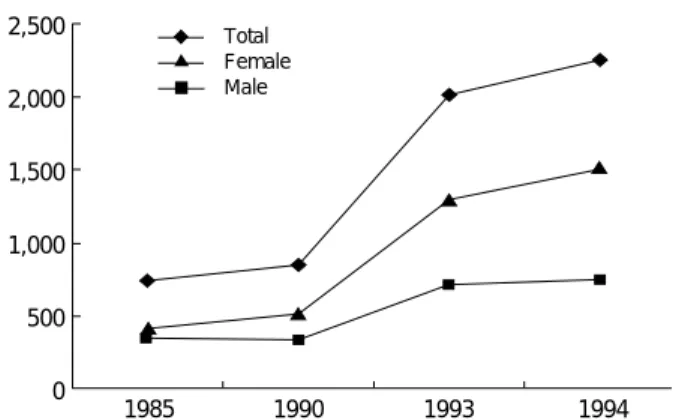
In Korea, the proportion of elderly people aged 65 yr and above represented 5% of the population in 1990 and is expected to rise to 12% in 2019 (17). As this proportion increases, it is to be expected that hip fractures will become a significant health problem (18). According to the Korean annual report on the cause of death statistics (19), the inci- dence of death by hip fracture, especially among women, had rapidly increased since 1990 (Fig. 1). Therefore, this study was conducted to evaluate the association between the prescription of psychotropics and the incidence of hip frac- ture in Korean elderly women.
MATERIALS AND METHODS
This study cohort was constructed from the female respon- dents to a self-administered questionnaire survey distributed by mail to the Korean Elderly Pharmacoepidemiology Cohort (KEPEC), which is comprised of 23,649 participants, consist- ing of 8,428 men and 15,221 women (20-22).
The eligibility criteria of the KEPEC were beneficiaries of the Korea Medical Insurance Corporation (KMIC) in 1993, over 65 yr of age, living in Busan city (the second largest in Korea), with no previous history of hip fracture (Fig. 2).
Since 1978 the KMIC has included government employees, schoolteachers, and pensioners living with their families. The total number of beneficiaries was around 4.7 million in 1993, about 11% of the total Korean population. The age distri- bution of the KEPEC members enrolled in this study was very similar to that of Korean elderly people (data not shown).
Busan had a population of 3.8 million in 1990 and was chosen for the size of its elderly population and the high feasibility of study population follow up for the purpose of determin- ing clinical outcomes including hip fracture.
The number of responders to the mail questionnaire sur- Jong-Myon Bae, Hye-Won Koo*,
Kui-Oak Jung�, Byung-Joo Park*�
Department of Preventive Medicine, Cheju National University College of Medicine, Cheju; Clinical Trial Center, Clinical Research Institute, Seoul National University Hospital*, Seoul; Department of Preventive Medicine�, Seoul National University College of Medicine, Seoul, Korea
Address for correspondence Byung-Joo Park, M.D.
Department of Preventive Medicine, Seoul National University College of Medicine, 28 Yongon-dong, Chongno-gu, Seoul 110-799, Korea
Tel : +82.2-740-8325, Fax : +82.2-747-4830 E-mail : [email protected]
65
A Cohort Study on the Association between Psychotropics and Hip Fracture in Korean Elderly Women
To test the hypothesis that the intake of psychotropics may increase the risk of hip fracture, a cohort study was conducted upon elderly Korean women. The Korean Elderly Pharmacoepidemiology Cohort was constructed from members of the Korea Medical Insurance Corporation over 65 yr of age who were living in Busan Metropolitan City in 1993. Study participants (n=6,043) were female respondents to a self-administered question survey. Information on the intake of psychotropics was obtained from the drug prescription database, which con- tained all psychotropic prescriptions during any hospital admission over the two- year period between January 1, 1993 and December 31, 1994. The cohort fol- low-up has been conducted with information on hip fracture being collected from the Korea Medical Insurance Corporation medical treatment claims database over the four year period between January 1, 1993 and December 31, 1996.
Three hundred and three subjects had received 745 psychotropics prescriptions and 56 cases of hip fracture were found. After adjusting for age, body mass index, and drinking history, it was found that the intake of psychotropics signifi- cantly increased the risk of hip fracture (adjusted odds ratio, 4.24; 95% confi- dence interval, 1.89-9.52). This study suggests that the intake of psychotropics might be an important risk factor for hip fracture in elderly Korean women.
Key Words : Psychotropic Drugs; Hip Fractures; Cohort Studies; Pharmacoepidemiology; Aged
Received : 17 August 2001 Accepted : 25 October 2001
vey, which was used to identify potential confounders, was 8,994, and accounted for 38% of the KEPEC. Among them, the 6,043 female responders became the study popu- lation.
Exposure to psychotropics was defined as any psychotropic prescription during any hospital admission between January 1, 1993 and December 31, 1994, which was on the drug prescription (DP) database of the KMIC. The first day of prescription was selected as the starting day of exposure to psychotropics. Because of the lack in Korea of a database that includes information on drug prescription, the DP database was constructed directly by ourselves from the prescription claims data that were submitted to the KMIC by the medi- cal care institutions for reimbursement. The names of the
psychotropics, daily amounts, and prescription period were also secured from the DP database.
To evaluate the cumulative effects of multiple prescriptions of psychotropics, the Total Standard Exposure Index (TSEI) was created. TSEI was defined as the sum of the individual drug exposure indices, which were calculated by summing individually the total amount of each psychotropic prescribed on a daily basis (according to the kind of psychotropics pre- scribed during hospital admission), and dividing these by the corresponding recommended daily dose of each drug (Table 2, 6). With the TSEI median value being 5, the study population was classified into 3 categories based on their TSEIs, namely, 1) zero, 2) less than 5, 3) 5 or more.
Potential cases of hip fracture were selected on the basis of diagnostic codes in KMIC’s medical treatment claims (MTC) database, which were sent from medical care institutions whenever a beneficiary received any treatment. If an inpatient had a diagnostic code of 820 on ICD-9 or S72 on ICD-10 between January 1, 1993 and December 31, 1996, we regard- ed her as a potential hip fracture case. A hospital survey was then performed to confirm the diagnosis by reviewing the medical records of the potential cases.
The date of hip fracture was defined as the date of admis- sion. The duration of observation was calculated from either January 1, 1993 or the date of becoming a KMIC beneficia- ry, whichever came last, until either the date of the hip frac- ture, the loss of beneficiaries or the end of the observation period (December 31, 1996), whichever came first.
Information on potential confounders was obtained by self-administered questionnaires. Five age groups were defined for the analysis: 1) 65-69 yr, 2) 70-74 yr, 3) 75-79 yr, 4) 80- 84 yr, and 5) 85 yr or older. Body mass index was calculated as weight (kg) divided by height (m)2, and the subjects were divided into two categories at a cut-off point of 24.0 kg/m2. Alcohol and smoking status were classified into three strata based on: 1) never drank/smoked, 2) quit drinking/smoking, and 3) current drinker/smoker. Finally, all subjects were asked whether they had endocrine, cardiovascular, or musculoskele- tal diseases.
Incidence density per 100,000 person-years was calculat- ed by dividing the number of hip fracture cases by follow- up person-years and the 95% confidence interval was esti- mated using approximate Wald confidence limits (23). Sur- vival analysis, by the Cox proportional hazards model, was used to identify potential confounders by calculating the relative risks and their 95% confidence intervals. The adjusted relative risk of psychotropics prescription on hip fracture was assessed, after adjustment for the effect of con- founders, using the Cox proportional hazards model. Statis- tical analysis was performed using SAS release 6.12 (24).
The population attributable risk percent (PAR %) was cal- culated using the adjusted relative risk and the prevalence of exposure (25).
2,500 2,000 1,500
1,000 500
0 1985 1990 1993 1994
Total Female Male
65 year-older & over; living in Busan, 1993
KEPEC (N=23,649)
Data Analysis
1993-1996 Medical Claims
database
Potential Cases
Hospital Survey Drug Prescription D/B
1993-1994
Questionnaire Survey
Study Participants with 1. Drug Prescription 2. Questionnaire data 3. Confirmed Diagnosis
Fig. 2.Flow of the Korean Elderly Pharmacoepidemiology Cohort Study.
F/U
Fig. 1.Number of death cases by hip fracture in Korea (19).
RESULTS
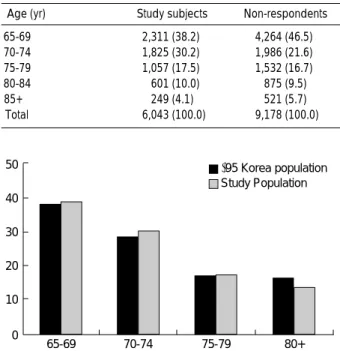
A total of 6,043 female KEPEC members responded to the survey questionnaire. The age distribution of the subjects was similar to that of non-respondents in KEPEC (Table 1), and to that of Korean elderly people in 1995 (Fig. 3), which indicated that the age distribution of the study participants was very similar to that of the Korean population.
Three hundred and three subjects had received 745 psy- chotropics prescriptions during hospital admissions, over a two-year period, 1993-1994 (Table 2). Antianxiety drugs were the most frequently prescribed psychotropics, and ac- counted for 79.3% of the total prescriptions. Fifty-six inci- dent cases of hip fracture were reported and confirmed from medical records over the four-year period between January 1, 1993 and December 31, 1996. Table 3 presented the inci- dence rates of hip fracture by age group. The incidence rate of hip fracture showed a significant increasing trend with age.
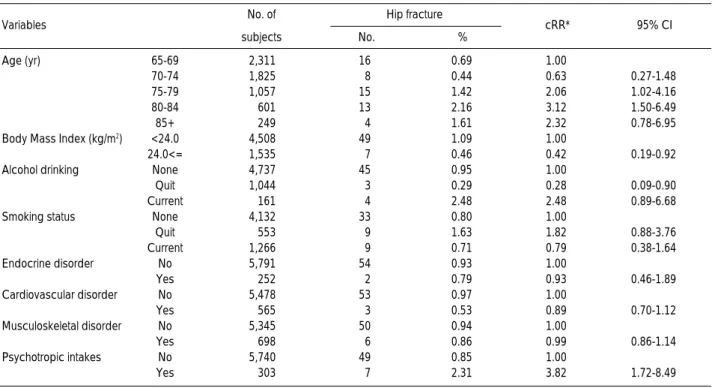
Table 4 displayed the crude relative risk (RR) of the potential risk factors for hip fracture, as estimated by the Cox propor- tional hazards model. Age, body mass index, and drinking history all exhibited a statistically significant association, with elder and more slender women being at increased risk for hip fracture. The association with age was especially signifi- cant (chi-square for trend=12.82; p<0.05). The group, which had quit drinking, was at a higher risk than the no-drinking group, but the habit of alcohol consumption did not show a
significant association. The crude RR for psychotropic intake was 3.82 at a 95% confidence interval of 1.72-8.49.
The results of multivariate analysis for psychotropic intake were adjusted for age, body mass index, and drinking history (Table 5). This adjustment showed that women receiving psychotropics were at a 4.24-fold increased relative risk (95%
CI, 1.89-9.52), and that women with a TSEI of less than 5 had an adjusted RR value of 5.77 (95% CI, 2.05-16.2), as com- pared with women with a TSEI of zero (Table 6).
DISCUSSION
In this study, the prescription of psychotropics was found to be an important risk factor for hip fracture in Korean elderly women, after adjusting the results for age, body mass index, and drinking history. The adjusted RR was 4.24, which sug- gests a stronger association than that previously reported by Ray et al. (12-14) and by Cumming and Klineberg (26).
These reports dealt with exposure to specific drugs includ- ing various types of psychotropics. Our result is compatible with that of Lichtenstein et al. (27), who found that the odds ratio for both the presence of confusion and psychotropic drug use was 5.07 (95% CI, 2.16-11.92). The population
Fig. 3.Distribution of elderly women in the study population and in Korean in 1995.
50 40 30 20 10
0 65-69 70-74 75-79 80+
’95 Korea population Study Population
Age (yr) Study subjects Non-respondents
65-69 2,311 (38.2) 4,264 (46.5)
70-74 1,825 (30.2) 1,986 (21.6)
75-79 1,057 (17.5) 1,532 (16.7)
80-84 601 (10.0) 875 (9.5)
85+ 249 (4.1) 521 (5.7)
Total 6,043 (100.0) 9,178 (100.0)
Table 1.Age distribution of the female groups in the Korea Elderly Pharmacoepidemiology Cohort (KEPEC) and in the Study Cohort
Kinds of psychotropics
Frequency (prescriptions)
TSEI*
Minimum Median Maximum
Antianxieties 591 0.12 2 15
Hypnotics 2 25 27.5 30
Antidepressants 75 2.5 10 100
Antimanics 23 200 200 300
Antipsychotics 54 0.5 4 200
Total prescriptions� 745
Table 2. Distribution of psychotropic prescriptions during admission among study subjects, 1993-1994
*TSEI (Total Standard Exposure Index) = DOSEi RDDi
(DOSE: total amount of each psychotropic drug, RDD: recommended daily dose of the drug, k: kinds of psychotropics);
�in 303 subjects.
k i=1
Age (yr) No. of hip
fracture Person-years ID* 95% C.I.�
65-69 16 9,087.2 176.1 110.3-284.1
70-74 8 7,173.4 111.5 59.9-216.7
75-79 15 4,140.3 362.3 223.9-593.4
80-84 13 2,364.3 549.8 329.5-932.6
85+ 4 978.4 408.8 192.6-1017.5
Table 3.Incidence rate of hip fracture per 100,000 person- years by age among study subjects, 1993-1996
*Incidence density per 100,000 person-years was calculated by divid- ing the number of hip fracture cases by person-years; �Confidence interval was estimated by using approximate Wald confidence limits.
attributable risk percentage (25) of psychotropic prescription in terms of hip fracture is 13.9%, which suggests that the prescription of psychotropics for elderly women in Korea should be carefully managed.
At the time of this study, Koreans could buy many medi- cines, but not psychotropics, at any drugstore without a doc- tor’s prescription. Thus, the prescriptions of psychotropics in hospitals probably approximately represent the real drug in- take status. This situation does much to validate the study design, which relied heavily upon KMIC’s MTC database, for the supply of all information about psychotropic type, dosage, and prescription period, as well as details of associ- ated medical services.
Fractures due to high-energy trauma were excluded. A hospital survey was undertaken to confirm the final diagnosis of the potential hip fracture cases, because the MTC database contains secondary data only. The primary physician’s pre- scription and medical care services received at the outpatient
Variables No. of Hip fracture
subjects No. %
cRR* 95% CI
Age (yr) 65-69 2,311 16 0.69 1.00
70-74 1,825 8 0.44 0.63 0.27-1.48
75-79 1,057 15 1.42 2.06 1.02-4.16
80-84 601 13 2.16 3.12 1.50-6.49
85+ 249 4 1.61 2.32 0.78-6.95
Body Mass Index (kg/m2) <24.0 4,508 49 1.09 1.00
24.0<= 1,535 7 0.46 0.42 0.19-0.92
Alcohol drinking None 4,737 45 0.95 1.00
Quit 1,044 3 0.29 0.28 0.09-0.90
Current 161 4 2.48 2.48 0.89-6.68
Smoking status None 4,132 33 0.80 1.00
Quit 553 9 1.63 1.82 0.88-3.76
Current 1,266 9 0.71 0.79 0.38-1.64
Endocrine disorder No 5,791 54 0.93 1.00
Yes 252 2 0.79 0.93 0.46-1.89
Cardiovascular disorder No 5,478 53 0.97 1.00
Yes 565 3 0.53 0.89 0.70-1.12
Musculoskeletal disorder No 5,345 50 0.94 1.00
Yes 698 6 0.86 0.99 0.86-1.14
Psychotropic intakes No 5,740 49 0.85 1.00
Yes 303 7 2.31 3.82 1.72-8.49
Table 4.The crude relative risk (cRR) and its 95% confidence interval (CI) of hip fracture among study subjects, 1993-1996
Variables aRR* 95% C.I.�
Intakes of psychotropics No 1.0
Yes 4.55 [2.03, 10.2]
Age (yr) 65-69 1.0
70-74 0.58 [0.25, 1.37]
75-79 1.87 [0.92, 3.78]
80-84 2.96 [1.41, 6.19]
85+ 2.20 [0.73, 6.62]
Body Mass Index (kg/m2) <24.0 1.0
24.0<= 0.46 [0.21, 1.03]
Drinking Habit None 1.0
Quit 0.29 [0.09, 0.93]
Current 2.49 [0.89, 6.90]
Table 5.The adjusted relative risk (aRR) and its 95% confi- dence interval of psychotropic intake for hip fracture among study subjects, 1993-1996
*Adjusted relative risk for all variables.
�95% confidence interval.
*cRR: crude relative risk.
Variables No. of subject No. of fracture cRR� 95% CI� aRR� 95% CI�
TSEI=0 5,741 49 1.0 1.0
TSEI<5 130 4 5.18 [1.86, 14.4] 5.77 [2.05, 16.2]
TSEI ≥5 172 3 2.84 [0.88, 9.16] 3.17 [0.98, 10.3]
Table 6.Crude and adjusted relative risk and its 95% confidence interval of TSEI* for hip fracture among study subjects, 1993-1996
*TSEI (Total Standard Exposure Index) = DOSEi RDDi
(DOSE: total amount of each psychotropic drug, RDD: recommended daily dose of the drug, k: kinds of psychotropics)
�Crude relative risk; �95% confidence interval; �Adjusted relative risk adjusted for age, body mass index, and drinking history.
k i=1
clinics could not be confirmed by hospital survey because only psychotropics prescribed during hospital admission were defined as exposure. Therefore, the result of this study might contain a dilution effect in terms of the amount of psychotropics received. Therefore, given that these results may in fact be an underestimation, they should be regarded as representing the minimum level of relative risk of hip frac- ture due to psychotropics among elderly Korean women.
The study subjects were restricted to female responders because there were only 11 incident cases of hip fracture during the 2-yr follow-up period among the male responders to the questionnaire survey. The female study participants demonstrated the comparatively low level of psychotropics exposure of only 5%, a level that prevented separate analysis of psychotropics by therapeutic class. These findings indicate that further confirmatory studies are needed.
A new index, TSEI, was developed in order to evaluate the dose-response relationship. However, the under 5 TSEI group exhibited a higher adjusted RR than the 5 or above TSEI group, thus producing an inverse J-pattern outcome.
This result could have been caused by ‘confounding by indi- cation’(28), as doctors probably would have modified the dosage of psychotropics to patients susceptible to hip frac- ture. An alternative explanation may be that TSEI was devel- oped for this present study and the validation of its useful- ness may require further study.
Some methodological problems may have influenced the validity of our results. Firstly, our data on psychotropics were limited to the information regarding prescription during hos- pital stays and some of the subjects in the unexposed group could have taken psychotropics at outpatient clinics, with a consequent underestimation of the psychotropic effects. Sec- ondly, the response rate of the questionnaire survey was 39.7 percent among the KEPEC members. As shown in Table 1 and Fig. 3, the similar age distribution of the subjects to both the non-respondents and the general Korean population sug- gests that this low response rate might not decrease the validi- ty of this paper. Thirdly, information on confounders was obtained from self-administered questionnaires. According to the questionnaire reliability and validity study by Park et al. (29), high reliability could be expected in terms of smok- ing, alcohol consumption, and anthropometrically related items. Fourthly, among the variables obtained by the question- naire survey, the history of estrogen replacement as a known protective factor of hip fracture was not adjusted for as a con- founder because it was considered that the subjects had only a rare chance of having had lifelong exposure to estrogen.
REFERENCES
1. Cummings SR, Black DM, Rubin SM. Lifetime risks of hip, Colles’, or vertebral fracture and coronary heart disease among white post- menopausal women. Arch Intern Med 1989; 149: 2445-8.
2. Cumming RG, Nevitt MC, Cummings SR. Epidemiology of hip fractures. Epidemiol Rev 1997; 19: 244-57.
3. Jacobsen SJ, Goldberg J, and Miles TP, Brody JA, Stier W, Rimm AA. Hip fracture incidence among the old and very old: a popula- tion-based study of 745,435 cases. Am J Public Health 1990; 80:
871-3.
4. Jacobsen SJ, Goldberg J, Miles TP, Brody JA, Stiers W, Rimm AA.
Race and sex differences in mortality following fracture of the hip.
Am J Public Health 1992; 82: 1147-50.
5. Farmer ME, White LR, Brody JA, Bailey KR. Race and sex differ- ences in hip fracture incidence. Am J Public Health 1984; 74:
1374-80.
6. Silverman SL, Madison RE. Decreased incidence of hip fracture in Hispanics, Asians, and Blacks: California hospital discharge data.
Am J Public Health 1988; 78: 1482-3.
7. Nevitt MC, Cummings SR, Kidd S, Black D. Risk factors for recur- rent nonsyncopal falls: a prospective study. JAMA 1989; 261: 2663-8.
8. Tinetti ME, Speechley M, Ginter SF. Risk factors for falls among elderly persons living in the community. N Engl J Med 1988; 319:
1701-7.
9. Sattin RW, Lambert-Huber DA, De Vito CA, Rodriguez JG, Ros A, Bacchelli S, Stevens JA, Waxweiler RJ. The incidence of fall injury events among the elderly in a defined population. Am J Epidemiol 1990; 131: 1028-37.
10. MacDonald JB, MacDonald ET. Nocturnal femoral fracture and continuing widespread use of barbiturate hypnotics. Br Med J 1977;
2: 483-5.
11. Cumming RG, Miller JP, Kelsey JL, Davis P, Arfken CL, Birge SJ, Peck WA. Medications and multiple falls in elderly people: the St Louis OASIS study. Age Ageing 1991; 20: 455-61.
12. Ray WA, Griffin MR, Schaffner W, Baugh DK, Melton LJ III. Psy- chotropic drug use and the risk of hip fracture. N Engl J Med 1987;
316: 363-9.
13. Ray WA, Griffin MR, Downey W. Benzodiazepines of long and short elimination half-life and the risk of hip fracture. JAMA 1989;
262: 3303-7.
14. Ray WA, Griffin MR, Malcolm E. Cyclic antidepressants and the risk of hip fracture. Arch Intern Med 1991; 151: 754-6.
15. MacDonald JB. The role of drugs in falls in the elderly. Clin Geriatr Med 1985; 1: 621-36.
16. Prudham D, Evans JG. Factors associated with falls in the elderly:
a community study. Age Ageing 1981; 10: 141-6.
17. Song KY. Policy issues for health and social services in aging. J Korean Med Assoc 1994; 37: 1147-53.
18. H jdrup S, Gr nbaek M, Gottschau A, Llauritzen JB, Schroll M, and the Copenhagen Centre for Prospective Population Studies.
Alcohol intake, beverage preference, and risk of hip fracture in men and women. Am J Epidemiol 1999; 149: 993-1001.
19. National Statistical Office (Korea). 1994 Annual report on the cause of death statistics-based on vital registration. Seoul: The Office: 1995.
20. Park BJ, Bae JM, Koo HW, Kim DS, Kwon JS, Jin K. Cohort study on the association between psychotropics and proximal femur frac- ture in the elderly people in Korea: Interim results. Korean J Clin Pharmacol Ther 1998; 6: 44-54.
21. Park BJ, Jung KO, Bae JM, Koo HW, Kim DS. Cohort study on the association between smoking and proximal hip fracture in the elder- ly people in Korea. Korean J Epidemiol 1998; 20: 246-56.
22. Park BJ, Jung KO, Koo HW, Bae JM. Nested case-control study on the association between alcohol and the risk of proximal hip fracture in the elderly people in Korea. Korean J Epidemiol 1999; 21: 93-103.
23. Rothman KJ, Greenland S. Modern Epidemiology. 2nd ed. Lippin- cott-Raven Publishers, Philadelphia 1998: 234-6.
24. SAS Institute Inc. The SAS for windows, Release 6.12. Cary, NC- 27513, U.S.A. 1989.
25. Hennekens CH, Buring JE. Epidemiology in medicine. Little, Brown
& Co., Boston 1987: 90-5.
26. Cumming RG, Klineberg RJ. Psychotropics, thiazide diuretics and hip fractures in the elderly. Med J Aust 1993; 158: 414-7.
27. Lichtenstein MJ, Griffin MR, Cornell JE, Malcolm E, Ray WA. Risk factors for hip fractures occurring in the hospital. Am J Epidemiol 1994; 140: 830-8.
28. Salas M, Hofman A, Stricker BH. Confounding by indication: An example of variation in the use of epidemiologic terminology. Am J Epidemiol 1999; 149: 981-3.
29. Park BJ, Kim DS, Koo HW, Bae JM. Reliability and validity study of a life style questionnaire for elderly people. Korean J Prev Med 1998; 31: 49-58.