Copyright © 2021. Korean Society for Neurorehabilitation i
HIGHLIGHTS
• Korean version of the Modified Barthel Index (K-MBI) demonstrates the most influential factors on the quality of life (QoL) of Parkinson's disease (PD) patients.
• Ambulation is the most influential factor in the K-MBI on PD patient QoL.
• Improved independence with mobility could be considered to be the goal of rehabilitation for PD patients.
Brain Neurorehabil. 2021 Jul;14(2):e13 https://doi.org/10.12786/bn.2021.14.e13 pISSN 1976-8753·eISSN 2383-9910
Original Article
Received: Apr 29, 2021 Revised: Jun 4, 2021 Accepted: Jul 6, 2021 Correspondence to Won Hyuk Chang
Department of Physical and Rehabilitation Medicine, Center for Prevention and Rehabilitation, Heart Vascular Stroke Institute, Samsung Medical Center, Sungkyunkwan University School of Medicine, 81 Ilwon-ro, Gangnam-gu, Seoul 06351, Korea.
E-mail: [email protected]
Yu Min Bang, Yoojin Song, Seo Jung Yun, Han Gil Seo, Won Hyuk Chang
Associated Factors on Quality of Life in Patients with Parkinson's Disease
Brain & NeuroRehabilitation
ABSTRACT
The objective of this study is to investigate the clinical and demographic factors that influence the quality of life in patients with Parkinson's disease (PD). This is a cross- sectional observational study of 47 patients in 2 hospitals with PD. All participants were asked to complete a disease-specific quality of life (QoL) questionnaire (PDQ-39). We gave a structured questionnaire interview and did a complete neurological examination on the same day. Additionally, we measured depression and dependency with the Geriatric Depression Scale-Short Form (GDS-SF) and the Korean version of the Modified Barthel Index (K-MBI).
The PDQ-39 had a significant relationship with each motor part of the Unified Parkinson's Disease Rating Scale, the Korean Mini-Mental State Examination (K-MMSE), the GDS-SF, and the K-MBI (p < 0.05). The factors that independently contributed to the PDQ-39 scores were K-MMSE, GDS-SF, and K-MBI (p < 0.05). Factors having the greatest influence on the PDQ-39 were K-MBI, K-MMSE, and GDS-SF in that order. In addition, the mobility item in the K-MBI was independently a significant relating factor in the PDQ-39 (p < 0.05). These results demonstrated that dependency, especially with the mobility issue, was the greatest influence on the QoL in patients with PD.
Keywords: Parkinson's Disease; Quality of Life; Independence; Rehabilitation
INTRODUCTION
Parkinson's disease (PD) is the second most common chronic neurodegenerative disorder of the central nervous system. The prevalence of PD has increased in older people because age is the greatest risk factor for its the development [1]. In Korea, there were 16,152 new cases of PD between 2010 and 2015, and the annual prevalence and incidence of PD has been increasing over the past six years [2]. Patients with PD can survive more than 10 years following diagnosis. However, most patients experience severe physical and mental impairments that limit independence and quality of life (QoL) as the disease progresses [3]. In patients with PD, therapeutic strategies have traditionally focused primarily on the cardinal motor symptoms of bradykinesia, rigidity, and tremor [4]. In addition, there are increased recognition and research into PD nonmotor symptoms such as cognitive and psychiatric issues, as well as autonomic and sleep dysfunction [4].
Original Article
Received: Apr 29, 2021 Revised: Jun 4, 2021 Accepted: Jul 6, 2021 Correspondence to Won Hyuk Chang
Department of Physical and Rehabilitation Medicine, Center for Prevention and Rehabilitation, Heart Vascular Stroke Institute, Samsung Medical Center, Sungkyunkwan University School of Medicine, 81 Ilwon-ro, Gangnam-gu, Seoul 06351, Korea.
E-mail: [email protected] Copyright © 2021. Korean Society for Neurorehabilitation
This is an Open Access article distributed under the terms of the Creative Commons Attribution Non-Commercial License (https://
creativecommons.org/licenses/by-nc/4.0) which permits unrestricted non-commercial use, distribution, and reproduction in any medium, provided the original work is properly cited.
ORCID iDs Yu Min Bang
https://orcid.org/0000-0003-3839-8272 Seo Jung Yun
https://orcid.org/0000-0002-2142-0472 Han Gil Seo
https://orcid.org/0000-0001-6904-7542 Won Hyuk Chang
https://orcid.org/0000-0002-4969-7895 Funding
This work was supported by the 2019 Research Grant from the Korean Society for Neurorehabilitation.
Yu Min Bang ,1 Yoojin Song,1 Seo Jung Yun ,2 Han Gil Seo ,2 Won Hyuk Chang 1
1 Department of Physical and Rehabilitation Medicine, Center for Prevention and Rehabilitation, Heart Vascular Stroke Institute, Samsung Medical Center, Sungkyunkwan University School of Medicine, Seoul, Korea
2 Department of Rehabilitation Medicine, Seoul National University College of Medicine, Seoul National University Hospital, Seoul, Korea
Associated Factors on Quality of Life
in Patients with Parkinson's Disease
Conflict of Interest
The authors have no potential conflicts of interest to disclose.
Rehabilitation therapy has been provided to patients with PD as an adjuvant to
pharmacological and surgical treatments to maximize functional abilities and to minimize secondary complications [5]. Although rehabilitation therapy can now be considered an essential component in the management of patients with PD, it is vital that the intervention be tailored to the changing clinical conditions and individual patient needs [5]. The ultimate goal of rehabilitation in patients with PD is improvement in the QoL. The individual
rehabilitation therapy to improve each motor or nonmotor symptom should be modified to improve QoL in patients with PD.
However, it remains unclear what factors influence the quality of life in patients with PD. The purpose of this study is to investigate clinical and demographic factors affecting the QoL of patients with PD.
MATERIALS AND METHODS
Participants
We enrolled a total of 47 patients at 2 hospitals who had idiopathic Parkinson's disease (IPD).
Inclusion criteria were (a) patients who had been diagnosed with IPD, (b) age over 19 years, (c) and who had taken the structural questionnaire with no definite cognitive impairment (Korean Mini-Mental State Examination [K-MMSE] > 19) [6]. We based IPD diagnoses on medical history, physical examination, and neuroimaging studies. Exclusion criteria were (a) preexisting and active major neurological disease, and (b) preexisting and active major psychiatric disease such as major depression, schizophrenia, bipolar disease, or dementia.
The Institutional Review Board (IRB) of each hospital approved this study protocol (IRB of Samsung Medical Center (IRB No. 2019-07-025) and IRB of Seoul National University Hospital (IRB No. 1907-193-1052)), and informed consent was obtained by participants prior to participation.
QoL assessments
To identify the QoL in IPD patients, we used the Parkinson's Disease Questionnaire-39 (PDQ- 39) which is a disease-specific QoL measure [7]. The PDQ-39 has been shown to have good reliability, responsiveness, and reproducibility. It is currently used in many trials to evaluate therapeutic effects [8]. This questionnaire asks patients how often they have experienced certain events because of Parkinson's disease over the previous month. The ratings range from 0 (never) to 4 (always). The questionnaire consists of 39-multiple-choice items covering 8 dimension: “mobility,” “activities of daily living,” “emotions,” “stigma,” “social activity,”
“cognition,” “communication,” and “bodily discomfort.” The total score is converted into the PDQ-39 summary index (PDQ-39 SI), ranging from zero to 100 points. The lower the score is, the greater is the QoL [9].
Potential influencing factors
We collected demographics such as sex, age, and disease duration. The modified Hoehn and Yahr scale for severity of IPD [10] and the K-MMSE [6] for cognitive function were administered. The Unified Parkinson's Disease Rating Scale (UPDRS) is used to measure the clinical characteristics and motor function of IPD [11]. The UPDRS consists of 4 parts. Part I (mentation, behavior, with mood scores ranging from 0 to 16), Part II (activities of daily living with scores ranging from 0 to 52), Part III (motor examination with scores ranging from 0 to 108), and Part IV (complications, with scores ranging from 0 to 23). In this study,
2/7 https://doi.org/10.12786/bn.2021.14.e13
QoL of PD Patients Brain & NeuroRehabilitation
https://e-bnr.org
we performed UPDRS Part I, II and III. Scores can range from 0 to 176, and higher scores indicate greater disability.
We also assessed mood with the Geriatric Depression Scale-Short Form (GDS-SF) [12] and measured dependency with the Korean Version of the Modified Barthel Index (K-MBI) [13].
The GDS-SF is a self-assessment scale often used to identify depressive symptoms in IPD [14]. It has 15 “yes/no” questions and is a self-report measure of depressive symptoms. All participants were asked to report whether they had experienced any of these symptoms over the previous week. The GDS-SF has a maximum score of 15, and higher scores indicate more serious symptoms. The K-MBI evaluates independence, based on each activity of daily living (ADL), such as bathing, feeding, toileting, walking, dressing, and others. The score ranges from 0 to 100, and higher scores indicate greater ADL independence [15]. Each K-MBI subscale was converted to interval-level measures using Rasch analysis [16]. Rasch analysis transforms summed scores to interval measures in which the intervals between units of the scale are equal. Each converted K-MBI subscale was computed to a range of zero to 100, with lower scores indicating greater disability.
Statistical analysis
We used SPSS version 24.0 (SPSS, Chicago, IL, USA) for the statistical analyses. The Shapiro- Wilk test was used to determine the distributional normality of all continuous variables (all were found to be normally distributed; p < 0.05). This analysis was used to assess correlation between the POQ-39 SI and potential influencing factors. After correlation analysis, we did linear regression analysis with the stepwise method to identify the meaningful independent influencing factors having significant variables. In addition, the comparison with correlation analysis was performed between the subjective complain and the objective measurement for the similar functional domain. P-values less than 0.05 were considered to be statistically significant.
RESULTS
Table 1 showed the general and functional characteristics of participants. Forty-seven patients were included, with a mean age of 68.2 years. The average duration for PD was 6.7 years. The average score of the PDQ-39 SI was 27.7. Among the 8 PDQ-39 SI dimensions, the dimensions with the higher scores were the mobility, emotional, and stigma scores. In contrast, the domains with lower scores were social support, cognition and communication, which showed relative higher levels of QoL in patients with PD (Fig. 1). Each mobility and mood dimension of PDQ-39 was significantly correlated with the ambulation item of K-MBI and GDS-SF (r2 = -0.729, p < 0.001 and r2 = 0.549, p < 0.001). However, there was no significant correlation between the cognition dimension of PDQ-39 and K-MMSE.
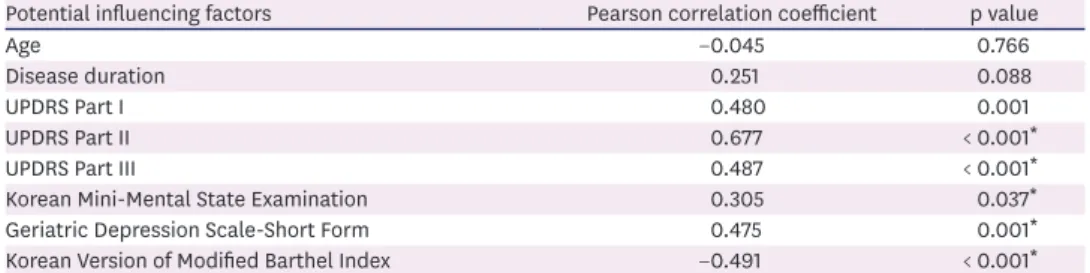
In our correlation analysis of POQ-39 SI and potential influencing factors, the PDQ-39 SI had a significant relationship with each UPDRS Part I, II, and III, and K-MMSE, GDS-SF, and K-MBI, respectively (p < 0.05). However, there was no significant correlation between PDQ- 39 SI with age or disease duration (Table 2). The results from linear regression analysis are summarized in Table 3. Of particular note, the 2 factors that independently influenced PDQ- 39 SI were K-MBI and GDS-SF (R2 = 0.423, p < 0.05). The K-MBI was the most significantly influencing factor on the PDQ-SI SI.
To assess which converted K-MBI subscale correlated to PDQ-39 SI, we did a correlation analysis and linear regression analysis. The analysis results showed that PDQ-39 SI was significantly correlated with bathing, feeding, stair climbing, dressing, bowel control, ambulation, and the converted transfer subscales, respectively (p < 0.05, Table 4). The results from linear regression analysis showed that only the converted ambulation had a significant independently negative relating factor to PDQ-39 SI (R2 = 0.272, p < 0.05).
4/7 https://doi.org/10.12786/bn.2021.14.e13
QoL of PD Patients Brain & NeuroRehabilitation
https://e-bnr.org
Table 1. Characteristics of participants (n = 47)
Characteristics Value
Age (mean ± SD, yr) 68.2 ± 7.9
Disease duration (mean ± SD, yr) 3.1 ± 4.2
Sex (M:F) 28:19
UPDRS Part I 2.8 ± 2.4
UPDRS Part II 13.2 ± 9.5
UPDRS Part III 25.3 ± 15.6
Modified Hoehn & Yahr stage (1:1.5:2:2.5:3:4:5) 6:4:8:10:9:8:2
Korean Mini-Mental State Examination 27.6 ± 2.1
Geriatric Depression Scale-Short Form 7.6 ± 2.7
Korean Version of Modified Barthel Index 88.2 ± 16.7
Parkinson's Disease Questionnaire-39 Summary Index 27.7 ± 18.7
UPDRS, Unified Parkinson's Disease Rating Scale.
35.5
27.2
30.7 31.0
21.5 22.6 24.5
28.4 27.7
Score
0 10 20 30 40
Mobility
Activities of daily living
Emotions Stigma
Social supportCognitions
CommunicationBodily discomfort PDQ-
39 SI
Fig. 1. Quality of life in participants.
Among the 8 PDQ-39 SI dimensions, the dimensions with the higher scores were the mobility, emotional, and stigma scores. In contrast, the domains with lower scores were social support, cognition and communication.
PDQ-39 SI, Parkinson's Disease Questionnaire-39 Summary Index.
Table 2. Correlation analysis of Parkinson's Disease Questionnaire-39 Summary Index
Potential influencing factors Pearson correlation coefficient p value
Age −0.045 0.766
Disease duration 0.251 0.088
UPDRS Part I 0.480 0.001
UPDRS Part II 0.677 < 0.001*
UPDRS Part III 0.487 < 0.001*
Korean Mini-Mental State Examination 0.305 0.037*
Geriatric Depression Scale-Short Form 0.475 0.001*
Korean Version of Modified Barthel Index −0.491 < 0.001*
*p < 0.05, correlation analysis between Parkinson's Disease Questionnaire-39 Summary Index and potential influencing factor.
UPDRS, Unified Parkinson's Disease Rating Scale.
DISCUSSION
These results indicate that K-MBI demonstrates the most influential factors on the QoL of PD patients. Additionally, ambulation is the most influential factor in the K-MBI on PD patient QoL. Therefore, improved independence with mobility could be considered to be the goal of rehabilitation for PD patients. This study could yield customized treatment options for Parkinson disease patients through goal-oriented rehabilitation treatment.
There had been insufficient evidence demonstrating the efficacy of rehabilitation in patients of PD until 20 years ago [17]. However, a recent meta-analysis reported that rehabilitation has clinically significant benefits for patients with PD [18]. Rehabilitation can now be considered to be an essential component in the management of PD patients. [5]. It is recommended to start PD rehabilitation as early as possible, and rehabilitation should be tailored on the individual patients' needs because PD is a chronic progressive disorder [5]. PD rehabilitation is primarily aimed at improving QoL. To plan a proper rehabilitation strategy for improvement of QoL, physiatrists should know which disease-related factors are the most relevant in patients with PD. In this study of 47 PD patients, it was confirmed that K-MBI measurements had the most influence on QoL, and ambulation was the most important factor associated with it. Because dependency is one of dimensions in PDQ-39, these findings in this study might be anticipated results. However it was a considerable finding that independence showed the most significantly influencing factor on QoL in comparison with severe other factors such as cognition,
motor function and mood. Therefore, the results of this study can be used as a guideline for establishing rehabilitation strategies for patients with PD.
In this study, the degree of depression is another significant factor relating to QoL in PD patients. This is consistent with the previous studies [19,20]. In addition to physical impairment, mood disorder should be considered when establishing rehabilitation strategies for PD patients. In previous studies [19,20], depression has been reported as being a more Table 3. Linear regression analysis of Parkinson's Disease Questionnaire-39 Summary Index
Predictor Linear regression statistics
B p R2
Constant −7.898 0.423
K-MBI −0.467 0.001
GDS-SF 2.000 0.026
K-MMSE 2.228 0.041
K-MBI, Korean Version of Modified Barthel Index; GDS-SF, Geriatric Depression Scale-Short Form; K-MMSE, Korean Mini-Mental State Examination.
Table 4. Correlation analysis of Parkinson's Disease Questionnaire-39 Summary Index and converted subscales of Korean Version of the Modified Barthel Index
Dimension Correlation coefficient p value
Personal hygiene −0.135 0.235
Bathing −0.265 0.030*
Feeding −0.351 0.008*
Toileting −0.273 0.032
Stair climbing −0.389 0.007*
Dressing −0.425 0.001*
Bladder control −0.245 0.116
Bowel control −0.398 0.006*
Ambulation −0.521 < 0.001*
Transfer −0.355 0.014*
*p < 0.05, correlation analysis between Parkinson's Disease Questionnaire-39 Summary Index and converted subscales of Korean version of the Modified Barthel Index.
significant determinant of health-related QoL than disability. The difference between these previous studies and the results of this study might lie in the differing characteristics of participants. This discrepancy may be because of the relatively younger age and higher functional level in participants of the present study as compared to previous studies.
However, our study had a greater prevalence of depression than in previous studies. Twenty- three patients (48.9%) showed a depression level greater than 8 points on GDS-SF [21] as compared to 7.7%–22.5% in the previous studies [19,20]. Because this discrepancy be due to socio-cultural characteristics, it is difficult to apply these results to another country. Further studies with more participants in various countries will be needed in the future.
There was a mismatch in the assessment of cognitive function between the measurement by medical staff and the actual patient complains. These results might be due to the relatively small number of questions in the cognition dimension of PDQ-39 and to the characteristics of cognitive function in PD patients. There was a significant discrepancy between subjective complaints of cognitive deficits and objective evidence of cognitive impairment in PD patients [22]. Therefore, it should be careful to use the condition dimension of PDQ-39 as a criterion for evaluating cognitive functions in PD patients.
This study has a few limitations. Since this study was conducted on participants from 2 tertiary hospitals in the same city, regional diversity could not be excluded. In addition to the factors analyzed in this study, there may be other factors such as balance and fall frequency that can affect the QoL of PD patients. The characteristics of caregivers could not be investigated in this study. The relationship between the patient and the patient's caregiver is also reported as one of the important factors of QoL in PD patients [23]. These limitations could be considered to the reason that the explanatory power of this study was medium (r2
= 0.420). Further studies that include the assessments of caregiver characteristics and other factors will be needed.
On conclusion, the results in this study revealed that the dependency, especially mobility was the most influencing factor on the QoL in patients with PD. These results could be used to set the goal of rehabilitation for PD patients.
REFERENCES
1. Reeve A, Simcox E, Turnbull D. Ageing and Parkinson's disease: why is advancing age the biggest risk factor? Ageing Res Rev 2014;14:19-30.
PUBMED | CROSSREF
2. Park JH, Kim DH, Kwon DY, Choi M, Kim S, Jung JH, Han K, Park YG. Trends in the incidence and prevalence of Parkinson's disease in Korea: a nationwide, population-based study. BMC Geriatr 2019;19:320.
PUBMED | CROSSREF
3. Rubenstein LM, DeLeo A, Chrischilles EA. Economic and health-related quality of life considerations of new therapies in Parkinson's disease. Pharmacoeconomics 2001;19:729-752.
PUBMED | CROSSREF
4. Kulisevsky J, Oliveira L, Fox SH. Update in therapeutic strategies for Parkinson's disease. Curr Opin Neurol 2018;31:439-447.
PUBMED | CROSSREF
5. Abbruzzese G, Marchese R, Avanzino L, Pelosin E. Rehabilitation for Parkinson's disease: Current outlook and future challenges. Parkinsonism Relat Disord 2016;22 Suppl 1:S60-S64.
PUBMED | CROSSREF
6/7 https://doi.org/10.12786/bn.2021.14.e13
QoL of PD Patients Brain & NeuroRehabilitation
https://e-bnr.org
6. Kang IW, Beom IG, Cho JY, Son HR. Accuracy of Korean-Mini-Mental Status Examination based on Seoul Neuro-Psychological Screening Battery II results. Korean J Fam Med 2016;37:177-181.
PUBMED | CROSSREF
7. Holden SK, Koljack CE, Prizer LP, Sillau SH, Miyasaki JM, Kluger BM. Measuring quality of life in palliative care for Parkinson's disease: a clinimetric comparison. Parkinsonism Relat Disord 2019;65:172-177.
PUBMED | CROSSREF
8. Schrag A, Jahanshahi M, Quinn N. What contributes to quality of life in patients with Parkinson's disease?
J Neurol Neurosurg Psychiatry 2000;69:308-312.
PUBMED | CROSSREF
9. Hagell P, Nilsson MH. The 39-Item Parkinson's Disease Questionnaire (PDQ-39): is it a unidimensional construct? Ther Adv Neurol Disorder 2009;2:205-214.
PUBMED | CROSSREF
10. Goetz CG, Poewe W, Rascol O, Sampaio C, Stebbins GT, Counsell C, Giladi N, Holloway RG, Moore CG, Wenning GK, Yahr MD, Seidl L; Movement Disorder Society Task Force on Rating Scales for Parkinson's Disease. Movement Disorder Society Task Force report on the Hoehn and Yahr staging scale: status and recommendations. Mov Disord 2004;19:1020-1028.
PUBMED | CROSSREF
11. Movement Disorder Society Task Force on Rating Scales for Parkinson's Disease. The Unified Parkinson's Disease Rating Scale (UPDRS): status and recommendations. Mov Disord 2003;18:738-750.
PUBMED | CROSSREF
12. Lopez FV, Split M, Filoteo JV, Litvan I, Moore RC, Pirogovsky-Turk E, Liu L, Lessig S, Schiehser DM.
Does the Geriatric Depression Scale measure depression in Parkinson's disease? Int J Geriatr Psychiatry 2018;33:1662-1670.
PUBMED | CROSSREF
13. Hong I, Lim Y, Han H, Hay CC, Woo HS. Application of the Korean version of the Modified Barthel Index:
development of a keyform for use in clinical practice. Hong Kong J Occup Ther 2017;29:39-46.
PUBMED | CROSSREF
14. Yesavage JA, Brink TL, Rose TL, Lum O, Huang V, Adey M, Leirer VO. Development and validation of a geriatric depression screening scale: a preliminary report. J Psychiatr Res 1982-1983;17:37-49.
PUBMED | CROSSREF
15. Takahashi K, Kamide N, Suzuki M, Fukuda M. Quality of life in people with Parkinson's disease: the relevance of social relationships and communication. J Phys Ther Sci 2016;28:541-546.
PUBMED | CROSSREF
16. Roth EJ, Heinemann AW, Lovell LL, Harvey RL, McGuire JR, Diaz S. Impairment and disability: their relation during stroke rehabilitation. Arch Phys Med Rehabil 1998;79:329-335.
PUBMED | CROSSREF
17. Deane KH, Ellis-Hill C, Jones D, Whurr R, Ben-Shlomo Y, Playford ED, Clarke CE. Systematic review of paramedical therapies for Parkinson's disease. Mov Disord 2002;17:984-991.
PUBMED | CROSSREF
18. Tomlinson CL, Patel S, Meek C, Herd CP, Clarke CE, Stowe R, Shah L, Sackley CM, Deane KH, Wheatley K, Ives N. Physiotherapy versus placebo or no intervention in Parkinson's disease. Cochrane Database Syst Rev 2013;CD002817.
PUBMED | CROSSREF
19. Karlsen KH, Larsen JP, Tandberg E, Maeland JG. Influence of clinical and demographic variables on quality of life in patients with Parkinson's disease. J Neurol Neurosurg Psychiatry 1999;66:431-435.
PUBMED | CROSSREF
20. Schrag A, Jahanshahi M, Quinn N. What contributes to quality of life in patients with Parkinson's disease?
J Neurol Neurosurg Psychiatry 2000;69:308-312.
PUBMED | CROSSREF
21. Cho MJ, Bae JN, Suh GH, Hahm BJ, Kim JK, Lee DW, Kang MH. Validation of geriatric depression scale, Korean version (GDS) in the assessment of DSM-III-R major depression. J Korean Neuropsychiatr Assoc 1999;38:48-63.
22. Siciliano M, Trojano L, De Micco R, Sant’Elia V, Giordano A, Russo A, Passamonti L, Tedeschi G, Chiorri C, Tessitore A. Correlates of the discrepancy between objective and subjective cognitive functioning in non-demented patients with Parkinson's disease. J Neurol. Forthcoming 2021.
PUBMED | CROSSREF
23. Burgener S, Twigg P. Relationships among caregiver factors and quality of life in care recipients with irreversible dementia. Alzheimer Dis Assoc Disord 2002;16:88-102.
PUBMED | CROSSREF