Review Article
수근관 증후군의 최근 6 년간의 연구 동향 분석 : China National Knowledge Ingrastructure (CNKI) 보고 연구를 중심으로
전현아 *⋅ 신원빈
†⋅ 임수연
‡⋅ 문영주 *⋅ 이지연 *⋅ 구승혁 *⋅ 김성현 *⋅ 문현우 *
부천자생한방병원 재활의학과*, 침구과†, 신경정신과‡
A Narrative Review of Carpal Tunnel Syndrome in Traditional Chinese Medicine: Using China National Knowledge Infrastructure Database
Hyun-A Jeon, K.M.D.*, Won-Bin Shin, K.M.D.
†, Su-Yeon Lim, K.M.D.
‡, Young-Joo Moon, K.M.D.*, Ji-Yun Lee, K.M.D.*, Seung-Hyeok Ku, K.M.D.*, Sung-Hyun Kim, K.M.D.*, Hyun-Woo Moon, K.M.D.*
Departments of Rehabilitation Medicine of Korean Medicine*, Acupuncture and Moxibustion Medicine
†, Oriental Neuropsychiatry
‡, Bucheon Jaseng Hospital of Korean Medicine
RECEIVED September 10, 2020 REVISED September 24, 2020 ACCEPTED October 6, 2020 CORRESPONDING TO Hyun-A Jeon, Department of Rehabilitation Medicine of Korean Medicine, Jaseng Hospital of Korean Medicine, 17 Buil-ro, 191beon-gil, Wonmi-gu, Bucheon 14598, Korea
TEL (031) 1577-0007 FAX (032) 320-8712 E-mail [email protected] Copyright © 2020 The Society of Korean Medicine Rehabilitation
Objective The purpose of this study was to investigate clinical studies between 2015 and 2020 on the traditional Chinese medicine treatment for carpal tunnel syndrome (CTS) using the China National Knowledge Infrastructure (CNKI) database.
Methods We searched clinical studies on the Chinese medicine treatment published in traditional Chinese medical journals on CTS through the CNKI search. Fifteen pub- lished studies between 2015 and 2020 were chosen and examined for the year of publication, sample size, study design type, diagnosis and evaluation of diverse cri- teria, treatment period, purpose of the study, and classification based on the treat- ment technique.
Results Out of 73 studies, 15 had practiced various Chinese medical treatments, such as acupuncture, moxibustion, manipulation, herbal medicine application therapy, and external herbal treatment.
Conclusions Various studies have investigated the Chinese medicine treatment for CTS in China. To envelope the treatment of CTS in Korean medicine, steady and val- uable therapies for high-level clinical research are required. In the future, this study could be helpful in the development of the treatment of CTS with Korean medicine.
(J Korean Med Rehabil 2020;30(4):119-132)
Key words Carpal tunnel syndrome, Median nerve, Chinese traditional medicine
서론 »»»
수근관 증후군이란 손목굴(carpal tunnel)의 크기나 공간을 줄이는 어떠한 상황이 정중신경을 압박하여 수 부의 정중신경이 분포하는 부위에 저림, 통증, 마비 등 의 증상과 엄지두덩근육의 위축과 약화를 주소로 하는
상지에서 발견되는 가장 흔한 압박성 신경병증이다1). 양방 치료에서 보존적 치료 방법은 손목에 부목 고 정, 수근관 내에 스테로이드 주사, non-steroidal anti-in- flammatory drugs (NSAIDs) 경구 복용, 물리 치료 등이 있으며 수술적 치료 방법에는 개방적 감압술, 내시경2), 관혈적 수근관 절개술3) 등이 있다.
외과적 수술법이 약물치료보다 우수하다고 알려진 바 있으나4), 감압술로 발생 가능한 합병증으로는 수술 반흔 부위의 압통, 수술 전 존재하는 수부 근력 약화의 지속, 지연되는 수부 기능의 회복 및 조기 일상생활 복 귀의 어려움 등이 있고5), 병력기간이 오래될수록 수술 을 통한 증상 개선 효과 또한 뚜렷하지 못하고4) 환자의 수술 거부, 경제적인 문제, 마취의 위험성과 같은 이유 로 수술을 기피하는 경우가 있어 비수술적 치료를 선택 하게 되는 경우가 많은 실정이다. 하지만 양방의 비수 술적 치료인 국소 스테로이드 주사, 경구용 스테로이드 제, 비스테로이드 소염제, 이뇨제, 치료적 초음파, 부목 을 통한 지지 치료법들도 장기적인 효과에 대한 근거는 부족한 실정이다6).
현대사회에서 스마트폰은 필수품으로 기기를 한 손 으로 장시간 사용함으로 인해 특히 젊은 사람들에게서 수근관 증후군의 발생 빈도가 증가하고 있어7) 이에 따 라 향후 수근관 증후군의 치료에 대한 의료적 수요가 증가할 것으로 생각된다.
현재 국내에서 이루어진 수근관 증후군의 한의학적 치료에 대한 연구는 증례논문으로서는 Lee 등8)은 CA 약침으로, Lim 등9)은 오공약침으로, Choi 등10)은 홍화 약침으로, Kim 등11)은 중성어혈약침과 황련해독탕약침 을 배합하여 치료한 보고가 있다. Lim 등12)은 침도 침술 로, Jung과 Kim13)은 온침 침술로, Lee 등14)은 華陀夾脊 穴 자침 치료 효과를 증례 보고하였으며, Choi와 Song15) 은 合谷刺 치료법과 봉약침을 시행하여 유효한 결과가 있었음을 보고한 바 있다. 또한 Heo16)는 공간 확장테이 핑치료로 증상의 완화가 있었음을 보고하였다. 수근관 증후군에 관한 무작위 대조군 시험(randomized controlled trial, RCT)연구는 Ku 등17)이 sweet 봉약침과 오공약침 의 효과 비교에 관한 1개의 연구가 있었다. Lee18)는 국내 학술지 중심으로 문헌 고찰 연구를 시행하였으며 Kim 과 Oh19)는 동의보감을 중심으로 수근관 증후군에 관하 여 고찰하였으나, 임상적 근거를 확립하기에는 보고된 증례가 부족하였고, 2015년 이후에는 수근관 증후군에 관한 한의 치료 증례 보고가 없었다.
이에 저자는 China National Knowledge Infrastructure (CNKI) 등의 검색 데이터베이스를 통해 중국에서 진행 된 수근관 증후군과 관련된 최신 임상 연구 분석을 통 하여 임상적 유효성이 높다고 판단되는 한의학적 치료
방법을 보고하는 바이다.
대상 및 방법 »»»
1. 논문의 검색
중의학 논문 검색은 중국학술정보원(CNKI)를 통하 여 시행하였다. 검색어는 ‘Carpal tunnel syndrome’, ‘CTS’,
‘腕管綜合症’을 기본으로 하였고 ‘中药学’, ‘中医学’, ‘治 療法’으로 한정하였다. 최신 연구 동향 및 치료 기법을 파악하기 위하여 2015~2020년의 기간에 발표된 수근관 증후군에 대한 한의학적 치료법을 사용한 임상 논문을 대상으로 하였으며, 총 73편의 논문을 확보 하였다.
2. 문헌 선택
문헌 선택은 독립된 두 명의 연구자가 사전에 정한 선정, 배제 기준에 따라 1차 배제를 시행하였다. 제목이 나 초록을 통해 1차적으로 선택하고, 이후 원문 확인 작 업을 시행하여 선택하였다. 두 연구자 간의 의견이 불 일치할 경우 해당 연구를 함께 검토하며 합의점을 찾 고, 합의가 이루어지지 않는 경우 제3의 다른 연구자의 의견을 구하여 해결하였다.
3. 논문의 선별
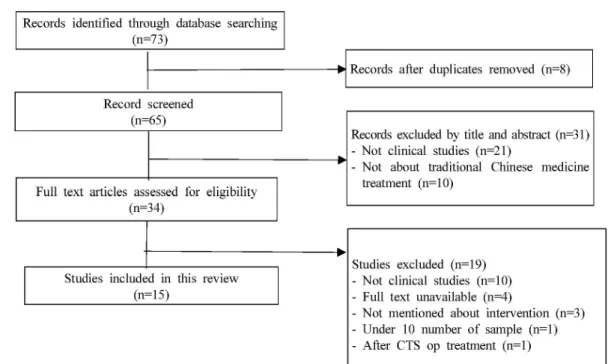
2015년부터 2020년까지 총 73편의 논문이 검색되었 으며 각 논문의 초록과 원문을 검토하여 수근관 증후군 의 치료에 대한 논문을 선별하였다. 선정된 논문에서 현재 한의학계에서 적용 가능한 침구 치료, 한약 치료, 추나 요법, 기타 외부 치료법, 중의학과 양방 의학의 결 합 등의 분야를 다룬 논문을 연구 대상으로 포함하였 다. 연구방법에 따라 논문을 검색한 결과 수집된 논문 은 총 73편이었으며, 이 중 중복된 논문 8편을 제외하 고 남은 65편을 대상으로 제목 및 초록 검토를 통해 논 문 선별을 시행하여 임상 연구가 아닌 논문 21편, 한의 학적 중재가 이루어진 연구가 아닌 논문 10편을 제외하 였다. 제목 및 초록 검토 이후 남은 34편을 대상으로 전 문 검토를 통해 임상 연구가 아닌 논문 10편, 전문을 구
Fig. 1. Flow chart of the study. CTS: carpal tunnel syndrome, op: operation.
할 수 없는 논문 4편, 한의학적 중재가 구체적으로 언급 되지 않은 논문 3편, 임상 증례가 10예 이하인 논문 1 편, 수술적 치료를 선행한 논문 1편을 제외하여 최종적 으로 15편의 논문이 선별되었다(Fig. 1).20-34)
4. 자료의 정리
선정된 15편의 논문들은 발표연도, 임상연구 형식, 평가 기준, 치료 기간, 연구 목적을 조사한 후 치료기법 별로 정리하였다.
결과 »»»
1. 발표 연도
논문은 2020년에 1편, 2019년에 5편, 2018년에 3편, 2017년에 2편, 2016년에 3편, 2015년에는 1편씩 발표되 었다.
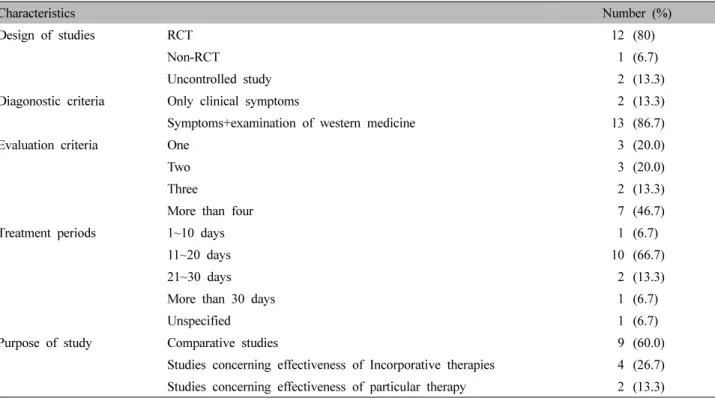
2. 임상 연구 형식(Table Ⅰ)
총 15편의 논문 중 무작위 대조군 시험(RCT)20-23,25-28,31-34)
이 12편(80%), 비무작위 대조군 시험(Non-RCT)24)이 1편 (6.7%), 단순 증례보고29,30)가 2편(13.3%)이었다.
3. 진단 및 평가 기준(Table Ⅰ)
각 연구에서 수근관 증후군 진단 기준을 살펴보면 환 자의 자각적 증상, 타 질환의 배제, 이학적 검사 및 전기 적 검사 등의 방법이 사용되었다. 수지의 감각이상, 저림, 근력약화 등의 임상 증상만을 기준으로 한 연구20,30)가 2 편(13.3%)이었으며 임상 증상과 서양 의학적 검사를 병 용한 연구21-29,31-34)가 13편(86.7%)이었다. 수근관 증후군 진단시 전기적 검사에서 신경전도 검사22-29,31-34)는 12건, 근전도 검사21)가 1건 사용되었으며, 이학적 검사로 Phalen's test21-29,31-34)과 Tinel's test21-29,31-34)가 13건 시행되었다. 임 상 증상 기준 중 미국신경과학회(American Academy of Neurology)에서 제안한 진단 지침을 사용한 연구24)가 1 편 있었다.
수근관 증후군에 대한 치료 전후 환자 상태 평가에 사용된 기준들은 numerical rating scale20,28,30), global symp-
Characteristics Number (%)
Design of studies RCT 12 (80)
Non-RCT 1 (6.7)
Uncontrolled study 2 (13.3)
Diagonostic criteria Only clinical symptoms 2 (13.3)
Symptoms+examination of western medicine 13 (86.7)
Evaluation criteria One 3 (20.0)
Two 3 (20.0)
Three 2 (13.3)
More than four 7 (46.7)
Treatment periods1~10 days 1 (6.7)
11~20 days10 (66.7) 21~30 days2 (13.3) More than 30 days1 (6.7)
Unspecified 1 (6.7)
Purpose of study Comparative studies 9 (60.0)
Studies concerning effectiveness of Incorporative therapies 4 (26.7) Studies concerning effectiveness of particular therapy 2 (13.3) RCT: randomized controlled trial.
Table Ⅰ. General Characteristics of Studies
tom score (GSS)20), symptom severity scale22,26,27), visual analog scale (VAS)23,25,31,32), functional status score26,27), Boston carpal tunnel questionnaire (BCTQ)27,32-34), Phalen’s test31,33), Tinel's test25,31,33), Weber two-point discrimination test33), wrist flexion test33), British medical research coun- cil grading standard34), comparison of high frequency ul- trasound22), sensory conduction velocity21,24,26,29,34), com- pound muscle action potential amplitude21,26,29,32,34), sen- sory nerve conduction velocity32), sensory action potential amplitude21,24,29,32,34), distal motor latency21,24,26,29,32,34), pa- tientrated wrist evaluation27) 등이 있었다. 이 평가 도구 중 1개만 사용한 연구23,28,30)는 3편(20%), 2개를 사용한 연
구20,22,25)는 3편(20%), 3개를 사용한 연구24,31)는 2편(13.3%),
4개 이상을 사용한 연구21,26,27,29,32-34)는 7편(46.7%)로 나 타났다.
4. 치료기간(Table Ⅰ)
치료기간이 명시되지 않은 연구25)가 1편(6.7%), 1~10일 간의 연구27)가 1편(6.7%), 11~20일간의 연구20-24,26,29-31,33)
가 10편(66.7%), 21~30일간의 연구28,32)가 2편(13.3%), 30일 이상의 연구34)가 1편(6.7%)으로 집계되었다.
5. 연구 목적(Table Ⅰ)
연구 목적별로 논문을 분석해 보면, 치료법 간의 효과를 비교하여 치료법의 유효성을 검증한 연구20,21,24,25,28,31-34)가 9편(60%), 서로 다른 치료법 간의 결합을 통한 치료 효 과 결과를 비교하고 관찰한 연구22,23,26,27)가 4편(26.7%), 특정한 치료법의 효과를 확인한 논문29,30)이 2편(13.3%) 이었다.
6. 치료기법별 논문 분석(Table Ⅱ)
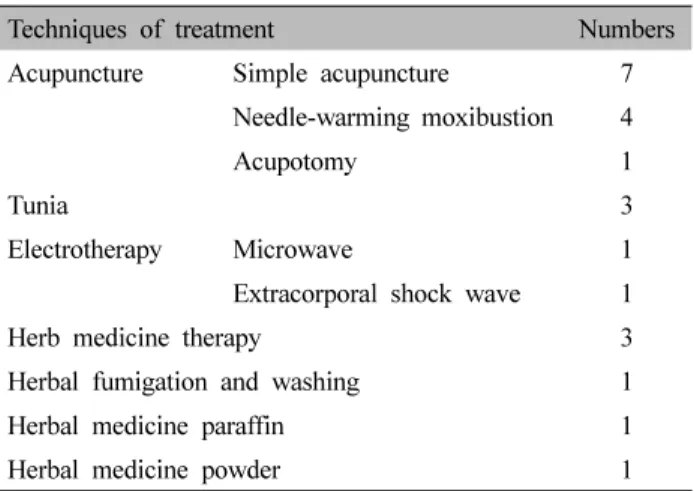
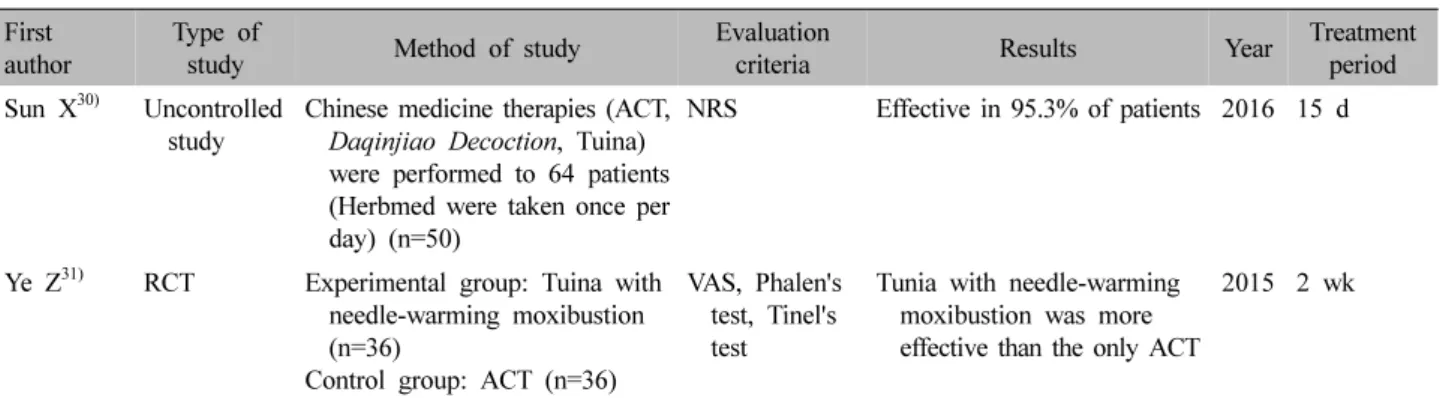
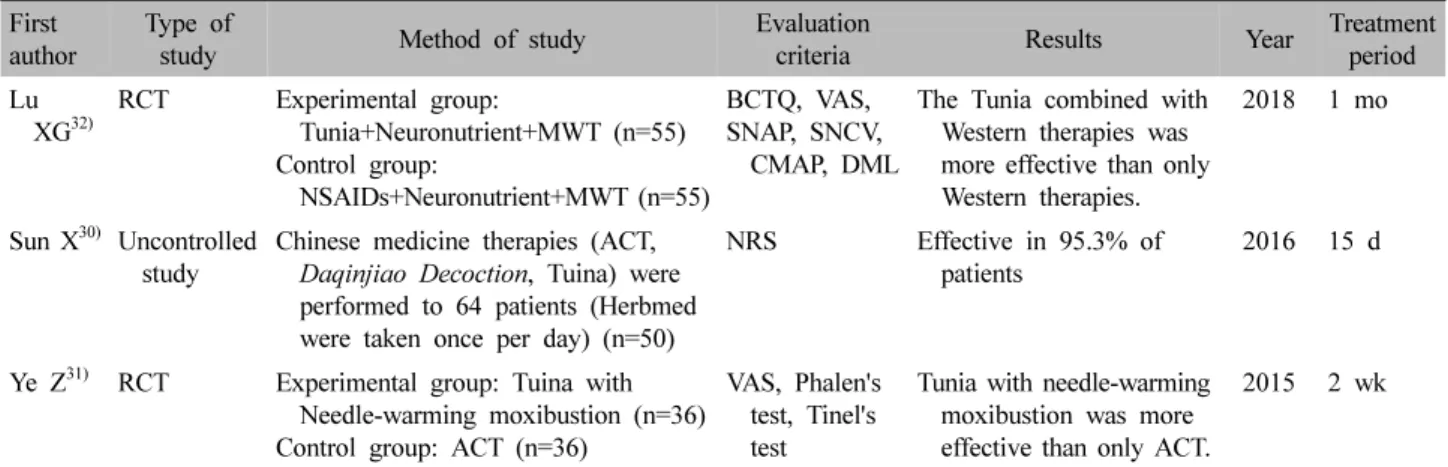
치료 기법으로는 자침요법은 총 12편으로 단순 침구 치 료를 사용한 연구가 7편20,21,26-30), 도침요법을 사용한 연구24) 가 1편, 애주구 치료를 병행하여 시행한 연구22,23,25,31)가 4 편이었다. 추나 치료법을 사용한 연구30-32)는 총 3편이 있 었고, 한약 복용 치료 연구30,33,34)는 3편이었으며, 이 중
2편33,34)은 수근관 증후군의 원인을 氣虛로 인한 혈류 정
Techniques of treatment Numbers
Acupuncture Simple acupuncture 7
Needle-warming moxibustion 4
Acupotomy 1
Tunia 3
Electrotherapy Microwave 1
Extracorporal shock wave 1
Herb medicine therapy 3
Herbal fumigation and washing 1
Herbal medicine paraffin 1
Herbal medicine powder 1
Table Ⅱ. Techniques of Treatment
체로 파악하여 치료하였다. 燻蒸法을 이용한 연구20)는 1 편, 外敷法을 이용한 연구21)와 한약 파라핀 요법을 이용 한 연구29)는 각각 1편이었다. 또한 수근관 증후군 치료 시 극초단파치료(microwave therapy)요법 및 체외충격 파(extracorporal shock wave) 요법 등 전기 치료와 충격 파 치료를 사용한 연구23,34)는 각 1편씩이었다.
1) 침구 요법
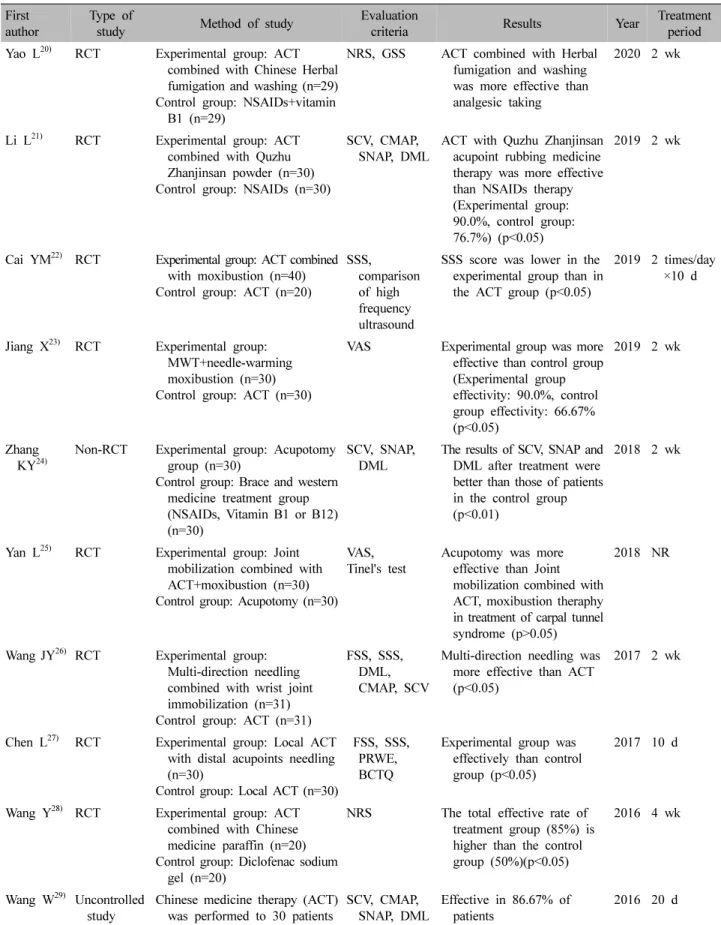
침구요법을 다룬 논문은 총 12편으로 그 내용은 다음 과 같다(Table Ⅲ). 침술 치료를 시행한 논문은 총 12편 이고, 그 중 4편은 애주구 치료법을 병행했다.
Yao20)이 시행한 연구에서 치료군은 大陵(PC 07), 合 谷(LI 04), 勞宮(PC 08), 外關(TE 05), 陽谿(LI 05)穴 등 에 20분 침술 치료 후 훈증 치료를 시행하였고, 대조군 은 비타민 B1정제(vitamin B1 Tab)와 메틸코발라민정 제(methylcobalamin Tab) 0.5 mg를 경구 복용하였다. 그 결과 침술 치료 후 훈증치료를 받은 치료군이 양방 경 구약 복용군보다 치료율이 더 높았다(p<0.01).
Li와 Liu21)의 연구에서 60명의 중증도 수근관 증후군 환자를 대상으로 치료군은 大陵(PC 07), 勞宮(PC 08), 合谷(LI 04), 內關(PC 06), 曲池(LI 11)穴에 자침 후 외치 약인 七珠展筋散穴位揉药을 바른 후 시계방향으로 염전 자극을 주었고 대조군에게 비스테로이드성 소염진통제 를 Tid로 투여하여 효과를 비교하였다. 그 결과 대조군 의 총 실효율은 76.7%이었으며 치료군의 총 유효율은 90.0%였다(p<0.05).
Cai 등22)은 60명의 환자 중 20명은 침술 치료만을 시 행하였고, 40명은 침술 치료에 大陵(PC 07)穴에 자침
후 애주구를 침병에 부착하여 열전달을 시행하는 온침 요법을 시행하여 치료효과를 고주파 초음파로 비교한 결과, 콩알뼈 수준에서 중앙 신경의 횡단면적 비교 시 실험군이 대조군보다 압박 부위 근처의 팽창된 중앙 신 경 섬유가 더 얇아졌고, 회복률이 더 높음을 보고하였 다(p<0.05).
Jiang 등23)은 60명의 환자를 무작위 대상으로 실험군 은 단파물리치료 후 온침치료를 시행한 후 애주구 치료 를 순서대로 시행하였고, 대조군은 단순 침술 치료를 2 주동안 시행하였다. 그 결과 단일 침술 치료보다 초단 파 물리치료와 결합된 온침, 애주구 치료가 더 유효율 이 높은 것으로 나타났다(p<0.05).
Zhang 등24)의 연구에서 치료군은 횡수근 관절인대 근위점과 긴 손바닥근 인대와 척골 사이의 가장자리에 있는 점을 표시한 후 멸균 후 도침으로 거친 인대 조직 을 3~4컷으로 나누어 잘라내는 치료를 시행하였고, 대 조군은 비스테로이드성 소염진통제와 비타민 경구 복 용 및 버팀대로 고정 치료를 병행하였다. 그 결과 실험 군이 대조군보다 높은 치료율을 보였다(p<0.01).
Yan25)의 연구에서 60명의 수근관 증후군 환자를 대 상으로 실험군은 관절 동원을 병행하고 침과 애주구 치 료를 시행했고, 대조군은 도침 치료를 하였다. 그 결과 실험군의 VAS 점수가 대조군보다 유의하게 낮았지만 (p<0.05), 총 유효치료율은 대조군이 실험군보다 높은 것으로 보였으나 통계적 의의는 없었다(p>0.05).
Wang 등26)은 62명 환자를 무작위로 대조군, 실험군 으로 나눈 뒤 실험군은 得氣를 위해 한 개의 침을 먼저 자입한 후 빠르게 淺層까지 올린 후 다시 양측을 향해 斜刺하여 자침한 모양이 닭발처럼(‘个’) 이루게 하는 合 谷刺 침술 치료를 시행하였고, 대조군은 단일 침치료를 2주 동안 시행하여 치료 효과를 평가하였다. 그 결과 실 험군이 대조군보다 총 유효율이 유의하게 더 높은 것으 로 나타났다(p<0.05).
Chen 등27)은 60명의 환자를 무작위로 실험군과 대조 군으로 나눈 뒤, 두 그룹에 공통적으로 患側의 勞宮(PC 08), 大陵(PC 07), 內關(PC 06), 魚際(LU 10), 合谷(LI 04)穴에 자침을 하였고, 실험군은 반대 측의 太衝(LR 03), 中封(LR 04)穴을 추가하여 10일 동안 치료하였다.
그 결과 총 치료율은 실험군이 대조군보다 더 높은 것 으로 나타났다(p<0.05).
First
author Type of
study Method of study Evaluation
criteria Results Year Treatment
period Yao L
20)RCT Experimental group: ACT
combined with Chinese Herbal fumigation and washing (n=29) Control group: NSAIDs+vitamin
B1 (n=29)
NRS, GSS ACT combined with Herbal fumigation and washing was more effective than analgesic taking
2020 2 wk
Li L
21)RCT Experimental group: ACT combined with Quzhu Zhanjinsan powder (n=30) Control group: NSAIDs (n=30)
SCV, CMAP,
SNAP, DML ACT with Quzhu Zhanjinsan acupoint rubbing medicine therapy was more effective than NSAIDs therapy (Experimental group:
90.0%, control group:
76.7%) (p<0.05)
2019 2 wk
Cai YM
22)RCT Experimental group: ACT combined with moxibustion (n=40) Control group: ACT (n=20)
SSS, comparison of high frequency ultrasound
SSS s core was lower in the experimental group than in the ACT group (p<0.05)
2019 2 times/day
×10 d
Jiang X
23)RCT Experimental group:
MWT+needle-warming moxibustion (n=30) Control group: ACT (n=30)
VAS Experimental group was more effective than control group (Experimental group effectivity: 90.0%, control group effectivity: 66.67%
(p<0.05)
2019 2 wk
Zhang
KY
24)Non-RCT Experimental group: Acupotomy group (n=30)
Control group: Brace and western medicine treatment group (NSAIDs, Vitamin B1 or B12) (n=30)
SCV, SNAP,
DML The results of SCV, SNAP and DML after treatment were better than those of patients in the control group (p<0.01)
2018 2 wk
Yan L
25)RCT Experimental group: Joint mobilization combined with ACT+moxibustion (n=30) Control group: Acupotomy (n=30)
VAS, Tinel's test Acupotomy was more effective than Joint mobilization combined with ACT, moxibustion theraphy in treatment of carpal tunnel syndrome (p>0.05)
2018 NR
Wang JY
26)RCT Experimental group:
Multi-direction needling combined with wrist joint immobilization (n=31) Control group: ACT (n=31)
FSS, SSS, DML, CMAP, SCV
Multi-direction needling was more effective than ACT (p<0.05)
2017 2 wk
Chen L
27)RCT Experimental group: Local ACT with distal acupoints needling (n=30)
Control group: Local ACT (n=30)
FSS, SSS, PRWE, BCTQ
Experimental group was effectively than control group (p<0.05)
2017 10 d
Wang Y
28)RCT Experimental group: ACT combined with Chinese medicine paraffin (n=20) Control group: Diclofenac sodium
gel (n=20)
NRS The total effective rate of treatment group (85%) is higher than the control group (50%)(p<0.05)
2016 4 wk
Wang W
29)Uncontrolled
study Chinese medicine therapy (ACT)
was performed to 30 patients SCV, CMAP,
SNAP, DML Effective in 86.67% of
patients 2016 20 d
Table Ⅲ. Summary of Studies Using Acupuncture Therapy
First
author Type of
study Method of study Evaluation
criteria Results Year Treatment
period Sun X
30)Uncontrolled
study Chinese medicine therapies (ACT, Daqinjiao Decoction, Tuina) were performed to 64 patients (Herbmed were taken once per day) (n=50)
NRS Effective in 95.3% of patients2016 15 d
Ye Z
31)RCT Experimental group: Tuina with needle-warming moxibustion (n=36)
Control group: ACT (n=36)
VAS, Phalen's test, Tinel's test
Tunia with needle-warming moxibustion was more effective than the only ACT
2015 2 wk
RCT: randomized controlled trial, ACT: acupuncture therapy, NSAIDs: non-steroidal anti inflammatory drugs, NRS: numerical rating scale, GSS: global symptom score, SCV: sensory conduction velocity, CMAP: compound muscle action potential amplitude, SNAP: sensory action potential amplitude, DML: distal motor latency, NR: not reported, SSS: symptom severity scale, MWT:
microwave therapy, VAS: visual analog scale, FSS: functional status score, PRWE: patientrated wrist evaluation, BCTQ: Boston carpal tunnel questionnaire.
Table Ⅲ. Continued
Frequency Acupoints
10 PC7 (Daereung)
8 LI4 (Hapgok)
7 PC8 (Nogung)
5 PC6 (Naegwan)
3 LI5 (Yanggye)
2 LI11 (Gokji)
1 LI10 (Susamni)
1 LU10 (Eoje)
1 TE5 (Oegwan)
1 TE2 (Aengmun)
1 TE3 (Jungjeo)
1 PC5 (Gans a)
1 Unaffected side on LR3 (Taechung)
1 LU9 (Taeyeon)
1 Unaffected side on LR4 (Jungbong) Table Ⅳ. Frequency of Acupoints Used in the Studies
Wang과 Bai28)은 40명의 환자를 대상으로 한약 파라핀 요법과 침술요법을 병행한 실험군 20명과 손목관절 에 디클로페낙나트륨젤(diclofenac sodium gel)을 도포 하여 치료한 대조군 20명의 치료 효과를 비교하였고, 그 결과 실험군의 총 유효율은 85%로 대조군의 50%보 다 유의하게 높았다(p<0.05).
Wang 등29)의 연구에서 수근관 증후군 환자 30명을 대상으로 患側의 大陵(PC 07), 內關(PC 06)穴을 중심으 로 자침하여 염전한 후, 患側의 內關(PC 06), 間使(PC 05), 合谷(LI 04), 勞宮(PC 08)穴자리에 강한 자극을 주 는 치료법을 시행하였다. 그 결과 30명의 환자 중 16명 이 치료되었고, 6명이 현저하게 효과적이며, 4명이 효과 가 있었고, 4명이 효과가 없었으며 총 유효율은 86.67%
임을 보고하였다.
Sun30)은 64명의 환자를 추나 치료, 침술 치료, 한약 치료를 시행했으며 14명은 치료, 47명은 효과가 있었 고, 3명은 효과가 없었으며 총 유효율은 95.3%였다.
Ye 등31)은 72명의 환자를 실험군은 먼저 추나 치료 를 받은 뒤 자침 치료와 함께 內關(PC 06), 合谷(LI 04) 穴에 애주구를 침병에 부착하여 열 자극을 가하는 온침 요법을 시행하였고 대조군은 단일 침 치료를 2주동안 시행하였다. 치료 효과를 평가한 결과 실험군이 치료군 보다 더 높은 유효율을 보였다(p<0.05).
총 12편의 논문에서 침술 치료와 관련된 혈위의 빈도 를 정리한 결과는 Table Ⅳ와 같다.
2) 추나 요법
추나 요법을 병행하여 수근관 증후군 치료를 시도한 논문은 총 3편이 있었다(Table Ⅴ).
Lu 등32)은 110명의 환자를 대조군과 실험군으로 무 작위로 분류하였는데, 두 그룹은 공통적으로 서양 경구 약물 치료, 신경영양제, 초단파 치료를 받았고, 실험군 은 추나 치료를 병행하여 1달 동안 치료를 받았다. 치료 후 추나 치료를 병행한 실험군이 대조군보다 호전 정도 가 높다는 결론을 도출하였다(p<0.05).
First
author Type of
study Method of study Evaluation
criteria Results Year Treatment
period Lu XG
32)RCT Experimental group:
Tunia+Neuronutrient+MWT (n=55) Control group:
NSAIDs+Neuronutrient+MWT (n=55)
BCTQ, VAS, SNAP, SNCV,
CMAP, DML
The Tunia combined with Western therapies was more effective than only Western therapies.
2018 1 mo
Sun X
30)Uncontrolled
study Chinese medicine therapies (ACT, Daqinjiao Decoction, Tuina) were performed to 64 patients (Herbmed were taken once per day) (n=50)
NRS Effective in 95.3% of
patients 2016 15 d
Ye Z
31)RCT Experimental group: Tuina with Needle-warming moxibustion (n=36) Control group: ACT (n=36)
VAS, Phalen's test, Tinel's test
Tunia with needle-warming moxibustion was more effective than only ACT.
2015 2 wk
RCT: randomized controlled trial, MWT: microwave therapy, NSAIDs: non-steroidal anti inflammatory drugs, BCTQ: Boston carpal tunnel questionnaire, VAS: visual analog scale, SNAP: sensory action potential amplitude, SNCV: sensory nerve conduction velocity, CMAP: compound muscle action potential amplitude, DML: distal motor latency, ACT: acupuncture therapy, NRS: numerical rating s cale.
Table Ⅴ. Summary of Using Tunia manipulation Therapy
First
author Type of
study Method of study Evaluation
criteria Results Year Treatment period Fu Y
33)RCT Experimental group : Yiqi Huoxue
Decoction was taken 2 times per day (n=32)
Control group : NSAIDs with vitamin B1 applying 3 times per day (n=31)
BCTQ, Weber two-point discrimination test, Tinel's test, Wrist flexion test
Herbmed therapy was more effective than Western medicine therapies (Experimental group: 93.75%, Control group: 87.10%)
2019 2 wk
Hu YX
34)RCT Experimental group: NSAIDs with ESW+Buyang Huanwu Decoction were taken 3 times per day (n=50) Control group 1: NSAIDs with ESW (n=50) Control group 2: NSAIDs with Buyang
Huanwu Decoction were taken 3 times per day (n=50)
BMRC Grading Standard, BCTQ, SCV, CMAP, SNAP, DML
The effective ratio was highest in the Experimental group
2019 8 wk
Sun X
30)Uncontrolled
study Chinese medicine therapies (ACT, Daqinjiao Decoction, Tuina) were performed to 64 patients (Herbmed were taken once per day) (n=50)
NRS Effective in 95.3% of
patients 2016 15 d
RCT: randomized controlled trial, ACT: acupuncture therapy, NSAIDs: non-steroidal anti inflammatory drugs, ESW: extracorporeal shock wave, BCTQ: Boston carpal tunnel questionnaire, BMRC grading standard: British medical research council grading standard, SCV: sensory conduction velocity, CMAP: compound muscle action potential amplitude, SNAP: sensory action potential amplitude, DML: distal motor latency, NRS: numerical rating s cale.
Table Ⅵ. Summary of Studies Using Herb Medicine Therapy
Sun30)은 64명의 환자를 대상으로 추나 치료, 침술 치 료, 한약 치료를 시행했으며 14명은 치료, 47명은 효과 가 있었고, 3명은 효과가 없었으며 총 유효율은 95.3%
였다.
Ye 등31)은 72명의 환자를 실험군은 먼저 추나 치료 를 받은 뒤 침술 치료와 함께 內關(PC 06), 合谷(LI 04) 穴에 애주구를 침병에 부착하여 열 자극을 가하는 온침
요법을 시행하였고 대조군은 단일 침 치료만 2주동안 시행하였다. 치료 효과를 평가한 결과 실험군이 치료군 보다 더 높은 유효율을 보였다(p<0.05).
3) 한약 요법
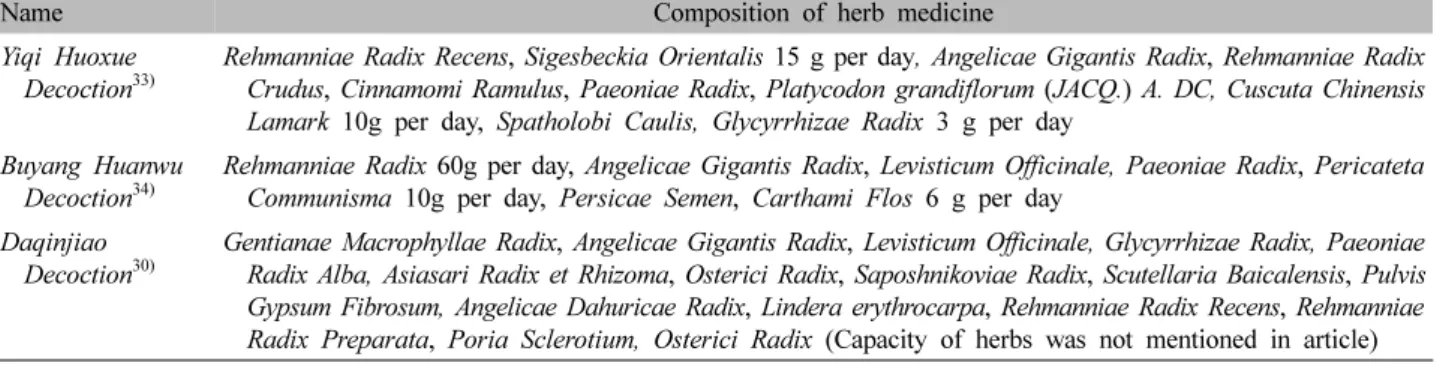
한약을 복용하여 수근관 증후군 치료를 시도한 논문 은 총 3편이 있다(Table Ⅵ, Ⅶ).
Name Composition of herb medicine Yiqi Huoxue
Decoction
33)Rehmanniae Radix Recens, Sigesbeckia Orientalis 15 g per day, Angelicae Gigantis Radix, Rehmanniae Radix Crudus, Cinnamomi Ramulus, Paeoniae Radix, Platycodon grandiflorum (JACQ.) A. DC, Cuscuta Chinensis Lamark 10g per day, Spatholobi Caulis, Glycyrrhizae Radix 3 g per day
Buyang Huanwu
Decoction
34)Rehmanniae Radix 60g per day, Angelicae Gigantis Radix, Levisticum Officinale, Paeoniae Radix, Pericateta Communisma 10g per day, Persicae Semen, Carthami Flos 6 g per day
Daqinjiao
Decoction
30)Gentianae Macrophyllae Radix, Angelicae Gigantis Radix, Levisticum Officinale, Glycyrrhizae Radix, Paeoniae Radix Alba, Asiasari Radix et Rhizoma, Osterici Radix, Saposhnikoviae Radix, Scutellaria Baicalensis, Pulvis Gypsum Fibrosum, Angelicae Dahuricae Radix, Lindera erythrocarpa, Rehmanniae Radix Recens, Rehmanniae Radix Preparata, Poria Sclerotium, Osterici Radix (Capacity of herbs was not mentioned in article) Table Ⅶ. General Characteristics of Herb Medicine
First author Method Composition of herb medicine
Yao L
20)Chinese herbal fumigation and washing
Lycopodii Herba, Spatholobi Caulis 30 g per day, Erythrinae Cortex, Impatiens balsamina, Carthami Flos 20 g per day, Araliae Continentalis Radix, Gigantis Radix 15 g per day, Gentianae Macrophyllae Radix, Olibanum, Myrrha 12 g per day, Saposhnikoviae Radix, Levisticum Officinale, Cinnamomi Ramulus 10 g per day, 1,000 ml
Li L
21)Quzhu Zhanjinsan
powder Draconis Sanguis, Olibanum, Agastachis Herba, Succinum, Bezoar Bovis, Panax ginseng Wang Y
28)Chinese medicine
paraffin Mori Ramulus, Lycopodii Herba, Impatiens balsamina, Clematidis Radix, Corydalis Tuber, Dahuricae Radix, Cinnamomi Ramulus, Carthami Flos 30 g per day, Erythrinae Cortex, Achyranthis Radix, Saposhnikoviae Radix 20 g per day, Olibanum, Myrrha 15 g per day, Natrii Sulfas 10 g per day
Table Ⅷ. General Characteristics of External Herb Medicine Therapy
그 중 Fu33)와 Hu34)는 수근관 증후군 환자들을 氣虛血 瘀症로 변증하여 치료한 연구를 보고하였다.
Fu33)의 연구에서 氣虛로 혈액이 정체된(氣虛血瘀症) 63명의 수근관 증후군환자들 실험군과 대조군으로 나 누어 실험군은 活血益氣湯을 1회에 200 ml씩 1일 2회 복용하였고, 대조군은 비타민 B1 정제(10 mg, 1일 3회), 메코발라민정제(methylcobalamin Tab)을 0.5 mg씩 1일 3회 복용하여 치료 효과를 평가 하였다. 그 결과 실험군 이 대조군보다 더 유효율이 높은 것으로 나타났다.
Hu34)는 氣虛로 인해 혈액이 정체된(氣虛血瘀症) 150 명의 수근관 증후군 환자를 실험군, 대조군1, 대조군2로 나누어 3그룹 모두 경구 메코발라민정제(mecobalamin Tab)를 1일 3회 복용하였다. 대조군1에는 大陵(PC 07), 內關(PC 06), 十宣(Ex-UE 11), 勞宮(PC 08)穴에 체외충 격파 치료를 병행하였고, 대조군2에는 補陽還五湯복용 을 병행하였고, 실험군은 補陽還五湯 복용과 체외충격 파 치료를 함께 병행하여 8주 동안 치료 효과를 평가하 였다. 충격파는 大陵(PC 07), 內關(PC 06), 少商(LU 11), 勞宮(PC 08)穴자리에 시행하였다. 그 결과 실험군이 대
조군1, 2보다 치료율이 높았다(p<0.05).
Sun30)이 시행한 연구에서 64명의 환자는 추나 치료, 침 치료, 한약 치료를 받았으며 한약 치료는 大秦艽湯을 1회에 100 ml씩 1일에 1회, 총 15일 복용하였다. 15일 치료 결과 14명은 치료, 47명은 효과가 있었고, 3명은 효과가 없었으며 총 유효율은 95.3%였다.
4) 한약 외용 요법
한약을 외용 요법으로 사용하여 수근관 증후군 치료 를 시도한 논문은 총 3편이었다(Table Ⅷ).
Yao20)의 연구에서 치료군은 환측의 大陵(PC 07), 合谷 (LI 04), 勞宮(PC 08), 外關(TE 05), 陽谿(LI 05)穴 등 20분 자침 치료 후 훈증 치료를 시행하였고, 대조군은 비타민 B1정제(vitamin B1)와 메틸코발라민정제(methylcobalamin Tab) 0.5 mg를 경구 복용하였다. 그 결과 자침 치료 후 훈증치료를 병행한 실험군의 치료율이 대조군보다 더 높았다(p<0.01).
Li와 Liu21)의 연구에서는 총 60명의 환자를 대상으로 大陵(PC 07), 勞宮(PC 08), 合谷(LI 04), 內關(PC 06), 曲
池(LI 11)穴에 자침 후 七珠展筋散穴位揉药을 도포한 후 시계방향으로 염전하는 치료법을 시행하였고, 대조군 은 마사지 및 양방 경구 치료제를 복용하여 두 그룹 간 의 치료 효과를 비교하였다. 七珠展筋散은 血渴, 乳香, 藿香, 琥珀, 牛黃, 人蔘 등이 주요성분으로 구성되어 있 으며 活血散瘀止痛, 消痰, 止血 작용이 있다. 그 결과 대 조군의 총 유효율은 76.7%였으며, 실험군의 총 유효율 은 90.0%였다(p<0.05).
Wang과 Bai28)는 40명의 환자를 대상으로 한약 파라 핀 요법과 침술요법을 병행한 실험군 20명과 손목관절 에 디클로페낙나트륨젤(diclofenac sodium gel) 도포 치 료를 시행한 대조군 20명으로 나누어 치료 효과를 연구 하였고, 그 결과 실험군의 총 유효율은 85%로 대조군 의 50%보다 유의하게 높았다(p<0.05).
고찰 »»»
수근관 증후군은 수근관 내에 내용물의 용적과 수근 관 크기 사이의 부조화로 인해 발생한다. 수근관의 구 조는 수근골과 횡수근 인대로 싸여 있으며 그 사이로 9 개의 굴곡건과 정중신경이 통과한다. 수근관내 압력 증 가를 유발하는 원인으로는 수근관 내의 너무 많은 내용 물, 너무 적은 공간, 수지굴건의 염증, 횡수근인대의 비 대 등이 있으며, 수근관 내 압력이 증가하면 정중신경 을 압박하게 되어 수지 저림, 정중신경 지배 영역의 이 상감각, 둔감, 작열감, 무지구의 위축 및 무지의 약화, 야간에 증상 심화 등과 같은 증상이 나타난다11,18).
수근관 증후군에 대한 양방 치료는 수술적 요법과 보 존적 요법으로 나눠진다. 개방성 감압술은 수술 후 수 부근력의 약화, 절개 부위의 반흔통 등과 같은 후유증 을 남길 수 있어 대안책으로 내시경적 감압술이 소개되 었으나 개방적 감압술의 합병증이 적은 대신 신경손상 및 동맥손상, 굴곡건 손상 등의 후유증을 유발할 수 있 다는 보고가 있다17). 그렇기 때문에 반복되는 수근관 증후군의 재발 및 엄지손가락의 위축, 심한 신경학적 장애가 있지 않은 경우에 우선적으로 보존적인 치료를 고려한다. 양방의 보존적 치료법 중에서 스테로이드 국 소 주사법이 다용되고 있으나 80%의 환자들은 일시적 인 효과를 얻었고 22%의 환자들에게 그 효과가 1년 이
상 지속된다고 발표하여 국소 주사 치료 효과가 일시적 인 경우가 있다는 결과가 보고된 바 있었고, NSAIDs의 복용은 위장관 장애 등의 부작용을 일으킬 수 있다는 단점이 있다는 결과가 보고되었다13,35).
한의학적으로 수근관 증후군은 痺證에 해당되며, 발 생 원인으로는 風寒濕熱의 邪氣가 經絡으로 침범하거나 筋骨, 關節에 凝滯 등이 있으며, 痲木, 浮腫, 疼痛, 腫脹, 屈伸不利와 같은 증상을 유발한다13). 黃帝內徑에서는 여러 원인으로 痺證이 발생할 수 있고, 또한 風寒濕의 三氣가 함께 또는 독립적으로 발병할 수 있으므로 鍼, 灸, 蔚 등의 다양한 방법을 사용하였음을 기재하였고, 東醫寶鑑에서도 원인과 증상에 따라 痺證에 다양한 치 료법을 사용하였다19).
최근 수근관 증후군과 관련한 한의 치료 중재를 적용 한 다양한 임상 연구들이 발표되고 있다. 하지만 연구에 따라 상이한 결과 및 한계점 등이 보고되고 있으며36,37) 약침 치료에 관한 연구8-10,15,17)가 다수 발표되었지만 수 기 요법이나 뜸 치료, 외용 치료와 같은 연구는 제한적 인 현황이며, 2016년 이후의 수근관 증후군에 대한 한 의 치료 중재에 대한 고찰이 이루어지지 않고 있는 실 정이다. 국내 수근관 증후군의 연구 설계 동향을 살펴 보면 임상연구 형식에서는 무작위 대조군 시험(RCT)
연구9,17)가 2건에 해당되며 진단 및 평가에 신경전도 검
사4,9,11,17,38)의 사용이 부족하며, 진단 및 평가에서 다양
한 국제 지표 중 VAS4,8,9,11-7,34,38,39) 지표만을 사용하고 있다. 추후 국내 수근관 증후군 연구에서 객관성 및 표 준성을 확보하기 위해 무작위 대조군 시험(RCT) 연구 가 활발히 시행되어야 하며, 진단 및 평가에 전기적 검 사를 다용하는 것이 권장되며, BCTQ, GSS와 같은 국 제적으로 통용되는 추가적인 지표의 사용이 필요하다 고 생각된다. 이에 본 연구는 수근관 증후군의 다양한 임상적 연구에 도움이 되기 위해 CNKI 검색 및 선별을 통해 2015년 이후 발표된 임상 논문 중 중의 치료를 시 행한 총 15편의 최신 연구 동향을 분석하여 국내에서 연구되지 않은 치료 방법과 복합적인 한의학 치료 방법 을 소개하고자 하였다.
본 연구에서 선정한 15편의 연구는 단독 치료보다는 침구 요법, 추나 요법, 탕약 요법, 외치요법 등을 복합 적으로 병용하여 치료하였다. 침구 요법과 관련된 연구 는 12편으로 가장 많았으며, 탕약 치료 관련 연구는 3
편, 외치요법 관련 논문은 3편이었다.
침구 요법 관련 연구에서는 온침 요법, 合谷刺 침술 요법, 도침 요법, 염전 요법 등 다양한 침술 치료가 사 용되고 있음을 알 수 있다. Li와 Liu21)는 수근관 증후군 을 筋痹病의 범주로 보고 七珠展筋散을 병행하여 자침 후 염전 자극을 주는 치료 방법은 經絡 氣血의 運行을 자극하여 국소의 血瘀 정체를 제거하는 효과가 있다고 보고하였다. Cai 등22), Jiang 등23), Yan25), Ye 등31)은 애 주구를 부착하여 열을 전달하는 온침 요법을 시행하였 고 온침요법은 열 자극을 통해 국소 혈관을 확장하고 혈액순환을 개선하고, 연조직 복구를 촉진하는 효과가 있음을 보고하였다. Zhang 등24)은 도침 치료법이 손목 터널 공간을 확대시켜 신경압박을 줄여 신경 영양이 회 복되는 효능이 있다고 보고하였다. Wang 등26)은 合谷刺 침술 요법을 사용하였으며 이 치료법은 국내 수근관 증 후군 치료에도 소개되었다15). Chen 등27)은 手厥陰心包 經과 足厥陰肝經의 혈위를 취하는 遠圍取穴法을 사용하 여 정중 신경의 압박 완화 및 감각 신경전도 개선 및 신 경 손상 복구에 효과적임을 보고하였다. 연구 설계 면 에서 단순 침 치료 연구29)보다는 침술 치료를 포함한 복합 중의학 치료 비교 연구22,23,25-27,31)와 복합 중의학 치료와 양방의 치료 효과를 비교한 연구20,21,24,28)가 주를 이루었다. 국내에서는 약침 치료에 관한 연구8-10,15,17)는 많지만 다양한 침술에 관련된 연구는 적은 현황이므로, 이처럼 수근관 증후군에 대한 다양한 침술 치료 연구들 은 임상에서의 적합한 치료 활용 및 추후 연구 설계 계 획에 도움이 될 것으로 생각한다.
추나 요법 관련 연구에서는 推法, 按法 등의 다양한 수기 치료법을 사용하여 혈액 순환을 촉진하여 국소 혈 액 정체를 제거하고, 염증 인자의 방출을 줄여 염증을 줄일 수 있다고 보고하였다. Lu 등32)은 手太陰肺經, 手 少陰心包經, 手少陰心經의 경로를 따라 推法을 2분 동안 시행한 후 大陵(PC 07), 內關(PC 06), 合谷(LI 04), 陽谿 (L 15), 魚際(LU 10), 勞宮(PC 08)穴 주위로 1분 동안 한 손가락으로 자극한 후, 횡수근 인대 부위로 부드럽 게 彈發法를 시행하고, 손목을 흔들면서 신전하는 동작 을 2분 동안 시행하였다. 그 후 의사는 한 손으로 환자 의 팔꿈치 위치를 잡고 다른 한 손으로 환자의 손바닥 과 손가락을 잡고 천천히 손등 쪽으로 신전하는 동작을 총 15분 시행하였음을 보고하였다. Sun30)은 外關(TE
05), 魚際(LU 10), 液門(TE 02), 勞宮(PC 08)穴 등에 按 法을 사용한 후 완관절을 천천히 회전 및 굴신시키는 동작을 시행하였다. 그 후 보조자는 환자의 팔을 양손 으로 잡은 뒤 의사는 환자의 손목을 잡고 양손으로 손 목을 견인하며 의사의 양 엄지손가락을 大陵(PC 07)穴 자리에 놓아 손목 터널의 氣血 停滯를 通하게하여 치료 하였음을 보고하였다. Ye 등31)은 의사는 엄지손가락을 사용하여 환자의 內關(PC 06), 外關(TE 05), 合谷(LI 04), 魚際(LU 10), 勞宮(PC 08), 大陵(PC 07)穴을 30초 간 지압한 후 手厥陰心包經의 경로를 따라 밀어내는 동 작을 3분 시행한 후, 心包經과 손바닥을 3분 동안 揉法 을 사용하고, 拇指、食指、中指를 2분 동안 捻法 시행 한 후 의사는 환자의 拇指 끝을 두 손가락으로 견인하 여 잡아당기며 食指、中指도 차례로 견인하였다. 그 후 완관절을 1분 동안 당기고 교차 방향으로 흔든 후 손바 닥과 완관절에 擦法을 시행하여 치료하였음을 보고하 였다. 위에서 설명한 세 가지 추나 기법의 공통점으로 횡수근 인대와 정중 신경이 주행하는 하완의 경락을 따 라 수기요법을 시행하였고, 수부를 굴곡, 신전하는 동 작을 통해 횡수근 인대의 압박을 덜어주었음을 알 수 있었다. 국내에서는 수근관 증후군에 대한 추나 연구 보고가 없기 때문에 이를 참고하여 수근관 증후군 치료 에 적극적으로 추나 기법을 도입하는데 활용할 수 있다 고 생각한다.
한약 요법 관련 연구에서는 세 가지 연구 모두 氣血 停滯를 치료해야 한다고 판단하였다. Fu33)와 Hu34)는 수 근관 증후군을 氣虛血瘀症으로 판단하였다. Fu33)는 活 血益氣湯을 복용하여 益氣補虛, 養血活血 효능으로 수 근관 증후군을 치료하는데 도움이 될 것이라고 판단하 였고, Hu34)는 補陽還五湯을 복용하여 益氣活血, 散瘀通 絡 효능으로 수근관 증후군을 치료한 연구를 보고하였 다. Sun30)은 大秦艽湯의 祛風通絡, 活血化瘀, 止痛和溫의 효능으로 치료하였다고 보고하였지만 구성 약재의 용 량은 기재하지 않은 점에 한계가 있었다. 국내에서는 수근관 증후군의 한약 치료에 변증을 나누어 시행한 연 구는 총 3편으로 사상에 따라 가감한 연구9) 1편, 출산 한 산모를 변증하여 한약을 투여한 연구34) 1편, 스트레 스 및 어혈상으로 변증하여 한약을 투여한 연구39)가 1 편 있다. 본 연구33,34)에서 수근관 증후군을 氣虛血瘀症 으로 변증하는 관점을 새롭게 제시하였으며, 이는 다양
한 변증 관점으로 환자를 치료하는데 도움을 줄 수 있다.
외용 요법 관련 연구에서는 Yao20)는 훈증 요법으로 活血化瘀, 祛風通絡의 효능이 있는 처방을 사용하였고 훈증 요법은 20분 동안 격일로 총 4주 동안 시행하였다.
Li와 Liu21)는 대학병원에서 자체적으로 만든 活血, 散瘀 止痛, 扶正祛邪 효능이 있는 七珠展筋散을 피부에 도포 하여 유효한 효과를 보았음을 보고하였다. Wang과 Bai28)는 運行氣血, 疏通经络 효능이 있는 한약 파라핀 치료를 보고하였으며 파라핀 치료는 20분 동안 1일 1 회, 총 4주 동안 시행되었다. 국내에서 수근관 증후군 외용 치료법에 熏蒸法9), 파라핀 요법9,11)을 사용하였지 만 치료에 사용된 구성약재와 용량이 기재되어 있지 않 았으며, 치료 시간과 기한이 명확하게 명시되지 않았다.
이에 반해 본 연구20,21,28)에서 외용 치료법의 구성약재, 치료 시간 및 총 기간이 명시되어 있으므로 추후 수근 관 증후군 외용 치료 계획 수립에 참고할 수 있을 것이 라고 생각한다.
본 연구의 한계점은 다음과 같다. 첫째, 논문의 수가 15편으로 적었고, 그 중에서도 12편의 무작위 대조군 시험(RCT)20-23,25-28,31-34), 1편의 비무작위 대조군 시험 (Non-RCT)24) 연구, 2편의 단순 증례보고29,30)로 본 연구 에서 분석한 논문의 근거가 제한적이라고 할 수 있다.
또한 각 치료 기법별에 해당하는 무작위 대조군 시험 (RCT) 연구의 개수가 적었기 때문에 체계적 문헌고찰 이나 메타 분석을 진행하지 못한 점에서 방법론적으로 한계가 있었다. 수근관 증후군에 대해 발표된 침 치료 메타 분석37) 이외에도 수근관 증후군 치료법에 관한 근 거중심에 의한 논문 고찰이 이루어지기 위해서는 향후 무작위 대조군 시험(RCT) 연구가 국내외로 발표되어야 더욱 체계적인 분석이 가능할 것으로 생각한다. 둘째, 치 료기간이 명시하지 않은 연구25)가 1편이 있고, 한약 복 용 연구에서 구성 약재의 용량이 기재되지 않은 연구30) 가 1편이 있으며, 외용 치료법에서도 구성 약재의 용량 이 기재되지 않은 연구21)가 1편이 있어 연구 동향을 확 고한 수준으로 파악하기 어려웠다. 셋째, 6개년의 최신 지견만을 확인하여 과거에 이미 입증되었을 수 있는 치 료법에 대해 조사하지 못하여 중의학 전반에서 사용된 한의학적 치료 기법을 모두 분석하지 못한 점에서 한계 가 있다. 그러나 수근관 증후군에 대한 중국 내 최신 연 구 동향을 살펴봄으로서 본 연구에서 분석한 15편 논문
에서 수근관 증후군에 중의학적 치료가 효과가 있다는 결과를 일관되게 확인할 수 있었고, 중국에서는 임상 연구가 지속적으로 시행되고 있으며 다양하고 복합적 인 치료에 대한 연구가 진행되고 있음을 확인할 수 있 었다.
본 연구가 수근관 증후군 한방 치료에 대한 임상근거 마련의 기초자료를 도입하는데 활용될 수 있다고 생각 하며 향후 체계적으로 설계된 임상연구의 시행으로 수 근관 증후군의 한의학 치료법 개발에도 보탬이 되길 기 대한다.
결론 »»»
CNKI를 중심으로 수근관 증후군의 중의 치료에 관 한 논문 15편을 분석한 결과 다음과 같은 결론을 도출 할 수 있었다.
1. 침구요법 관련 연구에서는 溫針, 刀針, 合谷刺法와 같이 기존의 침구이론을 응용한 치료법이 사용되었 다. 가장 높은 빈도로 사용된 혈위는 大陵(PC 07), 合谷(LI 04)이었으며 經絡 氣血의 運行을 자극하여 국소의 血瘀 정체 제거 및 국소 혈관 확장, 손목 터널 공간의 확대로 인한 신경압박을 줄이는 효능 이 있음을 보고하였다.
2. 수기요법 관련 연구로는 推法, 按法 등의 수기법을 사용하였으며, 추나 수기요법을 통해 국소 혈액 순환을 촉진하여 혈액 정체를 제거하였다고 보고 하였다.
3. 탕약치료 관련 연구에서는 氣血停滯를 풀어주는 효능을 처방으로 사용하였고, 그중 2편은 수근관 증후군을 氣虛血瘀症으로 변증한 연구를 보고하 였다.
4. 외치요법 관련 연구에서는 熏蒸法, 塗布法, 파라핀 요법이 사용되었으며 다른 치료와 병행했을 경우 의 임상적 효과를 보고하였으며 국내에서는 이와 관련하여 증례치료가 보고된 바가 없었다.
5. 침구치료, 수기요법, 탕약치료, 외치요법과 같은 다 양한 한의학적 연구가 진행되고 있으며, 초단파치 료와 같은 서양 물리치료도 같이 병행하여 다양한 기법을 시도하는 연구가 중국에서 진행되고 있었다.