Received:June 23, 2017, Revised:September 22, 2017, Accepted:October 17, 2017
Corresponding to:Yoon-Kyoung Sung, Department of Rheumatology, Hanyang University Hospital for Rheumatic Diseases, 222 Wangsimni-ro, Seongdong-gu, Seoul 04763, Korea. E-mail:[email protected]
Sang-Cheol Bae, Department of Rheumatology, Hanyang University Hospital for Rheumatic Diseases, 222 Wangsimni-ro, Seongdong-gu, Seoul 04763, Korea. E-mail : [email protected]
*These authors contributed equally to this work.
Copyright ⓒ 2018 by The Korean College of Rheumatology. All rights reserved.
This is a Open Access article, which permits unrestricted non-commerical use, distribution, and reproduction in any medium, provided the original work is properly cited.
Prevalence and Associated Factors for Non-adherence in Patients with Rheumatoid Arthritis
Dam Kim1,2, Ji-Young Choi3, Soo-Kyung Cho1,2, Chan-Bum Choi1,2, So-Young Bang4, Hoon-Suk Cha5, Jung-Yoon Choe6, Won Tae Chung7, Seung-Jae Hong3, Tae-Hwan Kim1, Tae-Jong Kim8, Eunmi Koh5, Hye-Soon Lee4, Jisoo Lee9, Shin-Seok Lee8, Sung Won Lee7, Sung-Hoon Park6, Seung-Cheol Shim10, Dae-Hyun Yoo1, Bo Young Yoon11,
Sang-Cheol Bae1,2*, Yoon-Kyoung Sung1,2*
1Hanyang University Hospital for Rheumatic Diseases, 2Clinical Research Center for Rheumatoid Arthritis (CRCRA), 3Kyung Hee University Medical Center, Seoul, 4Hanyang University Guri Hospital, Guri, 5Samsung Medical Center, Sungkyunkwan University School of Medicine, Seoul, 6Catholic University of Daegu School of Medicine, Daegu, 7Dong-A University Hospital, Busan, 8Chonnam National University Hospital, Gwangju, 9Ewha Womans University Mokdong Hospital, Seoul, 10Chungnam National University Hospital, Daejeon, 11Inje University Ilsan Paik Hospital, Goyang, Korea
Objective. To estimate the prevalence of non-adherence to rheumatoid arthritis (RA) medication and identify the associated fac- tors for non-adherence in RA patients. Methods. Among the KORean Observational study Network for Arthritis 3,523 patients who completed a questionnaire about the adherence to RA medication were analyzed. The patients were divided into two groups: 1) adherent group, patients who skipped medication ≤5 days within the past 2 months; and 2) non-adherent group, patients who skipped ≥6 days of medication. The baseline characteristics were compared, and multivariable regression analy- sis was performed to identify the associated factors for non-adherence. Results. The non-adherent group had 339 patients (9.6%). The common causes of non-adherence were forgetfulness (45.8%), absence of RA symptoms (24.7%), and discomfort with RA medication (13.1%). Younger age (odds ratio [OR] 1.02, p<0.01) and higher income (OR 1.70, p<0.01) were asso- ciated with an increased risk of non-adherence. Whereas higher functional disability (OR 0.68, p<0.01) and oral corticosteroid use (OR 0.73, p=0.02) were associated with a decreased risk of non-adherence. The associated factors differed according to cause of non-adherence. Having adverse events (OR 2.65, p=0.02) was associated with the risk of non-adherence due to dis- comfort with RA medication while a higher level of education (OR 2.37, p=0.03) was associated with the risk of non-adherence due to an absence of RA symptoms. Conclusion. The 9.6% of Korean RA patients were non-adherent to RA medication. The associated factors differed according to the cause of non-adherence. Therefore, an individualized approach will be needed to improve the adherence to RA medication. (J Rheum Dis 2018;25:47-57)
Key Words. Medication adherence, Arthritis, rheumatoid, Prevalence
INTRODUCTION
Rheumatoid arthritis (RA) is a chronic inflammatory disease that leads to joint destruction, disability and pre- mature mortality [1]. Current treatment guidelines for RA recommend early aggressive management with dis- ease-modifying anti-rheumatic drugs (DMARDs) [2].
The therapeutic approach for RA patients is mainly phar- macologic treatment, and therapeutic success is im- portant for reducing symptoms, functional damage and joint deformity [3]. Therefore, RA patients require many pills that are DMARDs, corticosteroids, analgesics and non-steroidal anti-inflammatory drugs (NSAIDs). In ad- dition, RA patients often have comorbidities due to the
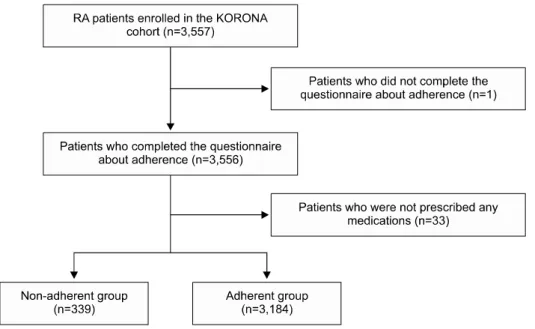
Figure 1. Patient selection flow chart. KORONA: KORean Ob- servational study Network for Arthritis.
disease’s chronic inflammatory mechanism. Thus, poly- pharmacy is more common than for other chronic dis- eases [4], and patients can experience complications with their course of treatment.
Drug adherence is important because it can affect dis- ease outcome [5]. Drug adherence is defined as the extent to which a patient’s behavior matches what is prescribed by healthcare providers [6]. The word “compliance” was used previously, but this focused on patient’s passive role in following a doctor’s order. Therefore, “adherence” is pre- ferred by healthcare providers. Adherence suggests a pa- tient’s rights in a therapeutic alliance or contract with their doctors [6,7]. Another term to explain the concept to taking medication is medication persistence which reflects continuously taking medications in a period of time [8].
Previous studies report that drug adherence of RA pa- tients is vary according to studies and detection tools;
about 30% estimated by medication event monitoring system (MEMS) to 80% by medication possession ratio and patient self-reported questionnaire [9-13]. In addi- tion, many studies report that factors such as socio- economics, disease-specific factors, and psychological factors are associated with drug adherence in RA patients [14-18]. However, most factors showed conflicting results.
Considering that there are various causes of non-adher- ence in RA patients, we assumed that the associated fac- tors for non-adherence also have to be analyzed according to the cause of non-adherence. Therefore, the purpose of this study was to estimate the prevalence of non-adher- ence to RA treatment in Korean RA cohort, and identify associated factors for non-adherence according to specific
causes in RA patients.
MATERIALS AND METHODS
Study population
Patients aged 18 or older who satisfied the 1987 American College of Rheumatology classification criteria for RA were recruited by rheumatologists in 23 centers during routine clinic visits as part of the KORean Obser- vational study Network for Arthritis (KORONA) [19].
KORONA is a nationwide prospective multicenter cohort which enrolls RA patients from 23 rheumatology centers.
Among patients enrolled in KORONA, only one patient who did not complete a questionnaire about adherence to RA treatment was excluded in this study.
Prevalence and causes of non-adherence to RA treatment
We evaluated the prevalence of drug adherence using a self-reported questionnaire. The question “How many days did you fail to take your medication in the preceding 60 days?” had a six-item scale response: 1) taken daily; 2) failed 1∼5 days; 3) failed 6∼15 days; 4) failed 16∼30 days; 5) failed 31 days or more; and 6) not prescribed any medication. We defined the adherent group as patients who skipped medication ≤5 days within the past 2 months and the non-adherent group as patients who skipped ≥6 days. Patients who were not prescribed any medication were excluded from analysis (Figure 1).
In addition, we obtained the reasons for non-adherence to RA medication in a multiple-choice question: 1) for-
getfulness; 2) absence of RA symptoms; 3) discomfort with RA medication; 4) taking an alternative treatment for RA; or 5) other.
Associated factors for non-adherence to RA treatment We collected information about patient demographic profiles and socioeconomic status including family in- come per month and level of education. Disease-specific information collected in detail included disease duration, disease activity defined as disease-activity score for 28 joints-erythrocyte sedimentation rate (DAS28-ESR), func- tional disability as a health assessment questionnaire (HAQ) and comorbidities. Experience of adverse events (AEs) was defined as the previous experience of any AEs since starting RA medication. Experience of AEs con- sisted of gastrointestinal (GI) AEs including stomach- ache, nausea/vomiting, dermatologic AEs such as alope- cia, pruritus, and other AEs.
For medications, type of RA and osteoporotic medi- cation and number of daily and weekly medications were collected. Detailed interviews and joint assessment were performed by rheumatologists or trained health pro- fessionals. Information about laboratory tests and medi- cations were collected by medical chart review.
Review of literature about medication adherence in patients with RA
Systematic literature review of studies reporting medi- cation adherence in patients with RA was performed in PubMed. Computerized search of database from their in- ception to March 17, 2017 was performed using key term of “arthritis, rheumatoid [MeSH Terms]” and “adherence [Title/Abstract] or compliance [Title/Abstract] or persis- tency [Title/Abstract]” in human subjects and articles written in English. In the table, studies with 100 patients or more were shown.
Ethical considerations
The study protocol was approved by the Institutional Review Board of Hanyang University Hospital (HYUH 2009-04-003, HYUH 2013-09-006) and other centers in- cluded in this study. Written informed consent was pro- vided by each patient.
Statistical analysis
After estimating the prevalence of non-adherent group patients, we compared their demographic and clinical characteristics using chi-square tests and Student t-tests.
To identify associated factors for non-adherence in RA pa- tients, we performed crude and multivariable logistic re- gression analysis using socioeconomic and clinical in- formation that can affect adherence to RA medication.
Since there is no gold standard of definition for non-ad- herence, we performed a sensitivity analysis using a defi- nition of non-adherent group as patients who skipped ≥ 16 days. And then we further analyzed associated factors for non-adherence due to absence of RA symptoms and discomfort with RA medication in non-adherent patients.
All analyses were performed using IBM SPSS software version 20.0 (IBM Co., Armonk, NY, USA). Results were considered statistically significant when p-values were less than 0.05.
RESULTS
Patient characteristics
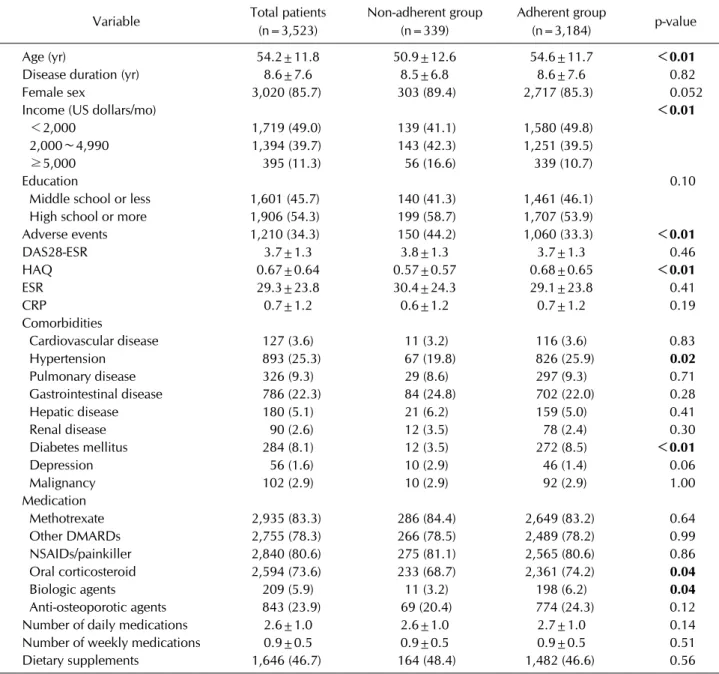
Mean age of patients in this study was 54.2 years and 85.7% were female (Table 1). Mean disease duration was 8.6 years and mean disease activity was 3.7 estimated by DAS28-ESR. In addition, 83.3% of patients were using methotrexate (MTX), and 5.9% were using biologic agents.
Prevalence of non-adherence
Among 3,523 patients included in analysis, 3,184 (90.4%) of RA patients were in the adherent group and 339 (9.6%) were in the non-adherent group (Table 1).
Patients in the non-adherent group were younger (50.9±12.6 years, non-adherent vs. 54.6±11.7 years, ad- herent, p<0.01), and had higher income. More patients in the non-adherent group reported ever-experience of AEs (44.2% vs. 33.3%, p<0.01). In addition, patients in the non-adherent group had lower HAQ score (0.57±0.57 vs. 0.68±0.65, p<0.01), but fewer had hypertension (19.8% vs. 25.9%, p=0.02) or diabetes mellitus (DM) (3.5% vs. 8.5%, p<0.01) compared with the adherent group. Fewer patients in the non-adherent group were us- ing oral corticosteroids (68.7% vs. 74.2%, p=0.04) or bi- ologic agents (3.2% vs. 6.5%, p=0.04); MTX, other DMARDs, NSAIDs/painkillers, and the number of daily or weekly medications did not vary between the two groups.
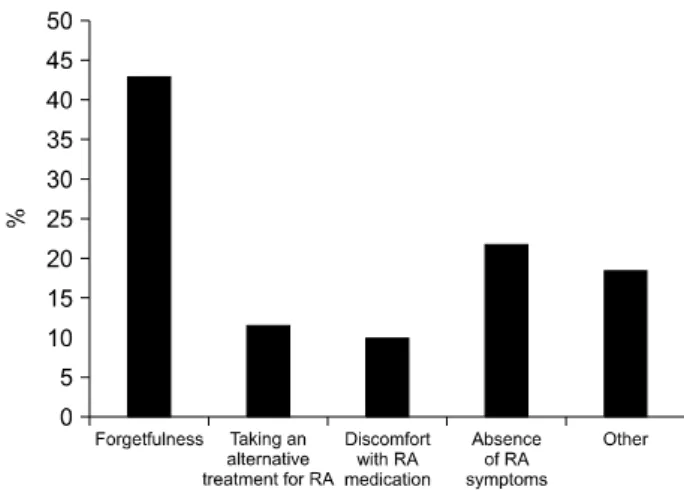
We collected the cause of non-adherence to RA medi- cation using a multiple-choice question (Figure 2). Common causes of non-adherence in the non-adherent group were forgetfulness (45.8%), absence of RA symptoms (24.7%), taking an alternative treatment for RA (14.6%), and dis-
Table 1. Demographic and clinical characteristics of study patients
Variable Total patients
(n=3,523)
Non-adherent group (n=339)
Adherent group
(n=3,184) p-value
Age (yr) 54.2±11.8 50.9±12.6 54.6±11.7 <0.01
Disease duration (yr) 8.6±7.6 8.5±6.8 8.6±7.6 0.82
Female sex 3,020 (85.7) 303 (89.4) 2,717 (85.3) 0.052
Income (US dollars/mo) <0.01
<2,000 1,719 (49.0) 139 (41.1) 1,580 (49.8)
2,000∼4,990 1,394 (39.7) 143 (42.3) 1,251 (39.5)
≥5,000 395 (11.3) 56 (16.6) 339 (10.7)
Education 0.10
Middle school or less 1,601 (45.7) 140 (41.3) 1,461 (46.1)
High school or more 1,906 (54.3) 199 (58.7) 1,707 (53.9)
Adverse events 1,210 (34.3) 150 (44.2) 1,060 (33.3) <0.01
DAS28-ESR 3.7±1.3 3.8±1.3 3.7±1.3 0.46
HAQ 0.67±0.64 0.57±0.57 0.68±0.65 <0.01
ESR 29.3±23.8 30.4±24.3 29.1±23.8 0.41
CRP 0.7±1.2 0.6±1.2 0.7±1.2 0.19
Comorbidities
Cardiovascular disease 127 (3.6) 11 (3.2) 116 (3.6) 0.83
Hypertension 893 (25.3) 67 (19.8) 826 (25.9) 0.02
Pulmonary disease 326 (9.3) 29 (8.6) 297 (9.3) 0.71
Gastrointestinal disease 786 (22.3) 84 (24.8) 702 (22.0) 0.28
Hepatic disease 180 (5.1) 21 (6.2) 159 (5.0) 0.41
Renal disease 90 (2.6) 12 (3.5) 78 (2.4) 0.30
Diabetes mellitus 284 (8.1) 12 (3.5) 272 (8.5) <0.01
Depression 56 (1.6) 10 (2.9) 46 (1.4) 0.06
Malignancy 102 (2.9) 10 (2.9) 92 (2.9) 1.00
Medication
Methotrexate 2,935 (83.3) 286 (84.4) 2,649 (83.2) 0.64
Other DMARDs 2,755 (78.3) 266 (78.5) 2,489 (78.2) 0.99
NSAIDs/painkiller 2,840 (80.6) 275 (81.1) 2,565 (80.6) 0.86
Oral corticosteroid 2,594 (73.6) 233 (68.7) 2,361 (74.2) 0.04
Biologic agents 209 (5.9) 11 (3.2) 198 (6.2) 0.04
Anti-osteoporotic agents 843 (23.9) 69 (20.4) 774 (24.3) 0.12
Number of daily medications 2.6±1.0 2.6±1.0 2.7±1.0 0.14
Number of weekly medications 0.9±0.5 0.9±0.5 0.9±0.5 0.51
Dietary supplements 1,646 (46.7) 164 (48.4) 1,482 (46.6) 0.56
Values are presented as mean±standard deviation or number (%), and bold value indicates statistical significance at the 0.05 level.
DAS28-ESR: disease activity score 28 joints-erythrocyte sedimentation rate, HAQ: health assessment questionnaire, ESR:
erythrocyte sedimentation rate, CRP: C-reactive protein, DMARDs: disease modifying anti-rheumatic drugs, NSAIDs: non-steroidal anti-inflammatory drugs.
comfort with RA medication (13.1%).
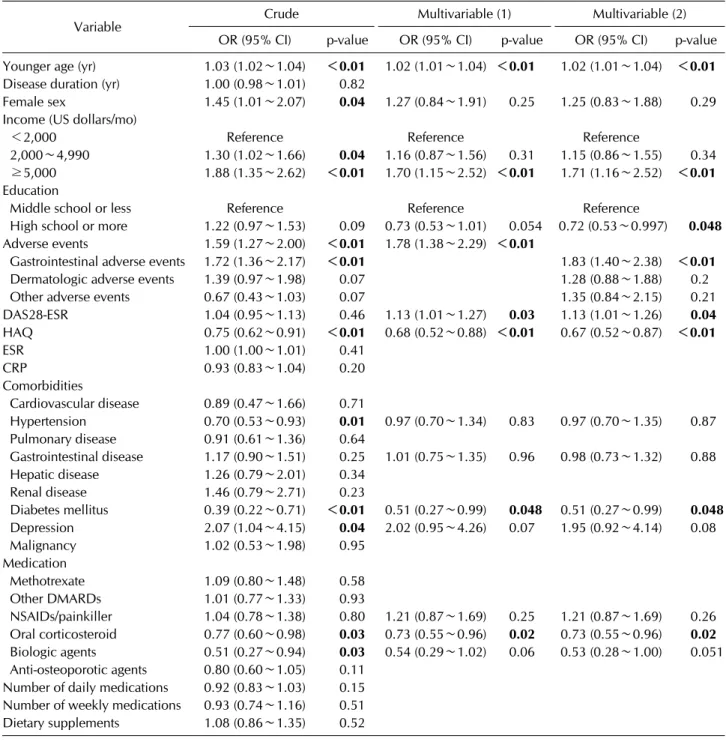
Associated factors for non-adherence in RA patients To identify associated factors for non-adherence in RA patients, we performed crude and multivariable logistic regression analysis (Table 2). In crude analysis, younger age, female sex, and higher income were associated with non-adherence in RA patients. Patients who experienced GI AEs or with depression were at increased risk of
non-adherence. Having hypertension or DM, or factors representing severe disease such as higher HAQ, or using oral corticosteroids or biologic agents were protective fac- tors against non-adherence in RA patients.
After adjusting for variables, younger age (OR 1.02, 95%
confidence interval [CI] 1.01∼1.04, p<0.01), higher in- come (OR 1.71, CI 1.16∼2.52 for income ≥5,000 dollars per month, p<0.01), experience of GI AEs (OR 1.83, CI 1.40∼2.38, p<0.01), and higher DAS28-ESR (OR 1.13,
Figure 2. Causes of non-adherence in rheumatoid arthritis (RA) patients.
CI 1.01∼1.26, p=0.03) were associated with increased the risk of non-adherence. Factors representing severe disease including higher functional disability (OR 0.67, CI 0.52∼0.87, p<0.01), and using oral corticosteroids (OR 0.73, CI 0.55∼0.96, p=0.02) were associated with decreased risk of non-adherence. The results of analysis using definition of non-adherent group as patients who skipped ≥16 days were almost identical to the definition of non-adherence as patients who skipped ≥6 days (data not shown).
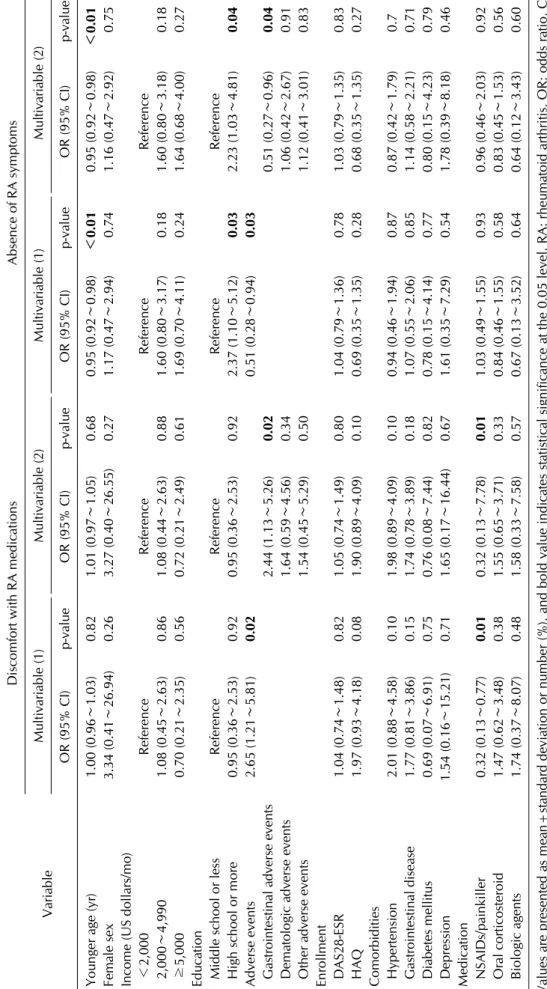
We further performed crude and multivariable re- gression analysis of associated factors for non-adherence according to intentional causes in non-adherent patients (Table 3). In adjusted analysis, having GI AEs (OR 2.44, CI 1.13∼5.26, p=0.02) was associated with increased risk of non-adherence due to discomfort with RA me- dication. Higher level of education (OR 2.23, CI 1.03∼
4.81, p=0.04) was associated with increased risk of non-adherence due to absence of RA symptoms without medication.
DISCUSSION
In this study, 9.6% of RA patients were defined as non-adherent due to not taking their medication 6 or more days out of 60. Younger age, higher income, and ex- perience of GI AEs were associated with increased risk of non-adherence. Having severe disease, as represented by higher functional disability and using oral corticosteroids, were associated with decreased risk of non-adherence in RA patients. Associated factors differed according to the cause of non-adherence: having GI AEs was associated with increased risk of non-adherence due to discomfort
with RA treatment, while higher level of education was associated with increased risk of non-adherence due to absence of RA symptoms.
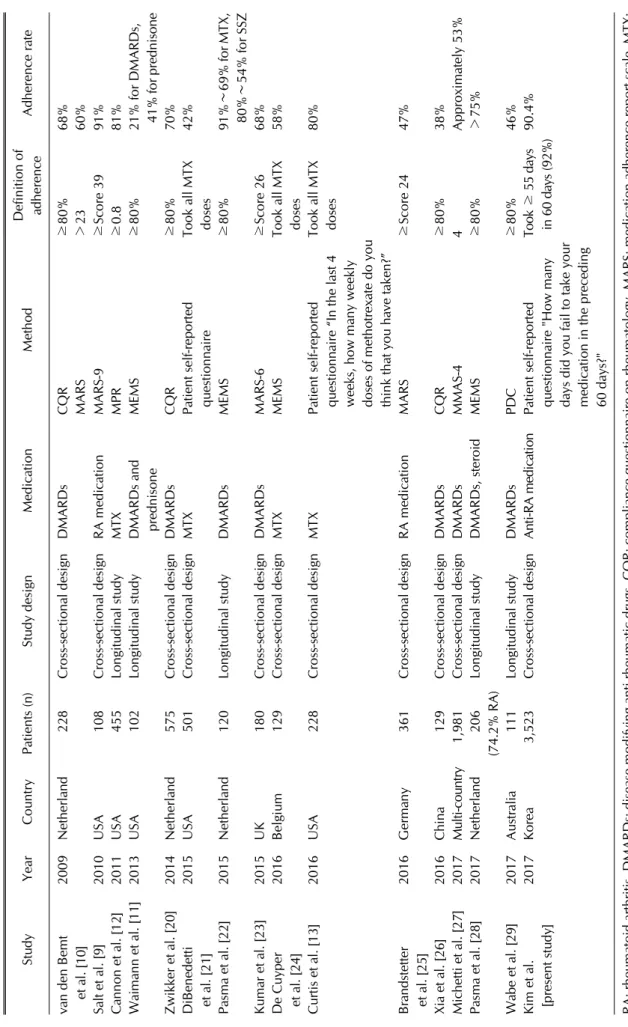
Previous studies reported about the adherence and asso- ciated factors affecting medication adherence in RA pa- tients (Table 4) [9-18,20-29]. In these studies, adherence rate, the ways to estimate drug adherence, and definitions of adherence differed between studies. Although we ex- pected that adherence rate estimated using electronic monitor such as MEMS will be lower than self-reported questionnaire, we could not find any definite difference of adherence rate in different ways to estimate drug adherence. The most feasible way to estimate drug adher- ence was self-reported measures. Compared to other measurement methods such as drug pill counts, elec- tronic monitors, rates of refilling prescriptions, or sample assays of drug levels or drug byproducts, self-reported measures are easy, speedy, flexible and have low cost bur- den [6,30,31]. We used self-reported measures as two re- lated questionnaires, and showed moderate correlation between the two questionnaires (data not shown). Among the questionnaires, we selected more objective questions that asked the number of days the patient failed to take their medication, and defined non-adherence failure to take medication 6 days or more.
Compared to previous studies, the adherence rate of 90.4% is quite high [9-18,20-29]. We assumed that this result was due to the characteristics of the patient cohort rather than our method of estimation. The patients in this cohort generally have good relationships with doctors, have insight into their disease, and are cooperative. As such, they may have good adherence to medication.
Similar to a previous study that reported that older pa- tients have higher adherence and patients who are busy tend to have lower adherence [14,32], we found that younger age was associated with non-adherence in RA patients. In this study, experiencing AEs was also asso- ciated with non-adherence in RA patients. We propose that experiencing AEs affects beliefs about medications, such as the general harm of medications, which are asso- ciated with drug adherence [10,16]. In contrast, variables that represent severe disease such as higher HAQ and use of oral corticosteroids had protective effects against non-adherence; these results were consistent with pre- vious studies [16,32]. Interestingly, higher DAS28-ESR was associated with non-adherence; in contrast, higher HAQ and use of oral corticosteroids were protective fac- tors against non-adherence. Since it is well-known that
Table 2. Associated factors for non-adherence in RA patients
Variable Crude Multivariable (1) Multivariable (2)
OR (95% CI) p-value OR (95% CI) p-value OR (95% CI) p-value Younger age (yr) 1.03 (1.02∼1.04) <0.01 1.02 (1.01∼1.04) <0.01 1.02 (1.01∼1.04) <0.01 Disease duration (yr) 1.00 (0.98∼1.01) 0.82
Female sex 1.45 (1.01∼2.07) 0.04 1.27 (0.84∼1.91) 0.25 1.25 (0.83∼1.88) 0.29 Income (US dollars/mo)
<2,000 Reference Reference Reference
2,000∼4,990 1.30 (1.02∼1.66) 0.04 1.16 (0.87∼1.56) 0.31 1.15 (0.86∼1.55) 0.34 ≥5,000 1.88 (1.35∼2.62) <0.01 1.70 (1.15∼2.52) <0.01 1.71 (1.16∼2.52) <0.01 Education
Middle school or less Reference Reference Reference
High school or more 1.22 (0.97∼1.53) 0.09 0.73 (0.53∼1.01) 0.054 0.72 (0.53∼0.997) 0.048 Adverse events 1.59 (1.27∼2.00) <0.01 1.78 (1.38∼2.29) <0.01
Gastrointestinal adverse events 1.72 (1.36∼2.17) <0.01 1.83 (1.40∼2.38) <0.01
Dermatologic adverse events 1.39 (0.97∼1.98) 0.07 1.28 (0.88∼1.88) 0.2
Other adverse events 0.67 (0.43∼1.03) 0.07 1.35 (0.84∼2.15) 0.21
DAS28-ESR 1.04 (0.95∼1.13) 0.46 1.13 (1.01∼1.27) 0.03 1.13 (1.01∼1.26) 0.04
HAQ 0.75 (0.62∼0.91) <0.01 0.68 (0.52∼0.88) <0.01 0.67 (0.52∼0.87) <0.01
ESR 1.00 (1.00∼1.01) 0.41
CRP 0.93 (0.83∼1.04) 0.20
Comorbidities
Cardiovascular disease 0.89 (0.47∼1.66) 0.71
Hypertension 0.70 (0.53∼0.93) 0.01 0.97 (0.70∼1.34) 0.83 0.97 (0.70∼1.35) 0.87 Pulmonary disease 0.91 (0.61∼1.36) 0.64
Gastrointestinal disease 1.17 (0.90∼1.51) 0.25 1.01 (0.75∼1.35) 0.96 0.98 (0.73∼1.32) 0.88 Hepatic disease 1.26 (0.79∼2.01) 0.34
Renal disease 1.46 (0.79∼2.71) 0.23
Diabetes mellitus 0.39 (0.22∼0.71) <0.01 0.51 (0.27∼0.99) 0.048 0.51 (0.27∼0.99) 0.048 Depression 2.07 (1.04∼4.15) 0.04 2.02 (0.95∼4.26) 0.07 1.95 (0.92∼4.14) 0.08
Malignancy 1.02 (0.53∼1.98) 0.95
Medication
Methotrexate 1.09 (0.80∼1.48) 0.58
Other DMARDs 1.01 (0.77∼1.33) 0.93
NSAIDs/painkiller 1.04 (0.78∼1.38) 0.80 1.21 (0.87∼1.69) 0.25 1.21 (0.87∼1.69) 0.26 Oral corticosteroid 0.77 (0.60∼0.98) 0.03 0.73 (0.55∼0.96) 0.02 0.73 (0.55∼0.96) 0.02 Biologic agents 0.51 (0.27∼0.94) 0.03 0.54 (0.29∼1.02) 0.06 0.53 (0.28∼1.00) 0.051 Anti-osteoporotic agents 0.80 (0.60∼1.05) 0.11
Number of daily medications 0.92 (0.83∼1.03) 0.15 Number of weekly medications 0.93 (0.74∼1.16) 0.51
Dietary supplements 1.08 (0.86∼1.35) 0.52
Values are presented as mean±standard deviation or number (%), and bold value indicates statistical significance at the 0.05 level.
RA: rheumatoid arthritis, OR: odds ratio, CI: confidence interval, DAS28-ESR: disease activity score 28 joints-erythrocyte sedimentation rate, HAQ: health assessment questionnaire, ESR: erythrocyte sedimentation rate, CRP: C-reactive protein, DMARDs: disease modifying anti-rheumatic drugs, NSAIDs: non-steroidal anti-inflammatory drugs.
high disease activity is associated with the use of oral cor- ticosteroids or high disability measured by high HAQ score [33,34], this result was somewhat surprising.
Several studies report conflicting results with regard to disease activity [5,32]. In one study, higher disease activ- ity was a predictive factor for drug adherence. On the oth-
er hand, another study found that non-adherence leads to high disease activity. Since our study has a cross-sectional design, higher disease activity as an associated factor for non-adherence could be the result of non-adherence.
Moreover, our multivariable analyses of associated fac- tors for non-adherence due to each cause showed that
Table 3. Associated factors for non-adherence due to each cause in non-adherent RA patients. Variable
Discomfort with RA medicationsAbsence of RA symptoms Multivariable (1)Multivariable (2)Multivariable (1)Multivariable (2) OR (95% CI)p-valueOR (95% CI)p-valueOR (95% CI)p-valueOR (95% CI)p-value Younger age (yr)1.00 (0.96∼1.03)0.821.01 (0.97∼1.05)0.680.95 (0.92∼0.98)<0.010.95 (0.92∼0.98)<0.01 Female sex 3.34 (0.41∼26.94)0.26 3.27 (0.40∼26.55)0.271.17 (0.47∼2.94)0.741.16 (0.47∼2.92)0.75 Income (US dollars/mo) <2,000ReferenceReferenceReferenceReference 2,000∼4,9901.08 (0.45∼2.63)0.861.08 (0.44∼2.63)0.881.60 (0.80∼3.17)0.181.60 (0.80∼3.18)0.18 ≥5,0000.70 (0.21∼2.35)0.560.72 (0.21∼2.49)0.611.69 (0.70∼4.11)0.241.64 (0.68∼4.00)0.27 Education Middle school or lessReferenceReferenceReferenceReference High school or more0.95 (0.36∼2.53)0.920.95 (0.36∼2.53)0.922.37 (1.10∼5.12)0.032.23 (1.03∼4.81)0.04 Adverse events2.65 (1.21∼5.81)0.020.51 (0.28∼0.94)0.03 Gastrointestinal adverse events2.44 (1.13∼5.26)0.020.51 (0.27∼0.96)0.04 Dematologic adverse events1.64 (0.59∼4.56)0.341.06 (0.42∼2.67)0.91 Other adverse events1.54 (0.45∼5.29)0.501.12 (0.41∼3.01)0.83 Enrollment DAS28-ESR1.04 (0.74∼1.48)0.821.05 (0.74∼1.49)0.801.04 (0.79∼1.36)0.781.03 (0.79∼1.35)0.83 HAQ1.97 (0.93∼4.18)0.081.90 (0.89∼4.09)0.100.69 (0.35∼1.35)0.280.68 (0.35∼1.35)0.27 Comorbidities Hypertension2.01 (0.88∼4.58)0.101.98 (0.89∼4.09)0.100.94 (0.46∼1.94)0.870.87 (0.42∼1.79)0.7 Gastrointestinal disease1.77 (0.81∼3.86)0.151.74 (0.78∼3.89)0.181.07 (0.55∼2.06)0.851.14 (0.58∼2.21)0.71 Diabetes mellitus0.69 (0.07∼6.91)0.750.76 (0.08∼7.44)0.820.78 (0.15∼4.14)0.770.80 (0.15∼4.23)0.79 Depression1.54 (0.16∼15.21)0.71 1.65 (0.17∼16.44)0.671.61 (0.35∼7.29)0.541.78 (0.39∼8.18)0.46 Medication NSAIDs/painkiller0.32 (0.13∼0.77)0.010.32 (0.13∼7.78)0.011.03 (0.49∼1.55)0.930.96 (0.46∼2.03)0.92 Oral corticosteroid1.47 (0.62∼3.48)0.381.55 (0.65∼3.71)0.330.84 (0.46∼1.55)0.580.83 (0.45∼1.53)0.56 Biologic agents1.74 (0.37∼8.07)0.481.58 (0.33∼7.58)0.570.67 (0.13∼3.52)0.640.64 (0.12∼3.43)0.60 Values are presented as mean±standard deviation or number (%), and bold value indicates statistical significance at the 0.05 level. RA: rheumatoid arthritis, OR: odds ratio, CI: confidence interval, DAS28-ESR: disease activity score 28 joints-erythrocyte sedimentation rate, HAQ: health assessment questionnaire, NSAIDs: non-steroidal anti-inflammatory drugs.
Table 4. Literature review of medication adherence in patients with RA StudyYearCountryPatients (n)Study designMedicationMethodDefinition of adherenceAdherence rate van den Bemt et al. [10]2009Netherland228Cross-sectional designDMARDsCQR≥80% 68% MARS>2360% Salt et al. [9]2010USA108Cross-sectional designRA medicationMARS-9≥Score 3991% Cannon et al. [12]2011USA455Longitudinal studyMTXMPR≥0.881% Waimann et al. [11]2013USA102Longitudinal studyDMARDs and prednisoneMEMS≥80% 21% for DMARDs, 41% for prednisone Zwikker et al. [20]2014Netherland575Cross-sectional designDMARDsCQR≥80% 70% DiBenedetti et al. [21]2015USA501Cross-sectional designMTXPatient self-reported questionnaire Took all MTX doses42% Pasma et al. [22]2015Netherland120Longitudinal studyDMARDsMEMS≥80% 91%∼69% for MTX, 80%∼54% for SSZ Kumar et al. [23]2015UK180Cross-sectional designDMARDsMARS-6≥Score 2668% De Cuyper et al. [24]2016Belgium129Cross-sectional designMTXMEMSTook all MTX doses58% Curtis et al. [13]2016USA228Cross-sectional designMTXPatient self-reported questionnaire “In the last 4 weeks, how many weekly doses of methotrexate do you think that you have taken?”
Took all MTX doses80% Brandstetter et al. [25]2016Germany361Cross-sectional designRA medicationMARS≥Score 2447% Xia et al. [26]2016China129Cross-sectional designDMARDsCQR≥80%38% Michetti et al. [27]2017Multi-country1,981Cross-sectional designDMARDsMMAS-44Approximately 53% Pasma et al. [28]2017Netherland206 (74.2% RA)Longitudinal studyDMARDs, steroidMEMS≥80%>75% Wabe et al. [29]2017Australia111Longitudinal studyDMARDsPDC≥80%46% Kim et al. [present study]2017Korea3,523Cross-sectional designAnti-RA medicationPatient self-reported questionnaire "How many days did you fail to take your medication in the preceding 60 days?"
Took ≥ 55 days in 60 days (92%)90.4% RA: rheumatoid arthritis, DMARDs: disease modifying anti-rheumatic drugs, CQR: compliance questionnaire on rheumatology, MARS: medication adherence report scale, MTX: methotrexate, MPR: medication possession ratio, MEMS: medication event monitoring system, SSZ: sulfasalazine, MMAS-4: the four-item Morisky Medication Adherence Scale, PDC: proportion of days covered.
DAS28-ESR and HAQ had different effects on non-adher- ence according to the cause.
Several studies investigated polypharmacy in RA and other diseases [10,16,35]. The studies showed conflict- ing results about associations between polypharmacy and drug adherence. We also analyzed the effect of the num- ber of daily and weekly medications and dietary supple- ments on drug adherence; we found no association be- tween them.
To find causes of non-adherence, non-adherence can be divided into two subtypes: unintentional (due to for- getfulness, regimen complexity or physical problems) and intentional (based on the patient’s decision to take no/less medication) [18]. In this study, forgetfulness was most frequent cause of non-adherence. In addition, many patients showed intentional non-adherence, discomfort with RA medication or absence of RA symptoms.
According to a previous review, patients with intentional nonadherence may make a benefit-risk analysis, weighing the perceived risks of treatment against the perceived benefits [18]. We assumed that demographic and clinical characteristics would be different between patients who experienced discomfort with RA medication and absence of RA symptoms. Thus, we further analyzed factors asso- ciated with non-adherence due to specific causes.
As we hypothesized, factors associated with non-adher- ence for each cause differed. Experiencing GI AEs was as- sociated with increased risk of non-adherence due to dis- comfort with RA medication, while GI AEs had protective effects against non-adherence due to the absence of RA symptoms. Although the questionnaire asking cause of non-adherence was multiple-choice question, patients who experience AEs tend to choose ‘AEs due to RA medi- cation’ as the cause of non-adherence (data not shown).
In addition, having NSAIDs/painkillers showed pro- tective effects against non-adherence due to discomfort with RA medication, but no significant association was seen between any medication and non-adherence due to the absence of RA symptoms. More patients without NSAIDs/painkillers identified the cause of their non-ad- herence as ‘AEs due to RA medication’ than patients with NSAIDs/painkillers, while there was no difference in
‘absence of RA symptoms’.
Among comorbidities, only DM showed positive effect on adherence. We think there are two possibilities. First, DM and RA are chronic diseases which need regular med- ication regardless of symptoms. Therefore, patients with DM and RA undergo frequent education about medication.
Second, RA patients with glucocorticoid, which increase the blood glucose level, are strictly educated to have regu- lar medication of DM from their doctor. This careful man- agement can have positive effect of medication adherence.
However, the relationship has to be revealed in future study. Differences in associated factors for non-adherence due to all causes, older age and higher level of education were associated with risk of non-adherence due to ab- sence of RA symptoms. Although many studies found that younger age is associated with non-adherence but education was not [15,16], we also know that patient knowledge, self-efficacy, and beliefs about the disease and its treatment influence adherence [10,15,16]. Therefore, among intentional non-adherence, especially when RA symptoms were absent without medication, patients with more experience and knowledge weigh benefits and risks for RA treatment and then decide not to take medicine.
In this study, we found that causes of non-adherence varied and differed according to patient profile and dis- ease status. Thus, uniform efforts to raise adherence could cause the reverse effect. Considering our results, we suggest patient education or reminder systems for pa- tients who tend to be forgetful about medication. In addi- tion, for patients who experience GI AEs, we should pre- scribe a more careful combination of medications or doses to minimize AEs. In patients without RA symp- toms, rapid decreases in medication through doctor-pa- tient communication are needed, especially for patients who are young and have high levels of education.
This study has several strengths. First, we analyzed as- sociated factors for non-adherence according to causes, and found that associated factors differed according to the cause of non-adherence. We assert that non-adherence must be considered on an individual basis. Second, com- pared to previous studies, we used a larger observational cohort that could better represent the RA patient po- pulation. However, we also had several limitations. First, self-reported questionnaires were used to identify adher- ence in RA patients. This method is useful for large groups of patients, but is not as accurate as other ob- jective methods. Second, since our study had a cross-sec- tional design, we could not report definite causal relation- ships between several associated factors and non-adherence.
Further study is needed using a prospective study design for conclusive results.
CONCLUSION
In conclusion, 9.6% of RA patients were non-adherent to medication. Associated factors for non-adherence dif- fered according to causes. Thus, an individualized ap- proach according to the cause of non-adherence is needed to improve adherence.
ACKNOWLEDGMENTS
This research was supported by a grant of the Korea Health Technology R&D Project through the Korea Health Industry Development Institute (KHIDI), funded by the Ministry of Health & Welfare, Republic of Korea (grant number. HI16C0061).
CONFLICT OF INTEREST
No potential conflict of interest relevant to this article was reported.
REFERENCES
1. Firestein GS. Evolving concepts of rheumatoid arthritis.
Nature 2003;423:356-61.
2. Singh JA, Furst DE, Bharat A, Curtis JR, Kavanaugh AF, Kremer JM, et al. 2012 update of the 2008 American College of Rheumatology recommendations for the use of dis- ease-modifying antirheumatic drugs and biologic agents in the treatment of rheumatoid arthritis. Arthritis Care Res (Hoboken) 2012;64:625-39.
3. Kuriya B, Xiong J, Boire G, Haraoui B, Hitchon C, Pope J, et al. Earlier time to remission predicts sustained clinical re- mission in early rheumatoid arthritis--results from the Canadian Early Arthritis Cohort (CATCH). J Rheumatol 2014;41:2161-6.
4. Treharne GJ, Douglas KM, Iwaszko J, Panoulas VF, Hale ED, Mitton DL, et al. Polypharmacy among people with rheuma- toid arthritis: the role of age, disease duration and comorbidity. Musculoskeletal Care 2007;5:175-90.
5. Contreras-Yáñez I, Ponce De León S, Cabiedes J, Rull- Gabayet M, Pascual-Ramos V. Inadequate therapy behavior is associated to disease flares in patients with rheumatoid arthritis who have achieved remission with disease-modify- ing antirheumatic drugs. Am J Med Sci 2010;340:282-90.
6. Osterberg L, Blaschke T. Adherence to medication. N Engl J Med 2005;353:487-97.
7. Horne R. Compliance, adherence, and concordance: im- plications for asthma treatment. Chest 2006;130(1 Suppl):
65S-72S.
8. Cramer JA, Roy A, Burrell A, Fairchild CJ, Fuldeore MJ, Ollendorf DA, et al. Medication compliance and persis- tence: terminology and definitions. Value Health 2008;11:
44-7.
9. Salt E, Frazier SK. Adherence to disease-modifying anti- rheumatic drugs in patients with rheumatoid arthritis: a narrative review of the literature. Orthop Nurs 2010;29:
260-75.
10. van den Bemt BJ, van den Hoogen FH, Benraad B, Hekster YA, van Riel PL, van Lankveld W. Adherence rates and asso- ciations with nonadherence in patients with rheumatoid ar- thritis using disease modifying antirheumatic drugs. J Rheumatol 2009;36:2164-70.
11. Waimann CA, Marengo MF, de Achaval S, Cox VL, Garcia-Gonzalez A, Reveille JD, et al. Electronic monitoring of oral therapies in ethnically diverse and economically dis- advantaged patients with rheumatoid arthritis: con- sequences of low adherence. Arthritis Rheum 2013;65:
1421-9.
12. Cannon GW, Mikuls TR, Hayden CL, Ying J, Curtis JR, Reimold AM, et al. Merging Veterans Affairs rheumatoid ar- thritis registry and pharmacy data to assess methotrexate adherence and disease activity in clinical practice. Arthritis Care Res (Hoboken) 2011;63:1680-90.
13. Curtis JR, Bharat A, Chen L, Greenberg JD, Harrold L, Kremer JM, et al. Agreement between rheumatologist and patient-reported adherence to methotrexate in a US rheu- matoid arthritis registry. J Rheumatol 2016;43:1027-9.
14. Park DC, Hertzog C, Leventhal H, Morrell RW, Leventhal E, Birchmore D, et al. Medication adherence in rheumatoid ar- thritis patients: older is wiser. J Am Geriatr Soc 1999;47:
172-83.
15. Brus H, van de Laar M, Taal E, Rasker J, Wiegman O.
Determinants of compliance with medication in patients with rheumatoid arthritis: the importance of self-efficacy expectations. Patient Educ Couns 1999;36:57-64.
16. Treharne GJ, Lyons AC, Kitas GD. Medication adherence in rheumatoid arthritis: effects of psychosocial factors.
Psychol Health Med 2004;9:337-49.
17. Viller F, Guillemin F, Briançon S, Moum T, Suurmeijer T, van den Heuvel W. Compliance to drug treatment of pa- tients with rheumatoid arthritis: a 3 year longitudinal study.
J Rheumatol 1999;26:2114-22.
18. van den Bemt BJ, Zwikker HE, van den Ende CH.
Medication adherence in patients with rheumatoid arthritis:
a critical appraisal of the existing literature. Expert Rev Clin Immunol 2012;8:337-51.
19. Sung YK, Cho SK, Choi CB, Park SY, Shim J, Ahn JK, et al.
Korean Observational Study Network for Arthritis (KORONA): establishment of a prospective multicenter co- hort for rheumatoid arthritis in South Korea. Semin Arthritis Rheum 2012;41:745-51.
20. Zwikker HE, van Dulmen S, den Broeder AA, van den Bemt BJ, van den Ende CH. Perceived need to take medication is associated with medication non-adherence in patients with rheumatoid arthritis. Patient Prefer Adherence 2014;8:
1635-45.
21. DiBenedetti DB, Zhou X, Reynolds M, Ogale S, Best JH.
Assessing methotrexate adherence in rheumatoid arthritis:
a cross-sectional survey. Rheumatol Ther 2015;2:73-84.
22. Pasma A, Schenk CV, Timman R, Busschbach JJ, van den Bemt BJ, Molenaar E, et al. Non-adherence to dis- ease-modifying antirheumatic drugs is associated with higher disease activity in early arthritis patients in the first year of the disease. Arthritis Res Ther 2015;17:281.
23. Kumar K, Raza K, Nightingale P, Horne R, Chapman S, Greenfield S, et al. Determinants of adherence to disease modifying anti-rheumatic drugs in White British and South Asian patients with rheumatoid arthritis: a cross sectional study. BMC Musculoskelet Disord 2015;16:396.
24. De Cuyper E, De Gucht V, Maes S, Van Camp Y, De Clerck LS. Determinants of methotrexate adherence in rheumatoid arthritis patients. Clin Rheumatol 2016;35:1335-9.
25. Brandstetter S, Riedelbeck G, Steinmann M, Loss J, Ehrenstein B, Apfelbacher C. Depression moderates the as- sociations between beliefs about medicines and medication adherence in patients with rheumatoid arthritis: Cross-sec- tional study. J Health Psychol 2016 May 1 [Epub]. DOI:
10.1177/1359105316646440.
26. Xia Y, Yin R, Fu T, Zhang L, Zhang Q, Guo G, et al.
Treatment adherence to disease-modifying antirheumatic drugs in Chinese patients with rheumatoid arthritis. Patient Prefer Adherence 2016;10:735-42.
27. Michetti P, Weinman J, Mrowietz U, Smolen J, Peyrin-Biroulet L, Louis E, et al. Impact of treatment-related beliefs on medication adherence in immune-mediated in- flammatory diseases: results of the global ALIGN study.
Adv Ther 2017;34:91-108.
28. Pasma A, Schenk C, Timman R, van 't Spijker A, Appels C, van der Laan WH, et al. Does non-adherence to DMARDs influence hospital-related healthcare costs for early arthritis in the first year of treatment? PLoS One 2017;12:e0171070.
29. Wabe N, Lee A, Wechalekar M, McWilliams L, Proudman S, Wiese M. Adherence to combination DMARD therapy and
treatment outcomes in rheumatoid arthritis: a longitudinal study of new and existing DMARD users. Rheumatol Int 2017;37:897-904.
30. Koneru S, Shishov M, Ware A, Farhey Y, Mongey AB, Graham TB, et al. Effectively measuring adherence to medi- cations for systemic lupus erythematosus in a clinical setting. Arthritis Rheum 2007;57:1000-6.
31. Rapoff MA, Belmont JM, Lindsley CB, Olson NY.
Electronically monitored adherence to medications by new- ly diagnosed patients with juvenile rheumatoid arthritis.
Arthritis Rheum 2005;53:905-10.
32. Tuncay R, Eksioglu E, Cakir B, Gurcay E, Cakci A. Factors affecting drug treatment compliance in patients with rheu- matoid arthritis. Rheumatol Int 2007;27:743-6.
33. Welsing PM, van Gestel AM, Swinkels HL, Kiemeney LA, van Riel PL. The relationship between disease activity, joint destruction, and functional capacity over the course of rheu- matoid arthritis. Arthritis Rheum 2001;44:2009-17.
34. Choi SC, Ingale SL, Kim JS, Park YK, Kwon IK, Chae BJ. An antimicrobial peptide-A3: effects on growth performance, nutrient retention, intestinal and faecal microflora and in- testinal morphology of broilers. Br Poult Sci 2013;54:
738-46.
35. Wawruch M, Zatko D, Wimmer G Jr, Luha J, Hricak V Jr, Murin J, et al. Patient-related characteristics associated with non-persistence with statin therapy in elderly patients fol- lowing an ischemic stroke. Pharmacoepidemiol Drug Saf 2017;26:201-7.