pH Dependence on the Degradation of Rhodamine B by Fe-ACF/TiO 2 Composites and Effect of Different Fe Precursors
Kan Zhang and Won-Chun Oh †
Department of Advanced Materials & Science Engineering, Hanseo University, Chungnam 356-706, Korea
(Received July 14, 2009, Revised & Accepted August 17, 2009)
Fe-ACF/TiO 2 복합체에 의한 로다민 B 용액의 분해에 있어서 pH 의존성 및 여러 가지 Fe 전구체의 효과
장 간 ․ 오 원 춘
† 한서대학교 신소재공학과
(2009년 7월 14일 접수, 2009년 8월 17일 수정 및 채택)
ABSTRACT:Iron-loaded activated carbon fibers (Fe-ACF) supported titanium dioxide (TiO
2) photocatalyst (Fe-ACF/TiO
2) was synthesized using a sol-gel method. Three different types of Fe-ACF/TiO
2were obtained by treatment with different precursor of Fe, and characterized using BET, SEM, XRD and EDX analysis. The photocatalytic activity of Fe-ACF/TiO
2was investigated by the degradation of Rhodamine B (Rh.B) solution under UV irradiation. From the experimental results, it was revealed that Fe-ACF/TiO
2composites show considerable photocatalytic ability for the removal of Rh.B by comparing non-treated ACF/TiO
2composites. And photo-Fenton reaction with Fe element was incoordinately influenced due to different precursor of Fe. It clearly indicates that Fe-ACF/TiO
2composites prepared using FeCl
3provided the highest photo-Fenton activity, then, which was affected by pH changes on the degradation of Rh.B.
요 약:졸-겔 방법을 사용하여 Fe-ACF/TiO
2복합체 광촉매를 제조하였다. 여러 가지 철 전구체를 사용하여 세 가지 Fe-ACF/TiO
2복합체를 제조하고 BET, SEM, XRD 및 EDX를 사용하여 특성화 하였다. UV 조사에서 Rh.B 용액의 분해에 의거하여 Fe-ACF/TiO
2복합체의 광촉매 특성을 파악 하였다. 실험 결과로부터, Fe-ACF/TiO
2복합 체는 ACF/TiO
2복합체 보다 Rh.B의 제거 효과가 더 우수함을 나타내었다. 또한 여러 가지 Fe 전구체 사용으로 인한 Fe 원소의 포토-펜톤 효과는 다르게 나타났다. FeCl
3을 사용하여 제조된 Fe-ACF/TiO
2복합체는 가장 우수한 포토-펜톤 효과를 나타내었고, pH 변화에 의존하여 Rh.B 용액 분해에 대하여 영향을 주었다.
Keywords:Fe-ACF/TiO
2composites; Fe precursors; Rh.B; photo-Fenton; photocatalytic activity
†
Corresponding Author. E-mail: [email protected]
Ⅰ . Introduction
In the last decade, titania has variable applications in paints, 1 pigments, hydrogen gas evolution 2 and environmental purifica- tion systems. 3 It is widely used due to its low cost, non-tox- icity, chemical stabilityand complete mineralization. 4-8 Howev- er, the existent drawback of titania is its relatively low quan- tum yield due to high electron/hole pairs recombination rate.
A high degree of recombination between charge carriers is a waste of radiation energy. Intuitively, efficient separation of charge carriers can assist photocatalytic system. Therefore, many attempts have been focused on reduced electron/hole pairs recombination rate, which includes dye sensitization, met- al ion doping, nonmetal doping, etc. 9-11 It is well known when
titania is treated with metal or metal oxides, its properties are remarkably modified. And the prevalent candidate of iron dop- ant in the titania matrix significantly influenced charge carrier recombination rate and interfacial electron-transfer rate, hence increasing the quantum yield of photocatalysts. 12-14 Namely the inimitable character of iron possesses different valence, and each other can easily transform with electron/hole pairs, hereby to reduce electron/hole pairs recombination rate, enhancing the photocatalytic activity. As reported in recent literatures, 15-20 iron ions were able to work in photo-Fenton process to enhance the photocatalytic activity by formation of OH. Radicals.
As we know, there are no reports concerning the change
of photo-Fenton reaction by different precursor of Fe. Howev-
er, the photo-Fenton process can be governed by the amount
and ratio of Fe 2+ /Fe 3+ , it was well known that an optimal ratio
would give an ideal work in photo-Fenton reaction. Many au-
thors reported that the Fe 2+ can be effectively oxidized to Fe 3+
by adjustment of solution pH. 21-22 It was considered that the effective oxidation of Fe 2+ to Fe 3+ can enhance the effect of photo-Fenton reaction due to less active Fe 2+ . Moreover, many studies also indicated that the pH of a reaction solution is an important parameter in the photocatalytic degradation of organic compounds using photocatalyst as TiO 2 . 23-24 It was considered that the interfacial electron transfer and the photo- redox process were affected by the influence of the surface charge of the photocatalyst due to various pH of initial reaction solution. 25 However, according to the former studies, 26-27 the contrary degradation effect were obtained by change of pH.
In this study, ACF was selected as the support for TiO 2
and Fe loading due to the good adsorption and uniform pore structure. 28-29 In addition, ACF in the form of felt or cloth is preferable for handling, compared with granular sup- ports. 30-31
In this paper, we synthesized Fe-ACF/TiO 2 composites us- ing different Fe precursors (FeCl 3 ․ 6H 2 O, Fe(NO 3 ) 3 .9H 2 O and Fe 2 (SO 4 ) 3 · 9H 2 O) by a sol-gel method. The synthesized cata- lyst has been characterized by BET, SEM, XRD and EDX.
And their photocatalytic degradation properties were compared with ACF/TiO 2 by degradation of Rh.B solution, and degrada- tion activity was discussed among the Fe-ACF/TiO 2 com- posites. Furthermore, effect of different initial solution pH on the degradation of Rh.B by using the synthesized photocatalyst was studied in detail.
II. Experimental
1. Materials
Activated Carbon Fiber (ACF) was purchased from EAST ASIS Carbon Fibers Co., Ltd, (Anshan, China). Hydrogen Peroxide (H 2 O 2 ) was purchased from Daejung Chemicals Metals Co., Ltd, (Korea). Titanium (IV) oxysulfate hydrate (TiOSO 4 ․ xH 2 O (TOS), Sigma-Aldrich, Germany) was se- lected as a titanium source for the preparation of ACF/TiO 2
composites, and FeCl 3 ․ 6H 2 O as the ferric source was pur- chased from Duksan Pure Chemical Co., Ltd, (Korea).
Fe(NO 3 ) 3 ․ 9H 2 O was also purchased from Duksan Pure Chemical Co., Ltd, (Korea). Fe 2 (SO 4 ) 3 · 9H 2 O was purchased from Yakuri Pure Chemical Co., Ltd, (Japan). The Rh.B was purchased from Samchun Pure Chemical Co., Ltd, Korea. The sodium hydroxide (NaOH) was purchased from Duksan Pure Chemical Co., Ltd, (Korea), and the hydrochloric acid (HCl) was purchased from Daejung Chemicals & Metals Co., Ltd, (Korea).
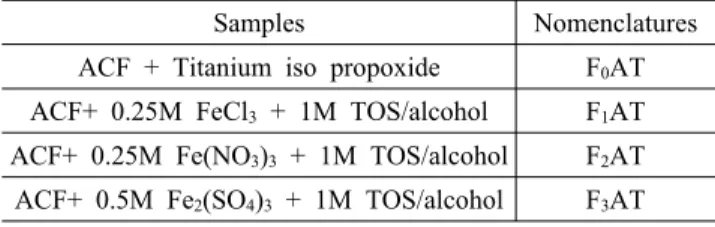
Table 1. Nomenclatures of ACF/TiO 2 and Fe-ACF/TiO 2 com- posites
Samples Nomenclatures
ACF + Titanium iso propoxide F
0AT ACF+ 0.25M FeCl
3+ 1M TOS/alcohol F
1AT ACF+ 0.25M Fe(NO
3)
3+ 1M TOS/alcohol F
2AT ACF+ 0.5M Fe
2(SO
4)
3+ 1M TOS/alcohol F
3AT
2. Preparation of samples
In this experimental process, 5 g ACF power was added into to 50 ml 0.25M Fe precursors (FeCl 3 ․ 6H 2 O, Fe(NO 3 ) 3
․ 9H 2 O and Fe 2 (SO 4 ) 3 ․ 9H 2 O) solution and the mixtures were stirred 24 h using a non-magnetic stirrer at room temperature.
After heat treatment at 773 K, we obtained the Fe-ACF. The Fe-ACF was put into the mixture of TOS and ethanol. Then the mixed solution was stirred for 5 h in an air atmosphere.
After stirring solution was transformed to gel state, and these gels were heat treated at 923 K for 1h. And then the Fe- ACF/TiO 2 composites were obtained. The nomenclatures of prepared samples are listed in Table 1. At the same time, an original sample of ACF/TiO 2 was quoted from former experi- ment 32 and compared with that of Fe-ACF/TiO 2 composites obtained.
3. Characteristics and investigations of the samples
The BET surface area by N 2 adsorption method was meas- ured at 77 K using a BET analyzer (Monosorb, USA). XRD (Shimadz XD-D1, Japan) result used to identify the crystal- linity by Cu Kα radiation. SEM used to observe the surface state and structure of Fe-ACF/TiO 2 composites using an elec- tron microscope (JSM-5200 JOEL, Japan). EDX spectra were also obtained for determining the elemental information of ACF/TiO 2 and Fe-ACF/TiO 2 composites. UV-vis absorption parameters for the MB solution decomposed by ACF/TiO 2 and Fe-ACF/TiO 2 composites under UV lamp irradiation were re- corded using a Spectronic (USA) spectrometer.
4. Photocatalytic activity of Fe-ACF/TiO
2
The photocatalytic decomposition was tested by different
Fe-ACF/TiO 2 composites powder and an aqueous solution of
MB in a 100 mL glass container and then irradition system
with 20W UV light at 365 nm, which was used at the distance
of 100 mm from the solution in darkness box. The same
amount of Fe-ACF/TiO 2 composites (0.03 g) was suspended
in 50 mL of 5.0 × 10 -5 mol/L Rh.B solution. The photocatalytic
activities of the prepared Fe-ACF/TiO 2 composites were inves-
(a) (b)
(c) (d)
(e) (f)
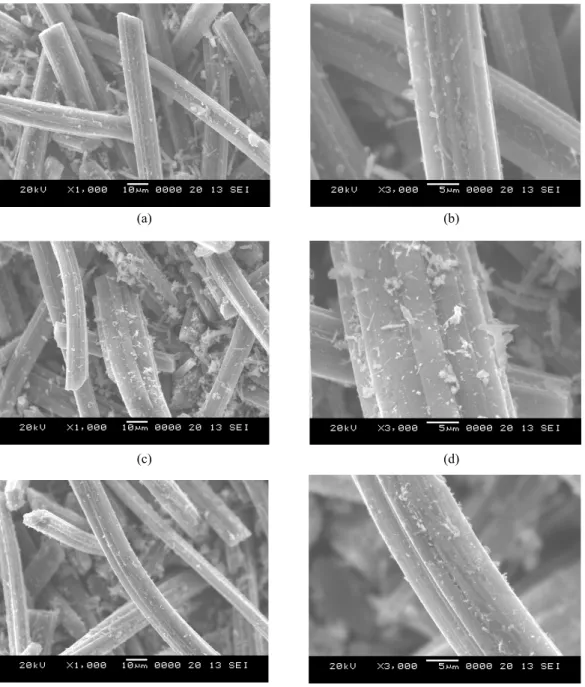
Figure 1. SEM images of ACF/TiO 2 and Fe-ACF/TiO 2 composites: F 1 AT: (a)×1000, (b)×3000; F 2 AT: (c)×1000, (d)×3000 and F 3 AT: (e) ×1000, (f)×3000.
tigated using the photodegradtion rate of Rh.B, which was measured for 0 min, 30 min, 60 min, 90 min and 120 min.
The red color of the solution faded gradually with time duo to the adsorption and decomposition of Rh.B. For reactions in different pH media, the initial pH of the suspensions was adjusted by the addition of either NaOH or HCl solutions.
And then the concentration of Rh.B in the solution was de- termined as a function of irradiation time from the absorbance change at a wavelength of 550 nm.
Ⅲ . Results and discussion
1. The surface characteristics
The value of BET surface area of pristine ACF, ACF/TiO 2
and Fe-ACF/TiO 2 samples are shown in Table 2. As shown
results of Table 2, the BET surface area of the as-received
ACF was 1842 m 2 /g. It can be clearly seen that the specific
surface area was decreased by treated with TiO 2 . This result
is thought that the decrease is due to the blocking of the micro-
Table 2. Specific BET surface areas of Pristine ACF, ACF/
TiO 2 and Fe-ACF/TiO 2 composite samples
Sample S
BET(m
2/g)
Pristine ACF 1842
F
0AT 1268
F
1AT 1047
F
2AT 960
F
3AT 1012
pores by surface complexes introduced through the formation of the ACF/TiO 2 composites. Especially, the variation of sur- face parameters for Fe-ACF/TiO 2 composites was probably caused by the TiO 2 and Fe compounds. The similar phenomena had also been observed in the references. 33-34
The SEM images of Fe-ACF/TiO 2 composites are shown in Figure 1. It shows that TiO 2 particles uniformly covered the surface of ACF, which was beneficial for the photocatalytic reaction because the photocatalytic reaction is carried out on the external surfaces of the TiO 2 /ACF composites catalysts by existing reactants using UV light and the nano-size structured catalyst could provide a more effective surface for MB adsorp- tion and UV light absorption. 35 In the comparison with differ- ent precursors of Fe in all samples, there was no significant difference. In previous studies, 36-41 a nitric acid treated on AC/TiO 2 composites enhanced the homogenous and uniform distribution of TiO 2 particles. It was considered that Fe- ACF/TiO 2 composites could have much more activity because the TiO 2 particles were mixed well with the ACF. We could not find out the Fe particle in SEM imagines of Fe-ACF/TiO 2
composites, dur to the small size of Fe particle. But it was confirmed in XRD and EDX results.
2. The composition of ACF/TiO
2
and Fe-ACF/TiO2
According to the former studies, 38,42 it is well known that the crystal structure of the TiO 2 is mainly determined by the heat treatment temperature. Figure 2 depicts XRD patterns of Fe-ACF/TiO 2 composites prepared at 927 K for 1 h. The peaks at 25.3, 37.8, 48.0, 53.8, 54.9 and 62.5º are the diffractions of (101), (004), (200), (105), (211) and (204) planes of anatase.
There are no peaks found at 27.4, 36.1, 41.2 and 54.3º that belong to the diffraction peaks of (110), (101), (111) and (211) of rutile. It indicated that the developed Fe-ACF/TiO 2 compo- sites only existed in anatase state. According to the former studies, 38,41 Pure anatase nanocrystallites can provide higher photocatalytic activity.
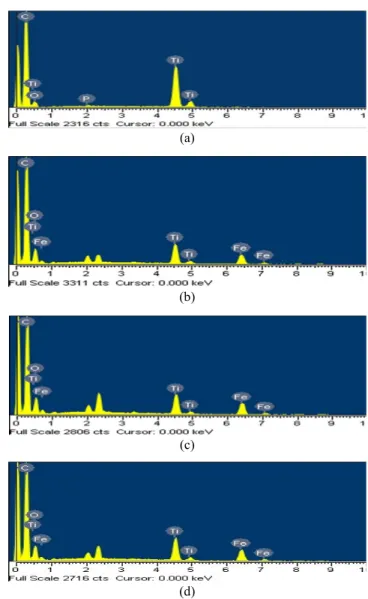
Figure 3 showed the results of the EDX for Fe-ACF/TiO 2
and ACF/TiO 2 . These spectra show the presence of the C, O and Ti elements. TiO 2 particles show a peak around 0.2
10 20 30 40 50 60
0 100 200 300 400 500 600
Int e ns ity (counts)
2 theta(
0) F
A F
F F
A F A F
F
A F F
A F A F
F
A F
A F A F
F
1AT F
2AT F
3AT A: Anatase F: Fe+2TiO3
Figure 2. XRD patterns of powdered Fe-ACF/TiO 2 compo- sites(F 1 AT, F 2 AT and F 3 AT).
(a)
(b)
(c)
(d)
Figure 3. EDX elemental microanalysis of ACF/TiO 2 and
Fe-ACF/TiO 2 composites: (a) F 0 AT, (b) F 1 AT (c) F 2 AT and
(d) F 3 AT.
Table 3. EDX elemental microanalysis of ACF/TiO 2 and Fe-ACF/TiO 2 composites
Samples Elements (wt.%)
C O Ti Fe
F
0AT 65.5 15.4 18.9 0
F
1AT 61.85 22.89 7.98 7.27
F
2AT 59.32 23.96 7.47 9.25
F
3AT 59.73 23.50 8.53 8.24
0 20 40 60 80 100 120
0.76 0.78 0.80 0.82 0.84 0.86 0.88 0.90 0.92 0.94 0.96 0.98 1.00
R e mo ve o f R h. B (c /c
0)
Irradiation time(minute)
F
0T F
1T F
2T F
3T
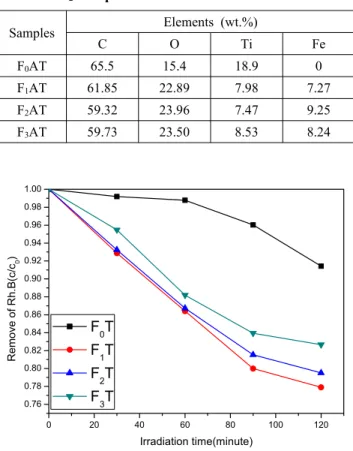
Figure 4. Remove of Rh.B in the aqueous solution on UV irradiation time for the ACF/TiO 2 (F 0 AT) and Fe-ACF/TiO 2
(F 1 AT, F 2 AT and F 3 AT) composites.
keV and another intense peak appears at 4.5 keV. The intense peak is assigned to TiO 2 in the bulk form and the less intense peak is assigned to TiO 2 surface. 43 The peaks due to Fe were clearly distinct in Fe-ACF/TiO 2 at 7.1 and 6.4 keV. Because of coating by Au for preparation of EDX images, some peaks appeared around 9.6 keV were omitted. Elemental composition analyses of the composite series were listed in Table 3.
3. Photocatalysis activity
Figure 4 showed remove of Rh.B in the aqueous solution on UV irradiation time for ACF/TiO 2 and Fe-ACF/TiO 2
composites. As the results of Figure 4, the Rh.B degradation efficiency was increased distinctly due to appearance of Fe.
It is noteworthy that the Fe modified ACF-TiO 2 enhances the photocatalytic activity greatly via photo-Fenton reaction. This reaction could be showed in following equation:
Fe
3++ OH
-+ hv → Fe
2++ OH
∙(1) As above mentioned, the reduction of Fe 3+ to Fe 2+ in OH -
solution under UV light gave rise of OH ∙ radicals. However, the one-step reaction has limitations, because recuperation of Fe 3+ is slow and difficult due to pH below 7 in reaction sol- ution after using photocatalysts degradation. 44-45 Therefore, for the photocatalytic activity of three Fe-ACF/TiO 2 composites, this was directly affected by an amount of Fe 3+ in initial syn- thesized Fe-ACF/TiO 2 composites.
To evaluate the actual photocatalytic activity of the Fe- ACF/TiO 2 photocatalysts, comparison of different Fe-ACF/TiO 2
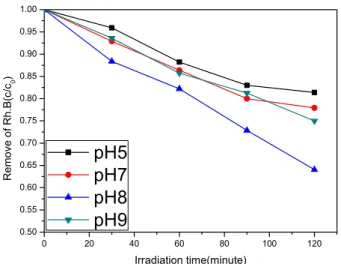
photocatalysts prepared, the preparation of Fe-ACF/TiO 2 com- posites using FeCl 3 ․ 6H 2 O has been found to be more photo- active than that of Fe(NO 3 ) 3 ․ 9H 2 O and Fe 2 (SO 4 ) 3 · 9H 2 O. It can be attributed to that a higher amount of Fe 3+ was formed during the preparation of Fe-ACF/TiO 2 . Generally, the for- mation of Fe-ACF composites can be inhibited by inorganic acid ions in different degree, which can be attributed to a de- crease of an effective combination of Fe and ACF because of the formation of more reactive Fe 3+ complexes with anions during the preparation of Fe-ACF. According to the former studies, 46-47 sulfonamides undergo photocatalytic degradation in processes conducted in the presence of Fe 3+ salts. The high- est catalytic activity was provided by FeCl 3 due to formation of more reactive inorganic radicals, while among the heteroge- neous catalysts. This fact was also confirmed by the results of our experiments, which is particularly clear for Cl - . Remove of Rh.B in the aqueous solution on UV irradiation time for F 0 AT composites under various pH are showed in Figure 5. The results indicated that the photocatalytic activity of ACF/TiO 2 is unchanged in different pH conditions. It was considered that the beneficial electron transfer had been oc- curred on ACF and/or Fe. 28 And TiO 2 surface is not positively or negatively charged in different pH conditions. It can be attributed to that the adsorption capability of TiO 2 is neglected in the presence of ACF.
0 20 40 60 80 100 120
0.90 0.92 0.94 0.96 0.98 1.00
R em ove of R h.B( c/c
0)
Irradiation time(minute)
pH5 pH7 pH8 pH9
Figure 5. Remove of Rh.B in the aqueous solution on UV
irradiation time for F 0 AT composites under varying pH.
0 20 40 60 80 100 120 0.50
0.55 0.60 0.65 0.70 0.75 0.80 0.85 0.90 0.95 1.00