http://dx.doi.org/10.5369/JSST.2014.23.3.158 pISSN 1225-5475/eISSN 2093-7563
Blind Signal Processing for Wireless Sensor Networks
Namyong Kim + and Hyung-Gi Byun
Abstract
In indoor sensor networks equalization algorithms based on the minimization of Euclidean distance (MED) for the dis- tributions of constant modulus error (CME) have yielded superior performance in compensating for signal distortions induced from optical fiber links, wireless-links and for impulsive noise problems. One main drawback of MED-CME algorithms is a heavy computational burden hindering its implementation. In this paper, a recursive gradient estimation for weight updates of the MED-CME algorithm is proposed for reducing the operations of the conventional MED-CME to at each iter- ation time for N data-block size. From the simulation results of the proposed recursive method producing exactly the same results as the conventional method, the proposed estimation method can be considered to be a reliable candidate for imple- mentation of efficient receivers in indoor sensor networks.
Keywords: Complexity, CME, Euclidean distance, Error distribution, Impulsive noise, Sensor networks
1. INTRODUCTION
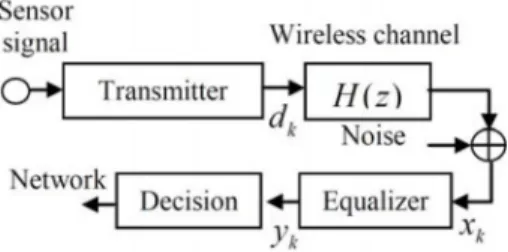
Sensor networks are composed of spatially distributed sensors, actuators and communication links so that sensor networks with wireless links require dealing with wireless-related communication problems and signal processing in addition to operations of sensors and actuators.
Some harsh problems in sensor network communication environment are multipath propagation and severe fading [1].
Besides, impulsive noise from indoor electric devices with electromechanical switches affects the indoor wireless links [2].
For multipath fading compensation, training-aided equalization methods or blind methods may be used to mitigate multipath propagation and to improve both bandwidth and energy efficiency [3]. Training-aided equalization methods have to use a sufficiently long training sequence in each data packet since sensors usually work with low duty-cycle [4]. This implies that training-aided algorithms are not suitable for the reason of wasting bandwidth and power as well. Blind
equalizer algorithms in which training sequences are removed are useful to enhance power and bandwidth efficiency [5]. For blind equalization the constant modulus error (CME) is usually used to be minimized. The CME is defined as the difference between the output power and a constant modulus predefined according to the modulation schemes. Based on the mean squared error (MSE) criterion on the average power of CME, the well-known constant modulus algorithm (CMA) has been developed for blind equalization [5]. The MSE criterion of the CMA can mitigate the influence of Gaussian noise on the algorithm due to its averaging operation.
However, indoor wireless sensor networks are interfered with not only Gaussian noise but also impulsive noise from a various sources of impulse noise. Impulsive noise induces large instantaneous system errors that often make the CMA on the basis of MSE criterion fail [6]. Instead of the MSE criterion that utilizes error energy, the correntropy concept has been proposed to cope with impulsive noise problems [6]. The correntropy blind method known to be effective in correlative signaling systems has shown not as satisfying as expected in the modulation schemes employing independently distributed symbol points [7].
As an alternative to the correntropy cost function, the Euclidean distance (ED) between CME distribution and the Dirac-delta function has been proposed to cope with impulsive noise problem as well as channel distortions [7]. The blind
O N ( ) 2 O N ( )
Division of Electronic Information and Communication Engineering, Kangwon National Unversity, Samcheok, Kangwon-Do 245-711, Korea
+