J Korean Surg Soc 2011;80:157-160
□ 증 례 □
DOI: 10.4174/jkss.2011.80.2.157
157
Correspondence to: Sun-Hyung Joo, Division of Hepatobiliary Surgery, Department of Surgery, East-West Neo Medical Center, Kyung Hee University College of Medicine, 149, Sangil-dong, Gangdong-gu, Seoul 134-727, Korea Tel: 02-440-6135, Fax: 02-440-6295, E-mail:
Received December 15, 2009, Accepted February 17, 2010
Acute Hepatic Failure Associated with Stevens-Johnson Syndrome Induced by Carbamazepine Treatment in
a Patient with Transverse Myelitis
Departments of Surgery and 1Neurology, Kyung Hee University School of Medicine and the Kyung Hee University Hospital at Gangdong, Seoul, Korea
Bum-Soo Kim, M.D., Sun-Hyung Joo, M.D., Hak-Young Rhee, M.D.
1, Ho-Cheol Park, M.D.
Carbamazepine-induced liver injury is less common, but the consequences of the side effects can be very serious leading to death or a need for liver transplantation. We report a case of a 60-year-old female transverse myelitis patient with fulminant hepatic failure and Stevens-Johnson syndrome induced by carbamazepine who successfully underwent deceased donor liver transplantation. The patient, a 60-year-old female, was admitted to our service due to acute liver insufficiency and a drowsy mental state attributable to carbamazepine. She had been treated with carbamazepine to control transverse myelitis. Fifty days after the use of carbamazepine, she developed jaundice, erythematous papules and bullae, and decreased consciousness. The diagnosis of Stevens-Johnson syndrome was considered. She underwent deceased donor liver transplantation. She was discharged with normal graft functions 5 months after transplantation. Thus, liver transplantation can be a feasible therapy for patients with carbamazepine-induced hepatic failure associated with Stevens-Johnson syndrome. (J Korean Surg Soc 2011;80:
157-160)
Key Words: Carbamazepine, Stevens-Johnson syndrome, Fulminant hepatic failure, Liver transplantation, Transverse myelitis
INTRODUCTION
Transverse myelitis (TM) is a focal inflammatory disorder of the spinal cord. Carbamazepine is widely used to relieve the neuropathic pain, but it is frequently associated with neurologic adverse events, Stevens-Johnson syndrome (SJS), and hepatic side effects. Carbamazepine-induced liver injury is less common, but the consequences of the side effects can be very serious, leading to death or a need for liver transplantation. We report a case of a 60-year-old female with fulminant hepatic failure (FHF) and SJS induced by carbamazepine who successfully underwent
deceased donor liver transplantation (DDLT). This is the first report in which neurologic and graft function in a patient with TM, FHF, and SJS recovered completely after DDLT.
CASE REPORT
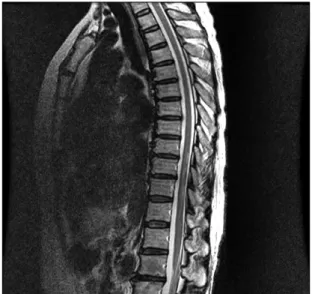
The patient, a 60-year-old female, was admitted to a neurologic department in another hospital for sensori- motor weakness of lower extremities. T2-weighted magnetic resonance imaging of the spine revealed diffuse and ill-defined high signal intensities at the T8-10 level com- patible with the neurologic deficit (Fig. 1). With the results of other laboratory tests, she was diagnosed as idiopathic TM and was treated with intravenous high-dose steroid.
After the pulse therapy, the motor power of the lower extremities had improved significantly but she complained of intermittent lancinating pain in the legs. The patient
158 J Korean Surg Soc. Vol. 80, No. 2
Fig. 1. The spinal magnetic resonance imaging (MRI) demonstrated diffuse, ill-defined high signal intensities at the T8-10 level on a T2 sagittal image.
had been treated with carbamazepine (200 mg twice daily) in another hospital to control her sensory symptom. Fifty days after starting carbamazepine, she developed jaundice, erythematous papules, bullae, and skin erosions (Fig. 2).
The patient was transferred to our liver unit because of acute liver insufficiency and a slowing of mentation, which was attributable to the carbamazepine.
On the initial physical examination, she was somnolent, but arousable. She was jaundiced and covered with erythematous macules and papules. The carbamazepine was stopped immediately. The neurologic examination revealed a motor weakness in both lower legs, graded as 1/5 according to the Medical Research Council grading system for muscle strength below the knee. A dermatologic con- sultation was obtained, and the diagnosis of SJS was considered. She went into severe hepatic coma in asso- ciation with elevation in the serum transaminase levels and a decrease in the prothrombin index. The maximum bilirubin concentration in the blood was 22.5 mg/dl and the peak AST, ALT, and ALP were recorded to be 583 U/L, 738 U/L, and 615 U/L, respectively. Her coagulation profile became abnormal, with an INR of 6.26 (normal range, 0.9∼1.2). The blood ammonia level was elevated to 393μg/dl (normal range, 19∼87μg/dl). The serologic tests for hepatitis were negative. The level of consciousness
decreased progressively and she became comatose. She was transferred to the intensive care unit and placed on mecha- nical ventilation. On the initial abdominal computed tomography (CT), a large amount of ascites and spleno- megaly were noted. On brain CT, cerebral edema was not noted. She was placed on the national emergency liver transplant waiting list. Her condition deteriorated rapidly and the model for end stage liver disease score was 39.
Despite continuous renal replacement therapy, she did not recover, but deteriorated and developed pulmonary edema.
Fortunately, 5 days after listing, a suitable deceased donor became available, and she underwent DDLT. The patho- logic findings of the explanted liver showed massive hepatic necrosis (Fig. 3). Immunosuppression was based on induc- tion therapy with steroids and FK 506. On post-operative day (POD) 5, the SJS gradually improved. Seven days after DDLT, she was able to open her eyes spontaneously. She was extubated 11 days after liver transplantation with full awakening and ability to expectorate. Her neurologic examination showed a quadriplegia in the immediate post- operative state, but she improved and gradually recovered the power of her extremities; by post-operative day 120 she was able to walk with a walking stick. On post-operative day 45, a fungal pneumonia occurred, but was controlled by aggressive physiotherapy and an antifungal agent. The patient underwent prolonged hospitalization for rehabili- tation due to acute TM and post-operative disuse syndrome. The patient was discharged with normal graft functions 5 months after DDLT. At the 12 month follow-up, the patient had no significant pathology and was ambulating independently.
DISCUSSION
TM is a rare neurologic syndrome caused by inflam- mation of the spinal cord, resulting in motor, sensory, and autonomic dysfunction.(1,2) TM is an interruption of spinal cord function not caused by macrotrauma.(3) The initial symptoms usually include lower back pain, abnormal sensations, such as burning, tickling, pricking, or tingling in the legs, and paraparesis of the legs. The paraparesis
Bum-Soo Kim, et al:Acute Hepatic Failure Associated with Stevens-Johnson Syndrome Induced by Carbamazepine 159
Fig. 3. The histopathology shows massive hepatic necrosis with widespread inflammation and canalicular cholestasis.
Hematoxylin and eosin staining. Original magnification,
×40.
Fig. 2. (A) Macular rash in the lower limb (B) skin exfoliation.
often progresses to paraplegia. The pain may consist of sharp, shooting sensations that radiate down the legs.
There is currently no treatment that has been clearly shown to improve the outcome in patients with TM. Treatment generally consists of supportive measures. The use of ste- roids to hasten recovery remains controversial, but is widely offered to patients during the acute phase.(4-6) Intravenous immunoglobulin (IVIG) is frequently used. Plasma ex- change was recently shown to be effective in patients with severe, isolated CNS demyelination.(7) In the case herein, we used plasma exchange, IVIG, and high-dose steroids, which may be helpful in course of acute TM.
Muscle pain that results from TM might be treated with analgesics (such as acetaminophen), non-steroidal anti-in- flammatoy drugs (such as naproxen or ibuprofen), anti- depressants, and anticonvulsant drugs (such as carbam- zepine). Carbamazepine has been found to be effective in the treatment of neuropathic pain by inhibiting conduction of impulses in neurons mediating pain. In this case, the patient had neuropathic pain and paralysis, and had been treated with carbamazepine to control her pain. Of note, carbamazepine may give rise to drowsiness, dizziness, and diplopia; these effects are reversible when the dose is lowered. Carbamazepine can cause more dangerous effects, such as severe rashes, bone marrow impairment, and liver damage, ranging from an asymptomatic rise in liver function tests, to acute liver failure. These effects are uncommon, but when they occur, the drug must be discontinued. The mechanism of liver injury in carba- mazepine-induced hepatitis remains poorly understood, although it is presumed to be an idiosyncratic hypersen- sitivity, possibly derived from a genetically-determined inability to inactivate toxic metabolites.
Carbamazepine is associated with severe skin reactions, such as SJS and toxic epidermal necrolysis (TEN).(8,9) SJS is a rare, but life-threatening skin and mucocutaneous disorder that is usually drug-induced.(10,11) Nearly one- half of cases are caused by a reaction to drugs or appear during viral infections and malignancies. Currently, there is no optimal treatment strategy for SJS. Recently, IVIG
160 J Korean Surg Soc. Vol. 80, No. 2
has been suggested. High-dose steroids and IVIG have been demonstrated to be of benefit in the recovery from SJS.(12) Plasma exchange is also beneficial for the treatment of SJS.
The outcomes of TM are diverse and most outcomes are associated with sequelae. There is a report that high-dose corticosteroids are effective in terms of the clinical outcome.(13) TM or SJS may be caused by a variety of immunologic mechanisms. Although we cannot prove the contribution, we believe that liver transplantation, es- pecially with high-dose steroids, IVIG, and immuno- suppressants, may be an efficacious strategy for clinical recovery from TM and SJS.
No other liver transplant patient with TM has been reported in the literature. In this case, we highlight the significant neurologic recovery from FHF and SJS induced by carbamzepine in a patient with TM and paraplegia In conclusion, liver transplantation can be a feasible therapy for patients with carbamazepine-induced hepatic failure associated with SJS and acute TM with paraplegia.
REFERENCES
1) Berman M, Feldman S, Alter M, Zilber N, Kahana E. Acute transverse myelitis: incidence and etiologic considerations.
Neurology 1981;31:966-71.
2) Jeffery DR, Mandler RN, Davis LE. Transverse myelitis.
Retrospective analysis of 33 cases, with differentiation of cases associated with multiple sclerosis and parainfectious events.
Arch Neurol 1993;50:532-5.
3) Ross DS, Swain R. Acute atraumatic quadriparesis in a college football player. Med Sci Sports Exerc 1998;30:1663-5.
4) Defresne P, Meyer L, Tardieu M, Scalais E, Nuttin C, De Bont B, et al. Efficacy of high dose steroid therapy in children with severe acute transverse myelitis. J Neurol Neurosurg Psychiatry 2001;71:272-4.
5) Kalita J, Misra UK. Is methyl prednisolone useful in acute transverse myelitis? Spinal Cord 2001;39:471-6.
6) Lahat E, Pillar G, Ravid S, Barzilai A, Etzioni A, Shahar E.
Rapid recovery from transverse myelopathy in children treated with methylprednisolone. Pediatr Neurol 1998;19:279-82.
7) Çelik Y, Tabak F, Mert A, Çelik AD, Aktuğlu Y. Transverse myelitis caused by Varicella. Clin Neurol Neurosurg 2001;
103:260-1.
8) Tennis P, Stern RS. Risk of serious cutaneous disorders after initiation of use of phenytoin, carbamazepine, or sodium valproate: a record linkage study. Neurology 1997;49:542-6.
9) Roujeau JC, Kelly JP, Naldi L, Rzany B, Stern RS, Anderson T, et al. Medication use and the risk of Stevens-Johnson syndrome or toxic epidermal necrolysis. N Engl J Med 1995;
333:1600-7.
10) Paquet P, Pierard GE, Quatresooz P. Novel treatment for drug-induced toxic epidermal necrolysis (Lyell’s syndrome). Int Arch Allergy Immunol 2005;136:205-16.
11) Patterson R, Tripathi A. Stevens-Johnson syndrome: Getting ready for the year 2000 and beyond. Ann Allergy Asthma Immunol 1999;83:339-40.
12) Straussberg R, Harel L, Ben-Amitai D, Cohen D, Amir J.
Carbamazepine-Induced Stevens-Johnson syndrome treated with IV steroids and IVIG. Pediatr Neurol 2000;22:231-3.
13) Lee DM, Jeon HS, Yoo WH. Transverse myelitis in a patient with primary antiphospholipid syndrome. Yonsei Medical Journal 2003;44:323-7.