Received November 3, 2015, Revised December 21, 2015, Accepted for publication January 4, 2016
*These authors contributed equally to this work as co-first authors.
Corresponding author: Youin Bae, Department of Dermatology, Hallym University Dongtan Sacred Heart Hospital, 7 Keunjaebong-gil, Hwaseong 18450, Korea. Tel: 82-31-8086-2630, Fax: 82-31-8086- 2638, E-mail: [email protected]
This is an Open Access article distributed under the terms of the Creative Commons Attribution Non-Commercial License (http://
creativecommons.org/licenses/by-nc/4.0) which permits unrestricted non-commercial use, distribution, and reproduction in any medium, provided the original work is properly cited.
ORIGINAL ARTICLE
Avoidance Behavior against Positive Allergens Detected with a Multiple Allergen Simultaneous Test Immunoblot Assay in Patients with Urticaria: Factors Associated with Avoidance Success/Failure
Min Kyung Lee*, In Ho Kwon1,*, Han Su Kim, Heung Yeol Kim, Eun Byul Cho, Youin Bae2, Gyeong Hun Park2, Eun Joo Park, Kwang Ho Kim, Kwang Joong Kim
Department of Dermatology, Hallym University Sacred Heart Hospital, Hallym University College of Medicine, Anyang,
1PHD Dermatology Clinic, Seoul, 2Department of Dermatology, Hallym University Dongtan Sacred Heart Hospital, Hallym University College of Medicine, Hwaseong, Korea
Background: Avoidance behavior against positive allergens detected by using multiple allergen simultaneous test (MAST)-immunoblot assay in patients with urticaria has been rarely reported. Objective: We aimed to assess the avoid- ance behavior of patients with urticaria against positive aller- gens detected with a MAST. Methods: One hundred and one urticaria patients who showed positivity to at least one aller- gen on a MAST completed a questionnaire regarding their test results. The avoidance behavior of the patients was eval- uated, and relevant determining factors of avoidance suc- cess/failure were statistically assessed. Results: We detected 144 different data (n=51, food allergens; n=17, pollen aller- gens; and n=76, aeroallergens) from 101 patients with urticaria. The avoidance failure rates were 33.3% for food al- lergens, 70.6% for pollen allergens, and 30.3% for aeroaller- gens. The pollen group showed a significantly higher avoid- ance failure rate than the food and aeroallergen groups (p< 0.05). The patients with higher educational levels or more se- vere urticaria tended to successfully avoid allergens (p<
0.05). The monthly household income level and patients’ re- liability to the test showed borderline correlations (p=0 .057 and p=0.075, respectively). Conclusion: We believe that the results of this study could be helpful in predicting avoid- ance success or failure against allergens in patients with urti- caria when clinicians conduct allergen-specific immunoglo- bulin E tests. (Ann Dermatol 28(1) 80∼85, 2016)
-Keywords-
Allergens, Immunoglobulin E, Urticaria
INTRODUCTION
Urticaria is a common cutaneous disease characterized by pruritic, edematous and erythematous papules or wheals.
Of the entire population, approximately 15%∼25% expe- rience this problem at least once in their lives1. As identi- fying eliciting factors may critically influence the duration of urticaria and patient compliance with treatment, it is crucial in the diagnosis and treatment of urticaria. However, identifying the exact cause is often difficult because there are many possible causative factors.
Immunoglubulin E (IgE)-mediated allergic reaction is con- sidered in the pathogenesis of acute urticaria. Thus, an elevated serum IgE level is expected in patients with acute urticaria. While not all chronic immunological urticaria is IgE-mediated and its relationship with IgE level is less sig- nificant than that with acute urticaria, in-vitro and in-vivo methods for identifying total or specific IgE levels can be recommended as diagnostic tests and frequently adapted
for the diagnosis of acute/chronic urticaria in addition to a detailed history taking and physical examination2. The skin prick test has been commonly performed, but it is in- vasive and is affected by drugs such as antihistamines. For the detection of specific IgE in serum, several laboratory tests are currently used. The radioallergosorbent test has been used, but its drawbacks include high cost and the need for radioactive agents during the test. Alternatively, the multiple allergen simultaneous test (MAST), especially the MAST-chemiluminescentassay (CLA), is a widely used tool for identifying serum allergens3, because it does not use a radioactive agent or high-cost equipment, and en- ables the simultaneous examination of multi-allergens with acceptable cost. Recently, the MAST-immunoblot as- say was introduced; it is an upgraded MAST assay, that is simpler and faster, and requires less amount of blood sam- ple than the MAST-CLA. The MAST-immunoblot assay has shown similar or better detection performance than the al- ready existing ImmunoCAP (Pharmacia Diagnostics, Uppsala, Sweden) specific IgE and skin prick tests4,5.
While the MAST-immunoblot assay has been widely used for the diagnosis and identification of causative factors of acute/chronic urticaria, studies have rarely been reported on the effect of specific IgE screening test results on pa- tients with urticaria regarding their subsequent avoidance behavior against positive allergens. The purpose of this study was to analyze the effect of MAST-immunoblot as- say results on the avoidance behavior against positive al- lergens of patients with urticaria, and to evaluate patient assessment results on the usefulness of the test.
MATERIALS AND METHODS
Patient enrollment
Among the patients with urticaria who underwent the MAST-immunoblot assay under the diagnosis of urticaria at the dermatology outpatient clinic of Hallym University Sacred Heart Hospital, those with at least one positive al- lergen were requested to answer a self-reported ques- tionnaire (Table 1) at least 1 month after their visit. For pa- tients younger than 12 years old, the questionnaire was completed by the parents because the avoidance behav- iors of children primarily depend on the parents. Patients with physical urticaria for whom the causative factors were relatively obvious (e.g., cold urticaria, dermato- graphic urticaria, cholinergic urticaria and solar urticaria), were excluded. Based on a chart review, patients with a history of atopic diseases, for which an IgE-mediated path- omechanism was likely, were also excluded.
The enrollment period was from June 2013 to February 2015, and 101 subjects completed the questionnaire. The
study was approved by the Institutional Review Board of Hallym University Sacred Heart Hospital (IRB No. 2012- I004). Written informed consent was obtained from all participants.
MAST-immunoblot assay
The MAST-immunoblot assay was performed using a food panel of the AdvanSure Allergy Screen kit (LG Life Sciences, Seoul, Korea), which is composed of 24 types of food allergens, 6 types of pollen allergens, and 11 types of aeroallergens such as mites, animals, and molds. The test was performed according to the manufacturer’s recom- mendations4. For each patient, 50 μl of serum was pipet- ted into the reaction trough that contained an aller- gen-coated membrane and incubated at room temperature for 45 minutes. Non-bound material was removed by washing. After this, biotin-tagged anti-human IgE antibody was added, and the mixture was incubated at room tem- perature for 30 minutes. After washing to remove un- bound antibodies, streptavidin conjugated with alkaline phosphatase was also added, and the mixture was in- cubated at room temperature for 30 minutes. Non-bound conjugates were removed by washing. After adding the substrate and incubating the mixture at room temperature for 20 minutes, an enzymatic color reaction resulted in the formation of precipitates on the test strips. After complete drying of the test strips, test results were read by using al- lergy screen reader (AdvanSure AlloScan; LG Life Sciences, Daejeon, Korea). The results were classified into 7 levels ranging from class 0 to 6. Reactions equal or more than class 2 (≥0.7 IU/ml) were considered positive.
Questionnaires
The patients completed the questionnaire, which included their demographic data such as age, sex, educational lev- el, monthly household income, and living environment;
avoidance behavior against positive allergens; and self-as- sessment on the usefulness of the MAST-immunoblot assay. Possible avoidance behaviors that might be per- formed by patients were listed as answer options for pa- tients to select. The “avoidance success” group consisted of patients who answered that they tried to avoid positive allergens. The “avoidance failure” group consisted of pa- tients who answered that they did not try or tried but failed to avoid positive allergens.
Statistical analysis
We divided the patients into 3 groups (food allergen, pol- len allergen, and aeroallergen-positive groups) according to their test results. In order to determine the factors asso- ciated with the success/failure of avoidance against pos-
Table 1. Questionnaire for urticaria patients with positivity for allergens
No. Questionnaire
1 What is your age?
2 At what age did the disease first occur?
3 What is your sex?
4 How severe is your disease, in your opinion?
5 Have you ever heard of the MAST-immunoblot assay (allergy blood test)?
6 How did your physician explain the MAST-immunoblot assay (allergy blood test) to you before conducting the test?
6-1 (Only for patients who received an explanation) What was your level of understanding regarding the MAST-immunoblot assay (allergy blood test)?
7 Do you know how many categories the MAST-immunoblot assay (allergy blood test) examines?
8 For which substances did you test positive?
9 Did you receive an explanation for the positive test results?
9-1 How did your physician explain the substances for which you tested positive?
10 When you tested positive for a food type, how did you try to avoid the substance?
10-1 What were the difficulties in avoiding the food types for which you tested positive?
11 When you tested positive for pollen, how did you try to avoid the substance?
11-1 Regarding positive test results for pollen, do you know the season in which the causative antigen commonly occurs?
11-2 Did you receive information from your physician regarding the season in which the pollen commonly occurs?
11-3 What were the difficulties in avoiding the pollen for which you tested positive for?
12 When the substance you tested positive for was an inhaled antigen (animal hair, mites, or mold), how did you act to avoid the substance?
12-1 What were the difficulties in avoiding the inhaled antigen you tested positive?
13 How well did you generally understand the explanation your physician provided regarding the test resultsand subsequent antigen avoidance therapy after undergoing the MAST-immunoblot assay (allergy blood test)?
14 Do you think the MAST-immunoblot assay (allergy blood test) is helpful for patient treatment?
15 Did the skin lesion improve during the month after undergoing the MAST-immunoblot assay (allergy blood test)?
15-1 If there was improvement in the skin lesion, do you think the improvement was related with implementation of avoidance therapy against the positive antigen?
15-2 If the skin lesion deteriorated, do you think the deterioration of the skin lesion was related with a failure to properly implement avoidance therapy against the positive antigen?
16 What is your highest educational level?
17 What is your montly household income? (If unemployed, please answer this for the head of your household) 18 What is your occupation? (Please enter the occupation of the head of your household if you are less than 18 years old) 19 Please select your residence type.
20 Do you trust the results of the MAST-immunoblot assay (allergy blood test)?
21 Would you recommend the MAST-immunoblot assay (allergy blood test) to a person with a similar disease?
MAST: multiple allergen simultaneous test.
itive allergens, a statistical analysis using a generalized es- timating equation was performed. All statistical analyses were performed with IBM SPSS Statistics software (Windows version 21.0; IBM Co., Armonk, NY, USA).
p-values<0.05 were considered statistically significant.
RESULTS
Demographic data of the patients
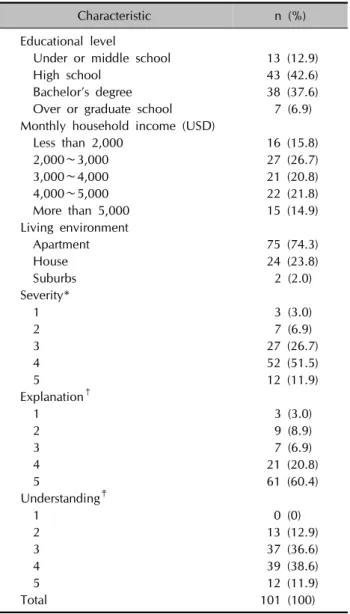
One hundred and one patients (45 men and 56 women) with urticaria were included in the study. The mean age of the patients was 31.5±15.9 years. Owing to the existence of multiple positive allergens in one patient, 144 different data, which were divided into 3 subgroups (n=51, food allergens; n=17, pollen allergens; and n=76, aero-
allergens) according to the positive allergens, were analyzed. The demographic data of the subjects are shown in Table 2.
Patients’ self-assessment of the usefulness of the MAST- immunoblot assay
The survey included questions concerning the patients’
belief in the reliability of the test. The participants were asked whether they believed that avoidance against pos- itive allergens affected the course and prognosis of their disease. Among the participants, 13.9% responded that there was a strong correlation between avoidance success and disease prognosis. On the other hand, 16.7% an- swered that avoidance against positive allergens had no effect on the prognosis. Patients’ willingness to recom-
Table 2. Demographic and clinical data of the subjects
Characteristic n (%)
Educational level
Under or middle school 13 (12.9)
High school 43 (42.6)
Bachelor’s degree 38 (37.6)
Over or graduate school 7 (6.9) Monthly household income (USD)
Less than 2,000 16 (15.8)
2,000∼3,000 27 (26.7)
3,000∼4,000 21 (20.8)
4,000∼5,000 22 (21.8)
More than 5,000 15 (14.9)
Living environment
Apartment 75 (74.3)
House 24 (23.8)
Suburbs 2 (2.0)
Severity*
1 3 (3.0)
2 7 (6.9)
3 27 (26.7)
4 52 (51.5)
5 12 (11.9)
Explanation†
1 3 (3.0)
2 9 (8.9)
3 7 (6.9)
4 21 (20.8)
5 61 (60.4)
Understanding‡
1 0 (0)
2 13 (12.9)
3 37 (36.6)
4 39 (38.6)
5 12 (11.9)
Total 101 (100)
USD: United States dollar. *Severity of urticaria. 1: mild, 2: mild to moderate, 3: moderate, 4: moderate to severe, 5: severe.
†Degree of explanation about the test by the physician. 1: not explained at all, 2: little explained 3: explained to some degree, 4: mostly explained, 5: fully explained. ‡Degree of understan- ding about the test. 1: not understood at all, 2: little understood, 3: understood to some degree, 4: mostly understood, 5: fully understood.
mend the MAST to other patients seeking the cause of their disease was also determined. Among the partic- ipants, 44.6% answered that they were willing to recom- mend the test to other patients with urticarial.
Avoidance behavior against positive allergens
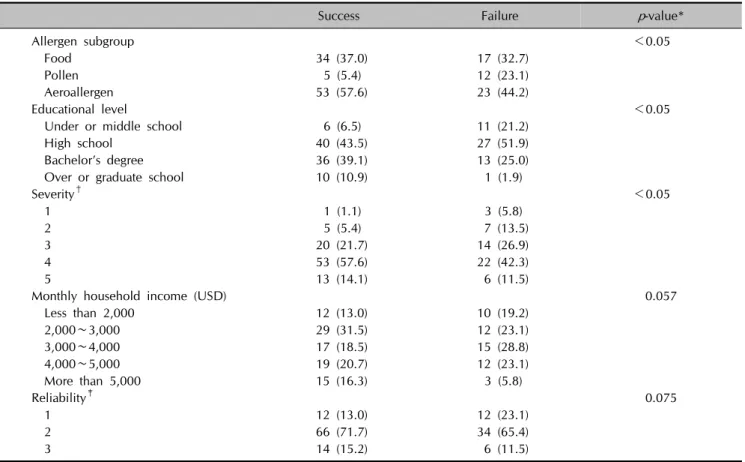
The success or failure of avoidance against positive aller- gens after MAST was determined. The patients who an- swered that they succeeded in avoiding positive allergens accounted for 63.9%, whereas the rest responded that
they failed. The patients who showed positivity to pollen allergens showed significantly higher avoidance failure rate than those who showed positivity to food allergens or aeroallergens (p<0.05, Table 3).
Relevant determining factors of success or failure of avoidance against positive allergens
We statistically analyzed the determining factors of avoid- ance success or failure against positive allergens with a generalized estimating equation (Table 3). The educa- tional level and severity of urticaria were associated with avoidance success or failure. Patients with a higher educa- tional level avoided positive allergens more successfully (p<0.05). Furthermore, the patients with more severe urti- caria were likely to avoid positive allergens successfully (p
<0.05). Household income level and reliability on the test showed borderline correlations in terms of their rele- vance to avoidance success/failure (p=0.057 and p= 0.075, respectively).
DISCUSSION
The association between IgE level and allergic diseases has been well studied. In-vitro laboratory tests to detect se- rum IgE are frequently performed for the diagnosis of aller- gic diseases. Allergen-specific IgE level has a significant value because it is directly associated with occurrence and exacerbation of allergic diseases6,7. In the last few deca- des, many of the pathomechanisms involved in urticaria have been discovered and evidence of the heterogeneity of urticaria has been accumulated8. In spite of the hetero- geneous pathogenesis of urticaria, IgE-mediated allergic reaction is frequently considered, especially in acute urticaria. Identifying causative factors is crucial for the di- agnosis and treatment of urticaria because it can greatly influence the duration of and patient compliance with treatment. If careful history taking and physical examina- tion are not sufficient to reveal the possible eliciting fac- tors, searching for IgE-mediated allergy is known to be helpful in determining eliciting factors of patients with ur- ticaria and is actually widely adapted by physicians when they treat patients with urticaria2.
The MAST-immunoblot assay, an in-vitro test for identify- ing multiple allergens simultaneously, was recently in- troduced and is being used with increasing frequency by virtue of its convenience9. As a part of diagnosing and identifying the causes of urticaria, clinicians frequently check whether patients have associated allergens with a MAST in addition to history taking and physical examina- tion. However, how patients with urticaria avoid positive allergens in real life after obtaining MAST results about
Table 3. Factors associated with avoidance success/failure against positive allergens
Success Failure p-value*
Allergen subgroup <0.05
Food 34 (37.0) 17 (32.7)
Pollen 5 (5.4) 12 (23.1)
Aeroallergen 53 (57.6) 23 (44.2)
Educational level <0.05
Under or middle school 6 (6.5) 11 (21.2)
High school 40 (43.5) 27 (51.9)
Bachelor’s degree 36 (39.1) 13 (25.0)
Over or graduate school 10 (10.9) 1 (1.9)
Severity† <0.05
1 1 (1.1) 3 (5.8)
2 5 (5.4) 7 (13.5)
3 20 (21.7) 14 (26.9)
4 53 (57.6) 22 (42.3)
5 13 (14.1) 6 (11.5)
Monthly household income (USD) 0.057
Less than 2,000 12 (13.0) 10 (19.2)
2,000∼3,000 29 (31.5) 12 (23.1)
3,000∼4,000 17 (18.5) 15 (28.8)
4,000∼5,000 19 (20.7) 12 (23.1)
More than 5,000 15 (16.3) 3 (5.8)
Reliability‡ 0.075
1 12 (13.0) 12 (23.1)
2 66 (71.7) 34 (65.4)
3 14 (15.2) 6 (11.5)
Values are presented as number (%). USD: United States dollar. *p<0.05 is considered statistically significant. †Severity of urticaria.
1: mild, 2: mild to moderate, 3: moderate, 4: moderate to severe, 5: severe. ‡Reliability on the test results. 1: not relied on, 2:
moderately relied on, 3: fully relied on.
possible susceptible allergens is controversial, and no studies have been conducted to investigate this issue. In this study, we analyzed the avoidance behavior of patients with urticaria against positive allergens after a MAST to identify variables that determine the success or failure of avoidance after patients obtain information about the aller- gens to which they are susceptible.
Several of the findings in the present study will likely be useful for clinicians treating patients with urticaria. First, the types of allergen were divided into food allergens, pol- len allergens, and aeroallergens. Patients who had pos- itivity for pollen allergens showed a significantly higher avoidance failure rate than those with positivity for food allergens or aeroallergens, which largely seems to be due to the practical difficulties of avoiding an air-borne ubiq- uitous allergen. Pollens can be categorized into tree pol- lens (e.g., birch and oak) and weed pollens (e.g., mug- wort, ragweed, and Humulus japonicus). They display seasonal distributions depending on their flowering period. Recently, changes in climate such as global warm- ing appear to have altered the spatial distribution of pol- lens, and contributed to an increased risk of allergic dis-
eases10,11. It also seems that pollens interact with air pollu- tion and, this increases the rate of pollen-induced allergic diseases10. Methods to avoid pollen allergens may include refraining from going outside during seasons in which causative allergens commonly occur, closing windows to prevent allergens from entering, or not going to mountains or parks. However, avoidance is not easy in reality.
Second, patients with a higher educational level were like- ly to avoid positive allergens more successfully (p<0.05).
This result seems to be based on the difference in the pa- tients’ understanding about the disease and allergen-spe- cific IgE screening test depending on the educational lev- el, which allows us to conclude that clinicians should pro- vide detailed explanations about the disease and avoid- ance methods after the test for patients with lower educa- tional levels.
Lastly, self-reported severity of urticaria appeared to be rel- evant to avoidance success/failure. The patients with more severe urticaria tended to more successfully avoid positive allergens (p<0.05). Kim et al.12 reported no correlation between MAST results and the clinical severity of chronic urticaria. However, we can assume that patients who
think they have a more severe disease are more motivated to rely on the MAST results to improve their symptoms, ir- respective of the subsequent outcome.
Although not reaching the statistical level of significance, patients with a higher household income and greater be- lief in the reliability of the MAST results were more likely to avoid positive allergens. On the question to evaluate how much the patients believe in the usefulness of the al- lergen-specific IgE screening test, only 13.9% of the pa- tients responded that they believed there was a correlation between their avoidance behavior and prognosis of their urticaria. This means that the self-assessment by patients regarding the usefulness of the allergen-specific IgE screening test was low, which allows us to assume that improving the reliability of the test would improve pa- tients’ avoidance behavior against susceptible allergens.
Furthermore, this result is attributed to the fact that while allergy to a particular antigen may become a cause of urti- caria, other various pathogenic factors can also cause urti- caria, and the causes are uncertain in many cases.
This study has several limitations that should be consid- ered when interpreting the results. The responses to the questionnaires depended on patient recall. For children who might not have been able to understand the ques- tionnaire, their parents completed the questionnaire, po- tentially creating a gap between the responses and real avoidance behaviors. Finally, because the study was per- formed in a single center, the results might not reflect lo- cal differences such as residential environment or eco- nomic level.
In conclusion, the authors conducted a survey of 101 pa- tients diagnosed with urticaria and showed positive aller- gens in the MAST-immunoblot assay. The avoidance be- havior against each positive allergen, and the determining factors of avoidance success or failure were analyzed. The results of this study showed a difference in avoidance be- havior depending on the type of allergen, patient educa- tional level, and severity of urticaria. This research is meaningful in that it is the first study to evaluate the effect of an allergen-specific IgE screening test on patient avoid- ance behavior against positive allergens in real life, and to analyze relevant determining factors of avoidance suc- cess/failure among the multiple patient-related variables.
We expect that this study can be used as a source to which clinicians can refer when they treat patients with
urticaria and perform allergen-specific IgE screening tests in the future. Further multi-center studies involving a larg- er population and additional variables are required to ver- ify our findings.
REFERENCES
1. Monroe EW, Jones HE. Urticaria. An updated review. Arch Dermatol 1977;113:80-90.
2. Zuberbier T, Aberer W, Asero R, Bindslev-Jensen C, Brzoza Z, Canonica GW, et al; European Academy of Allergy and Clinical Immunology; Global Allergy and Asthma European Network; European Dermatology Forum; World Allergy Organization. The EAACI/GA(2) LEN/EDF/WAO Guideline for the definition, classification, diagnosis, and management of urticaria: the 2013 revision and update. Allergy 2014;69:
868-887.
3. Shin JW, Jin SP, Lee JH, Cho S. Analysis of MAST-CLA results as a diagnostic tool in allergic skin diseases. Ann Dermatol 2010;22:35-40.
4. Oh EJ, Lee SA, Lim J, Park YJ, Han K, Kim Y. Detection of allergen specific IgE by AdvanSure Allergy Screen test.
Korean J Lab Med 2010;30:420-431.
5. Lee JH, Park KH, Kim HS, Kim KW, Sohn MH, Kim CH, et al. Specific IgE measurement using AdvanSure® system:
comparison of detection performance with ImmunoCAP®
system in Korean allergy patients. Clin Chim Acta 2012;
413:914-919.
6. Jung HJ, Park MY, Youn JI, Ahn JY. Usefulness of the MAST in allergic skin diseases. Korean J Dermatol 2014;52:387- 393.
7. Jung SW, Oh EJ, Lee J, Kim Y, Kim SY, Kim Y, et al. Use- fulness of total IgE in predicting positive allergen specific IgE Tests in Korean subjects. Korean J Lab Med 2010;
30:660-667.
8. Zuberbier T, Maurer M. Urticaria: current opinions about etiology, diagnosis and therapy. Acta Derm Venereol 2007;87:196-205.
9. Lim HS, Kim HS, Oh H. Current status of serum allergen tests in Korea. Korean J Lab Med 2008;28:124-129.
10. D'Amato G, Cecchi L, Bonini S, Nunes C, Annesi-Maesano I, Behrendt H, et al. Allergenic pollen and pollen allergy in Europe. Allergy 2007;62:976-990.
11. Beggs PJ. Impacts of climate change on aeroallergens: past and future. Clin Exp Allergy 2004;34:1507-1513.
12. Kim TH, Lee GY, Kim KJ. Correlation between results of the multiple allergosorbent test-chemiluminescent assay (MAST- CLA) and clinical severity of chronic urticaria. Korean J Dermatol 2009;47:911-917.