INTRODUCTION
Worldwide, less than 2% of new cancer diagnoses are of the brain and central nervous system [1,2]. Five-year survival rates among brain cancer patients have been reported as a little over
Genomic and Molecular Characterization of Brain Tumors in Asian and Non-Asian Patients of Los Angeles:
A Single Institution Analysis
Courtney Duong
1, Thien Nguyen
1, John P. Sheppard
1, Vera Ong
1, Lawrance K. Chung
1, Daniel T. Nagasawa
1, Isaac Yang
1-6Departments of 1Neurosurgery, 2Radiation Oncology, 3Head and Neck Surgery, David Geffen School of Medicine at University of California, Los Angeles (UCLA), Los Angeles, CA, USA
4Jonsson Comprehensive Cancer Center, 5Los Angeles Biomedical Research Institute, 6Harbor-UCLA Medical Center, David Geffen School of Medicine at University of California, Los Angeles (UCLA), Los Angeles, CA, USA
Received August 23, 2017 Revised August 24, 2017 Accepted September 21, 2017 Correspondence
Isaac Yang
Department of Neurosurgery, Radiation Oncology,
University of California, Los Angeles, 300 Stein Plaza, Suite 562, Los Angeles, CA 90095-6901, USA
Tel: +1-310-267-2621 Fax: +1-310-825-9384 E-mail: [email protected]
Background Worldwide, approximately 2% of new cancers are of the brain. Five-year survival rates among brain cancer patients have been reported as a little over a third. Differences in clinical outcomes between brain tumor patients of different races remain poorly understood.
Methods A retrospective chart review was performed on brain tumor resection patients≥18 years old. Demographics, treatment variables, and survival outcomes were collected. Primary outcomes were length of stay, recurrence rate, progression-free survival (PFS), and overall survival (OS).
Results A total of 452 patients were included in analysis. Females and males had nearly a 1:1 ratio (n=242 and n=220, respectively). Mean age was 54.8 years (SD: 14.5 range: 18-90). Females composed 69% (n=48) of Asian patients; males constituted 31% (n=22). Mean age of the Asian pa- tients was 55.9 years (SD: 14.6 range: 26-89). Asian-only cohort tumor pathologies included glioblas- toma (GBM) (n=14), high-grade glioma (n=7), low-grade glioma (n=4), meningioma (n=38), and metas- tases (n=7). Of the 185 meningioma patients, non-Asian patients comprised 79% of the group (n=146).
Of the 65 GBM patients in total, non-Asian patients made up 89% of the GBM cohort (n=58). There were no statistically significant differences between these groups of both cohorts in recurrence (p=
0.1580 and p=0.6294, respectively), PFS (p=0.9662 and p=0.4048, respectively), or OS (p=0.3711 and p=0.8183, respectively).
Conclusion Studies evaluating the survival between patients of different racial backgrounds against several tumor varieties are rare. Patients of certain racial backgrounds may need additional consider- ation when being attended to despite the same mutational composition as their counterparts. Repeated studies using national databases may yield more conclusive results.
Key Words Biomarkers; Race; Glioblastoma; Meningioma; Brain neoplasms.
a third, a mortality rate twenty-five times that of its incidence [2]. Comparatively, breast cancer’s 5-year survival rates have been reported as over 80% despite having a higher incidence rate than brain cancer [2,3].
Brain tumor epidemiology in specific races has been docu- mented, and studies into the mechanisms of mutation by race and pathology are well-established [1,4-31]. However, differ- ences in clinical outcomes between brain tumor patients of dif- ferent races are still being elucidated [25,32,33]. A prior study showed a higher probability of worse outcomes in Asian/Pacif-
This is an Open Access article distributed under the terms of the Creative Commons Attribution Non-Commercial License (http://creativecommons.org/licenses/by-nc/4.0) which permits unrestricted non-commercial use, distribution, and reproduction in any medium, provided the original work is properly cited.
Copyright © 2017 The Korean Brain Tumor Society, The Korean Society for Neuro- Oncology, and The Korean Society for Pediatric Neuro-Oncology
ic Islanders than in their white counterparts [25]. While these reports evaluated outcomes in a single tumor pathology, stud- ies evaluating the survival between patients of different racial backgrounds against several tumor types are rare.
To optimize treatment for patients with brain tumors, racial differences in progression-free survival (PFS) and overall sur- vival (OS) should be considered. Patients of certain racial back- grounds may need additional consideration despite identical mutational composition as their counterparts because of differ- ent underlying genotypic variations [33]. Compared to the white population, the Asian cohort had a higher incidence of isocitrate dehydrogenase (IDH), suggesting additional consideration for glioblastoma (GBM) treatment in Asian patients [33]. The ma- jority of existing studies focus on Asian populations, who com- pose 5.6% (n=17,320,856) of the total United States population [5,25,34-36]. At our institution, Asians comprise over 10% of the brain tumor population, nearly double the national percentage [37]. To further explore differences within this population group, we assessed differences in genetic markers and survival outcomes in patients of either Asian or non-Asian descent diag- nosed with brain tumors.
MaTeRIals aND MeThODs Inclusion criteria
A retrospective chart review was performed. Patients who had undergone brain tumor resection from March 2013 (year in which the electronic chart system was established at our in- stitution) through January 2017 were included. Patients with
“unknown” race were excluded. This study was approved by our center’s Medical Institutional Review Board.
Data collection
Patient demographics (age, sex, race, and ethnicity), treat- ment variables, and survival outcomes were collected. The entire population was stratified by race, with the subgroups as
“white,” “black,” “Hispanic or Latino,” and “Asian.” Patients in the Asian category were separately grouped by ethnicity. Cat- egorization was chosen based on examples from the most re- cent United States Census Bureau data [36,37]. Treatment vari- ables included operation duration, extent of resection (gathered from operative report), chemotherapy, and radiation modality and dosage. Primary outcomes were length of stay, discharge disposition, recurrence rate, PFS, and OS.
Mutational statuses and diagnoses were gathered from pa- thology reports. For patients diagnosed with GBM specifically, statuses were gathered for IDH, phosphate and tensin homo- logue (PTEN), tumor protein p53 (p53), chromosome 1p and chromosome 19q (1p/19q), epidermal growth factor receptor (EGFR), type III epidermal growth factor receptor (EGFRvIII),
overall antigen Ki-67 (Ki67) percentages, and methylation mutational statuses. World Health Organization (WHO) grade, glial fibrillary acidic protein (GFAP), epithelial mem- brane antigen (EMA), and S100 mutational statuses were ac- cumulated for meningioma patients. Patients were then orga- nized by tumor histological subtype.
statistical analysis
Wilcoxon signed-rank and Pearson’s tests were performed.
Correlation analyses were performed to identify relationships between race and all variables of interest for GBM and me- ningioma patients. Statistical analyses were performed using SAS, version 9.3 (SAS Institute, Cary, NC, USA). A p-value less than 0.05 was considered statistically significant.
ResUlTs
General population
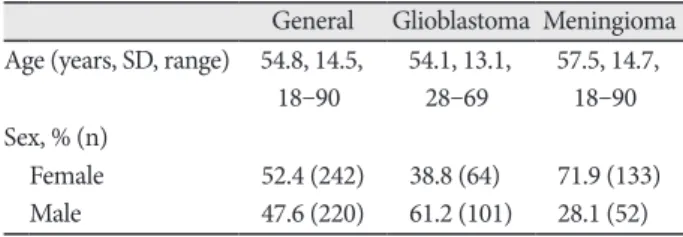
A total of 452 patients were included in the study. Demo- graphics of both cohorts are summarized in Table 1. Whites comprised 71% of the cohort (n=323), Asian 16% (n=70), Hispanic or Latino 9% (n=40), black 4% (n=18), and unspeci- fied 0.2% (n=1). Pathologies stratified by race are summarized in Table 2. The Asian-only population consisted of: Filipino 17% (n=12), Chinese 14% (n=10), Korean 10% (n=7), Viet- namese 4% (n=3), Pacific Islander 3% (n=2), Japanese 3%
(n=2), Burmese 1% (n=1), and unspecified 47% (n=33). Tu- mor pathologies in the Asian-only cohorts included are sum- marized in Table 3.
Glioblastoma
We identified 65 GBM patients in total across all races. Of patients diagnosed with GBM, non-Asian patients comprised 89% of the cohort (n=58) with the remaining 11% (n=7) be- ing Asian patients. There were no statistically significant dif- ferences between the groups in PTEN loss (p=0.705), p53 (p=0.086), 1p/19q loss (p=0.282), EGFR amplification (p=
0.709), EGFRvIII (p=0.118), overall Ki67 (p=0.695), O6-meth- ylguanine methyltransferase (MGMT) gene promoter meth- ylation status (p=0.090), or other gathered variables (Table 4).
Table 1. Demographics of all populations
General Glioblastoma Meningioma Age (years, SD, range) 54.8, 14.5,
18–90
54.1, 13.1, 28–69
57.5, 14.7, 18–90 Sex, % (n)
Female 52.4 (242) 38.8 (64) 71.9 (133)
Male 47.6 (220) 61.2 (101) 28.1 (52)
SD, standard deviation
dence of tumor pathology was not statistically different be- tween races. In that report, even when stratified by age, there were no significant differences or correlations between race and tumor pathology [4].
In our patients with GBM, there was no significant differ- ence between Asians and non-Asians for any of our variables.
PFS and OS between the two groups were not statistically dis- tinct from one another. There are several studies that docu- ment the mutational statuses of GBM, with some demonstrat- ing disparities in PFS and OS between races [23,25,26,28,32,33, 35,43-68]. Dai et al. [33] performed a meta-analysis of GBM patients which included studies from Europe, North America, and Asia. In their study of 3,464 patients, IDH mutation asso- ciated mortality rate decreased nearly two times more in Euro- Meningioma
A total of 185 meningioma patients were included. Non- Asian patients comprised 79% of the group (n=146) while Asian patients composed the last 21% of meningioma pa- tients (n=39). There were no statistically significant differenc- es between these groups in WHO grade (p=0.643), histologi- cal subtype (p=0.783), GFAP (p=0.197), EMA (p=0.057), S100 (p=0.549), Ki67 (p=0.592), or other collected variables (Table 4).
DIsCUssION
Differences in races, specifically Asians in contrast to other groups, in respect to brain tumor epidemiology has already been well studied [1,4-31]. Due to the considerable Asian pa- tient population at our institution, we endeavored to compare races within the cohort. We performed a retrospective chart analysis of patients, who underwent brain tumor resection at our institution. Race and all collected variables were tested in both GBM and meningioma patients. Survival outcomes were measured in those two cohorts against our collected variables.
Though several studies have reported significant proclivi- ties between tumor pathologies and certain races, there were no statistically significant differences between race and tumor pathologies in our population cohort [1,4-31,38-42]. Maile et al. [8] studied 35,663 patients in England and found that the general white population had the highest occurrence of GBM among other races. They also reported Pakistanis had two times the incidence of brain neoplasms compared to that of Bangladeshis (p<0.001) [8]. However Brown et al. [4] found that in a cohort of 2,096 pediatric patients, age-specific inci-
Table 3. Summary of pathologies by Asian ethnicityPathology Race
Pacific Islander Burmese Korean Filipino Vietnamese Chinese Japanese Unspecified
GBM/gliosarcoma 0 (0) 0 (0) 2.86 (2) 2.86 (2) 1.43 (1) 2.86 (2) 0 (0) 10.00 (7)
Low-grade glioma 1.43 (1) 0 (0) 0 (0) 0 (0) 0 (0) 0 (0) 0 (0) 4.29 (3)
High-grade glioma 1.43 (1) 0 (0) 0 (0) 1.43 (1) 0 (0) 0 (0) 0 (0) 7.14 (5)
Meningioma 0 (0) 1.43 (1) 7.14 (5) 11.83 (8) 1.43 (1) 10.00 (7) 2.86 (2) 20.00 (14)
Metastases 0 (0) 0 (0) 0 (0) 1.43 (1) 1.43 (1) 1.43 (1) 0 (0) 5.71 (4)
All values given in percentage and (n). GBM, glioblastoma
Table 4. Elements investigated in pathology cohorts Glioblastoma
p-values
Meningioma p-values
Age 0.0703 0.3581
Sex 0.0986 0.7487
Chemotherapy 0.2547 0.9903
Radiation 0.6093 0.5779
Surgery duration 0.5631 0.3395
Extent of resection 0.2671 0.0918
Length of stay 0.3900 0.1118
Discharge disposition 0.2397 0.8238
Follow up duration 0.8293 0.4121
Recurrence 0.6294 0.1580
Progression-free survival 0.4048 0.9662
Overall survival 0.8183 0.3711
Table 2. Summary of pathologies by race
Pathology Race
White or Caucasian Black or African American Hispanic or Latino Asian
GBM/gliosarcoma 30.5 (141) 0.2 (1) 3.1 (14) 3.1 (14)
Low-grade glioma 5.8 (27) 0 (0) 0 (0) 0.9 (4)
High-grade glioma 8.2 (38) 0.2 (1) 0 (0) 1.5 (7)
Meningioma 22.9 (106) 3.1 (14) 5.6 (26) 8.4 (38)
Metastases 2.4 (11) 0.4 (2) 0 (0) 1.5 (7)
All values given in percentage and (n). GBM, glioblastoma
pean populations than it did in Asian populations [33]. Addi- tional multivariate analysis between race, treatment modalities, and mutational variation is one approach that warrants further study to understand PFS and OS. A study by Wu et al. [28] ex- amined MGMT methylation in GBM patients of different ethnic groups and found no statistically significant differences between these groups with mutational statuses and OS. Because MGMT methylation results in higher sensitivity to chemotherapeutic agents, the lack of differences between methylation scores of various ethnic groups should contribute to similar PFS or OS among races [69-72]. This is consistent with our analysis of races in the GBM population. Emerging racial disparities al- ready published in GBM patients could be used in large meta- analysis studies to continue this line of research.
In addition, we examined correlates between race and other prognostic markers in patients with meningioma. While we found no significant correlations, several studies show a pro- clivity of meningiomas with certain ethnicities [5,73-75]. Das et al. [5] published an article on 48,001 patients from a Singa- porean hospital and found that Chinese patients had the high- est rate of meningioma occurrence. According to their study, over 90% of their malignant meningiomas were expressed in Chinese patients [5]. Despite the ethnic propensity for me- ningioma they found, PFS and OS in patients are comparable between ethnicities [5]. Analyses of mutational statuses and their effects as confounding factors in the survival outcomes of these patients propose a valid area of research that should be ex- plored more in depth. This model of analysis has already been well-applied to GBM research.
Our study was a retrospective review, which incurs several limitations. Data was gathered in a limited setting; therefore, the tested variables are not as homogenous as a prospective study. Patients with unspecified race or unknown mutational statuses, although still included here, could not be further dis- tinguished. Additionally, we reported from a single institution, while several similar studies acquired their cohort from a large, national database [6-8,13,25,32,34,38,61,76]. Therefore, our sample population may be limited in both size and location.
Socio-economic status of patients has been acknowledged to affect rates of brain tumor occurrence and may be a confound- ing variable [13,20-22,28,32,42,76-83]. While our analysis only used univariate statistics, future studies analyzing confound- ing factors, such as age, in survival rates are the next approach- es in identifying racial disparities.
Our single institution study facilitated the acquisition of so- cio-economic status, which in our future studies could eluci- date the role of socio-economic status on OS and PFS. Addi- tional multivariate analysis includes investigating the role of mutational statuses as confounding factors in race and survival outcome correlations. Racial disparities have been documented
in a few studies similar to the one performed by the authors.
Continued evaluation of those disparities is necessary to as- sure standardized treatment across all races.
In conclusion, while there are few studies assessing survival outcomes of different racial cohorts with various tumor pa- thologies, patients with the same mutational configuration may not have the same treatment response between varying racial backgrounds. Additional studies using larger cohorts, such as the Surveillance, Epidemiology, and End Results data- base, are necessary for more decisive results.
Conflicts of Interest
The authors have no financial conflicts of interest.
Acknowledgments
Lawrance K. Chung is supported by an American Medical Association 27 (AMA) Foundation Seed Grant and an AΩA Carolyn L. Kuckein Stu- dent Research Fellowship. Isaac Yang was partially supported by a Vision- ary Fund Grant, an Eli and Edythe Broad Center of Regenerative Medicine and Stem Cell Research UCLA Scholars in Translational Medicine Pro- gram Award, the Jason Dessel Memorial Seed grant, the UCLA Honberger Endowment Brain Tumor Research Seed Grant, and the STOP CANCER Research Career Development Award.
REFERENCES
1. Ferlay J, Soerjomataram I, Dikshit R, et al. Cancer incidence and mor- tality worldwide: sources, methods and major patterns in GLOBO- CAN 2012. Int J Cancer 2015;136:E359-86.
2. Howlader N, Noone AM, Krapcho M, et al. SEER Cancer Statistics Re- view (CSR) 1975-2014. Bethesda, MD: National Cancer Institute. (Ac- cessed July 28, 2017, at https://seer.cancer.gov/csr/1975_2014/).
3. Chen JG, Zhu J, Zhang YH, et al. Cancer survival in Qidong between 1972 and 2011: a population-based analysis. Mol Clin Oncol 2017;6:
944-54.
4. Brown M, Schrot R, Bauer K, Dodge J. Incidence of first primary cen- tral nervous system tumors in California, 2001-2005: children, adoles- cents and teens. J Neurooncol 2009;94:263-73.
5. Das A, Tang WY, Smith DR. Meningiomas in Singapore: demographic and biological characteristics. J Neurooncol 2000;47:153-60.
6. Dubrow R, Darefsky AS. Demographic variation in incidence of adult glioma by subtype, United States, 1992-2007. BMC Cancer 2011;11:325.
7. Gittleman H, Ostrom QT, Farah PD, et al. Descriptive epidemiology of pituitary tumors in the United States, 2004-2009. J Neurosurg 2014;121:
527-35.
8. Maile EJ, Barnes I, Finlayson AE, Sayeed S, Ali R. Nervous system and intracranial tumour incidence by ethnicity in England, 2001-2007: a descriptive epidemiological study. PLoS One 2016;11:e0154347.
9. Kohler BA, Ward E, McCarthy BJ, et al. Annual report to the nation on the status of cancer, 1975-2007, featuring tumors of the brain and other nervous system. J Natl Cancer Inst 2011;103:714-36.
10. Linabery AM, Ross JA. Trends in childhood cancer incidence in the U.S. (1992-2004). Cancer 2008;112:416-32.
11. Howard SC, Metzger ML, Wilimas JA, et al. Childhood cancer epide- miology in low-income countries. Cancer 2008;112:461-72.
12. Heshmat MY, Kovi J, Simpson C, Kennedy J, Fan KJ. Neoplasms of the central nervous system. Incidence and population selectivity in the Washington DC, metropolitan area. Cancer 1976;38:2135-42.
13. Ohgaki H, Kleihues P. Epidemiology and etiology of gliomas. Acta Neuropathol 2005;109:93-108.
14. Davis FG, McCarthy B, Jukich P. The descriptive epidemiology of brain tumors. Neuroimaging Clin N Am 1999;9:581-94.
15. Fan KJ, Pezeshkpour GH. Ethnic distribution of primary central ner- vous system tumors in Washington, DC, 1971 to 1985. J Natl Med Assoc 1992;84:858-63.
16. Jukich PJ, McCarthy BJ, Surawicz TS, Freels S, Davis FG. Trends in in- cidence of primary brain tumors in the United States, 1985-1994. Neu- ro Oncol 2001;3:141-51.
17. Kuratsu J, Takeshima H, Ushio Y. Trends in the incidence of primary in- tracranial tumors in Kumamoto, Japan. Int J Clin Oncol 2001;6:183-91.
18. McLendon RE, Robinson JS Jr, Chambers DB, Grufferman S, Burger PC. The glioblastoma multiforme in Georgia, 1977-1981. Cancer 1985;
56:894-7.
19. Stiller CA, Nectoux J. International incidence of childhood brain and spinal tumours. Int J Epidemiol 1994;23:458-64.
20. Deorah S, Lynch CF, Sibenaller ZA, Ryken TC. Trends in brain cancer incidence and survival in the United States: Surveillance, Epidemiology, and End Results Program, 1973 to 2001. Neurosurg Focus 2006;20:E1.
21. Chakrabarti I, Cockburn M, Cozen W, Wang YP, Preston-Martin S. A population-based description of glioblastoma multiforme in Los Ange- les County, 1974-1999. Cancer 2005;104:2798-806.
22. Preston-Martin S. Descriptive epidemiology of primary tumors of the brain, cranial nerves and cranial meninges in Los Angeles County.
Neuroepidemiology 1989;8:283-95.
23. Barnholtz-Sloan JS, Sloan AE, Schwartz AG. Racial differences in sur- vival after diagnosis with primary malignant brain tumor. Cancer 2003;
98:603-9.
24. Sadetzki S, Modan B, Chetrit A, Freedman L. An iatrogenic epidemic of benign meningioma. Am J Epidemiol 2000;151:266-72.
25. Thumma SR, Fairbanks RK, Lamoreaux WT, et al. Effect of pretreat- ment clinical factors on overall survival in glioblastoma multiforme: a Surveillance Epidemiology and End Results (SEER) population analysis.
World J Surg Oncol 2012;10:75.
26. Barnholtz-Sloan JS, Maldonado JL, Williams VL, et al. Racial/ethnic dif- ferences in survival among elderly patients with a primary glioblastoma.
J Neurooncol 2007;85:171-80.
27. Robertson JT, Gunter BC, Somes GW. Racial differences in the inci- dence of gliomas: a retrospective study from Memphis, Tennessee. Br J Neurosurg 2002;16:562-6.
28. Wu CC, Wang TJ, Jani A, et al. A modern radiotherapy series of surviv- al in Hispanic patients with glioblastoma. World Neurosurg 2016;88:
260-9.
29. Sze M, Butow P, Bell M, et al. Migrant health in cancer: outcome dis- parities and the determinant role of migrant-specific variables. Oncolo- gist 2015;20:523-31.
30. Grenade C, Phelps MA, Villalona-Calero MA. Race and ethnicity in cancer therapy: what have we learned? Clin Pharmacol Ther 2014;95:
403-12.
31. Allard JE, Maxwell GL. Race disparities between black and white wom- en in the incidence, treatment, and prognosis of endometrial cancer.
Cancer Control 2009;16:53-6.
32. Aizer AA, Ancukiewicz M, Nguyen PL, Shih HA, Loeffler JS, Oh KS.
Underutilization of radiation therapy in patients with glioblastoma:
predictive factors and outcomes. Cancer 2014;120:238-43.
33. Dai Y, Ning X, Han G, Li W. Assessment of the association between isocitrate dehydrogenase 1 mutation and mortality risk of glioblastoma patients. Mol Neurobiol 2016;53:1501-8.
34. Jung KW, Yoo H, Kong HJ, Won YJ, Park S, Lee SH. Population-based survival data for brain tumors in Korea. J Neurooncol 2012;109:301-7.
35. Mukasa A, Takayanagi S, Saito K, et al. Significance of IDH mutations varies with tumor histology, grade, and genetics in Japanese glioma pa- tients. Cancer Sci 2012;103:587-92.
36. Hoeffel EM, Rastogi S, Kim MO, Shahid H. The Asian population: 2010.
US census bureau, 2010. (Accessed March 23, 2016, at https://www.cen- sus.gov/prod/cen2010/briefs/c2010br-11.pdf).
37. Humes KR, Jones NA, Ramirez RR. Overview of Race and Hispanic Origin: 2010. US census bureau, 2010. (Accessed March 23, 2016, at
https://www.census.gov/prod/cen2010/briefs/c2010br-02.pdf).
38. Nomura K. Epidemiology of germ cell tumors in Asia of pineal region tumor. J Neurooncol 2001;54:211-7.
39. Araki C, Matsumoto S. Statistical reevaluation of pinealoma and related tumors in Japan. J Neurosurg 1969;30:146-9.
40. Oi S, Matsuzawa K, Choi JU, Kim DS, Kang JK, Cho BK. Identical char- acteristics of the patient populations with pineal region tumors in Japan and in Korea and therapeutic modalities. Childs Nerv Syst 1998;14:36- 41. Surawicz TS, Davis F, Freels S, Laws ER Jr, Menck HR. Brain tumor sur-40.
vival: results from the National Cancer Data Base. J Neurooncol 1998;
40:151-60.
42. Ostrom QT, Gittleman H, Xu J, et al. CBTRUS statistical report: prima- ry brain and other central nervous system tumors diagnosed in the United States in 2009-2013. Neuro Oncol 2016;18(suppl_5):v1-75.
43. Sanson M, Marie Y, Paris S, et al. Isocitrate dehydrogenase 1 codon 132 mutation is an important prognostic biomarker in gliomas. J Clin On- col 20091;27:4150-4.
44. Weller M, Felsberg J, Hartmann C, et al. Molecular predictors of pro- gression-free and overall survival in patients with newly diagnosed glioblastoma: a prospective translational study of the German Glioma Network. J Clin Oncol 2009;27:5743-50.
45. Hartmann C, Hentschel B, Wick W, et al. Patients with IDH1 wild type anaplastic astrocytomas exhibit worse prognosis than IDH1-mutated glioblastomas, and IDH1 mutation status accounts for the unfavorable prognostic effect of higher age: implications for classification of glio- mas. Acta Neuropathol 2010;120:707-18.
46. Parsons DW, Jones S, Zhang X, et al. An integrated genomic analysis of human glioblastoma multiforme. Science 2008;321:1807-12.
47. Carrillo JA, Lai A, Nghiemphu PL, et al. Relationship between tumor enhancement, edema, IDH1 mutational status, MGMT promoter meth- ylation, and survival in glioblastoma. Am J Neuroradiol 2012;33:1349- 48. Juratli TA, Kirsch M, Geiger K, et al. The prognostic value of IDH mu-55.
tations and MGMT promoter status in secondary high-grade gliomas.
J Neurooncol 2012;110:325-33.
49. Phillips JJ, Aranda D, Ellison DW, et al. PDGFRA amplification is com- mon in pediatric and adult high-grade astrocytomas and identifies a poor prognostic group in IDH1 mutant glioblastoma. Brain Pathol 2013;23:
565-73.
50. Shin JH, Lee YS, Hong YK, Kang CS. Correlation between the prognos- tic value and the expression of the stem cell marker CD133 and isoci- trate dehydrogenase1 in glioblastomas. J Neurooncol 2013;115:333-41.
51. Labussière M, Boisselier B, Mokhtari K, et al. Combined analysis of TERT, EGFR, and IDH status defines distinct prognostic glioblastoma classes. Neurology 2014;83:1200-6.
52. Molenaar RJ, Verbaan D, Lamba S, et al. The combination of IDH1 mu- tations and MGMT methylation status predicts survival in glioblastoma better than either IDH1 or MGMT alone. Neuro Oncol 2014;16:1263- 53. Bleeker FE, Atai NA, Lamba S, et al. The prognostic IDH1( R132 ) mu-73.
tation is associated with reduced NADP+-dependent IDH activity in glioblastoma. Acta Neuropathol 2010;119:487-94.
54. Killela PJ, Pirozzi CJ, Healy P, et al. Mutations in IDH1, IDH2, and in the TERT promoter define clinically distinct subgroups of adult malig- nant gliomas. Oncotarget 2014;5:1515-25.
55. Castells X, Acebes JJ, Majós C, et al. Development of robust discriminant equations for assessing subtypes of glioblastoma biopsies. Br J Cancer 2012;106:1816-25.
56. Stancheva G, Goranova T, Laleva M, et al. IDH1/IDH2 but not TP53 mu- tations predict prognosis in Bulgarian glioblastoma patients. Biomed Res Int 2014;2014:654727.
57. Takahashi Y, Nakamura H, Makino K, et al. Prognostic value of isoci- trate dehydrogenase 1, O6-methylguanine-DNA methyltransferase pro- moter methylation, and 1p19q co-deletion in Japanese malignant glioma
patients. World J Surg Oncol 2013;11:284.
58. Wang XW, Boisselier B, Rossetto M, et al. Prognostic impact of the iso- citrate dehydrogenase 1 single-nucleotide polymorphism rs11554137 in malignant gliomas. Cancer 2013;119:806-13.
59. Yan W, Zhang W, You G, et al. Correlation of IDH1 mutation with clinicopathologic factors and prognosis in primary glioblastoma: a re- port of 118 patients from China. PLoS One 2012;7:e30339.
60. Zhang W, Zhang J, Yan W, et al. Whole-genome microRNA expression profiling identifies a 5-microRNA signature as a prognostic biomarker in Chinese patients with primary glioblastoma multiforme. Cancer 2013;
119:814-24.
61. Das A, Tan WL, Teo J, Smith DR. Glioblastoma multiforme in an Asian population: evidence for a distinct genetic pathway. J Neurooncol 2002;60:117-25.
62. Watanabe K, Tachibana O, Sata K, Yonekawa Y, Kleihues P, Ohgaki H.
Overexpression of the EGF receptor and p53 mutations are mutually exclusive in the evolution of primary and secondary glioblastomas.
Brain Pathol 1996;6:217-23; discussion 223-4.
63. Ng HK, Lo SY, Huang DP, Poon WS. Paraffin section p53 protein im- munohistochemistry in neuroectodermal tumors. Pathology 1994;26:
64. Wang Y, Pan L, Sheng XF, Chen S, Dai JZ. Nimotuzumab, a human-1-5.
ized monoclonal antibody specific for the EGFR, in combination with temozolomide and radiation therapy for newly diagnosed glioblasto- ma multiforme: first results in Chinese patients. Asia Pac J Clin Oncol 2016;12:e23-9.
65. Yang H, Wei D, Yang K, Tang W, Luo Y, Zhang J. The prognosis of MGMT promoter methylation in glioblastoma patients of different race: a meta-analysis. Neurochem Res 2014;39:2277-87.
66. Lehrer S, Green S, Ramanathan L, Rosenzweig K, Labombardi V. No consistent relationship of glioblastoma incidence and cytomegalovirus seropositivity in whites, blacks, and Hispanics. Anticancer Res 2012;32:
1113-5.
67. Krishnamachari B, Il’yasova D, Scheurer ME, et al. A pooled multisite analysis of the effects of atopic medical conditions in glioma risk in dif- ferent ethnic groups. Ann Epidemiol 2015;25:270-4.
68. Tang J, Shao W, Dorak MT, et al. Positive and negative associations of human leukocyte antigen variants with the onset and prognosis of adult glioblastoma multiforme. Cancer Epidemiol Biomarkers Prev 2005;
14:2040-4.
69. Esteller M, Hamilton SR, Burger PC, Baylin SB, Herman JG. Inactiva- tion of the DNA repair gene O6-methylguanine-DNA methyltransfer-
ase by promoter hypermethylation is a common event in primary hu- man neoplasia. Cancer Res 1999;59:793-7.
70. Hegi ME, Liu L, Herman JG, et al. Correlation of O6-methylguanine methyltransferase (MGMT) promoter methylation with clinical out- comes in glioblastoma and clinical strategies to modulate MGMT activ- ity. J Clin Oncol 2008;26:4189-99.
71. Kitange GJ, Carlson BL, Mladek AC, et al. Evaluation of MGMT pro- moter methylation status and correlation with temozolomide response in orthotopic glioblastoma xenograft model. J Neurooncol 2009;92:23- 72. Amatu A, Sartore-Bianchi A, Moutinho C, et al. Promoter CpG island 31.
hypermethylation of the DNA repair enzyme MGMT predicts clinical response to dacarbazine in a phase II study for metastatic colorectal cancer. Clin Cancer Res 2013;19:2265-72.
73. Kepes J. Meningiomas. Biology, Pathology and Differential Diagnosis.
New York: Masson; 1982.
74. Bondy M, Ligon BL. Epidemiology and etiology of intracranial menin- giomas: a review. J Neurooncol 1996;29:197-205.
75. Rachlin JR, Rosenblum ML. Etiology and biology of meningiomas. In:
Al-Mefty O, editor. Meningiomas. NY: Raven Press; 1991. p.27-35 76. Sadetzki S, Zach L, Chetrit A, et al. Epidemiology of gliomas in Israel: a
nationwide study. Neuroepidemiology 2008;31:264-9.
77. Pashaki AS, Hamed EA, Mohamadian K, Abassi M, Safaei AM, Torka- man T. Efficacy of high dose radiotherapy in post-operative treatment of glioblastoma multiform--a single institution report. Asian Pac J Can- cer Prev 2014;15:2793-6.
78. Gurney JG, Kadan-Lottick N. Brain and other central nervous system tumors: rates, trends, and epidemiology. Curr Opin Oncol 2001;13:160- 79. Ohgaki H, Kleihues P. Population-based studies on incidence, survival 6.
rates, and genetic alterations in astrocytic and oligodendroglial gliomas.
J Neuropathol Exp Neurol 2005;64:479-89.
80. Elia-Pasquet S, Provost D, Jaffré A, et al. Incidence of central nervous system tumors in Gironde, France. Neuroepidemiology 2004;23:110-7.
81. Fleury A, Menegoz F, Grosclaude P, et al. Descriptive epidemiology of cerebral gliomas in France. Cancer 1997;79:1195-202.
82. Iwamoto FM, Reiner AS, Nayak L, Panageas KS, Elkin EB, Abrey LE.
Prognosis and patterns of care in elderly patients with glioma. Cancer 2009;115:5534-40.
83. Formenti SC, Meyerowitz BE, Ell K, et al. Inadequate adherence to ra- diotherapy in Latina immigrants with carcinoma of the cervix. Poten- tial impact on disease free survival. Cancer 1995;75:1135-40.