
D I A B E T E S & M E T A B O L I S M J O U R N A L
This is an Open Access article distributed under the terms of the Creative Commons Attribution Non-Commercial License (https://creativecommons.org/licenses/by-nc/4.0/) which permits unrestricted non-commercial use, distribution, and reproduction in any medium, provided the original work is properly cited.
Combination of Probiotics and Salvia miltiorrhiza Polysaccharide Alleviates Hepatic Steatosis via Gut Microbiota Modulation and Insulin Resistance
Improvement in High Fat-Induced NAFLD Mice
Wei Wang1,2, Ai-Lei Xu2, Zheng-Chao Li1, Yi Li2, Shun-Fu Xu2, Hua-Chao Sang2, Fachao Zhi1
1 Guangdong Provincial Key Laboratory of Gastroenterology, Department of Gastroenterology, Institute of Gastroenterology of Guangdong Province, Nanfang Hospital, Southern Medical University, Guangzhou,
2Department of Gastroenterology, Sir Run Run Hospital, Nanjing Medical University, Nanjing, China
Background: Nonalcoholic fatty liver disease (NAFLD) increases the risk of hepatocellular carcinoma, which is currently the leading cause of obesity-related cancer deaths in middle-aged men.
Methods: Probiotics with lipid-lowering function were screened from the fecal microbiota of healthy adults. Polysaccharide from different sources was screened for improving insulin resistance. The combination of probiotics and Salvia miltiorrhiza polysac- charide (LBM) was investigated for alleviating hepatic steatosis.
Results: First, Bifidobacterium bifidum V (BbV) and Lactobacillus plantarum X (LpX) were obtained from the fecal microbiota of healthy adults. Second, to improve insulin resistance, a Salvia miltiorrhiza Bunge polysaccharide showing good performance in reducing insulin resistance was obtained. The liver total cholesterol (TC) and total triglyceride (TG) levels and the serum levels of free fatty acid, alanine transaminase, aspartate transaminase, low density lipoprotein cholesterol, TG, and TC can be significantly reduced through supplementation with LpX-BbV (LB) in NAFLD mice. Interestingly, the function of the probiotic LB can be en- hanced by S. miltiorrhiza Bunge polysaccharide. Furthermore, the gut microbiota was modulated by LpX-BbV+S. miltiorrhiza Bunge polysaccharide (LBM). The lipopolysaccharide concentration of the LBM group was decreased by 73.6% compared to the NAFLD group. Ultimately, the mRNA concentrations of the proinflammatory cytokines (tumor necrosis factor α, interleukin 1β [IL-1β], and IL-6) decreased with LB and LBM treatment.
Conclusion: The results of this this study indicate that the LBM combination can be used as a therapeutic for ameliorating NAFLD via modulating the gut microbiota and improving insulin resistance.
Keywords: Gastrointestinal microbiome; Insulin resistance; Non-alcoholic fatty liver disease; Probiotics
Corresponding author: Fachao Zhi https://orcid.org/0000-0001-8960-2312 Guangdong Provincial Key Laboratory of Gastroenterology, Department of Gastroenterology, Institute of Gastroenterology of Guangdong Province, Nanfang Hospital, Southern Medical University, Guangzhou, No. 1838, Guangzhou Avenue North Rd, Baiyun District, Guangzhou 510515, China
INTRODUCTION
Nonalcoholic fatty liver disease (NAFLD) is characterized by hepatic steatosis in the absence of a history of significant drink- ing (alcohol) or other known history liver diseases. NAFLD re- sembles alcohol-induced fatty liver damage, which can develop into nonalcoholic steatohepatitis (NASH) and, eventually, he-
patocellular carcinoma [1]. NAFLD is the most common cause of chronic liver disease worldwide. Approximately 20% to 30%
of adults in developed countries suffer from NAFLD [2], and the prevalence of NAFLD in obese adults and those suffering from type 2 diabetes mellitus has increased to 75% and 50% to 75%, respectively [3,4]. NAFLD is a multifactorial disease [5].
Inflammatory, environmental, metabolic, and various genetic https://doi.org/10.4093/dmj.2019.0042
pISSN 2233-6079 · eISSN 2233-6087
factors and diets (the most important factor) have been con- sidered in its pathogenesis. Up to 80% of obese people suffer from NAFLD disease [6,7]. NAFLD is a new challenge in the field of modern medicine. There are two routes to relieve NAFLD: one route is inhibiting triglyceride (TG) synthesis, and the other one is promoting the metabolism of TGs. Hepat- ic steatosis can be improved by inhibiting lipid synthesis and promoting fatty acid oxidation, especially β-oxidation [2].
NAFLD is an acquired metabolic stress-induced liver injury associated with insulin resistance and genetic susceptibility [8,9]. Endogenous ethanol [10], gut microbiota [5], and hepat- ic tumor necrosis factor α (TNF-α) [11] play important roles in the pathogenesis of NAFLD. Systemic inflammation can be induced by high-fat diets (HFDs); insulin resistance, weight gain, and nonalcoholic fatty liver can be caused by disturbed metabolic homeostasis and gut microbial derangements. In patients with fatty liver, intestinal bacterial overgrowth is com- mon [12,13]. Intestinal permeability is associated with a fatty liver. The risk of spontaneous bacterial peritonitis can be in- creased by the increased intestinal permeability [14]. In addi- tion, the bacterial endotoxin has been considered as a hepato- toxin [15], which is produced by gram-negative bacteria. Con- siderable evidence shows that the balance of gut microbiota and insulin resistance is considered a key role in the pathogen- esis of NAFLD and NASH [5,16].
Fortunately, accumulating evidence has shown that probiot- ics are able to inhibit harmful bacteria and improve gastroin- testinal barrier function [17]. In particular, various Lactobacilli isolates attenuated liver pathology via stabilization of the intesti- nal barrier and anti-inflammatory actions [18]. A study demon- strated that alanine transaminase (ALTase), aspartate transami- nase (ASTase), TNF-α, and total cholesterol (TC) of NAFLD patients were reduced by Lactobacillus, Bifidobacterium, and Streptococcus [19]. Previous studies found that the serum lipid profiles can be influenced by Lactobacillus and Bifidobacterium [20].
Probiotics should impart the ability to tolerate gastric acidity and bile toxicity, survive under stressed conditions of the intes- tine and have antimicrobial effects against pathogens [21]. In this study, we attempt to relieve NAFLD by blocking TG syn- thesis (or enhancing TG metabolism) and reducing insulin re- sistance. The probiotics from the fecal microbiota of healthy adults were screened for cholesterol and TG clearance. More- over, polysaccharides were also screened for insulin resistance improvement. We aim to quickly establish methods for probi-
otic screening, and the effect of a probiotic combination (Lacto- bacillus plantarum+Bifidobacterium bifidum+polysaccharide) on the mitigation of NAFLD was examined.
METHODS
Isolation of probiotics from fecal microbiota of healthy adults
Samples were collected from fecal microbiota in healthy adults.
To ensure general health, the vital signs of volunteers were as- sessed and inclusion criteria were as follows: (1) 20 to 30 years of age; (2) free of known gastrointestinal and metabolic diseas- es, no history of gastrointestinal or metabolic disorders; (3) avoid taking medications; (4) limit alcohol consumption; (5) agree to avoid any changes in chronic medications; (6) willing to fill out all necessary research questionnaires and donate stool specimens; and (7) voluntary signing of written informed consent prior to participation in the study. Stool samples were harvested in sterile transparent-glass tubes (20 mL) and stored at 4°C. Stools were diluted by 10−4 to 10−6 with sterilized saline.
Then, 50-μL dilutions were spread onto the MRS (de MAN, ROGOSA and SHARPE) broth, and MRSP (MRS broth was added with 1.8 mmol/L sodium thioglycolate, 2.8 mmol/L L- cysteine hydrochloride, and 0.9 mmol/L CaCl2) and M17 agar plates in anaerobic incubation at 37°C for 48 hours.
Probiotics and polysaccharide screening
The cholesterol-lowering capability of the candidate strains de- termined by the ferric ammonium sulfate [22,23]. Briefly, iso- lates were inoculated (1%, v/v) into MRSC broth (MRS broth supplemented with 1.0 g/L cholesterol) and incubated at 37°C for 48 hours anaerobically. Next, 200-μL cultures were mixed with 4,800 μL ethanol after incubation. Then, the cells were re- moved by centrifugation (4,500 rpm, 20 minutes) at 4°C. Next, 4 mL of supernatant was slowly added to 2 mL of ferric ammo- nium sulfate reagent (Aladdin, Shanghai, China) and mixed well. The absorbance of the supernatant was measured by a spectrophotometer (Shimadzu, Kyoto, Japan) at 560 nm. The uninoculated samples were used as a negative control. Choles- terol clearance (CC) was calculated by the following formula:
CC=[(Ao–A)/Ao]×100%, where Ao and A are the absorbance of uninoculated and inoculated samples, respectively.
The TG-reducing activity was tested according to the Sarava- nan and Ponmurugan [24] method. Isolates were inoculated (1%, v/v) into 25 mL of MRST broth (MRS broth supplemented
with 1.0 g/L TG) and incubated at 37°C for 48 hours. Samples cultured in MRS medium were used as a negative control. The supernatant of the cultures obtained by centrifugation (4,500 rpm, 20 minutes, 4°C) was saponified by adding 0.5 mL saponi- fication reagent (50 g of potassium hydroxide, 400 mL isopro- panol, 600 mL distilled water) followed by 0.5 mL of acetylace- tone reagent (0.75 mL of acetylacetone, 40 mL of isopropanol, 60 mL distilled water). Evenly mixed mixtures were kept at 65°C for 1 hour in an oil bath and cooled. The blank control and a series of standard concentrations of triolein were treated using the same method, and absorbance at 420 nm was read:
C×T=cholesterol reduction rate (%)×TG reduction rate (%).
Polysaccharides from Dendrobium officinale, Talinum trian- gulare, and other sources were prepared according to the re- port [25]. Briefly, the D. officinale or other medicinal plant powder (20 g) was boiled three times with 600 mL distilled water for 3 hours. The polysaccharide was obtained by ethanol precipitation. After an 8-hour fast, mice were injected with glucose (3 g/kg), and after 15 minutes of glucose loading, an equal amount of polysaccharides was given by intragastric ad- ministration for 4 weeks. After the last administration, all the mice were fasted strictly but allowed free access to water as usual for 4 hours. Blood was collected for measurement of fast- ing glucose and insulin levels 12 hours after the last polysac- charide administration.
An insulin enzyme-linked immunosorbent assay (ELISA) kit (TSZ, San Francisco, CA, USA) was used to determine the fasting insulin (FINS). To select the polysaccharide with a good performance on reducing insulin resistance, the insulin sensi- tivity index (ISI) was calculated according to the following for- mulas: ISI=Ln [1/(FBG×FINS)] [26,27], where FBG was the level of fasting blood glucose (mg/dL) and FINS was the level of FINS (mIU/L). The index of insulin resistance was calculat- ed by the following formulas [28]: homeostasis model assess- ment of insulin resistance (HOMA-IR)=FINS (mIU/L)×FBG (mmol/L)/22.5.
Screening and identification of the candidate strains The effect of bile salts on the growth of these tested strains was carried out using a method described by Bao et al. [29]. After culturing in MRS broth at 37°C for 12 hours, the bacterial con- centration was adjusted to 108 colony-forming unit (CFU)/mL.
Afterward, samples were inoculated into (1%, v/v) MRSB broth (MRS broth supplemented with 0.3% bile salts [oxgall]).
Samples inoculated into MRS broth were used as controls.
Strains were incubated anaerobically at 37°C for 24 hours. To monitor bacterial growth, the optical density (OD620nm) was measured with a spectrophotometer. Survival percentage (%)=S/So×100%, where S was the OD620nm of the MRSB cul- ture and So was the OD620nm of the MRS culture (control). Ge- nomic DNA of the strain was extracted and amplified by poly- merase chain reaction (PCR) according to the method of Huang et al. [30]. After cloning, the candidate strains were identified by DNA sequencing (Sangon Biotech, Shanghai, China) [31], and the sequence was compared to the National Center for Biotechnology Information (NCBI) database.
Oral glucose tolerance test and insulin tolerance test Oral glucose tolerance tests (OGTTs) were measured at 0 to 6 weeks after treatments. Glucose load (2.0 g/kg of body weight) was conducted after 12 hours of fasting by oral gavage. After glu- cose administration, blood samples were collected at 0, 15, 30, 60, 90, and 120 minutes. Concentrations of glucose were mea- sured, and the total glucose area under the curve (AUCglucose) were calculated. The insulin tolerance test (ITT) was complet- ed after 6 hours of fasting. Next, 1.5 IU/kg insulin was infused into mice, and glucose was measured intraperitoneally. The constant rate for glucose disappearance during the ITT (KITT) was calculated using the formula 0·693/t1/2, where t1/2 was cal- culated from the slope of the least square analysis of the blood glucose levels during the linear decay phase of decline.
Mice and treatments
Forty male C57BL/6N mice (pathogen-free) were purchased from the Shanghai Laboratory Animal Center (Shanghai, Chi- na). The average initial body weight of the mice was approxi- mately 18.5 g. The mice were housed in clean, sterile, polypro- pylene cages under controlled conditions with a room temper- ature of 20°C to 24°C and a cycle of 12/12 hours light-dark.
Moreover, the experimental group and the control group were housed under the same conditions. During the first week, all mice were fed the same normal diet (ND). Afterward, the mice were randomly divided into four groups (n=10/group). The ND group received the normal diet, while the HFD group re- ceived the HFD diet; the HFD+(L. plantarum X [LpX]-B. bifi- dum V [BbV] [LB]) group received an HFD diet supplemented with LB via intragastric administration, and the HFD+(LpX- BbV+Salvia miltiorrhiza Bunge polysaccharide [LBM]) group received an HFD supplemented with LBM via intragastric ad- ministration. LB was a mixture of 1×10⁸ CFU/mL of LpX and
2×10⁸ CFU/mL BbV; LBM was composed of LB (1×10⁸ CFU/
mL LpX+2×10⁸ CFU/mL BbV) plus S. miltiorrhiza Bunge polysaccharide (50 mg/kg/day). After 30 minutes of LB ad- ministration, S. miltiorrhiza Bunge polysaccharide was given by intragastric administration. After the end of the experi- ment, all mice were sacrificed after fasting for 12 hours. The mice’s livers were collected, weighed and stored at –80°C. For bacterial DNA and RNA extraction, the small intestinal and liver were frozen immediately in liquid nitrogen. All animal experiments were approved by the Ethics Committee of South- ern Medical University Affiliated Nanfang Hospital (approval no. 20180415-NF325). All animal treatments were carried out in accordance with the Guidelines on Care and Use of Labora- tory Animals issued by the Chinese Council on Animal Re- search and the Guidelines of Animal Care.
Measurement of biochemical parameters in the serum and liver
The mice were sacrificed by cervical dislocation. The mice’s liv- er homogenate (1 g of liver tissue and 10 mL of sterilizing sa- line) was added into Folch solution (chloroform: formalde- hyde=2:1 [v/v]), mixed well and centrifuged (4,500×g, 5 min- utes). The supernatant of the liver was collected. The levels of high density lipoprotein cholesterol (HDL-C) and TC, TG and ASTase activity and ALTase activity were determined using test kits (Biosino Biotechnology and Science Inc., Beijing, China).
Endotoxin levels (lipopolysaccharide [LPS]) were measured by using a limulus amebocyte lysate (LAL) assay endotoxin assay kit (Charles River Lab, Wilmington, MA, USA). The concen- trations of acetate and butyrate were analyzed by Agilent 1260 Infinity high-performance liquid chromatography (HPLC;
Agilent, Santa Clara, CA, USA) according to the report of Adler et al. [32].
Reverse-transcription quantitative polymerase chain reaction
Total RNA of the collected tissue was extracted by using a TranZol RNA Extraction Kit (Trans Gen Biotech, Beijing, Chi- na). Afterward, cDNA was obtained from the total RNA by re- verse transcription using a cDNA synthesis kit (Takara Bio, Dalian, China). Interleukin 1β (IL-1β), TNF-α, and IL-6 were completed by using SYBR premix from Takara Bio. Primer se- quences used for mRNA quantification are presented in Sup- plementary Table 1.
Sequences of the primers used in the lipid metabolism gene
detection are presented in Supplementary Table 2. Fecal DNA was isolated using the QIAmp DNA stool mini kit (Qiagen, Hilden, Germany). Quantitative PCR analysis was performed using different genus- and phyla-specific primers for different bacterial groups according to the Kump et al. [33].
Statistical analysis
The software package SPSS version 13.0 (SPSS Inc., Chicago, IL, USA) was used for data analysis. All data are presented as the mean±standard deviation, and statistical significance was performed by one-way analysis of variance (ANOVA) followed by least significant difference for multiple comparisons. P val- ues less than 0.05 were considered to be statistically significant.
RESULTS
Screening of probiotics from the fecal microbiota of healthy adults
High levels of cholesterol and TGs were associated with the formation of hyperlipidemia [34]. To obtain the strain with a highly effective lipid-lowering function, 47 candidates isolated from fecal samples were examined. The results are shown in Fig. 1A. Isolate V exhibited the highest activity on TG clear- ance (68% TG clearance, 25% CC). The IX isolate showed the highest activity on CC. Interestingly, isolate X exhibited out- standing performance, with cholesterol and TG clearance of 57% and 53%, respectively. The selected candidate isolates (X, IX, V) were cultured in the simulated gastric fluid. Fortunately, the survival rates of isolates V and X were up to 87.4% and 78.6%, respectively. However, the IX isolates had relatively low bile resistance (survival rates <20%). Meanwhile, ∆lag phase of the tested isolates was investigated. The results showed that the growth of isolates X was slower than that of isolates V with a long ∆lag phase of 2.1 hours (Fig. 1B). Based on the 16S rDNA sequence identification, strain V, X was B. bifidum and L. plantarum, respectively. To enhance the performances of the strains synergistically, the ratio of LB was optimized in vitro.
The result showed that the cholesterol-TG clearance rate was up to the highest with a C×T value of 0.47, while the ratio of LB was 1:2 (Fig. 1C).
Insulin resistance is a cardinal feature of NAFLD [35]. Insu- lin resistance plays an important role during the development of NAFLD and progression to NASH [36]. To increase insulin sensitivity, polysaccharides derived from different sources were screened. The results showed that most of the tested polysac-
70 60 50 40 30 20 10 0
0.7 0.6 0.5 0.4 0.3 0.2 0.1 0
HFD+tea HFD+S. miltiorrhiza HFD+A. membranaceus HFD+C. militaris HFD+M. charantia L.
HFD+P. linteus HFD+L. barbarum HFD+water Control
HFD+60 mg/kg/day M HFD+50 mg/kg/day M HFD+40 mg/kg/day M HFD+30 mg/kg/day M HFD+20 mg/kg/day M HFD ND
40 36 32 28 24 20 16
5 4 3 2 1 0
100 80 60 40 20 0
6.05.5 5.04.5 4.03.5 3.02.5 2.01.5 1.00.5 0
Cholesterol clearance (%)C×T Polysaccharide sources Body weight (g)
Food intake (g/wk) Surviving percentage (%) ∆Lag phase (hr)
0 10 20 30 40 50 60 70 Degradability of triglyceride (%)
3:1 2:1 1:1 1:2 1:3 1:4 −6 −5 −4 −3
−6 −5 −4 −3
LpX:BbV ISI
ISI value
0 1 2 3 4 5 6
1 2 3 4 5 6
Strain IX
Surviving percentage ∆Lag phase
Strain V Strain X
Time (wk)
Week
A
C D
E F
G
B
(%). The ISI was calculated according to the following formulas: ISI=Ln [1/(FBG×FINS)], where FBG was the level of fasting blood glucose (mmol/L) and FINS was the level of fasting insulin (mU/L). All measurements were taken in triplicate, and experi- ments were repeated three times to evaluate the standard deviation. LB, Lactobacillus plantarum X (LpX)-Bifidobacterium bifidum V (BbV); LBM, LpX-BbV+Salvia miltiorrhiza Bunge polysaccharide; L. barbarum, Lycium barbarum; P. linteus, Phellinus linteus; M.
charantia L., Momordicacharantia L.; C. militaris, Cordyceps militaris; A. membranaceus, Astragalus membranaceus (Fisch.) Bunge; S.
miltiorrhiza, S. miltiorrhiza Bunge. aP<0.05, bP<0.01 indicates statistically significant differences compared with the high-fat diet (HFD) group (control), cP<0.01 indicates statistically significant differences compared with the normal diet (ND) group (control).
Fig. 1. (A) Strains screening. (B) The survival rate of three isolates in MRSB broth (MRS [de MAN, ROGOSA and SHARPE] broth containing 0.3% bile salts). (C) Effect of the ratio of Lactobacillus plantarum to Bifidobacterium bifidum on cho- lesterol-triglyceride reduction. (D) Effect of different polysaccharides on insulin resistance. (E) Effect of Salvia miltiorrhiza Bunge polysaccharide (M) dose on the insulin sensitivity index (ISI). The changes in (F) body weight and (G) food intake for 6 weeks. Food intake was estimated using the following formulas: Food intake=(initial weight of food provided–the final weight of food recovered [g]).
MRSB was MRS broth supplemented with 0.3% bile salts after 3 hours at 37°C.
The ∆lag phase was calculated as the time needed to increase by 0.5 absorbance units at 620 nm in MRSB minus the time requirement in MRS broth according to Ding et al. [37]. C×T=cholesterol reduction rate (%)×triglyceride reduction rate
HFD+LBM
ND HFD HFD+LB
HFD+LBM
ND HFD HFD+LB
Strain IX (35,68)
Strain X (53,57)
Strain V (68,25)
C×T
c c c
b b b a
charides can improve insulin resistance. In particular, com- pared to the other sources, the S. miltiorrhiza Bunge polysac- charide showed good performance with an ISI value of –4.26 was selected to reduce insulin resistance (Fig. 1D). Next, 50 mg/kg/day S. miltiorrhiza Bunge polysaccharide was observed to improve insulin resistance (Fig. 1E).
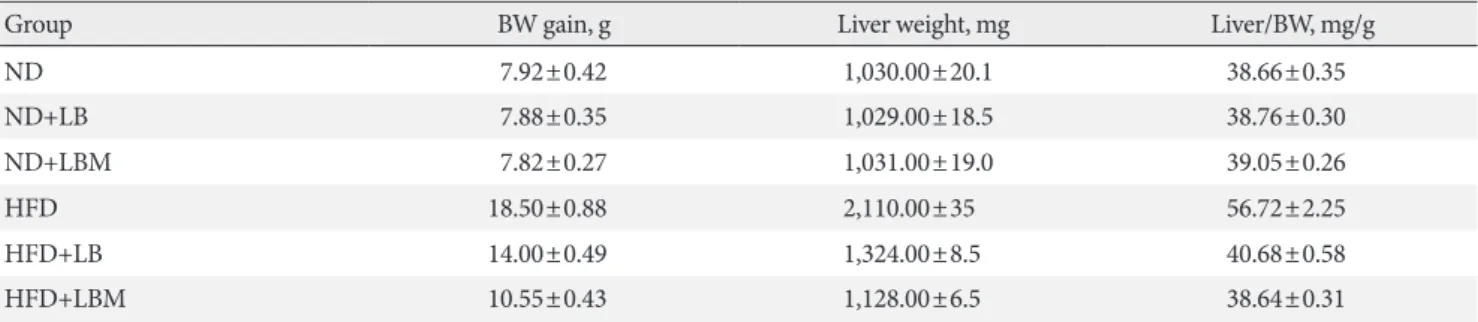
Effects of probiotic combination (LBM) on body index After HFD-induced treatment, the liver weight and body weight in the HFD group mice were significantly higher than those fed the ND. However, after LB or LBM treatment, a re- duction in body weight was observed (Table 1, Fig. 1F). The total body weight of the LB group and LBM group was reduced by 12.5% and 21.5%, respectively, compared to the HFD mouse models. This weight loss was not related to reduced food intake (Fig. 1G) [37]. In addition, compared to the HFD group, a significant reduction of the liver was observed in the HFD+LB group. Moreover, S. miltiorrhiza Bunge polysaccha- ride contributed to reducing the liver index values of HFD groups; however, the promoting effect was not significant (Ta- ble 1). The liver TC levels and liver TG levels were increased in the HFD group compared to the control group. In contrast, the liver TC and TG levels can be decreased by LB (1:2) in mice fed a HFD (Fig. 2A and B). The lipids can be reduced by LB or LBM, where the increased total short-chain fatty acid concen- tration (the metabolism products of lipids) in cecal content has been observed (Fig. 2D). After 6 weeks of HFD consumption, the mice showed increased glucose blood levels and insulin re- sistance. After LB or LBM treatment, the blood glucose levels were reduced (close to the control group), and the insulin re- sistance was improved. Compared to the HFD group, HOMA- IR in the LBM group was reduced by 66.3%, LBM has the po-
tential to reduce insulin resistance and improve insulin sensi- tivity (Fig. 2E, F, and J). In addition, NAFLD mice fed with LB (1:2) promoted excretion of cholesterol and total bile acid (Fig.
2C). Insulin sensitivity, as determined by the glucose disap- pearance rate (KITT) (Fig. 2I), ISI, or HOMA-IR (Fig. 2F and J), was decreased in HFD group mice and showed improve- ment after LB or LBM treatment. In the OGTT, the blood glu- cose increased to a maximum after 30 minutes of oral admin- istration of glucose in all groups (Fig. 2G and H). This in- creased blood glucose in the HFD group was significantly de- creased after administration of LBM (Fig. 2G). The inhibitory effect of LBM on blood glucose elevation by HFD treatment has been clearly reflected by the AUCglucose values (Fig. 2H).
Effects of probiotic combination (LBM) on lipid profiles The results showed that the serum TC, low density lipoprotein cholesterol (LDL-C), and TG levels of the HFD group de- creased significantly by treatment with probiotic LB (1:2) (Table 2). Compared to the ND group, the HDL level decreased significantly in the HFD group. In contrast, the HDL level of HFD-treated mice increased when supplemented with LB (1:2).
Furthermore, serum free fatty acid (FFA), ALTase, ASTase, LDL-C, TG, and TC levels in the HFD group were reduced by supplementation with LBM significantly.
Effect of combination (LBM) on gut microbiota
The relative abundance of gut microbiota at the phylum and genus levels was investigated. For the ND group, Firmicutes and Bacteroidetes (with 80% to 90% abundance) were the main members of the gut bacteria community presenting in the fe- ces at the phylum level. Moreover, compared to the ND group, the abundance of Cyanobacteria was increased by 68.75% in
Table 1. Body weight gain, liver weight, and liver index of mice in four groups
Group BW gain, g Liver weight, mg Liver/BW, mg/g
ND 7.92±0.42 1,030.00±20.1 38.66±0.35
ND+LB 7.88±0.35 1,029.00±18.5 38.76±0.30
ND+LBM 7.82±0.27 1,031.00±19.0 39.05±0.26
HFD 18.50±0.88 2,110.00±35 56.72±2.25
HFD+LB 14.00±0.49 1,324.00±8.5 40.68±0.58
HFD+LBM 10.55±0.43 1,128.00±6.5 38.64±0.31
Values are presented as mean±standard deviation. Liver index (liver/BW)=liver weight/final BW.
BW, body weight; ND, normal diet; LB, Lactobacillus plantarum X (LpX)-Bifidobacterium bifidum V (BbV); LBM, LpX-BbV+Salvia miltiorrhiza Bunge polysaccharide; HFD, high-fat diet.
70 60 50 40 30 20 10 0
100 80 60 40 20 0
35 30 25 20 15 10 5 0
15 12 9 6 3 0
8 6 4 2 0
35 30 25 20 15 10 5 0
3,000 2,500 2,000 1,500 1,000 500 0
20 15 10 5 0
140 120 100 80 60
6 5 4 3 2 1 0
Liver TG (mg/g)Total short chain fatty acid (μm/mg sample)Blood glucose (mmol/L)HOMA-IR Liver TC (mg/g)Serum insulin (mIU/L)AUCglucose Fecal TC (mg/g)Fasting blood glucose (mg/dL) Kitt (%/min)
ND
ND
20 40 60 80 100 120
ND
ND
ND
ND
ND
Fecal TC
ND
ISI=−7.03
ND HFD
HFD
Time (min)
At 6 weeks At 6 weeks
HFD
HFD
HFD
HFD
HFD
HFD
HFD HFD+LB
HFD+LB
HFD+LB
HFD+LB
HFD+LB
HFD+LB
HFD+LB
HFD+LB
HFD+LB HFD+LBM
HFD+LBM
HFD+LBM
HFD+LBM
HFD+LBM
HFD+LBM
HFD+LBM
HFD+LBM
HFD+LBM
b
b
b
b
b
b
b
a
b b
a
b
b
b
b a
b
b b
b a
b
b
A
D
G
J
B
E
H
C
F
I
Fig. 2. Liver (A) total cholesterol (TC) and (B) triglyceride (TG) levels in mice with different treatments. (C) Fecal TC of the four groups at the end of feeding period, mice orally fed high-fat diet (HFD) supplemented with a mixture of L.
plantarum-B. bifidum (1:2) and Salvia miltiorrhiza Bunge polysaccharide. (D) Total short-chain fatty acid concentration (the metabolized products of lipids) in cecal content. (E) Serum insulin; (F) fasting blood glucose (FBG). (G) Oral glucose tolerance test (OGTT) at 6 weeks after treatment and (H) the area un- der the curve (AUC) of OGTT at 6 weeks. (I) The glucose disappearance rate during the insulin tolerance test (KITT). (J) Homeostasis model assessment of insulin resistance (HOMA-IR). Insulin sensitivity index (ISI) =–ln (FPG×fasting insulin [FINS]). HOMA-IR=FINS (mIU/L)×FBG (mmol/
L)/22.5. Data are expressed as the mean±standard deviation. ND, normal diet;
LB, Lactobacillus plantarum X (LpX)-Bifidobacterium bifidum V (BbV); LBM, LpX-BbV+Salvia miltiorrhiza Bunge polysaccharide. aP<0.05, bP<0.01.
a
ISI=−8.3
ISI=−7.61 ISI=−7.22
HFD+LBM
ND HFD HFD+LB
the HFD group (Fig. 3A). After administering the probiotic combination (LBM), the abundance of Cyanobacteria in HFD- fed mice was reduced.
Moreover, the ratio of Bacteroidetes/Firmicutes in the HFD group decreased by 42.6% compared to the ND group. How- ever, the ratio of Bacteroidetes/Firmicutes was increased by 14.3% and 34.04% relative to the HFD group via administra- tion probiotics LB and LBM, respectively. At the genus level, the expression profiles of each group (16 highly abundant spe- cies >1.0% abundance), including the abundance of Bacteroi- des, Lactobacillus, Parabacteroides, Oscillospira, and Alistipes, were analyzed (Fig. 3B). Of those species, the abundance of Bacteroides, Lactobacillus, and Parabacteroides was increased by treatment with LB probiotics, while the Oscillospira and Alistipes were decreased by LBM.
Effects of probiotic combination (LBM) on endotoxin and liver inflammation
The concentrations of acetate, butyrate, and LPS were investi-
gated. The total concentrations of acetate and butyrate were sig- nificantly reduced by 81.7% and 80% in the HFD groups com- pared to the ND group. The acetate and butyrate concentrations of NAFLD mice were increased by supplementation with LBM (Fig. 4A and B). Moreover, the HFD group with a high LPS concentration was significantly reduced by probiotic (LB).
Moreover, the ability of probiotic LB was enhanced by S. milt- iorrhiza Bunge polysaccharide, the LPS concentration of LB group (0.23 endotoxin unit [EU]/mL) decreased by 73.6% com- pared to the HFD group (0.87 EU/mL); however, the difference between LB and LBM is not significant (P>0.05) (Fig. 4C).
Based on the changes in short-chain organic acid concentra- tions and gut microbial abundance in HFD-treated mice, we were trying to reveal the global influence of LBM on liver in- flammation. Inflammatory markers (TNF-α, IL-1β, and IL-6) of the liver were investigated. The results showed that inflam- matory markers were modulated by the probiotic combination (LBM). Compared to the HFD group, the mRNA concentra- tions of cytokines (TNF-α, IL-1β, IL-6) were reduced by LB
100 90 80 70 60 50 40 30 20 10 0
Mycoplasma Brachybacterium Brevibacterium Facklamia Staphylococcus Jeotgalicoccus Proteus Parabacteroides Anaerotruncus Eubacterium Alistipes Oscillospira Bacteroides Roseburia Bifidobacterium Lactobacillus Actinobacteria
Verrucomicobia Tenericutes Cyanobacteria Proteobacteria Firmicutes Bacteroidetes
HFD+LBM HFD+LB HFDND
Abundance (%)
0 20 40 60 80 100 Abundance (%)
A B
Fig. 3. Effect of probiotic combination (LBM) on gut microbiota in the intestines of tested mice. (A) The relative abundance of four groups at the phyla level and (B) the relative abundance of four groups at the genus level. ND, normal diet; HFD, high-fat diet; LB, Lactobacillus plantarum X (LpX)-Bifidobacterium bifidum V (BbV); LBM, LpX-BbV+Salvia miltiorrhiza Bunge polysaccharide.
ND HFD HFD+LB HFD+LBM
Table 2. Serum lipid levels in the four groups
Group TG, mg/dL TC, mg/dL LDL-C, mg/dL HDL-C, mg/dL ALTase, U/L ASTase, U/L
ND 92.9±1.0 84.7±0.58 25.9±0.15 57.5±0.6 26.3±0.5 55.1±1.2
HFD 115.1±2.1 168.5±3.2 65.5±0.82 25.9±2.1 83.5±2.5 128.5±12.2
HFD+LB 104.7±1.5 114.3±2.5 39.8±0.40 55.8±1.7 34.9±1.2 68.2±2.9
HFD+LBM 101.2±1.5 100.1±1.2 38.2±0.25 62.7±2.4 23.8±1.1 62.5±1.2
Values are presented as mean±standard deviation.
TG, triglyceride; TC, total cholesterol; LDL-C, low density lipoprotein cholesterol; HDL-C, high density lipoprotein cholesterol; ALTase, alanine transaminase; ASTase, aspartate transaminase; ND, normal diet; HFD, high-fat diet; LB, Lactobacillus plantarum X (LpX)-Bifidobacterium bifi- dum V (BbV); LBM, LpX-BbV+Salvia miltiorrhiza Bunge polysaccharide.
and LBM (Fig. 4D). Interestingly, the TNF-α concentration in the LBM group was significantly lower than that in the ND group.
The effect of LBM on lipid metabolism was investigated (Fig.
4E), and the results are shown in Fig. 4F. In the way of de novo
synthesis, increased hepatic expression of the four genes (ace- tyl-CoA carboxylase [ACC], fatty acid synthase [FAS], stearo- yl-CoA desaturase-1 [SCD-1], and sterol regulatory element binding protein 1c [SREBP-1c]) in the HFD group was ob- served compared with the ND group. The hepatic expression
30 25 20 15 10 5 0
1.2 1.0 0.8 0.6 0.4 0.2 0
180 160 140 120 100 80 60 40 20 0
3.0 2.5 2.0 1.5 1.0 0.5 0
6 5 4 3 2 1 0
Butyric acid (mM/g)LPS (EU/mL) Acetic acid (mM/g)Relative mRNA expression Relative expression
A
C
E
B
D
F
Fig. 4. Effect of probiotic combination LBM on the concentration of short-chain organic acids and endotoxin (lipopolysaccharide [LPS]) in cecal content. (A) Levels of butyrate in cecal content, (B) levels of acetate in cecal content, (C) LPS, (D) mRNA expression of inflammatory genes in the liver of mice. (E, F) Effect of LBM on the expression of the beginning synthesis genes and lipid oxida- tion genes. Relative mRNA levels are expressed as a ratio relative to β-actin. Values are expressed as the mean±standard deviation.
ND, normal diet; HFD, high-fat diet; LB, Lactobacillus plantarum X (LpX)-Bifidobacterium bifidum V (BbV); LBM, LpX- BbV+Salvia miltiorrhiza Bunge polysaccharide; TNF-α, tumor necrosis factor α; IL-1β, interleukin 1β; IL-6, interleukin 6; FAS, fat- ty acid synthase; ACC, acetyl-CoA carboxylase; SREBP-1c, sterol regulatory element binding protein 1c; SCD-1, stearoyl-CoA de- saturase-1; PPARα, peroxisome proliferator-activated receptor-α; CPT-1a, carnitine palmitoyltransferase-1a. aP<0.05, bP<0.01.
ND
ND
ND
TNF-α
FAS ACC SREBP-1c SCD-1 PPARα CPT-1a
IL-6 IL-1β
HFD
HFD
HFD HFD+LB
HFD+LB
HFD+LB HFD+LBM
HFD+LBM
HFD+LBM
b b
a a
a b
b
a b
b b
b
a a
b a
b
b b
b
b
a
b b
b
ND HFD HFD+LB HFD+LBM
ND HFD HFD+LB HFD+LBM
Fatty acid synthesis Fatty acid oxidation
of ACC, FAS, and SREBP-1c was clearly reduced after LBM treatment. The change in SCD-1 gene expression between the HFD group and the HFD supplemented with LB or LBM group was not significant (P>0.05). Compared to the HFD group, a significant decrease in the hepatic expression of SREBP-1c was induced by LBM (P<0.01) (Fig. 4E and F). Re- garding oxidation metabolism, genes associated with fatty acid oxidation (peroxisome proliferator-activated receptor-α [PPARα] and carnitine palmitoyltransferase-1a [CPT-1a]) showed a significant improvement with the help of LBM (P<0.05) (Fig. 4F).
DISCUSSION
Blood cholesterol can be reduced by various strains of Lactoba- cilli and Bifidobacteria, which is safe for consumption, such as Lactobacilli rhamnosus, L. paracasei, L. casei, and L. plantarum [38,39]. Fecal microbiota transplantation has been used for the treatment of Clostridium difficile-associated diarrhea and pseu- domembranous colitis [40], which highlighted a disease im- provement or resolution rate of 83% to 92% [41]. Therefore, the fecal microbiota of healthy adults was selected for the screening of probiotics (Lactobacillus), and most of the isolates performed a high CC capability in this study.
In addition, insulin resistance has been regarded as a key factor in the pathogenesis of metabolic syndrome [11]. Hepa- tocyte injury and inflammation could be promoted by hepatic insulin resistance [16,42]. It has been reported that different sources of polysaccharides (such as Ganoderma lucidum) could improve insulin resistance by regulating gut microbiota composition and inflammatory cytokines [43]. In the present study, different polysaccharides were screened, and the insulin sensitivity was improved by polysaccharides from S. miltiorrhi- za Bunge, which was the outstanding performer among the tested polysaccharides. Finally, the FFA, ALTase, ASTase, LDL- C, TG and TC levels of HFD-treated mice in serum were sig- nificantly reduced by LB (1:2). The function of the probiotic LB was enhanced by S. miltiorrhiza Bunge polysaccharide. In previous research, polysaccharides have been used to reduce IL-6, IL-1β, and TNF-α concentrations in plasma [43]. TNF-α expression and hepatic inflammation can be reduced by L.
rhamnosus and other probiotics [44]. Our research showed that the expression levels of TNF-α, IL-1β, and IL-6 can be re- duced by LBM; we speculate that it was the result of the syner- gy between L. plantarum-B. bifidum and S. miltiorrhiza Bunge.
Furthermore, it was shown that the composition of the intesti- nal microbiota can be regrouped by LBM in this study. The abundance of Cyanobacteria in HFD-fed mice was reduced by administering LBM. Previous studies indicated that microbio- ta composition is related to insulin resistance. Increased Cya- nobacteria (gram-negative bacteria) have been demonstrated as contributors to increased LPS levels, and all types of Cyano- bacteria can produce various toxins, which are involved in var- ious human diseases via increasing the hepatic damage trig- gered by hepatotoxins [45]. Moreover, we found that Bacte- roidetes/Firmicutes can be increased by LB and LBM. Numer- ous studies have suggested that Firmicutes/Bacteroidetes ratios are a compositional biomarker for obesity [46] and type 1 dia- betes mellitus [47]. Moreover, fecal extracts of ulcerative colitis patients were characterized by reduced levels of butyrate, ace- tate, methylamine, and trimethylamine in comparison with a control population [48,49]. The acetate and butyrate concen- trations of NAFLD mice were increased by supplementation LBM in this study. This result was consistent with the report of Turnbaugh et al. [49] and de Wit et al. [50]. Therefore, LBM combination has the potential to be used as a therapeutic for ameliorating NAFLD via modulation of the gut microbiota and improvement of insulin resistance.
SUPPLEMENTARY MATERIALS
Supplementary materials related to this article can be found online at https://doi.org/10.4093/dmj.2019.0042.
CONFLICTS OF INTEREST
No potential conflict of interest relevant to this article was re- ported.
AUTHOR CONTRIBUTIONS
Conception or design: W.W., F.C.Z.
Acquisition, analysis, or interpretation of data: Y. L., S.F.X.
Drafting the work or revising: W.W., A.L.X., Z.C.L.
Final approval of the manuscript: H.C.S., F.C.Z.
ORCID
Wei Wang https://orcid.org/0000-0002-6031-9692 Fachao Zhi https://orcid.org/0000-0001-8960-2312
ACKNOWLEDGMENTS
Funding for this study was provided by the Chinese Founda- tion for Hepatitis Prevention and Control–TianQing Liver Disease Research Fund Subject TQGB20190130 (http://www.
cfhpc.org). The funders had no role in study design, data col- lection and analysis, decision to publish, or preparation of the manuscript.
REFERNCES
1. European Association for the Study of the Liver (EASL); Euro- pean Association for the Study of Diabetes (EASD); European Association for the Study of Obesity (EASO). EASL-EASD- EASO clinical practice guidelines for the management of non- alcoholic fatty liver disease. Obes Facts 2016;9:65-90.
2. Nomura K, Yamanouchi T. The role of fructose-enriched diets in mechanisms of nonalcoholic fatty liver disease. J Nutr Bio- chem 2012;23:203-8.
3. Athyros VG, Tziomalos K, Gossios TD, Griva T, Anagnostis P, Kargiotis K, Pagourelias ED, Theocharidou E, Karagiannis A, Mikhailidis DP; GREACE Study Collaborative Group. Safety and efficacy of long-term statin treatment for cardiovascular events in patients with coronary heart disease and abnormal liver tests in the Greek Atorvastatin and Coronary Heart Dis- ease Evaluation (GREACE) Study: a post-hoc analysis. Lancet 2010;376:1916-22.
4. Michelotti GA, Machado MV, Diehl AM. NAFLD, NASH and liver cancer. Nat Rev Gastroenterol Hepatol 2013;10:656-65.
5. Abu-Shanab A, Quigley EM. The role of the gut microbiota in nonalcoholic fatty liver disease. Nat Rev Gastroenterol Hepatol 2010;7:691-701.
6. Sanyal AJ; American Gastroenterological Association. AGA technical review on nonalcoholic fatty liver disease. Gastroen- terology 2002;123:1705-25.
7. Ahmed M. Non-alcoholic fatty liver disease in 2015. World J Hepatol 2015;7:1450-9.
8. Gaggini M, Morelli M, Buzzigoli E, DeFronzo RA, Bugianesi E, Gastaldelli A. Non-alcoholic fatty liver disease (NAFLD) and its connection with insulin resistance, dyslipidemia, atheroscle- rosis and coronary heart disease. Nutrients 2013;5:1544-60.
9. Loomba R, Sanyal AJ. The global NAFLD epidemic. Nat Rev Gastroenterol Hepatol 2013;10:686-90.
10. Cope K, Risby T, Diehl AM. Increased gastrointestinal ethanol production in obese mice: implications for fatty liver disease
pathogenesis. Gastroenterology 2000;119:1340-7.
11. Kakino S, Ohki T, Nakayama H, Yuan X, Otabe S, Hashinaga T, Wada N, Kurita Y, Tanaka K, Hara K, Soejima E, Tajiri Y, Ya- mada K. Pivotal role of TNF-α in the development and pro- gression of nonalcoholic fatty liver disease in a murine model.
Horm Metab Res 2018;50:80-7.
12. Bauer TM, Schwacha H, Steinbruckner B, Brinkmann FE, Dit- zen AK, Aponte JJ, Pelz K, Berger D, Kist M, Blum HE. Small intestinal bacterial overgrowth in human cirrhosis is associated with systemic endotoxemia. Am J Gastroenterol 2002;97:2364- 70.
13. Madrid AM, Hurtado C, Venegas M, Cumsille F, Defilippi C.
Long-term treatment with cisapride and antibiotics in liver cir- rhosis: effect on small intestinal motility, bacterial overgrowth, and liver function. Am J Gastroenterol 2001;96:1251-5.
14. Thalheimer U, De Iorio F, Capra F, del Mar Lleo M, Zuliani V, Ghidini V, Tafi MC, Caburlotto G, Gennari M, Burroughs AK, Vantini I. Altered intestinal function precedes the appearance of bacterial DNA in serum and ascites in patients with cirrho- sis: a pilot study. Eur J Gastroenterol Hepatol 2010;22:1228-34.
15. Kirsch R, Clarkson V, Verdonk RC, Marais AD, Shephard EG, Ryffel B, de la M Hall P. Rodent nutritional model of steatohep- atitis: effects of endotoxin (lipopolysaccharide) and tumor ne- crosis factor alpha deficiency. J Gastroenterol Hepatol 2006;21:
174-82.
16. Pagano G, Pacini G, Musso G, Gambino R, Mecca F, Depetris N, Cassader M, David E, Cavallo-Perin P, Rizzetto M. Nonal- coholic steatohepatitis, insulin resistance, and metabolic syn- drome: further evidence for an etiologic association. Hepatolo- gy 2002;35:367-72.
17. Karczewski J, Troost FJ, Konings I, Dekker J, Kleerebezem M, Brummer RJ, Wells JM. Regulation of human epithelial tight junction proteins by Lactobacillus plantarum in vivo and pro- tective effects on the epithelial barrier. Am J Physiol Gastroin- test Liver Physiol 2010;298:G851-9.
18. Xu RY, Wan YP, Fang QY, Lu W, Cai W. Supplementation with probiotics modifies gut flora and attenuates liver fat accumula- tion in rat nonalcoholic fatty liver disease model. J Clin Bio- chem Nutr 2012;50:72-7.
19. Ma YY, Li L, Yu CH, Shen Z, Chen LH, Li YM. Effects of probi- otics on nonalcoholic fatty liver disease: a meta-analysis. World J Gastroenterol 2013;19:6911-8.
20. Malaguarnera M, Vacante M, Antic T, Giordano M, Chisari G, Acquaviva R, Mastrojeni S, Malaguarnera G, Mistretta A, Li Volti G, Galvano F. Bifidobacterium longum with fructo-oligo-
saccharides in patients with non alcoholic steatohepatitis. Dig Dis Sci 2012;57:545-53.
21. Cani PD, Delzenne NM. The role of the gut microbiota in en- ergy metabolism and metabolic disease. Curr Pharm Des 2009;
15:1546-58.
22. Azat R, Liu Y, Li W, Kayir A, Lin DB, Zhou WW, Zheng XD.
Probiotic properties of lactic acid bacteria isolated from tradi- tionally fermented Xinjiang cheese. J Zhejiang Univ Sci B 2016;
17:597-609.
23. Mei L, Tang Y, Li M, Yang P, Liu Z, Yuan J, Zheng P. Co-Ad- ministration of cholesterol-lowering probiotics and anthraqui- none from Cassia obtusifolia L. Ameliorate non-alcoholic fatty liver. PLoS One 2015;10:e0138078.
24. Saravanan G, Ponmurugan P. Ameliorative potential of S-allyl- cysteine: effect on lipid profile and changes in tissue fatty acid composition in experimental diabetes. Exp Toxicol Pathol 2012;64:639-44.
25. Zhang W, Zheng L, Zhang Z, Hai CX. Protective effect of a wa- ter-soluble polysaccharide from Salvia miltiorrhiza Bunge on insulin resistance in rats. Carbohydr Polym 2012;89:890-8.
26. Xing XY, Li YF, Fu ZD, Chen YY, Wang YF, Liu XL, Liu WY, Li GW. Antihypertensive effect of metformin in essential hyper- tensive patients with hyperinsulinemia. Zhonghua Nei Ke Za Zhi 2010;49:14-8.
27. Zhang Y, Hu T, Zhou H, Zhang Y, Jin G, Yang Y. Antidiabetic effect of polysaccharides from Pleurotus ostreatus in strepto- zotocin-induced diabetic rats. Int J Biol Macromol 2016;83:
126-32.
28. Ren D, Hu Y, Luo Y, Yang X. Selenium-containing polysaccha- rides from Ziyang green tea ameliorate high-fructose diet in- duced insulin resistance and hepatic oxidative stress in mice.
Food Funct 2015;6:3342-50.
29. Bao Y, Zhang Y, Zhang Y, Liu Y, Wang S, Dong X, Wang Y, Zhang H. Screening of potential probiotic properties of Lacto- bacillus fermentum isolated from traditional dairy products.
Food Control 2010;21:695-701.
30. Huang Y, Wang X, Wang J, Wu F, Sui Y, Yang L, Wang Z. Lacto- bacillus plantarum strains as potential probiotic cultures with cholesterol-lowering activity. J Dairy Sci 2013;96:2746-53.
31. Janda JM, Abbott SL. 16S rRNA gene sequencing for bacterial identification in the diagnostic laboratory: pluses, perils, and pitfalls. J Clin Microbiol 2007;45:2761-4.
32. Adler P, Frey LJ, Berger A, Bolten CJ, Hansen CE, Wittmann C.
The key to acetate: metabolic fluxes of acetic acid bacteria un- der cocoa pulp fermentation-simulating conditions. Appl En-
viron Microbiol 2014;80:4702-16.
33. Kump PK, Grochenig HP, Lackner S, Trajanoski S, Reicht G, Hoffmann KM, Deutschmann A, Wenzl HH, Petritsch W, Krejs GJ, Gorkiewicz G, Hogenauer C. Alteration of intestinal dysbiosis by fecal microbiota transplantation does not induce remission in patients with chronic active ulcerative colitis. In- flamm Bowel Dis 2013;19:2155-65.
34. Watts GF, Burke V. Lipid-lowering trials in the primary and secondary prevention of coronary heart disease: new evidence, implications and outstanding issues. Curr Opin Lipidol 1996;7:
341-55.
35. Utzschneider KM, Kahn SE. Review: the role of insulin resis- tance in nonalcoholic fatty liver disease. J Clin Endocrinol Metab 2006;91:4753-61.
36. Peverill W, Powell LW, Skoien R. Evolving concepts in the pathogenesis of NASH: beyond steatosis and inflammation. Int J Mol Sci 2014;15:8591-638.
37. Ding W, Shi C, Chen M, Zhou J, Long R, Guo X. Screening for lactic acid bacteria in traditional fermented Tibetan yak milk and evaluating their probiotic and cholesterol-lowering poten- tials in rats fed a high-cholesterol diet. J Funct Foods 2017;32:
324-32.
38. Ooi LG, Liong MT. Cholesterol-lowering effects of probiotics and prebiotics: a review of in vivo and in vitro findings. Int J Mol Sci 2010;11:2499-522.
39. Liu W, Xi X, Sudu Q, Kwok L, Guo Z, Hou Q, Menhe B, Sun T, Zhang H. High-throughput sequencing reveals microbial com- munity diversity of Tibetan naturally fermented yak milk. Ann Microbiol 2015;65:1741-51.
40. Palmer R. Fecal matters. Nat Med 2011;17:150-2.
41. Gough E, Shaikh H, Manges AR. Systematic review of intesti- nal microbiota transplantation (fecal bacteriotherapy) for re- current Clostridium difficile infection. Clin Infect Dis 2011;53:
994-1002.
42. Farrell GC. Signalling links in the liver: knitting SOCS with fat and inflammation. J Hepatol 2005;43:193-6.
43. Xu S, Dou Y, Ye B, Wu Q, Wang Y, Hu M, Ma F, Rong X, Guo J.
Ganoderma lucidum polysaccharides improve insulin sensitiv- ity by regulating inflammatory cytokines and gut microbiota composition in mice. J Funct Foods 2017;38 Pt A:545-52.
44. Bluemel S, Williams B, Knight R, Schnabl B. Precision medi- cine in alcoholic and nonalcoholic fatty liver disease via modu- lating the gut microbiota. Am J Physiol Gastrointest Liver Physiol 2016;311:G1018-36.
45. Durai P, Batool M, Choi S. Structure and effects of cyanobacte-
rial lipopolysaccharides. Mar Drugs 2015;13:4217-30.
46. Ley RE, Turnbaugh PJ, Klein S, Gordon JI. Microbial ecology:
human gut microbes associated with obesity. Nature 2006;444:
1022-3.
47. Wen L, Ley RE, Volchkov PY, Stranges PB, Avanesyan L, Stone- braker AC, Hu C, Wong FS, Szot GL, Bluestone JA, Gordon JI, Chervonsky AV. Innate immunity and intestinal microbiota in the development of type 1 diabetes. Nature 2008;455:1109-13.
48. Marchesi JR, Holmes E, Khan F, Kochhar S, Scanlan P, Shanah- an F, Wilson ID, Wang Y. Rapid and noninvasive metabonomic characterization of inflammatory bowel disease. J Proteome
Res 2007;6:546-51.
49. Turnbaugh PJ, Ley RE, Mahowald MA, Magrini V, Mardis ER, Gordon JI. An obesity-associated gut microbiome with in- creased capacity for energy harvest. Nature 2006;444:1027-31.
50. de Wit N, Derrien M, Bosch-Vermeulen H, Oosterink E, Kes- htkar S, Duval C, de Vogel-van den Bosch J, Kleerebezem M, Muller M, van der Meer R. Saturated fat stimulates obesity and hepatic steatosis and affects gut microbiota composition by an enhanced overflow of dietary fat to the distal intestine. Am J Physiol Gastrointest Liver Physiol 2012;303:G589-99.
Supplementary Table 1. Primers used for mRNA detection
Forward (5´-3´) Reverse (5´-3´)
TNF-α AAGCCTGTAGCCCACGTC CACCACTAGTTGGTTGTCTT
IL-1β GCCCATCCTCTGTGACTCAT AGG CCACAGGTATTTTGTCG
GAPDH ACCACAGTCCATGCC ATCAC TCCACCACCCTGTTG CTGTA
IL-6 GATGGATGCTACCAAACTGG AGCATTGGAAATTGGGGTA
Relative mRNA levels were normalized to the GAPDH level.
TNF-α, tumor necrosis factor α; IL-1β, interleukin 1β; GAPDH, glyceraldehyde 3-phosphate dehydroge- nase; IL-6, interleukin 6.
Supplementary Table 2. Sequences of the primers used in the lipid metabolism gene detection
Gene Forward (5´-3´) Reverse (5´-3´)
SREBP-1c GCGGAGCCATGGATTGCAC CTCTTCCTTGATACCAGGCCC
FAS AGCTGCCAGAGTCGGAGAAC TGTAGCCCACGAGTGTCTCG
CPT-1a TGAGCGACTGGTGGGAGGAG GAGCCAGACCTTGAAGTAGCG
SCD-1 TCTTCCTTATCATTGCCAACAC GCGTTGAGCACCAGAGTGTATC
PPARα CCAGTATTTAGGAAGCTGTCCT CGTTGTGTGACATCCCGACAG
ACC GGCCAGTGCTATGCTGAGAT AGGGTCAAGTGCTGCTCCA
β-Actin GCAAGAGAGGCATCCTCACC CGTAGATGGGCACAGTGTGG
SREBP-1c, sterol regulatory element binding protein 1c; FAS, fatty acid synthase; CPT-1a, carnitine palmi- toyltransferase-1a; SCD-1, stearoyl-CoA desaturase-1; PPARα, peroxisome proliferator-activated receptor-α; ACC, acetyl-CoA carboxylase.


![Fig. 4. Effect of probiotic combination LBM on the concentration of short-chain organic acids and endotoxin (lipopolysaccharide [LPS]) in cecal content](https://thumb-ap.123doks.com/thumbv2/123dokinfo/5220703.123362/9.892.84.797.132.799/effect-probiotic-combination-concentration-organic-endotoxin-lipopolysaccharide-content.webp)
