Veterinary Science
http://dx.doi.org/10.4142/jvs.2013.14.2.115
Received: 19 Aug. 2011, Revised: 15 Feb. 2012, Accepted: 4 Apr. 2012
Original Article
*Corresponding author: Tel: +82-31-463-4578; Fax: +82-31-463-4516; E-mail: [email protected]
ⓒ 2013 The Korean Society of Veterinary Science.
This is an Open Access article distributed under the terms of the Creative Commons Attribution Non-Commercial License (http://creativecommons.org/licenses/by-nc/3.0) which permits unrestricted non-commercial use, distribution, and reproduction in any medium, provided the original work is properly cited.
Genetic diversity of porcine reproductive and respiratory syndrome virus in Korea
Eun-Jin Choi
1, Chang-Hee Lee
1, Jae-Young Song
1, Hee-Jong Song
2, Choi-Kyu Park
1, Byounghan Kim
1, Yeun-Kyung Shin
1,*
1
Animal and Plant Quarantine Agency, Ministry of Agriculture, Food and Rural Affairs, Anyang 430-757, Korea
2
College of Veterinary Medicine, Chonbuk National University, Jeonju 561-756, Korea
The high genetic diversity of porcine reproductive and respiratory syndrome virus (PRRSV) has been an obstacle to developing an effective vaccine for porcine reproductive and respiratory syndrome (PRRS). This study was performed to assess the degree of genetic diversity among PRRSVs from Korean pig farms where wasting and respiratory syndrome was observed from 2005 to 2009.
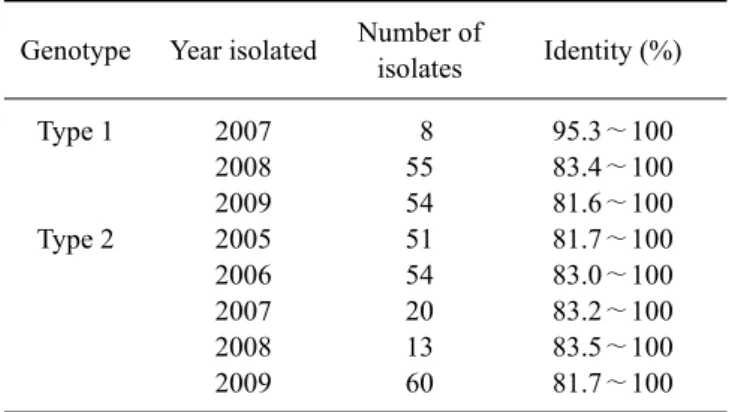
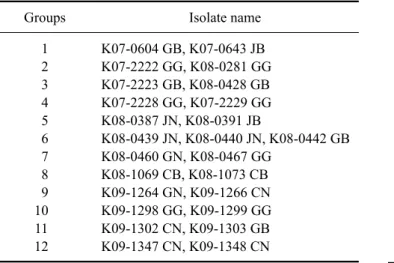
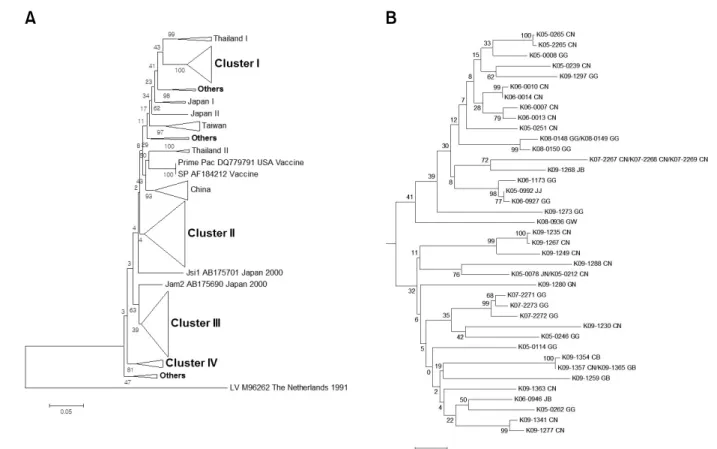
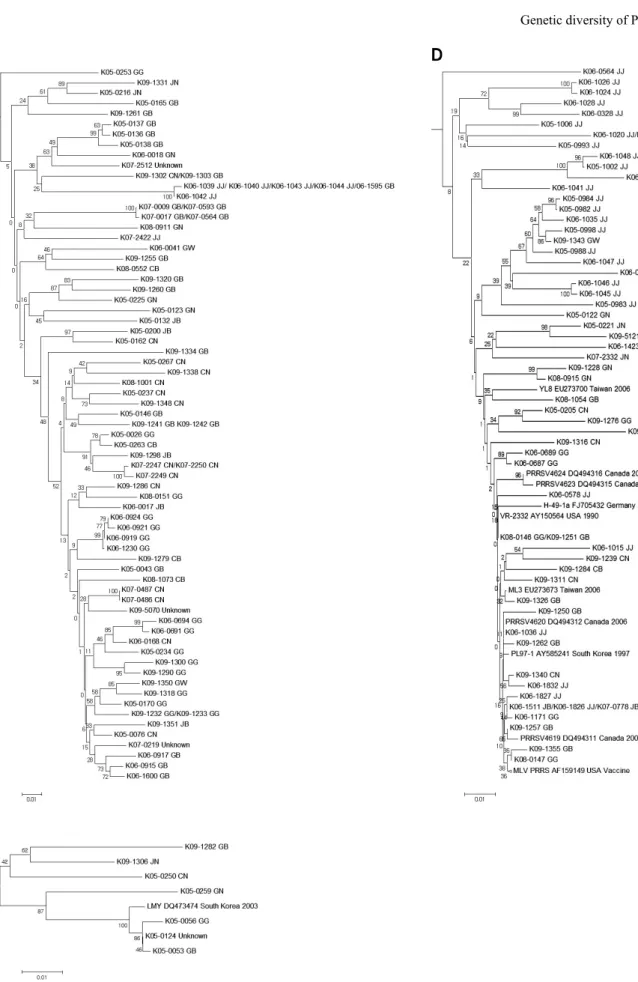
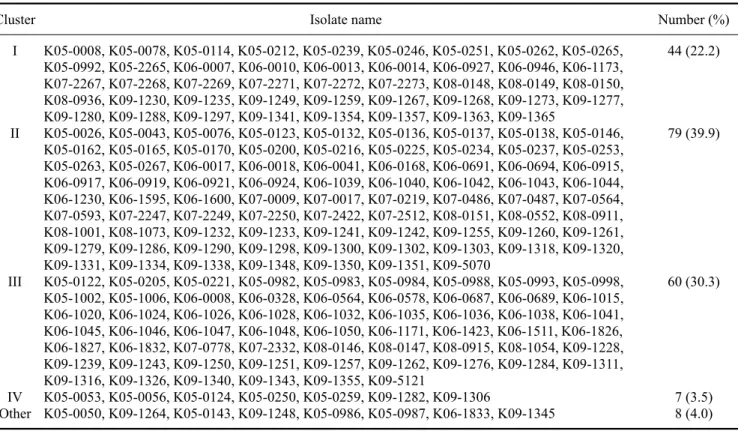
Samples from 786 farms were tested for the presence of PRRSV using reverse transcription PCR protocol. A total of 117 farms were positive for type 1 PRRSV while 198 farms were positive for type 2. Nucleotide sequences encoding the open reading frame (ORF) 5 were analyzed and compared to those of various published PRRSV isolates obtained worldwide. Sequence identity of the ORF 5 in the isolates was 81.6∼100% for type 1 viruses and 81.4∼100% for type 2 viruses. Phylogenetic analysis of the ORF 5 sequences showed that types 1 and 2 PRRSVs from Korea were mainly classified into three and four clusters, respectively. The analyzed isolates were distributed throughout the clusters independent of the isolation year or geographical origin. In conclusion, our results indicated that the genetic diversity of PRRSVs from Korean pig farms is high and has been increasing over time.
Keywords: Korea, open reading frame 5, phylogenetic analysis, porcine reproductive and respiratory syndrome virus
Introduction
Porcine reproductive and respiratory syndrome (PRRS) is an infectious disease that results in significant economic losses in the pig industry worldwide [9,21,30]. Since its first recognition during the late 1980s in the USA and
Europe, PRRS has spread throughout the world [1,3,5].
The causative agent, the porcine reproductive and respiratory syndrome virus (PRRSV), is a member of the order Nidovirales, family Arteriviridae, and genus Arterivirus [6,26]. PRRSVs are categorized into two genotypic groups based on the prototypic European (type 1) and North American (type 2) strains also known as Lelystad virus (LV) and VR-2332, respectively. Both strains share an approximately 60% sequence identity at the nucleotide level [23].
The PRRSV genome is approximately 15 kb in length and consists of at least nine open reading frames (ORFs) including ORFs 1a and 1b, ORFs 2a and 2b, and ORFs 3-7 [2,11]. ORFs 1a and 1b encode the enzymes responsible for replication, ORFs 2a and 3-5 encode membrane-associated glycoproteins, ORFs 2b and 6 encode non-glycosylated membrane proteins, and ORF 7 encodes the N protein [29].
GP5, encoded by ORF 5, is a commonly recognized antigen in animals showing a protection against PRRSV and an excellent candidate protein for producing a recombinant vaccine [4,11-13,24,31]. This protein also exhibits the highest degree of diversity within the same genotypic groups [32].
Since the emergence of type 2 PRRSV in Korea during 1993, the virus has spread widely [7,10,16,17,20,30].
Genetic analyses of type 2 PRRSVs have been performed for the ORF 5 region of 27 viruses isolated from 2002 to 2003 [7]. Type 1 PRRSV was first detected in Korea in 2005 [17]. Several studies have recently reported that the genetic diversity of type 1 PRRSVs has increased in Korea [17,20]. So far, few genetic or phylogenetic analyses of type 1 and type 2 PRRSV in Korea have been performed.
More representative samples and extensive sequence
libraries are needed to better understand the genetic
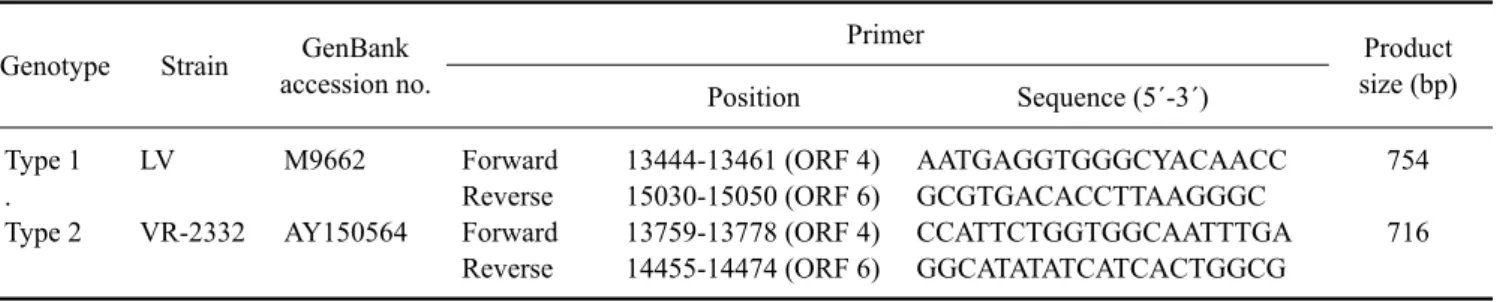
Table 1. Sequences of primers used for the detection and differentiation of porcine reproductive and respiratory syndrome viruses (PRRSVs)
Genotype Strain GenBank accession no.
Primer Product
size (bp)
Position* Sequence (5´-3´)
Type 1 Type 2
LV VR-2332
M9662 AY150564
Forward Reverse Forward Reverse
14653-14671 (ORF7) 15030-15050 (3´NCR) 14933-14951 (ORF7) 15346-15365 (3´NCR)
ATGGCCAGCCAGTCAATCA TCGCCCTAATTGAATAGGTGA ATGGCCAGCCAGTCAATCA TCGCCCTAATTGAATAGGTGA
398 433
*Primer position: forward primers correspond to sequences in open reading frame (ORF) 7 and reverse primers correspond to the 3´
non-coding region (NCR). LV: Lelystad virus.