393 http://dx.doi.org/10.4196/kjpp.2012.16.6.393
ABBREVIATIONS: Dex, dexamethasone; GRE, glucocorticoid response element; ITAM, immunoreceptor tyrosine-based activation motif;
ITIM, immunoreceptor tyrosine-based inhibition motif; FcεR, recep- tor for the Fc region of IgE; FcγR, Fc receptor for the Fc region of IgG.
Received July 4, 2012, Revised October 17, 2012, Accepted November 10, 2012
Corresponding to: Seung Kiel Park, Department of Biochemistry, College of Medicine, Chungnam National University, 6, Munwha- dong, Joong-gu, Deajeon 301-747, Korea. (Tel) 82-42-580-8224, (Fax) 82-42-580-8121, (E-mail) [email protected]
This is an Open Access article distributed under the terms of the
Creative Commons Attribution Non-Commercial License (http://
creativecommons.org/licenses/by-nc/3.0) which permits unrestricted non-commercial
use, distribution, and reproduction in any medium, provided the original work
is properly cited.
Dexamethasone Induces FcγRIIb Expression in RBL-2H3 Cells
Prashanta Silwal
1, Mi-Nam Lee
2, Choong-Jae Lee
2, Jang-Hee Hong
2, Uk Namgung
3, Zee-Won Lee
4, Jinhyun Kim
5, Kyu Lim
1, Gi Ryang Kweon
1, Jong IL Park
1, and Seung Kiel Park
1
1
Research Institute for Medical Sciences and Department of Biochemistry,
2Department of Pharmacology, College of Medicine, Chungnam National University, Daejeon 301-747,
3Department of Oriental Medicine, Daejeon University, Daejeon 301-721,
4Division of Life Science, Korea Basic Science Institute, Daejeon 300-716,
5Department of Internal Medicine, Chungnam National University Hospital, Daejeon 305-806, Korea
Mast cells are involved in allergic responses, protection against pathogens and autoimmune diseases.
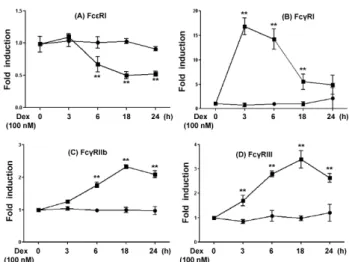
Dexamethasone (Dex) and other glucocorticoids suppress Fcε RI-mediated release of inflammatory mediators from mast cells. The inhibition mechanisms were mainly investigated on the downstream signaling of Fc receptor activations. Here, we addressed the effects of Dex on Fc receptor expressions in rat mast cell line RBL-2H3. We measured mRNA levels of Fc receptors by real-time PCR. As expected, Dex decreased the mRNA levels of activating Fc receptor for IgE (Fcε R) I and increased the mRNA levels of the inhibitory Fc receptor for IgG Fcγ RIIb. Interestingly, Dex stimulated transcriptions of other activating receptors such as Fc receptors for IgG (Fcγ R) I and Fcγ RIII. To investigate the mechanisms underlying transcriptional regulation, we employed a transcription inhibitor actinomycin D and a translation inhibitor cycloheximide. The inhibition of protein synthesis without Dex treatment enhanced Fcγ RI and Fcγ RIII mRNA levels potently, while Fcε RI and Fcγ RIIb were minimally affected. Next, we examined expressions of the Fc receptors on cell surfaces by the flow cytometric method. Only Fcγ RIIb protein expression was significantly enhanced by Dex treatment, while Fcγ RI, Fcγ RIII and Fcε RI expression levels were marginally changed. Our data showed, for the first time, that Dex regulates Fc receptor expressions resulting in augmentation of the inhibitory receptor FcγRIIb.
Key Words: Degranulation, Fc receptor, Glucocorticoid, Mast cells, Transcription
INTRODUCTION
Mast cells are hematopoietic origin cells that take part in allergic reactions and autoimmune diseases [1-4]. Stimu- lation of mast cells elicits inflammatory responses, such as degranulation, production of lipid-mediated inflammatory mediators, and cytokine production. Granules of mast cells contain histamine, proteases, β-hexosaminidase and many inflammatory molecules.
Mast and other immune cells express receptors for Fc region of IgG (FcγR) and IgE (FcεR). The FcγR have two oppos- ing families: activating Fc receptors (FcγRI, FcγRIIa and FcγRIII) and an inhibitory Fc receptor (FcγRIIb). FcεRI also is an activating receptor involved in allergic reactions.
Balanced signaling between activating and inhibitory Fc re- ceptors regulates immune system activity. An imbalance
might result in the development of allergic and autoimmune diseases [5]. FcγRIIb is only one inhibitory receptor that suppresses many aspects of immune responses such as au- toimmunity and infection [6]. Activating receptors are asso- ciated with a Src-family tyrosine kinase Lyn. They bind to corresponding antibodies and are cross-linked through mul- tivalent antigens specific to the antibodies. This event acti- vates Src family tyrosine kinases that phosphorylate ty- rosine residues in immunoreceptor tyrosine-based activa- tion motifs (ITAMs) which are in the cytoplasmic parts of receptors. Phosphorylated IATMs recruit signaling mole- cules that have Src homology (SH) 2 domain-containing proteins and then propagate activation signals [7]. The acti- vation of FcεRI receptors stimulates Lyn, Fyn and sub- sequently Syk. Syk phosphorylates tyrosine residues in an adaptor molecule, linker for activation of T cells (LAT). Pho- sphorylated LAT recruits phospholipase C (PLC) and Grb2.
PLC hydrolyzes phosphatidylinositol 4,5-bisphosphate to produce diacylglycerols and inositol 1,4,5-trisphosphates.
They result in the activation of protein kinase C (PKC) and
calcium ion mobilization required for degranulation. Grb2
recruits Ras GTPase and activates extracellular receptor-