
The Effect of Intravenous Injection of the Water Extract of Angelica gigas Nakai on Gliosis in the Middle Cerebral Artery Occlusion Rats
13
0
0
전체 글
(2) 005~018 당귀추출물.ps. 6. 2011.10.6 10:43 AM. 페이지6. MAC08. Journal of Pharmacopuncture 제 14권 제 3호( 2011년 9월). I. 서론. gliosis MCAO(Middle Cerebral Artery Occlusion) 3 2009. MCAO 2. II. 재료 및 방법 1. (glial scar) 6. 200-300g. Sprague-. Dawley cage. 3-4 NIH. (myelin). (gliosis) protein). GFAP(Glial fibrillary acidic (astrocyte). GFAP. 2.. CD81 CD81 (transmembrane protein). 250g 1,000 ml (Umbelliferae) gigas Nakai)(Oliv.) Diels. 3. (Angelica 12.82%. vitamin E 3. 0.9% 100mg/kg. 0.25 1. 2.
(3) 005~018 당귀추출물.ps. 2011.10.6 10:43 AM. 페이지7. MAC08. 7. 1. 60g. 1/10 1. 1 1. 2. 9. 5. 7. 4. MCAO. 300 mL 4 24. 4% paraformaldehyde 30% sucrose 4 (bregma) 3.0mm 4.5mm 40 (cryoprotectant solution) 24-well well 20. Longa 70% N2O, 30% O2. 5% isoflurane 2% isoflurane. 6. Cresyl violet. 27 G any) 4-0 nylon 0.28mm, rounded tip. (Durelon, Germintraluminal filament 18.5-19.0mm. 3 alcohol 2 70% alcohol. 0.05 M PBS xylen 5 100% 95% alcohol 1 2 0.5% cresyl violet. 1. 30 (Olympus, Japan). 2 7.. intraluminal filament 37. 0.5. 48 2mm 2% 2,3,5-triphenyltetrazolium chloride (Sigma Chemical Co. USA) 20 10%. heating pad. 5.. mg/kg). 7 xylazine (10 mg/kg). ketamine (50. 2mm (mm ) 3. 18 50 mL/ min (peristaltic pump) phosphate buffered saline (PBS) 4% paraformaldehyde. 250-. 8.. PBS. 24-well 10 3. 5-10. 0.05 M.
(4) 005~018 당귀추출물.ps. 2011.10.6 10:43 AM. 페이지8. MAC08. Journal of Pharmacopuncture 제 14권 제 3호( 2011년 9월). 8. 15-20. 1.0% H2O2 0.2% Triton X-100. 20. PBS. 521 1:100. 28% 445 16.1 mm3. 0.5-1 4. PBS 48 (GFAP, CD81, c-Fos, ERK) PBS 2 (horse anti-mouse IgG, goat anti-rabbit IgG, 1:100) PBS Avidin-biotin peroxidase complex 1 PBS 0.05% 3,3 diaminobenzidine tetrahydrochloride (Sigma Chemical Co. USA) 30 gelatin coated slide. 21.5 mm3 24%. (Fig. 1). 9.. (Olympus, Japan) CA1. CA2. 400. 10. MEAN SEM t-test one-way ANOVA p 0.05. III. 결과 1.. Fig 1. Measuring the size of cerebral infarction induced by MCAO (Middle Cerebral Artery Occlusion) in the mouse after intravenous injection of Angelica gigas Nakai showed the size was decreased in the Treatment group (A). Representative photomicrograph of TTC-stained coronal slices demonstrating infarctions(nonstained region) in the ipsilateral(left) cortex and striatum shows significant reduction in infarct size in Treatment group compared with MCAO rats. The size of infarction in the Control group was 521 21.5 mm3 which was 28% and in the Treatment group the size of infarction was 445 16.1 mm3 which was 24%. The size of cerebral infarction was meaningfully decreased in the Treatment group compared with Control group (B). Bar graphs depict infarct size in all the animals. Results are given mean sem **p 0.01 vs Control.. 2..
(5) 005~018 당귀추출물.ps. 2011.10.6 10:43 AM. 페이지9. MAC08. 9. 3. 7. CA1. gliosis. CA1 ( 400) 172 6.1. 8.1, 120. 127 7.6 160 7.2 CA2 189. 8.7, 144. GFAP. 9.6 CA1. GFAP GFAP. GFAP. GFAP 43. 2.3%. 67. 5.3%. 53. 2.4% (p<0.05) (Fig. 3). 19% CA2. 13% (Fig. 2). Fig 2. The effect of Angelica gigas Nakai on pyramidal cell death protection measured after 7 day following MCAO in male SD rats. Coronal sections were stained with cresyl violet. Number of Nissle stained pyramidal cells measured in CA1 and CA2 of hippocampus was decreased in Control group rats and increased after intravenous injection of Angelica extract water. The sections were taken pictures using microscope in HP at 40 , CA1 and CA2 at 400 (A) and converted into graphs (B). In the Treatment group, pyramidal cell death in the CA1 and CA2 was decreased 19% and 13% respectively, representing cell death protection of pyramidal cells in the hipat pocampus. HP; Hippocampus. Scale bar =500 HP, 200 at CA1 and CA2.. Fig 3. Effects of intravenous injection of Angelica extract water on GFAP (Glial fibrillary acidic protein) expression following ischemic injury by MCAO in SD rats. Coronal sections were rinsed and probed with GFAP antibody on the 7th day following MCAO. The sections were taken pictures using microscope. GFAP expression in hippocampus was increased after MCAO with darker staining and decreased with intravenous injection of Angelica extract water. Photomicrographs were taken at X40 (A) and X400 (B). GFAP expression was 43 2.3%, 67 5.3%, 53 2.4% in the normal, Control, Treatment group respectively. GFAP expression was measured from coronal sections of the rat and converted into graphs (C). Data show mean and standard deviation between Control and normal or Treatment group with significant difference. * p 0.01 Control vs Treatment. Sacle bar = 500 (A), 100 (B). 4.. CD81.
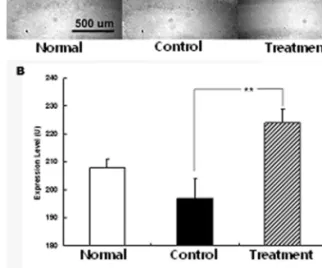
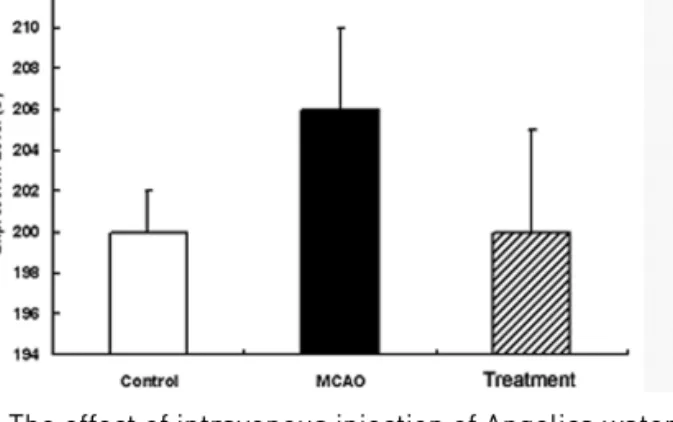
(6) 005~018 당귀추출물.ps. 2011.10.6 10:43 AM. 페이지10. MAC08. Journal of Pharmacopuncture 제 14권 제 3호( 2011년 9월). 10. GFAP CD81 CD81. CD81 CD81. CD81 55. 2.3, 69 CD81. 4.5, 60. 5.1%. (Fig. 4). Fig 5. The effect of intravenous injection of Angelica extract water on c-Fos expression in the MCAO rats. c-Fos expression in cortical layers was decreased after MCAO and increased with intravenous injection of Angelica water extract representing darker staining (A). The expression was measured from coronal sections of the rat and converted into graphs (B). Intravenous injection of Angelica extract water increased c-Fos expression significantly compared with Control. Data show mean and standard deviation between Control and Treatment group with significant difference. ** p 0.01. Scale bar= 500. Fig 4. Effects of intravenous injection of Angelica extract water on CD81 expression following ischemic injury by MCAO in SD rats. Coronal sections were rinsed and probed with CD81 antibody on the 7th day following MCAO. The sections were taken pictures using microscope at 40X (A). CD81 expression in hippocampus was increased after MCAO with darker staining and decreased with intravenous injection of Angelica extract water. The expression was 55 2.3, 69 4.5 and 60 5.1% in the Normal, Control and Treatment group respectively. Data show mean and standard deviation between groups. CD81 expression was decreased after intravenous injection of Angelica extract water without significant difference (B). Scale bar=500. 5.. c-Fos 197 7 U. c-Fos. c-Fos 208 3 U 224 5 U (Fig. 5). 6.. ERK 200. (Fig. 6). ERK. 2U 200 5 U. ERK 206. 4U.
(7) 005~018 당귀추출물.ps. 2011.10.6 10:43 AM. 페이지11. MAC08. 11. MCAO Fig 6. The effect of intravenous injection of Angelica water extract on ERK expression in the MCAO rats. ERK expression in cortical layers was increased after MCAO and decreased with intravenous injection of Angelica water extract with darker staining (A). The expression was measured from coronal sections of the rat and converted into graphs (B). Data show mean and standard deviation between Control and Treatment group. Scale bar= 400. (axon). Schwann cell) (axon sprout). IV. 고찰 (Umbeliferae) (Angelica gigas Nakai). coumarin decursin, decusinol, -sitosterol, nodakenetin, nodakenin butulidene phtalide, N-valerophenonone-O-carboxilic acid Vitamin B12, Vitamin A. Nogo, Omgp(oligodendrocyte-myelin glycoprotein), MAG(myelin-associated glycoprotein) tenascin-R, keratin, CSPGs(choldroitin sulphate proteoglycans). glutamic acid. cysterine. protease hydroxycholesterol cytokine.
(8) 005~018 당귀추출물.ps. 12. 2011.10.6 10:43 AM. 페이지12. MAC08. Journal of Pharmacopuncture 제 14권 제 3호( 2011년 9월). pyrogen GFAP 8-9nm 55kDa type intermediate filament glial filament cytoskeletal protein. CD81 CD81 CD81 CD81. astrogliosis astrogliosis GFAP antisera. GFAP CNS CA1 CA2. Muller cell GFAP. photorecepter GFAP. GFAP. GFAP. CD81. GFAP knock out. 43 53. 2.3%. 2.4%. GFAP 67 5.3% GFAP. c-Fos c-Fos c-Fos 72. GFAP 6-12 GFAP GFAP. c-Fos c-Fos. CD81 tetraspanin (transmembrane protein) tetraspanin molecular complex cell adhesion molecules molecule complexes second messenger system. c-Fos MCAO 7 c-Fos c-Fos. CD81 tive antibody). TAPA (Target of the antiprolifera-. CD81 epitope antiproliferative antibody CD81 CD81 microglial cell. ERK. protein kinase. ERK.
(9) 005~018 당귀추출물.ps. 2011.10.6 10:43 AM. 페이지13. MAC08. 13. Choi 100%. 40.8%. ERK. 79.4%. 38.7% ERK. 200mg/kg. 1. decrusinol 1,278.26ug/ml 2mg/kg 14.99ug/ml 56-58. V. 결론. GFAP, CD81 GFAP, CD81. GFAP. CD81. 1.. Chen. MCAO. 2. Bcl-2. Yang 25%. 250ml 15ml/kg Liao. 5g/kg. 3.. GFAP. 4.. CD81. 5.. c-Fos. 6.. ERK. CD81 147ug/ml. 184ug/ml 15.0ug/ml. c-Fos. GFAP ERK.
(10) 005~018 당귀추출물.ps. 14. 2011.10.6 10:43 AM. 페이지14. MAC08. Journal of Pharmacopuncture 제 14권 제 3호( 2011년 9월). VI. Acknowledgements This paper was supported by Wonkwang University in 2010.. VII. References 1. The Korean Society of Pathologists. Pathology. Seoul: Komoonsa. 1990:1261-2. 2. Statistics Korea. The cause of death statistics 2009.2009:6-12. 3. Anders JJ, Hurlock JA. Transplanted glial scar impedes olfactory bulb reinnervation. Exp Neurol. 1996;142(1):144-50. 4. Bahr M, Przyrembel C, Bastmeyer M. Astrocytes from adult rat optic nerves are nonpermissive for regenerating retinal ganglion cell axons. Exp Neurol. 1995;131(2):211-20. 5. McKeon RJ, Schreiber RC, Rudge JS, Silver J. Reduction of neurite outgrowth in a model of glial scarring following CNS injury is correlated with the expression of inhibitory molecules on reactive astrocytes. J Neurosci. 1991;11(11):3398-411. 6. Boucheix C, Rubinstein E. Tetraspanins. Cell Mol Life Sci. 2001;58(9):1189-205. 7. Song BK, Geisert GR, Vazquez-Chona F, Geisert EE Jr. Temporal regulation of CD81 following retinal injury in the rat. Neurosci Lett. 2003;338(1):29-32. 8. Hemler ME. Specific tetraspanin functions. J. Cell Biol. 2001;155(7):1103-8. 9. Levy S, Todd SC, Maecker HT. CD81 (TAPA1): A molecule involved insignal transduction and cell adhesion in the immune system. Annu Rev Immunol. 1998;16:89-109. 10. Lee SI. Ahn DG, Shin MG. Clincal Application of Herbal Medicine. Seoul: Traditional Medicine Research Center. 1993:357-58. 11. Son SY. Shennong Ben Cao Jing. Taipei: Wungwang Publishing Co. 1971:24.. 12. Herbology Professors Association. Clinical Herbology. Seoul: Younglimsa. 1995:578-80. 13. Li SZ. Ben Cao Gang Mu. Beijing: People’s Medical Publishing House. 1982:833-37. 14. Jung JU. Neuroprotective effect of Angelica gigas on focal cerebral infarction in the mouse. Gyungsan University Graduate School. Dissertation for Master Degree. 2000. 15. Jun YY, Park CS, Park CG. An experimental study of effect on brain damage and neuroprotective effect of Angelicae gigantis radix extract against cerebral ischemia in rats. The Korean Journal of Herbology. 2003;18(4):25-35. 16. Han SG, Lee BL. Effects of Angelica gigas Nakai herbal acupuncture into Hyolhae(SP10) of brain ischemic injury induced by Intraluminal Filament insertion in the rats. The journal of Korean acupuncture and moxibustion society. 2004;21(2):1-20. 17. Lee SH, Moon SJ, Shin JB, Hae RK, Seong KM, Yag JH, Song BK. The Effect of the Water Extract of Angelica Sinens on Gliosis Repression of Astrocyte after Hypoxic injury. J Korean Oriental Med 2008;29(1):167-178. 18. Longa EZ, Weinstein PR, Carlson S, Cummins R. Reversible middle cerebral artery occlusion without craniectomy in rats. Stroke. 1989; 20(1):84-91. 19. Zou S. Ben Jing Shu Zheng. Seoul:Daesung Medical. 2001:240-5. 20. Xu SN, Niu BZ. Chinese Traditional Medical Books Translation: Shennong Ben Cao Jing. Hebei:Hebei Science Technology Publising Co. 1997:68. 21. Oh MC, Ahn KS, Kim KH. Effects of Astragali Radix and Angelicae gigantis Radix on Immune Response in Mice. Journal of Kyunghee University Oriental Medical School. 1986;9(1):343-54. 22. Hann CK, Ahn DK. A Study on the Decursin content of Dang-Gwi and it’s Effect on the Hematopoiesis in Anemic Rabbit. Journal of.
(11) 005~018 당귀추출물.ps. 2011.10.6 10:43 AM. 페이지15. MAC08. 15. Kyung hee University Oriental Medical School. 1983;6(1):153-67. 23. Bradley RR, cuunniff PJ, Pereira BJ. Hemoatopoietic effect of Radix angelicase sinensis in a hemodialysis patient. Am J Kidney Dis. 1999;34(2):349-54. 24. Liao JF, Jan YM, Huang SY, Wang HH, Yu LL, Chen CF. Evaluation With receptor binding assay on the water extracts of ten-active herbal drugs. Proc Natl Sci Counc Repub China B. 1995;19(3):151-58. 25. Hu H, Hang B, Wang P. Anti-inflammatory effect of radix Angelicase sinensis. Chung Kuo Chung Hsi Chieh Ho Tsa Chih. 1999;16(11):684-86, 704. 26. Sung IH, Chae WS. The effect of Aquaacupuncture of Radix Corydalis and Radix Angelica in endotoxin induced thrombosis in mice. The journal of Korean acupuncture and moxibustion society. 1994;11(1):392-404. 27. Kim GS, Kim MD, Kim Y, Kim JH, Kim JH, Lee WC, Lim YG, Jung CG. Practical Clinical Guide for Western and Oriental Medicine. Seoul: Jung Dam Books. 2001;3:22-30. 28. Berry M, Maxwell WL, Logan A, Mathewson A, McConnell P, Ashhurst DE, Thomas GH. Deposition of scar tissue in the central nervous system. Acta Neurochir Suppl. 1983;32:31-5. 29. Fawcett JW, Asher RA. The glial scar and CNS repair. Brain Res Bull. 1999;49(6):377-91. 30. Asher RA, Fidler PS, Morgenstern DA, Adcock KH, Oohira A, Rogers JH, Fawcett JW. Neurocan is upregulated in injured brain and in cytokine-treated astrocytes. J Neurosci. 2000;20(7):2427-38. 31. Moon LD, Brecknell JE, Franklin RJ, Dunnett SB, Fawcett JW. Robust regeneration of CNS axons through a track depleted of CNS glia. Exp Neurol. 2000;161(1):49-66. 32. Fidler PS, Schuette K, Asher RA, Dobberton. A, Thornton SR, Calle-Patino Y, Muir E, Levine JM, Geller HM, Rogers JH, Faissner A, Fawcett JW. Comparing astrocytic cells lines that are inhibitory or permissive for axon growth: the major axon-inhibitory proteoglycan in NG2. J Neurosci. 1999;19(20):8778-88. 33. Guth L, Albuquerque EX, Deshpande SS, Barrett CP, Donati EJ, Warnick JE. Ineffectiveness of enzyme therapy on regeneration in the transected spinal cord of the rat. J Neurosurg. 1980;52(1):73-86. 34. Zhang SX, Geddes JW, Owens JL, Holmberg EG. X-irradiation reduces lesion scarring at the contusion site of adult rat spinal cord. Histol Histopathol. 2005;20(2):519-30. 35. Gimenez Y, Ribotta M, Rajaofetra N, MorinRichaud C, et al. Oxysterol(7beta-hydroxycholesteryl-3-oleate) promotes serotonergic reinnervation in the lesioned rat spinal cord by reducing glial reaction. J Neurosci Res. 1995;41(1):79-95. 36. Bethea JR, Nagashima H, Acosta MC, Briceno C, Gomez F, Marcillo AE, Loor K, Green J, Dietrich WD. Systemically administered interleukin-10 reduces tumor necrosis factor-alpha production and significantly improves functional recovery following traumatic spinal cord injury in rats. J Neurotrauma. 1999;16(10):851-63. 37. Puchala E, Windle WF. The possibility of structural and functional restitution after spinal cord injury. A review Exp Neurol. 1977;55(1):1-42. 38. Eng LF, Ghirnikar RS, Lee YL. Glial fibrillary acidic protein: GFAP-thirty-one-years (19692000). Neurochemical Res. 2000;25(9-10):1439-51. 39. Sarthy V, Ripps H. The Retinal muller cellstructure and Function. Kluwer Academic /Plenum Press, New york, NY. 2001. 40. Menet V, Gimenez Y, Ribotta M, Sandillon F, Privat A. GFAP null astrocytes are a favorable.
(12) 005~018 당귀추출물.ps. 16. 2011.10.6 10:43 AM. 페이지16. MAC08. Journal of Pharmacopuncture 제 14권 제 3호( 2011년 9월). substrate for neuronal survival and neurite growth. Glia. 2000;31(3):267-72. 41. Pekny M, Johansson CB, Eliasson C, Stakeberg J, Wallen A, Perlmann T, Lendhl U, Betsholtz C, Berthold CH, Frisen J. Abnormal reation to central nervous system injury to central nervous system injury in mice lacking glial fibrilary acidic protein and vimentin. J Cell Biol. 1999;145:503-14. 42. Kwon OK. Alteration of recovery of motor function and glial fibrillary acidic protein (GFAP) after spinal cord injury (SCI) in the rats. Gradutae School of Konkuk University. 2003. 43. Eddelstone M, Mucke L. Molecular profiles of reactive astrocytes-implication for their role neurologic disease. Neruosci. 1993;54(3):1536. 44. Schick MR, Nguyen VQ, Levy S. Anti-TAPA1 antibodies induce protein tyrosine phosphorylation that is prevented by increasing intracellular thiol levels. J Immunol. 1993;151(4):1918-25. 45. Berditchevski F, Tolias KF, Wong K, Carpenter CL, Hemler ME. A novel link between integrins, transmembrane-4 superfamily proteins (CD63 and CD81), and phosphatidylinositol 4kinase. J Biol Chem. 1997;272(5):2595-98. 46. Yauch RL, Hemler ME. Specific interactions among transmembrane 4 superfamily(TM4SF) proteins and phosphoinositide 4-kinase. Biochem J. 2000;351(3):629-37. 47. Oren, R, Takahashi, S, Doss C, Levy R, Levy S. TAPA-1, the target of an antiproliferative antibody, defines a new family of transmembrane proteins. Mol Cell Biol. 1990;10(8):4007-15. 48. Geisert EE Jr, Yang L, Irwin MH. Astrocyte growth, reactivity, and the target of the antiproliferative antibody, TAPA. J Neurosci. 1996;16(17):5478-87.. 49. Kelic S, Levy S, Suarez C, Weinstein DE. CD81 regulates neuron-induced astrocyte cellcycle exit. Mol Cell Neurosci. 2001;17(3):551-60. 50. Geisert EE Jr, Williams RW, Geisert GR, Fan L, Asbury AM, Maecker HT, Deng J, Levy S. Increased brain size and glial cell number in CD81-null mice. J Comp Neurol. 2002;453(1):22-32. 51. Dijkstra S, Duis S, Pans IM, Lankhorst AJ, Hamers FP, Veldman H, Bar PR, Gispen WH, Joosten EA, Geisert EE Jr. Intraspinal administration of an antibody against CD81 enhances functional recovery and tissue sparing after experimental spinal cord injury. Exp Neurol. 2006;202(1):57-66. 52. Herrera DG, Robertson HA. Activation of cfos in the brain. Prog Neurobiol. 1997;50(2-3):83-107. 53. Onodera H, Kogure K, Ono Y, Igarishi K, Kiyota Y, Nagaoka A. Proto-oncogene c-fos is transiently induced in the rat cerebral cortex after forebrain ischemia. Neurosci. L.eff. 1998;98(1):101-4. 54. Kamii H, Kinouchi H, Sharp FR, Epstein CJ, Sagar SM, Chan PH. Expression of c-fos mRNA after a mild focal cerebral ischemia in SOD-1 transgenic mice. Brain Res. 1994;662(1-2):240-4. 55. Masuhara K, Ohmichi M, Kurachi H, Tasaka K, Kanzaki T, Kimura A, Hayakawa J, Hisamoto K, Koike K, Murata Y. Involvement of extracellular signal-regulated protein kinase in gliosis induced during recovery from metabolic inhibition. Biochem Biophys Res Commun. 2000;267(3):892-96. 56. Wu YC et al. Pharmacological effectgs of Radix Angelica Sinensis (Danggui) on cerebral infarction. Chin Med. 2011;6(1):32. 57. Yang JW, Ouyang JP, Liao WJ, Tian J, Liu YM, Wei L, Wang BH, Li K.The effects of Chinese herb Angelica in focal cerebral.
(13) 005~018 당귀추출물.ps. 2011.10.6 10:43 AM. 페이지17. MAC08. 17. ischemia injury in the rat. Clin Hemorheol Microcirc. 2005;32(3):209-15. 58. Chen F, Yan ZK, Yang B. Effects of acupointinjection of compound Angelica-root Injectio on cerebral Bcl-2 and Bax immunoactivity and hemorheology in rats with cerebral ischemiareperfusion injury. Zhen Ci Yan Jiu. 2011;36(2):85-9. 59. Liao WJ, Fan M, Yang YH, Yang WT and Liu ML: Effects of Angelica sinensis injection on the neuronal metabolites and blood flow speed within reperfusion following the ischemic cerebral injury in rats. Zhongguo Yingyong Shenglixue Zazhi 2003;19(3):209-212. 60. Aghazadeh-Habashi A, Ibrahim A, Carran J, Anastassiades T, Jamali F.Single Dose Pharmacokinetics and Bioavailability of Glucosamine in the Rat. J Pharm Pharmaceut Sci. 2002;5(2):181-184. 61. Choi MS, Lee YH, Shim CK. Bioavailabilities of Omeprazole administered to rats through various routes. Arch Pharm Res. 1995 18(3):141-145. 62. Kim KM, Kim MJ, Kang JS. Absorption, distribution, metabolism, and excretion of decursin and decursinol angelate from Angelica gigas Nakai. J Microbiol Biotechnol. 2009;19(12):1569-72..
(14)
수치


관련 문서
Effects of Angelica gigas NAKAI pharm- acopuncture at ST 36 , BL 23 bilaterally on the body weight in Freund’s adjuvant-induced arthritis rats Control :
Effect of Angelica gigas radix palva water extract on the brain-blood barrier permeability changes induced by middle cerebral artery occlusion in rats..
Objectives: This study was performed to investigate the effects of Semen Persicae (SP) on infarct volume, COX-2 protein expression in the middle cerebral artery
Effect of Yield and Decursin Content According to the Accumulative Temperature and Seedling Size in Cultivation Areas of Angelica gigas Nakai.. Young Guk Kim * † , Young Sup Ahn
The current study is to examine the effect of the Uncariae Ramulus et Uncus on CD81 and GFAP expression in the rat brain following middle cerebral artery occlusion.. Methods :
The Improvement Effect of Fermented Angelica gigas Nakai Powder Against Orotic Acid-induced Fatty Liver in Rats.. Hee-Young Ahn, Kyu-Rim Park and
The L, b values of cold buckwheat noodles using a mixture of 0~3% of Ligularia fischeri powder and 0.5% of an ethanol-treated hot water extract of Angelica gigas Nakai
Methods :::: According to previous research data, the effect of Yanggyuksanhwa -tang on cerebral infarction, we induced cerebral infarction by middle cerebral
