I. Introduction
Most children enjoy drawing activities in science classes (Hayes et al., 1994). Therefore, many re- searchers have been integrating art and science (Sity and Buchinski, 2005; Stellflue et al., 2005; Schussler and Winslow, 2007). They suggested that science-art integrated classes were successful in connecting con- tent across science and art. Well-integrated science instruction with art often motivates students to more engage in science learning and to freely express their thoughts and feelings on what they have learned in science.
Stellflue and his colleagues(2005) integrated science and art, developed longitude activity ‘Plants, Pots, and Paints’ and appled to forth-and fifth-grade students.
The students were very motivated by their plant and art studies and their learning was enhanced in both subjects because of the integration. For example, in art class, students developed observations skills. Having learned more about plants' forms and functions in science class, students applied that knowledge to their drawings.
Flick and Larry(1990) found that the Draw-a-Scientist
activity changed students' standard image of scientists.
Drawings can be used to probe children's conception of natural environments (Strommen, 1995). There is a wide range of techniques which teachers could use to probe students' thinking (Driver et al., 1994). As a technique for exploring idea, drawing is a useful form of expression for children who have difficulty expressing their thoughts verbally (Rennie and Jarvis, 1995).
However, drawings are of limited value in detecting students' idea and yield less information than inter- views (Strommen, 1995). Since exploring students' drawings is open to misinterpretation by researchers, follow-up interviews were essential to clarity am- biguities (Dove et al., 1999). Drawing activities in conjunction with interviews have been successfully used to explore children's ideas about abstract concepts, e.g. ‘technology’ (Rennie and Jarvis, 1995).
We chose children's imaginary science drawings as a subject for this study for several reasons. The majority of primary students have often drawn ima- ginary science drawings. In addition, both science and art use the powerful tools of observation and imagination (Lee et al., 2000).
Exploring Korean Children's Imaginary Science Drawings:
A Case of Science-art Integration
Mun, Kongju Kim, Sung-Won
*Ewha Womans University
Abstract: Well-integrated science instruction with art often motivates students to more engage in science learning and to freely express their thoughts and feelings on what they have learned in science classes. This study, therefore, attempted to explore Korean children's imaginary science drawings. Ninety elementary students (3
rd-6
thgraders) in Seoul, South Korea, participated in this study. The guiding research questions were 1) what overall characteristics of students’ imaginary science drawings are and how these characteristics represent children’s image of science, and 2) what educational value of children’s imaginary science drawing activity as a case of science-art integration is. Data sources included a set of children’s drawings and individual interviews with selected students. From the drawings, it was found that most of the subjects that children drew tended to be limited to the space. In addition, the children tended to assimilate science into technology that makes our life more convenient. We also found imaginary science drawing can be a good science-art integrated instruction method. Imaginary science drawing has educational benefits; one is a tool to investigate children's thoughts and knowledge of science while the other is method that motivate children to learn science effectively.
*Corresponding author: Kim, Sung-Won ([email protected])
**Received on 12 January 2008, Accepted on 14 October 2008
Imaginary drawing simply means picture which represent their thoughts and imagination. Imaginary drawings can make people improve their intellectual capacity: memory, thinking ability, inquiry and etc(An, 1993). There is a very distinct difference between the imaginary drawing and the imaginary science drawing.
While the imaginary drawing is to draw things came up into mind without limitation of subjects, the meaningful imaginary science drawing has to stimulate children's scientific reasoning and creativity. Therefore, we suggested the definition of the imaginary science drawing as a drawing activity that allows children to express their own imagination, involving scientific concepts, creative ideas and scientific reasoning into their pictures. Therefore, the imaginary science dra- wings are pictures in which students described their scientific imagination
1), such as future life, new submarine transportation, robot, and etc.
Science and art are naturally overlapped. Both of them have been used as popular means of investig- ation in daily lives. Both involve ideas, theories, and hypotheses that are tested in places, the laboratory and art-studio respectively, where mind and hand come together. Artists, like scientists do, study materials, people, culture, history, religion, mythology and everything around us. Science and art, therefore, can be integrated effectively. The imaginary science drawing is a good case of science-art integration and it is already a very common activity in Korean elementary schools. However, there has been no research about imaginary science drawings until now.
We strongly believe well-organized studies about imaginary science drawing is necessary to develop art-science integrated instructional methods. Therefore, we investigated children's imaginary science drawings and their images of science through their drawings.
The research questions are as followings.
First. What are overall characteristics of children's imaginary science drawings and how do these charac- teristics represent children's image of science?
Second, What is the educational values of children's imaginary science drawing activity as a case of science-art integration?
II. Methods
1. Participants
A total of ninety children(28 3
rd, 29 4
th, 33 6
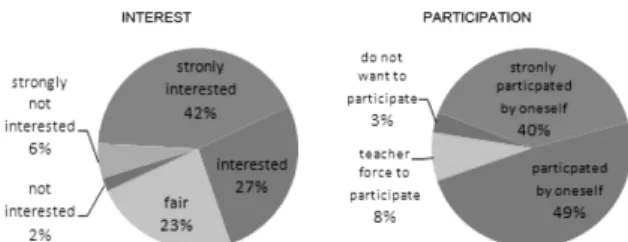
thgraders) from an elementary school in Seoul, in Korea, participated in this study. The majority of the children interested in the imaginary science drawing and participated by themselves (we pre-surveyed with the children about drawing activity in science class.
Fig. 1 shows the pre-survey result).
Fig. 1 Elementary Students' Interest and Participation in Science Imaginary Picture
2. Data sources
The drawings. The children were told that we wanted to discover their own ideas about scientific imagination within a regular science class. They were asked to work individually and to present their drawings to the Imaginary Science Drawing Contes t
2). Teacher asked children to describe their scientific imagination. No special subjects for drawings were provided. Children produced their drawings in an art-studio with an art teacher. Children could ask help to their teacher if they have some troubles, related to art skills.
Follow-up Interviews were conducted on twelve children(6 3
rd, 6 6
thgraders) who were selected based on the drawings they produced. The interviewer, one of researchers, visited the class when participants produced their imaginary science drawings. The in- terviewer investigated a classroom and children and made a note-taking. The interviews were conducted during the class and each interviewee talked with a interviewer about his or her drawing. Children were interviewed individually for about ten minutes with
1) The scientific imagination involves scientific concepts, creative ideas and scientific reasoning.
2) The Imaginary Science Drawing Contest is annual event in Korea. Most of elementary schools take place Imaginary Science Drawing Contest every year.
audio-recoding. The children were acknowledged that we wanted to talk with them about their drawings.
Interview protocol is semi-structured. In addition, questions for interview were mainly about asking students to describe their drawing and to explain why they draw it.
3. Data Analysis
The drawings were analysed for identifying characteristics of children's drawings. We classified drawings with regard to subject. Each drawing was placed into the one of ten categories according to the subject. In addition, we evaluated it based on the degree of both scientific imagination and scientific concept. All interviews were recoded and transcribed.
The frequency of common ideas from interview were noted. The study drew on analytical approaches to identify emerging patterns of drawings.
III. Results
1. Characteristics of children's drawings and children's image of science.
Three characteristics were emerged by investigating subjects of the children's drawings and interviews.
They are as followings.
First. The majority of the subject of drawings were the space. Most children described the space (43.3%) in their drawings. The children drew transportations for the space-journey, future cities in the space, space wars, aliens and etc. Table 1 shows various kinds of
Table 1Subjects of the children's drawings
Subject
Number of children (percentage)
Subject
Number of children (percentage) the space 39 (43.3%) the airb) 2 (2.2%)
dreama) 11 (12.2%) inventionc) 2 (2.2%) future city 11 (12.2%) war 2 (2.2%) robot 10 (11.1%) biology 2 (2.2%) submarine 10 (11.1%) biotechnology 1 (1.1%) total 90(100.0%) a) The drawing involved angels, imaginary animals, and etc.
b) The drawing involved flying in the air.
c) Children described their own invention on drawings.
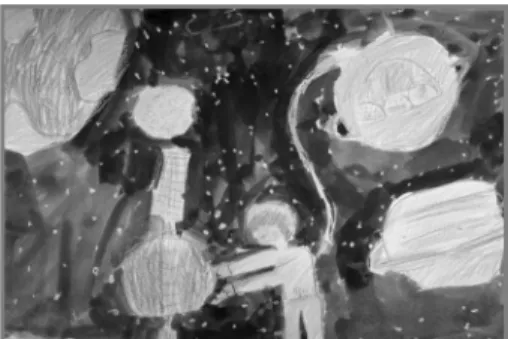
Fig. 2 Beom's Drawing : A man live in planet.
Fig. 3 Hoon's Drawing: House wife robot.
Fig. 4 Sook's Drawing : New transportation system.
subjects in children's drawings. It was found that subjects of drawings had lack of variety.
Beom(pseudonym) imagined the space in the future and draw it(Fig. 2). He imagined the space while he was drawing because he thought that there were a lot of things scientists have to study in the space. Beside Beom, many children drew the space in their drawings and had similar ideas. Those children believe that the development in science technology will make it easy to escape from the earth and travel the space. The fig. 2 is presented as an example of drawings whose subject is the space.
Second. The children tended to assimilate science
into technology that makes our life more convenient.
Most interviewees said that their lives in the future will be more convenient because many new tools and machines will be invented by scientists. Hoon (pseudonym) drew a housewife robot(Fig. 3). The robot cleans rooms and feeds fish instead of people;
therefore, people don't need to do any house chore.
In her drawing, people just watch a television. Also, Sook(pseudonym) imagined a new transportation system. People can take it from America to Korea in a very short time(Fig. 4). We found that children's attitude toward science is very positive through exploring drawings.
Third. The majority of children tended to express low scientific imagination in their drawings. The majority of students just drew their fantasy or dream.
They drew the objects related with science but did not express scientific concepts and scientific reasoning on their drawings. Yuri(pseudonym) drew a space craft in her drawing. Following the interview with her, she just drew what she memorized about space craft because she saw it on the book or TV before.
Therefore, it is not a meaningful imaginary science drawings because the meaningful imaginary science drawings have to involve scientific reasoning and ideas. The drawings like this can called fancy picture which is a picture describing imaginary things that do not exist in reality. Some of students express their scientific thought and ideas but others just drew their fantasy or dream. This is problematic because nobody has recognized this issue seriously and even teachers have not explained to children about what meaningful scientific imagination is.
Those characteristics we found above represent children's image of science. Therefore, we can iden- tified three themes of children's image of science from those characteristics: (1)space, (2)convenience, (3)fantasy. We concluded that the majority of Korean children tend to believe that science is closely related with the space, convenience, and fantasy.
2. Educational value of children's imaginary science drawing activity as a case of science-art integration
Many researchers found several educational benefits of integrated classes. They suggested that science-art integration classes were successful in connecting
content across science-art and well-integrated science classes with art can motivate students to more engage in science learning and to freely express their thoughts and feelings on what they have learned in science.
(Sity and Buchinski, 2005; Stellflue et al., 2005;
Schussler and Winslow, 2007). From the children's imaginary science drawings and interviews, we found two educational values of integrated classes that many researchers suggested. They are as followings.
First. Children can freely express their thoughts on what they have learned in science through imaginary science drawings. Children can express their scientific ideas through imaginary science drawings. Min drew a fire extinguishing helicopter. While he was drawing this picture, he was thinking about the effective way to extinguish fire on mountains. In addition, he came up with a very creative idea, a new helicopter which can change clouds to water. He expressed his new idea in his drawing. The picture(Fig. 5) shows a helicopter that has a pipe to collect clouds and pours water to fire on mountains. Like Min did, a lot of children presented what they have learned in science class into their imaginary science drawings. Therefore, we became able to figure out the tendency that children often express their thoughts in drawings.
The interview with Yuri is a good example of this.
Yuri is very interested in the space so she drew the solar system and represented her ideas about it. She remembered scientific knowledge what she learned during science classes that many planets orbit around the sun and the sun is center of the solar system.
Some of imaginary science drawings we collected represented children's science knowledge and scientific ideas.
Fig. 5 Min's Drawing: A fire extinguishing helicopter.
Second, Imaginary science drawing motivates children to more interested in science learning. Most interviewees answered that they enjoyed drawing activity and art classes. They voluntarily participate in imaginary science drawing activity. They engaged in learning science through imaginary science drawing activity because imaginary science drawing made them have many scientific inquiries. Most inter- viewees told that they became more interested in science after experiencing imaginary science drawing activity.
As a result, we suggested that imaginary science drawing would be a good science-art integrated instruction method. It has several educational benefits;
one is a tool to investigate children's thoughts and knowledge of science while the other is a method for motivating and encouraging students to learn science.
IV. Discussion
In this study, we investigated the characteristics of Korean children's imaginary science drawings and educational values of it in the point of view of science-art integration.
First of all, we found two characteristics of Korean children's drawings: (1) a lack of subject diversity and (2) positive attitude toward science technology.
We believe that the reasons why the subjects of children's imaginary drawings are limited is that there were no special instruction methods for imaginary science drawing. Most Korean teachers have not developed specific instructional methods for imaginary science drawing. They just asked children to draw something related to science in the class. Therefore, the children did not understand what imaginary science drawing actually is. In addition, the majority of children tended to express low scientific im- agination in their drawings.
We also found imaginary science drawing would be a good example for integrated curriculums.
Children are able to express their thoughts on what they have learned in science classes and be motivated in science learning through imaginary science dra- wings. Furthermore, imaginary science drawing has many educational values and possibility for educational
application. Korean teachers have been aware that imaginary science drawing has many benefits for changing students' attitude toward science, understan- ding scientific knowledge and improving art skills (Mun, 2007). In addition, Park(2000) suggested that making valid purposes of the instruction imaginary drawing activity is one of the most important tasks for teachers. Teachers must consider what they should teach through imaginary drawings when they introduce this activity to student in order to improve students' cognitive, affective, and creative abilities.
Even though imaginary science drawing has many educational possibilities, most Korean teachers involve students in imaginary science drawing activities without considering the purposes of those activities.
Moreover, in Korea, the imaginary science drawing activity is just a special event, held only in science- april
3). Therefore, we suggested that teachers should have to design special curriculums for integrating science and art (specially science and imaginary drawing). It will be very useful for formal and informal classes.
This study was the first study about student's imaginary science drawings. We explored students' imaginary science drawings. The results of this study could be useful for future studies about science imaginary drawing activities and scientific imagination.
Some suggested future research questions as follo- wings: (1) What instructional methods and materials can help students to improve their imaginary science drawings? (2) What factors affect students' imaginary science drawings? (3) What is the scientific imagi- nation? The future studies about imaginary science drawings can provided the additional information about scientific imagination.
References
An, Hobum. 1993. Education through Art.
Boyooksa, 42.
Driver, F., Squires, A., Rushworth, P. and Wood- Robinson, V. 1994. Making Sense of Secondary Science. London: Routledge.
Dove, J. E., Everett, L. A. and Preece, P. F. W.
Exploring a hydrological concept through children's
3) In Korea, April is the month of science.