Vol.18, No.1, (2016), pp.1~5 http://dx.doi.org/10.9714/psac.2016.18.1.001
```
1. INTRODUCTION
The first commercial superconducting conductor was fabricated about 50 years ago, in 1962. Even now, the majority of superconducting magnets is made of NbTi and Nb3Sn wires, which are mainly operated at 4.2 K. However, soaring liquid helium price has increased demands for cryogen-free superconducting magnet more than ever.
MgB2, which was discovered in 2001, is considered as the most promising candidate for the cryogen-free operation (>
10 K), replacing the NbTi due to its high critical transition temperature (Tc), cost-effectiveness, and simple crystalline structure.
A long-decade intensive research has led a progress in the MgB2 superconducting wire for high-field performance with various doping materials. However, it still shows some limitation of a low field performance. In particular, critical current density, Jc, has not been increased and was even lower than that of NbTi.
Recently, enhancement of the Jc and the upper critical field, Bc2, has been reported for MgB2 wires doped with malic acid additive [1]. The chemical solution method is an economical route for industrial fabrication. So far, many other groups have confirmed the effects of various organic or carbohydrate dopants of MgB2 [2-11]. The study of carbon incorporation using malic acid can be advantageous because of the highly uniform mixing between the carbon and boron powders. For a monofilament conductor, a high Jc of 10,000 Acm-2 at 4.2 K and 10 T has been previously reported using an Fe sheath and low temperature sintering processing at 650oC [12]. It is well known that a low sintering temperature keeps the grain size small, which
leads to a strong enhancement of pinning. Furthermore, the density of in-situ processed MgB2 is as low as half the theoretical density because of magnesium, Mg, evaporation [13]. The voids can act as a current limiting factor.
Therefore, processing with low temperature sintering would be even more valuable, especially around 600oC, because this is below the melting point of Mg. Such considerations indicate that there is still room to further improve the high field Jc performance if active carbon from malic acid can be incorporated into boron sites around this temperature.
For industrial applications, another major concern is that we have to further enhance the low field Jc capability up to the performance level of Nb-Ti superconductors as MgB2
is considered as one of the most likely candidates to replace them in the conventional Nb-Ti markets. In the literature, the Jc of commercial Nb-Ti wires exceeds 105 Acm-2 at 4.2 K and 6 T [14]. However, the critical current density in MgB2, even for SiC doped wires or tapes, has almost never reached this level, probably because of the presence of a large amount of impurity phase [15]. Even though a carbon doped tape fabricated by mechanical alloying has achieved this level, Jc performance is drastically degrades as the field perpendicular to the tape surface increases [16]. According to the report of Kováč et al., severely mechanically alloyed precursor powders can enhance the critical current anisotropy with increasing magnetic field since mechanical deformation can cause c-axis alignment of the MgB2 grains as they form [17].
2. EXPERIMENTAL
An MgB2/Nb/Monel monofilament wire with 10wt%
Magnesium diboride(MgB
2) wires for applications
Dipak Pateland Jung Ho Kim*
Institute for Superconducting and Electronic Materials, Australian Institute for Innovative Materials, University of Wollongong, North Wollongong, NSW 2500, Australia
(Received 7 March 2016; revised or reviewed 17 March 2016; accepted 18 March 2016)
Abstract
Field and temperature dependence of the critical current density, Jc, were measured for both un-doped and carbon doped MgB2/Nb/Monel wires manufactured by Hyper Tech Research, Inc. In particular, carbon incorporation into the MgB2 structure using malic acid additive and a chemical solution method can be advantageous because of the highly uniform mixing between the carbon and boron powders. At 4.2 K and 10 T, Jc was estimated to be 25,000 - 25,300 Acm-2 for the wire sintered at 600oC for 4 hours. The irreversibility field, Birr, of the malic acid doped wire was approximately 21.0 - 21.8 T, as obtained from a linear extrapolation of the J-B characteristic. Interestingly enough, the Jc of the malic acid doped sample exceeds 105 Acm-2 at 6 T and 4.2 K, which is comparable to that of commercial Nb-Ti wires.
Keywords : Critical current density, Malic acid, MgB2 wires
* Corresponding author: [email protected]
TABLE I
THE SPECIFICATIONS OF UN-DOPED (#960)
AND CARBON DOPED (#1391) WIRES.
Stran # Filament# Barrier Outer Powder composition
B source O.D Fill factor
(Sample ID.) Sheath (%) (mm) (%)
960 1 Nb Monel MgB2 99.8 0.83 27
1391 1 Nb Monel MgB2+ 99.8 0.83 21
10wt%C4H6O5
malic acid additive (hereafter, termed strand #1391), fabricated by Hyper Tech Research Inc. (HTR) was studied in this work. Scheme 1 shows a schematic illustration of continuous tube forming and filling (CTFF) and novel technique has been developed by HTR to fabricate a long-length conductor (> 1 km). In details, a continuous Nb strip is used as inner barrier. As this Nb ribbon-shape enters and moves through the tube shaping dies, this gradually form it into a ‘U’ shape. After the mixed power with Mg and B is inserted, the closing dies gradually close off the tube. After the tube is closed, it passes through subsequent dies to reduce the diameter to 0.8-1.2 nm. A final sintering is around 650-725oCfor 20-40 min under Ar flow. Details of experiments have been described elsewhere [1], [12]. For a comparison and a reference, we studied an un-doped MgB2 wire (strand #960) that was also manufactured by the same company. The specifications for each strand are summarized in Table I. Wire samples were sealed with Zr foil and then sintered under flows of high purity Ar gas. Transport critical current up to 400 A was measured by using the standard four-probe method with a criterion of 1 μVcm-1. The magnetic field was increased up to 18 T while the temperature was varied within a range of 4.2 K to 30 K.
3. RESULT AND DISCUSSION
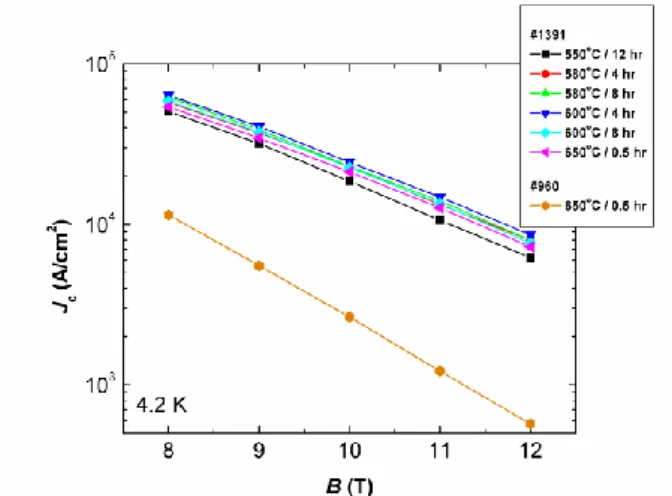
Critical current densities for malic acid doped wires sintered at different temperatures are shown in Fig. 1. Quite interestingly, even a sintering temperature as low as 550oC, the Jc is as high as ~18,000 Acm-2 at 4.2 K and 10 T. With a
slight increase in the sintering temperature and with a reduced sintering time, the Jc is further enhanced, for example, to 25,000 Acm-2 when the sample is sintered at 600oC for 4 hours. At an external magnetic field of 11.7 T, the Jc is still around 10,000 Acm-2. On the other hand, the Jc of the reference un-doped wire sintered at 650oC for 30 min was about an order of magnitude lower, about 2,800 Acm-2 at 4.2 K and 10 T.
The enhancement of the Jc by malic acid doping is also observed at 20 K, as can be seen in Fig. 2. Samples heat-treated in the same way, namely, sintered at 650oC for 30 min, were compared. The enhanced performance of critical current density by malic acid doping is even comparable to the performance seen in conventional Nb-Ti wires. For example, the Jc of 105 Acm-2 at 6 T and 4.2 K is comparable to Jc of commercial Nb-Ti wires under the same condition. The Jc in malic acid doped MgB2 wire also exceeds 104 Acm-2 at 5 T and 20 K. These Jc values are the highest record on published so far for an in situ processed Scheme 1. Schematic illustration of CTFF process. Fig. 1. The critical current density as a function of
sintering temperature for a malic acid doped MgB2 wires. Un-doped MgB2 wire (#960) is also shown as a reference. All lines are guides to the eyes.
Fig. 2. Magnetic field dependence of the critical current density for both un-doped (#960) and malic acid doped (#1391) MgB2 wires at 4.2 K and 20 K. The fit lines were calculated from the percolation model.
wire. We have already reported that the MgO fraction for malic acid doped wires was lower than for pure wires at all sintering temperatures [12]. A reduction in secondary phases can lead to a better grain connectivity. A similar reduction in the MgO fraction by chemical doping was also reported by Asthana et al. [18]. From micro-structural analysis of MgB2 doped with ethyltoluene, a smaller amount of the MgO, compared to the un-doped referemce sample was also observed, and this was ascribed to the reaction of the ethyltoluene with oxygen adsorbed on the surface of the boron particles.
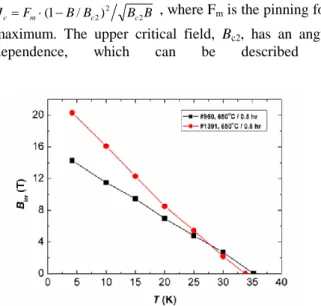
The irreversibility field, Birr, defined at a Jc criterion of 100 Acm-2, as obtained from a linear extrapolation of the field dependence of the critical current density, is shown in Fig. 3. At 20 K, the irreversibility fields for the un-doped and the doped samples are 7.0 T and 8.8 T, respectively. As we lowered the temperature, the difference in the irreversibility field sharply increases. The estimated Birr
values at 4.2 K are 14.2 T and 20.3 T, respectively. The irreversibility field can be enhanced either by increasing the upper critical field, Bc2, or by the reduction in the anisotropy parameter, . An estimate for both the upper critical field and the anisotropy parameter is possible with the percolation model reported by Eisterer and his co-workers [19]. The field dependence of the critical current density is numerically fitted by the following integral equation,
p dJ p J J p
c c c
79 . 1
0 1
)
(
where p(J) is the fraction of grains with critical current density above J and pc is the minimum fraction required for a superconducting current flow. The critical current of each grain is calculated with a grain boundary pinning model:
B B B B F
Jc m(1 / c2)2 c2 , where Fm is the pinning force maximum. The upper critical field, Bc2, has an angular dependence, which can be described by:
) ( sin ) ( cos )
( 2 2 2 2
2 cab
c B
B , from the anisotropic
Ginzburg-Landau theory. Only four fitting parameters, the upper critical field, the anisotropy parameter, the pinning force maximum and the percolation threshhold, are needed to describe the field dependence of the critical current for each temperature. We previously reported that for polycrystalline wire samples, the percolation threshold, pc, is usually 0.26 [12], and that value was used in this work as well. The other fitting parameters obtained for the both doped sample and un-doped sample processed in the same way are listed in Table II. Consistent with our previous report, both a reduction in the anisotropy parameter and an increase in the upper critical field affect the irreversibility field. For the malic acid doped sample studied in this work, however, there is more strong decrease in the anisotropy parameter, as shown in Table II, and that represents a major cause for the observed increase in the irreversibility field.
Another peculiar thing to be noted is that the pinning force maximum, Fm, is increased for the doped sample studied in this work, whereas in the previous sample it was lowered compared with that of the un-doped sample. The low field increase of the critical current density, which makes the doped sample comparable with Nb-Ti wires, is related to this increase in the pinning force maximum, which is probably due to low-energy ball-milling during the powder mixing process for the sample studied in this work.
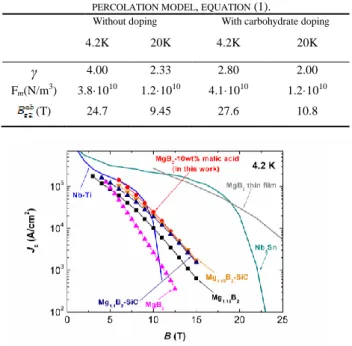
Our continuous efforts to increase the performance of MgB2 wires over the past few years [20-21] are summarized in Fig. 4. Stoichiometric binary MgB2 wires with various sheath materials and different numbers of filaments were first fabricated. Then, wires with 10%
excess Mg plus SiC dopant (Mg1.1B2-SiC), 15% excess Mg only (Mg1.15B2), and 15% excess Mg plus a SiC dopant (Mg1.15B2–SiC) were introduced. However, the best Jc was limited to 105 Acm-2 at 6 T and 104 Acm-2 at 11.5 T, respectively. Now with the malic acid doping, Jc values as high as 105 Acm-2 at 6.8 T and 104 Acm-2 at 11.7 T, comparable to those of commercial NbTi wires, as shown in Fig. 4, are achieved [20]. The critical current density is about 25,300 Acm-2 at 4.2 K and 10 T. However, much more attentions and efforts are still needed for real applications. Very recently, a cold high pressure densification has been suggested as an alternative way to enhance the mass density after a mechanical deformation process. The Jc at 4.2 K was reported to be further increased to ~40,000 Acm-2 for a malic acid doped conductor sintered at 600oC for 4 hours [22].
4. SUMMARY
We have measured the field and temperature dependence of the critical current density for in-situ processed MgB2 wire with malic acid additive. The critical current measurement results are comparable to those of commercial Nb-Ti wires or Mg1.15B2–SiC wire, the previous best reported result. The Jc for the malic acid doped MgB2 wire conductor sintered at 600oC for 4 hours was 25,300 Acm-2 at 4.2 K and 10 T, the highest (1)
Fig. 3. Temperature dependence of the Birr values for both un-doped (#960) and malic acid doped (#1391) MgB2 wires, as obtained from the J-B characteristic, using the Jc criterion of 100 Acm-2.
quantitative value published so far for in situ processed wires. The irreversibility field of the malic acid doped wire studied in this work at 4.2 K was as high as 21.3 T. The increase in the irreversibility field seems to be related to the reduction in the anisotropy parameter, and the improvement in the critical current density, especially in the low field region, is due to the increase in the pinning force maximum, according to the percolation model analysis. Quite interestingly, even at 20 K, Jc of the malic acid wire was much higher than that of the un-doped wire.
Even though, the Jc of the malic acid wire is slightly better than that of the best commercial Mg1.15B2–SiC wire reported so far, it is still has room for further improvement compared with MgB2 thin films [21, 23].
ACKNOWLEDGMENT
This work was supported by the Australian Research Council (FT110100170).
REFERENCES
[1] J. H. Kim, S. Oh, Y. -U. Heo, S. Hata, H. Kumakura, A. Matsumoto, M. Mitsuhara, S. Choi, Y. Shimada, M. Maeda, J. L.
MacManus-Driscoll, and S. X. Dou, “Microscopic role of carbon on MgB2 wire for critical current density comparable to NbTi,” NPG Asia Materials, vol. 4. pp. e3, 2012.
[2] Z. Gao, Y. Ma, X. Zhang, D. Wang, H. Yang, H. Wen and K.
Watanabe, “Influence of sintering temperature on the
superconducting properties of Zn-stearate-doped MgB2 tapes,”
Supercond. Sci. Technol. vol. 21, pp. 015016, 2008.
[3] X. Zhang, Y. Ma, D. Wang, Z. Gao, L. Wang, Y. Qi, S. Awaji, K.
Watanabe, and E. Mossang, “Phthalocyanine doping to improve critical current densities in MgB2 tapes,” Supercond. Sci. Technol.
vol. 22, pp. 045019, 2009.
[4] Y. Ma, Z. Gao, X. Zhang, D. Wang, Z. Yu, K. Watanabe, H. Wen, and E. Mossang, “Enhanced high-field performance in Fe-sheathed MgB2 tapes using inexpensive stearic acid additives,” J. Mater. Res.
vol. 22, pp. 2987-2991, 2007.
[5] Z. Gao, Y. Ma, X. Zhang, D. Wang, K. Watanabe, H. Yang and H.
Wen, “Influence of oxygen contents of carbohydrate dopants on connectivity and critical current density in MgB2 tapes,” Appl. Phys.
Lett., vol. 91, pp. 162504, 2007.
[6] Z. Gao, Y. Ma, X. Zhang, D. Wang, Z. Yu, H. Yang, H. Wen, and E.
Mossang, “Enhancement of the critical current density and the irreversibility field in maleic anhydride doped MgB2 based tapes,”
J. Appl. Phys., vol. 102, pp. 013914, 2007.
[7] B. -H. Jun, Y. J. Kim, K. S. Tan and C. -J. Kim, “Effective carbon incorporation in MgB2 by combining mechanical milling and the glycerin treatment of boron powder,” Supercond. Sci. Technol., vol.
21, pp. 105006, 2008.
[8] Y. J. Kim, B. -H. Jun, K. S. Tan, B. G. Kim, J. M. Sohn, and C. -J.
Kim, “Effect of glycerin addition on the superconducting properties of MgB2,” Physica C, vol. 468, pp. 1372-1374, 2008.
[9] B. -H. Kim, and C. -J. Kim, “The effect of heat-treatment temperature on the superconducting properties of malic acid-doped MgB2/Fe wire,” Supercond. Sci. Technol., vol. 20, pp. 980, 2007.
[10] A. Vajpayee, V.P.S. Awanaa, S. Balamurugan, E. T. Muromachi, H.
Kishan, and G.L. Bhalla, “Effect of PVA doping on flux pinning in bulk MgB2,” Physica C, vol. 466, pp. 46-50, 2007.
[11] A. Vajpayee, V. P. S. Awana, G. L. Bhalla, P. A. Bhobe, A. K.
Nigam and H. Kishan, “Superconducting properties of adipic-acid-doped bulk MgB2 superconductor,” Supercond. Sci.
Technol., vol. 22, pp. 015016, 2009.
[12] J. H. Kim, S. X. Dou, S. Oh, M. Jerčinović, E. Babić, T. Nakane and H. Kumakura, “Correlation between doping induced disorder and superconducting properties in carbohydrate doped MgB2,” J. Appl.
Phys., vol. 104, pp. 063911, 2008.
[13] E. W. Collings, M. D. Sumption, M. Bhatia, M. A. Susner and S. D.
Bohnenstiehl, “Prospects for improving the intrinsic and extrinsic properties of magnesium diboride superconducting strands,”
Supercond. Sci. Technol., vol. 21, pp. 103001, 2008.
[14] K. Vinod, R. G. Abhilash Kumar and U. Syamaprasad, “Prospects for MgB2 superconductors for magnet application,” Supercond. Sci.
Technol., vol. 20, pp. R1, 2007.
[15] (a) S. X. Dou, O. Shcherbakova, W. K. Yeoh, J. H. Kim, S.
Soltanian, X. L. Wang, C. Senatore, R. Flukiger, M. Dhalle, O.
Husnjak, and E. Babic, “Mechanism of Enhancement in Electromagnetic Properties of MgB2 by Nano SiC Doping,” Phys.
Rev. Lett., Vol. 98, pp. 097002, 2007. (b) H. Kumakura, H.
Kitaguchi, A. Matsumoto and H. Hatakeyama, Appl. Phys. Letts.
vol. 84, pp. 3669, 2004. (c) M. D. Sumption, M. Bhatia, M.
Rindfleisch, M. Tomsic, S. Soltanian, S. X. Dou and E. W. Collings,
“Large upper critical field and irreversibility field in MgB2 wires with SiC additions,” Appl. Phys. Lett. vol. 86, pp. 092507, 2005.
[16] W. Häßler, M. Herrmann, C. Rodig, M. Schubert, K. Nenkov and B.
Holzapfel, “Further increase of the critical current density of MgB2
tapes with nanocarbon-doped mechanically alloyed precursor,”
Supercond. Sci. Technol., vol. 21, pp. 062001, 2008.
[17] P. Kováč, I. Hušek, E. Dobročka, T. Melišek, W. Haessler and M.
Herrmann. “MgB2 tapes made of mechanically alloyed precursor powder in different metallic sheaths,” Supercond. Sci. Technol., vol.
21, pp. 015004, 2008.
[18] A. Asthana, A. Matsumoto, H. Kitaguchi, Y. Matsui, T. Hara, K.
Watanabe, H. Yamada, N. Uchiyama and H. Kumakura,
“Structural–microstructural characteristics and its correlations with the superconducting properties of in situ PIT-processed MgB2 tapes with ethyltoluene and SiC powder added,” Supercond. Sci.
Technol., vol. 21, pp. 115013, 2008.
[19] M. Eisterer, M. Zehetmayer, and H. W. Weber, “Current Percolation and Anisotropy in Polycrystalline MgB2,” Phys. Rev.
Lett., vol. 90, pp. 247002, 2003.
Fig. 4. Comparison of Jc-B characteristics at 4.2 K of the malic acid doped wire with those of other commercial MgB2 wires fabricated by the Hyper Tech Research. The malic acid doped MgB2 wire sintered at 600oC for 4 hours. The critical current density was about 25,300 Acm-2 at 4.2 K and 10 T.
TABLE II
THE FITTING PARAMETERS USED FOR THE CALCULATION FORM THE PERCOLATION MODEL, EQUATION (1).
Without doping With carbohydrate doping
4.2K 20K 4.2K 20K
γ 4.00 2.33 2.80 2.00
Fm(N/m3) 3.8·1010 1.2·1010 4.1·1010 1.2·1010
(T) 24.7 9.45 27.6 10.8
[20] M. A. Susner, M. D. Sumption, M. Bhatia, X. Peng, M. J. Tomsic, M. A. Rindfleisch, and E.W. Collings, “Influence of Mg/B ratio and SiC doping on microstructure and high field transport Jc in MgB2
strands,” Physica C, vol. 456, pp. 180, 2007.
[21] M. Tomsic, M. Rindfleisch, J. Yue, K. McFadden, D. Doll, J.
Phillips, M. D. Sumption, M. Bhatia, S. Bohnenstiehl, and E.W.
Collings, “Development of magnesium diboride (MgB2) wires and magnets using in situ strand fabrication method,” Physica C, vol.
456, pp. 203, 2007.
[22] R. Flükiger, H. S. A. Hossain, C. Senatore, M. Rindfleisch, M.
Tomsic, J. H. Kim and S. X. Dou, submitted to Supercond. Sci.
Technol.
[23] A. Matsumoto, Y. Kobayashi, K. Takahashi, H. Kumakura and H.
Kitaguchi, “MgB2 Thin Films Fabricated by a Precursor and Post-annealing Method Have a High Jc in High Magnetic Fields,”
Appl. Phys. Express, vol. 1, pp. 021702, 2008.