• 검색 결과가 없습니다.

Degradation characteristics of 2G HTS tapes with respect to an electrical breakdown

N/A
N/A
Protected

Academic year: 2021

Share "Degradation characteristics of 2G HTS tapes with respect to an electrical breakdown"

Copied!
5
0
0

로드 중.... (전체 텍스트 보기)

전체 글

(1)

```

1. INTRODUCTION

The development necessity of superconducting coil system with high voltage increases due to the demand of electrical power. One of the faults in high voltage operation is dielectric breakdown accident. Thus, the superconducting coil must be coped with an unexpected dielectric breakdown accident [1,2]. In this paper, the degradation characteristics of 2G HTS tapes were studied with respect to an electrical breakdown, to establish a fundamental database for designing high voltage superconducting systems [3]. The degradation tests of 2G HTS tapes were performed with three kinds of 2G HTS tapes whose stabilizer materials are different. To analyze the dependency of the degradation characteristics of 2G HTS tapes with stabilizer materials, three kinds of 2G HTS tapes which have stainless steel, brass and copper stabilizer were prepared and tested. All electrical breakdown tests were carried out under AC and lightening impulse voltages.

The degradation characteristics of 2G HTS tapes, such as Ic and index number, were measured by performing electrical breakdown tests and they were degraded by an electrical breakdown. Also, the degree of degradation was affected by the type of stabilizer material. Finally, the cross sectional views of 2G HTS tapes that have experienced an electrical breakdown test were observed by using a SEM.

As results, it is found that the degradation characteristics of 2G HTS tapes are concerned with micro-structural change and electrical resistivity of stabilizer layers.

2. EXPERMENTS

In order to analyze the dependency of the degradation characteristics of 2G HTS tapes with the breakdown voltage, all experiments were performed in liquid nitrogen.

The magnitude of breakdown voltages applied to the 2G HTS tapes were 50, 60, and 70kV, with AC and lightning impulse(IMP) voltages. The electrical characteristics, such as Ic and index number of 2G HTS tapes, were measured by using a four probe method with a 1µV/cm criterion in saturated liquid nitrogen at a temperature of 77K. The three kinds of 2G HTS tapes applied in this study were manufactured by SuNAM Company Limited. The samples of 2G HTS tapes were composed with different stabilizer materials. The stabilizer of the sample 1 was composed of copper laminated by stainless steel; that of the sample 2 was composed of copper laminated by brass; and finally, sample 3 was stabilized with copper only. The degradation characteristics, such as Ic and index number of 2G HTS tapes, were measured under electrical breakdown tests. The experimental results were described and analyzed.

2.1. Experimental Set-up

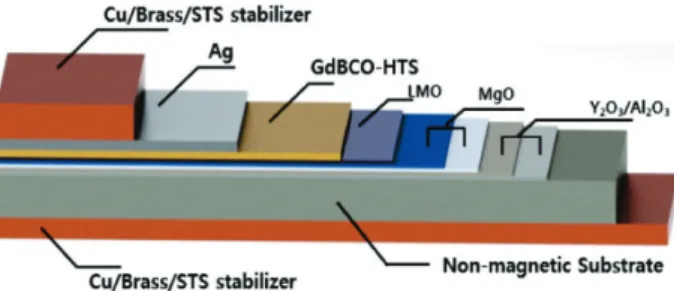
To verify the effect of electrical breakdown on 2G HTS, AC and lightening impulse voltages were applied to three kind of 2G HTS tapes. The 2G HTS tapes made by SuNAM were tested under electrical breakdown voltages (50, 60 and 70kV). As shown in Fig. 1 and Table 1, the sample 1 and 2 were stabilized with metal layers of copper laminated by stainless steel and brass respectively, and the sample 3

Degradation characteristics of 2G HTS tapes with respect to an electrical breakdown

Jong O Kang *, a , Onyou Lee a , Young Kyu Mo a , Junil Kim a , Seungmin Bang a , Hongseok Lee a , Jae-Hun Lee b , Cheolyeong Jang b , and Hyoungku Kang a

a Department of Electrical Engineering, Korea National University of Transportation, Chungju, Korea

b S u NAM Co., Ltd, 103 Seong-eun-ri, Wongok-myeon, Anseong, Korea

(Received 23 February 2015; revised or reviewed 18 March 2015; accepted 19 March 2015)

Abstract

The electrical insulation design for a superconducting coil system is important for developing high voltage superconducting apparatuses. Also, the degraded characteristics of superconducting tapes due to an electrical breakdown should be considered for superconducting coils design. In this study, the degradation characteristics of 2G high temperature superconducting (HTS) tapes were studied with respect to electrical breakdown tests. The degradation tests of 2G HTS tapes were performed with various stabilizer materials. The degradation characteristics of 2G HTS tapes such as critical current(Ic) and index number were observed by performing electrical breakdown tests. It was found that the characteristics such as Ic and index number can be degraded by an electrical breakdown. Moreover, it was concluded that the degradation characteristics of 2G HTS tapes were affected by a stabilizer material and applied breakdown voltage. The cross sectional view of 2G HTS tapes was observed by using a scanning electron microscope (SEM). As results, it is found that the degradation characteristics of 2G HTS tapes are concerned with hardness and electrical resistivity of stabilizer layers.

Keywords: degradation characteristics, critical current, electrical breakdown, index number, stabilizer, 2G HTS tapes

* Corresponding author: [email protected]

(2)

Fig. 1. Cross sectional view of 2G HTS tapes used in this work.

TABLE II

SPECIFICATIONS OF 2G HTS TAPES .

Sample 1 Sample 2 Sample 3

Manufacturer SuNAM SuNAM SuNAM

Ic [A] 200 133 137

Width [mm] 4 4 4

Stabilizer material STS

(lamination) Brass

(lamination) Copper (bare) Stabilizer thickness

[μm] 45 45 20

Total thickness [μm] 190 190 110

Hardness of stabilizer

[H·V] 220 110 80

Electrical resistivity of

stabilizer [Ω⋅m] 74 x 10 -8 6.67 x 10 -8 1.68 x 10 -8

was stabilized with that of copper on both sides. Therefore, the sample 3 was thinner than the other samples due to manufacturing processes of SuNAM. It is verified that the degradation characteristics are not largely affected by the thickness of stabilizer in the previous study [4]. The electrical breakdown voltages (50, 60 and 70kV) applied to the 2G HTS tapes were AC with 60Hz and lightning impulse with 1.2/50 µs waveform (wave front/wave tail). A sphere-to-plane electrode system made of stainless steel was prepared to perform the electrical breakdown tests.

The sphere electrode was connected to high voltage source, and the plane electrode was connected to the ground. An electrode system was used in liquid nitrogen to put a 2G HTS tape on a plane. The AC or lightning impulse voltage was increased at the rate of 1kV/s until breakdown. All experiments were performed 30min later to minimize the influence of void, which may cause the electrical breakdown [2]. The electrical breakdown voltages (50, 60 and 70kV) were applied to the 2G HTS tapes with AC and lightning impulse, by adjusting gap distance between a sphere electrode and a plane electrode. The schematic drawing of electrical breakdown experiments is shown in Fig. 2. The degradation characteristics of 2G HTS tapes, such as Ic and index number, were measured by using four probe method with a 1µV/cm criterion [5]. Each sample length was 140 mm, and length of voltage tap was set at 50 mm to measure Ic and index number. The damaged 2G HTS tapes were compared with 2G HTS tapes, which have not experienced electrical breakdown tests. The degree of degradation of 2G HTS tapes was analyzed with magnitude of breakdown voltages applied to 2G HTS tapes..

Fig. 2. The schematic drawing of electrical breakdown experiments.

2.2. Experimental Results and Discussion

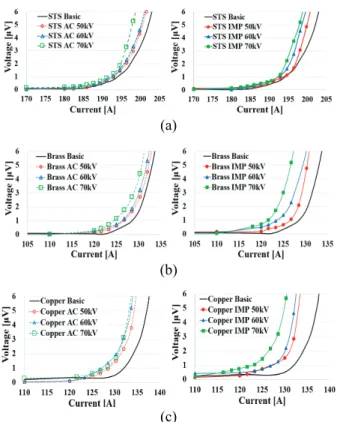
As shown in Fig. 3, the Ic of all sample tapes was measured with AC and IMP breakdown voltages. Fig.3. (a), (b), and (c) shows the V-I curves of sample 1, 2, and 3, respectively with the magnitude of breakdown voltages (50, 60, and 70kV, respectively). In Fig. 3 (a), ‘STS Basic’

indicates the V-I curve of sample 1 which was not affected by electrical breakdown test. The labels ‘STS AC 50kV’,

‘STS AC 60kV’, and ‘STS AC 70kV’ indicate the V-I

curve of sample 1 that were degraded by the AC breakdown

voltage tests with 50, 60, and 70kV, respectively. The Ic of

sample 1 which has not been damaged in breakdown tests,

was measured as 200A. The sample 1 stabilized by

stainless steel was measured as 195A, after the lightning

impulse breakdown voltage of 70kV. Also, Ic of sample 1

after the AC breakdown voltage of 70kV was measured as

196A. Experimental results show that Ic of sample 1 was

rarely affected by electrical breakdown. Fig. 3 (b) shows

the V-I curve of sample 2, damaged by AC and lightning

impulse breakdown voltages. As shown in Fig. 3 (b), the Ic

of sample 2 with AC breakdown voltage test was lightly

degraded with respect to magnitude of the applied

breakdown voltage; whereas the Ic of sample 2 damaged by

lightning impulse breakdown voltage rapidly decreased as

breakdown voltage increased. Thus, it was found that Ic

degradation of sample 2 was more severely affected by

lightning impulse breakdown voltage than that by AC

electrical breakdown voltage. In the same manner, it can be

seen in Fig. 3 (c) that the sample 3 was degraded with

respect to the applied breakdown voltage, as in the case of

sample 2. Therefore, it is concluded that the tendencies of

Fig. 2. The schematic drawing of electrical breakdown

experiments.

(3)

(a)

(b)

(c)

Fig. 3. V-I curves of 2G HTS tapes degraded by AC and IMP breakdown tests. (a) sample 1. (b) sample 2. (c) sample 3.

0 1 2 3 4 5 6

50kV 60kV 70kV

D ecr ea si ng ra tes o f I c [ %]

Breakdown voltage [kV]

Sample 1 AC Sample 2 AC Sample 3 AC Sample 1 IMP Sample 2 IMP Sample 3 IMP

Fig. 4. Decreasing rate of Ic with respect to the applied breakdown voltages.

Ic degradation with electrical breakdown tests are similar, except for sample 1 stabilized by stainless steel. However, the degree of Ic degradation was differently measured with stabilizer material of 2G HTS tapes. The Ic decreasing rate of 2G HTS tapes, with respect to the applied breakdown voltages, is shown in Fig. 4. As shown in Fig. 4, the decreasing rate of sample 1 stabilized by stainless steel layers is rarely varied with respect to applied breakdown voltages; whereas the decreasing rate of sample 3 stabilized by copper is severe varied among the 2G HTS tapes. Also, the decreasing rate of Ic is affected as breakdown voltage increased. Therefore, it was found that Ic degradation of sample 1 stabilized by stainless steel was the most smallest among the 2G HTS tapes.

The index number characteristics of 2G HTS tapes were measured with stabilizer materials, after the electrical

Fig. 5. Index number degradation of 2G HTS tapes with respect to the material of a stabilizer layers.

breakdown tests. The index number presents the sharpness of phase transition of superconducting tapes, and it can be calculated through the V-I curve characteristics. The index number of 2G HTS tapes was calculated by using Eq. (1).

Typically, E 1 and E 2 indicate the electric field intensity of 0.1 µV/cm and 1.0 µV/cm, respectively, when the voltage tap is set at 1cm. In this paper, E 1 is 0.5 µV/cm and E 2 is 5.0 µV/cm, because voltage tap is set at 5cm. I 1 and I 2 are current values which correspond to E 1 and E 2 , respectively.

)

In( )

In(

1 2

1 2

/I I /E

n = E (1)

The index numbers of sample 1, 2, and 3, which have not experienced electrical breakdown tests, were measured as 41.6, 43, and 44, respectively. The index numbers for degradation of 2G HTS tapes, with respect to the material of stabilizer layers, is shown in Fig. 5. As shown in Fig. 5, the index numbers of 2G HTS tapes were degraded with the increase in applied breakdown voltage. It can be seen that index number degradation of sample 1, damaged by AC of 70kV, was measured as 40.6; and that of sample 1, damaged by lightning impulse of 70kV, was measured as 38.32. It was found that the slight difference in the index number between AC and lightning impulse voltages was shown in the case of sample 1 stabilized by stainless steel layers. The index number of sample 2 and 3, shown in Fig.

5, is more severely degraded by lightning impulse breakdown voltage than by the AC breakdown voltage. It was found that the index number was more degraded by the lightning impulse breakdown voltage than by the AC breakdown voltage. The decreasing rate of index number with respect to the applied breakdown voltages is shown in Fig. 6. As shown in Fig 6, the decreasing rate of index number was gradually increased, as the applied breakdown voltage increased. Also, the decreasing rate of sample 3 stabilized by copper layers was the highest among the sample tapes, while the decreasing rate of sample 1 stabilized by stainless steel layers was the lowest among the sample tapes.

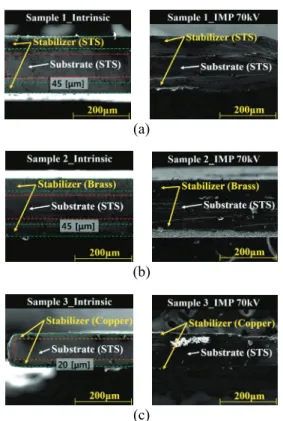
Fig. 7 shows the cross sectional view of 2G HTS tapes by using SEM, in order to verify the degree of degradation applied by an electrical breakdown voltage. As shown in Fig. 7, the micro-structural change of the 2G HTS tapes

0 5 10 15 20 25 30 35 40 45 50

basic 50 kV 60 kV 70 kV

Ind ex n um be r

Breakdown voltage [kV]

Sample 1 Sample 1 AC Sample 1 IMP

Sample 2 Sample 2 AC Sample 2 IMP

Sample 3 Sample 3 AC Sample 3 IMP

(4)

Fig. 6. Decreasing rate of index number with respect to the applied breakdown voltages.

(a)

(b)

(c)

Fig. 7. Corss sectional view of 2G HTS tapes by using SEM when lightning impulse voltage of 70kV is applied. (a) sample 1. (b) sample 2. (c) sample 3.

was observed with the lightning impulse breakdown voltage of 70kV. It was shown that micro-structure of sample 3 was most seriously damaged among the sample tapes. It was found that micro-structure of sample 3 has the biggest change, while that of sample 1 indicates the smallest change among the 2G HTS tapes with lightning impulse breakdown voltage of 70kV. It is assumed that this experimental result may be due to the different hardness and electrical resistivity of the stabilizer layers. The destruction of stabilizer layer may be caused by the kinetic energy occurred by an electrical breakdown. Thus, the stabilizer layer for protecting 2G HTS tapes was damaged by the kinetic energy. And then the mechanical damage was led to the superconductor layer of 2G HTS tapes. In this paper, the stabilizer hardness for samples 1, 2, and 3 were

measured to be 220, 110, and 80 H.V(this unit is hardness constant), respectively. Therefore, it was found that superconducting tape was better protected from the electrical breakdown voltage, when stabilizer layers were made with a robust material. Also, it is inferred that the micro-structural changes were concerned with electrical resistivity of stabilizer layers. The sample 3 stabilized by copper layers has the lowest electrical resistivity among the sample tapes. It caused a large amount of current when the local quench occurred in superconductor. It may generate heat or local quench and cause micro-structure damage.

The electrical resistivity of samples 1, 2, and 3 were measured as 74 x 10 -8 Ω⋅ m, 6.64 x 10 -8 Ω⋅ m, and 1.68 x 10 -8 Ω⋅ m, respectively. As a result, it is concluded that degradation characteristics of 2G HTS tapes are affected by hardness and electrical resistivity of stabilizer layers than the stabilizer thickness.

3. CONCLUSIONS

The degradation characteristics of 2G HTS tapes, such as Ic and index number, were measured by performing electrical breakdown tests with AC and lightning impulse voltages. Three kinds of sample tapes with various stabilizer materials were used in this work. Three kinds of 2G HTS tapes which have stainless steel, brass and copper stabilizer were prepared and tested. The experimental results on the degradation characteristics of 2G HTS tapes are described as follows:

 The degradation characteristics of 2G HTS tapes are dependent on the kind of stabilizer layer and applied breakdown voltage.

 The Ic and index number were degraded with respect to the magnitude of breakdown voltages applied to 2G HTS tapes.

 The degradation characteristics were higher with the lightning impulse breakdown voltage than the AC breakdown voltage.

 The degradation characteristics of sample 1 stabilized by stainless steel were the most superior among the sample tapes, while those of sample 3 stabilized by copper were the most vulnerable among the sample tapes with respect to breakdown voltage test.

 It is concluded that the degradation characteristics of sample 1 were the most robust among the sample tapes due to hardness and electrical resistivity of the stabilizer material.

ACKNOWLEDGMENT

This research was supported by Basic Science Research Program through the National Research Foundation of Korea(NRF) funded by the Ministry of Education(2014R 1A1A2058454)

0 10 20 30 40 50 60

50kV 60kV 70kV

D ec re asin g r at es of In de x n um be r [% ]

Breakdown voltage [kV]

Sample 1 AC Sample 2 AC Sample 3 AC

Sample 1 IMP Sample 2 IMP Sample 3 IMP

(5)

REFERENCES

[1] I. Sauers, “High voltage studies of dielectric materials for HTS power equipment,” IEEE Trans. Appl. Supercond., vol. 9, no. 6, pp 922-931, 2002.

[2] Jeong Il Heo, Jonggi Hong, Seokho Nam, Seyong Choi, and Hyoungku Kang, “Design of Current Leads for a High Voltage Superconducting Apparatus,” IEEE Trans. Appl. Supercond., vol.

23, Article #. 4800805, 2013.

[3] Hyoungku Kang, Chanjoo Lee, Seong Eun Yang, Tae Kuk Ko, and Bok-Yeol Seok, “Dielectric tests of superconducting coils for development of high voltage superconducting machines,” IEEE Trans. Appl. Supercond., vol. 17, pp. 1496-1496, 2007.

[4] Jong O Kang, Onyou Lee, Seungmin Bang, Junil Kim, Hongseok Lee, Jonggi Hong, Seokho Nam, and Hyoungku Kang,

“Degradation Characteristics of Superconducting Wires according to with respect to Electrical Breakdown Tests,” IEEE Trans. Appl.

Supercond., vol. 25, no.3, Article #. 8800804, 2015.

[5] Y. Iwasa, Case Study on Superconducting Magnets: Design and Operational Issues Plenum Press, 1994, pp. 306-307.

수치

Fig. 1. Cross sectional view of 2G HTS tapes used in this  work.
Fig. 4. Decreasing rate of Ic with respect to the applied  breakdown voltages.
Fig. 7. Corss sectional view of 2G HTS tapes by using SEM  when lightning impulse voltage of 70kV is  applied

참조

관련 문서