http://dx.doi.org/10.7585/kjps.2015.19.4.354 Open Access
354
소면적 재배작물 산마늘(Allium ochotense Prokh.) 중 살균제 Tebuconazole 및 Fludioxonil의 잔류특성
우민지·허경진·김지윤·Manoharan Saravanan·김세원
1·허장현*
강원대학교 농업생명과학대학 바이오자원환경학과, 강원대학교 친환경농산물안전성센터
1
강원도농업기술원 특화작물연구소
Residual characteristic of tebuconazole and fludioxonil in Allium victorialis (Allium ochotense Prokh.)
Woo Min-Ji, Kyung-Jin Hur, Ji-Yoon Kim, Manoharan Saravanan, Se-Weon Kim
1and Jang-Hyeon Hur * Department of Biological Environment, College of Agriculture and Life Sciences, Kangwon National University,
Chuncheon 200-701, Korea
Environment Friendly Agricultural Products Safety Center, Chuncheon 200-701, Korea
1
Specialty Crops Experiment station, Gangwon Agricultural Research and Extension Service, Pyeongchang 232-923, Korea
(Received on September 2, 2015. Revised on November 12, 2015. Accepted on December 23, 2015)
Abstract In recent years, Allium victorialis has been extensively used as a pharmacological agent for various diseases in the form of anti-arteriosclerotic, anti-diabetic and anti-cancer. Allium victorialis is severely affected by various fungal diseases since it naturally grow in the shady and humid environments in Korea. In this case, different types of fungicides are applied to control the fungal diseases in Allium victorialis. The present study was aimed to determine the residual characteristics of two fungicides namely tebuconazole and fludioxonil on Allium victorialis. For this study, the fungicides were drenched soil on Allium victorialis in the cultivation area Pyeongchang by the standard (two thousand fold) and double (thousand fold) dilutions. At the end of 15
th, 30
thand 40
thdays samples were collected for residue analysis. Residues of tebuconazole and fludioxonil were analyzed using GC/NPD (Gas Chromatography/Nitrogen Phosphorus Detector) and their recovery were found to be 108.8~119.5% and 91.3~104.8%, respectively. The method of limits of quantifi- cation for both fungicides was 0.01 mg kg
−1. Further, the results of this study shows that the residue levels of both fungicides on Allium victorialis were <0.01~0.12 mg kg
−1and 0.01~0.09 mg kg
−1and their % ADI (%
Acceptable Daily Intake) were 17.44% and 25.75%, respectively. Based on the results obtained in this study, we suggest that the residue levels of both of the fungicides on Allium victorialis are safe and these fungicides can also be used to control fungal diseases in Allium victorialis.
Key words Allium victorialis, Pesticide residue, Tebuconazole, Fludioxonil
서 론
국민의 소득향상과 함께 식생활이 개선되면서 신선채소에 대한 소비자들의 수요가 증가하고 있다. 이에 따라 특용작 물과 엽채류, 산채류 등이 속한 소면적 재배작물에 대한 관
심이 증가하여 재배면적과 재배작물이 다양화 되고 있다 (Jeon, 2014). 그러나 국민의 식생활 안전을 위해 실시하는 국립농산물품질관리원의 농산물 잔류농약 안전성 조사 결과 에 따르면 286품목 91,211건 중 1,209건이 농약잔류허용기 준을 초과하였으며, 산채류, 엽채류, 경채류 순으로 부적합 비율이 높아 소면적 재배작물에 대한 안전성 부적합 비율이 높은 것으로 나타났다(National Agricultural Products Quality Management Service, 2014). 또한 소면적 재배작물에 대한
*Corresponding author E-mail: [email protected]
ORIGINAL ARTICLES / RESIDUE
농약잔류허용기준(Maximum Residue Limit, MRL)이 일반 작물보다 많지 않아 병·해충을 방제하는데 어려움이 있으 며, 소면적 재배작물의 안전성 관리를 위해 농약의 잔류양 상에 대한 지속적인 연구 확대가 필요한 실정이다(Park et al., 2009).
소면적 재배작물 중 하나인 산마늘은 종자 파종에서 수확 기까지 4년에서 5년 정도 소요되는 작물로 잎·줄기 부분을 식용으로 한다(Rural Development Administration, 2015).
그늘지고 습한 환경에서 재배되는 특성으로 인해 잎마름병, 흰비단병 등의 병해가 발생하고 있으나 현재 산마늘에 대한 농약 선택의 폭이 넓지 않아 병해를 방제하는데 어려움을 겪고 있다(Ministry of Food and Drug Safety, 2015; Kwon, 2013). 잎마름병은 산마늘에 가장 피해를 많이 주는 병으로 알려져 있으며, 흰비단병은 최근 많이 발생하는 병으로 종 묘생산 단계부터 피해를 주어 급증하는 산마늘의 수요와 생 산에 영향을 주고 있다(Gangwon Agricultural Research and Extension Services, 2014).
따라서 본 연구는 산마늘을 대상으로 흰비단병 방제를 위 한 살균제 tebuconazole 및 fludioxonil의 잔류특성을 조사 하여 잔류허용기준(MRL) 및 안전사용기준 설정을 위한 자 료로 활용하고자 수행하였다.
재료 및 방법
시험약제 및 시약
본 연구에 사용된 tebuconazole (98.5%) 및 fludioxonil (98.5%)의 표준품은 Dr. Ehrenstorfer (Germany)에서 구입 하여 사용하였으며, 살포 농약은 tebuconazole 20% 액상수 화제(실바코플러스, 바이엘)와 fludioxonil 20% 액상수화제 ( 사파이어, 신젠타)를 사용하였다. 두 약제의 이화학적 성질 은 Table 1과 같다(Tomlin, 2009). 분석을 위해 사용된 acetone, acetonitrile, dichloromethane, n-hexane, ethyl acetate, methanol 은 Merck (Germany)사로부터 구입하여 사용하였
고, sodium sulfate anhydrous, sodium chloride는 DAE JUNG (Korea) 사의 제품을 사용하였다.
시험포장 및 약제처리
시험작물인 산마늘의 품종은 울릉산마늘이며, 강원도 평 창군 봉평면에 있는 강원농업기술원 특화작물시험장평창분 소에서 시험을 수행하였다. Tebuconazole 및 fludioxonil의 시험 구획은 기준량, 배량으로 구획하였으며 길이 30 m × 폭 1 m의 면적에 약제처리별 3반복 배치하여 각각의 처리 구 사이에 1 m의 완충구를 두고 시험을 수행하였다. 약제처 리는 토양관주처리로 두 약제의 처리 방법은 Table 2와 같다.
시료채취 및 증체율 조사
Tebuconazole 및 fludioxonil의 시료채취는 기준량, 배량 으로 토양관주처리 후 15, 30, 45일차에 수행하였으며, 채취 한 시료(1.5 kg/구)는 시료봉투에 밀봉하여 아이스팩이 들어 있는 아이스 박스에 보관하여 즉시 실험실로 운반하였다.
운반한 시료는 각 처리구에서 20개씩 무게를 측정한 후, 마 쇄 및 균질화하여 분석 전까지 영하 20
oC 이하의 deep freezer 에 보관하면서 분석 시료로 사용하였다.
표준검량선 작성
Tebuconazole (98.5%) 및 fludioxonil (98.5%) 표준품 101.52 mg을 각각 100 mL acetone에 녹여 1000 mg L
−1stock solution을 조제한 후, 단계별로 희석하여 0.1, 0.2, 0.5, 1.0, 2.0, 3.0, 5.0 mg L
−1의 working solution을 조제하 였다. 그 후 각각 1.0 µL 씩 GC/NPD에 주입하여 나타난 chromatogram상의 peak면적을 기준으로 검량선을 작성하여 직선성을 확인하였다.
잔류농약 분석
Tebuconazole의 추출 및 정제
Tebuconazole을 추출하기 위하여 세절한 시료 20 g에 Table 1. Chemicals structure and physicochemical properties of pesticide
Tebuconazole Fludioxonil
Chemical structure
IUPAC name ( RS)-1-p-chlorophenyl-4,
4-dimethyl-3-(1 H-1,2,4-triazol-1-ylmethyl)pentan-3-ol 4-(2,2-difluoro-1,3-benzodioxol-4-yl) pyrrole-3-carbonitrile
Mol. wt. 307.8 248.2
V.p. (mPa) 1.7 × 10
−3(20
oC) 3.9 × 10
−4(25
oC)
K
owlogP 3.7 (20
oC) 4.12 (25
oC)
Solubility in water 36 mg L
−1(20
oC) 1.8 mg L
−1(25
oC)
acetonitrile 100 mL 를 가하여 homogenizer로 10,000 rpm에 서 3분간 마쇄·추출한 후, 추출액 중 acetonitrile을 감압여 과하였다. 여액을 dichloromethane으로 각각 50 mL, 50 mL 로 2회 분배한 후, anhydrous sodium sulfate층을 통과시켜 탈수 및 감압 농축한 뒤 dichloromethane 5 mL로 재용해 하 였다. 정제는 SPE-Silica 1 g cartridge를 이용하였으며, dichloromethane 5 mL 로 pre-washing한 후, 추출액 5 mL를 loading 하여 버리고, 전개용매 1 (n-Hexane:ethyl acetate=
90:10, v/v) 10 mL로 세정하였다. 이 후 전개용매 2 (dichlo- romethane:methanol=95:5, v/v) 4 mL 로 다시 세정하였으며, 4 mL 를 이용하여 tebuconazole을 용출시켰다. 용출액을 감
압·농축하고, acetone 2 mL로 재용해하여 GC/NPD로 최종 분석하였으며, tebuconazole에 대한 기기 분석 조건은 Table 3과 같다.
Fludioxonil의 추출 및 정제
Fludioxonil 을 추출하기 위하여 세절한 시료 20 g에 acetonitrile 100 mL 를 가하여 homogenizer로 10,000 rpm에 서 3분간 마쇄·추출한 후, 추출액 중 acetonitrile을 감압여 과하였다. 여액을 dichloromethane으로 각각 80 mL, 70 mL 로 2회 분배한 후, anhydrous sodium sulfate층을 통과시켜 탈수 및 감압 농축한 뒤 dichloromethane 5 mL로 재용해 하 Table 2. Treatment of tebuconazole and fludioxonil to Allium ochotense Prokh.
Pesticide Formulation A.I.
a)(%) Application Concentration Dilution
Tebuconazole SC
b)20 Single dose 0.1 kg a.i./10 a 2,000
Double dose 0.2 kg a.i./10 a 1,000
Fludioxonil SC 20 Single dose 0.1 kg a.i./10 a 2,000
Double dose 0.2 kg a.i./10 a 1,000
a)Active ingredient
b)Suspenision concentrate
Table 3. Instrumental analysis conditions of tebuconazole in Allium ochotense Prokh.
Instrument Agilent GC 7890 (Agilent, U.S.A.) Detector Nitrogen Phosphorus Detector (NPD)
Column Agilent DB-17 (30 m × 0.25 mm I.D. × 0.25 µm)
Temperature
Column oven 140
oC (2 min. hold) → increased at 10
oC min.
−1to 250
oC → increased at 5
oC min.
−1to 300
oC (5 min. hold)
Injection port 260
oC Detector block 320
oC Gas flow rate
N
2flow 5.0 mL min.
−1H
2flow 3.0 mL min.
−1Air flow 60 mL min.
−1Injection volume 1.0 µL (splitless mode)
Retention time 16.66 min.
Table 4. Instrumental analysis conditions of fludioxonil in Allium ochotense Prokh.
Instrument Agilent GC 7890 (Agilent, U.S.A.) Detector Nitrogen Phosphorus Detector (NPD)
Column Agilent DB-5 (30 m × 0.25 mm I.D. × 0.25 µm) Temperature
Column oven 100
oC (0 min. hold) → increased at 10
oC min.
-1to 280
oC (2 min. hold) Injection port 260
oC
Detector block 300
oC Gas flow rate
N
2flow 5.0 mL min.
−1H
2flow 3.0 mL min.
−1Air flow 120 mL min.
−1Injection volume 1.0 µL (splitless mode)
Retention time 15.74 min.
였다. 정제는 SPE-NH
21 g cartridge 를 이용하였으며, dichlo- romethane 5 mL 로 pre-washing한 후, 추출액 5 mL를 loading 하여 버리고, 전개용매(dichloromethane:methanol=
95:5, v/v) 4 mL 를 이용하여 fludioxonil을 용출시켰다. 용출 액을 감압·농축하고 acetone 2 mL로 재용해하여 GC/NPD로 최종 분석하였으며, fludioxonil에 대한 기기 분석 조건은 Table 4 와 같다.
회수율 시험
분석법의 적합함을 확인하기 위하여 무처리구 산마늘 시 료 20 g에 두 약제의 표준용액 1 mg kg
−12 mL, 10 mg kg
−11 mL 를 각각 분석검출한계의 10배(0.1 mg kg
−1), 50 배(0.5 mg kg
−1) 수준으로 정확히 가하고, 균일하게 혼합하여 30분 간 방치한 후, 상기의 분석과정을 수행하여 회수율을 산출 하였다.
잔류농약의 ADI 대비 식이섭취율(% ADI) 산출
산마늘에 대한 tebuconazole 및 fludioxonil의 식이섭취량 인 EDI (Estimated Daily Intake)와 ADI (Acceptable Daily Intake) 를 기준으로 구한 식이섭취율은 다음 식으로부터 산 출하였다. 이 때 산마늘의 일일섭취량은 산채류의 일일섭취 량인 8.59 g을 적용하였으며, ADI는 한국 성인의 평균 체중 인 55 kg을 적용하였다(Ministry of Food and Drug Safety, 2014).
• EDI (Estimated Daily Intake, mg/day/man) = 잔류농도(mg kg
−1) × 8.59 g day
−1• 성인의 일일섭취허용량 = ADI (Acceptable Daily Intake)
× 55 kg
• ADI 대비 식이섭취율(% ADI) = (식이섭취량/일일섭취 허용량) × 100
결과 및 고찰
표준검량선 작성
산마늘 중 잔류농약 분석을 위한 표준검량선을 작성한 결 과, Table 5와 같으며 두 약제 모두 상관계수(R
2) 가 0.99 이 상으로 높은 직선성을 보여 분석법이 정량분석에 적합함을
확인하였다.
분석검출한계 및 회수율 시험
산마늘 중 tebuconazole 및 fludioxonil의 분석검출한계는 0.01 mg kg
−1이었으며, 회수율은 tebuconazole 108.8~
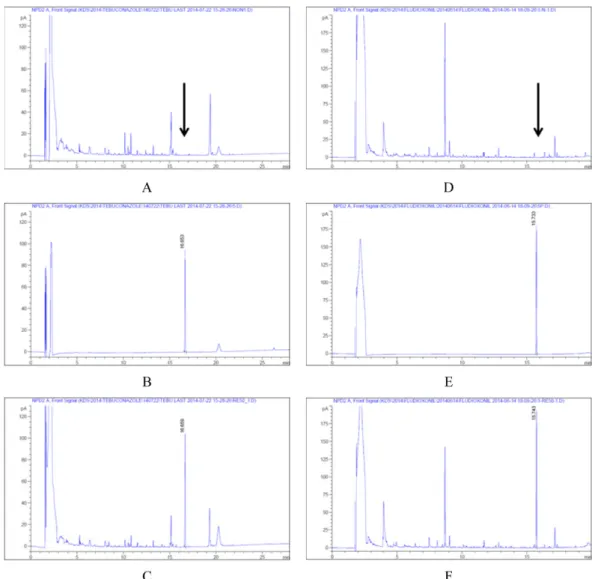
119.5%, fludioxonil 91.3~104.8%로 두 약제 모두 잔류농약 분석 회수율 범위인 70~120%와 변이계수(coefficient of variation, CV) 1.1~7.2%로 10% 이내의 기준을 만족하였다 (Table 6). 따라서 본 연구에서 확립한 분석법은 산마늘 중 두 약제에 대한 잔류분석에 적용 가능한 분석법임을 확인하 였다. 상기 분석 방법에 의한 tebuconazole 및 fludioxonil의 머무름 시간은 각각 16.66 min., 15.74 min.이었으며, GC/
NPD로 분석한 시험약제의 회수율 및 대표적 크로마토그램 은 Fig. 1와 같다.
산마늘의 증체율과 기상조건
약제살포 후 15, 30, 45일차에 채취한 산마늘의 증체율을 측정한 결과, tebuconazole의 경우 약제살포 15일 경과 후 5.78 ± 2.0 g, 30일 경과 후 9.65 ± 1.24 g, 45일 경과 후 18.2
± 1.98 g였으며, fludioxonil의 경우 각각 5.01 ± 1.59 g, 10.55
± 3.18 g, 18.95 ± 1.9 g으로 두 약제는 비슷한 증체율을 보였 다. 또한 시험기간 중 온도와 습도는 10.2~19.9
oC 와 43.6~
87.4% 범위임을 확인하였다.
산마늘 중 Tebuconazole 및 fludioxonil의 잔류특성 Tebuconazole 및 fludioxonil을 기준량과 배량으로 1회 토 양관주처리한 후 45일까지의 잔류량을 확인하였다(Fig. 2).
Tebuconazole의 경우 약제 살포 15일 경과 후 기준량 처리 및 배량 처리 시 최대 잔류량은 각각 0.02 mg kg
−1, 0.12 mg kg
−1이었으며, 30일 경과 후 각각 0.01 mg kg
−1, 0.04 mg kg
−1
이었다. 45일 경과 후 기준량 처리 시 검출한계 미만으로 나타났으며, 배량 처리 시 0.02 mg kg
−1이었다. Fludioxonil
Table 6. Recovery tests of tebuconazole and fludioxonil
Pesticide Add. conc. Recovery ± C.V. MLOQ
(mg kg
−1) (%, average ± C.V.) (mg kg
−1)
Tebuconazole 0.1 118.0 ± 1.1
0.5 112.3 ± 3.7 0.01
Fludioxonil 0.1 100.4 ± 7.2
0.5 94.3 ± 3.1
Table 5. A linear equation of calibration curve for the quantification of the pesticide residues in Allium ochotense Prokh.
Pesticide Linear equation R
2Tebuconazole y=52.727x-1.5002 0.9996
Fludioxonil y=72.929x-0.7964 0.9922
의 경우 약제 살포 15일 경과 후 기준량 처리 및 배량 처리 시 최대잔류량은 각각 0.06 mg kg
−1, 0.09 mg kg
−1이었으며, 30일 경과 후 각각 0.05 mg kg
−1, 45 일 경과 후 각각 0.01
mg kg
−1, 0.02 mg kg
−1이었다. 본 연구 결과, 토양관주처리 후 15일이 지난 후에도 잔류량이 나타났으며 이는 산마늘과 같은 엽채류의 경우 농약이 뿌리로 흡수된 후 바로 줄기와 Fig. 1. Chromatogram of tebuconazole (A: control, B: standard 5 mg kg
−1, C: recovery 0.5 mg kg
−1) and fludioxonil (D: control, E:
standard 5 mg kg
−1, C: recovery 0.5 mg kg
−1).
Fig. 2. Average of residual amounts of tebuconazole and fludioxonil.
잎을 통해 지상부로 상향 흡수·이행하여 잔류량이 나타난 것으로 사료된다(Jeon, 2014; Park 2004; Kim, 2014;
Wallerstein, 1976). 그러나 두 약제 모두 시간이 경과함에 따라 잔류량이 감소하였는데 농작물의 중량에 대한 농도로 표시되는 농약의 잔류량이 작물의 성장에 의해 희석될 수 있다는 내용을 근거로 비교하였을 때 산마늘이 생장하면서 잔류농약이 희석되었기 때문인 것으로 보인다(Jeon, 2010;
Kim, 2008). 따라서 농약의 분해 또는 소실에 영향을 주는 온도, 습도, 일조, 강우 등 기본적 요인뿐만 아니라 작물의 생장도 잔류농약의 농도를 감소시키는 요인이 된다는 것을 알 수 있었다(Jeong, 1990).
Tebuconazole 및 fludioxonil의 ADI 대비 식이섭취율(%
ADI)
Tebuconazole 및 fludioxonil의 최대 잔류량은 각각 0.12 mg kg
−1, 0.09 mg kg
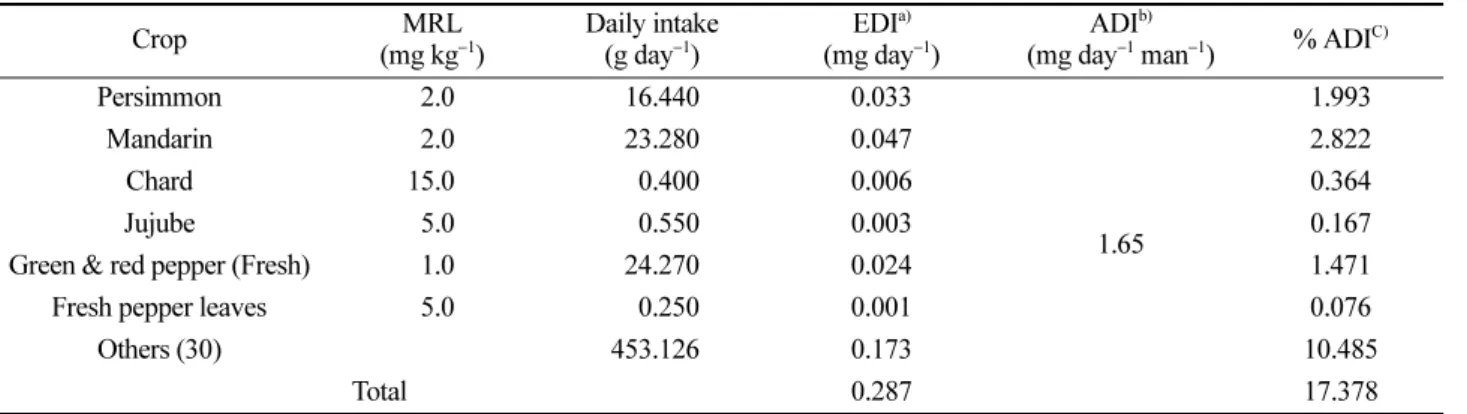
−1으로 두 약제의 최대 잔류량으로부터 산출한 ADI 대비 식이섭취율(%ADI)의 최대값은 각각 0.059%, 0.045% 였다. 또한 두 약제에 대한 산마늘을 포함한 전체 작물의 ADI 대비 식이섭취율(% ADI)은 tebuconazole 의 경우 17.44%, fludioxonil의 경우 25.75%로 나타나 산마 늘 중 tebuconazole 및 fludioxonil에 대한 ADI 대비 식이섭
취율은 80%를 초과하지 않았으며, 식이를 통한 두 약제의 노출 위험도는 안전한 수준인 것으로 판단되었다(Table 7, 8). 따라서 산마늘에 대한 tebuconazole 20% 액상수화제 및 fludioxonil 20% 액상수화제의 농약잔류허용기준(MRL)과 안전사용기준이 설정된다면 산마늘의 생산량 증가에 도움을 줄 수 있을 뿐만 아니라 안전사용기준 미설정 농약의 사용 을 방지하여 안전성 수준을 개선하고, 잔류농약 문제를 효 율적으로 관리할 수 있을 것이라 사료된다.
감사의 글
본 연구는 농촌진흥청 연구사업(2014년 소면적 및 수출유 망작물의 작물잔류성 시험)의 지원에 의해 수행되었으며, 이에 깊이 감사드립니다.
Literature cited
Jeon, S. O. (2014) Residue patterns of Fungicide Boscalid and Insecticide Chlorfenapyr in Korean Cabbage as a Minor Crop, Korea. pp. 2-3.
Jeon, Y. H. (2010) Residues of pesticides in a Kind of Minor Table 7. MRL Sheet of tebuconazole
Crop MRL
(mg kg
−1)
Daily intake (g day
−1)
EDI
a)(mg day
−1)
ADI
b)(mg day
−1man
−1) % ADI
C)Persimmon 2.0 16.440 0.033
1.65
1.993
Mandarin 2.0 23.280 0.047 2.822
Chard 15.0 0.400 0.006 0.364
Jujube 5.0 0.550 0.003 0.167
Green & red pepper (Fresh) 1.0 24.270 0.024 1.471
Fresh pepper leaves 5.0 0.250 0.001 0.076
Others (30) 453.126 0.173 10.485
Total 0.287 17.378
a)Estimate Daily Intake
b)Acceptable Daily Intake (0.03 mg kg−1) × 55 kg (average body weight of Korean)
C)(EDI/ADI) × 100
Table 8. MRL Sheet of fludioxonil
Crop MRL
(mg kg
−1)
Daily intake (g day
−1)
EDI (mg day
−1)
ADI
(mg day
−1man
−1) % ADI
Eggplant 0.3 1.300 0.000
1.65
0.024
Mandarin 1.0 23.280 0.023 1.411
Potato 0.02 23.600 0.000 0.029
Rape (leaves) 0.05 0.180 0.000 0.001
Green & red pepper leaves 0.3 24.270 0.007 0.441
Fresh pepper leaves 3.0 0.250 0.001 0.045
Others (29) 376.284 0.392 23.758
Total 0.423 25.709
Crop, Perilla Leaves, Korea. p. 4.
Jeong, Y. H. and Y. S. Park (1990) Korea Association of Farmers. Pesticide Science. p. 102.
Kim, J. Y., H. N. Kim, S. Manoharan, S. J. Heo, H. N. Jeong, J.
E. Kim, K. R. Kim, and J. H. Hur (2014) Translocation of Tolclofos-methyl from Ginseng Cultivated Soil to Ginseng (Panax ginseng C. A. Meyer) and Residue Analysis of Various Pesticides in Ginseng and Soil. Kor. J. Pesti. Sci., 18(3):130-140.
Kim, K. T. (2008) Residual Characteristics of Insceticide Indoxacarb in Minor Crops, Korea. p. 2.
Kwon, O. C. (2013) Stimulation of Seed Germination in Allium ochotense Prokh, Korea. p. 2.
Park, H. J., J. H. Choi, B. J. Park, C. S. Kim, Y. B. Ihm and G.
H. Ryu (2004) Uptake of endosulfan and procymidone from
arable soil by several vegetables (green house study). Kor.
J. Pesti. Sci., 8(4):280-287.
Park, J. H., M. I. R. Mamun, A. M. Abd El-Aty, J. H. Choi, G. J.
Im, C. H. Oh and J. H. Shim (2009) Anextrapolation from crop classifications based on pesticide residues trial data within vegetables in minor crops. Kor. J. Pesti. Sci,. 13:28- 38.
Tomlin, C. D. S (2009) The Pesticide Manual. British Crop Production Council, UK. pp. 520-521.
Tomlin, C. D. S (2009) The Pesticide Manual. British Crop Production Council, UK. pp. 1072-1073.
Wallerstein, I. S., B. Jacoby and A. Dinoor (1976) Absorption, retention and translocation of the systemic fungicide triarimol in plant. Pestic. Biochem. Physiol. 6:560-537.
⊙ ··· ⊙
소면적 재배작물 산마늘(Allium ochotense Prokh.) 중 살균제 Tebuconazole 및 Fludioxonil의 잔류특성
우민지·허경진·김지윤·Manoharan Saravanan·김세원
1·허장현*
강원대학교 농업생명과학대학 바이오자원환경학과, 강원대학교 친환경농산물안전성센터
1