Effect of Mesh Screen Device on Over-Expanded Supersonic Jet Noise
Yong-Hun Kweon, Jae-Hyung Kim, Chae-Min Lim, Toshiyuki Aoki and Heuy-Dong Kim
메쉬 스크린 장치가 과팽창 초음속 제트소음에 미치는 영향
권용훈*· 김재형** · 임채민**· 靑木俊之***· 김희동†Key Words : Mesh Screen (메쉬 스크린), Supersonic Jet (초음속 제트), Jet Shear Layer (제트 전단 층), Shock Cell Structure (충격파 셀구조), Jet Noise (제트소음)
Abstract
This paper describes an experimental work to investigate the effect of mesh screen device on the jet structure and acoustic characteristics of over-expanded supersonic jet. The mesh screen device is placed into the supersonic jet stream. In order to perturb mainly the initial jet shear layer, the hole is perforated in the central part of the mesh screen. The diameter of the perforated hole and the location of mesh screen device are varied. A Schlieren optical system is used to visualize the flow fields of supersonic jet without and with the mesh screen device. Pitot pressure measurement is carried out to obtain the pressure distribution in the jet flow. Acoustic measurement also is performed to obtain the OASPL and noise spectra. The results obtained show that the jet structure and the jet noise control effectiveness is strongly dependent upon the diameter of the perforated hole and the location of the mesh screen device in the jet stream. Provided that the mesh screen device is placed at the location to perturb effectively the initial shear layer, the present control method is effective in suppressing the supersonic jet noise.
1. Introduction
Supersonic jet noise consists of three major compo- nents (1) : the turbulent mixing noise, the broadband shock-associated noise, and the screech tones. The tur- bulent mixing noise appears in subsonic jets as well as supersonic jets. The other two noise components are only presented in an imperfectly expanded supersonic jet because they are generated due to the strong interaction between large-scale turbulence structures and shock cell structures.
A great number of experimental studies have been
performed on the reduction of supersonic jet noise. Most of the previous studies mainly concentrated on modify- ing the shear layer generated at the exit of the nozzle to reduce the jet noise. Tabs, asymmetric nozzles, porous plugs, etc. have been used in these control techniques, which have been successful in suppressing the super- sonic jet noise. The effective suppression of the screech tone was obtained by using small tabs installed at the nozzle exit (2). Norum (3) studied a variety of asymmetric nozzle configurations for screech tone suppression.
Recently, Debiasi and Papamoshou (4) investigated the effect of annular coaxial stream on the noise components of the supersonic jets operated at over-, correctly, and under-expanded conditions. They found that the addition of the annular coaxial stream to the supersonic jet can reduce the screech tones and effectively suppress Mach wave emissions. Zoppellari and Juve (5) tried to suppress the jet noise by using water that is injected into the jet
† Andong National University E-mail : [email protected]
TEL : (054) 820-5622 FAX : (054) 829-5495
*
POSCO Technical Research Lab.**
Andong National University***
Kyushu University, Japanstream through the multiple injectors near the exit of the nozzle.
From practical point of view, it is required that the method for jet noise reduction is easy to implement and to minimize penalty in weight. Very annoying jet noises are frequently encountered in many industrial applica- tions of high-speed jet technologies, such as the purge burner of city gas, the blow-off line of stream gas in power plants, etc. In these situations, noise control has to meet the needs of low cost and a simple structure (6, 7).
A new technique for the reduction of over-expanded supersonic jet noise using a mesh screen device is suggested in the present study. The mesh screen device has a simple structure and is easy to implement. The objective of the present study is experimentally to study the control effectiveness of the mesh screen device on the jet structure and jet noise.
2. Experimental Facilities and Measurement
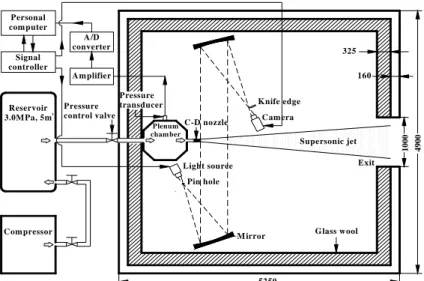
The present work is accomplished in an anechoic test room that is schematically shown in Fig. 1. Compressed dry air is stored in a high pressure tank that has a capacity of 5m3, and is supplied to the plenum chamber, in which a honeycomb system reduces flow turbulence.
A convergent-divergent nozzle with a design Mach number of 2.0 is installed in the end wall of the plenum chamber. The nozzle has a throat diameter of 20mm, an exit diameter of 26mm, and a straight section near the exit of the nozzle (see Fig. 2).
The pressure inside the plenum chamber is controlled by a pressure regulator valve that is located upstream of the plenum chamber. For the present nozzle with a design Mach number of 2.0, the correct expansion state at the exit of the nozzle is obtained at NPR=7.82. In the present study, over-expanded jet of NPR=5.0 is tested.
M irror Light source
Pin hole
Knife edge Camera C-D nozzle
Pressure transducer
Plenum cham ber Amplifier
A/D converter Personal
computer
Signal controller
Pressure control valve Reservoir
3.0M Pa, 5m3
Compressor
325
160
5250
1000 4900
Glass wool Supersonic jet
Exit
Fig. 1 Schematic diagram of experimental facilities (unit : mm)
(a) Mesh screen device (unit : mm) (b) Picture (front view) Fig. 2 Arrangement of a mesh screen device
The mesh screen device is illustrated in Fig. 2. It is placed perpendicular to the supersonic jet stream. The mesh screen is a wire-gauze screen that is made of long stainless wires with a very small diameter of 0.4mm.
The aperture size of mesh screen is 1.2mm¯1.2mm. In order to perturb mainly the initial jet shear layer, the hole is perforated in the central part of the mesh screen.
Thus, the jet flow near the axis of the nozzle discharges from the exit of the nozzle through the perforated hole, without the resistance of the mesh screen. The hole size with a diameter of Dm is varied between 0.0D and 1.0D.
The location (xm) of the device is also changed.
A Schlieren optical system is employed to visualize the qualitative jet structure. A pitot probe is used for impact pressure measurements both along the jet axis and in the radial direction from the jet axis. Acoustic measurements are made using a condenser microphone.
The microphone is located at 98°and the radial distance of 38D from the exit of the nozzle. The acoustic signals are analyzed by using a FFT analyzer to obtain the noise spectra and overall sound pressure level.
3. Results and Discussion
3.1 Effect of Mesh Screen Device on Jet Structure and Jet Noise
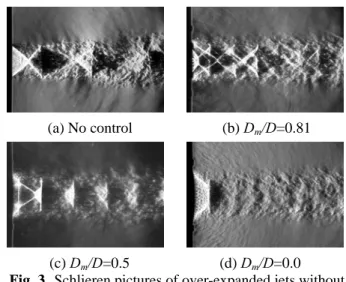
Fig.3 shows the Schlieren pictures of over-expanded jets with and without the mesh screen device. The mesh screen device is placed at the exit plane of the nozzle (xm/D=0.0). For uncontrolled over-expanded jet, oblique shock waves are generated near the exit of the nozzle, and these waves are reflected from the jet axis, as shown in Fig. 3(a). The reflected shocks are reflected again as the expansion waves toward the jet axis from the jet boundary, and lead to the repeated shock cell structure.
When the mesh screen device is placed at xm/D=0.0, the mesh screen device perturbs the initial jet shear layer.
As a result, it seems that the turbulence of the jet shear layer behind the mesh screen is weakened and the jet oscillation is stabilized, compared with the uncontrolled free jet. However, as shown in Fig. 3(b), the jet structure is very complicated due to the new oblique shock waves generated from the edges of the perforated hole. As the diameter of the perforated hole (Dm/D) decreases, the strength of the shock cell is significantly weakened.
(a) No control (b) Dm/D=0.81
(c) Dm/D=0.5 (d) Dm/D=0.0 Fig. 3 Schlieren pictures of over-expanded jets without
and with a mesh screen device (xm/D=0.0)
The impact pressure distributions for over-expanded jets with and without the mesh screen device are shown in Fig. 4, where pi, p0 and x are the impact pressure measured by a pitot probe, the pressure in the plenum chamber and the axial distance from the nozzle exit along the jet axis. For uncontrolled over-expanded jet, the jet stream has strong shock cell structure that leads to the fluctuation in the axial impact pressure at the range of x/D<5.0. The pressure decreases in the expansion regions of the shock cell structure, whereas it increases in the compression regions. For the range of x/D>5.0, the pressure decreases monotonically with an increase in x/D and approaches the ambient back pressure.
The presence of the mesh screen device in the jet stream considerably changes the axial impact pressure distribution. For Dm/D=0.81, the oscillation in the axial impact pressure distribution decreases, compared with that of uncontrolled free jet, whereas the axial impact pressure increases at the range of x/D>6.0. For Dm/D=0.5 and 0.0, the significant decrease in the impact pressure indicates that the shock cell structure is significantly weakened.
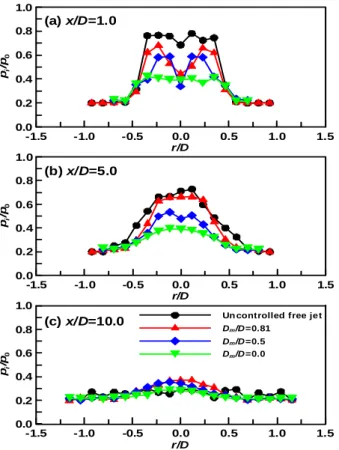
Fig. 5 shows the impact pressure distributions in radial direction at several downstream locations from the exit of the nozzle, where r/D indicates the radial distance from the jet axis. At x/D=1.0, it is showed that the impact pressure falls in the vicinity of the jet axis. This is due to losses caused by strong oblique shock waves in the first shock cell, as shown in Fig. 3. As r/D increases, the impact pressure decreases in the outer region of the jet stream and approaches the ambient back pressure.
0 2.5 5 7.5 10 12.5 15 x/D
0.0 0.2 0.4 0.6 0.8 1.0
pi /p0
Uncontrolled free jet Dm/D=0.81
Dm/D=0.5 Dm/D=0.0 NPR=5.0, xm/D=0.0
Fig. 4 Effect of mesh screen device on axial impact pressure distribution (xm/D=0.0)
-1.5 -1.0 -0.5 0.0 0.5 1.0 1.5
r/D 0.0
0.2 0.4 0.6 0.8 1.0
pi /p0
-1.5 -1.0 -0.5 0.0 0.5 1.0 1.5
r/D 0.0
0.2 0.4 0.6 0.8 1.0
pi /p0
-1.5 -1.0 -0.5 0.0 0.5 1.0 1.5
r/D 0.0
0.2 0.4 0.6 0.8 1.0
pi /p0
Un controlled free jet Dm/D=0.81
Dm/D=0.5 Dm/D=0.0
(a) x/D=1.0
(b) x/D=5.0
(c) x/D=10.0
Fig. 5 Impact pressure distribution in radial direction (xm/D=0.0)
When the mesh screen device is placed in the jet stream, the impact pressure loss in the vicinity of the jet axis increases due to oblique shock waves and Mach disk generated from the edges of the perforated hole. As Dm/D decreases, the loss in the kinetic energy of the jet flow increases, leading to the significant reduction of the pressure distribution in the radial direction. As expected, the pressure in radial direction significantly decreases due to the increase in the spreading rate of the shear layer at farther downstream locations. For Dm/D=0.81 and 0.5, the pressures in radial direction at x/D=10.0 are larger than those of uncontrolled jet.
1 10
f (kHz) 60
70 80 90 100 110
SPL (dB)
0.5 20 30
Un controlled fr ee jet
With mesh screen device (Dm/D=0.81) (a) Dm/D=0.81
1 10
f (kHz) 60
70 80 90 100 110
SPL (dB)
0.5 20 30
Un controlled free jet
With mesh screen d evice (Dm/D=0.5) (b) Dm/D=0.5
1 10
f (kHz) 60
70 80 90 100 110
SPL (dB)
0.5 20 30
Un controlled free jet
With mesh scr een d evice (Dm/D=0.0) (c) Dm/D=0.0
Fig. 6 Noise spectra of over-expanded jets with and without a mesh screen device (xm/D=0.0)
Fig. 6 shows the typical noise spectra of over- expanded jets with and without the mesh screen device.
For uncontrolled free jet, it is observed that there are three discrete peaks at f=5, 10 and 15kHz, referred to as the screech tone. When the mesh screen device of Dm/D=
0.81 is placed at the exit plane of the nozzle, the mesh screen device reduces the screech tone and significantly suppresses the sound pressure levels in the frequency range below 10kHz. As Dm/D decreases, the noise con- trol effectiveness of the mesh screen device is more remarkable due to the large losses in the kinetic energy of the jet stream.
3.2 Effect of Control Device Location
For over-expanded condition, the effect of the location of the mesh screen device on the jet structure is shown in Fig. 7, where Dm/D=0.81. When the mesh screen device is placed at xm/D=0.0 and 1.0, the mesh screen device can perturb the initial shear layer of the jet flow and influences the growth of the large scale turbulent structure in the shear layer. It seems that the mesh screen device stabilizes the jet flow. The jet structure upstream of the mesh screen does not change in the presence of the control device. For xm/D=0.25 and 0.5, the significant change in the jet structures are not observed because the mesh screen device can’t perturb enough effectively the initial shear layer of the jet flow. The jet flows somewhat oscillate.
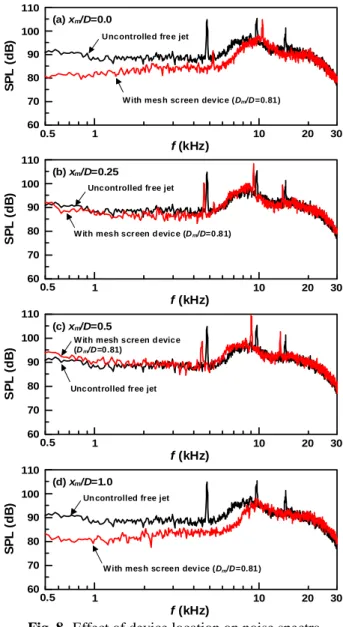
Fig. 8 shows the effect of the control device location on the noise spectra of over-expanded jets. As shown in Figs. 8(a) and 8(d), the significant reduction of super- sonic jet noise is obtained, provided that the mesh screen device is placed at the suitable location to perturb effect- tively the initial jet shear layer and to stabilize the jet oscillation. However, for Dm/D=0.81, the noise control of the mesh screen device is not effective when the mesh screen device is placed at xm/D=0.25 and 0.5.
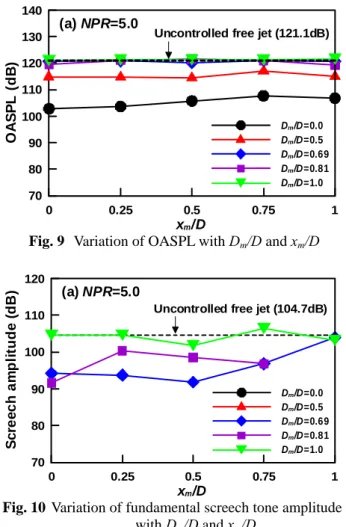
Fig. 9 shows the variation of overall sound pressure level (OASPL) with the diameter of the perforated hole (Dm/D) and the location of the mesh screen device (xm/D).
In the present study, the OASPL can be obtained by a numerical integration of the spectra as follows,
OASPL (dB) = 20log10
∫
040kHzS( )
f df
(a) xm/D=0.0 (b) xm/D=0.25
(c) xm/D=0.5 (d) xm/D=1.0 Fig. 7 Effect of device location on over-expanded jet
structure (Dm/D=0.81)
where S(f) is the power spectrum of prms/pref, with prms the root mean square pressure and pref=20μPa. pref is the reference commonly used as the effective value of the minimum audible sound pressure.
For over-expanded condition of NPR=5.0, the OASPL of uncontrolled free jet is 121.ldB as described using the dotted horizontal line in Fig. 9. The OASPL is reduced by 15-20dB for Dm/D=0.0 and by nearly 5dB for Dm/D=
0.5. For over-expanded jet, it seems that the location of the mesh screen device does not significantly influence the reduction in the OASPL. For Dm/D>0.5, the mesh screen device is not effective in suppressing the OASPL, regardless of all xm/D applied. This indicates that the mesh screen device with the perforated hole of larger Dm/D can’t perturb enough the initial jet shear layer.
1 10
f (kHz) 60
70 80 90 100 110
SPL (dB)
0.5 20 30
Uncontrolled free jet
With mesh screen device (Dm/D=0.81) (a) xm/D=0.0
1 10
f (kHz) 60
70 80 90 100 110
SPL (dB)
0.5 20 30
Uncontrolled fr ee jet
With mesh scr een d evice (Dm/D=0.81) (b) xm/D=0.25
1 10
f (kHz) 60
70 80 90 100 110
SPL (dB)
0.5 20 30
Uncontrolled free jet With mesh screen d evice (Dm/D=0.81)
(c) xm/D=0.5
1 10
f (kHz) 60
70 80 90 100 110
SPL (dB)
0.5 20 30
Un controlled free jet
With mesh screen device (Dm/D=0.81) (d) xm/D=1.0
Fig. 8 Effect of device location on noise spectra (Dm/D=0.81)
0 0.25 0.5 0.75 1 xm/D
70 80 90 100 110 120 130 140
OASPL (dB)
Dm/D=0.0 Dm/D=0.5 Dm/D=0.69 Dm/D=0.81 Dm/D=1.0
(a) NPR=5.0
Uncontrolled free jet (121.1dB)
Fig. 9 Variation of OASPL with Dm/D and xm/D
0 0.25 0.5 0.75 1
xm/D
70 80 90 100 110 120
Screech amplitude (dB)
Dm/D=0.0 Dm/D=0.5 Dm/D=0.69 Dm/D=0.81 Dm/D=1.0
(a) NPR=5.0
Uncontrolled free jet (104.7dB)
Fig. 10 Variation of fundamental screech tone amplitude with Dm/D and xm/D
Fig. 10 shows the variation of fundamental screech tone amplitude with Dm/D and xm/D. In figure, the dotted horizontal line indicates the amplitude of fundamental screech tone in the uncontrolled free jet. For uncontrolled over-expanded jet, the amplitude of the screech tone is 104.7dB. As shown in Fig.10, for Dm/D=0.0 and 0.5, the mesh screen device completely eliminates the screech tones, regardless of xm/D. For Dm/D=0.69 and 0.81, the control effectiveness of mesh screen device in reducing the screech tone is strongly dependent on both xm/D and Dm/D. However, for Dm/D=1.0, the mesh screen device is not effective in reducing the screech tone. It is believed that for over-expanded condition, the present control method with smaller xm/D and Dm/D is more effective in suppressing the screech tone.
4. Conclusion
The present study describes an experimental work to control supersonic jet noise using a mesh screen device that is placed perpendicular to the jet stream. The mesh
screen is a wire-gauze screen that is made of long stain- less wires with a very small diameter. In order to perturb the initial jet shear layer and to stabilize the jet oscillation, the hole is perforated in the central part on the mesh screen. In the present study, the diameter of the perforated hole and the location of the mesh screen device are varied to investigate the control effectiveness of supersonic jet noise.
From flow visualization, impact pressure and acoustic measurements, several useful conclusions are obtained.
The mesh screen device perturbs the initial shear layer of the jet flow and controls the growth of the large scale turbulent structure in the shear layer. As a result, it is believed that the present control method can lead to stabilize the jet oscillation and to weaken the shock cell structure. However, the mesh screen device causes some losses in the kinetic energy of the jet flow. The control effectiveness of the mesh screen device in reducing the screech tone is strongly dependent on the diameter of the perforated hole and the location of the mesh screen device in the jet stream. Provided that the mesh screen device is placed at the location to perturb enough the initial jet shear layer, the mesh screen device is very effective in suppressing the screech tone.
References
(1) Tam, C. K. W., 1995, "Supersonic Jet Noise,"
Annual Review of Fluid Mechanics, Vol. 27, pp. 17~43.
(2) Samimy, M., Zaman, K. B. M. Q. and Reeder, M. F., 1993, "Effect of Tabs on the Flow and Noise Field of an Axisymmetric Jet," AIAA J., Vol. 31, No. 4, pp. 609
~619.
(3) Norum, T. D., 1983, "Screech Suppression in Super- sonic Jets," AIAA J., Vol. 21, No. 2, pp. 235~240.
(4) Debiasi, M. and Papamoschou, D., 1999, "Acoustics of Under- and Over-Expanded Coaxial Jets," 37th AIAA Conference, AIAA 99-0081.
(5) Zoppellari, E. and Juve, D., 1998, "Reduction of Hot Supersonic Jet Noise by Water Injection," 4th AIAA/CEAS Conference, AIAA 98-2204.
(6) Kweon, Y.-H., Miyazato, Y., Aoki, T., Kim, H.-D.
and Setoguchi, T., 2005, "The Effect of a Cross Wire Device on Supersonic Jet Noise," 11th AIAA/CEAS Conference, AIAA 2005-2891.
(7) Kweon, Y.-H., Miyazato, Y., Aoki, T., Kim, H.-D.
and Setoguchi, T., 2006, "Control of Supersonic Jet Noise Using a Wire Device," J. Sound and Vibration, Vol. 297, pp. 167~182.