Wideband Optical Phase Conjugator using HNL-DSF in WDM Systems with Path-Averaged Intensity Approximation Mid-Span
Spectral Inversion
경로 평균 강도 근사 기법의 MSSI를 채택한 WDM 시스템에서 HNL-DSF를 갖는 광대역 광 위상 공액기
Seong-Real Lee* and Yun-Hyun Lee**
이성렬*, 이윤현**
요 약
장거리 3×40 Gbps 강도 변조 직접 검파 방식의 파장 분할 다중 시스템에서 색 분산과 자기 위상 변조에 의 한 광 펄스 왜곡을 최상으로 보상할 수 있는 최적의 펌프 전력을 컴퓨터 시뮬레이션을 통해 살펴보았다. 본 논 문에서 고찰한 파장 분할 다중 시스템은 전체 전송로 중간에 HNL-DSF (highly nonlinear dispersion shifted fiber)의 광 위상 공액기를 두어 광 신호 왜곡을 보상하는 경로 평균 강도 근사 (PAIA : Path-Averaged Intensity Approximation) 기법의 MSSI (Mid-Span Spectral Inversion)가 적용된 시스템이다. 우선 HNL-DSF 는 광대역 파장 분할 다중 전송에서 매우 유용한 비선형 매질이라는 것을 확인할 수 있었고, 두 번째 광 전송 로로 입사되는 공액파의 전력을 입력 광 신호의 전력과 같아지게 하는 HNL-DSF 광 위상 공액기의 펌프 전력 에서 최상의 보상이 얻어지는 것을 확인할 수 있었다. 결과적으로 PAIA MSSI 기법에 전송 거리에 관계한 최 적 펌프 전력을 갖는 HNL-DSF 광 위상 공액기를 적용하면 장거리 대용량 파장 분할 다중 시스템의 구현이 가능하다는 것을 확인할 수 있었다.
ABSTRACT
We investigated the optimum pump light power compensating distorted WDM signal due to both chromatic dispersion and self phase modulation (SPM). The considered system is 3×40 Gbps intensity modulation direct detection (IM/DD) WDM transmission system with path-averaged intensity approximation (PAIA) mid-span spectral inversion (MSSI) as compensation method. This system have highly nonlinear dispersion shifted fiber (HNL-DSF) as nonlinear medium of optical phase conjugator (OPC) in the mid-way of total transmission line. We confirmed that HNL-DSF is an useful nonlinear medium in OPC for wideband WDM transmission, and the excellent compensation is obtained when the pump light power of HNL-DSF OPC was selected to equalize the conjugated light power into the second half fiber section with the input WDM signal light power depending on total transmission length. By this approach, it is verified the possibility to realize a long-haul high capacities WDM system by using PAIA MSSI compensation method, which have HNL-DSF OPC with optimal pump light power depending on transmission length.
Key words : mid-span spectral inversion, cross phase modulation, self phase modulation, highly nonlinear dispsersion shifted fiber, optical phase conjugator.
* (주)에이티엔 (ATN Co. Ltd.) 기술연구소
** 한국항공대학교 전자정보통신컴퓨터공학부(School of Electro., Telecomm. and Computer Eng., Hankuk Aviation Univ.)
․논문번호 : 2003-1-3
․접수일자 : 2003년 1월 1일
I. Introduction
In long-haul and high bit-rate optical fiber communication systems using of erbium-doped fiber amplifier (EDFA)[1], optical pulse distortion due to the wavelength dispersion and Kerr effects in fibers limit the optical transmission capacities.
Various approaches have been proposed to compen- sate these pulse distortions[2],[3] and systems using an optical phase conjugator (OPC) are also one of the approaches[4],[5].
A wavelength convertor is one of the key components for enhancing the capacities and flexibility of future wavelength division multi- plexing (WDM) systems. In WDM systems with OPC as wavelength convertor and pulse distortion compensator, channel signals have to be converted into the phase conjugated lights as a whole.
Therefore OPC in the mid-span transmission line has to have the same bandwidth as that of the EDFA used.
It is difficult to use conventional dispersion shifted fiber (DSF) as a nonlinear medium for four wave mixing (FWM) generation in OPC. Because the generation efficiency of FWM is drastically changed depending on the wavelength separation between the signal and pump lights nearby the zero dispersion wavelength (ZDW) of DSF. In order to solve this problem, OPC using highly nonlinear dispersion shifted fiber (HNL-DSF) is proposed by Watanabe et al[6].
Also self phase modulation (SPM) compensation by OPC is limited by the asymmetry of the strength of the Kerr effects along the fiber with respect to the OPC position. To reduce this influence a method using path-averaged intensity approximation (PAIA) mid-span spectral inversion (MSSI) was proposed[7],[8]. It is predicted that the variation of compensation depends on the variation of a conjugated light power into second
half fiber section because of a fluctuation of pump light power in OPC. But this effect on the PAIA MSSI is not evaluated numerically or experi- mentally up to now.
We investigated optimum pump power of wideband OPC using HLN-DSF, which have to best compensate for pulse distortion in 3×40 Gbps WDM systems with PAIA MSSI. We use the split-step Fourier numerical simulation. And we use eye-opening penalty (EOP) in order to evaluate the efficiency of waveform distortion compensation. In order to simplify the analysis we neglect the cross phase modulation (XPM) of WDM channels. That is, we take account of the chromatic dispersion and SPM of WDM channel signals, since FWM can be suppressed in practical systems using the scheme such as the unequal channel spacing[9].
Ⅱ. Wideband OPC using HNL-DSF
The OPC used in the WDM systems must have a flattened conversion characteristics over the bandwidth of systems. The flattened FWM generation efficiency is the key point to realized the wideband OPC because of using FWM to obtain optical phase conjugated lights.
The flattened FWM generation efficiency will is expected by using HNL-DSF. If it is possible to convert different wavelength signals over wide bandwidth in a lump by using such fibers, it can be expected to apply the OPC for WDM systems.
PS(L1)
Pump LD
PC(0) HNL-DSF (Z0)
PP
EDFAEDFA
OBPF OBPF
AC(0) AS(L1)
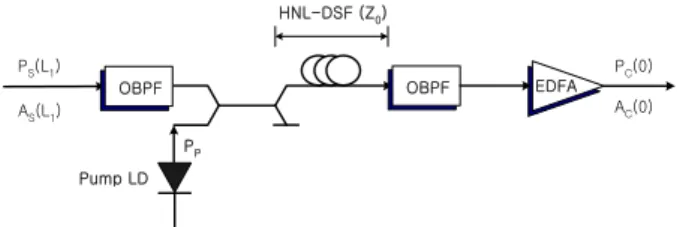
Fig. 1. Optical phase conjugator using highly- nonlinear dispersion shifted fiber.
Fig. 1 shows the configuration of the OPC using HNL-DSF. The signal
As with the wavelength
λs propagated in the first half fiber section is filtered by an optical band pass filter (OBPF), and the signal light will be coupled with the pump light of the wavelength
λp . The coupled light is injected into HNL-DSF with the ZDW
λ0, and consequently the FWM lights are generated. The wavelength of the obtained phase conjugated light is
λc
= 1/(2/λp
- 1/λs
). The light is filtered by OBPF, and the output light is amplified by the EDFA and launched into the latter half of the transmission line. Unlike the conventional OPC, the signal light is not amplified by the EDFA in the front of OPC. The ripple of conjugated light wave is reduced by this OPC configuration.
The conversion efficiency η is defined as a ratio of the FWM product power to the input probe (signal) power. The output power of the FWM product is calculated by the following equations[10].
PFWM = γ2oP2pPs(L1)exp (-αozo)L2effη
(1)
Leff = 1 - exp (-αozo)αo
(2)
Parameter Symbol Value HNL-DSF loss α
o
0.61 dB/km HNL-DSF nonlinearcoefficient γ
o
20.4 W-1 km-1 Pump light power Pp
18.7 dBm HNL-DSF length zo
0.75 km HNL-DSF ZDW λ0 1550 nm Pump lightwavelength λ
p
1549.5 nm, 1547.0 nm HNL-DSFdispersion slope
dD
o
dλ 0.032 ps/nm2/km Table 1. HNL-DSF OPC parameters.
η= α2o
α2o+Δβ2
[
1+ 4e(1- exp(-α- αozosin(Δβzozoo/2)))2]
(3)
Δβ=- 2πcλ30 λ3p λ2S
dDo
dλ (λs-λp)2(λ0-λp)
(4)
L
eff and
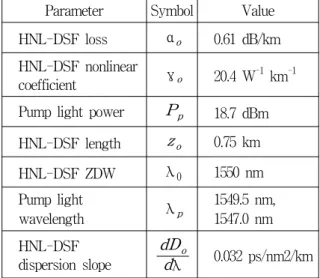
Δβare effective interacting length and phase mismatch parameter, respectively. The HNL-DSF OPC parameters in our calculation is summarized in Table 1.
The calculated value of η using Table 1 parameters is plotted in Fig. 2. The highest η obtained is 2.38 dB. The 3-dB bandwidth is 31 nm (1534~1565 nm), 12 nm (1541~1553 nm) in HNL-DSF OPC with 1549.5 nm, and 1548.3 nm pump light wavelength, respectively. The 31 nm bandwidth is corresponding to cover almost entire gain band of EDFA.
Ⅲ. Simulations and Evaluations
3-1 Simulation Modeling
The numerical analysis begins with the non- linear wave propagation equation[11]. The evolu- tion of the j-th signal wave of WDM
Aj is des- cribed by
Fig. 2. The calculated value of conversion efficiency.
Transmitter Receiver
M U X M U X
M U X D E M U X
OPCEDFA EDFA EDFA EDFA
PS(L1) PS(0)
l1
EDFA
PC(L2) PC(0)
lN
EDFA
l2
DSF 2 length L2 DSF 1 length L1
l
s2Transmitter
l
s1Transmitter
l
s3l
c2Receiver
l
c3ReceiverReceiver
l
c1Fig. 3. Simulation model
∂A
j
∂z = -α2 A
j
- i2 β2
j
∂2Aj
∂T2 + 16 β3
j
∂3Aj
∂T3 + iγ
j
|Aj
|2Aj (5)
β2j = - Dλ2j
2πc
,
β3j
=(
λj
dDdλ +D)
λ2j
(2πc)2
,
γj = n2ω0cAeff
,
T = t - vzgj
The parameters and symbols are as following. α : attenuation coefficient of the fiber,
λj : j-th channel signal wavelength,
β2j : fiber chromatic dispersion parameter,
β3j : third-order chromatic dispersion parameter,
γj : nonlinear coefficient,
D: fiber dispersion parameter,
c: light velocity,
n2: nonlinear refractive index,
Aeff : fiber effective cross section,
vgj : the group velocity,
dD/dλ: dispersion slope.
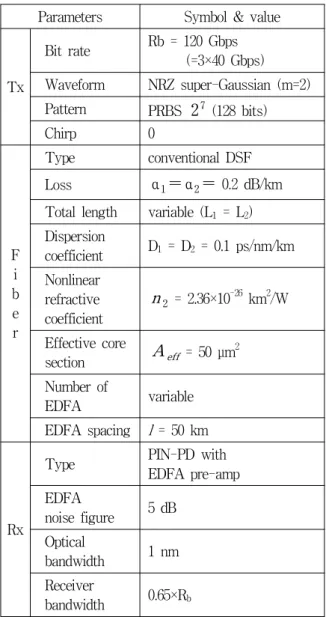
We use the unequal WDM channel spacing proposed by F. Forghieri et al.[9] in order to suppress the crosstalk due to FWM effects. The WDM channel signal wavelengths are 1550 nm, 1553.0 nm and 1555.8 nm, respectively. The simulation model is presented in Fig. 3 and the simulation parameters in this paper is summarized in Table 2, respectively.
3-2 Procedures of evaluation
The compensation of pulse distortion due to the chromatic dispersion is achieved by equalizing the
Parameters Symbol & value
Tx
Bit rate Rb = 120 Gbps (=3×40 Gbps) Waveform NRZ super-Gaussian (m=2) Pattern PRBS 27 (128 bits)
Chirp 0
F i b e r
Type conventional DSF Loss α1= α2= 0.2 dB/km Total length variable (L1 = L2) Dispersion
coefficient D1 = D2 = 0.1 ps/nm/km Nonlinear
refractive coefficient
n2 = 2.36×10⁻²⁶ km2/W
Effective core
section A
eff
= 50 μm2 Number ofEDFA variable EDFA spacing l= 50 km
Rx
Type PIN-PD with EDFA pre-amp EDFA
noise figure 5 dB Optical
bandwidth 1 nm Receiver
bandwidth 0.65×Rb
Table 2.Simulation parameters.
total dispersion of both fiber section, that is
D1L1=D2L2, in PAIA MSSI method. Since
the basic parameters in DSF1 and DSF2, that is
the fiber section length, attenuation coefficient,
EDFA spacing length, and the nonlinear coefficient
are setting to equal each other in this approaches,
compensation of pulse distortion due to SPM is also achieved by equalizing the phase conjugated light averaged-power into the second half fiber (
Pc
(0 )) with the input signal averaged-power into first half fiber (
Ps
(0)) as following,
P
s
(0)=Pc
(0 )(6)
But it is difficult to analytically verify the satisfaction of eq. (6) in PAIA MSSI because the conjugated light wave power is not presented with the signal light power. Initial conjugated light power magnitude depends on the pump light power in OPC. Therefore eq. (6) is satisfied only in special pump light power, and it is predicted that the best compensation will be achieved at this pump light power.
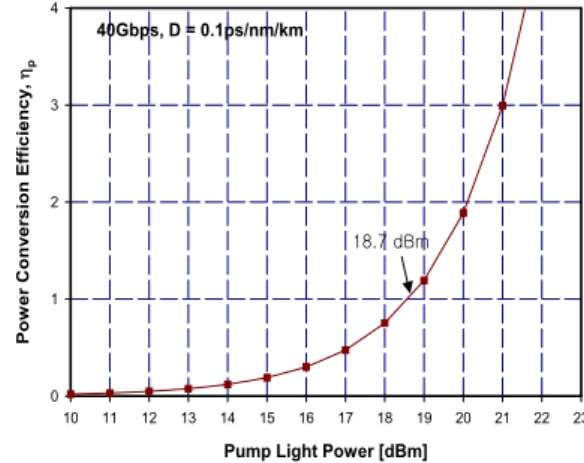
In order to verify the compensation degree depending on the variation of pump light power and the compensation condition of eq. (6), we define the power conversion efficiency
ηp as following
η
p
= Pc
(0) / Ps
(0)(7) The evaluation criterion is the 1 dB EOP. And evaluation procedures are following. First, we evaluate the power conversion efficiency and EOP dependence on the fluctuation of pump light power in OPC for the various transmission length. Second, we evaluate EOP dependence on the variation of input signal light power in 3×40 Gbps WDM systems for the various pump light power of OPC.
And then we exam the eye diagram analysis in the various cases.
Ⅳ. Results and Discussions
Fig. 4 shows EOP as a function of the pump light power for several transmission length when
the fiber dispersion coefficient is 0.1 ps/nm/km, input signal light power is 3 dBm and signal light wavelength is 1550 nm (CH. 1 wavelength), respectively. As shown in Fig. 4, the ranges of pump light power for an excellent compensation with performance less than 1 dB EOP becomes narrower as the transmission length becomes longer. In other words, it is necessary to determine a exact pump light power in the long-haul transmission systems for optimal compensation. And it is found that the magnitude of pump light power obtaining the minimum EOP becomes gradually smaller as the transmission length becomes gradually increased.
40Gbps, Ps = 3dBm D = 0.1ps/nm/km
Pump Light Power [dBm]
10 11 12 13 14 15 16 17 18 19 20 21 22 23 24 25 26 27 28
Eye Opening Penalty [dB]
0 1 2 3 4 5
L = 100km L = 300km L = 500km L = 1,000km L = 1,600km L = 2,000km
Fig. 4. Eye opening penalty dependence on the pump light power fluctuation in OPC.
40Gbps, D = 0.1ps/nm/km
Pump Light Power [dBm]
10 11 12 13 14 15 16 17 18 19 20 21 22 23
Power Conversion Efficiency, hp
0 1 2 3 4
18.7 dBm
Fig. 5. Power conversion efficency dependence on the pumplight power fluctuation in OPC.
Fig. 5 shows the power conversion efficiency as a function of the pump light power. The same power conversion efficiency is resulted regardless of the transmission length variation. The pump light power resulting an unity power conversion efficiency (
ηp
= 1) is 18.7 dBm. As comparing Fig. 4 with Fig. 5, it is found that the minimum EOP is presented at the pump light power higher than 18.7 dBm in the transmission length shorter than 500 km and at the pump light power lower than 18.7 dBm in the longer than 1,000 km, respectively.
We think that these phenomena are induced by the reduction of total cancellation, which is generated by the interaction of phase modulations (PM) caused by a chromatic dispersion and PM caused by SPM, respectively. And, consequently, the total PM cancellation becomes decreased as the transmission length becomes increased.
Fig. 6 shows EOP as a function of the input signal light power for several pump light power when the fiber dispersion coefficient is 0.1 ps/nm/km, pump light wavelength is 1549.5 nm in 1,000 km 3×40 Gbps WDM system, respectively.
First, we confirm that from a standpoint of 1 dB EOP criterion, the power penalty over all the
lp = 1549.5nm, D=0.1ps/nm/km
Input Power [dBm]
0 1 2 3 4 5 6 7 8 9
Eye Opening Penalty [dB]
0 1 2 3 4
Pp = 18.3dBm Pp = 18.7dBm
Pp = 15.9dBm Pp = 19.3dBm
Fig. 6. Eye opening penalty dependence on the input signal light power variation in 1,000 km 3×40 Gbps WDM system.
(a) Pp = 15.9 dBm, Ps = 2.2 dBm
(b) Pp = 18.3 dBm, Ps = 6.9 dBm
(c) Pp= 18.7 dBm, Ps = 5.4 dBm
(d) Pp = 19.3 dBm, Ps = 0.8 dBm
Fig. 7.Eye diagrams of received WDM signal having 1 dB EOP.
WDM channels is less than 0.1 dB at 18.7 dBm pump light power, and the power penalty is less than 1 dB in the other pump light power. From this result in Fig. 6, HNL-DSF is an useful nonlinear medium if input signal power range was selected in concern with pump light power in OPC. For example, WDM channel signal light power have to be selected lower than 1.5 dBm if the pump light power was 15.9 dBm.
But as shown in Fig. 5, though the best compensation of every WDM channels is achieved at 18.3 dBm pump light power in OPC alike the result in Fig. 4, when pump light power is only 18.7 dBm the impartial compensation of whole WDM channels (within the 0.1 dB power penalty) is achieved. This result is also confirmed through Fig. 7, which showed eye diagram of various received signal having 1 dB EOP.
As shown in Fig. 7, it is found that only when the pump light power is 18.7 dBm the excellent compensation is achieved with minimum jitter and minimum waveform distortion in comparison with the other pump light power.
From the above results, the important point to be confirmed is that HNL-DSF is very useful nonlinear medium for wideband OPC in PAIA MSSI method, while the exact pump light power should be selected in order to equalize the conjugated light power into the second half fiber section with the input WDM signal light power.
Ⅴ. Conclusions
We discussed WDM transmission systems based on PAIA MSSI compensation method. This WDM transmission system has OPC using HNL-DSF in the mid-way of total transmission line.
We confirmed that HNL-DSF is an useful nonlinear medium by appropriate selecting the input signal power ranges concerned with pump
light power in OPC. But in order to achieve the excellent compensation the pump light power must be selected to equalize the conjugated light power into the second half fiber section with the input WDM signal light power depending on total transmission length. This fact imply that it is needed to accurate establish the pump light power in relation to the transmission length, bit-rate, and channel capacity variations.
Consequently, by this approach, it is verified the possibility to realize a long-haul high capacities WDM system by using PAIA MSSI compensation method, which have HNL-DSF OPC with optimal pump light power depending on transmission length.
But we did not consider the influence of accu- mulated spontaneous emission (ASE) noise and XPM. As future task, the influence of ASE noise and XPM on PAIA MSSI compensation method should be evaluated for extending the transmission capacities in the long-haul WDM system.
References
[1] D. Marcuse, "Single-channel operation in very long nonlinear fibers with optical amplifiers at zero dispersion",
J. Lightwave Technol., vol. LT-8, no. 10, pp. 1548-1557, 1990.
[2] T. L. Koch and R. C. Alferness, "Dispersion compensation by active predistorted signal synthesis",
J. Lightwave Technol., vol.
LT-3, pp. 800-805, 1985.
[3] F. Quellete, "Dispersion cancellation using linearly chirped Bragg grating filters in optical waveguides",
Opt. Lett., vol. 12, pp.
847-849, 1987.
[4] A. Yariv, D. Fekete, and D. M. Pepper,
"Compensation for channel dispersion by nonlinear optical phase conjugation",
Opt.Lett.,
vol. 4, pp. 52-54, 1979.
[5] S. Watanabe, T. Naito, and T. Chikama,
"Compensation of chromatic dispersion in a single mode fiber by optical phase conju- gation",
IEEE Photon. Technol. Lett., vol.
5, no. 1, pp. 92-95, 1993.
[6] S. Watanabe, S. Takada, G. Ishikawa, H. Ooi, J. G. Nielson, and C. Sonne, "Simultaneous wavelength conversion and optical phase conjugation of 200 Gb/s (5×40 Gb/s) WDM signal using a highly nonlinear fiber four-wave mixer",
IOOC/ECOC '98, PD Paper TA3A, pp. 1-4, 1997.
[7] S. Watanabe and M. Shirasaki, "Exact compensation for both chromatic dispersion and Kerr effect in a transmission fiber using optical phase conjugation",
J. Lightwave Technol., vol. LT-14, no. 3, pp. 243-248, 1996.
이 성 렬 (李成烈)
1990년 2월 : 한국항공대학교 통신 정보공학과 (공학사)
1992년 8월 : 한국항공대학교 대학 원 통신정보공학과 (공학석사) 2002년 2월 : 한국항공대학교 대
학원 통신정보공학과 (공학박사) 1996년 1월 ~ 2002년 5월 : (주) 세영통신 전파연구소 책임연구원
2002년 6월 ~ 현재 : (주)에이티엔 기술연구소 연구소장 관심분야 : WDM 시스템, 광섬유의 비선형 효과, 광 솔
리톤 전송 등
[8] K. kikuchi and C. Lorattanasene, "Com- pensation for pulse waveform distortion in ultra-long distance optical communication systems by using midway optical phase conjugator",
IEEE Photon. Techno. Lett. vol. 6, pp. 1499-1501, 1994.
[9] F. Forghieri, R. W. Tkach and A. R.
Chraplyvy, "WDM systems with unequally spaced channels",
J. Lightwave Technol., vol. LT-13, no. 5, pp. 889-897, 1995.
[10] K. Inoue, "Four-wave mixing in an optical fiber in the zero-dispersion wavelength region",
J. Lightwave Technol., vol. LT-10, no. 11, pp. 1553-1561, 1992.
[11] G. P. Agrawal, Nonlinear Fiber Optics, Academic Press, pp 34-44, 1989.
이 윤 현 (李潤鉉)
1965년 2월 : 한국항공대학교 전 자공학과 (공학사)
1985년 2월 : 경희대학교 대학원 전자공학과 (공학박사)
1979년 9월 : 정보 통신 기술사 1988년 7월 : New York State
University at Buffalo 교환교수 1980년 ~ 현재 : 한국항공대학교 전자정보통신컴퓨터공
학부 교수
관심분야: 초고주파 회로 설계, 마이크로파 및 광통신, 안테나 및 전파전파, EMI/EMC 등