• 검색 결과가 없습니다.

Pharmacopuncture Combined with Electroacupuncture on Carpal Tunnel Syndrome: A Retrospective Case Series Study

N/A
N/A
Protected

Academic year: 2021

Share "Pharmacopuncture Combined with Electroacupuncture on Carpal Tunnel Syndrome: A Retrospective Case Series Study"

Copied!
8
0
0

로드 중.... (전체 텍스트 보기)

전체 글

(1)

Carthami Semen Pharmacopuncture Combined with Electroacupuncture on Carpal Tunnel Syndrome:

A Retrospective Case Series Study

Pyung-Wha Kim

1

, Seon Choe

2

, Kyungsun Han

1

, Changsop Yang

1

, Jinbok Lee

3

, Sungha Kim

1

*, Minseop Shin

4

*

1

Clinical Medicine Division, Korea Institute of Oriental Medicine, Daejeon, Republic of Korea

2

Division of Biomedical Informatics, Seoul National University College of Medicine, Seoul, Republic of Korea

3

Lee Jinbok Korean Medicine Clinic, Jeonju, Republic of Korea

4

Chuk-u Acupuncture & Moxibustion Korean Medicine Clinic, Jeonju, Republic of Korea

Received May 31, 2021 Reviewed May 31, 2021 Accepted June 4, 2021

While carpal tunnel syndrome (CTS) is the most common entrapment neuropathy affect- ing the wrist, resulting in substantial physical, psychological, and economic effects, there is no gold standard therapy for CTS. In this case series study, we aimed to report CTS patients treated with Carthami Semen Pharmacopuncture (CSP) and electroacupuncture (EA) showing improvements in their symptoms, and the combinatorial effects of CSP and EA. We collected medical records of CTS outpatients who received CSP and EA at Chuk- u Acupuncture & Moxibustion Korean Medicine Clinic from August 2017 to September 2018. The outcome measures were the visual analog scale (VAS) for pain, paresthesia, the Korean version of the Boston carpal tunnel questionnaire (K-BCTQ) score, and chang- es in nocturnal pain, Tinel sign, and Phalen’s test. We included patient satisfaction at the completion of all treatments. 17 patients were included for this case series study. After treatment, VAS for pain decreased significantly from 50.41 ± 16.19 to 9.59 ± 9.46, VAS for paresthesia also decreased significantly from 63.50 ± 11.49 to 14.75 ± 12.97, and K- BCTQ symptom severity scale decreased from 2.48 ± 0.68 to 1.89 ± 0.70 (all p < 0.001).

Nocturnal pain, Tinel signs, and Phalen’s test showed improvements after all the treat- ments. All the patients reported favorable overall satisfaction with the treatments, and 69.23% wanted future pharmacopuncture treatments if CTS recurred. No complications were detected. The combination of CSP and EA could be an effective and safe option in treating CTS.

Keywords: carpal tunnel syndrome, carthami semen pharmacopuncture, electroacupunc- ture, case-series study

*Corresponding Author Sungha Kim

Clinical Medicine Division, Korea Institute of Oriental Medicine, Daejeon 34054, Republic of Korea

Tel: +82-42-868-9345 E-mail: [email protected] Minseop Shin

Chuk-u Acupuncture & Moxibustion Korean Medicine Clinic, Jeonju 55056, Republic of Korea

Tel: +82-63-228-7579 E-mail: [email protected]

ABBREVIATIONS

AD, Anteroposterior diameter; AE, Adverse event; CSA, Cross-sectional area; CSP, Carthami Semen pharmacopuncture;

CTS, Carpal tunnel syndrome; EA, Electroacupuncture; K- BCTQ, Korean version of Boston carpal tunnel questionnaire;

KGMP, Korea good manufacturing practice; KM, Korean medi- cine; TCL, Transverse carpal ligament; TD, transverse diameter;

VAS, Visual analogue scale KGMP.

INTRODUCTION

Carpal tunnel syndrome (CTS) is the most common nerve entrapment syndrome at the level of the hand [1]. CTS preva- lence varies widely in the general population, ranging from 0.3%

to 5% due to the diagnostic criteria in different studies because the choice of broad (history or Phalen’s test) or strict (sensory or motor deficits) criteria leads to variability in the prevalence findings [1, 2]. In South Korea, one study reported 0.75% of

pISSN: 2093-6966 • eISSN: 2234-6856 https://doi.org/10.3831/KPI.2021.24.2.76

(2)

CTS prevalence in the general urban population [3].

Typical CTS symptoms are mainly hand pain, characterized as the proximal pain and sensory symptoms, and numbness, tingling, and muscular dysfunction, etc. [4]. Those symptoms are caused by compression of the median nerve in a space- limited osteofibrous canal (i.e., the carpal tunnel), and edema, tendon inflammation, and repetitive manual activities can con- tribute to it [1]. Furthermore, recent studies indicate that CTS patients suffer from substantial physical, psychological (e.g., anxiety and lower health-related quality of life) and economic (e.g., loss of earnings) consequences [1, 5].

Conventional treatments for CTS are conservative treat- ments such as splinting, local steroid injection, and oral cor- ticosteroids, and surgical intervention such as decompressive surgery [2, 6]. While local steroid injections can improve CTS conditions quickly, there are potential risks like persistent skin depigmentation or subcutaneous atrophy [6-8]. Decompressive surgery is more effective long-term than non-surgical conser- vative treatments [1]; however, side effects (e.g., formation of a painful neuroma, tender or hypertrophic scar, etc.) were com- monly reported in the surgical group [9].

Considering the risk of complications, acupuncture com- bined with herbal extract and electroacupuncture (EA) can be effective and safe interventions to treat CTS [2, 10, 11]. Phama- copuncture is a clinical technique that involves injecting a small amount of refined herbal extract into acupoints. Among Korean Medicine (KM) therapies, Carthami Semen pharmacopuncture (CSP) showed short-term symptom-relieving effects in some CTS cases [12, 13]. Moreover, in clinical fields in Korea, phar- macopuncture is frequently used and combined with acupunc- ture or electroacupuncture. However, the combinatorial effects of CSP and EA have never been reported in previous studies, despite its prevalent clinical use. Hence, in this study, we aimed to report case series of CTS who received CSP combined with EA, showing improvements in CTS symptoms and the combi- natorial effects of CSP and EA.

CASE REPORT

The medical records of all the outpatients, who were treated for CTS in Chuk-u Acupuncture & Moxibustion Korean Medi- cine Clinic (Jeonju, South Korea) from August 2017 to Sep- tember 2018, were collected. We included cases based on the following eligibility criteria: (1) patients diagnosed with CTS by KM doctors [The CTS-6 score of ≥ 12 points [14]; numb-

ness predominantly or exclusively in median nerve distribution (3.5 points), nocturnal symptoms (4 points), Thenar atrophy or weakness (5 points), positive Phalen’s test (5 points), loss of 2-point discrimination (> 5 mm) (4.5 points), positive Tinel sign (4 points). If necessary, an ultrasound observation for the cross-sectional area of the median nerve supported the diagno- sis of CTS [6, 15]. (2) age ≥ 19 years old. We excluded patients for whom the complete data records were not available, who were pregnant or lactating women, who had cardiovascular or kidney disease, and patients taking medication due to impaired liver or kidney, mental illness, and alcoholism.

The present study was approved by the Institutional Review Board of the Korea Institute of Oriental Medicine (I-1904/003- 001). Informed consent was obtained from all patients.

All the patients received CSP, acupuncture and EA. After insertion of acupuncture needles, electrical stimulation was ap- plied to initiate EA. All treatments were prepared and admin- istered based on the standardized treatment protocol by a KM doctor with 20 years of clinical acupuncture experience. Using a sterile hypodermic syringe (30-gauge, 1.0 cc; DM Medicrat, Dongbang, Seoul, South Korea), 0.1 mL of CSP solution was administered into “acupoint PC7”, which was around the trans- verse carpal ligament (TCL). In the supine position of hand, the needle was inserted perpendicularly to the skin toward PC7 at a depth of 0.5 cm. A skin test was conducted prior to CSP treat- ment. CSP solutions were provided in a sterile laboratory at AJ Extramural Herbal Dispensary in accordance with Korea Good Manufacturing Practice (KGMP) under the supervision of a KM Doctor. Refining oil extracted from Cathami Semen (the seeds of Carthamus tinctorius L.) was used to manufacture the CSP solution [16]. After CSP injection, acupuncture was per- formed in all patients using sterile acupuncture (stainless steel, diameter 0.25 mm × length 30 mm, Dong Bang; Gyeonggi-do, South Korea). After the insertion of acupuncture, EA (CELL- MAC, TSN-100; Gyeonggi-do, Korea) was performed at 2-Hz for 12 min. The acupoints were PC7, PC6, SI5 and LI5 on the affected side.

For Outcome measurements, the visual analog scale (VAS) for pain and paresthesia (including numbness and tingling), Korean version of Boston carpal tunnel questionnaire (K-BC- TQ) score [17], and changes in nocturnal pain, Tinel sign, and Phalen’s test were measured before and after the treatments. Pa- tients conducted satisfaction surveys at treatment completion.

Total 17 cases were included. The clinical characteristics of

the study subjects at baseline are summarized in Table 1. Treat-

(3)

Ta ble 1 . Clin ica l c ha ra ct er istics of a ll pa tien ts Case Se x/A ge BMI Job (Y/N)

Op. o f wrists (Y/N)

Af fect ed hand (R/L)

CTS-6 score be fo re Tx. Du ratio n of Tx. (d ays)

No. of Tx. se ssions

NSAIDs (Y/N, pe rio d)

Me di an ne rv e nu mbne ss Noctu rnal pain The nar atr oph y Phale n’s t est (+) Loss of 2 -poi nts discrimination Tine l sign (+) To tal 3.5 4 5 5 4.5 4 1 F/36 21 .22 N N R 3.5 4 0 5 0 4 16.5 32 7 N 2 F/5 1 20.03 N N R 3.5 4 0 5 0 4 16.5 26 7 N 3 F/53 19 .1 1 Y* N R 3.5 4 0 5 4.5 4 21 33 9 N 4 F/60 21 .83 N N R 3.5 4 0 5 0 0 12.5 134 4 N 5 F/52 25. 15 Y N R 3.5 4 0 5 0 4 16.5 15 2 N 6 F/53 23.5 1 N N R 3.5 4 0 5 0 4 16.5 11 5 N 7 F/66 22.2 1 N N L 3.5 4 0 0 4.5 4 16 7 5 N 8 F/4 7 22.35 Y N R 3.5 4 0 5 0 4 16.5 95 10 N 9 F/35 29.7 6 Y* N R 3.5 4 0 0 0 4 11 .5

60 14 N 10 F/49 26.7 1 Y* N R 3.5 4 0 5 0 4 16.5 105 10 N 11 F/4 1 20.28 Y* N L 3.5 4 0 5 0 4 16.5 8 5 N 12 F/22 24.6 1 Y* N R 3.5 4 0 5 0 4 16.5 79 5 Y (UK) 13 F/49 25.63 N N R, L 3.5 4 0 5 0 4 16.5 25 11 Y (1 w ee k) 14 F/63 27 .06 N N R, L 3.5 4 0 5 0 4 16.5 26 11 Y

(UK) 15 F/46 21 .09 N N R, L 3.5 4 0 5 0 4 16.5 9 5 N 16 F/52 29.59 Y N L 3.5 4 0 5 0 4 16.5 34 15 N 17 M/46 29.05 Y* N L 3.5 4 0 5 0 0 12.5 30 11 Y (UK) BMI, bo dy mass inde x; Op. o f wrists, Ope ratio n hist or y o f wrists; DM, Diabe te s me llitu s; CTS, Car pal tu nne l syndr ome; Tx., T reatme nt; UK, U nkno wn. *Jo bs re lat ed t o he avy mo ve me nts o f hands (e .g. au to me chanic, hair dre sse r, badmint on co ach, e tc.);

While CTS-6 sco re w as le ss than 12 po ints, clinical sym pt oms and CSA me t the d iagno sis crit eria;

du e t o par otitis.

(4)

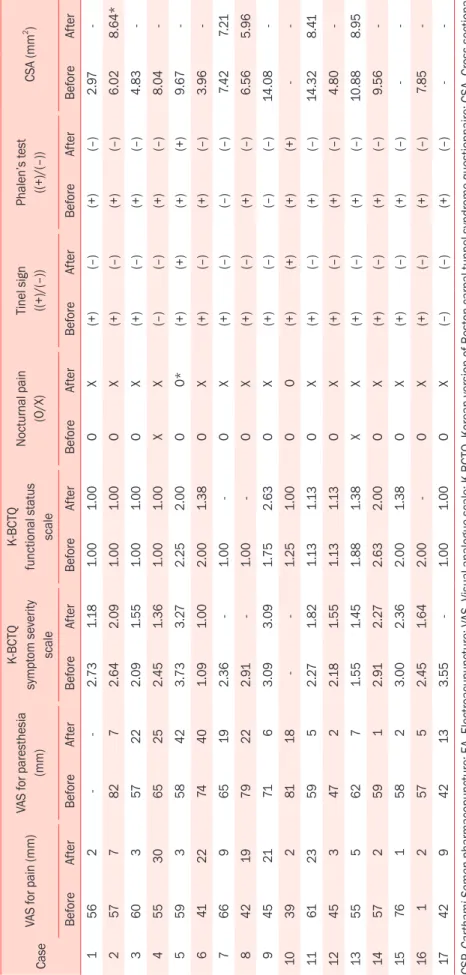
Ta ble 2. Assessmen t of ou tcome mea su res b ef or e a nd a fter CSP combin ed with EA in a ll p atien ts Case VAS f or pain (mm) VAS f or pare sthe sia (mm) K-BCTQ sym pt om se ve rity scale K-BCTQ fu ncti onal statu s scale

Noctu rnal pain (O/X) Tine l sign ((+)/(–)) Phale n’s t est ((+)/(–)) CSA (mm

2

) Be fo re Af te r Be fo re Af te r Be fo re Af te r Be fo re Af te r Be fo re Af te r Be fo re Af te r Be fo re Af te r Be fo re Af te r 1 56 2 - - 2.73 1. 18 1.00 1.00 O X (+) (–) (+) (–) 2.9 7 - 2 57 7 82 7 2.6 4 2.09 1.00 1.00 O X (+) (–) (+) (–) 6.02 8.6 4* 3 60 3 57 22 2.09 1.55 1.00 1.00 O X (+) (–) (+) (–) 4.83 - 4 55 30 65 25 2.45 1.36 1.00 1.00 X X (–) (–) (+) (–) 8.04 - 5 59 3 58 42 3.73 3.2 7 2.25 2.00 O O* (+) (+) (+) (+) 9.67 - 6 41 22 74 40 1.09 1.00 2.00 1.38 O X (+) (–) (+) (–) 3.96 - 7 66 9 65 19 2.36 - 1.00 - O X (+) (–) (–) (–) 7.42 7. 21 8 42 19 79 22 2.9 1 - 1.00 - O X (+) (–) (+) (–) 6.56 5.96 9 45 21 71 6 3.09 3.09 1.75 2.63 O X (+) (–) (–) (–) 14.08 - 10 39 2 81 18 - - 1.25 1.00 O O (+) (+) (+) (+) - - 11 61 23 59 5 2.2 7 1.82 1.1 3 1.1 3 O X (+) (–) (+) (–) 14.32 8.4 1 12 45 3 47 2 2.1 8 1.55 1.1 3 1.1 3 O X (+) (–) (+) (–) 4.80 - 13 55 5 62 7 1.55 1.45 1.88 1.38 X X (+) (–) (+) (–) 10.88 8.95 14 57 2 59 1 2.9 1 2.2 7 2.63 2.00 O X (+) (–) (+) (–) 9.56 - 15 76 1 58 2 3.00 2.36 2.00 1.38 O X (+) (–) (+) (–) - - 16 1 2 57 5 2.45 1. 64 2.00 - O X (+) (–) (+) (–) 7.85 - 17 42 9 42 13 3.55 - 1.00 1.00 O X (–) (–) (+) (–) - - CSP , Car thami Se me n phar maco pu nct ur e; EA , Ele ct ro acu pu nct ur e; V AS, V isu al analo gu e scale ; K -BCTQ, K or ean v er sio n o f Bo st on car pal t unne l synd ro me q ue st io nnair e; CSA , Cr oss-se ct io nal are a. *In o ne case (Case 2), CSA incre ase d fr om 6.02 mm

2

to 1 4.49 mm

2

(TD = 7 .1 mm, AD = 2.6 mm) at the midpo int of the tre atme nt sessio ns; ho we ve r, it sho we d a d ecre ase to 8.6 4 mm

2

at the com ple tio n o f tre atme nt.

(5)

ment was terminated according to patients’ improvement or KM doctor’s judgement. The mean treatment duration was 42.88 ± 38.14 days and the mean number of treatment sessions was 8.00 ± 3.71. By the last treatment, the VAS for pain signifi- cantly decreased from 50.41 ± 16.19 to 9.59 ± 9.46, and VAS for paresthesia was also significantly reduced from 63.50 ± 11.49 to 14.75 ± 12.97 (all p < 0.001). K-BCTQ symptom severity scale declined from 2.48 ± 0.68 to 1.89 ± 0.70 (p < 0.001). However, no statistically significant change in functional status scores were observed after the treatment course. Nocturnal pain, Phalen’s test and Tinel signs showed improvements after all the treatments (Table 2, 3).

Out of 17 patients, ultrasound observations were conducted in 14 patients before treatment for supporting diagnosis, and in only 5 patients after treatment. We observed changes in trans- verse diameter (TD), anteroposterior diameter (AD), and cross- sectional area (CSA; TD*AD*π/4) of the median nerve (Table 2).

In 4 cases (Case 7, 8, 11, 13), CSA decreased upon completion of treatment. In 1 case (Case 2), CSA increased from 6.02 mm

2

to 14.49 mm

2

at the midpoint of the treatment sessions. How-

ever, it showed a decrease to 8.64 mm

2

after treatment. In Case 11, a noticeable reduction in CSA was observed after treatment (Fig. 1).

No severe adverse events (AE) were detected during treat- ment. A few patients showed mild swelling and redness at acu- points, and subsided within 1-2 days.

The patient satisfaction survey was completed by 13 out of 17 participants (Table 4). All the respondents reported favor- able overall satisfaction with KM treatments. Moreover, 72.7%

of patients were open to future pharmacopuncture treatments if CTS recurred.

DISCUSSION

To the authors’ knowledge, this is the first case series study that aimed to report the clinical effects of CSP combined with EA on CTS. In response to KM treatment, 17 patients showed significant improvements in pain, paresthesia, and all other related symptoms in the short-term period. Furthermore, the patients showed no AEs or complications.

Table 3. Statistical analysis* for outcome scores change before and after CSP combined with EA in all patients

Variables Before treatment After treatment Mean difference (95% CI) p-value

VAS for pain (n = 17) 50.41 ± 16.19 9.59 ± 9.46 40.82 (31.18-50.47) < 0.001

VAS for paresthesia (n = 16) 63.50 ± 11.49 14.75 ± 12.97 48.75 (40.72-56.78) < 0.001 K-BCTQ symptom severity scale (n = 13) 2.48 ± 0.68 1.89 ± 0.70 0.59 (0.32-0.83) < 0.001 K-BCTQ functional status scale

(n = 13) 1.19 [1.00, 2.00]

1.13 [1.00, 1.38]

0.25 [0, 0.62]

0.713 CSP, Carthami Semen pharmacopuncture; VAS, visual analog scale; K-BCTQ, Korean version of Boston carpal tunnel syndrome questionnaire. *Data were analyzed using Statistical Package for Social Sciences (SPSS) version 22.0 for Windows (SPSS Inc., Chicago, IL, USA);

Wilcoxon signed-rank test was conducted due to non-normal distribution in score change;

Median value [Quartile1, Quartile3].

Figure 1. Transverse ultrasound images of the median nerve (arrows) in one patient (Case 11); (A) Before treatment, TD and AD were 9.6 mm

and 1.9 mm, respectively. CSA (= TD*AD*π/4) was 14.32 mm

2

; (B) After treatment, the TD and AD decreased into 5.1 mm and 2.1 mm, respec-

tively. Accordingly, CSA was 8.41 mm

2

.

(6)

KM treatments, such as acupuncture, pharmacopuncture, and electroacupuncture are effective as conservative treat- ments for musculoskeletal disorders like CTS in the absence of abnormalities like a tumor or post-fracture malunion [10].

Therefore, given the potential sequelae of steroid injections and surgical treatments, conservative treatments like KM can be recommended as initial treatment options. Phamacopuncture has been reported to have symptom-relieving effects in CTS [10-13]. CSP effects in CTS are likely due to a combination of pharmacological action and lubrication to the TCL [18]. Car- thami Semen extract has been reported to induce analgesic and anti-inflammatory effects, and decrease the size of swelling at joints [19, 20]. Although the mechanisms of CSP-mediated- alleviation of paresthesia and pain in CTS remain unknown, CSP may improve blood circulation around the TCL and digital flexor tendons, decrease wrist joint swelling, and ameliorate tendon inflammation.

For CTS patients, EA likely promotes pain inhibition and recovery stimulation. EA blocks pain by activating a variety of bioactive chemicals (i.e., opioids, serotonin, and norepi- nephrine) via peripheral, spinal, and supraspinal mechanisms.

Opioids desensitizes peripheral nociceptors and reduces pro- inflammatory cytokines peripherally and in the spinal cord [21]. Moreover, serotonin and norepinephrine induced by EA decrease spinal N-methyl-d-aspartate receptor (NMDAR) subunit GluN1 phosphorylation, which modulates NMDAR

activity and promotes transmission of nociceptive inputs [21, 22]. EA may also improve median nerve function at the wrist by somatotopically distinct neuroplasticity in the primary so- matosensory cortex of the brain [23]. Despite these compelling results, a review from Cochrane [2] concluded that it indicated that EA-mediated pain reduction was short-term.

Typical CTS symptoms are comparable to Arthralgia syn- drome ( 痺症 痺症 , Bi Syndrome) in KM. There are three representa- tive symptoms of Arthralgia syndrome, i.e., pain, numbness and dullness. Arthralgia syndrome is considered as a result of qi-blood circulation blockage and caused by pathogenic wind ( 風 風 ), cold dampness ( 寒濕 寒濕 ), and blood stasis ( 瘀血 瘀血 ) [13, 24].

In KM, Carthami Semen is considered to have warmness (

性 ) and promote blood circulation. Thus, in the concept of KM, CSP could help in influencing a blocked circulation of blood and removing the pathogenic wind, cold dampness, and blood stenosis, resulting in reduced pain and paresthesia related to Arthralgia syndrome [13].

In this study, besides mild redness and swelling, no severe AEs were detected. Furthermore, in another review, no severe AEs were associated with EA treatment for CTS [2]. Moreover, Choi et al. reported that water-soluble CSP did not induce any significant in vivo toxicological effects except localized symp- toms [16]. However, it still needs more evidence to combine EA and CSP on CTS.

The present retrospective case series study has several limi- Table 4. Patient satisfaction with KM treatment (n = 13)

Questions

Strongly disagree 1 N (%)

Disagree 2 N (%)

Moderate 3 N (%)

Agree 4 N (%)

Strongly agree 5 N (%)

Mean ± SD (N = 13)

“I am satisfied with KM treatments I have been given.”

0 (0) 0 (0) 9 (69.23) 4 (30.77) 0 (0) 3.31 ± 0.48

“I have been given the

pharmacopuncture treatment in a safe way.”

0 (0) 0 (0) 4 (30.77) 8 (61.54) 1 (7.69) 3.77 ± 0.60

“The pharmacopuncture treatment improved my CTS symptoms.”

0 (0) 0 (0) 3 (27.27) 9 (69.23) 1 (7.69) 3.85 ± 0.55

“The other KM treatments (except pharmacopunture) were helpful in improving my CTS symptoms.”

0 (0) 0 (0) 2 (18.18) 11 (23.08) 0 (0) 3.85 ± 0.38

“I will recommend pharmacopuncture to others in the future.”

0 (0) 0 (0) 7 (53.85) 5 (38.46) 1 (7.69) 3.54 ± 0.66

“If CTS recurs, I will intend to be given pharmacopuncture treatment.”

0 (0) 0 (0) 4 (30.77) 8 (61.54) 1 (7.69) 3.77 ± 0.60

KM, Korean Medicine; CTS, Carpal tunnel syndrome.

(7)

tations. First, this study is a case series with small sample size and a lack of control group; this indicates that it is limited to evaluate precisely the combinatorial effects of CSP and EA even though we can find the certain tendency of improvements in CTS symptoms after CSP combined with EA treatment. Hence, further prospective studies with large patients are needed. Sec- ond, all cases were limited to ‘mild to moderate’ CTS patients.

Patients with surgical indications accompanied by thenar atro- phy occasionally visit in KM Clinic, but there was no observa- tion for the case in this study. Lastly, the study lacked follow- up assessments for evaluating a recurrence rate. CTS is prone to recurrence; thus, a follow-up assessment must be performed to evaluate the duration of treatment effects in future studies.

While this study has several limitations, we found that CSP combined with EA could be safe and helpful in improving CTS symptoms. Further prospective studies with larger populations, follow-up assessments, and intensive observations of adverse effects are needed.

CONFLICT OF INTEREST

The authors declare that there are no conflicts of interest.

FINANCIAL SUPPORT

This study was supported by Korea Institute of Oriental Medicine (KSN2021210).

ORCID

Pyung-Wha Kim, https://orcid.org/0000-0002-8356-8392 Seon Choe, https://orcid.org/0000-0001-9504-2956 Kyungsun Han, https://orcid.org/0000-0002-9710-7845 Changsop Yang, https://orcid.org/0000-0003-1277-3329 Jinbok Lee, https://orcid.org/0000-0003-2725-4062 Sungha Kim, https://orcid.org/0000-0001-5542-3850 Minseop Shin, https://orcid.org/0000-0002-1698-8987

REFERENCES

1. Padua L, Coraci D, Erra C, Pazzaglia C, Paolasso I, Loreti C, et al. Carpal tunnel syndrome: clinical features, diagnosis, and management. Lancet Neurol. 2016;15(12):1273-84.

2. Choi GH, Wieland LS, Lee H, Sim H, Lee MS, Shin BC. Acu- puncture and related interventions for the treatment of symp-

toms associated with carpal tunnel syndrome. Cochrane Data- base Syst Rev. 2018;12(12):CD011215.

3. Lee JW, Kim JY, Hong YS, Kim SS, Kim WC, Kim HJ. The prevalence of carpal tunnel syndrome in an urban population. J Korean Soc Surg Hand. 2008;13(4):266-75.

4. Sim H, Shin BC, Lee MS, Jung A, Lee H, Ernst E. Acupuncture for carpal tunnel syndrome: a systematic review of randomized controlled trials. J Pain. 2011;12(3):307-14.

5. Jerosch-Herold C, Houghton J, Blake J, Shaikh A, Wilson EC, Shepstone L. Association of psychological distress, quality of life and costs with carpal tunnel syndrome severity: a cross-sectional analysis of the PALMS cohort. BMJ Open. 2017;7(11):e017732.

6. American Academy of Orthopaedic Surgeons. Management of carpal tunnel syndrome evidence-based clinical practice guide- line. Rosement: American Academy of Orthopaedic Surgeons;

2016. p. 7, 10-2, 407-8.

7. Kaile E, Bland JDP. Safety of corticosteroid injection for carpal tunnel syndrome. J Hand Surg Eur Vol. 2018;43(3):296-302.

8. Bae HS, Hong JW, Choi CM, Na BJ, Park SU, Moon SK, et al.

Comparison of therapeutic effect on carpal tunnel syndrome between oriental and western medicine. J Korean Orient Med.

2008;28(1):87-93.

9. Verdugo RJ, Salinas RA, Castillo JL, Cea JG. Surgical versus non-surgical treatment for carpal tunnel syndrome. Cochrane Database Syst Rev. 2008;2008(4):CD001552.

10. Ku JY, Lee KH, Cho SW, Lee SC, Youn HM, Jang KJ, et al.

Comparison of the effects between sweet bee venom pharmaco- puncture and scolopendrid pharmacopuncture on carpal tunnel syndrome (randomized, controlled clinical trial). J Pharmaco- puncture. 2010;13(4):75-89.

11. Lee SH, Yoon JW, Kim SJ. A comparative review on carthmi- flos pharmacopuncture treatment-focused on clinical study. J Korean Med Rehabil. 2017;27(4):55-65.

12. Choi SW, Park PB, Oh SJ. A case report of carpal tunnel syn- drome with Raynaud’s phenomenon treated by bee venom and carthami flos pharmacopuncture. J Pharmacopuncture.

2009;12(1):103-8.

13. Shin MS, Park MH, Lim ST, Shin JC, Lee BY, Lee SS, et al. Clini- cal study on treatment of the carpal tunnel syndrome with CF herbal acupuncture. J Pharmacopuncture. 2005;8(2):39-45.

14. Fowler JR, Cipolli W, Hanson T. A comparison of three diagnos- tic tests for carpal tunnel syndrome using latent class analysis. J Bone Joint Surg Am. 2015;97(23):1958-61.

15. Park GY. Ultrasound in the diagnosis of carpal tunnel syndrome.

J Korean Assoc Pain Med. 2006;5(2):81-5.

16. Choi YM, Jung DJ, Kim SH, Kim JU, Yook TH. Repeated intra-

muscular-dose toxicity test of watersoluble carthami flos (WCF)

pharmacopuncture in sprague-dawley rats. J Pharmacopunc-

(8)

ture. 2015;18(1):36-43.

17. Park DJ, Kang JH, Lee JW, Lee KE, Wen L, Kim TJ, et al. Cross- cultural adaptation of the Korean version of the Boston carpal tunnel questionnaire: its clinical evaluation in patients with car- pal tunnel syndrome following local corticosteroid injection. J Korean Med Sci. 2013;28(7):1095-9.

18. Yook TH, Song BY, Sin MS, Kim BH, Park JJ, Yun JH. Effects on the local thermal change following herbal acupuncture on D.I.T.I. J Korean Acupunct Moxib Soc. 2000;17(3):57-68.

19. Seo BI, Lee ES, Park JH, Kim SC, Byeon BH, Choi HY. A effica- cy of Korean and Chinese Carthami Semen on analgesic effect, anti-inflammation and arthritis. Korea J Herbol. 2001;16(1):1- 10.

20. Kim SH, Lee JM. Effects of aqua-acupuncture with carthami flos

oil on gout in rats induced by microcrystalline sodium urate. J Korean Acupunct Moxib Soc. 1998;15(1):483-91.

21. Zhang R, Lao L, Ren K, Berman BM. Mechanisms of acupunc- ture-electroacupuncture on persistent pain. Anesthesiology.

2014;120(2):482-503.

22. Zhang X, Wu J, Lei Y, Fang L, Willis WD. Protein phosphatase modulates the phosphorylation of spinal cord NMDA receptors in rats following intradermal injection of capsaicin. Brain Res Mol Brain Res. 2005;138(2):264-72.

23. Maeda Y, Kim H, Kettner N, Kim J, Cina S, Malatesta C, et al.

Rewiring the primary somatosensory cortex in carpal tunnel syndrome with acupuncture. Brain. 2017;140(4):914-27.

24. Zhang EQ. Bi syndrome (arthralgia syndrome). J Tradit Chin

Med. 2010;30(2):145-52.

수치

Table 1. Clinical characteristics of all patients CaseSex/AgeBMIJob (Y/N)
Table 2. Assessment of outcome measures before and after CSP combined with EA in all patients CaseVAS for pain (mm)VAS for paresthesia (mm)K-BCTQ symptom severity  scaleK-BCTQ functional status scale
Table 3. Statistical analysis* for outcome scores change before and after CSP combined with EA in all patients

참조

관련 문서

Methods: We treated the patient diagnosed as carpal tunnel syndrome by Korean medical treatment such as acupuncture, pharmacopuncture and herbal medicine at

METHODS: A total of 60 subjects (30 carpal tunnel syndrome with trigger finger and 30 carpal tunnel syndrome without trigger finger) were assessment for pain, muscle strength

METHODS: A total of 60 subjects (30 carpal tunnel syndrome with trigger finger and 30 carpal tunnel syndrome without trigger finger) were assessment for pain, muscle

Temporal Relationship between Symptomatic and Electrophysiological Improvement to Postoperative Carpal Tunnel Syndrome

Abstract This study compared the median nerve, ulnar never, and F waves of patients diagnosed with early Carpal Tunnel Syndrome to acontrol group to determine whether F waves could

Usefulness of Ultrasonographic Examination in Carpal Tunnel Syndrome Caused by a Median Artery: A Case Report.. Byong San Choi, M.D., Chae Geun