- 1730 -
적응 역전파 학습 알고리즘을 이용한 신경회로망 제어기 설계
최경미1, 최윤호2, 박진배1
1연세대학교 전기전자공학과, 2경기대학교 전자공학부
Direct Adaptive Control Based on Neural Networks Using An Adaptive Backpropagation Algorithm
Kyoung Mi Choi1, Yoon Ho Choi2 and Jin Bae Park1
1 Department of Electrical and Electronic Engineering, Yonsei University, Seoul, Korea
2 Department of Electronic Engineering, Kyonggi University, Suwon, Korea
( )
x k1 x k2
( )
x kn( )
∑
( )
F k1 F k2
( )
L F kn( )
L
( )
1
w1,1 k w1n n,
( )
k( )
2
w1,1 k w1,n2
( )
k( )
y kn
( )
x k1 x k2
( )
x kn( )
∑
( )
F k1 F k2
( )
L F kn( )
L
( )
1
w1,1 k w1n n,
( )
k( )
2
w1,1 k w1,n2
( )
k( )
x k1 x k2
( )
x kn( )
∑
( )
F k1 F k2
( )
L F kn( )
L
( )
1
w1,1 k w1n n,
( )
k( )
2
w1,1 k w1,n2
( )
k( )
y kn
<Fig. 1> Neural network with three layers
<Fig. 2> Schematic of a direct adaptive controller Abstract - In this paper, we present a direct adaptive control
method using neural networks for the control of nonlinear systems.
The weights of neural networks are trained by an adaptive backpropagation algorithm based on Lyapunov stability theory. We develop the parameter update-laws using the neural network input and the error between the desired output and the output of nonlinear plant to update the weights of a neural network in the sense that Lyapunove stability theory. Beside the output tracking error is asymptotically converged to zero.
1. Introduction
Generally, the training method of neural network is the gradient-based backpropagation algorithms. However the gradient-based backpropagation method has the local minimum problem when the input signal has large bounded disturbance signal.
And the gradient-based backpropagation may slowly converge.[1-4]
In order to solve those problems, an adaptive backpropagation training method has been develped in. The concept of an adaptive backpropagation algorithm is as follows. At the first, the Lyapunov function is chosen. Then the weights of a neural network are updated to make ∆ . We can use Lyapunov stability theory. It is shown that error can asymptotically converge to zero as time goes to infinity because the candidate of Lyapunov function is error dynamics, [5].
In this paper, we propose nonlinear system controllers using direct adaptive method. That controller is based on a neural network training of the adaptive backpropagation method. In order to nonlinear systems are stable, the controller can use the adaptive backpropagation algorithm.
2. Main Results
2.1 Neural Network Structure
In this paper, we consider a feedforward neural network with three layers. Fig. 1 shows a schematic diagram of neural network with three layers. The output layer has a single linear node, the hidden
layer has nodes, an input vector is
⋯ . The nonlinear function of hidden layer is
, (1)
where is a positive constant.
The output of the th node in the hidden layer is
. (2) The output is composed by each weights and nonlinear functions as follows:
, (3)where is connection weight between hidden nodes and input nodes. The is connection weight between hidden nodes and
output nodes.
2.2 Direct Adaptive Control of Nonlinear System
In this section, we describe the nonlinear systems and design of the feedforward neural network using adaptive backpropagation.
A direct adaptive control can be schematically represented by Fig.
2. It is composed of four parts: a nonlinear plant, reference signal for compactly specifying the desired output of control system, a feedback control law containing neural network, and an adaptation mechanism for updating the weights of a neural network using adaptive backpropagation (BP) [6].
We consider here the problem of controlling the plant is described by the difference equation
⋯ , (4) where the function is very complicated.
We can defined the error signal as where is the desired reference signal and is the plant output. The aim of control is to determine a bounded control input such that
lim
→ ∞
. The input signal can be computed as follows:
⋯ . (5) However, since ⋯ is complex, the controller is 2007년도 대한전기학회 하계학술대회 논문집 2007. 7. 18 - 20
- 1731 -
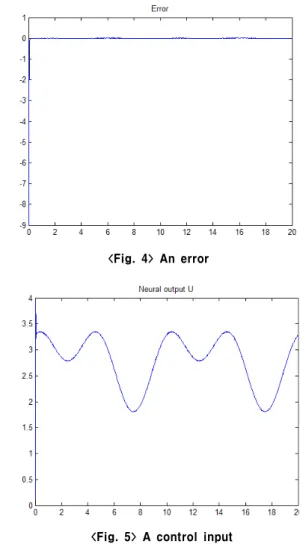
<Fig. 3> The output of plant
<Fig. 5> A control input
<Fig. 4> An error estimated online as using a neural network.
The control input to the plant is computed using in place of
⋯ as
. (6) where, is an output of a neural network.
We can apply controller using neural network not only complex nonlinear function but also unknown plant.
2.3 Training method using adaptive backpropagation algorithm
The Lyapunov stability adaptive BP algorithm in this paper is aimed at constructing an energy surface with a single global minimum point through the adaptive adjustment of the weights as the time gose to infinity[5].
The first step in the development of such a learning procedure is to choose Lyapunov function , where is positive function.
We can update the weights to make ∆ .
Then the weights and are updated as follow:
⋯
(7)
⋯
,(8) where ≠≠. Beside the error can asymptotically converge to zero as time goes to infinity.
3. Simulation Example
In this section, we consider a three-layered neural adaptive contorl, as seen in Fig 2.
The plant is as follows :
( ) ( ) ( ) ( ) ( )
( ) ( )
2 2
1 2.5
, 1
1 1
y k y k y k f y k y k
y k y k
⎡ ⎤
− ⎣ + ⎦
⎡ − ⎤=
⎣ ⎦ + + − (9)
The reference signal is as follows :
(10) The inputs of a neural network are .Fig. 3 shows the output of plant and desired signal. Fig. 4 shows the error between the reference signal and the output of plan
.
We can show the neural network output in Fig. 5.
4. Conclusion
In this paper, we have developed the neural network controller using the Lyapunov stability adaptive BP algorithm. The error asymptotically convergences to zero as time goes to infinity. The
new controller has been applied nonlinear system in the simulation section.
We will develop the controllers are the strong roboust input disturbance and the general nonlinear systems using the Lyapunov stability adaptive BP algorithm. Thus we will apply nonholonomic systems such as mobile robot.
5. Acknowledgement
This work was supported by the Brain Korea 21 Project in 2007.
[Reference]
[1] H. Sira-Ramirez and E. Colina-Morles, “A sliding mode strategy for adaptive learning in adalines,” IEEETransaction on Circuits System I, Fundam. Theory Appl., Vol. 42, No. 12, pp. 1001-1012, Dec.
1995.
[2] G. G. Parma, B. R. Menezes, and A. P. Braga, “Sliding mode algorithm for training multilayer artificial neural networks,” Electron.
Lett., Vol. 34, No. 1, pp. 97-98, 1998.
[3] J. A. K. Suykens, J. Vandewalle, and B. L. R. De Moor, “NLp theory: checking and improving stability of recurrent neural networks for nonlinear modeling,” IEEE Transaction on Signal Processing, Vol.
45, No. 11, pp. 2682-2691, Nov. 1997.
[4] O. Kaynak, K. Erbatur, and M. Ertugrul, “The fusion of computationally intelligent methodologies and siliding-mode control – a survey,” IEEE Transaction on Ind. Electron., Vol. 48, No. 1, pp.
4-17, Feb. 2001.
[5] Z. Man, H. R. Wu and S. Liu, X. Yu, “A New Adaptive Backpropagation Algorithm Based on Lyapunov Stability Theory for Neural Networks,” IEEE Transaction on neural networks., Vol. 17, no.
6, pp. 1580-1591, 2006
[6] J. J. E. Slotine and W. Li, Applied Nonlinear Control. Englewood Cliffs, NJ: Prentice-Hall, 1991