• 검색 결과가 없습니다.

Malignant Struma Ovarii Detected Incidentally Due to Contralateral Ovarian Torsion

N/A
N/A
Protected

Academic year: 2021

Share "Malignant Struma Ovarii Detected Incidentally Due to Contralateral Ovarian Torsion"

Copied!
6
0
0

로드 중.... (전체 텍스트 보기)

전체 글

(1)

Undergraduate Student, Department of Pathology

1

, Keimyung University School of Medicine, Daegu, Korea

Corresponding Author: Yu Na Kang, M.D., Department of Pathology, Keimyung University School of Medicine 56 Dalseong-ro, Jung-gu, Daegu 700-712, Korea

Tel : +82-53-250-7290 E-mail: [email protected]

Abstract

Struma ovarii is a rare and highly specialized form of ovarian teratoma, in which thyroid tissue is the exclusive element (>50%). It comprises about 2% of all teratomas, and the majority of struma ovarii is benign tumor. But malignant struma ovarii, which showed malignant cell change arising in the benign struma ovarii, rarely reported. Here, we report an incidentally detected case of papillary thyroid carcinoma arising in the struma ovarii due to contralateral ovarian torsion in a 80-year old female.

Key Words : Malignant struma ovarii, Papillary carcinoma, Teratoma, Torsion

Han Joon Kim, Yu Na Kang

1

, M.D.

Malignant Struma Ovarii Detected Incidentally Due to Contralateral Ovarian Torsion

Introduction

Struma ovarii is a monodermal variant of ovarian teratoma, initially described by Bottlin in 1888.

Later, by Pick in 1902 and 1903, who recognized that struma ovarii was composed of thyroid tissue [1]. Although 5-15% of all ovarian teratomas may contain some thyroid tissue; only 2% of these are made exclusively of struma ovarii. The vast majority of struma ovarii is benign tumors (95%) [2]. But malignant struma ovarii, which showed malignant cell change arising in the benign struma ovarii, rarely reported. The most common histologic type

of malignancy arising in the struma ovarii is papillary thyroid carcinoma [3].

Case Report

A 80-years-old woman was admitted, due to

lower abdominal pain. There were no specific

findings in past history and family history. On

physical examination, a huge palpable abdominal

mass was found. Ultrasound examination in the

emergency department of Dong San Medical Center

showed a large round multiseptated mass in the cul-

(2)

de-sac (Fig. 1A). On pelvic examination, vagina showed no specific lesion but the cervix showed motion tenderness. On dynamic abdomen and pelvic CT, there was a multiseptated cystic mass, measuring 13×10.5×10 cm in maximum dimensions (Fig. 1B). Pelvic MRI examination also revealed a large multiloculated cystic mass suspicious of mucinous cystic neoplasm (Fig. 1C).

In laboratory finding, tumor markers such as CA-19-9 and CA-125 were within normal range.

Total abdominal hysterectomy with bilateral salpingoopherectomy was done along with Culdoplasty.

Received specimen for frozen section was the right ovary attached to the fallopian tube. Grossly, the uterus was normal sized. The right ovary was 16.0×10.0×9.5 cm in dimensions and 707.0 gm in weight.

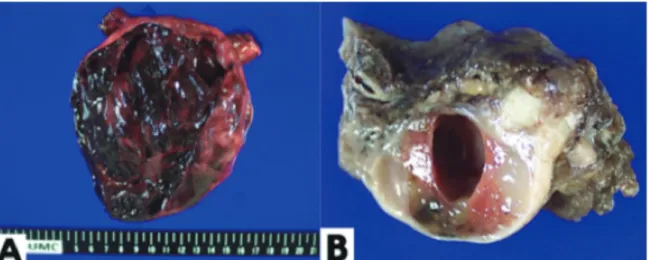
Cut surface of the right ovary showed a large, markedly congested, multilocular cystic mass containing mucoid material (Fig. 2A). In contrast to right ovary, the left ovary was small, measuring 3.1×2.0×2.0 cm . Cut surface of the left ovary shows a pale tan to pink glistening solid and cystic lesion with an area of ill-defined whitish solid and firm tissue (0.6×0.5×0.5 cm) at the upper portion of the left ovary (Fig. 2B).

Microscopically, the right ovary and fallopian tube showed massive hemorrhage, congestion, and coagulative necrosis without viable lining epithelial cells. Most of the left ovary showed benign thyroid follicles, and diagnosed as struma ovarii. The upper portion of the left ovary showed typical papillary fronds composed of optically clear nuclei, irregular n u c l e a r m e m b r a n e, n u c l e a r g r o o v e a n d pseudoinclusion, representing a papillary thyroid carcinoma (Fig. 3). There was no evidence of lymphovascular invasion or perineural invasion of the tumor cells. Additional immunohistochemical stains showed positivity for thyroglobulin, galectin-3 and HBME-1 in the tumor cells (Fig. 4) Malignant struma ovarii was incidentally detected by operation of a wrenched large contralateral mucinous neoplasm.

Ultrasound examination of neck after operation showed an about 10.3×14.5×14.9 mm sized heterogeneous slightly hypoechoic mass in the lower pole of the right thyroid lobe. Some color signals are noted within the mass. Possibility of nodular hyperplasia was considered. An about 4.8×8.8×8.5 mm sized heterogeneous isoechoic nodule in the left thyroid lobe. Possibility of nodular hyperplasia was considered. Several small colloid

Fig. 1. A: Transvaginal ultrasound examination showed multiseptated huge mass in right adnexa. B:

Abdominopelvic computed tomography showed a large ovoid multiseptated cystic mass of right

ovary, suspicious of mucinous cystadenoma. C: Magnetic resonance imaging of pelvis showed a

large ovoid multiloculated cystic mass in right adnexa.

(3)

cysts were noted in both thyroid lobes. An about 13.1 mm sized enlarged lymph node in the left supraclavicular region probably a reactive lymph node was found. Thyroid function test after operation was in normal range. The patient is still alive for 6 years after the diagnosis of malignant struma ovarii, papillary thyroid carcinoma arising in

struma ovarii.

Discussion

Ovarian teratoma is a common benign ovarian tumor consist of ectodermal, mesodermal, and Fig. 2. A: Right ovary shows a large multiloculated cystic mass containing hemorrhagic material. B: Left

ovary shows pale tan to pink glistening solid and cystic lesions with an area of ill-defined whitish firm tissue.

Fig. 3. A: Numerous benign thyroid follicles within the left ovarian stroma are seen (H&E, ×100). B:

Benign thyroid follicles (left) are compared with malignant papillary thyroid carcinoma (right)

within the left ovary (H&E, ×400). C: Papillary structure composed of optically clear nuclei,

irregular nuclear membrane, nuclear groove and pseudoinclusion represents papillary carcinoma in

left ovary (H&E, ×400).

(4)

endodermal components, and thyroid tissue component may be found in about 20% of the ovarian teratoma. But struma ovarii containing 50%

or more thyroid tissue, is rare, accounting for only 2% of all ovarian teratomas [4]. The majority of struma ovarii is benign tumor, and malignant struma ovarii is rare. Generally malignant struma ovarii occurs in the fifth decade and preferentially involves the left ovary rather than the right ovary. In all reported cases, a total of 39 cases up until 2004, the average age at clinical presentation was 44.

Patients predominately presented 45% with a pelvic mass, 40% with abdominal pain, 9% with menstrual irregularities and 5% with hyper-thyroidism [5].

Commonly the patient undergoes surgery, because a malignant ovarian tumor is suspected on radiologic examination [6]. Metastasis from malignant struma ovarii is uncommon, seen in 5-23% of patients with malignant struma ovarii. However, the recent studies suggest a higher potency of recurrence [3].

Diagnosis of struma ovarii is usually made after operation, because frozen section often only reveals a teratoma [6]. Histopathologically, struma ovarii is composed of various-sized thyroid follicles filled with pink-staining, homogenous, gelatinous colloid,

lined with cuboidal or columnar epithelium [7].

Malignant struma ovarii showing histopathologic features of thyroid carcinoma, are found in 5-37% of all struma ovarii [6]. Papillary carcinoma is the most common histologic type [8-10]. Common criteria for diagnosis of malignant struma ovarii is the presence of nuclear features of papillary thyroid carcinoma.

Nuclei of the tumor cells are enlarged, clear, ground glass, empty and overlapping. The papilla consists of a central fibrovascular stalk with loose connective tissue and variably sized, thin-walled vessels.

Mitoses are rare. Intranuclear inclusions of cytoplasm and nuclear grooves are often found.

These neoplasms exhibit nuclear features similar to those of their counterparts in the thyroid gland of neck. The identification of psammoma bodies in the context of a thyroid-type papillary neoplasm is highly supportive in the diagnosis of carcinoma [7].

Immunohistochemical staining with thyroglobulin is very useful in supporting a diagnosis of struma ovarii [11]. Antibodies such as Hector Battifora mesothelial [cell]-1 (HBME-1) and galectin-3, can also help to diagnosis papillary thyroid carcinoma [12,13]. Molecular analysis revealed that v-raf murine sarcoma viral oncogene homolog B1 (BRAF) Fig. 4. A: Both papillary thyroid carcinoma components and benign thyroid follicles are all stained for

thyroglobulin (×100). B&C: The tumor cells of papillary thyroid carcinoma (right) only shows

positive cytoplasmic reaction for galectin-3 (B, ×100) and HBME-1 (C, ×100).

(5)

mutations, common in papillary thyroid carcinoma, were also present in 66% of malignant struma ovarii with papillary features [14]. RET/PTC ( RET proto- oncogene rearrangements) were seen in 70% of malignant struma ovarii with follicular variant papillary thyroid carcinoma [15].

Rare cases of thyroid carcinoma metastasizing to the ovary, have been reported, and it should be differentiated from malignant struma ovarii. In those cases, the primary thyroid tumor should be detected b y c l i n i c a l t h y r o i d e x a m i n a t i o n a n d ultrasonography, and the ovarian tumor should show no component of teratoma [16]. In our patient, ultrasound examination of thyroid did not reveal any pathologic lesions. Malignant struma ovarii should be differentiated from other primary ovarian tumors, such as granulosa cell tumor, Brenner tumor, papillary serous cystadenoma or cystadenocarcinoma. Differential diagnosis can be made by the cytologic features representing typical thyroid follicles, and by immunohistochemical staining of organ specific antibodies such as thyroglobulin, TTF-1, inhibin, WT-1 (Wilms tumor- 1), and CA-125 [10].

There is no consensus on management of malignant struma ovarii. Surgical removal of the ovarian tumor is main treatment. Surgical treatment varies from total abdominal hysterectomy, plus bilateral salpingo- oophorectomy with omentectomy, to conservative surgery involving unilateral oophorectomy or strumectomy (cystectomy), for preservation of fertility. Some authors have suggested that total abdominal hysterectomy with bilateral salpingo- oophorectomy is a reasonable option in postmenopausal women or in premenopausal women who have completed childbearing. In cases where preservation of fertility is desired, c o n s e r v a t i v e s u r g e r y, s u c h a s u n i l a t e r a l oophorectomy or strumectomy (cystectomy), should be attempted only if there is an unilateral lesion

without evidence of capsular invasion or metastasis [10]. However postoperative management is still controversial [17]. Adjuvant treatment options are including thyroxine, to reduce TSH secretion, near- total thyroidectomy with radioactive iodine ablation.

Because of its rarity and the lack of consensus in treatment, the prognosis of thyroid type carcinoma arising in struma ovarii is difficult to estimate. If only histological criteria are considered, 14% with typical follicular carcinoma, 7% with papillary carcinoma, 100% with undifferentiated (anaplastic) carcinoma, and 0% with highly differentiated follicular carcinoma of ovarian origin (HDFCO) died of neoplasm [18]. Even when clinically malignant, the neoplasm shows long survival, as evidenced by an 84% 25-year survival. Unless obviously poorly differentiated, no single histologic or clinical feature reliably predicts which neoplasms will be biologically malignant. However dense fibrous adhesions and larger strumal size, especially over 12 cm, are suggestive of neoplasms that will have spread at the time of operation or are likely to recur [19].

Summary

Ovarian teratoma is a common benign ovarian tumor, but struma ovarii containing 50% or more thyroid tissue, is rare. Among them, malignant struma ovarii arising in old women is rarer. So we report the malignant struma ovarii, detected incidentally due to the torsion of contralateral ovarian mass in 80-year-old women.

References

1. Boettlin R, Pick L. On gynaecological cancer. In:

O'Dowd MJ, Philipp EE, editors. The History of

(6)

obstetrics and gynaeco-logy. 1 ed. London: Informa Healthcare; 2000. p. 587-9.

2. Checrallah A, Medlej R, Saade C, Khayat G, Halaby G.

Malignant struma ovarii: an unusual presentation.

Thyroid 2001;11:889-92.

3. Makani S, Kim W, Gaba AR. Struma Ovarii with a focus of papillary thyroid cancer: a case report and review of the literature. Gynecol Oncol 2004;94:835-9.

4. Kim JY, Lim YJ, Lee JS, Lee SJ, Park JY, Nam JH.

Papillary type thyroid carcinoma originating in struma ovarii: Case report and review of the literature. Korean J Obstet Gynecol 2011;54:548-52.

5. Miyazaki K, Tokunaga T, Katabuchi H, Ohba T, Tashiro H, Okamura H. Clinical usefulness of serum squamous cell carcinoma antigen for early detection of squamous cell carcinoma arising in mature cystic teratoma of the ovary. Obstet Gynecol 1991;78:562-6.

6. Yassa L, Sadow P, Marqusee E. Malignant struma ovarii.

Nat Clin Pract Endocrinol Metab 2008;4:469-72.

7. Medeiros F. Germ cell tumors of the ovary. In: Crum CP, Nucci MR, Lee KR, editors. Diagnostic Gynecologic and Obstetric Pathology. Philadelphia: Elsevier; 2006.

p. 920-1.

8. Devaney K, Snyder R, Norris HJ, Tavassoli FA.

Proliferative and histologically malignant struma ovarii:

a clinicopathologic study of 54 cases. Int J Gynecol Pathol 1993;12:333-43.

9. Robboy S, Krigman H, Donohue J, Scully R. Prognostic indices in malignant struma ovarii: Clinicopathologic analysis of 36 patients with 20+ year follow up. Mod Pathol 1995;8:95A.

10. Zhang X, Axiotis C. Thyroid-type carcinoma of struma ovarii. Arch Pathol Lab Med 2010;134:786-91.

11. Szyfelbein WM, Young RH, Scully RE. Cystic struma

ovarii: a frequently unrecognized tumor. A report of 20 cases. Am J Surg Pathol 1994;18:785-8.

12. Dabbs DJ. Diagnostic Immunohistochemistry:

Theranostic and Genomic Applications. Philadelphia:

Saunders; 2010. P. 303.

13. Casey MB, Lohse CM, Lloyd RV. Distinction between papillary thyroid hyperplasia and papillary thyroid carcinoma by immunohistochemical staining for cytokeratin 19, galectin-3, and HBME-1. Endocr Pathol 2003;14:55-60.

14. Schmidt J, Derr V, Heinrich MC, Crum CP, Fletcher JA, Corless CL, et al. BRAF in papillary thyroid carcinoma of ovary (struma ovarii). Am J Surg Pathol 2007;31:1337-43.

15. Boutross-Tadross O, Saleh R, Asa SL. Follicular variant papillary thyroid carcinoma arising in struma ovarii. Endocr Pathol 2007;18:182-6.

16. Brogioni S, Viacava P, Tomisti L, Martino E, Macchia E. A special case of bilateral ovarian metastases in a woman with papillary carcinoma of the thyroid. Exp Clin Endocrinol Diabetes 2007;115:397-400.

17. Salman WD, Singh M, Twaij Z. A case of papillary thyroid carcinoma in struma ovarii and review of the literature. Patholog Res Int 2010;2010:352476.

18. Roth LM, Karseladze AI. Highly differentiated follicular carcinoma arising from struma ovarii: a report of 3 cases, a review of the literature, and a reassessment of so-called peritoneal strumosis. Int J Gynecol Pathol 2008;27:213-22.

19. Robboy SJ, Shaco-Levy R, Peng RY, Snyder MJ, Donahue J, Bentley RC, et al. Malignant struma ovarii:

an analysis of 88 cases, including 27 with extraovarian

spread. Int J Gynecol Pathol 2009;28:405-22.

수치

Fig. 1.   A: Transvaginal ultrasound examination showed multiseptated huge mass in right adnexa
Fig. 3.   A: Numerous benign thyroid follicles within the left ovarian stroma are seen (H&E, ×100)

참조

관련 문서