1. INTRODUCTION
Human motion recognition has a wide range of applications in video surveillance, healthcare, smart home, smart driving, and human-computer inter- action [1,2]. At present, the task of action recog- nition mainly includes two directions, the method based on RGB video and the method based on skel- eton data. However, RGB-based action recognition relies too much on the appearance information of the environment and objects. Problems such as background interference and sensitivity to lighting changes have always limited the development of RGB-based methods. By contrast, skeleton-based methods focus more on the action features them- selves. In other words, the skeleton data contain the position information of human joints with strong robustness to scale changes and illumination changes, which also have invariance to the camera
angle, human rotation and motion speed[3,4]. Deep learning automatically mines the information fea- tures in data through network fitting, which has become a new direction in the field of action recog- nition. For data sets, action recognition methods based on deep learning can be divided into recog- nition methods based on video data and recognition methods based on skeleton data.
The traditional action classification method for video data is based on the spatial information in the video frame and the information representation in the time domain. Simonyan et al.[1] proposed a dual-stream recognition method, which trains a convolutional neural network on video images and dense optical flow separately, then averages the in- put probabilities and outputs the final recognition rate. The dual-stream method can not only learn the color contour information of the video picture, but also learn the short-term time sequence in-
Dual-Stream Fusion and Graph Convolutional Network for Skeleton-Based Action Recognition
Zeyuan Hu
†, Yiran Feng
††, Eung-Joo Lee
†††ABSTRACT
Aiming Graph convolutional networks (GCNs) have achieved outstanding performances on skeleton- based action recognition. However, several problems remain in existing GCN-based methods, and the problem of low recognition rate caused by single input data information has not been effectively solved.
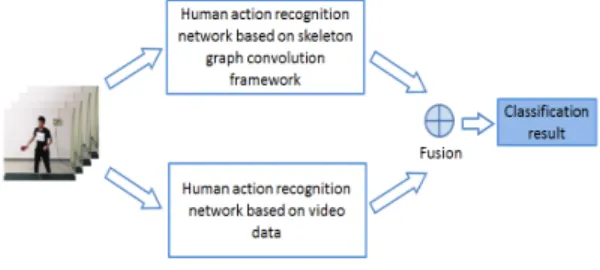
In this article, we propose a Dual-stream fusion method that combines video data and skeleton data.
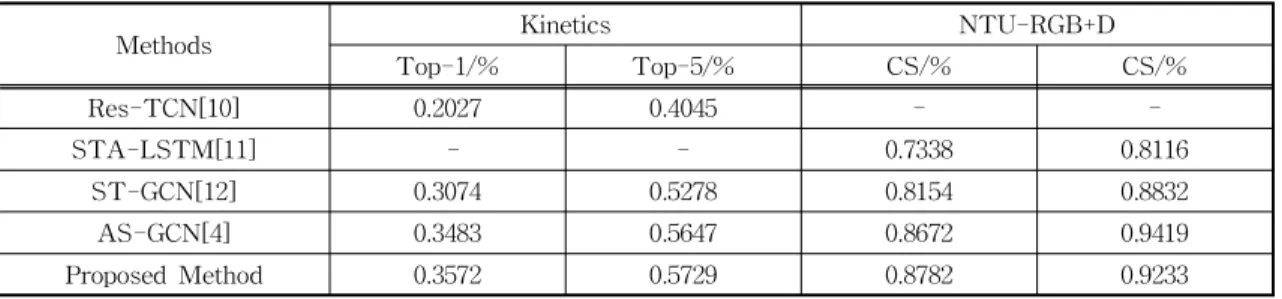
The two networks respectively identify skeleton data and video data and fuse the probabilities of the two outputs to achieve the effect of information fusion. Experiments on two large dataset, Kinetics and NTU-RGBC+D Human Action Dataset, illustrate that our proposed method achieves state-of-the-art.
Compared with the traditional method, the recognition accuracy is improved better.
Key words: Skeleton-Based Action Recognition, Graph Convolutional Network, Skeleton Data, Video Data, Information Fusion
※ Corresponding Author : Eung-Joo Lee, Address: 428, Sinseon-ro, Nam-gu, Busan, Korea, TEL : +82-53-629- 1143, FAX : +82-, E-mail : [email protected]
Receipt date : Jan. 19, 2021, Approval date : Mar. 15, 2021
†
Dept. of Information Communication Engineering, Tongmyong University (E-mail : [email protected])
†††
Dept. of Information Communication Engineering, Tongmyong University
(E-mail : [email protected])
†††
Dept. of Information Communication Engineering,
Tongmyong University
formation of the action, but it cannot handle the long-term time sequence information network of the action well.
Video data has good color information and con- tour information, which can be fully learned through the network model. Moreover, video data collection is convenient, and it is relatively easy to construct large-scale data sets. However, the video data collected by the camera only has the positional features of the two-dimensional plane. For video images, most of the current network models can only learn human color contour information, and the information richness is low, which is the reason for the low recognition accuracy of such methods.
The recognition method based on skeleton data achieves the purpose of classification by con- structing a network model that can learn the spatial position information of the joint point coordinates and the time sequence change information of the joint points. However, the three-dimensional coor- dinates of the human joints are simply input into the network model as a whole, and the link rela- tionship between the keys of the human body is not fully considered. However, the skeleton data has spatial three-dimensional information, which can directly reflect the spatial transformation of human motion. However, the contour information of the image is lacking. For actions with small dif- ferences, only bone data is used, which is often dif- ficult for the network to distinguish.
Therefore, this paper rewards different network models for the two data respectively, and performs probabilistic fusion of the output results of the two models. This method combines the advantages of the two kinds of data to a certain extent, and effec- tively realizes the information fusion of the two kinds of data.
2. RELATED WORK
The operators in traditional CNNs, convolution and pooling, depend on the translation invariance
of data. However, the graph data, as non-Euclidean data, do not satisfy translation invariance, and each node has a different local structure. Compared with the classic spatio-temporal convolutional neural network[5], GCN solves the problem of high com- putational complexity and high dimensionality of the generated features, which will take up a lot of memory. Bruna et al.[6] formulated the first graph convolution neural network in 2013, and they de- fined graph convolution in spectral space based on the convolution theorem. This method was later developed into the spectral method. Defferrard et al.[7] adopted recursive Chebyshev polynomials as filters, which is more efficient than the previous filters. To make graph convolution useful in the field of semi-supervised learning on graphs, Kipf and Welling[8] simplified Chebyshev networks.
They proposed first-order graph convolutional neural networks[8], which contains aggregation functions that define node correlations. Thus, this method is seen as a bridge between the spectral and spatial methods. Chebyshev networks[7] and first-order graph convolutional neural networks[8]
can be viewed as using Laplace matrices or its va- rieties as aggregation functions. The core idea of spatial graph convolution is aggregating node in- formation using edge information to generate new node representations. Niepert et al.[9] use a greedy strategy to sort the nodes in a local neighborhood and then perform a spatial convolution filtering op- eration on the sorted nodes.
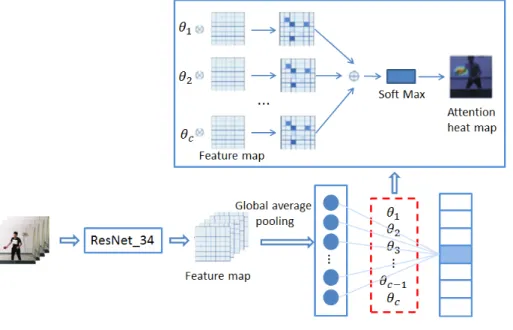
The convolutional neural network performs
convolution calculations on the image and con-
tinuously condenses the image characteristics. The
output of the last layer of the network contains rich
information. The parameters obtained by training
when inputting this information into the full link
layer objectively reflect that some areas of the final
feature map should be worthy of attention. By
summing the results of all channels and inputting
the attention heat map (Fig. 1), such a module is
called an attention module. In this way, the net-
work model can spontaneously focus on important parts, which is conducive to subsequent action classification.
3. PROPOSED METHOD
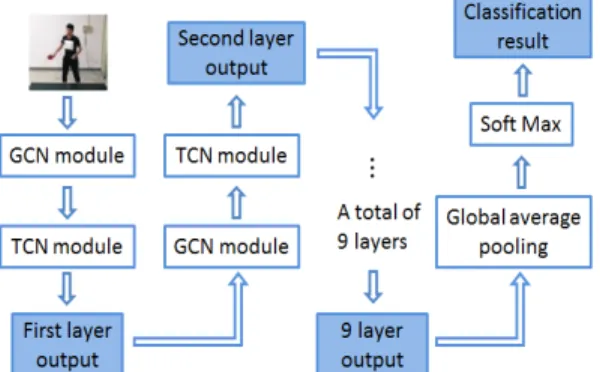
3.1 Action recognition based on skeleton data Construct a spatial undirected graph structure on a skeleton sequence with N joint points and T frames . Among them, the node collection
⋯ ⋯ includes all nodes of the skeleton sequence. As the network input, the fea- ture vector
on node
is composed of the three-dimensional coordinate vector of the i-th joint point in the t-th frame. According to the con- nectivity of the human body structure, the joints in a frame are linked by edges, and each joint will be linked to the same joint point in consecutive frames. The edge set E consists of two subsets:
the first subset
∈ represents the bone links of each frame, where H is the total num- ber of human joint points; the second subset
represents the joint points connect- ed in consecutive frames. As shown in Fig. 2.
Fig. 2. Visual Structure of input data.
For the input data, first use graph convolution to encode the positional relationship of the joint points in space. In a single-frame human body joint point connection structure, a sampling function is defined on the neighbor set of the joint point
;
≤ ∈ . Among them,
represents the minimum length of any
path from
to
. Set D=1, that is, only the
Fig. 1. Attention heat map generation.
first-order neighbor nodes of node
are selected.
A single node
of a single frame of video is ag- gregated by graph convolution and the feature out- put
can be expressed as: