Phylogenetic Analysis of Native Vigna sinensis in Korea Using DNA Sequence of Internal Transcribed spacer (ITS) Region
Pil-Soo Seo
1, Sook-Young Lee
2and Yong Kook Shin
3*
1Environment-Friendly Agriculture Division, Sunchang Agricultural Development & Technology Center, 1548 Damsun-ro, Yudeung-myeon, Sunchang-gun, Jeonbuk 56025, Korea
2Innovation Center for Dental Science & Engineering, Chosun University, Pilmun-daero, Gwangju 61452, Korea
3School of Integrated Oriental Medical Bioscience, Semyung University, 65 Semyung-ro, Jecheon, Chungbuk 27136, Korea Received December 27, 2016 /Revised January 8, 2017 /Accepted January 20, 2017
Cowpea (Vigna unguiculata (L.) Walp.) is recognized as a potential source of protein and other nutrients. The genus Vigna includes 100 wild species of plants. Especially, Vigna unguiculata includes annual cowpeas (ssp. unguiculata) and ten wild perennial subspecies. DNA sequence of internal tran- scribed spacer (ITS) region was determined for Vigna sinensis, one of native plant, which was found in recent but thought to have gone extinct in Korea. The seeds of Vigna sinensis used in this study were donated from Dong-Young Jo. The DNA sequence of ITS-5.8S-ITS2 for Vigna sinensis obtained from this study was deposited as Vigna sinensis AY195581 on GenBank of NCBI (National Center for Biotechnology Information). We investigated the sequence-based phylogenetic relationships of plants related and clarified its taxonomical position. DNA similarities among subspecies including Vigna un- guiculata showed the range 98 to 100% in sequence-based phylogenetic analysis using total 507 base pairs of ITS1, 5.8S and ITS2. Vigna unguiculata and subspecies were grouped independently as one cluster from other Vigna species used in the phylogenetic analysis. In this study, based on the phylo- genetic analysis using the ITS1-5.8S-ITS2 sequence of Vigna sinensis, it may be concluded to be classi- fied to one of Vigna unguiculata substrains.
Key words : Cowpea, ITS, phylogeny, Vigna sinensis, Vignia unguiculata
*Corresponding author
*Tel : +82-43-649-1693, Fax : +82-43-649-1702
*E-mail : [email protected]
This is an Open-Access article distributed under the terms of the Creative Commons Attribution Non-Commercial License (http://creativecommons.org/licenses/by-nc/3.0) which permits unrestricted non-commercial use, distribution, and reproduction in any medium, provided the original work is properly cited.
ISSN (Print) 1225-9918 ISSN (Online) 2287-3406 Journal of Life Science 2017 Vol. 27. No. 3. 351~354 DOI : https://doi.org/10.5352/JLS.2017.27.3.351
Introduction
Cowpea (Vigna unguiculata (L.) Walp.) is recognized as a potential source of protein and other nutrients. It is culti- vated for its immature pods and mature seeds and is con- sumed by people all around the world, especially in the de- veloping nations [5, 10]. Cowpea [Vigna unguiculata (L.) Walp.] is an important food legume in less-developed coun- tries of the tropics and subtropics, especially in sub-Saharan Africa, Asia, and Central and South America [8] and this region in West and Central Africa represents over 66% of the 12.5 million ha grown worldwide. It is a staple food for millions of poor people living in the dry areas of the world where it is difficult to grow any other crop. The worldwide production of dry cowpea for 2002 was estimated at 7.4 bil-
lion pounds from 20 million acres and the major producing countries are of Africa, Asia and Latin America.
The genus Vigna includes 100 wild species of plants [6].
Especially, V. unguiculata includes annual cowpeas (ssp. un- guiculata) and ten wild perennial subspecies. Subspecies un- guiculata includes all the domesticated (var. unguiculata), as well as wild and weedy, forms [var. spontanea (Schweinf.) Pasquet] [4]. Six species of them are staple crops of culti- vation and it is presumed that five of the six species be origi- nated from Asia. Previously, according to some researchers, Vigna unguiculata (L.) Walp. has been mixed with V. sinensis, V. catjang, V. repens, Dolichos unguiculata, D. sinensis, or D.
datjang and so on, but it was mainly called as V. sinensis.
Usual name has been also called as cowpea, black-eye pea, catjang, catiang, asparagus bean, yard-long bean or others.
Even though plant taxonomy for the genus Vigna still has
been much argued, the species including the genus Vigna
are classified into five subspecies including two wild type
species (subsp. dekindtiana growing naturally in regions of
Ethiopia and Saharan Africa and subsp. Mensensis) and
three cultivation type species (subsp. unguiculata, subsp. cy-
lindrical and subsp. sesquipedalis) [11]. Maréchal et al. [3] clas-
- Note -
352 생명과학회지 2017, Vol. 27. No. 3
sified three cultivation type subspecies as variants and called them bound with cv-gr. Textilis Subsp. unguiculata, and clas- sified four variants, subsp. stenophylla, subsp. stenophylla and subsp. tenuis into subsp. dekindtiana.
At present, most of researchers classify cultivation type into three subspecies, but others have been still classifying the subspecies to distinct species. Vigna unguiculata (L.) Walp. subsp. unguiculata is called as cowpea or common cowpea and it as single subspecies occupies the biggest culti- vation area in the world.
In this study, DNA sequence of internal transcribed spacer (ITS) region was determined for Vigna sinensis, one of native plant, which was found in recent but was thought to have gone extinct in Korea. We investigated the Sequence-based phylogenetic relationships of plants related and clarified its taxonomical position.
Materials and Methods
The seed of Vigna sinensis
The seed of Vigna sinensis used in this study was donated from Dong-Young Jo.
DNA isolation
For DNA extraction, 100 mg seed sample from con- servation treatment of frozen in liquid nitrogen) was finely ground in liquid nitrogen. The pulverized sample was in- cubated in buffer (2% cetyltrimethylammonium bromide, 1.4 M NaCl, 100 mM Tris–HCl [pH 8.0], 20 mM EDTA [pH 8.0], 1% polyvinylpyrrolidone [mass weight 10,000], 0.2% β -mercaptoethanol, and 0.1 mg mL
-1proteinase K) at 55°C for 60 min [1]. After this step, the solution was extracted twice with chloroform:isoamyl-alcohol (24:1 v/v). DNA was precipitated by the addition of cold isopropanol to the sol- ution followed by centrifugation; the resulting pellet was washed with 70% ethanol and allowed to air dry. The DNA pellet was resuspended in 50 μL TE buffer (10 mM Tris–
HCl [pH 8.0] and 0.1 mM EDTA [pH 8.0]) containing ribonu- clease A (10 μg mL
-1) and incubated at 37°C for 30 min [7].
PCR amplification
To evaluate DNA suitability for PCR amplification, pri- mers specific for the internal transcribed spacer (ITS) region of ITS1-5.8S-ITS2 ribosomal DNA [13] were used for amplifi- cation in 20-μL final reaction volumes containing 25 ng DNA, Taq polymerase buffer (50 mM KCl, 10 mM Tris–HCl
[pH 8.8], and 0.8% Nonidet P40), 1.5 mM MgCl
2, 100 μM of each dNTP, 0.2 μM of each primer, and 1 U Taq polymer- ase (Fermentas Life Sciences, Burlington, Canada). PCR am- plification was performed as described by Spiridonov and Moens [9]. Two sets of primers were used in the PCR re- actions: (1) TW81 (5-GTTTCCGTAGGTGAACCTGC-3) and AB28 (5-ATATGCTTAAGTTCAGCGGGT-3) or (2) 18S (5-TT GATTACGTCCCTGCCCTTT-3) and 26S (5-TTTCACTCGCC GTTACTAAGG-3) [2, 12], respectively. PCR products were purified using QIAquick PCR or Gel Purification Kit (Qiagen Ltd, Crawley, UK). Amplifications were conducted as fol- lows: initial denaturation at 94°C for 3 min, followed by 35 cycles of 30 s at 94°C, 1 min at 58°C, and 1 min at 72°C, with a final extension at 72°C for 7 min. Amplification prod- ucts were analyzed by electrophoresis on a 1.5% agarose gel stained with SYBR Gold.
DNA Sequencing
The refined PCR products were directly sequenced with the use of a BigDye Terminator Cycle Sequencing Ready Reaction Kit (Applied Biosystems, USA). The cycle sequenc- ing reaction was performed with a PCR Thermal Cycler
MP(Takara, TP3080, Japan). The sequencing reaction was per- formed for 5 min at 96℃ at first and consisted of 25 cycles of the following: 10 sec at 96℃, 10 sec at 52℃, and 2 min at 60℃. The cycle sequencing products were purified with use of CENTRI-SEP Spin Columns (Applied Biosystems, USA). DNA sequences were analyzed using an ABI PRISM 310 Genetic Analyzer (Applied Biosystems, USA).
Alignment and phylogenetic analysis
The nucleotide sequence of ITS1-5.8S-ITS2 was aligned with reference sequences obtained from plants related using BLAST Basic Local Alignment Search Tool (http://www.
ncbi.nlm.nih.BlAST). After collecting DNA sequences, the phylogenetic tree was constructed on BLAST.
Results and Discussion
The DNA sequence of ITS-5.8S-ITS2 for Vigna sinensis ob-
tained from this study was deposited as Vigna sinensis AY
195581 on GenBank of NCBI (National Center for Biotechnol-
ogy Information). DNA similarities among subspecies in-
cluding Vigna unguiculata showed the range 98 to 100% in
sequence-based phylogenetic analysis using total 507 base
pairs of ITS1, 5.8S and ITS (data not shown). Vigna un-
Journal of Life Science 2017, Vol. 27. No. 3 353
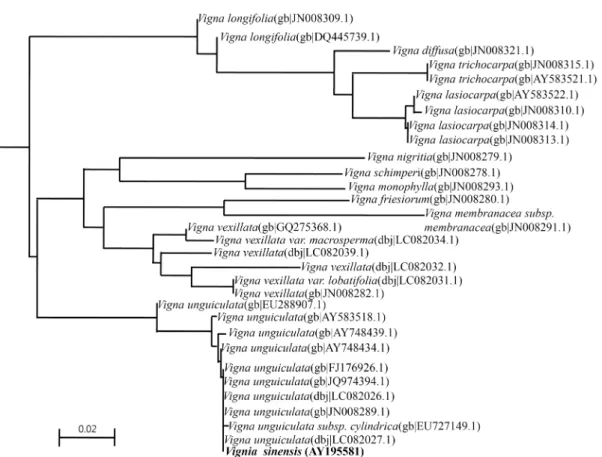
Fig. 1. Phylogenetic tree of ITS1-5.8S-ITS2 sequences for Vigna species using Neighbour-Joining method. A total of 507 bp aligned positions were used. Vigna sinensis of which the sequence was determined in this study is indicated in bold. Bar, 0.02 sub- stitution per nucleotide position.
guiculata and subspecies were grouped independently as one cluster from other Vigna species used in the phylogenetic analysis (Fig. 1). It is presumed that the cluster of Vigna un- guiculata subspecies be branched comparatively lately to oth- er species of genus Vigna, and now occurred much on genet- ic divergence. In addition, it is showed that the cluster of Vigna unguiculata subspecies is genetically independent, compared to other species of genus Vigna, Vigna longifolia, Vigna vexillata, Vigna membranacea, Vigna friesiorum, Vigna monophylla, Vigna schimperi, Vigna nigritia, Vigna lasiocarpa, Vigna trichocarpa and Vigna diffusa (Fig. 1).
In this study, based on the phylogenetic analysis using the ITS1-5.8S-ITS2 sequence of Vigna sinensis, it may be concluded to be classified to one of Vigna unguiculata subspecies. The fact of this study is that the phylogenetic position of Vigna sinensis, one of native plant, found in recent but thought to have gone extinct in Korea, is clearly identi- fied from plants related of Vigna unguiculata through se- quence-based phylogenetic analysis.
References
1. Doyle, J. J. and Doyle, J. L. 1990. A rapid total DNA prepara- tion procedure for fresh plant tissue. Focus 12, 13-15.
2. Joyce, S. A., Reid, A., Driver, F. and Curran, J. 1994. Applica- tion of polymerase chain reaction (PCR) methods to the identification of entomopathogenic nematodes, pp. 178-187.
In: Burnell, A. M., Ehlers, R. U. and Masson, J. P. (eds.), COST 812 Biotechnology: Genetics of entomopathogenic nematodesbacterium complexes. Proceedings of symposium and workshop, St Patrick’s College, Maynooth, County Kildare, Ireland. Luxembourg, European Commission, DGXII.
3. Maréchal, R., Mascherpa, J. M. and Stainer, F. 1978. Etude taxonomique d’un groupe complexe d’speces des genres Phaseolus et Vigna (Papilionaceae) sur la base de donnees morphologiques et polliniques, traitees par l’analyse in- formatique. Boissiera 28, 1-273.
4. Pasquet, R. S. 1993. Classification infraspécifique des forms spontanées de Vigna unguiculata (L.) Walp. (Fabaceae) à par- tir de données morphologiques. Bull. Jardin Bot. Nat. Bel.
62, 127-173
5. Phillips, R. and McWatters, K. 1991. Contribution of cow- peas to nutrition and health. Food Technol. 45, 127-130.
6. Schrire, B. D. 2005. Tribe Phaseoleae, pp. 393-431. In: Lewis,
354 생명과학회지 2017, Vol. 27. No. 3
초록:토종 갓끈동부의 ITS1, 5.8S 및 ITS2의 염기서열을 이용한 계통 분석
서필수
1․이숙영
2․신용국
3*
(1순창군농업기술센터 친환경농업과, 2조선대학교 치과용정밀장비 및 부품 지역혁신센터, 3세명대학교 한방바이오
융합과학부)
본 연구에서 밝혀진 갓끈동부의 ITS1, 5.8S 및 ITS2의 염기서열은 NCBI (National Center for Biotechnology Information)의 GenBank에 Vigna sinensis AY195581로 등록하였다. ITS1, 5.8S 및 ITS2의 총 염기서열 507 염기서 열을 이용한 Vigna sinensis (AY195581)의 분자계통분석에서 Vigna unguiculata 및 그 아종들과 98~100% 범위의 염기서열 상동성을 보였다. Vigna unguiculata는 계통분석에 이용된 다른 종들로부터 독립된 하나의 cluster로 그 룹핑(grouping)이 됨을 확인하였다. 본 계통분석은 Vigna unguiculata가 Vigna 속의 다른 종에 비해 비교적 최근에 분화되었으며, 현재 유전적인 변화가 많이 일어나고 있음 보이고 있다. 또한, Vigna 속, Vigna longifolia, Vigna vex- illata, Vigna membranacea, Vigna friesiorum, Vigna monophylla, Vigna schimperi, Vigna nigritia, Vigna lasiocarpa, Vigna trichocarpa, Vigna diffusa의 다른 종들과 비교하여 유전적으로 독립적인 종임을 확인하였다. 본 연구의 Vigna sinensis의 ITS1, 5.8S 및 ITS2를 이용한 계통분석은 Vigna sinensis를 Vigna unguiculata로 분류하는 것이 타당 한 것으로 보여진다. 본 종은 국내에서 멸종된 것으로 알려져 있었으나 최근 토착 식물로써 발견되었고 이 갓끈동 부의 관련 식물 종들과의 분자계통학적 위치를 명확히 밝힘에 의의가 있다고 하겠다.
G., Schrire, B., Mackinder, B. and Lock, M. (eds.), Legumes of the world. Royal Botanic Gardens, Kew.
7. Sereno, M. L., Vencovsky, R., Albuquerque, P. S. B. and Figueira, A. 2006. Genetic diversity and natural population structure of cacao (Theobroma cacao L.) from the Brazilian Amazon evaluated by microsatellite markers. Conserv. Genet.
7, 13-24.
8. Singh, B. B., Mohan Raj, D. R., Dashiell, K, E. and Jackai, L. E. N. 1997. Advances in cowpea research. IITA-JIRCAS, Ibadan, Nigeria.
9. Spiridonv, S. E. and Moens, M. 1999. Two previously un- reported species of steinernematids from woodlands in Belgium. Rus. J. Nematol. 7, 39-42.
10. Uzogara, S. and Ofuya, Z. 1992. Processing and utilization of cowpeas in developing countries: a review. J. Food Process.
Preserv. 16, 105-147.
11. Verdcourt, B. 1970. Studies in the Leguminosae-Papilionoi- deae for the ‘Flora of Tropical East Africa’: IV. Kew Bull.
24, 507-569.
12. Vrain, T. C., Wakarchuk, D. A., Levesque, A. C. and Hamil- ton, R. J. 1992. Intraspecific rDNA restriction fragment length polymorphism in the Xiphinema americanum group.
Fundamen. Appl. Nematol. 15, 563-573.
13. White, T. J., Bruns, T., Lee, S. and Taylor, J. 1990. Amplifica- tion and direct sequencing of fungal ribosomal RNA genes for phylogenetics, pp. 315-322. In: Innis, M. A., Gelfand, D.
H., Sninsky, J. J. and White, T. J. (eds.), PCR Protocols: A Guide to Methods and Applications. Academic Press, New York.