231
한 국 균 학 회 지
The Korean Journal of Mycology
Mycological Characteristics of Nine Unrecorded Yeasts from Flowers in the Orchard of Yesan-gun,
Chungcheongnam-do and Hanbat Arboretum in Daejeon City, Korea
Sang-Min Han, Se-Hee Hyun, Ja-Won Shin, Ha-Kun Kim and Jong-Soo Lee*
Department of Biomedicinal Science and Biotechnology, Paichai University, Daejeon 302-735, Korea
ABSTRACT : Six unrecorded yeasts, Cryptococcus festucosus 41-3, Cryptococcus heveanensis 56-4, Debaryomyces nepalensis 95- 4, Issatchenkia occidentalis 142-1, Dioszegia zsoltii 39-1, and Kwoniella europala 47-2 were screened from 108 yeasts isolated from flowers and fruits in orchards of Yesan-gun, Chungcheongnam-do, Korea. The morphological and cultural characteristics of these unrecorded yeasts were investigated. They had various shapes, including ellipsoidal, globose, and oval, and also had budding mode in vegetable reproduction, except I. occidentalis 142-1 (fission mode). K. europaea 47-2 only formed pseudomy- celium. D. zsoliti 39-1 did not grow in yeast extract-malt extract medium, potato dextrose medium, and vitamin-free medium. C.
festucosus 41-3 grew well in 5% NaCl-containing yeast extract-peptone-dextrose medium and had a growth pH range of 7.0~
10.0. Three unrecorded yeasts Ogataea polymorpha HB45-1, Rhodotonula hinnulla HB62-2, and Cryptococcus rajasthanensis HB80-4 were screened from 51 yeasts isolated from flowers in Hanbat arboretum in Daejeon city, Korea. They were globose in shape and did not form pseudomycelium. In addition, O. polymorpha HB45-1 and C. rajasthanensis HB80-4 had budding mode in vegetable reproduction. All of them grew well in vitamin-free medium and C. rajasthanesis HB80-4 also grew in 50% glucose and 5% NaCl-containing YPD medium.
KEYWORDS : Mycological characteristics, Unrecorded yeasts, Orchard and arboretum
Until now, almost all yeasts have been isolated and re- ported from Korean fermented foods and their raw ma- terials such as traditional alcohol beverages and nuruks, soy sauces and soy pastes and its koji, meju etc. [1-4].
Recently, we isolated various yeasts from wild flowers in cities [5, 6], mountains [7], and coastal areas [8], and islands including Jeju-island [9], Ulleungdo and Yokjido [10], Korea. We also screened and characterized unrecor- ded yeasts [11, 12].
In a previous paper, we reported on yeast diversities of
flowers and fruits in some orchards [13] of Yesan-gun and Hanbat arboretum [14] of Daejeon city, Korea. This study describes the microbiological characteristics of the unrecorded yeasts screened from the above mentioned orchards and arboretum.
Characteristics of the unrecorded yeasts from orchard flowers of Yesan-gun, Chungcheongnam-do, Korea
We screened the unrecorded yeasts by searching Keris, PubMed and other fungal taxonomy databases [11] and investigated their morphological and cultural characteri- stics using a previously described method [11, 12].
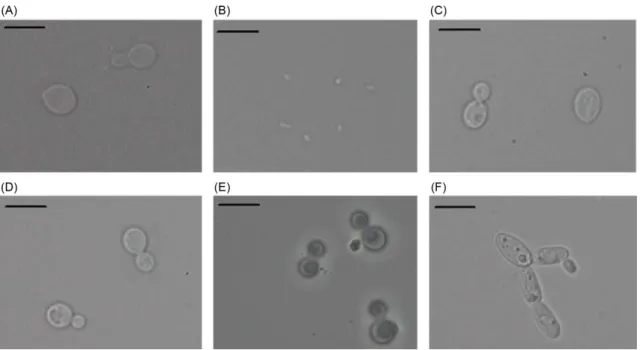
Six unrecorded yeasts, Cryptococcus festucosus 41-3 and Cryptococcus heveanensis, 56-4, Debaryomyces nepalensis 95-4, Issatchensis occidentalis 142-1, Dioszegia zsoltii 39-1, and Kwoniella europaea 47-2 were screened from 108 yea- sts from flowers and fruits in three orchards of Yesan- gun, Korea. The morphological and cultural characteris- tics of the six unrecorded yeasts are summarized in Table 1. All of the unrecorded yeasts had various shapes, and did not form pseudomycelium, except K. europaea 47-2.
All of the unrecorded yeasts, except D. zsoltii 39-1 grew
Research Note
*Corresponding author E-mail: [email protected] Received August 6, 2014 Revised September 23, 2014 Accepted September 23, 2014
This is an Open Access article distributed under the terms of the Creative Commons Attribution Non-Commercial License (http://
creativecommons.org/licenses/by-nc/3.0/) which permits unrestricted non-commercial use, distribution, and reproduction in any medium, provided the original work is properly cited.
Kor. J. Mycol. 2014 September, 42(3): 231-234 http://dx.doi.org/10.4489/KJM.2014.42.3.231 pISSN 0253-651X • eISSN 2383-5249
© The Korean Society of Mycology
232
Han et al.well in yeast extract-peptone-dextrose (YPD), yeast ext- ract-malt extract (YM), and potato-dextrose (PD) broth.
D. nepalensis 95-4, I. occidentalis 142-1, and K. europaea 47-2 grew in vitamin-free media. In particular, C. festu- Table 1. Morphological and cultural characteristics of the newly reported yeasts from wild flowers in orchards of Yesan-gun in Chungcheongnam-do, Korea
Strains
Cryptococcus festucosus
41-3
Cryptococcus heveanensis
56-4
Debaryomyces nepalensis
95-4
Dioszegia zsoltii
39-1
Issatchenkia occidentalis
142-1
Kwoniella europaea
47-2 Isolation Source (Name of flowers) Prunus
tomentosa
Prunus salicina L.
Diospyros kaki
Prunus salicina L.
Prunus persica
Prunus persica Morphological characteristics
Shape E1) G G2) G O3) O
Vegetable reproduction B B B B F4) B5)
Size (µm) 0.2×0.8 1.4×1.4 1.3×1.3 2.1×2.1 1.2×1.8 1.6×1.8
Ascospore - - + + + +
Pseudomycelium - - - +
Cultural characteristics
Growth on YM4) medium +++ +++ +++ - +++ ++
YPD medium ++ +++ +++ +++ +++ +++
PD medium + - + - ++ +
Vitamin-free medium - - ++ - ++ ++
50% Glucose YP medium + - - - - -
5%(20%) NaCl-YPD ++ (-) - (-) - (-) - (-) - (-) + (-)
Colony color in YPD medium C7) C C O8) W9) C
Growth range in temp./pH 20~37oC /pH 7~10
20~30oC /pH 4~7
20~37oC /pH 4~8
25~37oC /pH 7~8
20~37oC /pH 4~8
20~30oC /pH 4~7
1)E, Ellipsoidal 2)G, Globose 3)O, Oval 4)F, Fission 5)B, Budding 6)\YM, Yeast extract-malt extract 7)C, Cream 8)O, Orange 9)W, White.
Table 2. Morphological and cultural characteristics of the newly reported yeasts from wild flowers in Hanbat arboretum of Daejeon city, Korea
Strains Cryptococcus rajasthanensis HB80-4
Ogataea polymorpha HB45-1
Rhodotorula hinnulea HB62-2 Isolation source (Name of Flowers) Unknown flower Elaeagnus umbellata T. Unknown flower Morphological characteristics
Shape G1) G G
Vegetable reproduction B B2) F3)
Size (µm) 1.3×1.3 0.9×0.9 1.2×1.3
Ascospore - + -
Pseudomycelium - - -
Cultural characteristics
Growth on YM4) medium +++ ++ +++
YPD medium +++ +++ +++
PD medium ++ ++ ++
Vitamin-free medium ++ ++ ++
50% Glucose YP medium + - -
5%(20%) NaCl-YPD ++ (-) ++ (-) - (-)
Colony color in YPD medium C5) C C
Growth range in temp./pH 20~30oC / pH 4~7 20~30oC / pH 7~8 20~30oC / pH 4~10
1)G, Globose 2)B, Budding 3)F, Fission 4)\YM, Yeast extract-malt extract 5)C, Cream
Mycological Characteristics of Nine Unrecorded Yeasts from Flowers
233
cosus 41-3 grew well in 5%-NaCl containing YPD medi- um and was also an alkalophile, growing in the range of pH 7.0~10.0.
Bai et al. [15] first reported on a new ballistoconi- dium-forming yeast, Dioszegia zsoltii, from various plant leaves collected in Yunnan, China. Cryptococcus festuco- sus was also reported as a new hymenomycetous yeast in the holtermannia clade [16], and Guerreiro et al. [17] re- ported on Kwoniella europaea, basidiomyces yeast, which have a tetropolar mating system. Cryptococcus heveanensis [18] was known as a sister species to the pathogenic Cryptococcus species and Issatchenkia occidentalis [19]
was first isolated from the esophagus of a leukemic pa-
tient. Ethanol production of Debaryomyces nepalensis [20]
was also reported. However, their taxonomic characteri- stics or application in industry have not yet been studied in detail.
Characteristics of the unrecorded yeasts from flowers in Hanbat arbotretum of Daejeon city, Korea
Ogataea polymorpha HB45-1, Rhodotorula hinnulea HB 62-2, and Cryptococcus rajasthanensis HB80-4 were scr- eened as unrecorded yeasts from 51 yeasts from flowers and fruits in Hanbat arboretum, Daejeon city, Korea. All of them were globose in shape and did not have pseudo- mycelium. Three unrecorded yeasts grew well in YPD, Fig. 1. Morphological characterization of six isolates of yeasts (Scale bar = 2µm). A; Dioszegia zsoltii 39-1, B; Cryptococcus fes- tucosus 41-3, C; Kwoniella europaea 47-2, D; Cryptococcus heveanensis 56-4, E; Debaryomyces nepalensis 95-4, F; Issatchenkia occi- dentalis 142-1.
Fig. 2. Morphological characterization of three isolates of yeasts (Scale bar = 2µm). A; Cryptococcus rajasthanensis HB80-4, B;
Ogataea polymorpha HB45-1, C; Rhodotorula hinnulea HB62-2.
234
Han et al.YM, and PD media and vitamin-free medium. C. rajas- thanensis HB80-4 was sugar-tolerant, growing in 50%
glucose-containing YPD medium and was also a halo- tolerant yeast with O. polymorpha HB45-1, grew in 5%
NaCl-containing YPD medium.
Ogataea polymorpha is closely related to Ogataea para- polymorpha, the ascosporic state of Candida parapoly- morpha [21] and Cryptococcus rajasthanesis, an anamor- phic yeast, is also related to C. laurentii, isolated from Rajasthan, India [22].
ACKNOWLEDGEMENTS
This study was funded by the project on survey and excavation of Korean indigenous species of NIBR under the Ministry of Environment, Republic of Korea.
REFERENCES
1. Lee JS, Yi SH, Kown SJ, Ahn C, Yoo JY. Enzyme activities and physiological functionality of yeasts from traditional Meju.
Kor J Appl Microbiol Biotechnol 1997;25:448-53.
2. Kim JH, Kim NM, Lee JS. Physiological characteristics and ethanol fermentation of thermotolerant yeast Saccharomyces cerevisiae OE-16 from traditional meju. Kor J Food Nutr 1999; 12:490-5.
3. Jeong SC, Lee DH, Lee JS. Production and characterization of an anti-angiogenic agent from Saccharomyces cerevisiae K-7.
J Microbiol Biotechnol 2006;16:1904-11.
4. Lee JS, Choi YJ, Kwon SJ, Yoo JY, Chung DH. Screening and characterization of osmotolerant and gas-producing yeasts from traditional Doenjang and Kochujang. Food Biotechnol 1996;5:54-8.
5. Kang MG, Hyun SH, Ryu JJ, Min JH, Kim HK, Lee JS. Note on newly isolated yeasts from wild flowers in Daejeon city, Korea. Kor J Mycol 2012;40:174-6.
6. Min JH, Hyun SH, Kang MG, Lee HB, Kim CM, Kim HK, Lee JS. Isolation and identification of yeasts from wild flo- wers of Daejeon city and Chungcheongnam-do in Korea. Kor J Mycol 2012;40:141-4.
7. Min JH, Ryu JJ, Kim HK, Lee JS. Isolation and identification of yeasts from wild flowers in Gyejoksan, Oseosan and Beak- amsan of Korea. Kor J Mycol 2013;41:47-51.
8. Min JH, Lee HB, Lee JS, Kim HK. Identification of yeasts iso- lated from wild flowers collected in coast areas of Korea based on the 26S rDNA sequences. Kor J Mycol 2013;41:185-91.
9. Hyun SH, Mun HY, Lee HB, Kim HK, Lee JS, Isolation of yeasts from wild flowers in Gyonggi-do and Jeju island of Korea and production of anti-gout xanthine oxidase inhibitor.
J Microbiol Biotechnol 2013;41:389-90.
10. Hyun SH, Min JH, Kim AR, Kim HK, Lee JS. Isolation and diversity of yeasts from wild flowers in Ulleung do and Yokjido, Korea. Kor J Mycol 2014;42:28-33.
11. Hyun SH, Lee HB, Kim CM, Lee JS. New records of yeasts from wild flowers in coast near areas and inland areas, Korea.
Kor J Mycol 2013;41:74-80.
12. Hyun SH, Lee HB, Lee JS. Characteristics of unrecorded yeasts, Rhodosporidium fluviale, Rhodosporidium paludigenum, Candida sp. 80-J-3 and Kluyveromyces thermotolerans isolated from wild flowers in Korea. Kor J Mycol 2014;41:181-4.
13. Hyun SH, Lee JG, Park WJ, Kim HK, Lee JS. Isolation and diversity of yeasts from fruits and flowers of orchard in Sin- am-myeon of Yesan-gun, Chungcheongnam-do, Korea. Kor J Mycol 2014;42:21-7.
14. Hyun SH, Min JH, Kim SA, Lee JS, Kim HK. Yeasts associa- ted with fruits and blossoms collected from Hanbat arbore- tum, Daejeon, Korea. Kor J Mycol 2014;42:178-82.
15. Bai FY, Takashima M, Nakase T. Dioszegia zsoltii sp. Nov., a new ballistoconidium-forming yeast species with two varie- ties. J. Gen. Appl. Microbiol 2002;48:17-23.
16. Golubev W, Sampaio J, Alves L, Golubev N. Cryptococcus festucosus sp. nov. a new hymenomycetous yeast in the Hol- termannia clade. Can J Microbiol 2004;50:1001-6.
17. Guerreiro MA, Springer DJ, Rodriques JA, Rusche LN, Find- ley K, Heitman J, Fonseca A. Molecular and genetic evidence for a tetra polar mating system in the basidiomycetous yeast Kwoniella mangrovensis and two sibling species. Eukaryot Cell 2013;12:746-60.
18. Metin B, Findley K, Heltman J. The mating type locus(mat) and sexual reproduction of Cryptococcus heveanensis: insights into the evolution of sex and sex-determining chromosomal regions in fungi. PLoS Genet 2010;6:1-19.
19. Sahand I, Moragues MD, Alhambra A, Palacio A, Quindos G, Ponton J. Isolation of Issatchenkia occidentalis from the esophagus of a leukemic patient. Rev Iberoam Micol 2006;
23:235-7.
20. Kumdam H, Murthy S, Gummadi S. Production of ethanol and arabitol by Debaryomyces nepalensis: influence of process parameters. AMB Express 2013;3:1-12.
21. Kurtzman C. A new methanol assimilating yeast, Ogataea parapolymorpha, the ascosporic state of Candida parapoly- morpha. Antonie van Leeuwenhoek 2011;100:455-62.
22. Saluja P, Prasad GS. Cryptococcus rajasthanensis sp. nov., an anamorphic yeast species related to Cryptococcus laurentii, isolated from Rajasthan, India. Int J Syst Evol Microbiol 2007;57:414-8.