The Effect of Translationally Controlled Tumor Protein (TCTP) of the Arctic Copepod Calanus glacialis on Protecting Escherichia coli Cells against Oxidative Stress
Yu Kyung Park
1, Chang-Eun Lee
1, Hyoungseok Lee
1, Hye Yeon Koh
1, Sojin Kim
2, Sung Gu Lee
1, Jung Eun Kim
1, Joung Han Yim
1, Ju-Mi Hong
1, Ryeo-Ok Kim
3, Se Jong Han
1and Il-Chan Kim
1*
1Division of Life Sciences, Korea Polar Research Institute (KOPRI), Incheon 21990, Korea
2Department of Neurosurgery, Seoul National University College of Medicine, Seoul National University Hospital, Seoul 03080, Korea
3Chemicals Research Division, National Institute of Environmental Research, Incheon 22689, Korea Received April 8, 2020 /Revised October 30, 2020 /Accepted October 30, 2020
Translationally controlled tumor protein (TCTP) is one of the most abundant proteins in various eu- karyotic organisms. TCTPs play important roles in cell physiological processes in cancer, cell pro- liferation, gene regulation, and heat shock response. TCTP is also considered an important factor in the resistance to oxidative stress induced by dithiothreitol or hydrogen peroxide (H
2O
2). Arctic cala- noid copepods have a variety of antioxidant defense systems to regulate the levels of potentially harmful reactive oxygen species generated by ultraviolet radiation in the Arctic marine ecosystem.
However, information on the antioxidant activity of TCTP in the Arctic Calanus glacialis is still scarce.
To understand the putative antioxidant function of the Arctic copepod C. glacialis TCTP (Cg-TCTP), its gene was cloned and sequenced. The Cg-TCTP comprised 522 bp and encoded a 174-amino acid putative protein with a calculated molecular weight of ~23 kDa. The recombinant Cg-TCTP (Cg-r TCTP) gene was overexpressed in Escherichia coli (BL21), and Cg-rTCTP-transformed cells were grown in the presence or absence of H
2O
2. Cg-rTCTP-transformed E. coli showed increased tolerance to high H
2O
2concentrations. Therefore, TCTP may be an important antioxidant protein related to tolerance of the Arctic copepod C. glacialis to oxidative stress in the harsh environment of the Arctic Ocean.
Key words : Antioxidant, arctic copepod, Calanus glacialis, recombinant TCTP, TCTP
*Corresponding author
*Tel : +82-32-760-5541, Fax : +82-32-760-5509
*E-mail : [email protected]
This is an Open-Access article distributed under the terms of the Creative Commons Attribution Non-Commercial License (http://creativecommons.org/licenses/by-nc/3.0) which permits unrestricted non-commercial use, distribution, and reproduction in any medium, provided the original work is properly cited.
Introduction
The translationally controlled tumor protein (TCTP) is highly conserved among eukaryotes, and it was originally described as being a growth-related protein in mouse ascites and erythro-leukemic cells [4]. In several organisms, TCTPs are related to diverse cellular processes including apoptosis, microtubule organization, and ion homeostasis, and to inter- act with many proteins [4].
Oxidative stress is known to drive and support the aging process and the development of various diseases; therefore, there has been a growing interest on identifying genes that can protect cells from oxidative stress damaging effects.
Several studies demonstrated that TCTP has important func-
tions in cell growth and anti-apoptotic activity [6, 14, 23, 26]. In particular, upregulation of cellular TCTP levels in- duced by oxidative stress were found to affect the cellular protection against cell death. Indeed, TCTP upregulation in- duced by treatment with hydrogen peroxide (H
2O
2) or ar- senic trioxide was observed in breast cancer [23]. However, in the case of another tumorigenic cell line (CHO-K1), H
2O
2treatment did not enhanced TCTP levels [26]. Overall, the underlying mechanism of oxidative stress-promoted TCTP upregulation remains poorly understood.
Reactive oxygen species (ROS), such as H
2O
2, superoxide, and hydroxyl radicals, are produced in cells in the course of normal metabolism, as a result of various oxidative reactions. In vitro treatment of cells with exogenous H
2O
2has been related to intracellular ROS production, with ROS
accumulation inside cells triggering DNA strand breaks, the
oxidation of lipids, and the decrease of intracellular antioxi-
dants. Moreover, if the oxidative stress is low, cells may sur-
render to the cytotoxic effects of the accumulated ROS and
die by either apoptosis or necrosis, according to the type
of cell and microenvironment conditions [13, 25, 29].
Polar coastal ecosystems have been threatened by in- creased ultraviolet B (UV-B) radiation due to ozone deple- tion [24]. UV-B radiation can penetrate significant biological depths in seawater and causes biological damage by altering the DNA in the nuclei of the cells [8]. Direct UV-B exposure has been associated with physiological and biological proc- esses in Arctic amphipods [28], northern temperate zoo- plankton, and ichthyoplankton [7]. UV-B has been also linked to oxidative stress, as it can induce the generation of ROS in surface waters [1] and to influence the Arctic ma- rine ecosystem [17].
Copepod species of the genus Calanus take part in a pre- dominant proportion of zooplankton biomass in the Arctic Ocean, and they have been proposed as useful model organ- isms for toxicology, genetics, and molecular biology studies [2, 19, 26]. Indeed, copepods have provided interesting in- sights into stress reactions in gene profiling studies [16, 21, 22]. Interestingly, in order to regulate ROS, the Arctic cala- noid copepods have a variety of antioxidant defense systems. However, to date, little is known on the potential antioxidant effect of TCTP in the Arctic Calanus glacialis.
In this study, the antioxidant activity of TCTP was ana- lyzed in Arctic copepod C. glacialis in Escherichia coli cells under stress conditions driven by H
2O
2. Such information may provide additional insights on the antioxidant potential of TCTP.
Materials and Methods
Sample collection
C. glacialis was collected in July 2005 from the seawater around the Korea Arctic Research Station, Dasan, in Ny- Ålesund, Svalbard, Norway (79°N, 12°E). Samples were ho- mogenized in TRIzol reagent for RNA extraction. The identi- fication of this species was conducted by partial large sub- unit ribosomal DNA (LSU rDNA) sequence analysis [18].
Amplification of TCTP
Total RNA was extracted using easy-BLUE Total RNA Extraction kit (Intron, Seongnam, Korea), and was dissolved in RNase-free water. The isolated RNA was stored at −80°C until further use. To synthesize complementary DNA (cDNA), 2 μg of total RNA was used, and the cDNA was synthesized using the M-MLV Reverse Transcriptase kit (Enzynomics, Daejeon, Korea) according to the manufacturer’s instructions.
For recombinant protein expression, the open reading frame
(ORF) of TCTP (Cg-TCTP) was amplified by polymerase chain reaction (PCR) as per the following conditions: 35 cy- cles of 94℃ for 30 sec, 46℃ for 30 sec, 72℃ for 50 sec, with a final extension at 72℃ for 10 min. Primers were designed from the expressed sequence tags of C. glacialis. The nucleo- tide sequences of the forward and reverse PCR primers were 5'ATGAAGATCTTCAAGGATGT–3' and 5'–CTAGCACT TCTCCTCTTCAAGAC–3', respectively. The amplified fragment was purified using a PCR product purification kit (Intron, Seongnam, Korea).
Expression of and purification of recombinant Cg- TCTP
The PCR product was directly inserted into the pEXP5 TOPO TA vector (Invitrogen, Waltham, Massachysetts, USA), which was used to transform E. coli BL21 (DE3) cells. The cloning strategy was designed to induce the expression of TCTP from C. glacialis containing an additional C-terminal His6 tag (Cg-rTCTP). The transformants were spread onto Lauria–Bertani (LB) agar plates containing 50 μg/ml ampi- cillin and incubated at 37°C, and recombinant cells were cul- tured on LB medium containing 50 μg/ml ampicillin. Protein expression was induced as the culture optical density (OD) reached 0.7 to 0.8 by the addition of 0.5 and 1 mM isopropyl β-D-thiogalactopyranoside (IPTG). Optimal expression of Cg-rTCTP was achieved at 0.5 mM IPTG. Cg-rTCTP was di- rectly analyzed on a 10% sodium dodecyl sulphate-poly- acrylamide gel electrophoresis and stained with Coomassie brilliant blue (Bio-Rad, Hercules, California, USA). The pro- tein samples were boiled for 10 min at 100°C before being loaded onto the gel. Subsequently, the histidine-tagged re- combinant proteins were purified using an immobilized metal affinity column chromatography (Clontech, Kusatsu, Japan) according to the manufacturer's recommendations.
Immunoblotting
Upon the gel electrophoresis, the proteins were transferred
to a PVDF membrane (Millipore, Cambridge, Massachysetts,
USA). Afterwards, the membrane was blocked with 5% skim
milk and incubated for 2 hr at room temperature with an
Anti-His6 IgG (1:500; Roche, Buonas, Switzerland), followed
by a peroxidase-conjugated AffiniPure F(ab’)2 fragment an-
ti-chicken IgG (H+L) (1:20,000; Jackson ImmunoResearch
Laboratories, West Grove, Pennsylvania, USA) for additional
1 hr at room temperature. Next, the PVDF membrane was
washed, and the SUPEX Western blot detection kit (Neuro-
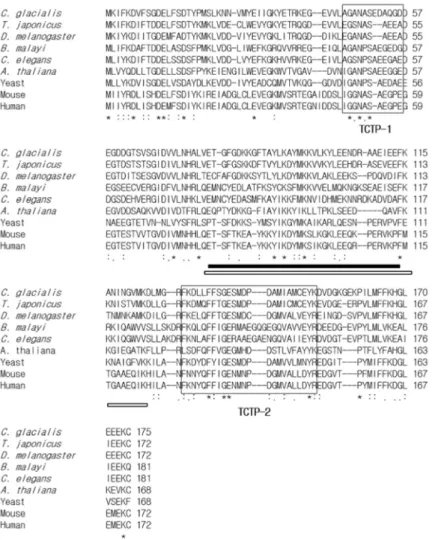
Fig. 1. Multiple sequence alignment of various TCTPs was determined using the ClustalW software. The boxes show the TCTP-1 and TCTP-2 signature regions. Calcium-bind- ing (CaB) and microtubule binding (MTB) regions are indicated by dark and white bars, respectively.
nex, Providence, Rhode Island, USA) was used to visualize the protein signals. The respective images were detected with a luminescent image analyzer (LAS-3000; Fujifilm, Tokyo, Japan).
H
2O
2tolerance bioassay
To test the sensitivity of E. coli cells to H
2O
2, Cg-rTCTP- transformed bacterial cells were grown until the OD range of the culture reached 0.7-0.8. Then, the cultures were in- duced with IPTG at a final concentration of 0.5 mM added to the LB medium containing ampicillin. H
2O
2was serially added to the induced bacterial cells, ranging from 1 to 20 mM and cultured for 12 and 24 hr. A plate culture was used to test the diluted cells (ranging from 1:1 to 1:10), with 10 µl of each dilution being platted on LB agar medium contain- ing 3 and 5 mM H
2O
2. Plates were then incubated at 37°C overnight. Bacterial cells expressing the empty vector were similarly plated as controls. Growth of the bacterial cells af- ter incubation was compared between the control and ex- perimental groups.
Results
Sequence analysis of C. glacialis TCTP
To evaluate the TCTP sequence, its ORF was obtained
from the full-length C. glacialis cDNA. The resulting ORF
comprised 522 bp, encoding 173 amino acids. Based on a
BLAST search using the inferred amino acid sequence,
Cg-TCTP showed high similarity of sequence identity with
other eukaryotic TCTP genes. Alignment of the predicted
Cg-TCTP sequence with the corresponding TCTP from eight
different organisms showed a high degree of preservation
over long-term evolution. According to the characteristic fea-
tures of TCTPs, Cg-TCTP also comprised distinctly specified
TCTP-1 and TCTP-2 signature, which represent the amino
acid positions 45-56 and 129-152, respectively. Alignment of
the basic amino acid-rich domain sequences revealed sim-
ilarities with part of the microtubule-binding domain (MTB)
and calcium-binding domain (CaB). Moreover, the Cg-TCTP
amino acid sequence showed 71% homology with that of
Tigriopus japonicus. In addition, alignment of Cg-TCTP with
A B
Fig. 2. Chromatographic purification and separation of Cg-TCTP protein. Optimal expression of Cg-rTCTP was achieved at 0.5 mM IPTG. Cg-rTCTP was directly analyzed on a 10% sodium dodecyl sulphate-polyacrylamide gel and stained with Coomassie brilliant blue. The histidine- tag- ged recombinant proteins were purified using an immo- bilized metal affinity column chromatography. A. 10%
sodium dodecyl sulphate-polyacrylamide gel electro- phoresis (SDS-PAGE) results before (lane 1) and after (lane 2) induction. Recombinant Cg-TCTP protein puri- fied on a Co-NTA column (lane 3). B. Immunoblot analy- sis of the recombinant protein (lane 1; control vector, lane 2; His-tagged Cg-rTCTP). The arrows indicate the TCTP recombinant protein.
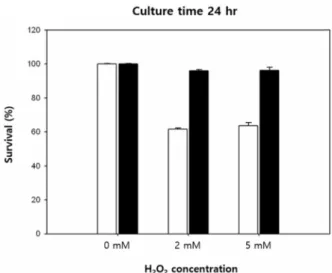
Fig. 3. Comparison of growth resistance to hydrogen peroxide (H2O2) between Escherichia coli transformed with pEXP5 TOPO TA vector containing C. glacialis TCTP and pEXP5 TOPO TA vector alone as control. In order to confirm the antioxidant potential of Cg-rTCTP, E. coli cells ex- pressing the recombinant protein or the empty vector alone were cultured in media containing 0-5 mM H2O2
for 24 hr. Survival capacity of control E. coli (white box) and bacteria expressing the recombinant Cg-TCTP (black box) in the presence of difference concentrations of H2O2
for 24 hr.
TCTP homologue proteins of T. japonicus (accession AAR 88095), Brugia malay (XP_001897741), Caenorhabditis elegans (Q93573), Drosophila melanogaster (Q9VGS2), yeast (NP_
594328), Arabidopsis thaliana (AAM66134), mouse (P14701), and human (NP_003286) was determined using ClustalW (Fig. 1).
Expression of C. glacialis TCTP
The cDNA of C. glacialis TCTP was inserted into a eukary- otic expression vector, which was used to induce the ex- pression of a recombinant Cg-TCTP in E. coli. Analysis of the obtained Cg-sTCTP revealed a ~23 kDa protein on SDS-PAGE (Fig. 2A, lane 3), which was detected in low amounts in both insoluble and soluble fractions of the cell extracts (Fig. 2A, lane 2). The Cg-rTCTP expression in E. coli was detected by immunoblotting using a monoclonal anti- body against His-tag (Fig. 2B).
Evaluation of Cg-rTCTP-transformed E. coli cells resistance to H
2O
2To further confirm the antioxidant potential of Cg-rTCTP, E. coli cells expressing the recombinant protein or the empty
vector alone were cultured in media containing 0-5 mM H
2O
2for 24 hr. The survival rate of the cells transformed with the empty vector (control) was reduced by approx- imately 36-40% at 2 and 5 mM H
2O
2compared with cells in the absence of H
2O
2, whereas Cg-rTCTP-transformed cell survival was largely unaffected by H
2O
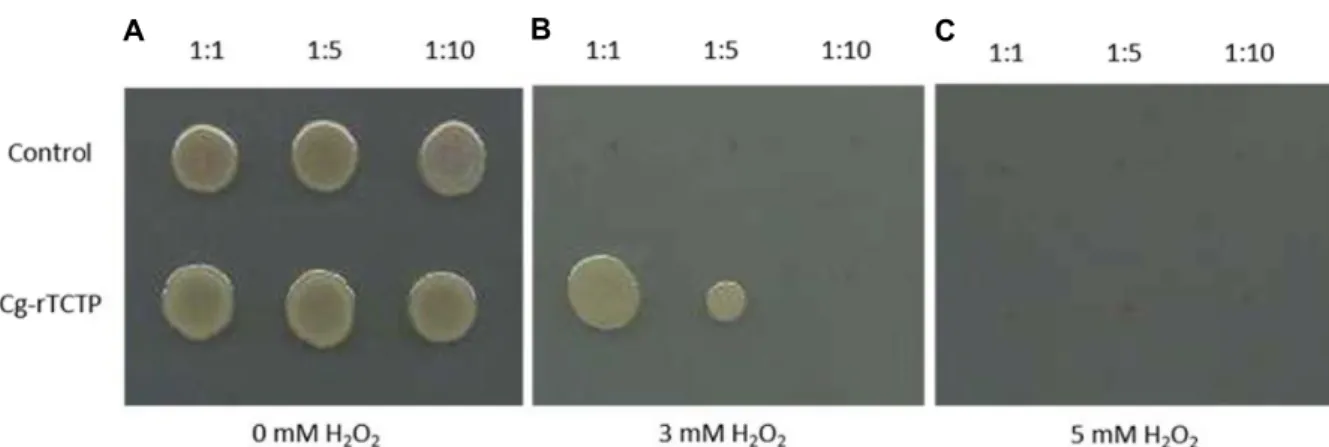
2-induced toxicity (Fig. 3). In plate cultures containing 5 mM H
2O
2, which was a critical concentration for inhibiting cell growth, E. coli cells harboring TCTP and the empty vector did not survived (Fig.
4C). However, Cg-rTCTP-producing cells survived at a den- sity of 1:5 in medium containing 3 mM H
2O
2(Fig. 4B).
Additional analyses revealed that as soon as E. coli cells were exposed to H
2O
2, their logarithmic growth was im- paired and the culture reached a stationary-like phase. When the H
2O
2concentration was 3 mM, which was critical con- centration for inhibiting cell growth in plate culture, the sur- vival status of E. coli expressing Cg-rTCTP was maintained as compared with the control group (Fig. 5).
Discussion
This study is the first report on the antioxidant activity
of TCTP from C. glacialis in the Arctic Ocean. Aquatic organ-
A B C
Fig. 4. Hydrogen peroxide (H2O2) tolerance of E. coli cells transformed with Cg-rTCTP gene. Cells were serially diluted (from 1:1 to 1:10) and were plated on LB agar containing different concentrations (0 mM, 3 mM, or 5 mM) of H2O2. After incubation for 12 hr at 37℃, the growth of cells harboring the empty vector was inhibited, whereas cells expressing Cg-rTCTP showed enhanced growth up to a dilution of 1:5 in the presence of 3 mM H2O2 (B).
Fig. 5. Growth curves of control (pEXP5 TOPO TA vector control) and transformed (Cg-rTCTP) E. coli cells in LB medium containing ampicillin. A plate culture was used to test the diluted cells (ranging from 1:1 to 1:10), with 10 μl of each dilution being platted on LB agar medium containing 3 mM H2O2 for 24 hr. Bacterial cells expressing the empty vector were similarly plated as controls. Growth of the bacterial cells after incubation was compared between the control and experimental groups.
Growth was monitored spectrophotometrically by following the optical density at A600 nm.
isms are frequently exposed to environmental factors (e.g., cold, heat, and osmotic conditions) and chemical stresses (e.g., endocrine disruptor chemicals and hydrocarbons).
Therefore, organisms may respond to these stresses by acti- vating different cellular mechanisms [20], with protective re- actions being described in both prokaryotes and eukaryotes [27]. To date, few studies on gene expression and stress re- sponse from marine copepods have been published, al- though they are known to have defense mechanisms [20].
Indeed, previous reports have identified TCTP as an anti- oxidant enzyme in filarial parasites [15]. TCTP was shown to exhibit an extracellular function as a histamine release
factor and to hold anti-apoptotic activity [6]. In addition, the expression of TCTP was upregulated under stress con- ditions, such as oxidative stress, heat shock, and the presence of metals.
In the present study, a recombinant protein derived from
C. glacialis TCTP was expressed in E. coli. The complete nu-
cleotide sequence of the Cg-TCTP was 522 bp in length, and
its predicted encoded protein showed high similarity to the
T. japonicus (71%). TCTP is highly conserved among eukary-
otic organisms. Interestingly, Cg-TCTP was found to com-
prise two signature regions, named TCTP 1 and TCTP 2,
which are structurally similar to the Mss4/Dss4 family [30].
Moreover, it also had basic amino acid-rich regions at 45-56 and 129-152 bp, which were very similar to the MTB and CaB domains, respectively. In accordance with this finding, TCTP was previously described as a calcium-binding protein that protects cells from calcium stress-induced apoptosis [15].
Gnanasekar and Ramaswamy (2007) confirmed that pres- ence of three cysteines located in the central portion of the protein in filarial TCTPs and suggested that these cysteine residues in recombinant TCTP from Brugia malayi were crit- ical for its antioxidant function. However, only two cysteines were identified at 149 and 175 position of the Cg-TCTP se- quence [14]. Despite of this difference, the findings herein described clearly suggest that Cg-TCTP may hold anti- oxidant activity. Notably, Cg-rTCTP-transformed E. coli cells survived under oxidative stress conditions. In the broth cul- ture, Cg-rTCTP expression enabled E. coli cells to survive in the presence of 5 mM H
2O
2for 24 hr (Fig. 3). However, cell growth on a plate containing 5 mM H
2O
2was completely inhibited for 12 hr. When the H
2O
2level was increased to 10 and 20 mM, the growth of transformed and control cells was strongly inhibited (data not shown). It has been re- ported that recombinant TCTP homologs survive at a max- imum concentration of 1.2 mM H
2O
2[14]. However, in this study, it was confirmed that Cg-rTCTP-producing cells were capable of sustaining growth at high concentrations (3 mM) of H
2O
2. Control cells were incubated with purified TCTP at various concentrations (0, 0.007, 0.07, and 0.7 mg), which revealed that high concentration of TCTP (0.7 mg) enhanced bacterial growth, whereas in the absence of TCTP it was in- hibited (data not shown). As shown for the control condition in Fig. 5, as soon as the induced cells were exposed to H
2O
2, growth entered a stationary-like phase. In contrast, the growth of Cg-rTCTP-transformed cells was maintained re- gardless of H
2O
2presence, which was similar to the growth profile of control cells not exposed to H
2O
2. Altogether, these results suggest that the TCTP of C. glacialis may have a pro- tective function against H
2O
2-induced damage. Nevertheless, additional studies are still necessary to explore the anti- oxidative protective mechanisms of C. glacialis TCTP.
Over the past few years, several studies have explored the biologically relevant functions of TCTP. For example, TCTP is a known target for artemisinin and has protective functions against heat stress [3, 25]. Artemisinin is a highly valuable drug used to treat malaria [11, 31] and is also known to exhibit anticancer and anti-inflammatory activities [9, 10, 32, 33]. Additionally, Eichhorn et al. (2013) suggested
that the antimalarial activity of artemisinin may be related to molecular interaction with TCTP [12]. Furthermore, some researchers have suggested that TCTP mRNA is down- regulated in yeast cells exposed to heat shock [5], and that TCTP expression is modulated by stresses such as starvation and heat stress [6]. Contrasting to these findings, evaluation of the impact of artemisinin treatment and exposure to heat shock on the growth of Cg-rTCTP-transformed cells failed to show any significant effects (data not shown).
To confirm the antioxidant effect of Cg-TCTP, Cg-rTCTP- transformed E. coli cells were exposed to oxidative con- ditions using H
2O
2. Overall, the transformed cells showed increased tolerance against oxidative stress, indicating that overexpression of Cg-rTCTPs protect bacterial cells from oxi- dative damage caused by H
2O
2exposure. Altogether, this study suggests that Cg-TCTP may have an important func- tion as an antioxidant protein, and its antioxidant effect can be related to improved oxidative stress tolerance of C. glacia- lis in the harsh environment of the Arctic Ocean. Additional studies are still warranted to provide more information on function of TCTP in C. glacialis in the Antarctic and Arctic Oceans.
Acknowledgement
This research was supported by the research project (PE20010) of the Korea Polar Research Institute, Republic of Korea.
The Conflict of Interest Statement
The authors declare that they have no conflicts of interest with the contents of this article.
References
1. Abele, D., Ferreyra, G. A. and Schloss, I. 1999. H2O2 accumu- lation from photochemical production and atmospheric wet deposition in Antarctic coastal and off-shore waters of Potter Cove, King George Island, South Shetland Islands.
Antarct. Sci. 11, 131-139.
2. Ara, K., Nojima, K. and Hiromi, J. 2002. Acute toxicity of Bunker A and C refined oils to the marine harpacticoid co- pepod Tigriopus japonicus mori. Bull. Environ. Contam.
Toxicol. 69, 104-110.
3. Bhisutthibhan, J., Pan, X. Q., Hossler, P. A., Walker, D. J., Yowell, C. A., Carlton, J., Dame, J. B. and Meshnick, S. R.
1998. The Plasmodium falciparum translationally controlled
tumor protein homolog and its reaction with the antimalarial drug artemisinin. J. Biol. Chem. 273, 16192-16198.
4. Bohm, H., Benndorf, R., Gaestel, M., Gross, B., Nürnberg, P., Kraft, R., Otto, A. and Bielka, H. 1989. The growth-re- lated protein P23 of the Ehrlich ascites tumor: translational control, cloning and primary structure. Biochem. Int. 19, 277-286.
5. Bonnet, C., Perret, E., Dumont, X., Picard, A., Caput, D. and Lenaers, G. 2000. Identification and transcription control of fission yeast genes repressed by an ammonium starvation growth arrest. Yeast 16, 23-33.
6. Bommer, U. A. and Thiele, B. J. 2004. The translationally controlled tumour protein (TCTP). Int. J. Biochem. Cell. Biol.
36, 379-385.
7. Browman, H., Rodriguez, C. A., Béland, F., Cullen, J. J., Davis, R. F., Kouwenberg, J. H. M., Kuhn, P. S., McArthur, B., Runge, J. A., St-Pierre, J. F. and Vetter, R. D. 2000. Impact of ultraviolet radiation on marine crustacean zooplankton and ichthyoplankton: a synthesis of results from the estuary and Gulf of St. Lawrence, Canada. Mar. Ecol. Prog. Ser. 199, 293-311.
8. Dahms, H. U. and Lee, J. S. 2010. UV radiation in marine ectotherms: molecular effects and responses. Aquat. Toxicol.
97, 3-14.
9. Efferth, T., Dunstan, H., Sauerbrey, A., Miyachi, H. and Chitambar, C. R. 2001. The anti-malarial artesunate is also active against cancer. Int. J. Oncol. 18, 767-773.
10. Efferth, T., Sauerbrey, A., Olbrich, A., Gebhart, E., Rauch, P., Weber, H. O., Hengstler, J. G., Halatsch, M. E., Volm, M., Tew, K. D., Ross, D. D. and Funk, J. O. 2003. Molecular modes of action of artesunate in tumor cell lines. Mol.
Pharmacol. 64, 382-394.
11. Efferth, T. 2007. Willmar Schwabe Award 2006: Antiplasmo- dial and antitumor activity of artemisinin—from bench to bedside. Panta. Med. 73, 299-309.
12. Eichhorn, T., Winter, D., Büchele, B., Dirdjaja, N., Frank, M., Lehmann, W. D., Mertens, R., Krauth-Siegel, R. L., Simmet, T., Granzin, J. and Efferth, T. 2013. Molecular interaction of artemisinin with translationally controlled tumor protein (TCTP) of Plasmodium falciparum. Biochem. Pharmacol. 85, 38-45.
13. Formichi, P., Radi, E., Battisti, C., Tarquini, E., Leonini, A., Di Stefano, A. and Federico, A. 2006. Human fibroblasts un- dergo oxidative stress-induced apoptosis without inter- nucleosomal DNA fragmentation. J. Cell. Physiol. 208, 289- 297.
14. Gnanasekar, M. and Ramaswamy, K. 2007. Translationally controlled tumor protein of Brugia malayi functions as an antioxidant protein. Parasitol. Res. 101, 1533-1540.
15. Graidist, P., Yazawa, M., Tonganunt, M., Nakatomi, A., Lin, C. C., Chang, J. Y., Phongdara, A. and Fujise, K. 2007.
Fortilin binds Ca2+ and blocks Ca2+-dependent apoptosis in vivo. Biochem. J. 408, 181-191.
16. Hansen, B. H., Altin, D., Rørvik, S. F., Øverjordet, I. B., Olsen, A. J. and Nordtug, T. 2011. Comparative study on acute effects of water accommodated fractions of an artificially
weathered crude oil on Calanus finmarchicus and Calanus glacialis (Crustacea: Copepoda). Sci. Total. Environ. 409, 704- 709.
17. Häder, D. P., Williamson, C. E., Wängberg, S. Å., Rautio, M., Rose, K. C., Gao, K., Helbling, E. W., Sinha, R. P. and Worrest, R. 2015. Effects of UV radiation on aquatic ecosys- tems and interactions with other environmental factors.
Photochem. Photobiol. Sci. 14, 108-126.
18. Kim, I. C., Lee, C. E., Cho, H. H., Hong, S. G., Lee, J. S., Lee, H. S. and Lee, H. K. 2008. Molecular cloning and ex- pression of the mitochondrial 60-kDa heat shock protein from an Arctic copepod Calanus glacialis. Genes and Genomics 30, 101-111.
19. Kwok, K. W. and Leung, K. M. 2005. Toxicity of antifouling biocides to the intertidal harpacticoid copepod Tigriopus ja- ponicus (Crustacea, Copepoda): effects of temperature and salinity. Mar. Pollut. Bull. 51, 830-837.
20. Lauritano, C., Procaccini, G. and Ianora, A. 2012. Gene ex- pression patterns and stress response in marine copepods.
Mar. Environ. Res. 76, 22-31.
21. Lee, Y. M., Kim, I. C., Jung, S. O. and Lee, J. S. 2005. Analysis of 686 expressed sequence tags (ESTs) from the intertidal harpacticoid copepod Tigriopus japonicus (Crustacea, Cope- poda). Mar. Pollut. Bull. 51, 757-768.
22. Lee, Y. M., Park, T. J., Jung, S. O., Seo, J. S., Park, H. G., Hagiwara, A., Yoon, Y. D. and Lee, J. S. 2006. Cloning and characterization of glutathione S-transferase gene in the in- tertidal copepod Tigriopus japonicus and its expression af- ter exposure to endocrine-disrupting chemicals. Mar. Environ.
Res. 62, S219-223.
23. Lucibello, M., Gambacurta, A., Zonfrillo, M., Pierimarchi, P., Serafino, A., Rasi, G., Rubartelli, A. and Garaci, E. 2011.
TCTP is a critical survival factor that protects cancer cells from oxidative stress-induced cell-death. Exp. Cell. Res. 317, 2479-2489.
24. Madronich, S., McKenzie, R. L., Björn, L. O. and Caldwell, M. M. 1998. Changes in biologically active ultraviolet radia- tion reaching the Earth’s surface. J. Photochem. Photobiol. 46, 5-19.
25. Mak, C. H., Poon, M. W., Lun, H. M., Kwok, P. Y. and Ko, R. C. 2007. Heat-inducible translationally controlled tumor protein of Trichinella pseudospiralis: cloning and regulation of gene expression. Parasitol. Res. 100, 1105-1111.
26. Nagano-Ito, M., Banba, A. and Ichikawa, S. 2009. Functional cloning of genes that suppress oxidative stress-induced cell death: TCTP prevents hydrogen peroxide-induced cell death. FEBS Lett. 583, 1363-1367.
27. Nico, M., Straalen, V. and Roelofs, D. 2012. An introduction to ecological genomics. 2nd ed. Oxford University Press.
28. Obermüller, B., Karsten, U. and Abele, D. 2005. Response of oxidative stress parameters and sunscreening compounds in Arctic amphipods during experimental exposure to max- imal natural UVB radiation. J. Experiment. Mar. Bio. Eco. 323, 100-117.
29. Saito, A., Hayashi, T., Okuno, S., Nishi, T. and Chan, P.
H. 2006. Modulation of proline-rich akt substrate survival
초록:북극 동물플랑크톤 Calanus glacialis TCTP (Translationally Controlled Tumor Protein)가 산화적 스트레스 상태에서 E. coli 세포의 저항성에 미치는 효과
박유경
1․이창은
1․이형석
1․고혜연
1․김소진
2․이성구
1․김정은
1․임정한
1․홍주미
1․김려옥
3․한세종
1․ 김일찬
1*
(1극지연구소 생명과학연구부, 2서울대학교병원 & 서울대학교 의과대학 신경외과, 3국립환경과학원 화학물질연구과)
TCTP는 다양한 진핵생물에서 풍부하게 존재하는 단백질 중에 하나이며, 암, 세포 증식, 유전자 조절 등과 관련 된 세포의 생리학적 기작에서 중요한 역할을 담당하는 것으로 알려져 왔다. 더구나, TCTP는 dithiothreitol (DTT)
나 hydrogen peroxide (H
2O
2)에 의해 유도되는 산화적 스트레스에 대한 저항성에 관여하는 중요한 단백질로 주목
받아 왔다. 한편, 극지역 서식 생물들은 강한 자외선에 의해 발생한 활성산소를 조절하기 위한 다양한 항산화 방어 체계를 가지고 있다. 본 연구에서는 북극 동물플랑크톤 Calanus glacialis에서 분리된 TCTP가 산화적 스트레스 하에 서 E. coli 세포의 저항성에 미치는 효과를 관찰하였다. C. glacialis에서 분리된 TCTP 유전자(ORF 522 bp) 서열을 분석하였고, 약 23 kDa의 재조합 단백질을 제작하였다. 관찰 결과, TCTP 재조합 단백질이 E. coli 세포에서 과발현
되었을 때, 세포들은 H
2O
2에 의해 유도된 산화적 스트레스에 대한 저항성이 증가하는 것을 확인하였다. 본 관찰을
통해, 북극 C. glacialis TCTP 단백질의 항산화 조절자로서의 역할에 대한 가능성을 처음으로 제시하였다.
signaling pathways by oxidative stress in mouse brains after transient focal cerebral ischemia. Stroke 37, 513-517.
30. Sun, J., Wu, Y., Wang, J., Ma, F., Liu, X. and Li, Q. 2008.
Novel translationally controlled tumor protein homologue in the buccal gland secretion of Lampetra japonica. Biochimie 90, 1760-1768.
31. Turschner, S. and Efferth, T. 2009. Drug resistance in Plasmo- dium: natural products in the fight against malaria. Mini- Rev. Med. Chem. 9, 206-214.
32. Wang, Z., Qiu, J., Guo, T., B., Liu, A., Wang, Y., Li, Y. and
Zhang, J. Z. 2007. Anti-inflammatory properties and regu- latory mechanism of a novel derivative of artemisinin in experimental autoimmune encephalomyelitis. J. Immunol.
179, 5958-5965.
33. Xu, H., He, Y., Yang, X., Liang, L., Zhan, Z., Ye, Y., Yang, X., Lian, F. and Sun, L. 2007. Anti-malarial agent artesunate inhibits TNF-alpha-induced production of proinflammatory cytokines via inhibition of NF-kappaB and PI3 kinase/Akt signal pathway in human rheumatoid arthritis fibroblast- like synoviocytes. Rheumatology 46, 920-926.