• 검색 결과가 없습니다.

Study on Application of Skin Care Cosmetic and Stabilization of Idebenone by Forming Niosome Vesicle Technology

N/A
N/A
Protected

Academic year: 2021

Share "Study on Application of Skin Care Cosmetic and Stabilization of Idebenone by Forming Niosome Vesicle Technology"

Copied!
8
0
0

로드 중.... (전체 텍스트 보기)

전체 글

(1)

http://dx.doi.org/10.12925/jkocs.2019.36.2.592

Study on Application of Skin Care Cosmetic and Stabilization of Idebenone by Forming Niosome Vesicle Technology

In-Young Kim

1✝

1✝

Skin Science R&D Center, Biobeautech Co., Ltd.

Sagimakgol-ro, Seongnam-si, Gyeonggi-do, 13207, Republic of Korea (South) (Received June 10, 2019; Revised June 28, 2019; Accepted June 28, 2019)

  Abstract : This study is to stabilize insoluble and unstable active ingredient which is Idebenone (INCI name: hydroxydecyl ubiquinone) in a multi-lamellar vesicle (MLV) and to stabilize it in the skin care cosmetics. Idebenone is good effective raw material in the treatment of Alzheimer's disease in the medical field and a powerful antioxidant in dermatology. It is well known as a substance that inhibits the formation of melanin and cleans the skin pigment. However, it did not dissolve in any solvent and it was difficult to apply in cosmetic applications. Niosome vesicle was able to develop a nano-particle by making a multi-layer of idebenone encapsulated with a nonionic surfactant, hydrogenated lecithin and glycine soja (soybean) sterols and passing it through a high pressure microfluidizer. Idebenone niosome vesicle (INV) has been developed to have the ability to dissolve transparently in water and to promote transdermal penetration. The appearance of the INV was a yellowish liquid having specific odor, and the particle size distribution of INV was about 10~80 nm.

The pH was 5~8 (mean=6.8). This capsulation with idebenone was stored in a 45°C incubator for 3 months and its stability was observed and quantitatively measured by HPLC. As a result, the stability of the sample encapsulated in the niosome vesicle (97.5%) was about 66.3% higher than that of the non-capsule sample of 32.5%. Idebenone 1% INV was used for the efficacy test and clinical trial evaluation as follows. The anti-oxidative activity of INV was 38.2%, which was superior to that of 12.8% tocopherol (control). The melanin-reducing effect of B16 melanoma cells was better than INV (17.4%) and Albutin (control) (9.6%). Pro-collagen synthesis rate was 128.2% for INV and 89.3% for tocopherol (control). The skin moisturizing effect was 15.5% better than the placebo sample. The elasticity effect was 9.7% better than the placebo sample. As an application field, INV containing 1% of idebenone is expected to be able to develop various functional cosmetic formulations such as skin toner, ampoule essence, cream, eye cream and sunblock cream. In addition, it is expected that this encapsulated material will be widely applicable to emulsifying agents for skin use in the pharmaceutical industry as well as the cosmetics industry.

Keywords : Idebenone, Niosome, lamellar structure, liposome, skin care



Corresponding author

(E-mail: [email protected])

(2)

Fig. 1. Molecular structures of idebenone (INCI name; hydroxydecyl ubiquinone, C

19

H

30

O

5

); M.W: 338.4385 g/mol, IUPAC name:

2-(10-hydroxydecyl)-5,6-dimethoxy-3-methylcyclohexa-2,5-  diene-1,4-dione.

1.INTRODUCTION

The INCI name for Idebenone is yellow powder called hydroxydecyl ubiquinone.

IUPAC: 2-(10-hydroxydecyl)-56-dimethoxy-  3-methylcyclohexa-25-diene-14-dione, the molecular structure of which is C19H30O5, 338.4385g/mol (see Fig. 1).

Idebenone is known for its strong antioxidant properties. Idebenone is also attracting attention as a powerful antioxidant [1~5]. Idebenone, which excellently promotes cell growth, cell protection, and antioxidant activity, plays a role in promoting regeneration from the dermis to the collagen and elastin as well as the water layer. In addition, it inhibits melanin production, reduces skin pigmentation, brightens skin and suppresses skin pigmentation, and has an effect on elasticity, wrinkle removal and skin tone improvement[6~8]. In particular, it was reported to be useful for the treatment of Alzheimer's disease. When a cerebrovascular disorder occurs, a large amount of clutamine acid is produced at the nerve end, and calcium is introduced into the nerve cell, resulting in a shortage of clutathione, an intracellular reducing substance [9,10]. As a result, the cells are oxidized and destroyed.

Idebenone has the effect of inhibiting the destruction of mitochondria by eliminating the free radicals produced during cell death.

Idebenone is a synthetic analog of coenzyme Q10[11,12,13]. Coenzyme Q10 (ubiquinone) produced in the liver - It is a compound that

changes depending on the intake of vitamin B2, B3, B6, C, folic acid and pantothenic acid.

In the absence of these vitamins, the synthesis of coenzyme Q10 is suppressed[14,15].

Ubiquinone promotes the production of primary energy molecule ATP (adenosine triphosphate). As you get older, the amount of coenzyme in your body drops, which is useful for slowing the aging process and preventing degenerative diseases. There are some limitations to the use of natural coenzyme Q10[16,17]. The ubiquinone molecule is quite large and has about 50 carbon residues in the side chain, higher hydrophobicity prevents interference with the membrane[18~21]. Also, instead of antioxidant effects, prooxidant properties may occur under certain conditions.

To overcome this drawback, attempts to synthesize coenzyme Q10 derivatives retain all the positive properties of natural materials, but they do not have disadvantages. To date, only one of the molecules synthesized in this series has been approved as a drug [22,23].

Idebenone inhibits lipid peroxidation by protecting nerve cell membranes and mitochondria from damage. Coenzyme Q10 is a component of the electron transport chain located in the inner mitochondrial membrane [24].

This study was to stabilize insoluble and

unstable Idebenone (INCI name: hydroxydecyl

ubiquinone) in a multi-lamellar vesicle (MLV)

and to improve its skin. Idebenone is effective

in the treatment of Alzheimer's disease in the

medical field and a powerful antioxidant in

(3)

dermatology. It is well known as a substance that inhibits the formation of melanin and cleans the skin pigment. However, it did not dissolve in any solvent and it was difficult to apply in cosmetic formulas. INV was able to develop a nano-particle by making a multi-layer of idebenone encapsulated with a nonionic surfactant, hydrogenated lecithin, polyglyceryl-10 dioleate and glycine soja (soybean) sterols and passing it through a high pressure microfluidizer. In addition, we report the results of evaluating the skin whitening effect of wrinkle improvement effect of anti-oxidative effect melanin reduction ratio pro-collagen synthesis rate as efficacy evaluation.

2. MATERIALS AND EXPERIMENTAL METHODS

2.1. Materials

Idebenone (above 99%): Biobeautech Co., Ltd., Korea, Hydrogenated lecithin: SOYA Lecithic-75H, Friend Co., Ltd., Glycine soja (soybean) sterol: Biobeautech Co., Ltd., Korea, PEG-40 Castor Oil: Kao Chemicals, Japan, 1,3-Butylene Glycol: Oxea, USA, Glycerin: LG Chemicals, Korea, 1,2-Hexanediol: Biobeautech Co., Ltd., Korea, Tocopheryl Acetate: BASF, Germany, Allantoin: Biobeautech Co., Ltd., Korea, Polyglyceryl-10 dioleate: Biobeautech Co., Ltd., EDTA-2Na: Sigma & Aldrich, etc. In addition, all raw materials used in this study were used cosmetic and food raw materials without further treatment.

2.2. Equipment

Homo-dispersing Mixer: Hansung Engineering Co., Ltd, Korea, Agi-Dispersing Mixer: Hansung Engineering Co., Ltd, Korea, High Pressure Microfluidizer: Micronox Co., Ltd., Korea, pH meter: Donglim science limited., Korea, Polarized microscopy (Olympus CX-40, Japan), in-vivo skin evaluating equipment, elasticity activity, whitening and fine

wrinkle effect from Aram Huvis Co. Ltd., Korea. Particle Sizer: Melvern, UK, Zeta-Sizer:

Shumazu, Japan, UV Spectrophotometer:

Donglim Science, Korea.

2.3. Preparation of Niosome vesicle containing Idebenone

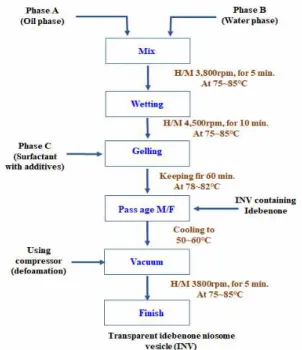
The process for making idebenone niosome vesicle (INV) is as follows (see Fig. 2).

1) Dissolve the surfactant, hydrogenated lecithin, in the polyol by heating to 70°C.

2) Water is added and wetted at 70°C for 1-2 hours, then idebenone is added to dissolve together.

3) Passage it through the microfluidizer three times to make it clear.

4) This is cooled and defoamed to complete the production.

5) Check the pH and particles to analyze the particles.

Fig. 2. Preparing method of idebenone noisome

vesicle using high pressure

microfluidizer.

(4)

2.4. Evaluation of Effectiveness

The efficacy evaluation evaluated the skin science value of idebenone by measuring anti-oxidative activity, melanin-reducing effect, pro-collagen synthesis rate, skin moisturizing effect. Each efficacy evaluation was carried out by using the evaluation methods commonly used in cosmetics, and the controls were selected to compare and select the most representative components.

3. RESULT AND DISCUSSIONS

3.1. Development of Idebenone Niosome Vesicles (INV)

Generally, there are several type technologies in cosmetic formulations (see Fig. 3). As you can see Fig. 3, they showed that the various stabilizing technologies in skin care formulas of cosmetics; (A) Oil-in-Water (O/W), (B) Water-in-Oil (W/O), (C) Water-in-Oil- in-Water (W/O/W), (D) Niosome vesicles with forming bi-layer.

Fig. 3. The various stabilizing technologies in skin care formulas of cosmetics; (A) Oil-in-Water (O/W), (B) Water-in-Oil (W/O), (C) Water-in-Oil-in-Water (W/O/W), (D) Niosome vesicles with forming bi-layer.

INVs are prepared by mixing at above their melting points followed by cooling to room temperature by passing through high pressure microfluidizer. We developed transparent INV

solution by passage high pressure microfluidizer with Fig. 4. Surfactants of niosome vesicle were composed of hydrogenated lecithin, polyglyceryl-10 dioleate, glycine soja (soybean) sterols were used as wetting multi-lamella gel when just put in around 2 to 7wt% as an emulsifier. Then, it is possible to make packing in the multi-layers from using them. Fig. 5 shows the structure of INVs. Also, it is a photograph showing the result of analysis by an electron microscope. To make INV, the composition of the surfactant used was to make a niosome nano-particle using 2 to 7%

hydrogenated lecithin, 3 to 5% polyglyceryl-10 dioleate, and 1 to 5% glycine soja (soybean) I was able to. Fig. 5, (A) is photograph depicting the formation of a bi-layer of INV. (B) is a photograph in which a bi-layer is formed. It was confirmed that multi-lamella vesicle was formed. Fig. 5 shows the results of various nano-particles using niosome surfactant.

Fig. 4. Finished sample of yellowish transparent idebenone noisome vesicle (INV) containing 1% idebenone.

Fig. 5. Forming pictures of lamellar layer

containing idebenone using surfactant

lipid; (A): formation of bi-layer of

MLV. (B): bi-layer is formed (niosome

vesicle).

(5)

Terms Control 1 Control 2 INV Remarks Appearance Transparent Semi-transparent Semi-transparent Standard

Odor Specific Odor Specific Odor Specific Odor Standard

Specific Gravity (g/mL) 1.003 0.998 1.005 Method 1

Droplet Size Below 30nm 60~150nm 30~80nm Particle Sizer

Stability (after 3 months) Stable Stable Stable Incubator at 45℃

Application Skin toner Essence Capsulation Cosmetic fields

Table 1. Particle Size Measurements of Several Formulations of Niosome Vesicle with Idebenone 1% Solution

As you can see Fig. 6, (A) showed a clear micellar state with a common solubilizing system. (B) is a translucent niosome solution that forms a bi-layer with oils. (C) is a sample of 1% idebenone developed as a transparent niosome vesicle. Its pH was 6.8. It was good stabilized at high temperature incubator (45°C)

Fig. 6. Various nano-particles depend on droplet size using noisome surfactant:

(A) solubilizing system, (B): niosome solution of semi-transparent with bi-layer of MLV. (C): transparent niosome nano-particle with idebenone 1% solution.

3.2. Droplet size measurements of noisome vesicles

INVs were measured and shown in Table 1.

Control 1 is a formulation using PEG-60 hydrogenated castor oil at 30 nm for a typical

solubilized sample. Control 2 is a condition that can be used for essence formulation with 60 ~ 150nm translucent particles. INV is a possible sample for embedding idebenone into nanoparticles at 30-80 nm.

3.3. Results of Effectiveness

3.3.1. Anti-Oxidative Activity

Idebenone is known to be an excellent antioxidant. In the cosmetics industry in recent years, it is preferred to use highly effective ingredients. Even with a small amount, effective cosmetics are worth so much. Therefore, in this study, the anti-oxidative activity of idenone was compared with that of tocopherol and green tea extract as a control group. As shown in Fig. 7, the anti-oxidative effect was more than three times higher than that of tocopherol or green tea extract.

Fig. 7. Anti-oxidative effect of idebenone

comparing with other control two

materials.

(6)

3.3.2. Moisturizing Activity

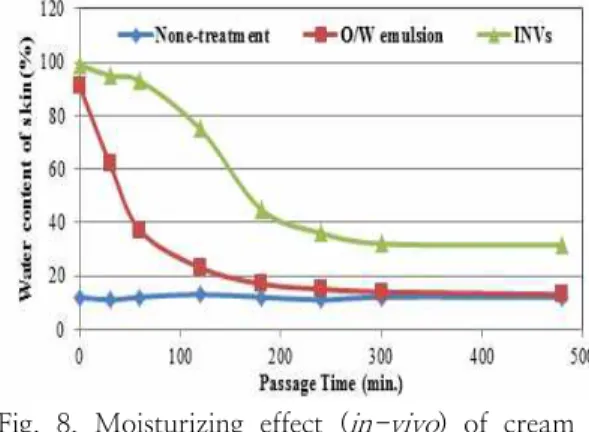
Fig. 8 is that moisturizing effect of idebenone cream after passed 480 minutes was 31.6%

(*P>0.05) superior conventional cream than control (O/W cream). Due to the formation of MLV nano-particle around droplets of lamellar layer, it could be incorporated a large amount of water hold capacitance as well as moisturizing effect is continued for a long lasting time. Also, they have some advantages that could make easily milky lotion and cream.

As shown in Fig. 8, the skin moisture content of the none treatment was 12%. The conventional O/W emulsion was 13%. However, in the case of INV formulation, the result was more than 60.06% before the application of 31.6%.

Fig. 8. Moisturizing effect ( in-vivo ) of cream of SLC BB/CC cream compared with conventional O/W cream; (n=10, 3 times, * P>0.05).

3.3.3. B16 melanin reducing activity

Idebenone has excellent antioxidative effects, but it is known to be effective in reducing melanin deposition in spiny freckles. Therefore, the melanin reduction effect was tested. As shown in Fig. 9, the reduction effect of B-16 melanoma cells was reduced by 15.5% in 1000 mL of arbutin. Idebenone showed a reduction of 38.7% in 1000mL.

Fig. 9. B-16 melanoma cell reducing effect ( in-vivo ) of cream of INV cream compared with arbutin; (n=10, 3 times, * P>0.05).

4. CONCLUSIONS

We have studied the stabilization method of idebenone niosome nano-particles and obtained the following conclusions. As a result, the stability of the sample encapsulated in the niosome capsule (97.2%) was about 66.2%

higher than that of the non-capsule sample of 32.5%. Idebenone 1% MLV Niosome vesicle was used for the efficacy test and clinical trial evaluation as follows. The anti-oxidative activity of MLV niosome vesicle was 38.2%, which was superior to that of 12.8% tocopherol (control). The melanin-reducing effect of B16 melanoma cells was better than MLV niosome nano-particle (17.4%) and Albutin (control) (9.6%). Pro-collagen synthesis rate was 128.2%

for MLV niosome vesicle and 89.3% for

tocopherol (control). The skin moisturizing

effect was 15.5% better than the placebo

sample. As an application field, MLV niosome

vesicle containing 1% of idebenone is expected

to be able to develop various functional

cosmetic formulations such as skin toner,

ampoule essence, cream, eye cream and

sunblock cream. In addition, it is expected that

this encapsulated material will be widely

applicable to emulsifying agents for skin use in

the pharmaceutical industry as well as the

cosmetics industry.

(7)

References

1. I. Y. Kim, J. D. Lee, H. C. Ryu, C. K.

Ahoh, “Formation of liquid crystal gel with hydrogenated lecithin and its effectiveness”, J. Soc. Cosmet. Scientists Korea, Vol. 29, No.2 pp. 181-191, (2003).

2. Inoue T., tsujii K., Okamoto K., Toda K.,

“Differential scanning calorimetric studies on the melting behavior of water in stratum corneum”, J Invest Dermatol, Vol. 86, pp.689-693, (1986).

3. J. Levin and H. I Maibach, “Correlation transepidermal water loss and percutaneous absorption: an overview”, Cosmetics and Toiletries, Vol. 120, No.7 pp.28-31, (2005).

4. S. Nishiyama, H. Komatsu, and M. Tanaka,

“A study on skin hydration with cream”, J.Soc. Cosmet. Chem. Japan, Vol. 16, No.2 pp.136-143, (1983).

5. L. Norlen, “Skin barrier Formation: The membrane folding model”, The J. of Investigative Dermatology, Vol. 117, No.4 pp.823-829, (2001).

6. T. Okamoto, Y. Matsushita, E. Matsuura, M. Masuda, “The preparation of visible emulsion and its applications to cosmetics”, J.Soc. Cosmet. Chem. Japan, Vol. 39, No.4 pp. 290-297, (1983).

7. T. Suzuki, J. Fukasawa, H. Iwai, “Multi- lamellar emulsion of stratum corneum lipid”, J.Soc. Cosmet. Chem. Japan, Vol.

27, No.3 pp.193-205, (1993).

8. M.Yada, J. Yamamoto, and H. Yokoyama,

“Spontaneous formation of regular defect array in water-in-cholestric liquid crystal emulsions”, Langmuir, Vol. 18, pp.7436- 7440, (2002).

9. J. C. Loudet, H. Richard, G. Sigaud, and P.

Poulin, Nanoaqueous liquid crystal emulsions, Langmuir, Vol. 16, pp.6724- 6730, (2000).

10. Y. Sakai, M. Suzuki, Y. Ohara, S. Okabe,

“Resolving the conflict of a simultaneously highly moisturizing and occlusive emulsion film”, 23rd Congress IFSCC Orlando,

pp.26-30, (2004).

11. R. S. Summers, B. Summers, P. Chandar, C.

Feinberg, R. Gursky, A. V. Rawlings, “The effect of lipids, with and without humectant, on skin xerosis”, J. Soc. Cosmet.

Chem., Vol. 47, pp.27-39, (1996).

12. Y. Suzuki, H. Tsutsumi, “Surfactant with hydroxyl groups as hydrophilic portion solution behavior of alkyl diglyceryl ethers in water”, Oil chemistry, Vol. 36, pp.947-953, (1987).

13. F. Tirnaksiz, O. Kalsin, “A topical w/o/w multiple emulsions prepared with tetronic 908 as a hydrophilic surfactant:

formulation, characterization and release and study”, J. Pharm PharmaceutSci., Vol.

8, No.2 pp.299-315, (2005).

14. G. Grubauer, K. R. Feingold, R. M. Harris, and P. M. Elias, “Lipid content and lipid type as determinants of the epidermal permeability barrier”, J. of Lipid Research, Vol. 30, pp.89-96, (1989).

15. S. E. Friberg, K. Larsson, J. Sjoblom, “Food Emulsions, Marcel Dekker, Inc.”, New York, pp.45-106, (2004).

16. T. Suzuki, J. I. Fukasawa, H. Iwai, I. Sugai,

“Multilamellar emulsion of stratum corneum lipid”, 16th IFSCC Yokohama, pp.3-28, (1994).

17. Y. Aoki and Y. Sumida, “Enhancement of moisturizing abilities of skincare products by a novel water retaining system”, 22nd IFSCC congress, Edinburgh, Vol. 38, pp.1-8 (2002).

18. I. Y. Kim, C.K. Zhoh, and H.C. Ryoo,

“Liquid crystalline technology of cosmetic industry and moisturizing effect of skin”, J.

of the society of cosmetic scientists of Korea, Vol. 30, No.2, pp.1226-2587, (2004).

19. G. Y. Chae, R. H. Gyeon, M.W Jang, M. J.

Kim, “Whitening and antioxidative effect of rice bran fermented by bacillus subtilis”, J of KOCS, Vol. 37, No.2 pp.153-159, (2011).

20. Bibita S., J. H Shin, E. K. Kim, “Potential

(8)

Skin Whitening Agents of Natural Origin from South Asian Region”, J of KOCS, Vol.

35, No.1 pp.1-9, (2009).

21. Richard A. Baxter, “Anti-aging properties of resveratrol: review and report of a potent new antioxidant skin care formulation”, Journal of Cosmetic Dermatology, Vol. 7, pp.2-7 (2016).

22. I. Y. Kim, B. R. Seong, M. H. Lee, “Triple matrix capsulation having visible effects and stabilizing functions”, J of KOCS, Vol. 35, No.1 pp.1-9, (2009).

23. M. Palumbo, A. Russo, V. Cardile, M.

Renis, D. Paolino, G. Puglisi and M. Fresta,

“Improved Antioxidant Effect of Idebenone- Loaded Polyethyl-2-Cyanoacrylate Nanocapsules Tested on Human Fibroblasts”, Pharmaceutical Research, Vol.

19, No. 1 pp.71-77, (2002).

24. R. Pignatello, R. Acquaviva, A. Campisi, G.

Raciti, T. Musumeci and G. Puglisi, “Effects

of liposomal encapsulation on the

antioxidant activity of lipophilic prodrugs of

idebenone”, Journal of Liposome Research,

Vol.21, No.1 pp.46-54, (2011).

수치

Fig. 2.  Preparing method of  idebenone  noisome  vesicle  using  high  pressure  microfluidizer.
Fig. 4. Finished sample of yellowish transparent  idebenone  noisome  vesicle  (INV)  containing  1%  idebenone.
Fig. 7. Anti-oxidative  effect  of  idebenone  comparing  with  other  control  two  materials.
Fig.  9.  B-16  melanoma  cell  reducing  effect  ( in-vivo )  of  cream  of  INV  cream  compared  with  arbutin;  (n=10,  3  times,  *  P>0.05).

참조

관련 문서

1 John Owen, Justification by Faith Alone, in The Works of John Owen, ed. John Bolt, trans. Scott Clark, "Do This and Live: Christ's Active Obedience as the

Finally this thesis provides an pragmatic analysis of the as constructions, which argues that the emergence of functional marking of as is attributable

Fourth, as the information technology is developed due to the fourth industrial revolution and the proportion of information technology in the commercial

In this regard, this research is expected to be used for the development for the future policies to boost technology transfer and commercialization as

The study conducted a study of literature and research, and in literature, the study of cosmetic behavior, nail behavior, self esteem, and

This study aims to suggest a basic data for the activation of aromatherapy pimple treatment program with the pimple skin care and treatment by testing the actual

In the second place, the principle of application by the party concerned based on the principle of joint application details should be introduced to secure

Depth Sensor As a sensor to measure hydrostatic pressure of knowing the depth of the device.. Board 1,2 The performance of various sensors and controls to be able to use