ISSN: 1738-7167
DOI: http://dx.doi.org/10.7731/KIFSE.2015.29.5.007
연소 시험에서 발생하는 일산화탄소와 이산화탄소의 발생
정영진
강원대학교 소방방재공학과, 강원대학교 소방방재연구센터
Production of Carbon Monoxide and Carbon Dioxide Gases in the Combustion Tests
Yeong-Jin Chung
Dept. of Fire Protection Engineering, Kangwon National University Fire & Disaster Prevention Research Center, Kangwon National University (Received July 24, 2015; Revised September 21, 2015; Accepted October 12, 2015)
요 약
본 연구에서는 메틸렌피페라지노메틸-비스-포스폰산 금속염(PIPEABPM
n+) 과 메틸렌피페라지노메틸-비스-포스폰산 (PIPEABP) 으로 처리된 리기다 소나무의 연소독성가스의 생성을 시험하였다. 15 wt%의 메틸렌피페라지노메틸-비스-포스 폰산 금속염과 메틸렌피페라지노메틸-비스-포스폰산 수용액으로 각각 리기다 소나무에 3회 붓칠하여 실온에서 건조시킨 후, 콘칼로리미터(ISO 5660-1)를 이용하여 연소독성가스의 생성을 시험하였다. 그 결과, 메틸렌피페라지노메틸-비스-포스 폰산 금속염으로 처리한 시험편은 메틸렌피페라지노메틸-비스-포스폰산 철염(PIPEABPFe
2+) 으로 처리한 시험편을 제외 하고, 메틸렌피페라지노메틸-비스-포스폰산을 처리한 시험편과 비교하여 최대일산화탄소의 생성(CO
peakproduction) 이 (0.0136~0.0178% at 532~678 s) 으로 낮게 나타났다. 그리고 금속염으로 처리한 시험편(PIPEABPM
n+) 은 금속염으로 처 리하지 않은 시험편(PIPEABP)보다 낮은 최대이산화탄소의 생성(CO
2 peakproduction) 이 (0.0537~0.0628% at 532~
678 s) 임을 보였다. O
2의 생성농도는 사람에게 치명적일 수 있는 수준인 15%보다는 훨씬 높으므로 그로 인한 위험성은 배제할 수 있었다. 따라서 메틸렌피페라지노메틸-비스-포스폰산 금속염으로 처리한 시험편은 처리 하지 않은 시험편과 비교하여 연소-유독성을 부분적으로 감소시켰다.
ABSTRACT
This study was performed to test the production of combustion toxic gases by Pinus rigida specimens treated with vari- ous types of methylpiperazinomethyl-bis-phosphonic acid M
n+(PIPEABPM
n+) and methylpiperazinomethyl-bis-phos- phonic acid (PIPEABP). Three coats of 15 wt% PIPEABPM
n+and PIPEABP solutions were applied to plates of Pinus rigida at room temperature. After drying the treated specimens, the production of combustion toxic gases was examined using a cone calorimeter (ISO 5660-1). The specimens treated with PIPEABPM
n+showed lower carbon monoxide pro- duction (CO
peak; 0.0136~0.0178% at 532~678 s) than the PIPEABP plates, except for the specimen treated with PIPEAB- PFe
3+. In addition, the peak carbon dioxide production (CO
2 peak) was lower (0.03648~0.3648% at 373~433 s) than that of the PIPEABP-treated plate. Notably, oxygen production was much higher than 15%, which can be fatal to humans. There- fore, the resulting risk could be eliminated. The results indicate that the combustion toxicities were partially decreased due to treatment of the virgin plate with PIPEABPM
n+.
Keywords : Methylpiperazinomethyl-bis-phosphonic acid M
n+(PIPEABPM
n+)s, ISO 5660-1, Pinus rigida, Combustion toxic gases, Carbon monoxide
1. 서 론
화재 시 발생되는 비열적 위험을 주는 화학 물질들은 주 로 연기, 독성, 부식, 냄새 등이다. 이로 인해 비열적 위험 요소들의 화학적 성질과 생성속도의 평가는 상대적으로
공기흐름 속도에 비해 생명과 재산의 보호에 매우 중요하 다. 화재로 의한 희생자 중에서 약 75~80%는 직접적인 화 염노출에 의한 것이 아니라 연기, 유독가스 등의 흡입과, 혹은 산소 고갈에 의한 것이다(1). 화재 시 발생하는 유독 가스에 대한 연구는 그 대상 물질에 따라 매우 다양하게
E-Mail: [email protected]
TEL: +82-33-540-3121, FAX: +82-33-540-3129
이루어져 왔으며, 특히 일산화탄소는 서서히 퍼지는 유독 한 가스로 인체내의 헤모글로빈과의 강한 결합성으로 적 은 양으로도 매우 치명적이다(1).
일산화탄소(CO)는 화재발생 시에는 항상 존재하며 사람 에게 노출 시 정신상태의 혼란을 일으키고 의식을 잃게 만 드는 치명적인 가스이다. 심할 경우에는 화재로 인한 CO 가스 흡입으로 죽음에 이르게 하기도 한다. Ernst와 Zibrak(2) 는 CO가 Carboxyhemoglobin (COHb)을 형성함으로써 Hypoxia(저산소증)를 일으키고 Oxyhemoglobin의 해리를 일으킨다고 하였다. 또한, Thom(3)은 CO의 Hemoglobin에 대한 친화도가 Oxygen (O2)의 친화도에 비해서 200배 이 상 더 높다고 제시하였다. 또한, 한 연구결과(4)에 의하면
“Hemoglobin의 CO에 대한 친화도는 매우 커서, COHb의 형태로 존재하는 Hemoglobin의 비율이 CO가 흡입됨에 따 러서 점진적으로 계속 증가한다.”고 한다. 또한, Toxicology Update(5)에 의하면 1단계의 10~30% COHb 혈중 농도를 일으키는 CO에 대한 노출은 고동치는 일시적 두통, 숨가 뿜 현상 및 현기증 등의 증상을 일으킨다. 2단계 중간정도 의 30~50% COHb 혈중 농도는 심각한 두통, 나약함, 현기증, 메스꺼움, 구토, 실신, 심박 급속증 등의 증상을 야기한다. 마지막으로 심각한 3단계의 50~80% COHb 농도는 실신, 발작, 혼수상태, 심혈관 중독, 호흡실패 및 사망= 등의 더욱 심각한 증상을 발생시킨다. 한편 CO 값 으로부터 체내의 % COHb를 계산하는 방법은 식(1)을 따 른다(6).
% COHb = (3.317 × 10⁻⁵) (ppm CO)1.036 (RMV) (1) 여기서, ppm CO: CO concentration (ppm), RMV:
respiration minute volume (L/min), t: exposure time (min)을 의미한다.
이산화탄소(CO2)는 CO처럼 화재 시 발생하며, Purser(7) 는 5% 이하의 CO2가 CO만큼 유독하지는 아닐지라도 호 흡을 자극해 호흡량을 증가시킨다고 하였다. 따라서 3%
정도의 CO2는 RMV값을 두 배 정도로 상승시키고, 5%
정도의 CO2는 RMV값이 세배가 된다. 즉 CO2는 과호흡 (hyperventilation)을 일으켜서 다른 유독한 CO 같은 생성 물의 흡수를 촉진시키는 역할을 하는 것이다. 이에 대한 공식은 아래와 같이 식(2)로 주어진다.
RMV (L/min) = exp(0.2496 × % CO2+ 1.9086) (2) 여기서, % CO2: CO2 concentration (%), RMV: respiration minute volume (L/min)을 의미한다.
한편, King의 연구(8)에 따르면, 대략 3~6%의 CO2는 호 흡장애의 정도가 점점 증가하고, 대략 5~6%의 CO2는 호 흡장애의 정도가 심각해지면서 두통과 구토를 수반하며 호흡실패 및 증상불편감 증세가 나타나고, 6% 정도의 CO2에서 사람들은 20분 이상 견디기 힘들게 된다. 7~
10%의 CO2는 현기증, 졸림, 의식상실의 심각한 호흡상태 에서 복합적으로 나타난다. 또한 CO2 농도가 10% 이상이 되면 의식상실이 더욱 급속하게 나타나며 사람들은 대략 2분 이내에 의식을 잃게 된다.
화재발생 시 산소(O2)농도 저하에 노출된 사람들의 경우 저산소증을 일으키게 되는데, Luft(9)의 사람을 대상으로 한 실험에 의하면 노출정도에 따라서 총 4가지의 단계로 나뉜다. 첫 번째 단계(indifferent phase)는 O2 농도 14.4~
20.9% 사이에 존재하며, 15%의 농도에 근접하면 운동부 하(exercise tolerance)의 초기단계의 증상이 나타나는 등 의 경미한 영향이 발생한다. 두 번째 단계(compensated phase)는 O2 농도 11.8~14.4%로 심장박동의 약간의 증가, 정신운동에 영향, 단기기억상실증, 이성적 판단에 대한 영 향 등의 다양한 증상을 수반한다. 세 번째 단계(manifest hypoxia phase)는 O2농도 9.6~11.8%로 감각이 점점 무뎌 지면서 좀 더 고차원의 프로세스의 정신단계 및 신경근 통 제의 저하, 매우 중요한 판단능력 및 자유의지의 상실 등의 증상을 수반한다. 마지막으로 네 번째 단계(critical hypoxia phase)는 O2 농도 7.8~9.6%로 판단 및 이해능력의 붕괴로 인하여 의식불명의 상태로 진입하게 되며, 이어서 호흡이 중단되고 최종적으로 사망에 이르게 된다.
따라서 화재시험을 통해 발생하는 유독가스에 대한 정 량적 연구가 필요하다. 가연물의 안정성은 화재조건에 노 출되었을 때의 착화성, 열방출률, 화재의 전파 및 연소가 스의 유해성 등으로 평가할 수 있다. 이들 중 열방출률은 화재시에 대상 물질의 잠재 위험성을 나타내기 때문에 중 요하다. 열방출률을 측정하기 위하여 많은 기술이 발전되 어 왔는데 그 중의 하나가 콘칼로리미터(cone calorimeter) 이다(10). 콘칼로리미터에 의한 열방출률 측정은 대부분의 유기재료가 연소 중에 산소 1 kg이 소비되면 약 13.1 MJ의 열이 방출되는 산소 소비 원리를 바탕으로 하고 있다(11).
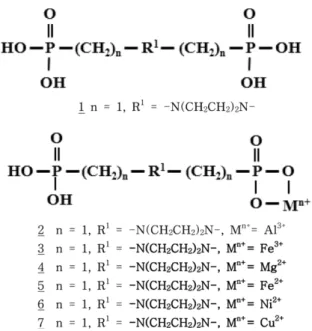
본 연구에서는 목재의 효과적인 활용에 대한 화재 위험 성을 개선하기 위하여 기 보고된 화합물(Scheme 1)(12-14), methylenepiperazinomethyl-bis-phosphonic acid, P(O)(OH)2 CH2N(CH2CH2)2NCH2P(O)(OH)2 (PIPEABP) 1와 methyl- enepiperazinomethyl-bis-phosphonic acid, P(O)(OH)2 CH2N(CH2CH2)2NCH2P(O)(OH)2Al3+ (PIPEABPAl3+) 2, methylenepiperazinomethyl-bis-phosphonic acid, P(O)(OH)2 CH2N(CH2CH2)2NCH2P(O)(OH)2Fe3+ (PIPEABPFe3+) 3, methylenepiperazinomethyl-bis-phosphonic acid, P(O)(OH)2 CH2N(CH2CH2)2NCH2P(O)(OH)2Fe2+ (PIPEABPMg2+) 4, methylenepiperazinomethyl-bis-phosphonic acid, P(O)(OH)2 CH2N(CH2CH2)2NCH2P(O)(OH)2Fe2+ (PIPEABPFe2+) 5, methylenepiperazinomethyl-bis-phosphonic acid, P(O)(OH)2 CH2N(CH2CH2)2NCH2P(O)(OH)2Fe2+ (PIPEABPNi2+) 6, methylenepiperazinomethyl-bis-phosphonic acid, P(O)(OH)2 CH2N(CH2CH2)2NCH2P(O)(OH)2Cu2+ (PIPEABPCu2+) 7을 택하여, 콘칼로리미터(ISO 5660-1)를이용하여 발생가스
관련 값을 측정 비교하여 난연제 설계의 기초적인 정보를 제시하고자 한다.
2. 실 험
2.1 시약 및 재료
본 연구에 사용된 시험편은 리기다 소나무로서 시중에서 일반 건자재용을 구입하였고, 이 시험목은 제재 작업 전 1 yr 동안 자연건조 되었다. 화학적 첨가제로서 PIPEABP, 1(12), PIPEABPAl3+, 2(13), PIPEABPFe3+, 3(13),PIPEABPMg2+, 4(14), PIPEABPFe2+, 5(14), PIPEABPNi2+, 6(14), PIPEABPCu2+, 7(14)은 기 합성된 것을 사용하였다. 이들의 금속이온 함량 은 Al3+ (0.10 wt%), Fe3+ (14.09 wt%), Mg2+ (0.78 wt%), Fe2+ (6.07 wt%), Ni2+ (6.44 wt%), Cu2+ (6.44 wt%)였다.
또한 Al3+, Fe3+, Mg2+, Fe2+, Ni2+, Cu2+의 표준환원전위, Eo(15)는 각각 −1.66, +0.71, −2.37, −0.44, −0.25, +0.337 V 로서, Eo 값이 양의 값으로 크면 환원이 용이함을 의미하 며, 또한 전기음성도도 크다는 것을 의미한다. 그리고 Table 2의 최대질량감소율(peak mass loss rate, MLR peak) 은 기 보고된(16,17) 자료를 이용하였다.
기타 시약은 Samchun Pure Chemical Co., LTD에서 특 급시약을 구입하여 정제 없이 그대로 사용하였다.
2.2 메틸렌피페라지노메틸-비스-포스폰산 금속염 처리 방법
15 wt% 메틸렌피페라지노메틸-비스-포스폰산염 수용액 으로 시험편의 한 면에 붓칠하고 난 뒤 24 h 동안 상온에 서 자연 건조시킨 후, 다시 같은 방법으로 2회 더 실시하 였다. 이를 오븐에서 55oC, 23 h 동안 건조시켜 측정 시험 편으로 하였다. 첨가제의 농도는 모든 시험편에 대하여 15 wt%로 일정하게 조절하였다. 공시편은 같은 목재를 증 류수로 붓칠한 후 위와 같은 방법으로 건조시켜 비교 데이 터로 이용하였다. 건조 후 시험편의 무게는 PIPEABP 1 (30.15 g), PIPEABPAl3+ 2 (30.70 g), PIPEABPFe3+ 3 (31.16 g), PIPEABPMg2+ 4 (30.90 g), PIPEABPFe2+ 5 (30.20 g), PIPEABPNi2+ 6 (30.51 g), PIPEABPCu2+ 7 (30.44 g)였다(13,14).
2.3 콘칼로리미터 시험
연소특성 시험은 ISO 5660-1(18)의 방법에 의해 듀얼 콘칼 로리미터(dual cone calorimeter, Fire Testing Technology) 를 이용하여 Table 1의 조건에서 수행하여 착화되는 시간 과 착화된 시료로부터 연소 독성 관련 지수를 구하였다.
시험편은 단열재인 저밀도 유리섬유를 이용하여 높이를 조절하였으며, 시편 홀더로의 열손실을 감소시키기 위하여 전도도가 낮은 고밀도 세라믹판 재료로 절연시켰다.
3. 결과 및 고찰
3.1 콘칼로리미터 시험
질량감소율(mass loss rate, MLR)은 화재거동에 대하여 추가적인 정보를 준다(19). Table 2 및 Figure 1에 나타낸 리기다 소나무에 금속염 첨가제로 처리한 시험편에 대하 여 MLR peak은 각각 PIPEABPMgAl3+ 2 (0.122 g/s at 350 s), PIPEABPFe3+ 3 (0.127 g/s at 330 s), PIPEABPMg2+ 4 (0.121 g/s at 305 s), PIPEABPFe2+ 5 (0.113 g/s at 300 s), PIPEABPNi2+ 6 (0.123 g/s at 275 s), PIPEABPCu2+ 7 (0.104 g/s at 290 s)으로서 금속이온이 함유되지 않은 시험 편 PIPEABP 1 (0.129 g/s at 420 s)에 비교하여 (1.6~
19)% 낮았다. 이것은 각 금속이온 자체의 특성에 따라 차 이가 있으나, 금속이온 첨가제가 금속이온이 함유되지 않 은 첨가제보다 목재에 쉽게 침투하여 난연작용이 나타나 는 것으로 이해된다. 그러나 금속이온 첨가제로 처리한 시 험편의 MLR peak에 다다르는 시간이 단축되는 것은 금속 Scheme 1. Methylenepiperaziinomethyl-bis-phosphonic acid
(Mn+)s.
Table 1. The Experimental Conditions and Standard of the Cone Calorimeter
Standard ISO 5660-1 Burning time (s) 1800
Specimen size (±02) (mm) 10 × 100 × 100 Burning atmosphere Air Heat flux (kW/m2) 25 Experimental conditions (oC) 23 ± 2 Combustion direction Horizontal Relative humidity (%) 50 ± 5
이온 자체의 열전도성으로 인한 것으로 이들의 난연성과 서로 충돌하는 것으로 생각된다. 이에 대하여 MLR ( )은 다음과 같은 식(3)으로 주어진다(20).
또는 (3) 여기서, (kW) = HRR, (kg/s) = MLR, Δhc (kJ/kg)
= EHC로 표시되며, MLR은 HRR을 유효연소열(effective heat of combustion, EHC)로 나눈 것을 의미한다.
산소소모율(oxygen consumption rate, O2 consumption rate)에 대하여 대부분의 가연성 재료들은 연소 시 소비되 는 산소에 의해 열량을 방출한다(11). Table 2 및 Figure 2 에 보여준 바와 같이 리기다 소나무에 금속염 첨가제로 처 리한 시험편의 최대 산소소모율은 각각 PIPEABPAl3+ 2
(0.1147 g/s at 375 s), PIPEABPFe3+ 3 (0.1074 g/s at 330 s), PIPEABPMg2+ 4 (0.1051 g/s at 315 s), PIPEABPFe2+ 5 (0.1084 g/s at 300 s), PIPEABPNi2+ 6 (0.1137 g/s at 290 s), PIPEABPCu2+ 7 (0.0947 g/s at 310 s)으로서 금속이온이 함유되지 않은 시험편 PIPEABP 1 (0.1240 g/s at 430 s)에 비교하여 (7.5~23.6)% 낮았다. 이것은 연소 시 각 금속이 온 자체의 특성에 따라 차이가 있으나, 금속이온 첨가제가 산소소모율이 적은 것으로 이해된다.
그러나 각 금속이온 첨가제로 처리한 시험편의 최대 산 소소모율에 다다르는 시간이 단축되는 것은 질량 감소율 과 유사한 경향으로 금속이온 자체의 열전도성으로 인한 m·
Q·
HRR( ) = m· Δh⋅ c m· = Q· HRR( )/Δhc
Q· m·
Table 2. Combustive Properties of Pinus rigida Specimens Painted with 15 wt% Methylenepiperazinomethyl-Bis-Phosphonic Acid (Mn+) Solutions at 25 kW/m2 External Heat Flux
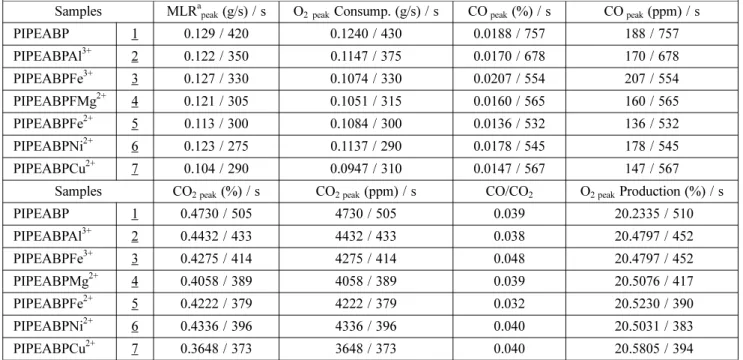
Samples MLRapeak (g/s) / s O2peak Consump. (g/s) / s CO peak (%) / s CO peak (ppm) / s PIPEABP 1 0.129 / 420 0.1240 / 430 0.0188 / 757 188 / 757 PIPEABPAl3+ 2 0.122 / 350 0.1147 / 375 0.0170 / 678 170 / 678 PIPEABPFe3+ 3 0.127 / 330 0.1074 / 330 0.0207 / 554 207 / 554 PIPEABPFMg2+ 4 0.121 / 305 0.1051 / 315 0.0160 / 565 160 / 565 PIPEABPFe2+ 5 0.113 / 300 0.1084 / 300 0.0136 / 532 136 / 532 PIPEABPNi2+ 6 0.123 / 275 0.1137 / 290 0.0178 / 545 178 / 545 PIPEABPCu2+ 7 0.104 / 290 0.0947 / 310 0.0147 / 567 147 / 567
Samples CO2 peak (%) / s CO2 peak (ppm) / s CO/CO2 O2 peak Production (%) / s PIPEABP 1 0.4730 / 505 4730 / 505 0.039 20.2335 / 510 PIPEABPAl3+ 2 0.4432 / 433 4432 / 433 0.038 20.4797 / 452 PIPEABPFe3+ 3 0.4275 / 414 4275 / 414 0.048 20.4797 / 452 PIPEABPMg2+ 4 0.4058 / 389 4058 / 389 0.039 20.5076 / 417 PIPEABPFe2+ 5 0.4222 / 379 4222 / 379 0.032 20.5230 / 390 PIPEABPNi2+ 6 0.4336 / 396 4336 / 396 0.040 20.5031 / 383 PIPEABPCu2+ 7 0.3648 / 373 3648 / 373 0.040 20.5805 / 394
aPeakmass loss rate; bO2 peakconsumption rate.
Figure 1. Mass loss rate curves of Pinus rigida specimens painted with 15 wt% methylenepiperazinomethyl-bis-phos- phonic acid (Mn+) solutions at 25 kW/m2 external heat flux.
Figure 2. Oxygen consumption rate curves of Pinus rigida specimens painted with 15 wt% methylenepiperazinomethyl- bis-phosphonic acid (Mn+) solutions at 25 kW/m2 external heat flux.
것으로 이들의 난연성과 서로 충돌하는 것으로 생각된다.
가연성 물질들은 화재 시 불이 꺼질 때 까지 다양한 연소 유독가스들을 발생시킨다. 발생되는 다양한 유독가스들 중 에서 이 연구에서는 CO, CO2, O2을 중심으로 살펴보았다.
Kimmerle의 연구(21)에 따르면 15% 미만의 O2 농도는 사람들에 치명적인 영향을 미칠 수 있기 때문이며, 또 매 우 높은 농도의 CO2와낮은 농도 CO일지라도 사람을 질 식(asphyxiant effect)시킬 수 있기 때문이다.
CO는 화염과 목재사이에서 휘발성물질의 불완전연소의 반응생성물이다. 그러므로 휘발성 물질의 분해속도의 한 측정법인 열방출률이 증가하는 것은 CO 가스 수율의 증 가가 동반된다(22). Table 2에 나타낸 바와 같이 리기다 소나무에 금속염 첨가제를 처리한 시험편에서 CO peak수 율은 PIPEABPMn+ (0.0136~0.0178% at 532~678 s)으로 서 금속염이 함유되지 않은 난연제 PIPEABP 처리 시험편 의 CO pea 수율(0.0188% at 757 s)에 비교하여 (19.5~27.6)%
낮게 나타났다. 이것은 시험편의 무기물 함량에 의한 연소 억제 효과로 인해 연기발생이 감소되는 것과 같은 맥락으
로 이해된다(23-25). 그러나 PIPEABPMFe3+ (0.0207% at 554 s)으로 처리한 시험편은 예외적으로 높았다. 이것은 Fe3+의 목재에 대한 침투성이 강하여 일부 불완전 연소효과 를 나타내는 것으로 이해된다. 이 것은 Table 2 및 Figure 5에 136~207 ppm으로 측정되었다. 즉, OSHA의 허용 기준(PEL)(26) 50 ppm의 2.72~4.14배의 치명적인 독성을 발생하는 것으로 계산되었다. 특히 PIPEABP로 처리한 시 험편의 경우, 착화 후 초기 225 s에서 52 ppm으로 나타내 어 OSHA의 허용기준을 상회하였다. 그러나 금속이온 (PIPEABPMn+)으로 처리한 시험편들은 허용기준을 넘지 않았으므로 착화 후 초기에는 인체에 피해를 주지 않을 것 으로 이해된다.
CO2 peak수율은 금속염 첨가로 처리한 시험편(2~7)에 대
하여 0.4432~0.3648% at 373~433 s으로서 금속염이 함유 되지 않은 시험편(1)의 CO2 peak 수율(0.4730% at 505 s)에 비교하여 상대적 낮게 나타났다. 이것은 알킬렌디아미노알 킬-비스-포스폰산 금속염에 의하여 열전도성 증가로 인하 여 완전연소가 조기에 이루어지는 것으로 예상된다. CO2 발생커브는 2개의 피이크를 갖는다. 첫 번째 피이크는 목 재의 가열로부터 착화기간 동안에 일어난다. 그리고 두 번 째 피이크는 시험편의 모든 표면에 열파(thermal wave)가 시험편의 뒤쪽에서 반사되므로써 시험편의 연소속도가 증 가하는 후면효과(back effect)(27)에 의하여 발생한다. 두 피 이크 사이의 CO2 발생율은 탄화과정 동안에 걸쳐서 낮아 진다. 목재가 연소하는 동안에 가열온도가 상승되면 증가 하는 질량감소속도에 따라 CO2 발생율도 증가한다.
이것은 셀룰로오스로 구성된 목재 조직에 금속염 첨가제 의 침투성과 열전도의 용이함에 의하여 초기에 CO2 peak 발 생속도가 비교적 높았으나, 시간이 경과함에 따라 CO2 peak
발생 시간은 단축되었다. Table 2 및 Figure 6에 3648~
4730 ppm으로 측정되었다. 이 것은 OSHA의 허용기준 (PEL)(28) 5000 ppm에는 미치지 못하였다. 그러나 CO2 자 체의 유독성 보다는 호흡을 자극하여 과호흡읗 일으칠 소 Figure 3. CO production (%) curves of Pinus rigida speci-
mens painted with 15 wt% methylenepiperazinomethyl-bis- phosphonic acid (Mn+) solutions at 25 kW/m2 external heat flux.
Figure 4. CO2 production (%) curves of Pinus rigida speci- mens painted with 15 wt% methylenepiperazinomethyl-bis- phosphonic acid (Mn+) solutions at 25 kW/m2 external heat flux.
Figure 5. CO production (ppm) curves of Pinus rigida speci- mens painted with 15 wt% methylenepiperazinomethyl-bis- phosphonic acid (Mn+) solutions at 25 kW/m2 external heat flux.
지가 있다. MSHA(29)에 의하면, 이산화탄소는 잠재적 흡 입 독성 물질과 단순한 질식을 가져다 준다. 그것은 폐를 통해 대기로부터 인체에 들어가서 혈액에 분 배 한 다음에 산 - 염기 불균형 또는 산성 혈액증을 일으킬 수있다. 산성 혈액증은 이산화탄소의 과잉에 의해 발생, 과량의 CO2가 더 생성쪽으로 평형을 이동하며, 수소 이온은 이와 같이 산성 환경을 조성하며 호흡 시 산성 혈액증은 혈액의 pH 는 7.35 미만이 된다. 정상적인 생리학적 환경 하에서, CO2의 높은 농도가 폐보다는 혈액 내로 확산하여, CO2 농 도 구배의 형성에서 식(4)와 같이 이산화탄소와 물의 반응 에의 탄산(H2CO3)을 형성하고 그 다음 수소 이온[H+]과 탄산수소 이온[HCO3−]로 해리된다.
CO2 + H2O ↔ H2CO3 ↔ H+ + HCO3− (4) Table 2에 CO/CO2비를 나타내었다. 각 시험편의 특성 에 따라 특별한 차별성은 없으나, PIPEABPFe2+ 5로 처리 한 시험편은 적은 값(0.032)을 가지므로 상대적으로 독성 이 낮은 것으로 예상된다.
Table 2 및 Figure 7에 의하여 나타낸 바와 같이 금속염 난연제로 처리한 시험편(2~7)의 최대 산소 생성 수율은 (20.4797~20.5805)%으로 무처리한 시험편(1)의 최대 산소 생 수율 20.2335%에 비교하여 낮은 수치를 나타내었다.
이것은 특별한 차별성이 없는 것으로서, O2의 농도는 사람 에게 치명적일 수 있는 수준인 15%(9)보다는 훨씬 높으므 로 그로 인한 위험성은 배제될 수 있었다. 따라서 메틸렌 피페라지노메틸-비스-포스폰산 금속염으로 처리한 시험편 은 처리하지 않은 시험편과 비교하여 연소-유독성을 부분 적으로 감소시켰다.
4. 결 론
4종의 메틸렌피페라지노메틸-비스-포스포닉산염과 1종 의 메틸렌피페라지노메틸-비스-포스포닉산으로 처리한 리 기다 소나무 시험편의 연소독성가스 생성에 관한 실험을 ISO 5660-1 표준에 의한 콘칼로리미터를 이용하여 수행하 였으며, 다음과 같은 결론을 얻었다.
1) CO peak 수율은 PIPEABPMn+ (0.0136~0.0178% at 532~
678 s)으로서 금속염이 함유되지 않은 난연제 PIPEABP 처리 시험편의 CO peak수율(0.0188% at 757 s)에 비교하 여 (19.5~27.6)% 낮게 나타났다. 이것은 시험편의 무기물 함량에 의한 연소억제 효과로 이해된다.
2) CO2 peak 수율은 금속염(PIPEABPMn+) 첨가로 처리한 시험편에 대하여 0.4432~0.3648% at 373~433 s으로서 금 속염이 함유되지 않은 시험편의 CO2 peak 수율(0.4730% at 505 s)에 비교하여 상대적 낮게 나타났다. 이것은 알킬렌디 아미노알킬-비스-포스폰산 금속염에 의하여 열전도성 증 가로 인하여 완전연소가 조기에 이루어지는 것으로 예상 된다.
3) CO/CO2비에 대하여 특별한 차별성은 없으나, PIPEABPFe2+로 처리한 시험편은 적은 값(0.032)을 가지 므로 상대적으로 독성이 낮은 것으로 예상된다.
4) O2의 최대생성농도는 (20.2335~20.5805% at 383~
510 s)으로서 사람에게 치명적일 수 있는 수준인 15% 보 다는 훨씬 높으므로 그로 인한 위험성은 배제 되었다.
5) 따라서 메틸렌피페라지노메틸-비스-포스폰산 금속염 으로 처리한 시험편은 처리하지 않은 시험편과 비교하여 연소-유독성을 부분적으로 감소시켰다.
References
1. R. H. White and M. A. Dietenberger, “Wood Handbook:
Wood as an Engineering Material”, Ch. 17: Fire Safety (1999).
2. A. Ernst and J. D. Zibrak, “Carbon Monoxide Poison- ing”, N. Engl. J. Med., Vol. 339, No. 22, pp. 1603-1608 (1998).
3. S. R. Thom, “Carbon Monoxide Pathophysiology and Figure 6. CO2 production (ppm) curves of Pinus rigida spec-
imens painted with 15 wt% methylenepiperazinomethyl-bis- phosphonic acid (Mn+) solutions at 25 kW/m2 external heat flux.
Figure 7. O2 production (%) curves of Pinus rigida speci- mens painted with 15 wt% methylenepiperazinomethyl-bis- phosphonic acid (Mn+) solutions at 25 kW/m2 external heat flux.
Treatment”, Physiology and Medicine of Hyperbaric Oxygen Therapy, Saunders Elsevier, Philadelphia, pp.
321-347 (2008).
4. C. L. Beyler, “SFPE Handbook of Fire Protection Engi- neering”, Section2, National Fire Protection Association, Quincy, Massachusetts, pp. 114-115 (2008).
5. “Toxicology Update”, Journal of Applied Toxicology, Vol. 19, No. 5, pp. 379-386 (1999).
6. R. D. Stewart, J. E. Peterson, E. D. Baretta, H. C. Dodd and A. A. Herrmann, “Experimental Human Exposure to High Concentrations of Carbon Monoxide”, Archives of Environmental Health, Vol. 26, No. 1, pp. 1-7 (1973).
7. D. A. Purser, “A Bioassay Model Fortesting the Incapac- itating Effects of Exposure to Combustion Product Atmo- spheres Using Cynomolgus Monkeys”, Journal of Fire Sciences, Vol. 2, No. 1, pp. 20-26 (1984).
8. B. G. King, “High Concentration-short Time Exposures and Toxicity”, Journal of Industrial Hygiene and Toxicol- ogy, Vol. 31, No. 6, pp. 365-375 (1949).
9. U. C. Luft, “Aviation Physiology: the Effects of Altitude in Handbook of Physiology”, American Physiology Soci- ety. Washington, DC, pp. 1099-1145 (1965).
10. V. Babrauskas, “New Technology to Reduce Fire Losses and Costs”, Eds. S. J. Grayson and D. A. Smith, Else- vier Appied Science Publisher, London, UK. (1986).
11. M. M. Hirschler, “Thermal Decomposition and Chemical Composition”, 239, ACS Symposium Series 797 (2001).
12. Y. J. Chung and E. Jin, “Synthesis of Alkylenediaminoal- kyl-Bis-Phosphonic Acid Derivatives”, J. of Korean Oil Chemist’s Soc., Vol. 30, No. 1, pp. 1-8 (2013).
13. M. H. Park and Y. J. Chung, “Combustive Properties of Pinus Risids Plates Painted with Alkylenediaminoalkyl- Bis-Phosphonic Acid (M2+)”, Fire Sci. Eng. Vol. 28, No.
6, pp. 28-34 (2014).
14. E. Jin and Y. J. Chung, “Combustion Characteristics of Pinus rigida Plates Painted with Alkylenediaminoalkyl- Bis-Phosphonic Acid (M2+)”, Fire Sci. Eng., Vol. 27, No.
6, pp. 70-76 (2013).
15. J. C. Kotz, P. M. Treichel and G. C. Weaver, “Electron Transfer Reactions, Chemistry & Chemical Reactivity”, Sixth Ed., Thomson Learning, Inc., Toronto, Canada (2006).
16. E. Jin and Y. J. Chung, “Combustion Characteristics of Wood Specimens Treated with Methylenepiperazinomethyl-
Bis-Phosphonic Acid (Mn+)s”, Fire Sci. Eng., Vol. 28, No. 3, pp. 55-61 (2014).
17. Y. J. Chung, “Combustive Properties of Specimens Treated with Methylenepiperazinomethyl-Bis-Phosphonic Acid (Mn+)s”, Appl. Chem. Eng., Vol. 26, No. 4, in press (2015).
18. ISO 5660-1, “Reaction-to-Fire Tests-Heat Release, Smoke Production and Mass Loss Rate - Part 1: Heat Release Rate (Cone Calorimeter Method)”, Genever (2002).
19. V. Babrauskas, “The SFPE Handbook of Fire Protection Engineering”, Fourth Ed., National Fire Protection Asso- ciation, Massatusetts, U.S.A. (2008).
20. J. G. Quintire, “Principles of Fire Behavior”, Chap. 5, Cengage Learning, Delmar, U.S.A. (1998).
21. G. Kimmerle, “Aspects and Methodology for the Evalua- tion of Toxicological Parameters During Fire Exposure”, Journal of Combustion Toxicology, Vol. 1 (1973).
22. A. P. Mourituz, Z. Mathys and A. G. Gibson, “Heat Release of Polymer Composites in Fire”, Composites:
Part A, Vol. 38, No. 7, pp. 1040-1054 (2005).
23. M. M. Hirscher, “Reduction of Smoke Formation from and Flammability of Thermoplastic Polymers by Metal Oxides”, Polymer, Vol. 25, (March), pp. 405-411 (1984).
24. J. Zhang, D. D. Jiang and C. A. Wilkie, “Thermal and Flame Properties of Polyethylene and Polypropylene Nanocomposites Based on an Oligomerically-modified Clay”, Polm. Degrad. Stab., Vol. 91, pp. 298-304 (2006).
25. Y. J. Chung, H. M. Lim, E. Jin and J. K. Oh, “Combus- tion-retardation Properties of Low Density Polyethylene and Etylene Vinyl Acetate Mixtures with Magnesium Hydroxide”, Appl. Chem. Eng., Vol. 22, pp. 439-443 (2011).
26. OHSA, “Carbon Monoxide”, OSHA Fact Sheet, United States National Institute for Occupational Safety and Health, September 14 (2009).
27. M. J. Spearpoint and G. J. Quintiere, “Predicting the Burning of Wood Using an Integral Model”, Combus- tion and Flame, Vol. 123, pp. 308-325 (2000).
28. OHSA, “Carbon Dioxide”, Toxicological Review of Selected Chemicals, Final Rule on Air Comments Proj- ect, OHSA’s Comments, Jannuary 19 (1989).
29. MSHA, “Carbon Monoxide”, MSHA’s Occupational Ill- ness and Injury Prevention Program Topic, U.S. Depart- ment of Labor (2015).