319
JOURNAL OF KOREAN FOREST SOCIETY
콘칼로리미터를 이용한 소나무와 밤나무의 연소특성
정 영 진*
강원대학교 소방방재공학과
Combustion Characteristics of the Pinus Rigida and Castanea Savita Using Cone Calorimeter
Yeong-Jin Chung*
Department of Fire and Disaster Prevention, Kangwon National University, Kangwo-do 245-711, Korea
요 약: 건자재로서나무결함중의하나는그의가연성이다. 본연구의목적은한국에서자란리기다소나무와밤나 무의연소성질을시험하는것과건자재로서의사용에대한바람직한특성을알아내는것이다. 콘칼로리미터(ISO 5660- 1)는열방출율과 CO, CO2 발생과연기차폐와같은연기지수를측정하는데이용되어졌다. 50 kW/m2의열속하에서 밤나무의평균열방출율은 소나무의평균열방출율 150.77 kW/m2과비교하여 160.7 kW/m2을나타내었다. 밤나무는
소나무에비해숯생성으로인한증대된난연성을보였다. 밤나무는 소나무에비하여높은 CO 수율과높은 CO/CO2
수율을나타내었다.
Abstract:
One of the limitation of wood as building material is its flammability. The purpose of this paper is to examine the combustion properties of the pinus rigida and castanea savita which are grown in Korea and meet the desirable characteristics for use of construction materials. The cone calorimeter (ISO 5660-1) was used to determine the heat release rate (HRR) and fire smoke index, as well as CO and CO
2production and smoke obscuration. The HRR
meanof the castanea savita at 50 kW/m
2was 160.7 kW/m
2in comparison with 150.7 kW/
m
2for the pinus rigida. Castanea savita showed an increase of retardant properties attributed to char formation compared with that of pinus rigida. The castanea savita has high CO
peakyield and high CO/CO
2yield compared with that of pinus rigida.
Key words
:
Heat release rate, combustion characteristics, fire smoke index, char formation서 론
요즈음나무는친환경적
,
저탄소녹색성장의동력으로 주목을끌고있다.
그러나건자재로서나무의결점은그의가연성이다
.
일반적으로나무의주요성분은셀룰로오스
:
활엽수(40- 44%),
침엽수(40-44%),
헤미셀룰로오스:
활엽수(23-40%),
침엽수
(20-32%),
리그닌:
활엽수(15-25%),
침엽수(25-35%)
등의비율로이루어진다
(Shafizadeh and DeGroot, 1976).
이들은아주다른열분해특성이있으며
,
이것은구성물질들이다른온도범위에따라휘발성물질들을방출하며 분해한다
(Drysdale, 1996):
셀룰로오스240-350
oC,
헤미셀 룰로오스200-260
oC,
리그닌280-500
oC.
나무의열분해특성은리그닌성분이증가됨에따라더높은온도로변한 다
.
그의방향족화학구조는900
oC
에서35-38%
에달하는 높은숯(char)
을만들어낼수있다(Chirico
et al., 2002).
이는리그닌함량이다른물질보다많기때문이다
.
또한목재의 탄화속도는목재의열분해와열발생의상호작용 에영향을 받으며
,
이들은목재의 종류,
밀도,
습기함량,
열 침투성
,
열적특성과 같은 많은 변수들의 함수이다(Dehaan, 2002; Micael, 1999; Yang, 2003).
숯은산소가쉽게연소영역에접근하는것을허용하지 않기때문에폴리머물질의연소속도를감소시킨다
(Pearce
et al
., 1981).
나무는연소될때타르와검뎅이의침착에의 하여 동반된 연기를 방출한다(Carle and Brown, 1976;
Kubler, 1980).
나무의불완전연소가일어난다면대부분의 경우에
carbon monoxide, nitrous oxides, sulphur oxides, polycyclic aromatic hydrocarbon(PAH)
그리고입*Corresponding author
E-mail: [email protected]
자들이방출된다
(Tissari
et al., 2007; Glasius, 2006).
나무의열분해및연소의거동에대하여착화는중간열
속
(heat flux)
에서백열을거쳐서염열로진행하며그다음증대된열속으로부터직접염열로발전된다
(Bilbao
et al.,
2001).
이연구는 발연착화에대하여최소열속에 대한정보를제공한다
.
또이론적인착화모델로표면의숯연 소를포함한나무의열분해에대하여콘칼로리미터를이 용하여 나무결방향또는 그의수직방향으로하여 방사 열속에노출될때수직방향으로나무의백열및불꽃착 화를연구했다(Boonmee and Quintiere, 2002; 2004).
본연구의목적은 콘칼로리미터를이용하여소나무와 밤나무의열방출율및연기발생을비교하고자한다
.
재료 및 실험방법
본연구에서사용된시험목은한국에서자란나무종으 로서경기도용인소재지역농부로부터직접얻었다
.
그리고선택된종은전형적인수종이다
. ISO 3130, 1975
에의하여측정된학명과수분함량을포함하는시험에서사
용된나무종이
Table 1
에나타내었다.
나무를베어서각나무를연소하는기간은약
2
년이경과되었다.
시편의bulk
밀도는그의무게와시험하기전의부피로부터계산되어 졌다
.
콘칼로리미터
(ISO 5660-1, 2002)
는다음주성질을결정하는데사용되어졌다
:
열방출율(HRR), CO
와CO
2생산 과 연기차폐와 같은 화재연기지수(EN 13823, 2002;
Chung, 2007).
dual cone calorimeter(Fire Testing Technology)
에 의한 열방출율측정은대부분의유기재료가연소중에산소1 kg
이소비되면약
13.1 MJ
의열이방출되는산소소비원리를바탕으로하고있다
(Hirschler. 2001).
설정한복사열에노출 된시편이착화되어연소될때의열방출율은연소생성물 흐름속의산소농도와유속으로부터유도된산소소비량을 측정하여평가하였다.
재료의연소로인한열방출량과단위면적당열방출율은식
(1)
과(2)
에의하여계산된다. (1) (2)
이때
q
A(t) :
단위면적당열방출율(kW/m
2), q(t) :
열방출율
(kW), A
s:
실험체의 표면적(m
2),
Δh
c:
순수연소열(kJ/
kJ), r
o:
화학양론적산소대연료질량비, C :
산소소비량 보정상수(m
1/2kg
1/2K
1/2), P :
오리피스의압력차(Pa), T
e:
오리피스에서의기체의절대온도
(K), XO
2: O
2의몰분율에 대한산소분기눈금판독값, X
oO
2:
산소분석기눈금의초 기값이다.
콘칼로리미터시험은현재실제화제조건을가장잘모 사한시험방법으로서일정량의공기를 공급하면서재료
의연소성을정확하게평가할수있는동적방법
(dynamic
method)
이다.
실험방법은ISO 5660-1
에따라실시하였고, 10 mm
시편을100 mm
×100 mm( 2 mm)
정사각형으로 절단하고온도23±2
oC,
상대습도50±5%
에서항량이될 때까지유지한다음알루미늄호일로비노출면을감싼다.
시험에앞서콘히터의열량이설정값
±2%
이내,
산소분석 기의산소농도가20.95±0.01%
가되도록교정하고배출유 량을0.024±0.002 m
3/s
로설정하였다.
시험편은고밀도세라믹섬유보드위의저밀도섬유
blanket
에놓여졌다.
모서리프레임은모서리프레임효과를최소화하기위해사 용되어졌다
.
시험은ISO 5660-1
표준으로1
분당평균질량손실율이
150 g/m
2미만으로떨어질때종료되어졌다.
모든연소시험은그들의재현성을보증하기위하여
3
번씩 수행하였다.
본연구에서선정된시료는 콘칼로리미터에수평으로 설치하고외부점화장치를부착한상태로
50 kW/m
2복사열에수분동안노출시켜착화되는시간과착화된시료로 부터열방출율및연소파라미터를구하였다
.
결과 및 고찰
1. 열방출율
물질의성질은그것이연소할때열이물질로부터방 출되어지는속도
,
연기생성,
가스독성을결정한다.
시험 하는동안에결정되는주연소특성은열방출율(heat release
rate, HRR)
이다.
그것은연소모델링을위하여중요한측정이다
(Babrauskas, 1984; Babrauskas and Grayson, 1992).
물질에 관련된연소의 이해를 돕는다른중요한성질은 착화시간
(time to ignition, TTI)
과 질량손실율(mass loss rate, MLR)
이다.
외부 열원
50 kW/m
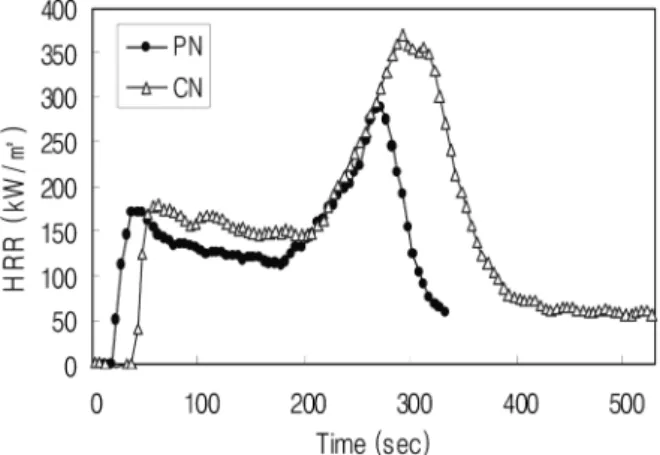
2에서 시험된 천연나무 종의HRR
mean는소나무(150.7 kW/m
2)
가밤나무(160.7 kW/m
2)
q t( ) (Δhc⁄ro)(1.10)C P TΔ ⁄ c XoO2–XO21.105 1.5XO– 2 ---
=
qA( )t =q t( )⁄As
–o
Table 1. Properties of wood species used in tests.
Samples Class Height
(m) Age
(years) Density
(kg/m3) Moisture content
Pinus rigida Softwood 12.5 24 419 (%)10
Castanea sativa Hardwood 10.5 27 654 11
와비교하여매우빈약한거동을나타내었다
(Table 2).
이 것은Table 1
에나타낸바와같이밤나무의밀도(654 kg/
m
3)
에비하여소나무의밀도(419 kg/m
3)
가작은결과로설명된다
(Tran and Wite, 1992).
또한같은이유로소나무와 밤나무는HRR
peak에도달된시간이 각각270 s, 290 s
로나타났다
. Figure 2
에서보여준바와같이밤나무는강한난연성을가지는것으로나타났다
. HRR
커브는소나무와밤나무가비슷한경향을보여준다
.
그럼에도불구하고연소의끝에서
2
가지물질의잔여물 들이완전히다르다는것을아는것은중요하다.
밤나무 의연소후잔여물은소나무의잔여물과비교하여오직 검은색으로나타났다.
소나무종은부드러운힌색의재였 다.
이것은일반적으로각수종중에서추출된리그닌함량을가지고연관지어설명될수있겠으나
,
동일한 실험 조건에서원하는동일한수종을택하여실시된비교실험 결과 자료를 얻기는 매우 어렵다.
따라서 잘알려진(Shafizadeh and DeGroot, 1976)
침엽수영역에속하는소나무의리그닌함량
(25-35%)
과활엽수영역에속하는밤나무리그닌 함량
(18-25%)
에의해숯생성(Chirico
et al.,
2002)
을비교할수있다.
그러나이것은 무리가따를수있으며
,
숯생성은기타많은변수들과의함수관계가있는 것이 설득력이 있다고 판단된다(Dehaan, 2002; Micael, 1999; Yang, 2003).
소나무의연소시에는다른수종에비 하여일반적으로잘알려진테르핀류의휘발성물질을많 이함유하는것에대하여더욱지배적인연소반응이이루 어지는것으로판단된다.
연소의착화시간
(TTI)
은각종에대하여Table 2
에나타내었다
. TTI
는밤나무가37 s
로소나무(17 s)
에비하여늦어진다
. Figure 2
에서나타낸바와같이밤나무는숯생성을나타내었다
.
이로인하여밤나무는숯의단열효과(Pearce
et al.
, 1981)
로강한난연성을나타내는것으로파단된다.
질량손실율
(MLR)
은화재거동에대하여추가적인정보를 준다
(Delichatsios
et al., 2002). Figure 3
에서 보여준50 kW/m
2 에서소나무의평균MLR
은0.109 g/s,
밤나무 는0.112 g/s
였다.
그러나연소하는동안초기의질량손실 율에대해서는특별한차이가없으나시간이지남에따라 소나무는질량손실율이소멸되나밤나무는끝가지 유지 되는것을볼수있었다.
이것은위에서언급한두가지나무종의연소의착화
(TTI)
와같은맥락으로밀도차이와숯생성으로인한숯의단열효과로설명될수있다
(Pearce
et al
., 1981).
Table 2. Combustion properties of native wood species.
Samples aTTI
(s) bMLRmean
(g/s) cHRRmean
(kW/m2) dTSRwhole
(m2/m2) eSEAmean
(m2/kg) COmean
(kg/kg) CO2mean
(kg/kg) CO/CO2
Pinus rigida 17 0.109 150.7 200.4 51.55 0.0083 1.14 0.0072
Castanea sativa 37 0.112 160.7 213.6 31.67 0.0148 1.21 0.0122
aTime to ignition; bMass loss rate; cHeat release rate; dTotal smoke release; eSpecific extinction area
Figure 1. HRR curves of native wood species at 50 kW/m
2external heat flux. PN: Pinus rigida, CN: Castanea sativa.
Figure 2. The residues of native wood after combustion.
Figure. 3. MLR curves of native wood species at 50 kW/m
2external heat flux.
2. 연기와 탄소 산화물 방출
물질에관련된연소의이해를돕는또다른중요한파 라미터는연기와
CO
가스의방출이다.
일반적으로나무의 연소가스생성물의독성은CO
2를동반하는CO
의방출에의하여결정되어진다
.
그결과는Table 2
에주어진다.
총연기방출율
(total smoke release, TSR
whole)
은소나무와 밤나무가각각200.4 m
2/m
2, 213 m
2/m
2였다(Figure 4).
이 들값의미미한차이로는어떠한특성을설명하기에는부 족하다.
연기차폐는비소화면적(specific extinction area,
SEA
meann)
으로 설명되어 진다.
비소화면적은연기방출율(smoke production rate, SPR)
을질량감소율로나눈것으 로연기관련지수로많이연구되고있다.
소나무의비소 화면적(51.55 m
2/kg)
은밤나무(31.67 m
2/kg)
보다대단히높게나타났다
(Figure 5).
그것은소나무가연소의초기단계에서쉽게빠른속도로연소되기때문으로판단된다
.
또 한밤나무의비소화면적이소나무보다상대적으로적은 것은밤나무가난연효과의존재와더불어저발연성종임 을알수있었다.
CO
와CO
2의 수율은 물질 연소에 의존한다(Hull and Paul Keith, 2007). Figure 6
은 콘칼로리미터에서방출된 시간에따른CO
mean생산을나타낸다.
밤나무에의해방출 된CO
의양은소나무의그것보다점차적으로증가되어진 다.
소나무로부터CO
의생산은시간에따라감소되어진 다.
밤나무로부터CO
생산은소나무의것보다비교적높다
(
소나무: 0.0083 kg/kg,
밤나무: 0.0148 kg/kg).
Figure 7
은콘칼로리미터에서방출된시간에따른CO
2생산을나타내었다
.
소나무는320 s
에서CO
2peak: 2544 kg/
kg
로밤나무(CO
2peak: 8.68 kg/kg at 355 s)
의그것에비교하여매우높은수율의
CO
2를방출했다.
이것은순간적으로완전한연소가일어나고있는것을나타나고
, CO/CO
2비가낮은것은노출독성이낮다는것을나타낸다
. 결 론
한국에서자란소나무와밤나무종의열방출율과연기 발생을측정하였다
.
1.
소나무의HRR
mean(150.7 kW/m
2)
는 밤나무(160.7 Figure 4. TSR curves of native wood species at 50 kW/m
2external heat flux.
Figure 5. SEA curves of native wood species at 50 kW/m
2external heat flux.
Figure 6. CO production rate curves of native wood species at 50 kW/m
2external heat flux.
Figure 7. CO
2production rate curves of native species wood
at 50 kW/m
2external heat flux.
kW/m
2)
와비교하여낮은열방출을나타내었다.
이것은 밤나무의 밀도(654 kg/m
3)
에 비하여소나무의 밀도(419 kg/m
3)
가작은결과로설명된다.
또한같은이유로밤나무는소나무의
TTI(17 s)
에비하여오랜시간동안의TTI
가소요되었다
(37 s).
2.
밤나무는 소나무에비하여높은CO
mean수율(0.0148 kg/kg)
과높은CO/CO
2수율(0.0122)
을방출하였다.
그러 나밤나무는낮은SEA
mean(31.67 m
2/m
2)
을나타내었다.
그것은밤나무가저발연성수종이며
,
연소공정중에소나무 에비하여많은양의숯을생성하여불완전연소를하기 때문으로판단된다.
3.
밤나무는비교적높은CO
mean 수율(0.0148 kg/kg)
때문에연소시소나무와비교해서인체에더욱위험한나무 종으로판단된다
.
인용문헌
1. Babrauskas, V. 1984. Development of cone calorimeter-A bench-scale heat release rate apparatus based on oxygen consumption, Fire and Materials 8(2): 81-95. doi: 1002/
fam.810080206
2. Babrauskas, V. 2001. Ignition of wood, pp. 71-88. In : A Review of the State of the Art. Interflam 2001, Inter- science Communications Ltd., London, UK.
3. Babrauskas, V. and Grayson, S.J. 1992. Heat release in Fires, E & FN Spon (Chapman and Hall), London, UK.
pp. 644.
4. Bilbao, R., Mastral J.F., Aldea, J., Ceama, N. Bertran, N., Lana, J.A. 2001. Experimental and theretical study of the ignition and smoldering of wood including convective effects, Combustion Flame 126: 1363-1372.
5. Boonmee, N. and Quintiere, J.G. 2002. Glowing the igni- tion and burning rate of wood. pp. 289-296. In: Twenty- ninth Symposium (international) on combustion, The Combus- tion Institute, 29.
6. Boonmee, N. and Quintiere, J.G. 2004. Glowing ignition of wood: the onset of surface combustion. pp. 2303-2310.
In: Thirtieth Symposium (international) on Combustion, The Combustion Institute. 30.
7. Carle, J.B. and Brown J.L.1976. Wood as a source of solid fuel. In : Watt, G.S. ed. a review, New Zealand For- est Service, Auckland. NZ.
8. Chirico, A.D., Armanini, M., Chini, P., Cioccolo, G., Provasoli, F., and Audiso, G. 2002. Flame retardants for polypropylene based on lignin, Polymer Degradation and Stability 79: 139-145.
9. Chung, Y.J. 2007. Flame retardancy of veneers treated by ammonium salts, Journal of the Korean Industrial & Engi- neering Chemistry 18: 251-254.
10. DeHaan, J.D. 2002. Kirks's fire investigation, pp. 84-112.
fifth edition, Prentice Hall.
11. Delichatsios, M., Paroz, B. and Bhargava, A. 2003. Flam- mability properties for charring materials, Fire Safety Journal 38: 219-228.
12. Drysdale, D. 1996. An introduction to fire dynamics, john Wily & Sons, U.S.A.
13. EN 13823, 2002. Reaction to Fire Tests for Building Products. Building Products Excluding Floorings Exposed to the Thermal Attack by a Single Burning Item.
14. Glasius, M., Ketzel, M., Wahlin, P., Jensen, B., Monster, J., Berkowicz, R. and Palmgren F. 2006. Impact of wood combustion on particle levels in a residential area in Den- mark, Atmospheric Environment 40(37): 7115-7124. doi :10.1016/j.atmosenv.2006.06.047
15. Hirschler, M. 2001. Thermal decomposition and chemical composition, pp. 239-300, American Chemical Society Symposium Series 797.
16. Hull, R.T. and Paul Keith, T. 2007. Bench-scale assess- ment of combustion toxicity-a critical analysis of current protocols, Fire Safety Journal 42(5): 340-365. doi: 10.1016/
j.firesaf.2006.12.006
17. ISO 3130, 1975. Wood-Determination of Moisture Con- tent for Physical and Mechanical Tests.
18. ISO 5660-1, 2002. Reaction-to-Fire Tests ñHeat Release, Smoke Production and Mass Loss RateñPart 1: Heat Release Rate (Cone Calorimeter Method)-Part 2: Smoke Production Rate (Dynamic Measurement).
19. Kubler, H. 1980. Wood as building and hobby material, pp.139-149J. John Wiley & Sons, Inc., U.S.A.
20. Michael, J.S. 1999. Predicting the ignition and burning rate of wood in the cone calorimeter using an intergral model, pp.30-46. NIST GCR 99-775, U.S.A.
21. Pearce, F.M., Khanna, Y.P. and Raucher, D. 1981. Ther- mal analysis in polymer flammability, Chap. 8. In : Ther- mal Characterization of Polymeric Materials, Academic Press, New York, U.S.A.
22. Shafizadeh, F. and DeGroot, W. F. 1976. Combustion characteristics of cellulosic fuels. In : Shafizadeh F., Sarkenen K.V. and Tillman D.A. edds. Thermal Uses and Properties of Carbohydrates and Lignins, Academic Press, New York, U.S.A.
23. Tissari, J., Hytonen, K. Lyynranen, J. and Jokinienmi J.
2007. A nodel field measurement method for determining fire particle and gas emissions from residential wood combustion, Atmospheric Environment 41(37): 8330-8344.
24. Tran, H.C. and White R.H. 1992. Burning rate of solid wood measured in a heat release calorimeter, Fire Mater, 16: 197-206.
25. Yang, L., Chen, X., Zhou, X. and Fan, W. 2003. The pyrolysis and ignition of charring matrials under an exter- nal heat flux, Combustion and Flame 133: 407-413.
(2009년 4월 14일 접수; 2009년 6월 5일 채택)