online©ML Comm
□ 원 저 □
생물정신의학 Vol. 16, No. 2, May 2009
No Association Study of SLC6A4 Polymorphisms with Korean Autism Spectrum Disorder
*Hee Jeong Yoo, M.D., Ph.D.,
1)In Hee Cho, M.D., Ph.D.,
2)Mira Park, Ph.D.,
3)So Young Yang,
4)Soon Ae Kim, M.D., Ph.D.
4)5)†한국인 자폐스펙트럼장애와 SLC6A4 유전다형성의 연관 연구*
유희정1)·조인희2)·박미라3)·양소영4)·김순애4)5)†
bjectives:The serotonin transporter gene(SLC6A4) is one of the most widely studied candidate genes in autism spectrum disorder(ASD), but there have been conflicting results from studies into the associat- ion between SLC6A4 and ASD. The aim of this study was to evaluate the association between single nucleotide polymorphisms(SNPs) in the SLC6A4 gene and ASD in the Korean population.
Methods:We selected 12 SNPs in SLC6A4 and observed the genotype of 151 Korean ASD trios. We tested the family-based association for each individual polymorphism and haplotype by using the standard TDT me- thod in Haploview(http://www.broad.mit.edu/mpg/haploview/).
Results:Through transmission-disequilibrium testing and haplotype analysis, we could not find any statisti- cally significant transmitted allele or haplotype. In addition, a case-control association test with Korean HapMap data did not reveal any statistical significance.
Conclusion:Although serotonin-related genes must be considered candidate genes for ASD, we suggest that common SNPs of SLC6A4 are not important markers for associations with Korean ASD.
KEY WORDS:Autistic disorders·Serotonin transporter·Genetic polymorphism·Haplotypes·Association.
서 론
O
ABSTRACT
*This work was supported by the Korea Research Foundation Grant funded by the Korean Government(MOEHRD, Basic Research Promotion Fund)(KRF-2006-311-E00266). And Mira Park was supported by the Korea Research Foundation Grant funded by the Korean Government(MOEHRD, Basic Research Promotion Fund)(KRF-2007-531-C00018).
1)분당서울대학교병원 정신과 Department of Psychiatry, Seoul National University Bundang Hospital, Seongnam, Korea
2)가천의과대학교 길병원 정신과학교실 Department of Neuropsychiatry, Gachon Medical School, Incheon, Korea
3)을지대학교 의과대학 예방의학교실 Department of Preventive Medicine, School of Medicine, Eulji University, Daejeon, Korea
4)을지대학교 의과대학 약리학교실 Department of Pharmacology, School of Medicine, Eulji University, Daejeon, Korea
5)을지대학교 의과학연구소 Medical Sciences Research Institute, Eulji University, Daejeon, Korea
†교신저자:김순애, 301-746 대전광역시 중구 용두동 143-5
전화) (042) 259-1672, 전송) (042) 259-1668, E-mail) [email protected]
Introduction
Autism spectrum disorders(ASDs) are neuropsy- chiatric developmental disorders characterized by im- pairment in social communication and a preference for repetitive and solitary interests and behaviors. Se- veral family and twin studies have reported the role of genetics in the etiology of autism.1) In association genetic studies for ASDs, several neurotransmitter genes such as serotonin-related genes are considered as candidate genes because of the possible involvement of neurochemical effects in pathogenesis of ASDs.
Serotonin(5-hydroxytryptamine or 5-HT) has been considered to play an important role in ASD develop- ment. A relatively high platelet serotonin level was observed in a subset of ASD subjects and their first- degree relatives2);the blood serotonin level was also found to correlate with the verbal intelligence quo- tient(IQ) and the severity of the disorder.3-5) The use of selective serotonin reuptake inhibitor drugs(SSRIs) was found to improve some symptoms such as repe- titive behavior, aggression, and language use in indi- viduals with autistic disorder.6-8) Numerous genes, for example, the serotonin transporter gene, the trypto- phan hydroxylase gene, and the monoamine oxidase A gene, are involved in regulating serotonin levels, and some of them have been screened in ASD indi- viduals.9-12)
The serotonin transporter is a major component of the serotonergic system and is thought to play a role in autism pathogenesis. The serotonin transporter gene
( SLC6A4 )
is one of the most widely studied can- didate genes for ASD;it is located in chromosome 17q11.2 and has 14 exons. Several linkage studies and genome-wide screening studies have found evidence of a linkage near the serotonin transporter gene.13-15) Some studies have also reported an association bet- ween autism and polymorphic markers in the SLC6A4 gene, such as 5-HTTLPR insertion-deletion polymor- phisms in the promoter region. The association between the 5-HTTLPR polymorphism of SLC6A4 and ASD has produced controversial results that touch upon ethnic diversity, methods of genetic analysis, and sym-ptom profiles of ASD.9)14)16-20) It is suggested that hy- perserotonemia in ASD may be associated with the effects of regulation and expression of SLC6A4 via the 5-HTTLPR promoter polymorphism.21)22) The re- sults of the association analysis using single nucleo- tide polymorphisms(SNPs) of SLC6A4(i.e., rs2020 942, rs2066713, and rs2020936) in several studies were controversial. Kim et al.17) reported an associat- ion between autism and these SNPs in 115 trios ex- amined, but their results were not consistent with those of McCauley et al.14) or Wu et al.23) In their ex- tensive study with large cohort samples, Ramoz et al.24) reported the absence of a linkage or association with 9 SNPs and 5-HTTLPR covering SLC6A4 or any haplotypes.
By using the transmission/disequilibrium test(TDT), we found a significant preferential transmission of the long allele of 5-HTTLPR in Korean ASD.25) To further investigate the role of SLC6A4 in susceptibi- lity of Korean population to ASD, we evaluated the association between ASD and common SNPs of SLC
6A4 by using 151 ASD trios in the Korean population.
Methods
1. Subjects
The subjects were recruited from a family-based genetic association study of ASD conducted by the same research group.25)26) Subject ascertainment and diagnostic methods have been described previously.
Briefly, ASD was diagnosed using the Autism Diag- nostic Interview-Revised(ADI-R)27) and the Korean version of the Autism Diagnostic Observation Sche- dule(ADOS)28) with the best estimates of 2 board-cer- tified child psychiatrists. Subjects diagnosed to have or strongly suspected of having neurofibromatosis, tu- berous sclerosis, metabolic encephalopathies, Down’s syndrome, Fragile X syndrome, or other known chro- mosomal abnormalities were excluded. We obtained written informed consent from all participants, and the study was approved by the Institutional Review Boards(IRB) of the participating institutions. This study included 151 complete trios, consisting of pa- tients with ASD(79.9±35.6 months, 86.1% males,
87.4% autism, 13.5% Pervasive Developmental Dis- order-Not Otherwise Specified(PDD-NOS), and 1.6%
Asperger’s disorder) and their biological parents. Th- eir psychological characteristics were almost similar, as described previously.26)
For a case-control association study, we used Ko- rean HapMap project data of 7 SNPs(rs3813034, rs 1042173, rs6352, rs140701, rs2020942, rs6354, and rs2020936) in the SLC6A4 gene from 90 Korean adult samples with a 1:1 male to female ratio(http:
//sysbio.kribb.re.kr:8080/khapmap/index.jsp).
2. Genotyping
Blood samples from all subjects were collected in tubes containing EDTA and stored at -70℃. Geno- mic DNA was extracted using the G-spin Genomic DNA Extraction Kit(Intron, Daejeon, Korea).
We evaluated the genetic structure of SLC6A4 by using the Entrez SNP Database(http://www.ncbi.nlm.
nih.gov/) and determined SNP in the coding region (cSNP) and a common genetic variation of SLC6A4 (i.e., SNPs in the gene region with minor allele fre- quencies >5% in 2 Asian populations). We selected 5 cSNPs(rs6352, rs28914834, rs28914832, rs2228673, and rs28914828), 4 SNPs in the intronic regions(rs 3794808, rs140701, rs2020942, and rs2020936), 1 SNP in the 5’-untranslated region(rs6354), 1 SNP in the 3’-untranslated region(rs1042173), and 1 SNP in the 3’-near gene region(rs3813034) of SLC6A4. Ge- notyping was performed using the GoldenGateTM as- say(Illumina, San Diego, USA).
3. Statistical analysis
To evaluate the data quality and the presence of genotypic errors, we evaluated the Hardy-Weinberg equilibrium and Mendelian inheritance of the genoty- pes within the trios. We tested the family-based as- sociation for each individual polymorphism and ha- plotype by using the standard TDT method in Ha- ploview(http://www.broad.mit.edu/mpg/haploview/).
Statistical significance was defined as p<0.05.
To evaluate the power of the samples to detect an excessive transmission of alleles, we used the program PBAT.29) We assume that autism prevalence to be K=
0.006, with a targeted significance level of 0.05. In terms of the frequency of the disease allele, we used observed frequency of the highly transmitted allele and we employed the additive model.
Tests to compare the alleles, genotypes and haplo- type frequencies of cases with those of Korean Hap- Map controls were conducted using SNPAlyze 5.0.4 (Dynacom, Chiba, Japan).
Results
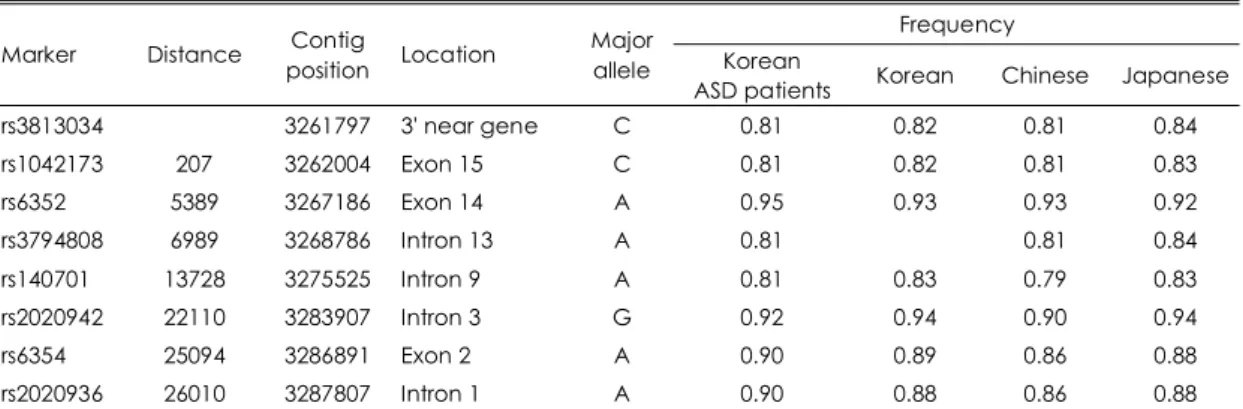
The genotypic distribution for all the SNPs did not deviate from that expected based on the Hardy-Wein- berg equilibrium. Four cSNPs(rs28914834, rs2891 4832, rs2228673, and rs28914828) were monomor- phic. Information on these SNPs is given in Table 1.
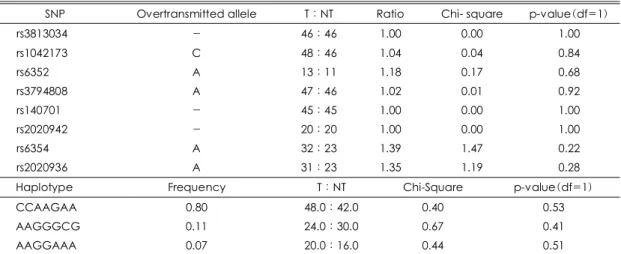
In the TDT analysis, we did not find any statistically significant overtransmitted SNP alleles in the ASDs (Table 2). Estimation of the pairwise linkage disequ-
Table 1. Information of single nucleotide polymorphism of the SLC6A4 gene
Frequency Marker Distance Contig
position Location Major
allele Korean
ASD patients Korean Chinese Japanese rs3813034 3261797 3' near gene C 0.81 0.82 0.81 0.84 rs1042173 207 3262004 Exon 15 C 0.81 0.82 0.81 0.83 rs6352 5389 3267186 Exon 14 A 0.95 0.93 0.93 0.92 rs3794808 6989 3268786 Intron 13 A 0.81 0.81 0.84 rs140701 13728 3275525 Intron 9 A 0.81 0.83 0.79 0.83 rs2020942 22110 3283907 Intron 3 G 0.92 0.94 0.90 0.94 rs6354 25094 3286891 Exon 2 A 0.90 0.89 0.86 0.88 rs2020936 26010 3287807 Intron 1 A 0.90 0.88 0.86 0.88
Frequency of Korean population for each marker is obtained from the information by Korean HapMap data- base. And that of the other populations are obtained from the information by International HapMap database
ilibrium(LD) to determine the extent of LD for the SNPs showed that all the SNPs were in strong dise- quilibrium(D’>0.9) with each other(Table 3). Be- cause of strong LDs among the SNP markers, in the haplotype analysis, we found only 3 haplotypes con- sisting of 7 SNPs in SLC6A4, and we did not observe any significant association between the haplotypes and ASD(Table 2).
We used an odds ratio(OR) of 1.7 for carrying one disease allele. Considering the prevalence of ASD in 0.6% of general population, the power of TDT for rs 1042173, rs6352, rs3794808, rs6354, and rs2020936 was 0.373, 0.131, 0.378, 0.218, and 0.218, respectively.
A type I error rate of 0.05 was used in all calculations.
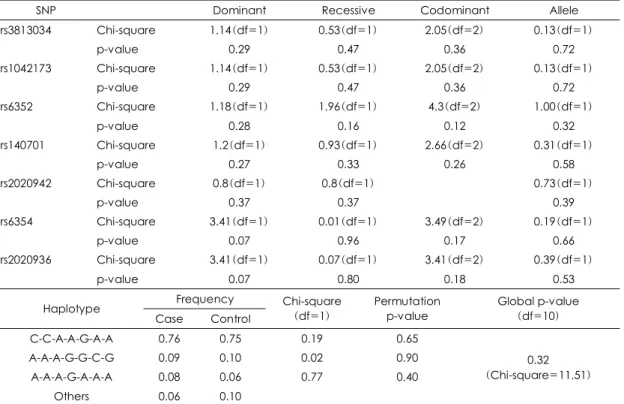
In the case-control association analysis, we did not observe any statistically significant differences in all- ele, genotype, and haplotype frequencies between our
ASD cases and the Korean HapMap controls(Table 4).
Discussion
Several previous reports have indicated the possi- bility of a linkage and/or association between SLC6A4 and ASD. Kim et al.17) revealed an association between autism and SNPs of SLC6A4 in 115 trios. However, studies involving TDTs have failed to reveal any consistent evidence of this association. In the present study, we did not observe any statistically significant transmission from biological parents to Korean ASD children with more SNPs(i.e., 12 SNPs in the SLC 6A4 gene, of which 8 SNPs were analyzed with sta- tistical tools) in the TDT and haplotype analysis. Mo- reover, the power values of our study were very small, and our study has potential limitations with regard to
Table 3. Linkage disequilibrium matrix between SNPs of the SLC6A4 gene in Korean autism spectrum disorder family data
D’/r2 rs3813034 rs1042173 rs6352 rs3794808 rs140701 rs2020942 rs6354
rs1042173 1.00/0.98
rs6352 1.00/0.01 1.00/0.01
rs3794808 0.99/0.97 1.00/0.99 1.00/0.01
rs140701 0.99/0.98 0.99/0.96 1.00/0.01 0.99/0.97
rs2020942 0.89/0.28 0.95/0.31 1.00/0.01 0.95/0.31 0.89/0.28
rs6354 0.95/0.51 0.95/0.50 1.00/0.01 0.95/0.50 0.95/0.51 1.00/0.01
rs2020936 0.98/0.53 0.98/0.52 1.00/0.01 0.98/0.53 0.98/0.53 1.00/0.01 1.00/0.97 Table 2. Transmission disequilibrium test of the SLC6A4 gene in Korean autism spectrum disorders trios
SNP Overtransmitted allele T:NT Ratio Chi- square p-value(df=1)
rs3813034 - 46:46 1.00 0.00 1.00
rs1042173 C 48:46 1.04 0.04 0.84
rs6352 A 13:11 1.18 0.17 0.68
rs3794808 A 47:46 1.02 0.01 0.92
rs140701 - 45:45 1.00 0.00 1.00
rs2020942 - 20:20 1.00 0.00 1.00
rs6354 A 32:23 1.39 1.47 0.22
rs2020936 A 31:23 1.35 1.19 0.28
Haplotype Frequency T:NT Chi-Square p-value(df=1)
CCAAGAA 0.80 48.0:42.0 0.40 0.53
AAGGGCG 0.11 24.0:30.0 0.67 0.41
AAGGAAA 0.07 20.0:16.0 0.44 0.51
Haplotypes were constructed with rs3813034+rs1042173+rs3794808+rs140701+rs2020942+rs6354+rs2020936. T:
transmitted, NT:not transmitted
detection of causative variants or variants with more modest effects. Furthermore, the control subjects were not age and sex matched with the study subjects, and psychiatric disorders in the control subjects were not evaluated. Nonetheless, the results of the case-control analysis did not reveal any statistically significant re- sults.
The reason for these differences in association re- sults might be as follows. First, ethnic differences might contribute to different genetic associations. This study included only Asian Korean population, similar to the study of Wu et al.(175 Han Chinese trios)23); thus, the sample population differed from that used in the study by Kim et al.(94 Caucasians, 7 Americans, 8 Asian Americans, and 6 Hispanics).17) Second, the sample size of the study by Kim et al. was relatively small compared to that of our study. Therefore, the results of the study by Kim et al need to be consi- dered. Finally, the genetic heterogeneity of ASDs and the possibility of involvement of other genes or en-
vironmental factors such as gene-gene interaction or gene-environmental interaction must be considered.
Although our study had certain limitations such as relatively small sample size and a lack of information on phenotypes and environmental risk factors, our findings suggest that common SNPs(minor allele frequency of more than 0.01) and haplotypes for
SLC6A4 do not appear to significantly contribute to
ASD in the Korean population. Nonetheless, we be- lieve that the association study of the 5-HTTLPR(not SNPs) marker for SLC6A4 must be replicated in a larger Korean population, together with a phenotypic analysis, because of its functional effects and a pre- vious report on positive association.25)References
1. Bailey A, Le Couteur A, Gottesman I, Bolton P, Simo- noff E, Yuzda E, et al. Autism as a strongly genetic dis- order: evidence from a British twin study. Psychol Med 1995;25:63-77.
Table 4. Case-control association test between the SLC6A4 gene and autism spectrum disorder in Korean po- pulation
SNP Dominant Recessive Codominant Allele Chi-square 1.14(df=1) 0.53(df=1) 2.05(df=2) 0.13(df=1)
rs3813034
p-value 0.29 0.47 0.36 0.72 Chi-square 1.14(df=1) 0.53(df=1) 2.05(df=2) 0.13(df=1)
rs1042173
p-value 0.29 0.47 0.36 0.72 Chi-square 1.18(df=1) 1.96(df=1) 4.3(df=2) 1.00(df=1)
rs6352
p-value 0.28 0.16 0.12 0.32 Chi-square 1.2(df=1) 0.93(df=1) 2.66(df=2) 0.31(df=1)
rs140701
p-value 0.27 0.33 0.26 0.58 Chi-square 0.8(df=1) 0.8(df=1) 0.73(df=1)
rs2020942
p-value 0.37 0.37 0.39 Chi-square 3.41(df=1) 0.01(df=1) 3.49(df=2) 0.19(df=1)
rs6354
p-value 0.07 0.96 0.17 0.66 Chi-square 3.41(df=1) 0.07(df=1) 3.41(df=2) 0.39(df=1)
rs2020936
p-value 0.07 0.80 0.18 0.53 Frequency
Haplotype
Case Control
Chi-square (df=1)
Permutation p-value
Global p-value (df=10) C-C-A-A-G-A-A 0.76 0.75 0.19 0.65
A-A-A-G-G-C-G 0.09 0.10 0.02 0.90 A-A-A-G-A-A-A 0.08 0.06 0.77 0.40
Others 0.06 0.10
0.32 (Chi-square=11.51)
Haplotypes were constructed with rs3813034+rs1042173+rs6352+rs140701+rs2020942+rs6354+rs2020936
2. Cross S, Kim SJ, Weiss LA, Delahanty RJ, Sutcliffe JS, Leventhal BL, et al. Molecular genetics of the pla- telet serotonin system in first-degree relatives of patients with autism. Neuropsychopharmacology 2008;33:353-360.
3. Abramson RK, Wright HH, Carpenter R, Brennan W, Lumpuy O, Cole E, et al. Elevated blood serotonin in autistic probands and their first-degree relatives. J Au- tism Dev Disord 1989;19:397-407.
4. Anderson GM, Freedman DX, Cohen DJ, Volkmar FR, Hoder EL, McPhedran P, et al. Whole blood seroto- nin in autistic and normal subjects. J Child Psychol Psy- chiatry 1987;28:885-900.
5. Cook EH, Leventhal BL. The serotonin system in au- tism. Curr Opin Pediatr 1996;8:348-354.
6. Anderson GM. Genetics of childhood disorders: XLV.
Autism, part 4: serotonin in autism. J Am Acad Child Adolesc Psychiatry 2002;41:1513-1516.
7. Gordon CT, State RC, Nelson JE, Hamburger SD, Ra- poport JL. A double-blind comparison of clomipramine, desipramine, and placebo in the treatment of autistic dis- order. Arch Gen Psychiatry 1993;50:441-447.
8. McDougle CJ, Naylor ST, Cohen DJ, Volkmar FR, He- ninger GR, Price LH. A double-blind, placebo-controll- ed study of fluvoxamine in adults with autistic disorder.
Arch Gen Psychiatry 1996;53:1001-1008.
9. Persico AM, Pascucci T, Puglisi-Allegra S, Militerni R, Bravaccio C, Schneider C, et al. Serotonin transpor- ter gene promoter variants do not explain the hyperse- rotoninemia in autistic children. Mol Psychiatry 2002;7:
795-800.
10. Betancur C, Corbex M, Spelewoy C, Philippe A, La- planche JL, Launay JM, et al. Serotonin transporter gene polymorphisms and hyperserotoninemia in autistic disorder. Mol Psychiatry 2002;7:67-71.
11. Jones MB, Palmour RM, Zwaigenbaum L, Szatmari P.
Modifier effects in autism at the MAO-A and DBH loci.
Am J Med Genet B Neuropsychiatr Genet 2004;126B:
58-65.
12. Veenstra-VanderWeele J, Anderson GM, Cook EH Jr.
Pharmacogenetics and the serotonin system: initial stu- dies and future directions. Eur J Pharmacol 2000;410:
165-181.
13. International Molecular Genetic Study of Autism Con- sortium(IMGSAC). A genomewide screen for autism:
strong evidence for linkage to chromosomes 2q, 7q, and 16p. Am J Hum Genet 2001;69:570-581.
14. McCauley JL, Olson LM, Dowd M, Amin T, Steele A, Blakely RD, et al. Linkage and association analysis at the serotonin transporter(SLC6A4) locus in a rigid-com- pulsive subset of autism. Am J Med Genet B Neuro- psychiatr Genet 2004;127B:104-112.
15. Yonan AL, Alarco´ n M, Cheng R, Magnusson PK, Sp- ence SJ, Palmer AA, et al. A genomewide screen of 345 families for autism-susceptibility loci. Am J Hum
Genet 2003;73:886-897.
16. Conroy J, Meally E, Kearney G, Fitzgerald M, Gill M, Gallagher L. Serotonin transporter gene and autism: a haplotype analysis in an Irish autistic population. Mol Psychiatry 2004;9:587-593.
17. Kim SJ, Cox N, Courchesne R, Lord C, Corsello C, Akshoomoff N, et al. Transmission disequilibrium ma- pping at the serotonin transporter gene(SLC6A4) re- gion in autistic disorder. Mol Psychiatry 2002;7:278-288.
18. Persico AM, Militerni R, Bravaccio C, Schneider C, Me- lmed R, Conciatori M, et al. Lack of association be- tween serotonin transporter gene promoter variants and autistic disorder in two ethnically distinct samples. Am J Med Genet 2000;96:123-127.
19. Yirmiya N, Pilowsky T, Nemanov L, Arbelle S, Feinsi- lver T, Fried I, et al. Evidence for an association with the serotonin transporter promoter region polymorphism and autism. Am J Med Genet 2001;105:381-386.
20. Zhong N, Ye L, Ju W, Brown WT, Tsiouris J, Cohen I.
5-HTTLPR variants not associated with autistic spec- trum disorders. Neurogenetics 1999;2:129-131.
21. Coutinho AM, Oliveira G, Morgadinho T, Fesel C, Ma- cedo TR, Bento C, et al. Variants of the serotonin tr- ansporter gene(SLC6A4) significantly contribute to hy- perserotonemia in autism. Mol Psychiatry 2004;9:264- 271.
22. Lesch KP, Bengel D, Heils A, Sabol SZ, Greenberg BD, Petri S, et al. Association of anxiety-related traits with a polymorphism in the serotonin transporter gene re- gulatory region. Science 1996;274:1527-1531.
23. Wu S, Guo Y, Jia M, Ruan Y, Shuang M, Liu J, et al.
Lack of evidence for association between the serotonin transporter gene(SLC6A4) polymorphisms and autism in the Chinese trios. Neurosci Lett 2005;381:1-5.
24. Ramoz N, Reichert JG, Corwin TE, Smith CJ, Silver- man JM, Hollander E, et al. Lack of evidence for as- sociation of the serotonin transporter gene SLC6A4 with autism. Biol Psychiatry 2006;60:186-191.
25. Cho IH, Yoo HJ, Park M, Lee YS, Kim SA. Family- based association study of 5-HTTLPR and the 5-HT2A receptor gene polymorphisms with autism spectrum dis- order in Korean trios. Brain Res 2007;1139:34-41.
26. Yoo HJ, Cho IH, Park M, Cho E, Cho SC, Kim BN, et al. Association between PTGS2 polymorphism and autism spectrum disorders in Korean trios. Neurosci Res 2008;62:66-69.
27. Yoo HJ. Korean version of Autism Diagnostic Interview- Revised(ADI-R). Hakji-sa, Seoul;2007.
28. Yoo HJ, Kwak Y. Korean version of Autism Diagnostic Observation Schedule(ADOS). Hakji-sa, Seoul;2007.
29. Lange C, DeMeo DL, Laird NM. Power and design con- siderations for a general class of family-based associat- ion tests: quantitative traits. Am J Hum Genet 2002;71:
1330-1341.