장마기 집중호우와 배수방법이 토양수분 및 포도 ‘진옥’과 ‘캠벨얼리’의 광합성 특성과 생육에 미치는 영향
최영민
1
⋅정성민2
⋅최동근1*
1)1
전북대학교 원예학과,2
국립원예특작과학원 과수과(2016년 11월 3일 접수; 2016년 12월 16일 수정; 2017년 2월 14일 수락)
Effects of Heavy Rain during Rainy Season and Drainage Methods on Soil Water Content, Photosynthesis Characteristics, and Growth in
‘Jinok’ and ‘Campbell Early’ Grapes
Young Min Choi 1 , Sung Min Jung 2 and Dong Geun Choi 1*
1 Department of Horticulture, Chonbuk National University, Jeonju 54896, Korea
2 Fruit Research Division, Institute of Horticultural & Herbal Science, Rural Development Administration, Wanju 55365, Korea
(Received November 3, 2016; Revised December 16, 2016; Accepted February 14, 2017)
ABSTRACT
Recently, it is increasing the grape farm which is converted from paddy field to orchard. These soil which are poor drainage extremely also can be damaged a lot by excessive water or flooding during heavy rain season on summer. Therefore the aim of this study was carried out to measure the changes of soil water potential and to compare the growth responses of ‘Jinok’ (Vitis spp.) and ‘Campbell Early’ (V. labruscana) grapes under three drainage systems (control, conventional drainage, and under drainage). After heavy rain, soil water potential holding times above -15 kpa applied water excessive were 352, 348 and 180 hours in control, conventional, and under drainage systems, respectively. The clay content of the under drainage system was lower than the other systems about 8-12%. The crop water stress index was lowest in the under drainage and highest in the control. Also, photosynthetic rate has showed the opposite result with crop water stress index. It was significant differences between the treatments but, the value has not shown significantly different between the varieties. In addition, leaf area and the trunk growth rate was more effective in under drainage than in the control and conventional drainage.
Key words: Crop water stress index (CWSI), Severe rain storm, Trunk growth, Photosynthetic rate, Under drainage
* Corresponding Author : Dong Geun Choi ([email protected])
DOI: 10.5532/KJAFM.2017.19.1.1
ⓒ Author(s) 2017. CC Attribution 3.0 License.
I. 서 언
우리나라의 연강수량은 평균적으로 1,000∼1,800mm 로 적은 편은 아니고, 계절적으로는 연강수량의 50∼
60%가 여름에 집중되어 있어 여름철 토양 과습 또는 침 수에 의한 농작물 피해와 병해충의 2차적 피해가 발생할 수 있다. 또한 고소득을 목적으로 논에서 밭으로 전환하 는 농가 중 포도 재배 농가의 수가 증가하고 있으며, 논 토 양의 경우 토양 물리성이 매우 불량해 장마기 침수피해 가 가중되기도 한다.
배수불량 농경지에서 암거배수의 주된 목적은 뿌리 주변의 과잉수분을 배제시킴으로써 토양의 통기성을 좋 게 하고, 토양산소의 부족에 의한 토양환원을 막아 수분 스트레스를 최소화하여 작물의 생산성을 높이고 작업 환경을 개선하여 농작업의 효율성을 높이기 위해 이루 어지고 있으며(Skaggs et al., 1982), 명거배수는 시설비 투자 없이 배수할 수 있는 방법으로 관행적으로 이용되 고 있으나 논 토양의 특성 상 한계가 있다. 그 동안 논의 배수개선 연구는 주로 배수 불량지 및 저습답 개량, 간척 지 제염의 한 방법으로 연구되어 왔다(Han et al., 1970;
Joo, 1976; Kim, 1976; Kwun et al., 1980; Lee et al., 2001). Ji(1981)는 논에서 밭작물을 재배하기 위한 지하 배수 목표량을 50mm⋅day
-1
, 지표 잔류수 허용일수를 1일 이내, 지하수위저하속도(강우 후 2∼3일 지하수위) 를 40∼50cm, 투수계수 10∼4cm⋅sec-1
이상으로 각 각 설정한 바 있으며, 지하 침입수로 인한 지하수위 상승 을 억제하고 항시 지하수위를 지표면 아래 0.5∼0.6m 깊 이까지 저하시켜야 한다고 보고한 바 있다.따라서 본 연구는 집중호우 시 배수방법별 토양수분 의 변화 정도와 그에 따른 생육반응을 비교하고, 또한 국 립원예특작과학원에서 1983년 ‘델라웨어’에 ‘캠벨얼 리’를 교배하여 2004년 최종 선발한 품종인 포도 ‘진옥’
과 대비품종으로 ‘캠벨얼리’를 선정하여 품종간 토양수 분에 대한 반응을 비교하고자 수행하였다.
II. 재료 및 방법
2.1. 기상자료 수집 및 배수방법
2015∼2016년 동안의 기온 특성 조사는 포도배수시 험포장과 약 300m 떨어진 전북대학교 과수실험실습포 장(35°51'04.3"N 127°07'53.0"E) 내 설치된 자동기상관 측시스템(AWS, automatic weather system)을 이용하였 으며, AWS에 내장된 데이터로거(CR1000, Campbell
Scientific, USA)를 통해 자료를 수집하였다. 또한 평균 강우량과 누적강우량의 변화는 기상청(KMA) 자료를 이용하였다.
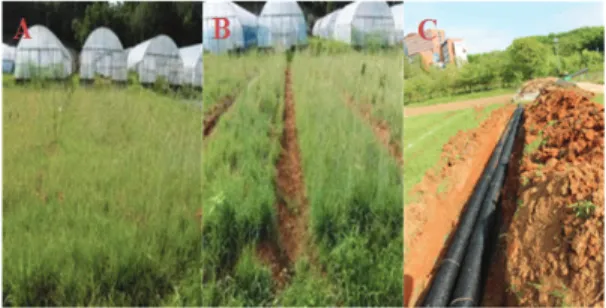
선정한 시험포장은 전북대학교 교내 시험포장 중 답전 전환 포장과 비슷한 조건을 가진 토양을 선정하였으며, 식재 전 토양 배수처리를 위해 명거배수(conventional drainage)는 식재 열간 중앙부를 30cm 깊이로 골을 만들 어 자연적인 배수를 유도하였으며, 암거배수(under drainage)는 재식열에 50∼60cm 깊이로 5∼7%의 경사 를 주어 직경이 25cm인 유공관 2개씩을 매설하였다. 무 처리(control)는 물이 고이지 않도록 지균작업을 하고, 명거배수 및 암거배수시 토양수분과 생육을 비교하였다 (Fig. 1).
Fig. 1. The different drainage system before planting in
grape orchard. A: control, B: conventional drainage, C:under drainage.
2.2. 실험수 관리
실험재료인 포도 ‘진옥’과 ‘캠벨얼리’는 5C (V.
berlandieri * V. riparia)에 접을 붙인 1년생 접목묘를
2015년 5월 20일 식재하여 2015∼2016년에 걸쳐 조사 하였다. 재식거리는 2×2.5m로 식재하였고 수형은 웨이 크만형(Wakeman System)으로 유도하였으며, 모든 재배 관리는 농촌진흥청 표준영농재배에 준하여 관리하였다.2.3. 토양 환경 조사
토양수분포텐셜과 지온은 7월 4일부터 7월 21일까지 토양환경측정로거(Almemo 2890-9, Alhborn Corp.
Germany)에 지중온도센서와 텐시오메터를 지표로부 터 20cm 깊이에 매설하여 일변화를 측정하였다.
토양입도분석은 2015년 5월 식재전과 2016년 10월 에 토양샘플을 채취하여 농촌진흥청 농업과학기술 연구 조사분석기준안(2012)에 준하여 Pipette법을 이용하여 산출하였다.
2.4. 광합성속도 측정
광합성 관련 parameters의 측정은 휴대용 광합성측정 장치(LC pro+, ADC Bioscientific Ltd., England)를 이 용하여 광량(Photosynthetic Photon Flux, PPF)은 1,000 μmol⋅m
-2
⋅s-1
, CO2
는 ambient, 엽면적은 6.25cm2
로 조절하여 광합성속도(A, photosynthetic rate)를 측정하 였다. 측정시기는 강우 시작 5일(7월 4일), 10일(7월 9 일), 14일(7월 13일) 오전 9시 30분부터 12시 사이에 처리당 6 잎을 측정하였다.2.5. 엽온, 작물스트레스지수(CWSI, crop water stress
index) 및 열지수(IG
, water vapor transfer) 조사 잎의 표면온도는 열화상카메라(testo 882, TestoAG, Germany)를 이용하여 잎과의 측정 거리로 30cm 간격을 두어 방사율(emissivity) 0.95의 조건에서 배수처리당 6 잎을 정오(midday)에 측정하였으며, 데이터 추출은 IR soft를 이용하여 잎의 가장자리와 엽맥을 제외한 엽신의 최소 30지점 이상을 포인트로 지정한 후 작물스트레스 지수와 열지수를 다음 식(Idso et al., 1981; Jackson, 1982)에 대입하여 산출하였다.T
l
은 측정 대상의 엽온이며, Twet
는 수관하부의 햇빛 을 받지 않는 완전히 전개된 잎의 엽온, Tdry
는 햇빛을 충 분히 받고 있는 수관상부의 완전히 전개된 잎의 엽온에 서 산출하였다.2.6. 엽면적 및 주간단면적 조사
엽면적(leaf area)은 8월 하순경 배수처리별 중⋅상 위에 착엽한 15엽을 채취하여 측정하였으며, 주간단면 적은 2015년과 2016년 각각 낙엽기에 모든 처리 주를 대상으로 접목부 상단 10cm 높이에서 디지털버니어캘 리퍼스를 이용하여 측정하였다.
2.7. 통계분석
수집된 데이터의 분석은 Windows용 SAS system release 8.01(SAS Institute Inc, Cary, N.C., USA)을 이 용하여 Duncan의 다중검정(DMRT), T-검정 및 요인분 석(factor analysis)을 실시하였다.
III. 결과 및 고찰
3.1. 기상 변화
우리나라의 강수 특성은 여름철 위험강우기(장마기) 에 연중 강수량의 대부분이 집중되어 있는 것으로 알려 져 있다. 기상청(KMA)에서 제공하는 자료를 토대로 1981-2010년까지 총 30년간의 월별 강우량을 보면 6월 167.9, 7월 299.6, 8월에 277.5mm의 강우가 내렸으며, 연 총 강우량(1313.2mm)의 56.7%(745.0mm)가 이 시 기에 집중되어 있음을 알 수 있다(Fig. 2). 또한 포도 ‘진 옥’과 ‘캠벨얼리’의 재식시기인 2015년에는 30년 평균 치에 비해 강수량이 적은 편이었으나 2016년의 6∼7월 의 평균강수량은 30년 평균치와 비슷하였다.
Fig. 2. Average precipitation (A) and cumulative
precipitation (B) in Jeonju area. Standard data (1981-2010) is average precipitation during 30 years.집중호우기(장마기)의 강수량도 토양수분과 작물생 육에 밀접한 관계가 있으나, 이 시기의 연속 강우일수 또 한 매우 중요하다. 토양 배수가 불량한 과원에서는 이 시 기의 연속적 강우에 의해 과습 또는 침수와 같은 토양 조 건이 수일간 지속될 수 있는데, 이는 근권 내 급격한 산소
감소(Kozlowski, 1997)로 작물 생육에 직⋅간접적인 영 향을 줄 수 있으며, 이 시기 생육이 쇠약해진 작물은 강우 이후 나타나는 강한 일사에서 일소와 같은 생리장해나 병해충 등 2차적 피해가 발생할 수도 있다.
2016년에는 남부지방을 중심으로 6월 18일부터 7 월 16일까지 약 한 달간 장마가 지속되었는데, 강수일 수 15.8일에 평균강수량 283.8mm를 기록하였다 (KMA). 특히 연속강우 일수는 5∼7일로, 이 기간 시험 포장 내 약 222.5mm의 많은 강우가 내렸으며(Fig.
3A), 누적 강수량이 6월 30일부터 7월 5일까지 급격 히 증가하였다(Fig. 3B). 이 시기(6월 30일부터 7월 5 일까지)의 강수량은 2016년 1월부터 10월까지 강수 량의 21.5%에 해당한다.
Fig. 3. Diurnal variation of precipitation, duration of
sunshine (A), and accumulation rainfall (B) in experiment area during the rainy season.3.2. 집중호우에 의한 토양수분 변화
집중호우기에 배수처리별로 배수력을 평가하기 위해 7월 5일부터 21일까지 약 15일간 토양수분퍼텐셜 측정 센서와 지온센서를 토중에 매설하였다. 동일시기의 무 처리, 명거배수, 암거배수의 지중온도는 순서대로 평균 26.0, 25.9, 25.1℃를 보여 무처리와 명거배수가 암거배
수보다 약 1℃ 정도 높게 유지되었으며, 상대적으로 지 온의 편차가 크게 나타났다(Fig. 4B).
일반적으로 주요 온대과수의 적정 토양수분은 -20∼
-40kpa로 알려져 있는데, 본 실험기간동안의 명거배수 와 무처리구의 토양수분은 -15kpa 이하로 낮아지지 않 아 과습에 대한 기준을 -15kpa로 임의 설정하였다. 토양 수분포텐셜은 무처리와 명거배수가 비슷한 경향을 보였 고 암거배수가 집중강우 이후 급격히 낮아지는 경향을 보였으며 1주일 간격으로 약 -10kpa 수분이 감소하여 뚜렷한 차이를 보였다(Fig. 4A). 7월 5일부터 21일까지 배수처리 토양의 토양 과습 유지시간은 Fig. 5와 같다.
-15kpa을 기준으로 이상의 토양수분 유지시간은 무처 리, 명거배수, 암거배수가 각각 352, 348, 180시간으로 암거배수가 다른 배수처리구에 비해 약 50% 수준으로 낮았다. -15∼-10, -10∼-5, -5kpa 유지시간도 암거배수 가 매우 낮아 상대적으로 집중호우에 의한 배수 효과는 암거배수가 더 양호할 것으로 판단되었다.
Fig. 4. Diurnal variation of soil water potential (A) and
soil temperature (B) in experiment area during the rainy season.Treatment Cont rol
Conv entio nal d raing e
Unde r dra inage
C u m u la tiv e t im e of so il w a te r p o te n tia l ( h r)
0 100 200 300 400
> -5 kpa
> -10 kpa
> -15 kpa
240 92 20
204 108 36
28 68 84
Fig. 5. Dwelling time of soil water potentials according
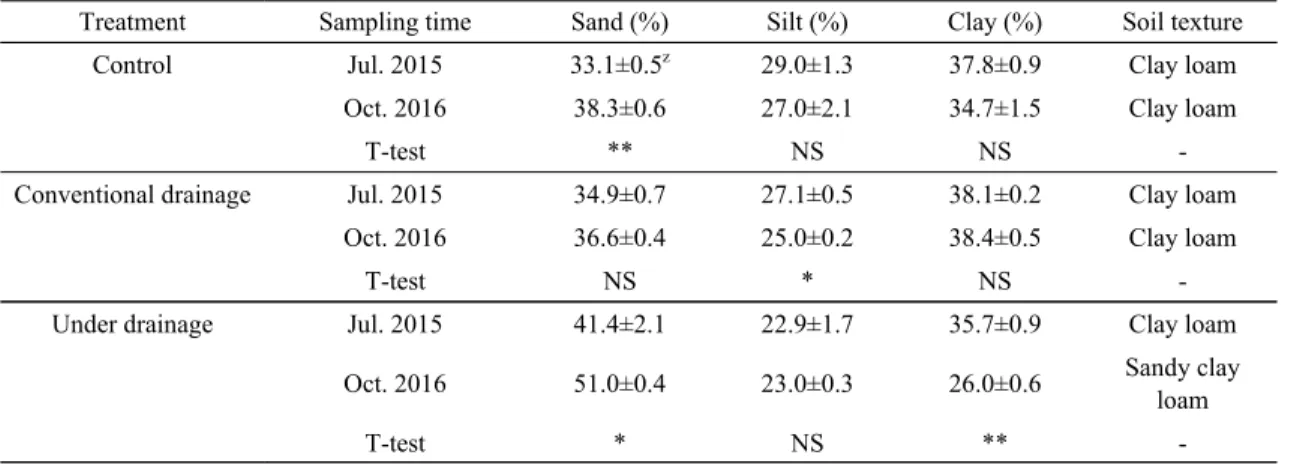
to different drainage methods during 16 days (total 384 hours).토양의 입도는 2015년 시험수 식재 전, 점토가 무처 리, 명거, 암거배수 순으로 37.8, 38.1, 35.7%로 35∼
38% 이내에 포함되었다. 2015년과 2016년의 점토함량 의 T-검정 결과는 암거배수에서 각각 35.7, 26.0%로 약 9.7% 유의하게 감소하였고 모래함량은 증가하였으며, 토성 역시 식양토(clay loam)에서 사질식양토(sandy clay loam)으로 변경되었다(Table 1). 무처리구에서 모 래의 함량이 유의하게 증가하였고 명거배수에서는 미사 의 함량이 감소하였으나 토양의 배수력은 토양의 점토 함량에 의해 크게 영향을 받게 되므로 점토 함량에 의존 적이다. 또한 배수불량 논에 암거배수를 설치하여 지하 배수를 촉진시킨 결과 명거배수구와 무처리구에 비해
암거배수구에서 통기성, 내수성, 투수력, 마찰저항, 전 단저항이 증가하고 토양수분 함량, 용적밀도, 토양경도 등이 감소하여 밭 토양으로 전환될 수 있다(Doh et al., 1994). 이러한 결과는 시설재배지 심토에 암거배수관을 설치할 경우에도 효과가 있는 것으로 보고되었다(Kim
et al., 2003; Kim et al., 2006). 따라서 논토양이나 점토
함량이 매우 높아 입단의 형성이 어려운 배수불량토양 에서의 암거배수는 토양의 물리성을 향상시켜 배수가 양호해짐을 의미한다.3.3. 광합성속도와 작물스트레스 지수의 차이
작물에서의 적외선 열화상(infrared thermography) 은 물이 기공을 통해 소실될 때 엽온은 감소하지만 기공 이 닫히면 증산은 더 이상 발생하지 않고 증산에 의한 열 의 하강이 이루어지지 않으므로 잎의 온도가 올라간다 는 사실에 기인한다(Fuchs, 1990; Gates, 1964; Jones etal., 2002). 즉 작물의 스트레스 정도를 판단하기 위해 수
관 및 잎을 대상으로 한 열적이미지의 접근방법은 수분 이 기공을 통해 소실됨에 따라 잎이 냉각되고, 반대로 기 공닫힘은 엽온이 증가한다는 원칙을 기반으로 한다 (Grant et al., 2012). 이 방법은 포도의 수분 상태 평가 (Costa et al., 2012; Jones et al., 2002), 수분스트레스 비 교(Gardner et al., 1981), 육종효율 증진과 자연 생태계 의 관리 및 모니터링(Grant et al., 2012) 등에 이용되어 왔다. 따라서 열적인 특성을 측정하는 것은 식물 수분스 트레스의 지표로써 이용될 수 있으며(Jones, 2004), 물리 적 접촉을 통한 기공 반응 방해를 억제할 우려가 있는 가Treatment Sampling time Sand (%) Silt (%) Clay (%) Soil texture Control Jul. 2015 33.1±0.5
z
29.0±1.3 37.8±0.9 Clay loam Oct. 2016 38.3±0.6 27.0±2.1 34.7±1.5 Clay loamT-test ** NS NS -
Conventional drainage Jul. 2015 34.9±0.7 27.1±0.5 38.1±0.2 Clay loam Oct. 2016 36.6±0.4 25.0±0.2 38.4±0.5 Clay loam
T-test NS * NS -
Under drainage Jul. 2015 41.4±2.1 22.9±1.7 35.7±0.9 Clay loam Oct. 2016 51.0±0.4 23.0±0.3 26.0±0.6 Sandy clay
loam
T-test * NS ** -
z
means±S.E.NS, *, **
Nonsignificant or significant at P = 0.05, 0.01.Table 1. Physical properties of soil according to different drainage methods in cultivated ‘Jinok’ and ‘Campbell Early’
grapes vineyard
스교환 측정방법보다 간편하고 빠르다는 장점을 가진다 (Guilioni et al., 2008).
잎의 열적인 특성을 이용하여 산출한 배수방법간 작 물스트레스지수(CWSI)는 두 품종 모두 무처리구에서 명거배수 및 암거배수보다 높게 나타났으며, 명거배수 와 암거배수간, 그리고 품종간에는 유의한 결과를 보이 지 않았다(Table 2). 유사하게 water vapor transfer (I
G
) 는 무처리에서 가장 낮게 조사되었다(Table 2). 스트레 스를 받는 작물에서 작물스트레스지수는 높아지고 water vapor transfer는 낮아진다는 사실은 많은 연구결 과들과 일치하였다(Grant et al., 2012; Idso et al., 1981;Jackson, 1982).
집중호우가 시작된 6월 30일을 기준으로 5일(7월 4 일), 10일(7월 9일), 14일(7월 13일)의 광합성속도를 조 사한 결과(Table 2), 조사기간 내 두 품종 모두 명거배수 와 무처리구는 암거배수보다 광합성속도가 낮았고 암거 배수의 경우 호우 5일, 10일까지는 큰 변화가 없었으나 호우 후 14일에는 약간 감소하여 상대적으로 명거배수 또는 무처리구보다 과습에 의한 광합성속도 감소가 지 연된 것으로 판단되었다.
일반적으로 광합성속도와 기공전도도(stomatal condu- ctance)간에는 높은 정의 상관관계를 나타내며(Faria et
al., 1996), 기공개폐(Kozlowski and Pallardy, 1979;
Sena Gomes and Kozlowski, 1980a; 1980b; 1980c)와
water vapor transfer간에는 고도로 유의한 부의관계가 성립된다(Grant et al., 2012). 따라서 이러한 관계는 스 트레스를 받은 식물체가 스트레스를 받지 않은 식물체 보다 작물스트레스지수가 높아지고 water vapor transfer 는 낮으며, 광합성속도와 기공전도도는 작물스트레스 지수와 정의관계, water vapor transfer와는 부의관계가 있음을 의미한다. 이러한 의미로 Table 2에서와 같이 암 거배수처리는 두 품종 모두에서 작물스트레스지수가 낮 고 water vapor transfer와 광합성속도가 높게 나타나는 것은 과다한 집중 호우와 연속강우일수에 의해 명거배수 및 무처리구의 토양이 산소가 부족한 혐기성 상태가 되는 것에 기인하며, 이로 인해 뿌리의 양수분흡수가 저해되 어 지상부의 생육에 영향을 미치는 것으로 판단된다. 반 면 작물스트레스지수와 water vapor transfer는 품종 내 배수 방법간 유의한 차이는 존재하나 품종간에는 유의 한 결과를 보이지 않았는데, 두 가지 변수의 측정시에는 일조량, 기온, 바람, 습도와 같은 환경적 요인과 작물의 수분상태 등과 같은 내적 요인 등 여러 가지 요인들이 복 합적으로 영향을 미치기 때문으로 생각된다. 따라서 작 물 수체 열적인 특성을 이용한 스트레스의 신속한 평가는 일부 가능하나 보다 정밀한 측정을 위해서는 온실과 같이 환경요인의 제어가 가능한 곳에서의 측정이 효과적일 것 으로 판단되며, 위와 같은 조건들을 고려해야 함으로 일 정 부분 한계가 있음을 시사한다.
Cultivar Drainage methods Water uptake efficiency Photosynthetic rate (umol⋅m
-2
⋅s-1
)CWSI
I G 5 DARz
10 DAR 14 DAR
Jinok
Control 1.06±0.12
y
ax
0.06±0.12b 10.6±0.4c 11.3±0.4c 11.6±0.4b Conventional drainage 0.71±0.10b 0.82±0.38a 12.5±0.5b 12.8±0.5b 10.3±0.3c Under drainage 0.66±0.05b 0.62±0.15ab 16.2±0.3a 16.0±0.4a 13.8±0.4a CampbellEarly
Control 1.46±0.17a 0.24±0.09b 11.2±0.4c 12.2±0.6b 12.2±0.5b Conventional drainage 0.94±0.07b 0.15±0.13b 12.5±0.4b 13.2±0.5b 11.1±0.4b Under drainage 0.64±0.13b 1.54±0.68a 16.0±0.4a 16.5±0.3a 14.0±0.5a Significance
Cultivar (A) NS NS NS NS *
Treatment (B) NS NS * ** **
A * B NS * NS NS NS
z
Days after rainfall.y
Standard errors.x
Means followed by the same letters in columns are not significantly different according to DMRT test (p ≤ 0.05)NS, *, **
Nonsignificant or significant at P = 0.05.Table 2. Effect of the different drainage methods on crop water stress index (CWSI), water vapor transfer (I G), and photosynthetic rate (A) in ‘Jinok’ and ‘Campbell Early’ grapevines
3.4. 엽과 주간부 생육의 차이
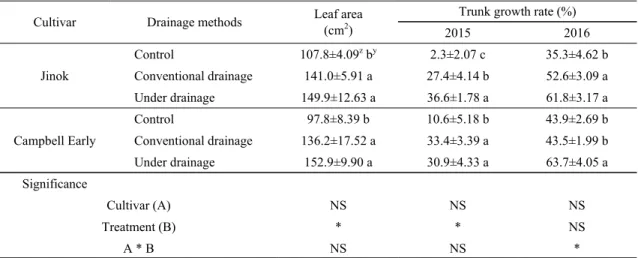
앞서 집중호우기에 암거배수는 무처리와 명거배수보 다 배수가 효과적이고 이 시기의 작물의 생육반응에도 지 대한 영향을 미치는 것을 알 수 있었다. 이러한 결과들은 수체의 생육에도 영향을 미치는데, 그 결과는 Table 3과 같다. 엽면적의 경우, 두 품종 모두 무처리구가 가장 낮았 으며, 명거배수와 암거배수간에는 통계적 차이는 존재하 지 않았으나 수치적으로 암거배수가 약간 높은 경향이었 다. 또한 주간부 단면적의 생장율은 2015, 2016년과 두 품종 모두 엽면적지수와 마찬가지로 무처리구가 가장 낮 았으며, 2016년 포도 ‘진옥’의 암거 및 명거배수간 차이 는 없고 ‘캠벨얼리’에서의 차이는 존재하였다.
엽면적에서의 두 배수처리(암거, 명거배수)는 큰 차 이를 보이지 않았는데, 이는 집중강우 이전에 이미 완전 히 전개된 잎을 채취하여 측정하였으므로 2016년 7월 동안의 집중강우의 영향이라기보다는 2년에 걸친 배수 방법에 따라 무처리가 지속적으로 토양의 여러 물리화 학적 특성이 약화된 결과로 생각된다. 토양의 과습과 침 수는 산소부족으로 인해 TCA 회로가 정상적으로 작동 되지 않고 ATP가 주로 알코올 발효에 의해서 합성되므 로(Mendelssohn et al., 1981; Perata and Alpi, 1993;
Saglio et al., 1980) 뿌리에서는 ATP와 ADP가 줄어들 고(Saglio et al., 1980; Tripepi and Mitchell, 1984) 뿌리 를 통한 수체 내로의 수분 흡수가 감소하며, 기공폐쇄에 의해 기공전도도가 줄어들고 잎의 호흡량이 증가하는
등 에너지관련 대사체계가 크게 제한된다(Liao and Lin, 1994). 또한 침수에 의한 식물의 기공폐쇄(Kozlowski and Pallardy, 1979; Sena Gomes and Kozlowski, 1980a, 1980b, 1980c)와 그에 따른 광합성의 감소(Beckman et
al., 1992; Childers and White, 1942; Pezeshki and
Chambers, 1985; Sena Gomes and Kozlowski, 1980a) 및 엽온을 기준으로 한 엽과 대기간의 확산압차 증가 (Kang et al., 2007; Naidoo et al., 1997), 호르몬 교란과 질소 공급 감소에 따른 잎의 황화나 조기 노화(Pezeshki, 1994) 등을 유발할 수 있다.이러한 결과로 연중 비슷한 시기에 집중된 호우 및 강 우의 연속일수 등에 따라 배수방법에 따른 토양입도의 변 화와 토양수분의 과습은 작물의 가장 기본적인 대사과정 인 광합성과 호흡과정에 교란을 일으키고, 작물에 스트 레스를 유발하기 때문에 전체적인 생장량이 감소함을 나 타낸다. 따라서 스트레스에 의한 생리반응 및 생장 감소 는 결과적으로 포도 과립의 부피와 크기(Champagnol, 1998), 당 감소 및 착색불량(Hardie and Considine, 1976) 열과 발생(Lang and Thorpe, 1988) 등의 과실 품 질을 악화시키기 때문에 토양 배수가 불량한 과원에서 는 초기 조성 시 충분히 고려해야 할 것이다.
본 실험은 배수력을 높이기 위해 일반 과원에서 주로 이용되는 암거배수의 효과를 증명하고 생육에도 영향을 미칠 수 있다는 학술적인 데이터를 제시하고자 수행되 었다. 암거배수의 효과에 대해서는 교과서적으로 양호
Cultivar Drainage methods Leaf area (cm
2
)Trunk growth rate (%)
2015 2016
Jinok
Control 107.8±4.09
z
by
2.3±2.07 c 35.3±4.62 b Conventional drainage 141.0±5.91 a 27.4±4.14 b 52.6±3.09 a Under drainage 149.9±12.63 a 36.6±1.78 a 61.8±3.17 aCampbell Early
Control 97.8±8.39 b 10.6±5.18 b 43.9±2.69 b Conventional drainage 136.2±17.52 a 33.4±3.39 a 43.5±1.99 b Under drainage 152.9±9.90 a 30.9±4.33 a 63.7±4.05 a Significance
Cultivar (A) NS NS NS
Treatment (B) * * NS
A * B NS NS *
z
Standard errors.y
Means followed by the same letters in columns are not significantly different according to DMRT test (p ≤ 0.05)NS, *
Nonsignificant or significant at P = 0.05.Table 3. Effect of the different drainage methods on leaf area and trunk growth rate in ‘Jinok’ and ‘Campbell Early’
grapevines
한 방법으로 소개되고 있으나 실제 국내 연구 중 암거배 수로 기인되는 토양수분 변화와 생육과의 관계에 대한 연구는 전무한 실정이다. 실험 결과, 암거배수는 명거배 수 또는 무처리 보다 토성이 개량되는 효과가 발생하였 고, 이로 인해 집중호우 시 배수에 더 효과적임이 입증되 었으며, 생육 증대의 결과로 이어졌다. 따라서 답전 전환 토양이나 점토함량이 높아 배수가 불량한 것으로 판단 되는 토양에 개원하는 경우, 명거배수만으로는 큰 효과 를 얻기 힘들며 암거배수가 반드시 필요할 것으로 판단 된다.
감사의 글
본 논문은 농촌진흥청(과제번호: PJ01090707)의 지 원에 의해 이루어진 것임.
적 요
최근 논에서 밭으로 개원하는 포도농가가 증가하고 있으며, 토양 배수성이 극히 불량한 이러한 토양은 여름 철의 집중호우기(장마기)때 과습 또는 침수해를 받을 우 려가 매우 높다. 따라서 본 연구는 배수방법(무처리, 명 거배수, 암거배수)을 달리하여 토양의 수분변화를 측정 하고, 이에 따른 포도 ‘진옥’(Vitis spp.)과 ‘캠벨얼리’(V.
labruscana)의 생육반응을 비교하고자 수행하였다. 집
중 호우 이후 토양과습에 해당하는 –15kpa 이상의 토양 수분포텐셜 유지시간은 무처리, 명거배수구, 암거배수 구에서 각각 352, 348, 180시간으로 조사되었으며, 상대 적으로 암거배수의 점토함량은 다른 배수처리구보다 약 8∼12% 낮았다. 집중 호우 이후 작물수분스트레스지수 는 암거배수가 가장 낮고 무처리가 가장 높았으며, 광합 성속도는 반대의 결과를 보여 처리간 차이는 유의하였 으나 품종간에는 큰 차이를 보이지 않았다. 또한 엽면적 과 주간부단면적의 생장량 역시 암거배수가 무처리와 명거배수보다 효과적이었다.REFERENCES
Beckman, T. G., R. L. Perry, and J. A. Flore, 1992:
Shot-term flooding affects gas exchange characteristics of containerized sour cherry trees. HortScience 27(12), 1297-1301.
Champagnol, F., 1998: Criteria of quality of the harvest.
In: C. Flanzy. (Ed.) Oenology, Scientific and
Technological Foundations, 653-659. Lavoisier Tec &
Doc, Paris.
Childers, N. F., and D. G. White, 1942: Influence of submersion of roots on transpiration, apparent photosynthesis, and respiration of young apple trees.
Plant Physiology 17(4), 603-618.
Costa, J. M., M. F. Ortuño, C. M. Lopes, and M. M.
Chaves, 2012: Grapevine varieties exhibiting differences in stomatal response to water deficit. Functional Plant
Biology 39, 179-189.
Doh, D. H., S. J. Kim, S. K. Jin, and R. C. Jo, 1994: A study on variation of the soil physical characteristics of multi utilized paddy field by the introduction of subsurface drainage facility. Journal of Life Science 1, 87-96.
Faria, T., J. I. García-Plazaola, A. Abadía, S. Cerasoli, J.
S. Pereira, and M. M. Chaves, 1996: Diurnal changes in photoprotective mechanisms in leaves of cork oak (Quercus suber) during summer. Tree Physiology 16, 115-123.
Fuchs, M., 1990: Infrared measurement of canopy temperature and detection of plant water stress.
Theoretical and Applied Climatology 42(4), 253-261.
Gardner, B. R., B. L. Blad, and D. G. Watts, 1981: Plant and air temperatures in differentially irrigated corn.
Agricultural Meteorology 25, 207-217.
Gates, D. M., 1964: Transpiration and leaf temperature.
Annual Review of Plant Physiology 19, 211-238.
Grant, O. M., M. J. Davies, C. M. James, A. W. Johnson, I. Leinonen, and D. W. Simpson, 2012: Thermal imaging and carbon isotope composition indicate variation amongst strawberry (Fragaria×ananassa) cultivars in stomatal conductance and water use efficiency. Environmental and Experimental Botany
76, 7-15.
Guilioni, L., H. G. Jones, I. Leinonen, and J. P. Lhomme, 2008: On the relationships between stomatal resistance and leaf temperatures in thermography. Agricultural
and Forest Meteorology 148(11), 1908-1912.
Han, W. D., D. H. Jung, and H. C. Kim, 1970: Study on mole drainage. pp. 13-19. In Research report of agro-evnironment research. Institude of Agricultural Engineering & Utilization, Suwon, Korea.
Hardie, W. J., and J. A. Considine, 1976: Response of grapes to water-deficit stress in particular stages of development.
American Journal of Enology Viticulture 27(2), 55-61.
Idso, S. B., R. D. Jackson, P. J. Pinter, R. J. Reginato, and J. L. Hatfield, 1981: Normalizing the stress-degree- day parameter for environmental variability.
Agricultural Meteorology 24, 45-55.
Jackson, R. D., 1982: Canopy temperature and crop water stress. Advances in Irrigation volume 1, 43-80, Elsevier.
Ji, G. H., 1981: Study on subsurface drainage system for the multipurpose paddy field. Journal of the Korean
Society of Agricultural Engineers 23(4), 15-20.
Jones, H. G., 2004: Application of thermal imaging and infrared sensing in plant physiology and ecophysiology.
Advances in Botanical Research 41, 107-163.
Jones, H. G., M. Stoll, T. Santos, C. de Sousa, M. M.
Chaves, and O. M. Grant, 2002: Use of infrared thermography for monitoring stomatal closure in the field. Journal of Experimental Botany 53(378), 2249-2260.
Joo, J. H., 1976: A study of underground drainage in low and wet paddy field. Jinju Agricultural & Forestry
Junior College 15, 113-120.
Kang, S. B., H. I. Jang, I. B. Lee, J. M. Park, and D. K.
Moon, 2007: Changes in photosynthesis and chlorophyll fluorescence of ‘Campbell Early’ and ‘Kyoho’ grapevine under long-term waterlogging condition. Korean
Journal of Horticutural Science & Technology 25(4),
400-407.Kim, C. U., 1976: Studies on improvement of low and wet paddy field underdrainage (1) - Change of decreasing water depth and ground water level.
Research Review Kyungpook National Univercity 22,
331-338.Kim, D. S., J. E. Yang, Y. S. Ok, and K. Y. You, 2006:
Effect of perforated PVC underdrainage pipe on desalting of plastic film house soils. Korean Journal of
Soil Science and Fertilizer 39(2), 65-72.
Kim, L. Y., H. Y. Cho, and K. H. Han, 2003: Effects of tile drain on physicochemical properties and crop productivity of soils under newly constructed plastic film house. Korean Journal of Soil Science and
Fertilizer 36(3), 154-162.
Kozlowski, T. T., 1997: Responses of woody plants to flooding and salinity. Tree Physiology 17(7), 1-29.
Kozlowski, T. T., and S. G. Pallardy, 1979: Stomatal responses of Fraxinus pennsylvanica seedlings during and after flooding. Physiologia Plantarum 46(2), 155-158.
Kwun, S. K., D. O. Jung, and W. D. Han, 1980: Influence of subsurface drain spacings desalinization and drainage tidal reclaimed lands. Research Reports of
the Office of Rural Development 22, Korea, 1-9.
Lang, A., and M. Thorpe, 1988: Why do grape berries split. Smart, R., Thornton, R., Rodriguez, S. and
Young, J., (eds.) Proceedings of the second international cool climate viticulture and oenology symposium; 11–
15. January 1988; Auckland, New Zealand (New Zealand Society for Viticulture and Oenology:
Auckland, New Zealand) pp. 69–71.
Lee, S. H., Y. An, S. H. Yoo, and Y. S. Jung, 2001:
Desalinization effect of subsurface drainage system with rice hull packing. Journal of Korean Society of
Agricultural Engineers 43(5), 63-69.
Liao, C. T., and C. H. Lin, 1994: Effect of flooding stress on photosynthetic activities of Momordica charantia.
Plant Physiology and Biochemistry 32(4), 479-485.
Mendelssohn, I. A., K. L. McKee, and W. H. Patrick, 1981: Oxygen deficiency in Spartina alterniflora roots: Metabolic adaptation to anoxia. Science
214(4519), 439-441.
Naidoo, G., H. Rogalla, and D. J. von Willert, 1997: Gas exchange responses of a mangrove species, Avicennia
marina, to waterlogged and drained conditions.
Hydrobiologia 352, 39-47.
Perata, P., and A. Alpi, 1993: Plant responses to anaerobiosis. Plant Science 93(1-2), 1-17.
Pezeshki, S. R., 1994: Plant response to flooding.
289-312. In: R. E. Wilkinson (ed.). Plant environment interactions. Marcel Dekker, New York, USA.
Pezeshki, S. R., and J. L. Chambers, 1985: Stomatal and photosynthetic response of sweet gum (Liquidambar
styraciflua) to flooding. Canadian Journal of Forest Research 15(2), 371-375.
Saglio, P. H., P. Raymond, and A. Pradet, 1980:
Metabolic activity and energy charge of excised maize root tips under anoxia. Plant Physiology 66(6), 1053-1057.
Sena Gomes, A. R., and T. T. Kozlowski, 1980a: Growth responses and adaptations of Fraxinus pennsylvanica seedlings to flooding. Plant Physiology 66, 267-271.
Sena Gomes, A. R., and T. T. Kozlowski, 1980b:
Responses of Melaleuca quinquenervia seedlings to flooding. Physiologia Plantarum 49(4), 373-377.
Sena Gomes, A. R., and T. T. Kozlowski, 1980c: Effects of flooding on growth of Eucalyptus camadulensis and E. globulus seedling. Oecologia 46, 139-142.
Skaggs, R. W., S. Hardjoamidjojo, E. H. Wiser, and E. A.
Hiler, 1982: Simulation of crop response to surface and subsurface drainage systems. Transactions of the
ASAE 25(6), 1673-1678.
Tripepi, R. R., and C. A. Mitchell, 1984: Stem hypoxia and root respiration of flooded maple and birch seedlings. Physiologia Plantarum 60, 567-571.