• 검색 결과가 없습니다.

Study on Information Ethics Education and Production of Tools in Domestic Early Childhood Education Institutions

N/A
N/A
Protected

Academic year: 2021

Share "Study on Information Ethics Education and Production of Tools in Domestic Early Childhood Education Institutions"

Copied!
11
0
0

로드 중.... (전체 텍스트 보기)

전체 글

(1)

JKSCI

Study on Information Ethics Education and

Production of Tools in Domestic Early Childhood Education Institutions

1)

Yan Ha*, Jong-Man Lee*

*Professor, Dept. of Early Childhood Education, Kyung-In Women's University, Incheon, Korea

*Professor, Dept. of Early Childhood Education, Kyung-In Women's University, Incheon, Korea

[Abstract]

Due to the fourth industrial revolution, people are excessively exposed to smart devices regardless of age, and the dependence is increasing rapidly. In the same context, various problems on information ethics have emerged to infant teachers and children. Therefore, there is a need to present guidelines for infants on the correct use of smart devices. This study proposes means to promote information ethics education in infant education based on a survey on future teachers attending Department of Early Childhood Education. Also, it suggests development of various teaching materials. The main significance of the research is to provide a balanced information ethics education and to develop interactive teaching materials. It also calls for infant teachers, as wells as infants, to understand the need for information ethics education and to provide desirable media education for infants.

▸Key words: Early Childhood, Information Ethics, Early Childhood Teacher, Education Material, Smartphone

[요 약]

4차 산업혁명으로 인하여 날이 갈수록 연령과 상관없이 과도하게 스마트기기에 많이 노출되고 있으

며 , 이에 대한 의존도가 급증하고 있는 실정이다. 최근 유아교사 및 유아 대상으로 무분별한 스마트폰

기기 노출 등으로 인한 스마트폰과의존 등 다양한 정보윤리의 문제점이 등장하고 있다 . 이에 따라 유아교육학과에 재학 중인 예비유아교사들을 대상으로 국내 유아대상 정보윤리교육의 현황에 대해

설문조사를 하고 , 이를 바탕으로 정보윤리교육 활성화 방안을 제시, 다양한 교재교구 개발 사례를 제안

하고자 한다 . 본 연구의 가장 큰 의의는 유아들에게 정보윤리교육을 균형있게 실시하며, 상호작용이

활발한 다양한 교재교구 개발하고자 한다 . 또한 유아 뿐만 아니라 유아교사들에게 정보윤리교육의 필요성을 강조하고 바람직한 유아 미디어 교육을 실시하도록 하는 것이다 .

▸주제어: 유아교육, 정보윤리, 유아교사, 교재교구, 스마트폰

∙First Author: Yan Ha, Corresponding Author: Yan Ha

*Yan Ha ([email protected]), Dept. of Early Childhood Education, Kyung-In Women's University

*Jong-Man Lee ([email protected]), Dept. of Early Childhood Education, Kyung-In Women's University

∙Received: 2019. 11. 06, Revised: 2019. 12. 12, Accepted: 2019. 12. 12.

∙This work was extended from “Study about Information Ethics education in Domestic Institute of Early Childhood Education” of 2018 winter KSCI conference.

Copyright ⓒ 2020 The Korea Society of Computer and Information http://www.ksci.re.kr pISSN:1598-849X | eISSN:2383-9945
(2)

I. Introduction

New smart devices and digital content are emerging daily in the wake of the fourth industrial revolution. The age of users are getting younger and overreliance on smartphones is becoming an important issue not only among younger children as well as teenagers. For infants, exposure to smartphones has become so common as their parents are heavily dependent on smartphones. Yet infants have lack of control over their smartphone use. Thus, education and specific guide for self-control should be provided for infants.

Education at home by parents is very important but above all, this study emphasizes systemic education at early childhood education institutions such as preschool and daycare centers because of the heavy reliance on activities carried out in the curriculum of such institutions. In addition, teachers themselves need to understand the seriousness of children's overreliance on smartphones and actively participate in information ethics education. Nonetheless, it is not easy for teachers to have interest in new devices or activities with a lot of workload in various areas.

According to a 2014 study [1], 95.1% of 5-year-old population are general users, 2.9% are users with potential risk and 2.0% are users of high-risk. The Ministry of Science and ICT and National Information Society Agency first conducted a survey on the status of infant addiction in 2015, and found out that the proportion of high-risk users was 2.5%

in the group of children aged 3 to 5, which is 0.9%

higher than that of 6 to 9-year-old children(1.6%).

In 2017, the proportion of children with risk (both potential and high risk) was 19.1%, and in 2018, the number increased by 1.6% to 20.7%. The Ministry of Science and ICT announced that the prevalence of infant addiction is the largest among all age groups.

Accordingly, information ethics education is not being properly conducted whereas the importance of education in the field is increasing day by day.

In fact, there are few teachers with expertise that are in charge of information ethics.[2] So this study

figures out the degree of interest of teachers on media education and whether they participate in development of teaching materials. Based on such research, it introduces means to promote information ethics education.

This study introduces education programs, activities for infants and development of teaching materials in order to prevent overreliance on smartphones based on an information ethics education survey conducted on future infant teachers. In particular, the significance is on infants establishing an appropriate attitude to use computers throughout life. With this goal, infant teachers encouraged to recognize the importance of information ethics education and actively participate in it.

Recently, government agencies and portal sites are producing videos or animations for information ethics education and prevention of overreliance on smartphones targeting infants. However, it is an irony that education is done by using the media even when informing the seriousness of excessive media use. It is that not enough creative teaching materials are available. Therefore, this study suggests the need for and various measures to developing new materials. It also stresses the importance of cooperation of the government, counseling centers and teachers.

Chapter 2 introduces the existing programs and institutions in Korea and identifies the status of infant teaching tools. Chapter 3 surveys the necessity of information ethics education and proposes a model and the production of infant education tools based on the survey results. In Chapter 4, this study notes the contribution part and future research tasks as a conclusion.

II. Preliminaries

1. Related departments and supporting programs

The main programs undertaken by relevant

government departments for primary and secondary

schools are as follows.[3]

(3)

Research on information ethics education for infants includes a case in which a program was developed and applied as a result of a study on the understanding of infant teachers and the necessity of them[4]. The reasons for failing to provide information ethics education were "lack of knowledge on the content itself and teaching methods,"followed by "lack of control over the Internet use of infants"

and "lack of educational materials". Thus, this study focuses on program development and providing examples of developing teaching materials.

2. Nuri Curriculum

Nuri Curriculum aims the formation of basis for democratic citizens by supporting healthy and harmonious growth of 3 to 5-year-old children.

Nuri Curriculum is composed of 5 fields: physical activities and health, communication, social relations, artistic experiences and scientific research. Each field being thoroughly designed according to child development stages, the 5 fields in together point a single goal. The recently announced Nuri Curriculum (revised in 2019) is a child-centered and play-centered national level curriculum for children. Its strategies are to establish educational system, to reinforce the individualities of kindergartens by simplifying the contents and to support teachers' abilities to implement the Nuri Curriculum.

The following are the courses of Nuri Curriculum related to information ethics education[5].

① Information Society and Life

Information and related devices, appropriate postures when using a computer, proper usage of computers, convenience of using a computer, cyber travel

② Manners of information society and Netiquette Internet manners, search and selection of useful information, right usage of internet bulletin boards, manners when sending e-mails or chatting through the internet

③ Counterfeiting the adverse effects of information society

Computer viruses, protection of personal information, prevention of internet and game addiction, language etiquette on the internet, prevention of spam

This study classifies 6 important areas of information ethics education among the courses listed above. The classification is the outline of the survey on information ethics education conducted on infants and (future) infant teachers.

① Protection of personal information

② Game addiction

③ Overreliance on smartphones

④ Internet manners

⑤ Copyright

⑥ Etc

3. Current use of teaching materials

Representative examples of infomration ethics education centers or institutions are Iwill Center and Smart Rest Center. These are government-related centers providing preventive education through various programs

1) Big Book of Iwill Center etc.

Iwill Center is a center sponsored by Seoul City Government for preventing Internet addication and provides preventive education programs and counseling. It receives applications from kindergartens and provides training to prevent excessive smartphone use of infants. The training is called SMART KID [6] which makes use of Big Book developed by Gangbuk Iwill Center. It composes of quizzes, stories, songs, games and etc, but has limitations in that self-created stories and songs are not popular enough.

2) Puppet show of Smart Rest Center etc

Smart Rest Center[7] run by National Information

Society Agency(NIA) sends professional instructors to

(4)

daycare centers in order to actively respond to the issue of overreliance on the Internet and smartphones and prevent it. Also, Smart Rest Center, together with NIA Internet School for Children and Korea Communications Commission, sponsors children to watch puppet shows that teach children to form a healthy internet culture. But puppet shows face the shortage of not being very popular as they are being self-created by the instructors.

① Bareun Internet School

Ÿ Tigger and Firends (puppet show)

Ÿ Smartphones of Heungbo and Nolbo (Korean traditional music play)

Ÿ Toto and his Promise Clock (puppet show)

Ÿ Health Internet Exercise (exercise)

Ÿ A Special Present for Gomi (story)

② Smart Rest Center

Ÿ Practice note (keeping record of practices)

Ÿ Little Bunny has Changed! (video)

Ÿ Doridoridodo! Give Me My Friend Back!

(songs to teach rules) 3) Child-related websites

Junior Naver[8] and Kidkids.net[9] provide safety education videos and etc. Since it is difficult for infant teachers to create videos by themselves, they can make use of the existing videos uploaded on portal sites or child-related websites when conducting safety education.

① Junior Naver[8]

Ÿ Internet ethics education certificate

Ÿ Personal information protection certificate

Ÿ Child safety education (campaign)

Ÿ Safety Evaluation System (content)

Ÿ TV stories (story)

Ÿ Animation (story)

② Kidkids.net[9]

Ÿ Daily, weekly and annual activity plan

Ÿ Job placement at child education institutions (recruitment of teachers)

Ÿ Drawings and materials related to Nuri Curriculum (data)

4) Sharing stories with picture books

Picture books related to media or smartphone overreliance are used. Activities are to be expanded in groups such as big/small group talk, and can be done with books themselves or newly made PPT story books. Main picture books or stories are as follows.

Ÿ Boy in the Digital Cave [10]

Ÿ Give Me My Smartphone Back [11]

Ÿ Baby Chick in Internet [12]

Ÿ I Promise [13]

Ÿ TV Book [14]

Ÿ I will Turn Off the Television [15]

Ÿ More than Television [16]

Ÿ Daddy Online [17]

Ÿ How about not Having a Smartphone? [18]

Ÿ The Boy and The Toy[19]

Ÿ Winnie’s New Computer[20]

III. The Proposed Scheme

This study proposes an education model for the vitalization of information ethics education for infants in Korea in the era of fourth industrial revolution. It aims to provide systematic information ethics education for infants and puts great significance on the training of infant teachers and infants in preparation of the future. In addition, this research is intended to promote an education suitable to domestic situations by linking and strengthening information ethics education in the Nuri Curriculum for 5-year-olds applied since 2012.

1. Survey

This study was conducted on the basis of a survey and tool-making activity conducted for 15 weeks on students of Infant Media Education class (3 credits, 3 hours) at K University in Incheon.

The survey was executed in May 2019 on 62

bachelor students of the Department of Early

Childhood Education in order to identify the status

of information ethics education and to seek ways to

(5)

develop it. 21 are currently working as teachers at kindergartens. The work experience of them are:

less than a year (13), more than a year but less than 2 years (4), more than 2 year (4). 41 do not have the experience as teachers other than their practice period (1 to 3 months).

In addition, a survey was conducted on December 2019 on 10 teachers of K kindergarten in Incheon. Out of 10, 3 teachers were with 1 to 3 years of work experience, 5 were with 3 to 5 years experience and 2 were with more than 5 years. In total, this paper covers the responses of 72 teachers.

Category Field experience and exercise period

Respond ents

Current teachers

~ 1 year 13

1 year ~ 2 years 5

2 years ~ 13

Future

teachers 1 to 3 months 41

Table 1. Field experience of respondents

1) Understanding on information ethics

Survey question to figure out the state of understanding on information ethics can differ according to target groups: as a university student, as a (future) infant teacher and as a child. This classification intends to find out whether the respondents possess the right and distinguished understanding on information ethics as their position changes.

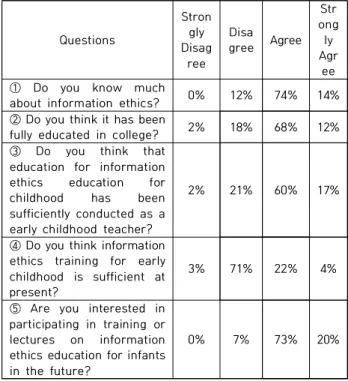
88% of the students surveyed think that they are well of information ethics education, and 80%

believe that sufficient education has been made in college. In comparison, as a teacher, 77% believe that information ethics education is sufficient, whereas for infants, 74% say that the education is not sufficient. It can be understood that education for infants is about three times more necessary than infant teachers. In addition, 93% of the respondents approved of the need for education, saying that they want to receive education through training or lectures if they had a chance later on.

As the society changes rapidly, the need for new content and learning will continue to emerge.

Questions

Stron gly Disag

ree Disa gree Agree

Str ong ly Agr ee

① Do you know much

about information ethics? 0% 12% 74% 14%

② Do you think it has been

fully educated in college? 2% 18% 68% 12%

③ Do you think that education for information ethics education for childhood has been sufficiently conducted as a early childhood teacher?

2% 21% 60% 17%

④ Do you think information ethics training for early childhood is sufficient at present?

3% 71% 22% 4%

⑤ Are you interested in participating in training or lectures on information ethics education for infants in the future?

0% 7% 73% 20%

Table 2. Survey on understanding of Information Ethics

2) Priority of information ethics education for infants and infant teachers

They survey researched fields of information ethics education considered important as a university student and for infants. Weighted values were applied from 1st to 5th place.

① What is your main focus about information ethics education?

Fig. 1. Major Fields of Information Ethics Education for Infants

② What is the focus on infants about information

ethics education?

(6)

Fig. 2. Major Fields of Information Ethics Education for Infants

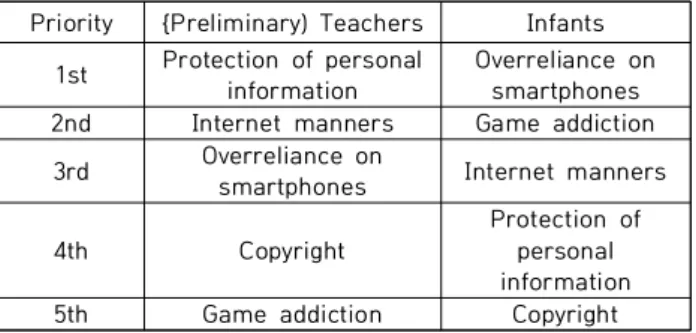
It can be seen that the priority of information ethics education changes. As an infant teacher, personal information protection and internet manners are the most important, whereas for infants, overreliance on smartphones or game addictions should be dealt with more emphasis.

Priority {Preliminary) Teachers Infants 1st Protection of personal

information Overreliance on smartphones 2nd Internet manners Game addiction 3rd Overreliance on

smartphones Internet manners

4th Copyright

Protection of personal information

5th Game addiction Copyright

Table 3. Survey about priority of Information ethics among fields for kids and teachers

3) Experience of information ethics education and new suggestions

Respondents of the survey have field experiences in different kindergartens of which the period vary from 2 to 3 months to 14 years. The study investigated whether the respondents experienced information ethics education either directly or indirectly while working in the field.

Type Questions

Q1 Have you ever experienced information ethics training for infants?

Q2 Have you ever done any information ethics activity for infants?

Q3 Have you ever made a teaching manual for information ethics for infants?

Q4 What is relatively the good part of the information ethics field for infants?

Q5 What part of information ethics training for infants do you think is insufficient?

Q6 Do you think there are enough information ethics teaching tools for infants?

Table 4. Survey on infant teachers on their experience of information ethics education

Q1. If you have experienced information ethics education for infants, please write down the case.

(What) Addiction on media, protection of personal information, etc

(How) Watching safety education videos, watching puppet shows, etc.

Only few students answered this question.

Q2. Have you ever done any information ethics education for infants?

(What) Internet manners (Using appropriate language), Eduction to prevent internet and computer addiction, etc

(How) Watching videos

Only a few students answered this question.

Q3. If you have made a teaching tool for information ethics education for infants, please write down the case.

(What) Smartphone safety education (How) Making puppet shows and PPT

Only 2 students answered this question.

Q4. Which part of information ethics education for infants do you think is relatively well settled?

(What) Overreliance on smartphones, game

addiction, internet manners, protection of personal

information, etc

(7)

(How) Contents on Youtube, Junior Naver, education through videos

Most respondents answered that there are relatively more videos and media contents related to fields of overreliance on smartphones, game addiction and internet manners.

Q5. Which part of information ethics education for infants do you think is insufficient?

(What) Protection of personal information, copyright, overreliance on smartphones, game addiction, internet manners, etc

(How) There are some inappropriate parts that do not fit the targets such as age. Videos release indiscriminate violence and provocative scenes.

In-depth exercise is difficult with such contents.

Even though education to prevent overreliance on smartphones exists, there should be more.

Education on personal information protection and copyright should increase as well.

Q6. Do you think there are enough teaching aids for information ethics education? If you disagree, which part do you think needs to be improved?

(What) In-depth contents should be supported in areas including overreliance on smartphones.

(How) Support from the government and education for teachers are insufficient. More teaching tools are in need. Interactive tools need to be made and latest media devices should be installed in classrooms.

According to this research, 98%of the respondents said they would participate in training or lectures on information ethics education. It is that they rarely experienced such education in the field.

Even if they had the experience, such education was mostly done by hiring special instructors or providing video clips of safety education.

In addition, teaching materials have not been developed enough yet. Existing materials are limited to certain topics such as overreliance on smartphones and to video clips produced by the government or portal sites. As a result, kindergartens lack teaching tools for information ethics education. In order to deal with this issue, training for teachers of kindergartens are necessary to carry out quantitative and qualitative growth of information ethics education. In particular, development of diverse contents and new devices is tough. It is because those who have worked as a teacher for long face difficulties to introduce themselves to new devices and adapt to a new system or environment. Therefore, it is essential to promote education for new teachers and students from Department of Early Childhood Education by organizing a subject on the curriculum.

2. Model Proposal

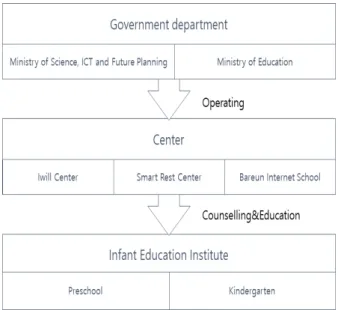
This study proposes an educational model which requires cooperation between the government, related centers and universities in all areas such as resources, research education and etc. It aims to form a systematic educational system and give support to related researches.

First, the government should organize information ethics education for the entire population through cooperation among related departments. Through a systematic education system which gets advanced as students get older, it can provide continuous and linked education from infancy to secondary education and avoid repetition.

Second, close linkage and collaboration among

related agencies and centers is necessary. Instead

of centers and universities producing repetitive

programs and similar teaching materials

respectively, they need to work together and

develop specialized programs and teaching aids of

each institution.

(8)

Fig. 3. Information Ethics Education System for Infants and Teachers

Third, cooperation between experienced and new infant teachers may lead to an open environment familiar to the latest media devices which makes it easier to develop new teaching materials. They should work together to understand the targets and develop teaching materials with information on IT and the media. It is urgent to move on to new form of education from the current video-oriented information ethics education by developing various types of interactive teaching aids.

3. Teaching Aid Suggestion

The trend is changing from traditional education via media to education on media[21]. A variety of teaching aids are needed other than the existing video clips. Following are the things to consider when making teaching aids.

1) Things to consider when making teaching materials[22]

Whether they are:

Ÿ Appropriate to infant development level

Ÿ Attractive to infants

Ÿ Educationally meaningful for infants

Ÿ Taught with safe, sound and hygienic aids

Ÿ Made with various purposes

Ÿ Could be made by various methods with

various materials

Ÿ Appropriate size and weight

Ÿ Easy to store

Ÿ Economical

Ÿ Suitable to our culture

2) Main contents of the tool-making plan [23]

Ÿ Life theme

Ÿ Age

Ÿ Activity type

Ÿ Activity goals

Ÿ Factors related to the curriculum

Ÿ Things to prepare

Ÿ How to make the tools

Ÿ Activity methods

Ÿ Things to keep in mind

3) Suggestion

① Balanced information ethics education

First, information ethics education should be associated with the Nuri Curriculum. It teaches about information society and life, manners of information society and preventing adverse effects of information society.

Second, information ethics education should be done in a balanced way. Currently, the education is focused on topics like overreliance on smartphones.

In addition to the dependence on smartphones, topics like protection of personal information, copyright and etc. require expansion of the contents according to age and corresponding development level and proper use of teaching aids.

Third, both teachers and infants should possess the sense of information ethics. Especially, the need for information ethics education for infants, even more than teachers, is rising.

Fourth, information ethics education should be done according to age with educational institutions.

Intensified contents are necessary. Systematic and

intensified education need to be carried out by

continuous classes designed according to age

instead of one-off special lectures.

(9)

② Proposal for Development of Various Teaching Tools

This study informs the urgency of the development of various teaching tools and suggests support from the government, universities and centers. In particular, it proposes teachers to adopt media into educational contents[21] or emphasize information ethics education. This study shows related examples.

First, efforts to connect online and offline are required. The expansion of unplugged education is designed to ensure proper media use. Such education aims to break away from media viewing and direct use of media.

Category Detail

Title It is dangerous to use a smartphone while walking

Type Sharing stories

Age 5

Goals

To pay attention to smartphone related signs

To acknowledge the dangerousness of using smartphone while walking in the

street

To learn the right attitude of using a smartphone

Materials

Pictures of signs

Pictures of streets with smartphone related signs

Stickers of road signs

Photo

Made by Yejin Kim, K university

Table 5. Teaching materials to draw attention on right smartphone usage

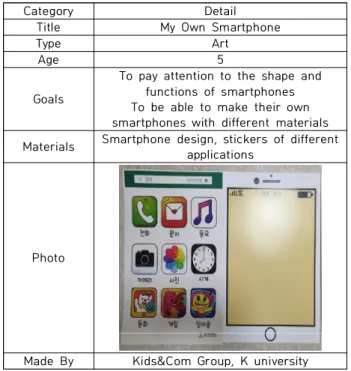
Second, it is necessary to create interactive teaching materials unlike the current video-oriented teaching aids. New tools are to help independent activities of children.

Category Detail

Title My Own Smartphone

Type Art

Age 5

Goals

To pay attention to the shape and functions of smartphones To be able to make their own smartphones with different materials Materials Smartphone design, stickers of different

applications

Photo

Made By Kids&Com Group, K university Table 6. Teaching Materials: Decorating a Smartphone

Third, the government should seek ways to newly adapt existing stories rather than creating new ones. Aesop's fables and traditional folktales are good sources. They are not only well known but also they do not have copyright problems. So familiar characters and storylines of them can be used. Puppet shows or storytelling are good examples of their applications.

Category Detail

Title Story-A Boy and His Toy

Type Language, Art

Age 5

Goals

To think of friends or other toys that media cannot replace

To express thoughts and feelings in various ways after listening to a story

To learn to cherish friends and valuable things to me Materials Cotton Flannel Board etc.

Photo

Made by Soyoung Lee, K university

Table 7. Teaching Material Using Cotton Flannel Board

(10)

Creative works require a lot of preparation time to perform, but they are interesting and refreshing.

③ Government Support and Cooperation between Teachers

Government-level support and preventive education programs are required to ensure proper media use and forming positive ways of thinking for infants.

First, increased government support is needed for the future. Kindergartens and infant education centers should be supported with educational programs.

Second, efforts should be made by universities to foster educational programs and raise children.

Third, cooperation between existing teachers and new teachers is necessary. With the media devices being continuously developed, the focus of development should be on teachers who can easily adapt to the new devices.

Fourth, many opportunities to participate in training and to make use of teaching materials should be given to teachers. There is a need for teachers have to actively participate in development on their own. It is that current development of teaching materials by non-specialists has to move on to more professional, age-specific development by experts.

IV. Conclusions

The fourth industrial revolution has caused people to be excessively exposed to smart devices regardless of age. This paper, recognizing the seriousness of damages on infants because of indiscriminate exposure to smartphone devices, proposes an infant education method to ensure proper use of smartphones and teaching of information ethics. Through a survey on current and preliminary infant teachers, it suggests a means to vitalize information ethics education. And above all, a cooperative model among the

government, related centers, educational institutions such as pre-schools and kindergartens and universities that foster infant teachers is of utmost importance. In addition, it aims to teach proper attitudes to use computers and information ethics to infants through such model. Also, infant teachers themselves should be aware of the importance of information ethics and actively participate in training, planning and production of teaching aids. It is also urgent to develop an action plan and make teaching materials that enable interaction between children other than simple video clips. Moreover, the significance of diverse information ethics education, such as game addiction, personal information protection, internet manners and copyright as well as overreliance on smartphones, should be recognized. Even development of such topics in terms of content and teaching materials needs to be followed. This study intends to contribute to the fostering of infants very ethical and prepared for the future through media education. A further research task is to establish a system to evaluate various teaching aids. Many different contents and materials are to be evaluated and improved according to infant education standards through a suitable assessment system or a tool.

REFERENCES

[1] KyungSim Yim, SooHwang Kim, HaeKyung Hong, A Study of Correlation among Young Children’s Smart-phone Addiction, Self-respect, and Self-regulation, Journal of Future Early Childhood Education, Vol.21, No.4, p.203~221, November 2014.

[2] KilMo Kim, SeongSoo Kim, SeongSik Kim, Development of Assessment Toll about Professionalism of the Information Ethics Teachers, Journal of the Korean Association of Information Education Vol.18, No.1, p.1~11, March 2014.

[3] 2017 Integrated Guidance for Reducing & Preventing Excessive dependence on smartphones Subjected to National Schools, http://l.iamschool.net/articles/view/48612946

[4] JunOh Jo, Haeik Hwang, The Development and Application of

Early Childhood Information Communication Ethics Education

(11)

Program, Journal of Children’s Society Vol. 30, No. 3, pp.161-175, June 2009.

[5] Haeik Hwang, Minjung Kang, Shinyoung Kang, Juno Joe, Early childhood education and Multimedia, Yangseowon, pp.112-133, 2015.

[6] SMART KID, Gangbuk I will center, http://www.gbiwill.or.kr/.

[7] Internet Addiction Prevention Center, http://www.iapc.or.kr/

[8] Junior Naver, http://jr.naver.com/campaign [9] Kidkids, www.kidkids.net/

[10] Pactrick Mcdonell, Digitoll, Scholar KOREA, 2016.

[11] MyungSook Choi, Give My smartphone back, Goraebaesok KOREA, 2017.

[12] Jean Willis, Chic addicted in Internet, Dampuse, 2014.

[13] YoungBong Won, WonJu Hwangbo, I Pormise, Good cyberkids KOREA, 2016.

[14] MIjean Chon, Television BooK, KidsM, 2017.

[15] James Proimis, Turn off TV, Doorekids KOREA, 2014.

[16] ReRua Jean, Beyond Television, Book&BeanTree KOREA, 2019.

[17] Philiped Chementer, Dad is on-line, GreenForest Junior KOREA, 2016.

[18] Minkyung Lee, Without Smartphone?, Dreamsodam Korea, 2014.

[19] Sonya Hartnett, The Boy and The Toy, The Penguin Group, 2010.

[20] Thomas Valerie, Winnie’s new computer, Oxford U.K, 2006.

[21] OkJeong Gi, Heejeon Seo, Bokyng Ge, Youngmi Gho, Ejung Kwon, Miae Kim, Heyjeong Kim, Sujin Yim, Early Childhood Education and Media Application, Changjisa, 2018.

[22] Sunae Lee, Seoyeon Han, Eunseok Yu, Kyungae Han, A Study of Teaching Materials For Young Children, 2018. Jungminsa [23] So Young Hwang, A study of Teaching Materials for Young

Children, JungMinsa, 2018

Authors

Yan Ha received the B.S, Ph.D. degrees in Computer Science and Engineering from Duksung Woman’s University and ChonBuk National University, Korea, in 1992 and 2000, respectively. Especially, she received th M.S. degreed in Computer Education from Ewha Woman’s University. Dr. Ha joined the Visit professor of the SEITI at Central Michigan University, MI, USA, in 2005. She is currently a Professor in the Department of early childhood education, KyungIn Women’s University. She is interested in Computer Education and Computing thinking for early childhood and preliminary teacher.

Jong-Man Lee received the B.S., M.S. and

Ph.D. degrees in Agricultural Education and

Lifelong Education from Seoul National

University, Korea, in 1980, 1984 and 1991,

respectively. Dr. Lee joined the faculty of the

Department of Early Childhood Education at Kyung-In

Women's University, Incheon, Korea, in 1995. He is

currently a Professor in the Department of Early Childhood

Education at Kyung-In Women's University. He is interested

in Multimedia Education as a Teaching Methodology in

Early Childhood Education.

수치

Table  1.  Field  experience  of  respondents
Table 4. Survey on infant teachers on their experience  of  information  ethics  education
Fig. 3. Information Ethics Education System for Infants and  Teachers
Table  5.  Teaching  materials  to  draw  attention  on  right  smartphone  usage

참조

관련 문서

Abstract The purpose of this study is to verify the effect of participating in teaching material development program using 3D printer on the recognition of

Abstract The purpose of this study is to figure out the application of perceived quality and authentication evaluation system of teaching materials and implements for children in