휴먼 라이브러리 서비스를 위한 데이터 구조 개발
Development of a Data Structure for Human Library Services
한승희, 이혜원 서울여자대학교 문헌정보학과
Seunghee Han([email protected]), Hyewon Lee([email protected]) 요약
본 연구에서는 휴먼 라이브러리 서비스의 체계적 관리, 운영을 돕기 위해 휴먼 라이브러리 운영에 필요한 구성요소를 규정하고 이를 기반으로 휴먼 라이브러리 운영을 위한 데이터 구조를 제안하였다. 기존 연구에 서 제안된 휴먼 라이브러리 구성요소인 ‘운영자’, ‘사람 책’, ‘사서’, ‘자원봉사자’ 이외에 본 연구에서는 ‘이용 자’를 추가하여 총 5가지의 휴먼 라이브러리 운영을 위한 구성요소를 제안하였다. 그리고 이를 기반으로
‘휴먼 라이브러리’, ‘휴먼 북’, ‘이용자’라는 3가지 메타 개념을 도출하였고, 도출된 메타 개념을 이용하여 휴 먼 라이브러리 운영을 위한 메타데이터 세트를 개발하였다. 또한 메타데이터 세트의 타당성을 검증하고 활 용성을 높이기 위하여 본 연구에서는 메타데이터 요소를 XML 문서로 선언하였으며, 메타 개념들을 연결하 는 구조도 반영하였다. 본 연구의 결과를 통해 도서관에서는 이용자 프로파일 관리를 통해 이용자에게 휴먼 북 추천 서비스를 제공하는 등 이용자 중심의 서비스를 개발할 수 있다.
■ 중심어 :∣휴먼 라이브러리∣리빙 라이브러리∣휴먼 북∣휴먼 라이브러리 운영∣휴먼 라이브러리 메타데이터∣데이터 구 조화∣
Abstract
In this study, we suggested a data structure for the management of human libraries based on the analysis of the significant components for systematically managing and operating the human library service. At first, we proposed the components of human library metadata set which are 'Human Resource', 'Human Resource', 'Librarian', 'Volunteer', and ‘User’. And this study verified the meta concepts of metadata set such as 'Human Library', 'Human Book' and 'User’, developed the metadata set for human library using the meta concepts. To check the validity of the metadata set and to improve its usability, we created and published a XML document including the metadata structure and link between the meta concepts. In conclusion, this study provided the possibility that the library could develop the service recommended human book to user through user profile.
■ keyword :∣Human Library∣Living Library∣Human Book∣Human Library Management∣Human Library Metadata∣Data Structure∣
* 이 논문은 2018학년도 서울여자대학교 교내학술연구비의 지원을 받았음.
접수일자 : 2018년 07월 30일 수정일자 : 2018년 09월 05일
심사완료일 : 2018년 09월 06일
교신저자 : 이혜원, e-mail : [email protected]
I. Introduction
The Human Library Service was initiated in Denmark in 2000. It is a new concept of library services that provides information and knowledge through face-to-face communication. In the human library it is people, not books or printed materials, who are regarded as information sources.
The human library program helps people understand the diversity of community members and reduce prejudice or bias against others. These advantages are causing human libraries to be extended throughout the world. In Korea, human libraries have run in many forms since their introduction in 2010. Now there is a need for more well-organized management and administration for the human library to allow its further development.
Librarians and scientists in the field of library and information science have made policies and regulations related to human libraries and have provided library services. They have taken the close relationships between library elements into account.
The title “human library” was developed from the term “library”; however, the human library is different from ordinary libraries. One of the most distinct differences is that human books serve as information resources in the human library. Human books are different from other library resources in their forms and attributes. Due to the uniqueness of these resources, human libraries have to be careful to adapt the existing policies and management techniques of information resources in normal libraries[1]. Therefore, the characteristics of the human library should be considered in order to build management frameworks through the adoption of existing policies from other libraries.
Metadata is a core element for the effective management of a library. A digital library is operated
on the integrated structure of metadata comprising the collection management system, catalog, users, and library administration. Thus, it is necessary for standardized metadata structures to run human libraries systematically. However, there is no similar research that suggests a method for systematic data structure for human library management.
It has been nearly 10 years since the introduction of human library services in Korea. However, this service has been activated only in some libraries.
This is probably because the system providing the human library service has not been properly structured. If there are suggested data structures and metadata for human library services, many libraries will be able to build a system for managing human library services.
Therefore, in this study, it was suggested that constructing a scheme for human library has been so important because there hasn't been any scheme for the core element of human library service in Korea.
This study defines the core elements of managing human libraries by supporting systematic management and operations, and it suggests using administrative metadata of a human library based on the defined core elements.
II. Human Libraries
1. The concept and its characteristics
The Human Library is an international movement that promotes an inclusive way to challenge prejudice through social contact. Just like in a real library, a user can choose a book from the human collection.The difference is that books are human beings (“Human Books”), and the books and users enter into a personal dialog[2]. The Human Library is a new type of library service that enables users' information
behavior by borrowing 'Human Book' that serves as a book as a user borrows a book from a library and obtains information and knowledge. Beyond the indirect experience of the knowledge gained through books, the Human Library allows users to meet users who have knowledge and experience that they are interested in, thereby widening the range of knowledge and understanding, and further expanding communication.
It was created for the 2000 Roskilde Music Festival by a group of Danish activists who formed in response to a violent hate crime. Their idea was to use the mechanism of a library to facilitate conversations that challenge prejudice, thereby reducing the risk of tension and violence. Since then the movement has expanded over 70 countries around the world[3].
The Human Library enables groups to break stereotypes by challenging the most common prejudices. During the event, users borrow human books for half an hour to listen to their story and ask questions. During these scheduled encounters, users are asked to interact with new ideas, thoughts, and personalities to challenge held stereotypes and beliefs[4]. It is a concrete, easily transferable and affordable way of encouraging tolerance and understanding[5].
The aim of human books is to focus on prejudices and stereotypes people have. Furthermore, they could focus on any subject or be anyone, such as happy workers who are satisfied in their field of work or persons who tell others about their personal experiences.
Human libraries connect users to human books whom the users want to read and support communication between users and books to help share the information, knowledge, or life experiences of the human books. This is just like ordinary
libraries, which play a role in extending the boundaries of the knowledge of users by helping them find the information they want and use it.
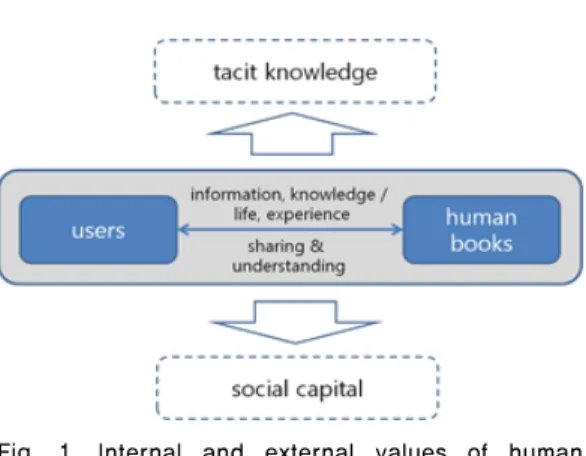
As the interactions between users and human books can be regarded as an internal value, behaviors in a human library can help the creation of external values, as shown in [Fig. 1]. The internal and external value in human libraries would be explained as follows.
First, human libraries enable users to activate the creation of tacit knowledge[6]. Tacit knowledge is a kind of knowledge that cannot be sufficiently articulated by verbal means. It involves intangible factors embedded in personal beliefs, experiences, and values[7]. The tacit knowledge is subconsciously understood and applied, difficult to phrase, developed from direct experience and action, and usually, shared through social networks, for example, highly interactive conversation, story-telling and sharing of experiences[8]. Accuracy and concreteness can be increased when the tacit knowledge is delivered through interaction between users and human books.
Second, Human library services foster bridging social capital by breaking down prejudice through face-to-face conversation[9]. Social capital is “the expected collective or economic benefits derived from the preferential treatment and cooperation based on social networks”[10]. As the Urban Libraries Council[11] points out, the human library is “uniquely positioned to ‘bridge’ - builds networks that bring together different types of people who may not share experiences with each other otherwise.” The library's original mission of providing a neutral, safe space for learning provides an open environment which invites users to ask probing questions[12]. The human library acts as an extension of the mission that drives public libraries[13].
Fig. 1. Internal and external values of human libraries
2. Human libraries in Korea
The living library program was first introduced in 2010 by the National Assembly Library in Korea[14].
Nowadays, local governments and citizen associations lead the movement in many areas under various names, such as ‘Human Library’, ‘Living Library’, and
‘Breathing Library’.
The Nowon Human Library (http://www.humanlib.or.kr/), operated by Nowon District, a local government in Korea, is significant for being the first human library led by a local government in Korea since 2012.
The Hope Institute (http://www.makehope.org/), an official partner of The Human Library Organization, carries out a key role in disseminating the human library concept among non-governmental organizations (NGOs).
The idea of the human library is to reduce prejudices and stereotypes through conversations between users and human books. In general, Koreans are reluctant to show their prejudices and stereotypes.
For this reason, human libraries in Korea are a bit different in comparison to their stated purpose and are more likely to give “storytelling events” as the main theme of the human library.
The human library concept is especially applied to career education programs for youths in Korea.
Teenagers can meet diverse human books working at different professional areas through the human library service and can get plentiful career information and experiences from the human books.
For example, Seoul Human Library, which is operated by the Seoul Metropolitan Government, currently has over 100 human books registered for 14 subjects, and operates a “Senior Library” service for the local aged population. The service makes human books with oral history collected from the local seniors in the form of sound materials and distributes them to schools and public agencies. These materials are used as educational resources to teach life wisdom and experiences.
In Korea, there are many conflicts between ages, genders, levels of education, occupations, social classes, ideologies, and other areas. It can be said that the main reason for these conflicts is preconceptions or stereotypes. In this respect, the value and idea of the human library is thought provoking to Korean society. By encouraging knowledge, understanding, diffusion of communication, the library promotes trust among people to lessen the conflicts between local societal groups. Even though the genuine purpose of the human library is a little bit different in Korea, this change could eventually enrich social capital in Korea.
3. Core Elements for Management of the Human Library
In general, library management has four elements:
the collection, facility, librarians, and users. Likewise, the human library has four important management-related elements[2].
The first element is a human library manager, who is in charge of management of the library. He/she prepares the plans of initiation, operation, and evaluation of the human library.
The second element is a human book, which is just
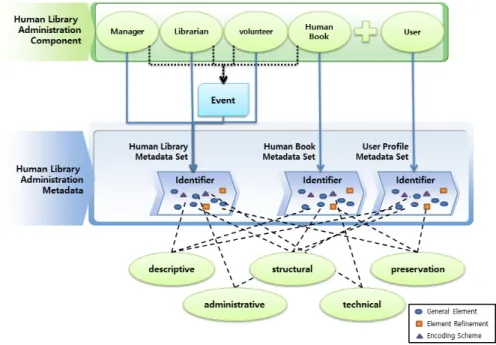
Fig. 2. The basic principles of construction of metadata elements
as critical in a human library as a physical book is in a normal library. Those who are ready to share their personal life experiences can become human books.
They must have mature attitudes in order to effectively communicate with others.
The third element is a librarian. The duties of regular librarians include the management of circulation records and human book catalogs.
Librarians analyze users’ needs and support connecting human books to users in the human library. A librarian, the first person visitors see when they go to a library, facilitates communication between users and human books. The librarian provides information about the purpose and guidelines of the human library and suggests the right human book for a user.
The forth element is a volunteer. The role of a volunteer is very important in order to successfully holding a human library. Volunteers support the
promotion of a library program as well as translation when the human library is held in different languages.
In addition, one other core element is essential for the effective management of the human library. It is a user, who is the most important element in the human library because the development and diffusion of the human library are based on the users. In fact, the reason the human library exists is to meet the needs of users. It is useless if any users do not come to the library even though there are excellent places and facilities to be prepared and skilled librarians to serve in the library. For the success of the human library users have to be ready to communicate with human books, learn from them, and have open minds.
They can break prejudices and stereotypes by interacting with human books, sharing in the reflections and life experiences of the human books.
III. Core Metadata for Management of the Human Library
Users can search in human book catalogs for the human books they would like to meet. It is the same process used by those who visit normal libraries as well. The human library catalogs provide the same function to the users as those of normal libraries such as retrieval of specific resources, identification of location, and availability of the resources. Ordinary catalogs in libraries contain physical materials and explicit information, while human library catalogs contain tacit knowledge and life experiences in informal communication.
The elements of administrative metadata for the human library should be built on metadata recommendations and requirements and should cover the unique characteristics of information resources in the human library as well as those in normal libraries.
Intner, Lazinger, and Weihs[15] suggested metadata principles as follows:
“First, modularity allows metadata schema designers to create new metadata applications by combing elements from various previously established metadata schemas. Secondly, extensibility refers to the ability of metadata systems to allow for extensions so that the needs of a particular application can be accommodate. Thirdly, refinement refers to the ability to a metadata schema to allow its users to choose a level of detail appropriate to a given application. Forthly, multilingualism states that it is essential to adopt metadata architectures that “respect linguistic and cultural diversity”[16].
1. Policies for the Development of the Metadata Set
We conceptualize the elements of the administrative metadata of the human library with the follow principles:
Firstly, the metadata elements consider multiple core components of the management of the human library. The metadata elements that this study suggests include library managers, human books, librarians, and volunteers found in previous studies, but the study adds users as well.
Secondly, the metadata elements perform five basic functions of metadata: administrative, descriptive, use, technical, and preservative functions[15].
Thirdly, this study suggests that the concept identifiers allow for sharing in Web environments and for the declaration of metadata elements on the Web.
Lastly, the metadata elements are based on Dublin Core (DC) qualifiers and specify element refinements to make the meaning of an element narrower or more specific for the broad conceptual elements and utilize encoding schemes. [Fig. 2] shows the basic principles of the construction of metadata elements in the management of the human library.
2. Development of the Metadata Set of Management of the Human Library
2.1 Human Library Metadata
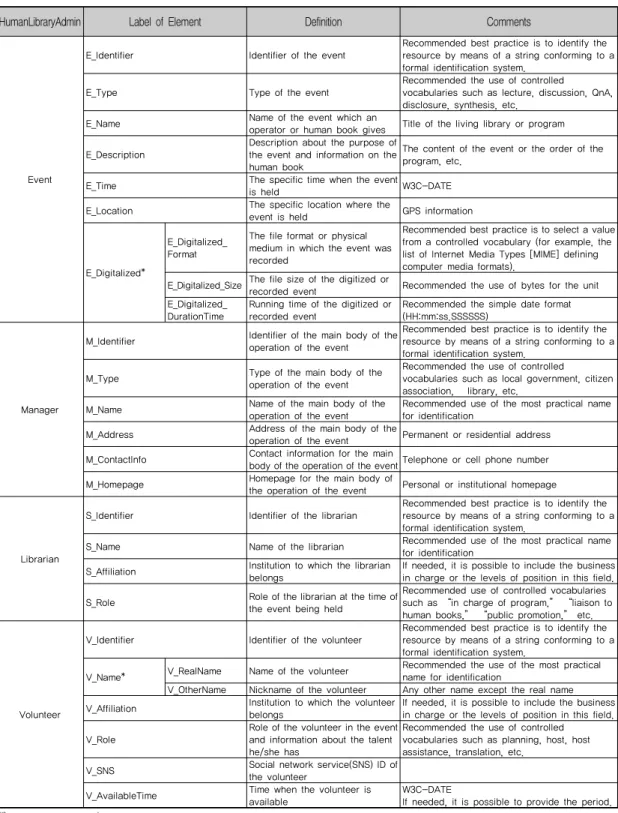
Metadata for the human library consist of management metadata, including library managers, librarians, and volunteers, as well as declaration metadata of events, which are the outcomes of the management objects. Each label, its definition, and related comments are described in [Table 1].
An event is an outcome of the human library and reflects the environments where human books and users meet together. The element of “E_Digitalized”
in an event defines technical elements and provides tools for recording the circumstances during the event. The element refinements, a qualifier, specify the coverage of the elements and formats, the size, the running time, etc.
A human library manager gives information about
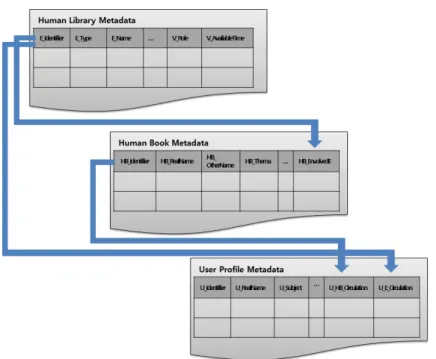
Fig. 3. The links between metadata elements
events and human books to users. He or she is responsible for the events and prepares spaces to hold these events as well as information resources.
A librarian is a liaison between the events, human books, and users. Professional knowledge about the tacit information of human books and the abovementioned events is required in order to be a librarian in the human library.
A volunteer is a supporter who helps to get the event into gear. Volunteers offer their talents and contribute to the management of the human library.
2.2 Human Book Metadata
The concept of human book metadata is about resources. It is a fundamental element among metadata sets and provides the information of human books (See [Table 2]).
The elements of human book metadata include identifiers, names, themes, affiliations, levels of
position, areas of activity, professions and careers, conditions of use, types of social contribution, subject terms, email address, contact information, social networking site identification information (SNS IDs), homepages, the requirements of digitalization of the human book, event information, and so on. In addition, we restrict element refinements of the scope of meaning of human books. The subject and occupation of the human book are classified by the existing classification scheme, and the candidate values of data elements are suggested.
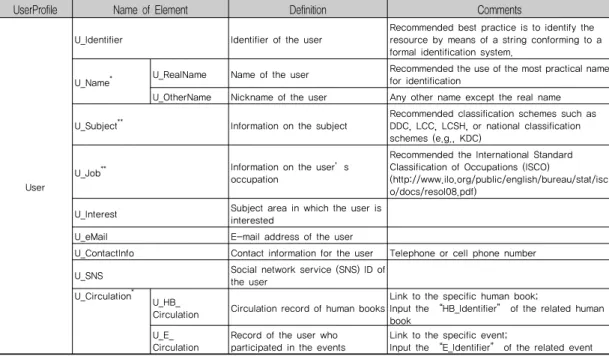
2.3 User Profile Metadata
The concept of user profile metadata is associated with managing the profiles of event attendants. This type of metadata can be used to activate the human library as a library resource. User profile metadata elements contain identifiers, names, subjects, interests, email address, contact information, SNS
IDs, homepages, circulation records, and so on, as described in [Table 3]. The element of circulation records, “U_Circulation,” is used to link a certain human book to a specific event.
We define metadata elements mentioned above and implement the metadata scheme by Greenberg[17] in [Table 1-3].
Greenberg[17] suggested firstly, a collection of metadata elements gathered to support a function, or a series of functions for an information object.
Secondly, a collection of metadata elements, forming a structured container, to which data value are added.
Thirdly, a collection of data elements, with their attributes formalized in a specification. Examples of element attributes includes the metadata element’s
“name”, “identifier”, “label”, “definition”, and the “date the element” was declared.
2.4 Characteristics of Metadata for Management of Human Library
We suggested the principles and concepts of the development of the metadata set in Chapter 3.1 and defined the metadata set of management in Chapter 3.2. The three characteristics of metadata for the management of the human library in this study can be summarized as follows:
First, we conceptualize the human library that links human books to users, the human book as a crucial resource, and the user as a new component of the human library. These three conceptualized metadata can be implemented effectively for management of the human library and its application.
Second, the metadata elements are effective for data identification and data connection because they support information management and use by identifiers in the Web environment. We will deal with this matter in Chapter 4.2.
Third, we specialize the range of the meaning of
the suggested metadata elements. The element refinements as a qualifier and the encoding scheme are implemented so that the metadata allow for specifying the elements with a broad range of concepts. This can help to boost the practical use of existing knowledge. In addition, we show instances and events in a certain domain via the controlled vocabulary in advance.
IV. Application of Metadata Set
1. XML Structure
The following [Fig. 3] shows a part of the document written in XML representing the metadata elements suggested in [Table 1] through 3. The validation of the XML document was performed by EditiX-XML. The XML document is shown in Appendix 1.
2. Metadata Structure to Link between Concepts
The human library shares knowledge and emotions by direct face-to-face meetings between people. As the human library runs, it should find knowledge that users need, be interested in social changes in perception, and consider information environments that local communities can accept. As mentioned in Chapter 3.1, this study defines the administrative metadata based on the three concepts of human library, human books, and user profiles. It is fundamental that the library collects information about human books and users and provides explanations about the main body of operation. The library should provide the link between concepts. To assign the real value to a metadata element and verify the elements and connect them, the links to more refined concepts should be required.
HumanLibraryAdmin Label of Element Definition Comments
Event
E_Identifier Identifier of the event Recommended best practice is to identify the
resource by means of a string conforming to a formal identification system.
E_Type Type of the event Recommended the use of controlled
vocabularies such as lecture, discussion, QnA, disclosure, synthesis, etc.
E_Name Name of the event which an
operator or human book gives Title of the living library or program
E_Description Description about the purpose of
the event and information on the human book
The content of the event or the order of the program, etc.
E_Time The specific time when the event
is held W3C-DATE
E_Location The specific location where the
event is held GPS information
E_Digitalized*
E_Digitalized_
Format
The file format or physical medium in which the event was recorded
Recommended best practice is to select a value from a controlled vocabulary (for example, the list of Internet Media Types [MIME] defining computer media formats).
E_Digitalized_Size The file size of the digitized or recorded event Recommended the use of bytes for the unit E_Digitalized_
DurationTime Running time of the digitized or
recorded event Recommended the simple date format
(HH:mm:ss.SSSSSS)
Manager
M_Identifier Identifier of the main body of the
operation of the event
Recommended best practice is to identify the resource by means of a string conforming to a formal identification system.
M_Type Type of the main body of the
operation of the event
Recommended the use of controlled vocabularies such as local government, citizen association, library, etc.
M_Name Name of the main body of the
operation of the event Recommended use of the most practical name for identification
M_Address Address of the main body of the
operation of the event Permanent or residential address
M_ContactInfo Contact information for the main
body of the operation of the event Telephone or cell phone number
M_Homepage Homepage for the main body of
the operation of the event Personal or institutional homepage
Librarian
S_Identifier Identifier of the librarian Recommended best practice is to identify the
resource by means of a string conforming to a formal identification system.
S_Name Name of the librarian Recommended use of the most practical name
for identification
S_Affiliation Institution to which the librarian
belongs If needed, it is possible to include the business
in charge or the levels of position in this field.
S_Role Role of the librarian at the time of
the event being held
Recommended use of controlled vocabularies such as “in charge of program,” “liaison to human books,” “public promotion,” etc.
Volunteer
V_Identifier Identifier of the volunteer Recommended best practice is to identify the
resource by means of a string conforming to a formal identification system.
V_Name* V_RealName Name of the volunteer Recommended the use of the most practical
name for identification
V_OtherName Nickname of the volunteer Any other name except the real name
V_Affiliation Institution to which the volunteer
belongs If needed, it is possible to include the business
in charge or the levels of position in this field.
V_Role Role of the volunteer in the event
and information about the talent he/she has
Recommended the use of controlled vocabularies such as planning, host, host assistance, translation, etc.
V_SNS Social network service(SNS) ID of
the volunteer
V_AvailableTime Time when the volunteer is
available W3C-DATE
If needed, it is possible to provide the period.
(*: element refinement)
Table 1. Human Library Metadata
Resource Name of Element Definition Comments
HumanBook
HB_Identifier Identifier of the human book Recommended best practice is to identify the
resource by means of a string conforming to a formal identification system.
HB_Name
*HB_RealName Name of the human book Recommended the use of the most practical
name for identification
HB_OtherName Nickname of the human book Any other name except the real name
HB_Theme Theme of the human book It is possible to include the subject or title of the
human book in the theme.
HB_Affiliation Institution to which the human book
belongs If needed, it is possible to include the business
in charge or the levels of position in this field.
HB_Activity Scope of the activity of the human
book and his/her career It is possible to include an introduction of the human book in the scope of the activity.
HB_Subject
**Information on the subject Recommended classification schemes such as
DDC, LCC, LCSH, or national classification schemes (e.g., KDC)
HB_Job
**Information on the human book’s
occupation or profession
Recommended the International Standard Classification of Occupations (ISCO) http://www.ilo.org/public/english/bureau/stat/is co/docs/resol08.pdf
HB_Condition Conditions relating to the time
period of the human book W3C-DATE
If needed, it is possible to provide the period.
HB_ContributionType Tacit knowledge or contribution to
the local society
Recommended the use of controlled vocabularies such as:
- Knowledge and information sharing: career experiments, advice for careers, etc.
- Life and experiment sharing: emotional support, breaking from prejudice, etc.
- Information sharing about the local community
HB_Keyword Subject of the human book in the
event
HB_eMail E-mail address of the human book
HB_ContactInfo Contact information for the human
book Telephone or cell phone number
HB_SNS Social network service (SNS) ID of
the human book
HB_Homepage Homepage of the human book
HB_Digitalized
*HB_Digitalized_Form at
Digital format in which the human book was recorded, such as interview, lecture, etc.
Recommended best practice is to select a value from a controlled vocabulary (for example, the list of Internet Media Types [MIME] defining computer media formats).
HB_Digitalized_Size The file size of the digital content about the human book Recommended the use of bytes for the unit
HB_Digitalized_Durat
ionTime Running time of the digital content
about the human book Recommended the simple date format (HH:mm:ss.SSSSSS)
HB_EnvolvedE Information on the event in which
the human book is involved Link to the specific event;
Input the “E_Identifier” of the related event
Table 2. Human Book Metadata
UserProfile Name of Element Definition Comments
User
U_Identifier Identifier of the user Recommended best practice is to identify the
resource by means of a string conforming to a formal identification system.
U_Name
*U_RealName Name of the user Recommended the use of the most practical name
for identification
U_OtherName Nickname of the user Any other name except the real name
U_Subject
**Information on the subject Recommended classification schemes such as
DDC, LCC, LCSH, or national classification schemes (e.g., KDC)
U_Job
**Information on the user’s
occupation
Recommended the International Standard Classification of Occupations (ISCO)
(http://www.ilo.org/public/english/bureau/stat/isc o/docs/resol08.pdf)
U_Interest Subject area in which the user is
interested
U_eMail E-mail address of the user
U_ContactInfo Contact information for the user Telephone or cell phone number
U_SNS Social network service (SNS) ID of
the user
U_Circulation
*U_HB_
Circulation Circulation record of human books Link to the specific human book;
Input the “HB_Identifier” of the related human book
U_E_ Circulation Record of the user who
participated in the events Link to the specific event;
Input the “E_Identifier” of the related event (*: element refinement, **: encoding scheme)
Table 3. User Profile Metadata
The present study attempts to connect concepts and resolve the structure of metadata sets described in Chapter 3.2. [Fig. 3] shows an applicable structure of metadata to link between concepts.
Firstly, the given structure links human books and users around the outcomes of the human library, i.e., an event. If there are “HB_EnvolvedE” and “U_E_Circulation”
sharing, “E_Identifier” human books and users who participate in a certain event are connected.
Secondly, the event that a human book operates in is connected to users who participate based on a single human book. This allows for the focused control and utilized environment about human books as well as their public promotion. The library can manage data about the specific events that a human book is involved in through “HB_EnvolvedE.” A specific human book whom a user circulates is connected to the user through “U_HB_Circulation.”
Thirdly, the event is connected to a human book
that is circulated by a user who participates in the event. “U_E_Circulation” and “U_HB_Circulation”
correspond to this linkage. The recommendation service about the human library can take advantage of the link between the event and the human book through the user. The users’ human book circulation records are accumulated in the database through the 'U-Circulation' element, and the accumulated data can be utilized for the recommendation service as follows. First, the user's circulation record itself serves as a user profile, and can provide a service that recommends which human book is appropriate when the user wants to use the human book service later. Second, the cumulative human book circulation data can recommend human books to other users with similar tendencies and interests. With these recommendation services, the human library service becomes more active and the user satisfaction will be improved.
V. Conclusion
This study defines the core elements of managing human libraries by supporting systematic management and operations, and it suggests using administrative metadata of a human library based on the defined core elements. In Chapter 2, we introduce the concept and its characteristics about the human library in Korea and draw the important management-related components for management of the human library. In Chapter 3, we suggest the basic principles of development of the human library management and administrative metadata sets of the human library based on the conceptualized components.
In Chapter 4, we declare XML statements using suggested metadata sets and propose the linked structure among metadata elements.
First of all, we suggested five management-related components of management for the human library, which are human library manager, human book, librarian, volunteer, and user who is especially added in this study. Based on this, three meta-concepts of
“human library,” “human book,” and “user” are determined. We developed administrative metadata sets of the human library using determined meta-concepts. In succession, we stated XML structures with the metadata elements and suggested the linked structures of metadata with the purpose of verifying the validity and increasing availability. By applying the metadata structure suggested by the present study, systematical management of the human library can be realistic. Especially, the control of user profiles can support the development of recommendation services of human books such as user-focused services that existing libraries provide.
This research was an attempt to activate the human library service, and it was significant that the data structure for managing the human library
service components was proposed for the first time using metadata. Based on the metadata presented in this study, it is possible to carry out a research that suggests an ontology structure for human library services in the future. The ontology proposed in the next study will support service extension through connection of external contents and human library service. If the components of the human library service are linked with linked data based on the ontology, the utilization of this service will be even higher.
The human library metadata proposed by this study can connect to the Web resources. Users can access various types of information, and human library operators can provide the services more actively using this advantage. For example, the human library can connect to OPACs, human resource databases, massive open online course (MOOC), Wikipedia, TED, etc. To this end, the further research will be an extension of metadata elements of the human library suggested by this study. Research about the publication of Linked open data (LOD), which can ensure the interoperability, is also a possible plan for the next study, as well.
참 고 문 헌
[1] C. Cho, “A Study on the Human Library: The Case of Human Library in Seongbuk-Gu, Seoul,” J. of the Korean Biblia Society of Library and Information Science, Vol.13, No.1, pp.9-28, 2014.
[2] http://changelingaspects.com/PDF/LL_English_
Final.pdf, 2015.03.15.
[3] http://humanlibraryuk.org/human-library/, 2015.01.02.
[4] B. M. Maguth and J. Hilburn, “People As Books:
Using a Living Library to Enhance Social
Studies Education,” The Oregon J. of the Social Studies, Vol.1, No.1, pp.36-44, 2013.
[5] http://humanlibrary.org/what-is-the-living-libr ary.html, 2015.02.17.
[6] Y. Zhai, Y. Zhao, and R. Wang, “Human Library:
A New Way of Tacit Knowledge Sharing,” in Zhu, M. (Ed.), Business, Economics, Financial Science, and Management, Advances in Intelligent and Soft Computing(AISC), Vol.143, pp.335-338, 2012.
[7] M. Polanyi, The Tacit Dimension, University of Chicago Press, 2009.
[8] S. Bhirud, L. Rodrigues, and P. Desai,
“Knowledge Sharing Practices In Km: A Case Study in Indian Software Subsidiary,” Journal of Knowledge Management Practice, http://www.tlainc.com/articl103.htm, 2015.05.07.
[9] J. B. Edwards, M. Robinson, and K. R. Unger,
Transforming Libraries, Building Communities:
The Community-Centered Library,
The Scarecrow Press, Inc., 2013.[10] R. Putnam, Bowling Alone: The Collapse and
Revival of American Community, Simon and
Schuster, 2000.[11] http://www.abcdinstitute.org/docs/ULCReport.
pdf, 2015.04.03.
[12] http://www.local-level.org.uk/uploads/8/2/1/0/
8210988/locallivinglibraryreport.pdf, 2015.03.03.
[13] E. Went, “The Human Library: Sharing the Community With Itself,” Public Libraries, Vol.51, No.3, pp.38-40, 2012.
[14] J. Yoo and H. Shim, “The first Korean Living Library from the National Assembly Library of Korea,” The KLA Journal, Vol.51, No.3, pp.37-39, 2010.
[15] S. S. Intner, S. S. Lazinger, and J. Weihs,
Metadata and Its Impact on Libraries, Conn:
Libraries Unlimited, 2006.
[16] E. Duvallll, W. Hodgins, S. Sutton, and S. L.
Weibel, “Metadata Principles and Practicalities,”
D-Lib Magazine, Vol.8, No.4. http://www.dlib.
org/dlib/april02/weibel/04weibel.html, 2015.05.20.
[17] J. Greenberg, “Understanding Metadata and Metadata Schemas,” in R. P. Smiraglia (Ed.),
Metadata: A Cataloger’s Primer, NY: Haworth
Information Press, pp.17-36, 2005.저 자 소 개
한 승 희(Seunghee Han) 정회원
▪2004년 8월 : 연세대학교 문헌정 보학과(문학박사)
▪2004년 10월 ∼ 2005년 12월 : 일 본게이오대학 방문연구원(한국 연구재단 Post-Doc.)
▪2007년 3월 ∼ 현재 : 서울여자 대학교 문헌정보학과 교수
<관심분야> : 텍스트 마이닝, 클러스터링, 정보검색 및 기획
이 혜 원(Hyewon Lee) 정회원
▪2007년 2월 : 연세대학교 문헌정 보학과(문학박사)
▪2009년 3월 ∼ 현재 : 서울여자 대학교 문헌정보학과 교수
▪2018년 3월 ∼ 현재 : 서울여자 대학교 데이터과학 연계전공 주 임교수
<관심분야> : 정보조직, 메타데이터, 온톨로지