http://crossmark.crossref.org/dialog/?doi=10.14474/ptrs.2016.5.4.163&domain=pdf&date_stamp=2016-12-25
Received: 11 October, 2016 Revised: 26 October, 2016 Accepted: 30 October, 2016 Corresponding author: Won-Seob Shin
Department of Physical Therapy, Daejeon University, 62 Daehak-ro, Dong-gu, Daejeon 34520, Republic of Korea Tel: 82-42-280-2294 Fax: 82-42-280-2290 E-mail: [email protected]
This is an Open-Access article distributed under the terms of the Creative Commons Attribution Non-Commercial License (http://creativecommons.org/licens es/by-nc/4.0) which permits unrestricted non-commercial use, distribution, and reproduction in any medium, provided the original work is properly cited.
Copyright © 2016 Korean Academy of Physical Therapy Rehabilitation Science
https://doi.org/10.14474/ptrs.2016.5.4.163 pISSN 2287-7576
eISSN 2287-7584
Phys Ther Rehabil Sci 2016, 5 (4), 163-169 www.jptrs.org
Effects of vibration resistance exercise on strength, range of motion, function, pain and quality of life in persons with tennis elbow
Jong-Hun Lim
a, Won-Seob Shin
a,baDepartment of Physical Therapy, Graduate School of Health and Medicine, Daejeon University, Daejeon, Republic of Korea
bDepartment of Physical Therapy, Collage of Health and Medical Science, Daejeon University, Daejeon, Republic of Korea
Objective: The purpose of this study was to investigate the effects of vibration resistance exercise (VRE) in patients with tennis elbow on strength, range of motion (ROM), function, pain and quality of life (QOL).
Design: Randomized controlled trial.
Methods: Twenty-seven participants were randomly assigned to either the VRE group (n=9), weight resistance exercise (WRE) group (n=9) or control group (n=9). Each group underwent hot compress for 15 minutes and electrotherapy for 15 minutes. The VRE group underwent exercises using a vibrating ball for 5 minutes. The WRE group underwent exercises using dumbbells for 5 minutes. All participants were evaluated on wrist extension strength using a hand-held dynamometer, grip strength level through an electric dynamometer, and ROM through a smartphone goniometer application before and after intervention. Patient-rated ten- nis elbow evaluation, Visual Analogue Scale and Short Form 8 were measured by questionnaires.
Results: There were showed significant differences among the VRE, WRE and control group in wrist extensor muscle and hand grip strength, ROM, elbow function, pain and QOL after intervention (p<0.05). The VRE group showed a greater significant im- provement in wrist extensor muscle strength and elbow function compared with the others (p<0.05). The VRE and the WRE groups had a more significant improvement in wrist extensor muscle and hand grip strength, ROM and pain compared with the control group (p<0.05). However, there were no significant differences in QOL among the three groups.
Conclusions: Combining VRE with thermotherapy and electrotherapy appears to be more effective in improving wrist extension strength, ROM, elbow function, QOL in tennis elbow patients.
Key Words: Strength training, Tennis elbow, Vibration
Introduction
Tennis elbow is a disease that has a variety of different names, such as lateral epicondylitis, lateral epicondylosis, lateral epicondylalgia [1,2].
Tennis elbow is an inflammatory disease that commonly occurs in the common extensor tendon located in the outer elbow [3]. Tennis elbow an endemic that mainly occurs in the dominant hand of adults between the ages 35-54 years old [4], is prevalent within 1%-3% of the adult population
[5], and has no specific differences between men and women [6]. Tennis elbow is one of the most common muscu- loskeletal diseases that occurs mainly in the outer elbow [7]
with pain perceived in the outer elbow during resisted wrist and finger extension [2].
Pain is often radiated into the wrist and forearm [8]. These impairments produce handgrip weakness, and with pain oc- curring during wrist movements in the radial deviation, the use of the hand is restricted during daily life activities [8].
Pain occurring with tennis elbow is generally long-lasting,
lems in life in which the ability to perform personal tasks and activities at home are impaired, thus contributing to eco- nomic loss, and subsequently reducing quality of life [11].
Physical therapy intervention for acute tennis elbow in- cludes cold therapy, heat therapy for chronic conditions, re- laxation and ultrasound, microwave therapy, electrical stim- ulation, muscle stretching, strengthening exercises, and use of a brace [12]. In addition, taping of the muscles in the el- bow region [13] joint mobilization technique [2,14] are also known to be effective treatment techniques. Dynamic ex- ternal resistance exercises are performed using weights or dumbbells for strengthening and rehabilitation exercises as a musculoskeletal intervention.
When lowering or lifting a certain weight load, muscle pain arises due to maximum load being put at only one point within the joint range of motion, which can lead to diffi- culties in performing exercises for tennis elbow treatment [15].
Vibration treatment is effective in improving motor func- tion, metabolic rate, and increase blood flow, which sub- sequently reduces inflammation and muscular damage com- pared to dynamic external resistance exercises [16,17].
Currently, the whole body vibration is being used as an ex- ercise method for functional improvement [18,19] which not only stimulates the muscles directly receiving the vibration stimulation, but also has an effect on adjacent muscles as well [20].
A previous study reported significant improvements in jumping ability and lower extremity muscle strength after undergoing whole body vibration training for 4 months [21].
Whole body vibration had an effect on decreasing in- flammation and pain after the occurrence of delayed onset of muscle soreness occurs after running [22]. Previous studies have reported that muscle training with vibration stimulus is effective in improving flexibility, postural control, balance, and coordination [23-25].
Although the previous studies report a positive influence of oscillatory motion, the vibration stimulus was applied to the whole body rather than a local area for certain muscles, and the effect is limited to being seen in the lower extremity rather than the upper extremity. Studies where the effects of applying local oscillation stimulation on the upper extremity for a musculoskeletal problem are insufficient Therefore, the purpose of this study was to evaluate the effect of apply- ing localized vibrational motion on the upper extremity on wrist muscle strength, joint range of motion, function, pain,
Methods Subject
This study included subjects who were diagnosed with tennis elbow and were admitted and receiving physical ther- apy from the A rehabilitation center in Daejeon.
The inclusion criteria were positive results on the Thomsen test, resisted middle finger test, and Mill’s test [26], while the exclusion criteria were subjects with complaints of se- vere wrist pain, subjects who were currently receiving in- jections or medication, those who were having to undergo surgery, those with another orthopedic disease requiring sur- gery, or those with pathological conditions such as diabetes or high blood pressure.
A total of twenty-seven subjects who had met the se- lection criteria were randomly divided into the vibration re- sistance exercise (VRE) group (n=9), weight resistance ex- ercise (WRE) group (n=9) or the control group (n=9). All subjects have voluntarily agreed to participate in the study after being aware of the study purpose and methods. This study was conducted with the approval of the institutional review board of the Daejeon University (IRB no. 1040647- 201606-HR-020-03).
Procedure
This study included the VRE, WRE, and control groups with intervention conducted three times a week for four weeks. The subjects in the control group received for 15 mi- nutes and interferential current electrical therapy for 15 minutes. After the subjects in the VRE and WRE received therapy for 30 minutes, they had exercised for an addition of 5 minutes.
Vibration resistance exercise group
The Powerball (Powerball classic 250 Hz; RPM Sports
Ltd., Contae Thiobraid Árann, Ireland) was created for ex-
ercise purposes without applying excessive force on the
joints and muscles. While sitting in an upright posture with
the affected arm placed on an armrest with 90 degrees of el-
bow flexion and forearm pronation, the subjects used their
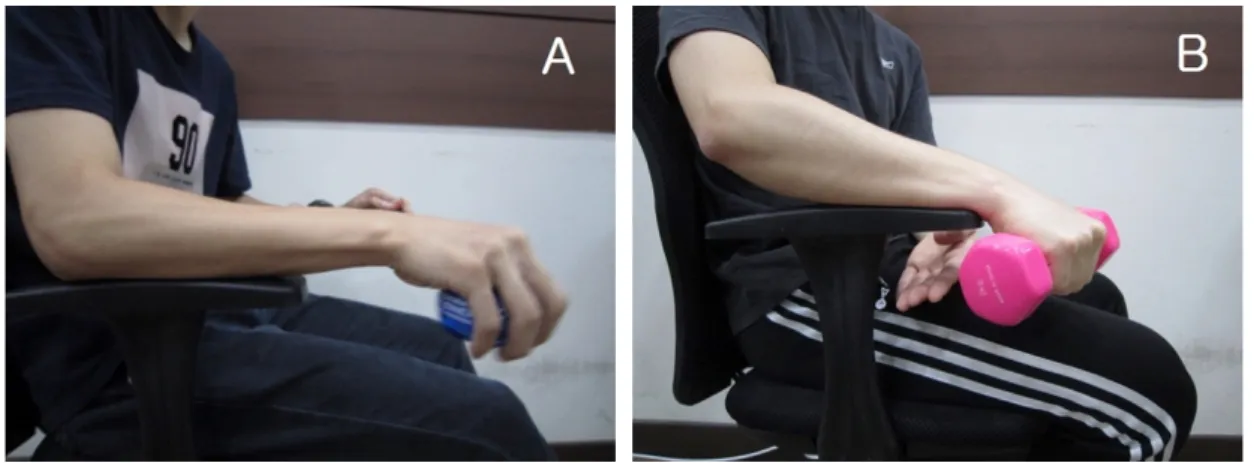
wrist rotate the Powerball out towards the body for 5 mi-
nutes [27]. Subjects used the Powerball after they had been
fully informed and trained of the use of the equipment
(Figure 1A).
Figure 2. (A) Wrist extensor strength. (B) Hand-grip strength. (C) Joint range of motion evaluation.
Figure 1. (A) Vibration resistance exercise. (B) Weight resistance exercise.
Weight resistance exercise group
WRE were performed eccentrically with a 2 kg dumbbell for men and a 1 kg dumbbell for women for 5 minutes [28].
Subjects sat on a chair with armrests with the affected elbow raised, and after raising the arm off the arm rest with elbow flexion and forearm pronation, wrist contractions were re- peated up to the extent where there was no pain in the mid-range of motion using only the wrist (Figure 1B).
Outcome measures
Strength assessmentWrist extensor muscle strength
After placing the upper extremity on a table with the 90 degrees of shoulder flexion, elbow extension, forearm pro- nation, and 20 degrees of wrist extension, the maximal iso- metric extension force of the wrist extensors was assessed using the portable PowerTrack II Commander hand-held dy- namometer (JTech Medical, Midvale, UT, USA) [29].
Strength assessments were carried out three times, with a
1-minute rest period between each assessment (Figure 2A) [30].
Hand-grip strength
The baseline digital Smedley spring dynamometer (Sammons Preston, Bolingbrook, IL, USA) was used to assess hand- grip strength. In a seated position with the subject’s upper extremity placed on an armrest, elbow was in 90 degrees flexion, and forearm and wrist in neutral position, hand-grip strength was assessed by having the subject pull the handle of the dynamometer to their maximum ability while the up- per extremity was held 15 degrees in front of the trunk (Figure 2B) [31].
The dynamometer has an interrater reliability of 0.93- 0.94 [32].
Joint range of motion evaluation
With the wrist in neutral position, the angle achieved dur-
ing maximum wrist extension was assessed using the Clino-
meter (Plaincode Software Solution, Stephanskirchen, Germany)
which is a smartphone application.
Gender (male/female) 6/3 5/4 9/0 5.014
Age (y) 42.44 (7.945) 41.78 (7.48) 39.78 (4.68) 0.369
Height (cm) 168.89 (10.09) 165.78 (10.23) 173.56 (3.40) 1.897
Weight (kg) 65.67 (12.72) 65.89 (11.23) 74.11 (5.42) 1.971
Dominant side (Rt/Lt) 8/1 9/0 9/0 2.077
Side of lesion (Rt/Lt) 6/3 6/3 8/1 1.543
Values are presented as number only or mean (SD).
VRE: vibration resistance exercise, WRE: weight resistance exercise, Rt: right, Lt: left.
With the forearm placed on the chair armrest, with 90 de- grees of elbow flexion, the angle between the radius and the second metacarpal was measured by the radial styloid axis of the forearm in pronation. The interrater reliability for an- gular measurements was 0.76-0.95 (Figure 2C) [33].
Evaluation of elbow functional ability
The patient-rated tennis elbow evaluation (PRTEE) is a questionnaire that includes 5 questions related to pain, 6 questions related to special activities, and 4 questions about general activities, totaling up to 15 questions with 0 being the highest score and 10 being the lowest score. The five pain-related questions add up to 50 points, and the 10 activ- ity-related questions add up to 50 points (special activities+
general activities) totaling up to 100 points [34]. The PRTEE evaluation has an interrater reliability of .96, with lower scores indicating a higher level of elbow function.
Pain levels
To assess the level of elbow pain, the visual analogue scale (VAS) using a 10 cm line was used where the line is divided into 1 cm segments with 0 cm indicating no pain and 10 cm indicating excruciating pain. The VAS evaluation method for pain is high in reliability and validity [35].
Quality of living
The form includes 8 items including questions about gen- eral health, physical functioning, physical role limitations, pain, vitality, social function, mental, and emotional role limitations with higher scores indicating a higher quality of life. The reliability of the assessment has a Cronbach’s value of 0.82 [14].
Data and statistical analysis
For this study, the PASW Statistics ver. 18.0 program
(IBM Co., Armonk, NY, USA) was used for data analysis.
The general characteristics of subjects were described using the mean and standard deviation values, and the Shapiro- Wilks test was performed in order to verify the normality of the subjects.
The paired t-test was used to compare between two groups before and after intervention and a one-way ANOVA was used to compare the differences in the amount of change between each group. The significance level was set at α=
0.05.
Results
A total of twenty-seven participants were included in the study with 9 subjects in the VRE group, 9 subjects in the WRE group, and 9 subjects in the control group. There was no significant difference in gender, age, height, weight, side of dominance, between the three groups (p>0.05; Table 1).
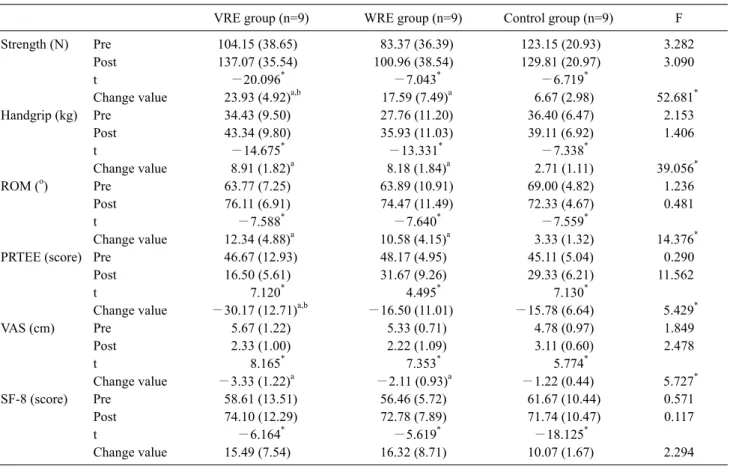
There was a significant difference in wrist extensor strength, hand-grip strength, wrist range of motion, func- tional ability of the elbow, pain levels and quality of life be- tween each group before and after intervention, there was a significant difference (p<0.05).
In comparison of the three groups, the VRE group showed a significant increase in muscle strength and functional per- formance compared to the WRE and control group (p<0.05).
The VRE and WRE group showed a significant improve-
ment in the change values of extensor muscle strength, hand
grip, wrist range of motion, and pain levels compared to the
control group (p<0.05). However, there was no significant
difference between the three groups in quality of life pre and
post intervention (Table 2).
Table 2. Pre-post intervention comparison of three groups (N=27)
VRE group (n=9) WRE group (n=9) Control group (n=9) F
Strength (N) Pre 104.15 (38.65) 83.37 (36.39) 123.15 (20.93) 3.282
Post 137.07 (35.54) 100.96 (38.54) 129.81 (20.97) 3.090
t −20.096* −7.043* −6.719*
Change value 23.93 (4.92)a,b 17.59 (7.49)a 6.67 (2.98) 52.681*
Handgrip (kg) Pre 34.43 (9.50) 27.76 (11.20) 36.40 (6.47) 2.153
Post 43.34 (9.80) 35.93 (11.03) 39.11 (6.92) 1.406
t −14.675* −13.331* −7.338*
Change value 8.91 (1.82)a 8.18 (1.84)a 2.71 (1.11) 39.056*
ROM (o) Pre 63.77 (7.25) 63.89 (10.91) 69.00 (4.82) 1.236
Post 76.11 (6.91) 74.47 (11.49) 72.33 (4.67) 0.481
t −7.588* −7.640* −7.559*
Change value 12.34 (4.88)a 10.58 (4.15)a 3.33 (1.32) 14.376*
PRTEE (score) Pre 46.67 (12.93) 48.17 (4.95) 45.11 (5.04) 0.290
Post 16.50 (5.61) 31.67 (9.26) 29.33 (6.21) 11.562
t 7.120* 4.495* 7.130*
Change value −30.17 (12.71)a,b −16.50 (11.01) −15.78 (6.64) 5.429*
VAS (cm) Pre 5.67 (1.22) 5.33 (0.71) 4.78 (0.97) 1.849
Post 2.33 (1.00) 2.22 (1.09) 3.11 (0.60) 2.478
t 8.165* 7.353* 5.774*
Change value −3.33 (1.22)a −2.11 (0.93)a −1.22 (0.44) 5.727*
SF-8 (score) Pre 58.61 (13.51) 56.46 (5.72) 61.67 (10.44) 0.571
Post 74.10 (12.29) 72.78 (7.89) 71.74 (10.47) 0.117
t −6.164* −5.619* −18.125*
Change value 15.49 (7.54) 16.32 (8.71) 10.07 (1.67) 2.294
Values are presented as mean (SD).
VRE: vibration resistance exercise, WRE: weight resistance exercise, ROM: range of motion, PRTEE: patient-rated tennis elbow evaluation, VAS: visual analogue scale, SF-8: short form 8.
aSignificant difference compared with the control group (p<0.05). bSignificant difference compared with the weight resistance group (p<0.05).
*p<0.05.
Discussion
The purpose of this study was to investigate the effects of applying vibration resistance movement on elbow muscle strength, range of motion, pain levels, and quality of life in patients with tennis elbow. After four weeks of intervention, greater changes in elbow muscle strength and function were observed in the VRE group compared to the WRE group. In this study, elbow muscle strength, function, pain levels were significantly improved post intervention in the VRE, WRE, and control group subjects. There were greater changes that have been observed in the VRE group, and these results are consistent with previous studies where the application of vi- bration stimulus was reported to be effective in pain relief and functional improvement in patients with low back pain [36]. In addition, significant increases in muscle flexibility have been observed in other studies [37]. Even when per- forming leg press exercises with the same load, subjects
were able to withstand greater amounts of weight bearing when subjected to vibration stimuli [38]. Therefore, im- proved pain relief, exercise capacity, and flexibility has been observed with the use of VREs.
Muscle strength, joint range of motion, elbow function, and pain levels in the control group also improved sig- nificantly post intervention; however, this may be due to the application of a hot pack and electrical treatment.
The WRE group showed a significant improvement in muscle strength, endurance, and pain compared to the con- trol group, and the results of improved muscle strength are similar to those from previous studies where the ability of the muscle to withstand stress and pain thresholds by apply- ing stress onto the muscles [39].
The short form 8, which is used to assess quality of life,
showed that there were significant improvements in the
WRE, WRE, and control group, but no significant differ-
ence in between groups. There were decreased levels of pain
quality of life.
Tennis elbow is caused by a strong impact from a sudden opposite direction during wrist extension, and due to the damaged muscle receiving repetitive stress, the normal heal- ing process is prevented, and thus, triggering pain [40].
When the lateral part of the elbow is directly palpated, pain arises, which is characterized by a decrease in grip strength [41], and a resulting reduction of muscle strength and function [42].
The results of this study showed that application of VRE had an effect on muscle strength, joint range of motion, pain and quality of life in those with tennis elbow. The results showed that it is possible for application of vibration stimuli to clinically improve muscle strength, joint range of motion, elbow function and elbow pain in patients with tennis elbow.
For this study, the Powerball was used to provide VRE, which is considered to be simple, does not require the use of heavy dumbbells, and is possible to overcome the disadvan- tages of using dumbbells for resistance exercises.
In addition, the advantages of using the Powerball in- cludes being easy to carry, and the VREs can be can be im- plemented without being concerned of time or space re- straints.
One limitation of this study was that the subjects were be- tween the ages of 35 to 55 years old, therefore, the possible effects on other age groups is not known. Also, since the vi- bration resistance was only applied in a circular motion on the wrist, movement effects on various directions are not known. Therefore, further studies that will investigate the effects of applying VREs using a variety of methods are needed.
Conflict of Interest
The authors declared no potential conflicts of interest with respect to the authorship and/or publication of this article.
References
1. Noteboom T, Cruver R, Keller J, Kellogg B, Nitz AJ. Tennis el- bow: a review. J Orthop Sports Phys Ther 1994;19:357-66.
2. Vicenzino B, Collins D, Wright A. The initial effects of a cervical spine manipulative physiotherapy treatment on the pain and dys- function of lateral epicondylalgia. Pain 1996;68:69-74.
3. Schnatz P, Steiner C. Tennis elbow: a biomechanical and ther-
5. Hong QN, Durand MJ, Loisel P. Treatment of lateral epi- condylitis: where is the evidence? Joint Bone Spine 2004;71:
369-73.
6. Shiri R, Viikari-Juntura E. Lateral and medial epicondylitis: role of occupational factors. Best Pract Res Clin Rheumatol 2011;
25:43-57.
7. Potter HG, Hannafin JA, Morwessel RM, DiCarlo EF, O'Brien SJ, Altchek DW. Lateral epicondylitis: correlation of MR imag- ing, surgical, and histopathologic findings. Radiology 1995;196:
43-6.
8. Sran M, Souvlis T, Vicenzino B, Wright A. Characterisation of chronic lateral epicondylalgia using the McGill pain question- naire, visual analog scales, and quantitative sensory tests. Pain Clinic 2001;13:251-9.
9. Bernhang AM. The many causes of tennis elbow. N Y State J Med 1979;79:1363-6.
10. Binder AI, Hazleman BL. Lateral humeral epicondylitis--a study of natural history and the effect of conservative therapy. Br J Rheumatol 1983;22:73-6.
11. Labelle H, Guibert R, Joncas J, Newman N, Fallaha M, Rivard CH. Lack of scientific evidence for the treatment of lateral epi- condylitis of the elbow. An attempted meta-analysis. J Bone Joint Surg Br 1992;74:646-51.
12. Smidt N, Assendelft WJ, van der Windt DA, Hay EM, Buchbinder R, Bouter LM. Corticosteroid injections for lateral epicondylitis: a systematic review. Pain 2002;96:23-40.
13. Lee MH, Park RJ. The effects of ultra sound and taping treatment on the pain and grip strength in lateral epicondylitis. J Korean Phys Ther 2004;16:125-38.
14. Bost JE, Williams BA, Bottegal MT, Dang Q, Rubio DM. The 8-item Short-Form Health Survey and the physical comfort com- posite score of the quality of recovery 40-item scale provide the most responsive assessments of pain, physical function, and mental function during the first 4 days after ambulatory knee sur- gery with regional anesthesia. Anesth Analg 2007;105:1693- 700.
15. Kisner C, Colby LA. Therapeutic exercise: foundations and techniques. 6th ed. Philadelphia: F.A. Davis Company; 2012.
16. Cardinale M, Soiza RL, Leiper JB, Gibson A, Primrose WR.
Hormonal responses to a single session of wholebody vibration exercise in older individuals. Br J Sports Med 2010;44:284-8.
17. Hubbard RJ, Petrofsky JS, Lohman E, Berk L, Thorpe D.
Plyometrics and vibration: no clear winner on efficacy. Phys Ther Rehabil Sci 2014;3:86-92.
18. Gusso S, Munns CF, Colle P, Derraik JG, Biggs JB, Cutfield WS, et al. Effects of whole-body vibration training on physical func- tion, bone and muscle mass in adolescents and young adults with cerebral palsy. Sci Rep 2016;6:22518.
19. Park J, Choi W, Lee S. Effects of immediate unilateral whole body vibration on muscle performance and balance in young adults. Phys Ther Rehabil Sci 2013;2:115-8.
20. Ritzmann R, Gollhofer A, Kramer A. The influence of vibration type, frequency, body position and additional load on the neuro- muscular activity during whole body vibration. Eur J Appl Physiol 2013;113:1-11.
21. Torvinen S, Kannus P, Sievänen H, Järvinen TA, Pasanen M, Kontulainen S, et al. Effect of four-month vertical whole body vi- bration on performance and balance. Med Sci Sports Exerc 2002;
34:1523-8.
22. Broadbent S, Rousseau JJ, Thorp RM, Choate SL, Jackson FS, Rowlands DS. Vibration therapy reduces plasma IL6 and muscle soreness after downhill running. Br J Sports Med 2010;44:888- 94.
23. Cochrane DJ, Stannard SR. Acute whole body vibration training increases vertical jump and flexibility performance in elite fe- male field hockey players. Br J Sports Med 2005;39:860-5.
24. Sands WA, McNeal JR, Stone MH, Russell EM, Jemni M.
Flexibility enhancement with vibration: acute and long-term.
Med Sci Sports Exerc 2006;38:720-5.
25. Asakawa Y, Lee MM, Song CH. The effect of whole body vi- bration training on postural sway in patients with spinal cord in- jury: a pilot study. Phys Ther Rehabil Sci 2013;2:70-4.
26. Stasinopoulos D, Stasinopoulos I. Comparison of effects of Cyriax physiotherapy, a supervised exercise programme and po- larized polychromatic non-coherent light (Bioptron light) for the treatment of lateral epicondylitis. Clin Rehabil 2006;20:12-23.
27. Legg JP. The effect of Powerball on grip strength [Master de- gree]. Johannesburg: Johannesburg University; 2010.
28. Peterson M, Butler S, Eriksson M, Svärdsudd K. A randomized controlled trial of eccentric vs. concentric graded exercise in chronic tennis elbow (lateral elbow tendinopathy). Clin Rehabil 2014;28:862-72.
29. Phillips BA, Lo SK, Mastaglia FL. Muscle force measured using
“break” testing with a hand-held myometer in normal subjects aged 20 to 69 years. Arch Phys Med Rehabil 2000;81:653-61.
30. Toemen A, Dalton S, Sandford F. The intra- and inter-rater reli- ability of manual muscle testing and a hand-held dynamometer for measuring wrist strength in symptomatic and asymptomatic subjects. Hand Therapy 2011;16:67-74.
31. Mathiowetz V, Rennells C, Donahoe L. Effect of elbow position
on grip and key pinch strength. J Hand Surg Am 1985;10:694-7.
32. Yoon MR, Choi HS, Shin WS. Effects of the abdominal draw- ing-in maneuver and the abdominal expansion maneuver on grip strength, balance and pulmonary function in stroke patients. J Korean Phys Ther 2015;27:147-53.
33. Park IW, Lim OB, Park KN, Yi CH. Intra- and inter-rater reli- ability of measuring passive range of shoulder motion with smartphone and goniometer in patients with stroke. Phys Ther Korea 2014;21:1-12.
34. Overend TJ, Wuori-Fearn JL, Kramer JF, MacDermid JC.
Reliability of a patient-rated forearm evaluation questionnaire for patients with lateral epicondylitis. J Hand Ther 1999;12:31-7.
35. Wagner DR, Tatsugawa K, Parker D, Young TA. Reliability and utility of a visual analog scale for the assessment of acute moun- tain sickness. High Alt Med Biol 2007;8:27-31.
36. Rittweger J, Just K, Kautzsch K, Reeg P, Felsenberg D. Treat- ment of chronic lower back pain with lumbar extension and whole- body vibration exercise: a randomized controlled trial.
Spine (Phila Pa 1976) 2002;27:1829-34.
37. van den Tillaar R. Will whole-body vibration training help in- crease the range of motion of the hamstrings? J Strength Cond Res 2006;20:192-6.
38. Hwang SH, Cho YG, Sohn RH, Kim YH, Kim HS, Lim DH.
Effects of strengthening exercise using vibrating leg-press J Biomed Eng Res 2009;30:221-5.
39. Kim JY, Seo WY, Park CH, Kim DW. Clinical results after a re- habilitation program for lateral epicondylitis of the elbow. J Korean Orthop Assoc 2011;46:380-6.
40. Shmushkevich Y, Kalichman L. Myofascial pain in lateral epi- condylalgia: a review. J Bodyw Mov Ther 2013;17:434-9.
41. Haker E. Lateral epicondylalgia: diagnosis, treatment, and eval- uation. Crit Rev Phys Rehabil Med 1993;5:129-154.
42. Kohia M, Brackle J, Byrd K, Jennings A, Murray W, Wilfong E.
Effectiveness of physical therapy treatments on lateral epicon- dylitis. J Sport Rehabil 2008;17:119-36.