• 검색 결과가 없습니다.

Development of Think-aloud Program for Acquiring Abstraction Concept

N/A
N/A
Protected

Academic year: 2021

Share "Development of Think-aloud Program for Acquiring Abstraction Concept"

Copied!
8
0
0

로드 중.... (전체 텍스트 보기)

전체 글

(1)

Development of Think-aloud Program for Acquiring Abstraction Concept

1)

Ji-Yun Kim*, Tae-Wuk Lee**

Abstract

In this paper, we propose a think-aloud program for acquiring abstraction concept. Think-aloud is a technique, which is good for teaching higher-order thinking skills to learner. We intend to propose a program for teaching abstraction concept to learners directly, as software education is being reinforced in the current education policy. For the study, we develop a program depending on ADDIE model. According to these steps, we analyzed related works such as computational thinking, think-aloud technique, and direct instructional model. After that, we split and structuralized the learning tasks for achieving a goal. And then, we constructed steps for the instruction and detailed contents of the program. We did a survey for verification to nine experts and we corrected the program according to it.

▸Keyword : Abstraction, Computational Thinking, Think-aloud

I. Introduction

세계 각국의 저명한 오피니언 리더들이 모여 그 권위를 인정 받는 다보스 포럼이 2016년 1월 스위스 다보스에서 ‘제4차 산 업혁명의 이해(Mastering the Fourth Industrial Revolution)’

를 주제로 개최되었다. 공장 기계화 체계의 마련으로 인한 1차, 대량생산이 불러일으킨 2차, 전자장치와 IT 기술의 발달로 야 기된 3차 산업혁명에 이어 오늘날에는 인공지능과 빅데이터가 기반이 되어 4차 산업혁명의 시대가 도래 하였다는 것이다 [1][2].

제4차 산업혁명은 제조업과 ICT를 융합하여 경쟁력을 높이 는 차세대 산업혁명을 의미[3]하며, 독일의 경우 이를 바탕으 로 인더스트리 4.0이라는 이름으로 제조업에 IT기술을 접목하 여 완전한 자동생산 체계 구축과 생산과정의 최적화를 위한 정 책을 추진하고 있다[4].

이러한 흐름에 따라 가까운 미래에는 빅데이터 기반의 인공 지능과 로봇이 인간의 업무를 대신하여 사회의 큰 변화가 올 것이며, 따라서 산업에 미치는 컴퓨팅 요소들의 영향력이 점점 더 커질 것이다.

교육부에서는 이러한 사회 흐름에 대비할 수 있도록 2017년

부터 순차적으로 적용될 교육과정에 초·중학교에서 소프트웨어 교육을 의무화 하는 등 관련 교육을 강화하겠다는 방침을 내놓 았다. 소프트웨어 교육을 통해 컴퓨팅 사고력을 가진 인재를 양 성하고, 이를 국가 경쟁력 발전으로 이어지도록 하겠다는 것이 다.

그러나 교육부에서 보인 학생들의 컴퓨팅 사고력에 대한 의 지와는 달리, 이를 가르칠 교수기법에 관한 연구는 미비한 실정 이다. 이에 본 논문에서는 본격적인 새 교육과정의 적용에 앞서 컴퓨팅 사고력 개념의 습득을 위한 프로그램을 개발하고, 이를 통해 컴퓨팅 사고력 개념의 교수에 대한 하나의 방법을 제안하 고자 한다.

II. Preliminaries

1. 컴퓨팅 사고력

1.1 컴퓨팅 사고력의 정의

컴퓨팅 사고력은 카네기 멜론 대학의 J. M. Wing 교수로부 터 본격적으로 논의되기 시작한 Computational Thinking을 우

∙First Author: Ji-Yun Kim, Corresponding Author: Tae-Wuk Lee

*Ji-Yun Kim ([email protected]), Dept. of Computer Education, Korea National University of Education

**Tae-Wuk Lee ([email protected]), Dept. of Computer Education, Korea National University of Education

∙Received: 2016. 11. 22, Revised: 2016. 12. 05, Accepted: 2016. 12. 27.

(2)

Researcher Definition Remarks J. M. Wing

(2006)[5] Ways to think like a computer scientist

- Containing more than being able to program a computer

- Fundamental skill for everyone (not just for computer scientists)

ISTE&CSTA (2011)[6]

Problem-solving process that includes some characteristics

Characters:

- Formulating problems

- Logically organizing and analyzing data - Representing data

- Automating

- Identifying analyzing, and implementing possible solutions

- Generalization YJLEE et al.

(2014)[7]

Algorithmic thinking ability which can solve problems efficiently and effectively using capacity of computing system

Using computing system: From simple uses to planning and designing a custom computing system

MOE (2015)[8]

Ability to understand problems in real life and various fields, and to implement and apply solutions creatively by utilizing basic concepts and principles of computer science and computing systems

JSKIM et al.

(2015)[9]

Thinking ability to solve everyday life problems effectively by using basic concepts and fundamentals of computing

Definition focused on the stable establishment of software education at the school

Table 1. Definition of Computational Thinking

Researcher J. M. Wing

(2008)[10] ISTE&CSTA (2011)[6] MOE (2015)[11] JSKIM et al. (2015)[9]

Component

Abstraction

Data Collection Data Analyzing&

Organizing Decomposition

Data Analysis

Pattern recognition Data Representation

Formulating Problem Decomposition

Abstraction Abstraction

Abstraction Algorithms &

Procedures Algorithms

Automation

Automation Automation

Programming Simulation Implementing &

Identifying Solution Parallelization Generalizing Table 2. Component of Computational Thinking

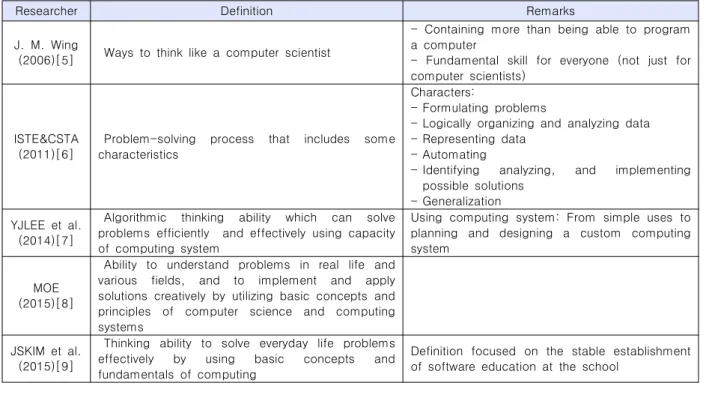
리말로 표기할 때 사용하기로 합의한 용어이다. 국내외 연구에 서의 컴퓨팅 사고력의 정의를 정리하면 Table 1과 같다.

기존 연구에서의 컴퓨팅 사고력의 정의를 종합하면 공통적 으로 ‘컴퓨팅 자원을 활용’하여 ‘문제를 해결’하는 사고과정임 을 알 수 있다. 따라서 본 연구에서는 컴퓨팅 사고력을 ‘문제 해 결을 위하여 컴퓨팅의 자원과 원리를 활용하는 사고과정’으로 정의하고, 이 컴퓨팅 사고력의 개념을 가르칠 방법으로 Think-aloud를 도입하여 진행하는 수업을 설계하고자 한다.

1.2 컴퓨팅 사고력의 구성요소

국내외 학자들의 컴퓨팅 사고력 구성요소에 관한 연구를 정 리하면 Table 2와 같다.

1.3 추상화

Table 2와 같이 컴퓨팅 사고력의 구성요소에 대한 학자들의 연구에는 모두 추상화가 포함되어 있다. 하지만 각각의 의미는 구분에 따라 조금씩 다르다. 넓은 의미의 추상화는 문제 해결에 관한 인간의 사고과정 전반을 의미[7]하며, 본 논문에서는 연 구 주제에서의 추상화가 이에 해당한다. 좁은 의미의 추상화는 핵심 요소를 정의하기 위해 복잡함을 줄이는 것[8]을 의미하 며, 본 논문에서 다루는 세부 구성요소로서의 추상화가 이에 해 당한다.

본 논문에서 추상화의 구성요소는 학교 현장에서의 현실적

인 고려를 바탕으로 김진숙 외(2015)[9]의 CT요소 중심모델

을 기반으로 한다. 또한 이 중 광의의 추상화에 해당하는 세 가

지 요소-분해, 패턴 인식, 추상화-에 관한 사고 방법을 주제로

하는 프로그램을 설계할 것이다.

(3)

2. Think-aloud

Think-aloud는 우리말로 ‘소리내어 생각하기’, ‘사고구술법’,

‘발성사고법’ 등으로 번역된다. 머릿속 사고의 과정을 말로 표 현해내는 방법으로 많은 질적 연구에서 프로토콜 수집의 방법 으로 활용되고 있다.

Think-aloud는 과거 인지심리학에서 주로 사용되던 내성법 (introspection)에서 비롯되었다. 내성법은 실험 대상자가 자신 의 사고에 대해 즉각적으로 구두로 보고하도록 하여 실험 대상 의 사고과정에 대한 프로토콜을 수집하는 방법이다. 내성법은 사고의 과정에서 구술까지 해야 하기에 실험 대상의 인지부하 가 증가하며 자료로서의 객관성이 떨어진다는 비판을 받았다.

그러나 사고과정에 대한 즉각적인 자료 수집이 가능하며, 부적 절한 사고과정에 대한 자료까지도 얻을 수 있다는 장점이 있어 오늘날 Think-aloud 기법으로 발전하기에 이르렀다[12][13].

교육에서의 Think-aloud는 교수방법과 평가기법으로 이용 될 수 있다. 교수법으로서의 Think-aloud는 주로 사고의 방법 이나 과정을 가르칠 때 유용하다. 교사가 해당 사고법을 적용하 여 머릿속에 생각나는 대로 말로 표현하여 시범을 보이면 학습 자는 이를 모방하여 사고 과정을 소리내어 말로 표현하며 연습 할 수 있다. Think-aloud를 평가기법으로 활용하면 평가하기 어려운 사고 과정의 습득 여부를 알아보기 용이하다. 학생은 학 습을 통해 배운 사고방법을 평가 문제에 적용하여 사고의 과정 을 말로 드러내고, 교사는 피드백을 통해 오류가 있는 경우 이 를 정정해주거나 평가의 기준으로 삼을 수 있다[14].

교육에서의 기존 연구를 살펴보면, 특수교육에서는 인지적 행동치료를 위한 수단으로, 언어교육에서는 인지전략의 습득을 위한 교수 도구로 주로 활용하고 있다.

컴퓨터교육에서는 김수환 외(2010)가 사고발성법을 적용하 여 프로그래밍의 과정에서 나타나는 초보학습자들의 행동 및 사고과정을 분석하여 과학적 분석의 준거를 제시하였다[15].

또한 고효정(2015)은 Think-aloud를 활용하여 실험대상의 사 고구술 프로토콜을 수집하고, 이를 활용하여 스마트폰 이용자 의 도움추구행위 모형을 연구하였다[16]. 컴퓨터교육에서의 Think-aloud 이용 연구들은 모두 Think-aloud를 프로토콜 획 득을 위한 질적 연구의 도구로 활용했음을 알 수 있다. 그러나 교수방법으로 Think-aloud를 적용하고 그 효과를 검증한 연구 는 부족한 실정이다. 이에 본 논문에서는 Think-aloud 기법이 고등 사고력을 가르치는데 효과적인 기법인 점에 착안하여 추 상화 능력 습득을 위한 프로그램을 설계하고, 그 타당성을 검증 하고자 한다.

3. 직접교수모형

직접교수법은 미국에서 학습에 불리한 환경에 있는 학생들 을 효과적으로 가르칠 수 있는 방법의 연구 결과로, 오레곤 대 학의 직접교수모형으로 알려지게 되었다. 직접교수법은 목표의 달성을 위해 과제를 세분화하고, 이를 차례대로 가르쳐 원하는 목표에 도달하는 것을 목적으로 한다.

직접교수모형을 적용하여 효과적으로 수업을 운영할 수 있 는 과제는 단순 지식보다는 고등사고기능, 문제해결능력이다.

교사가 사고기능이나 전략의 원리에 대해 설명하고, 직접 방법 을 시범보이면 학생이 이를 충분히 적용하여 연습하도록 하기 때문이다. ‘문제 해결을 위하여 컴퓨팅의 자원과 원리를 활용하 는 사고과정’인 컴퓨팅 사고력은 고등 사고력에 해당하므로, 직 접교수모형을 적용하기 적합한 주제이다.

직접교수모형이 교육에 활용되는 예를 살펴보면, 먼저 음악 과, 미술과, 체육과 등의 예체능 교과에서는 기능을 가르쳐 원 리를 알고 반복 연습하여 체득하도록 하는 수업에 사용된다. 수 학과의 경우, 산술법을 교사의 문제풀이 시범을 통해 가르치고, 학습자가 이를 모방해 문제를 해결하는 수업에 이용된다. 또한 국어과, 영어과 등의 언어 교과에서는 문법 영역이나 읽기 영역 에서 전략을 적용하는 방법을 다룰 때 이 모형이 사용된다.

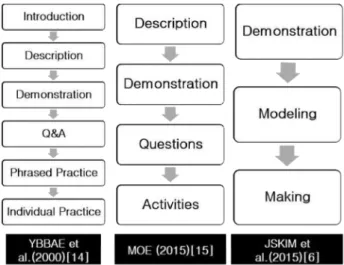
직접교수법을 모형화한 직접교수모형은 기능이나 방법 중심 의 주제를 다루는 모든 교과에서 두루 사용되는데, 명시적으로 제시된 절차를 정리하면 Fig. 1과 같다.

Fig. 1. Steps of Direct Instruction Model

배영부 외(2000)는 직접교수법의 단계를 ‘도입 – 교사의 설 명- 교사의 시범 – 질문과 대답 – 단계적 연습 – 독립적 연습’

으로 소개하면서 유의점으로 학생의 연습시간을 충분히 배당하 고 목표달성을 최우선시 해야 한다고 했다. 직접교수법은 교사 주도의 수업형태이나, 교사가 역할을 조금씩 줄여 학생의 연습 시간을 최대한 확보하면 얼마든지 학습자 중심의 수업이 될 수 있다고 보았다[17].

교육부(2015)는 직접교수모형의 단계로 ‘설명하기 – 시범 보이기 – 질문하기 – 활동하기’를 소개했다. 이는 일반적인 직 접교수모형의 단계를 따른 것으로 국어과 교육에 적합하게 약 간의 변형을 가미하였다[18].

김진숙 외(2015)는 소프트웨어 교육을 위한 교수학습모델을

개발하며 직접교수법과 관련하여 시연중심모델(DMM 모델)을

제안하였다. 그 단계를 ‘시연 – 모방 – 제작’으로 제시했는데,

(4)

‘시연’은 직접교수법의 설명하기와 시범에 해당하는 단계이며,

‘모방’은 질문에 해당하는 단계이다. 또한 ‘제작’은 학생 연습, 활동에 해당하는 단계이다[9].

III. The Proposed Scheme

1. 연구 절차 및 방법

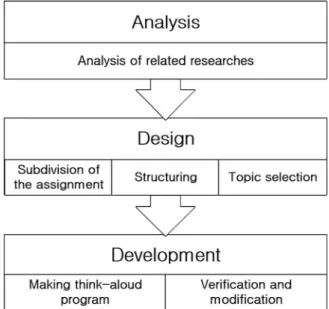
추상화 개념 습득을 위한 Think-aloud 프로그램의 개발은 교수설계모형인 ADDIE 모형(분석 – 설계 – 개발 – 실행 – 평 가)에 따라 이루어졌다. 본 연구에서는 실행과 평가 단계를 제 외한 개발 단계까지만 수행하였다. 후속 연구에서 프로그램에 대한 실행과 평가를 진행할 것이다.

Fig. 2. Development Process of Think-aloud Program

먼저 분석 단계에서는 관련된 선행 연구 분석을 통하여 프로 그램 개발을 위한 이론적 토대를 마련하였다. 이어 설계 단계에 서는 목표 달성을 위한 과제를 세분화하고, 이를 구조화하여 프 로그램의 차시별 주제를 선정하였다. 개발 단계에서는 Think-aloud 프로그램의 수업 진행 단계와 전체적인 내용을 정하고 이에 따른 수업지도안을 작성하였다. 이후 전문가 9인 을 대상으로 내용타당도 검증을 실시하였고, 이 내용을 바탕으 로 수정을 거쳐 프로그램을 완성하였다.

2. Think-aloud 프로그램 설계

추상화의 세 가지 요소를 학습하기 위한 수업의 흐름은 Fig.

3와 같다.

Fig. 3. Think-aloud Program Process

본격적인 프로그램에 앞서 사전학습으로 Think-aloud를 소 개하여 학생들의 이해를 돕고, 이후 문제 해결을 위하여 분해- 패턴인식-추상화의 순서로 수업을 진행한다. 마지막 수업에서 는 지금까지 배운 모든 추상화 방식을 적용하여 문제를 해결해 보도록 한다.

프로그램의 각 차시에는 직접교수모형을 적용할 것이다. 단, 문제 해결 중심인 마지막 차시는 예외로 한다. 각 수업에 적용 될 모형의 절차를 표로 나타내면 Fig. 4와 같다.

Fig. 4. Steps for the Instruction

도입 단계에서는 Think-aloud 기법을 상기하여 학생들의 선행지식을 활성화 하고, 학습 동기를 유발한다. 직접교수법의 특성상 전개 단계에서 학습자의 흥미가 다소 낮아질 수 있으므 로 여기서 학습의 필요성과 의욕을 불러일으키는 것은 매우 중 요하다.

전개 단계는 직접교수모형의 절차에 따라 ‘설명 – 시범 – 질 의응답 – 연습’ 순으로 활동이 진행된다. 먼저 설명 단계에서는 가르치려는 사고력의 개념, 필요성, 원리, 절차 및 방법에 대해 충분히 설명하여, 학습자들의 이해를 돕는다. 다음으로 시범 단 계에서는 Think-aloud 기법을 활용하여 목표로 하는 추상화 기법의 사고 과정을 시연한다. 이 때 시범보이는 문제는 매 차 시 동일한 문제로 심화·확대해 나가 수업 간 연계성을 확보한 다. 이후 질의응답 단계에서는 질문을 통해 학생들의 이해를 점 검하고 피드백을 통해 학생들의 사고 과정을 교정한다.

연습 단계에서는 교사의 시범과 이해를 바탕으로 학생들이

직접 사고과정을 연습해본다. 직접교수법을 적용한 수업이 교

사 일변도의 수업이 되지 않기 위해서는 이 연습 단계에서 학

습자의 연습이 충분히 보장되어야 한다. 본 프로그램의 연습 단

(5)

Sess. Concept Learning Objective Activities Prior

Learni ng

Think-al oud

Students explain think-aloud technique.

- Introduce and practice students of think-aloud technique

1 Decomp

osition

Students decompose complex problem into small problems.

Introduction - Remind students of think-aloud technique

- Motivate learning: How can I do a complex errand?

Expansion

Description - Explain the concept, necessity, and principle of the decomposition

Demonstra tion

- Demonstrate a decomposition by using think-aloud

Q&A

- Students fill in the blanks the examples of think-aloud

- Students explain how to decompose problem Practice

- Groups solve exercise tasks and present their answers

- Teacher provide feedback Closure - Decompose the question as many as possible

2

Pattern recognit

ion

Students simplify problems by recognizing repetition or trend.

Introduction - Remind students of think-aloud technique

- Motivate learning: What is the next thing? (IQ test questions)

Expansion

Description - Explain the concept, necessity, and principle of the pattern recognition

Demonstra tion

- Demonstrate a pattern recognition by using think-aloud

Q&A

- Students fill in the blanks the examples of think-aloud

- Students explain how to recognize the pattern Practice

- Groups solve exercise tasks and present their answers

- Teacher provide feedback Closure - Groups make questions which has repetition

- Each group find the pattern in another group’s question

3 Abstract ion

Students reduce complexity by removing unnecessary things and finding core elements.

Introduction - Remind students of think-aloud technique - Motivate learning: Naming the set

Expansion

Description - Explain the concept, necessity, and principle of the abstraction

Demonstra

tion - Demonstrate an abstraction by using think-aloud Q&A

- Students fill in the blanks the examples of think-aloud

- Students explain how to abstract the problem Practice

- Groups solve exercise tasks and present their answers

- Teacher provide feedback

Closure - Talk about the areas in which they can apply abstraction 4

Problem Solving Practice

Students abstract problem to make matter solvable.

Introduction - Introduction of the topic: Drawing safety map of my village Expansion - Each group makes the plan by discussion

Closure - Each group presents their plan Table 3. Think-aloud program contents

계에서 교사는 모둠별로 연습문제를 다르게 제시하고, 학습자 는 개별적으로 문제에 대한 Think-aloud를 하여 사고 과정을 연습한다. 이후 모둠별로 의견을 나누어 하나의 모범 Think-aloud 프로토콜을 작성하고 이를 전체적으로 발표하여 다른 학생들과 의견을 나눌 수 있도록 한다. 이 때 교사는 이에 대한 피드백을 제공하고 필요하면 사고방법에 대한 교정을 해 주도록 한다. 매 차시 주어지는 모둠별 연습문제는 같은 문제이 며, 따라서 학습자들은 자신이 전 차시에 만들어놓은 답안에 추 가적인 사고를 적용해 문제를 추상화해나가도록 구성하여 차시 간 연계성을 확보한다.

마지막 정리 단계에서는 정리 및 복습 활동과 다음차시 예고 를 통하여 수업을 마무리하고 다음 시간 수업을 위한 준비를 하도록 한다.

3. Think-aloud 프로그램 개발

앞서 논의한 절차에 따라 구체화 한 프로그램 내용은 Table

3와 같다.

(6)

IV. Experiments and Results

1. 내용 타당성 검증 설문 및 결과

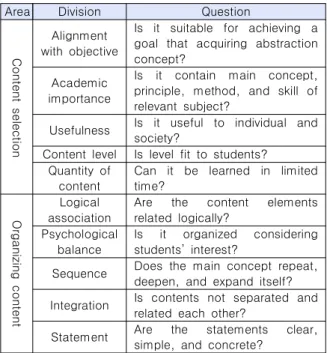
프로그램의 내용 타당성 검증을 위해 허형 외(1996)의 교육 내용 선정·조직에 관한 평가 준거[19]를 활용하였다. 평가 도 구는 Table 4와 같으며 여기에 자유서술 문항을 한 개 추가한 설문지를 작성하여 전문가 9인을 대상으로 리커트 5척도 설문 조사를 실시하였다. 전문가 집단은 컴퓨터교육 석사과정 이상 의 현직 교사로 구성하였으며, 타당성 분석을 위해 Lawshe(1975)의 내용타당도 비율(Content Validity Ratio, CVR) 산출 공식[20]에 적용하여 검증하였다. 검증 결과는 Table 5와 같다.

Area Division Question

C o n te n t s e le c tio n

Alignment with objective

Is it suitable for achieving a goal that acquiring abstraction concept?

Academic importance

Is it contain main concept, principle, method, and skill of relevant subject?

Usefulness Is it useful to individual and society?

Content level Is level fit to students?

Quantity of content

Can it be learned in limited time?

O rg a n iz in g c o n te n t

Logical association

Are the content elements related logically?

Psychological balance

Is it organized considering students’ interest?

Sequence Does the main concept repeat, deepen, and expand itself?

Integration Is contents not separated and related each other?

Statement Are the statements clear, simple, and concrete?

Table 4. Assessment area

Area Division Avg SD CVR Result

C o n te n t s e le c tio n

Alignment

with objective 4.56 0.50 1.00 Pass Academic

importance 4.11 0.87 0.78 Pass Usefulness 4.67 0.67 0.78 Pass Content level 4.56 0.68 0.78 Pass

Quantity of

content 4.67 0.67 0.78 Pass

O rg a n iz in g c o n te n t

Logical

association 4.44 0.68 0.78 Pass Psychological

balance 4.44 0.68 0.78 Pass Sequence 3.89 0.74 0.33 Fail Integration 4.33 0.67 0.78 Pass Statement 4.33 0.82 0.56 Fail Table 5. The result of validation

응답자 수가 9명인 경우 CVR값이 0.78 이상인 경우 타당하 다고 판단할 수 있으므로, 계열성과 내용 진술 영역을 제외한 나머지 영역에서는 타당성을 인정받았다. 타당성이 충분하지 않은 영역들의 경우, 각 추상화 개념의 반복 연습이 모자라 계 열성이 다소 부족하다는 전문가의 의견이 있었다. 또한 내용 서 술에 있어 추상화의 각 과정은 분절적인 것이 아니라 이어지는 것이므로, 하나의 문제를 가지고 발전시켜 완성 해나가는 수업 형태를 명시적으로 서술하는 것이 바람직하겠다는 의견이 있었 다.

2. 설문 결과에 따른 프로그램 수정

설문의 결과에 따라 사고 방법의 종합 연습 차시를 3차시 추 상화와 4차시 문제해결 수업 사이에 Table 6과 같이 한 차시 추가하였다. 이는 학습한 방법을 전체적으로 한 번 더 반복연습 하고 문제 해결로 넘어갈 수 있도록 하여 계열성을 확보하고자 함이다. 또한 Table 7과 같이 차시에서 다루는 주제를 명시하 여 계열성과 내용진술의 명확성을 확보하였다.

Sess. Concept Theme

1 Decomposi

tion - Teacher: Running food booth in the school festival

- Student: Exercise tasks for each group

(Students apply newly learned thinking skill on same problem during these sessions)

2 Pattern recognition

3 Abstraction

4

Synthetic Abstraction

Practice

- Teacher: Making a plan for a school trip

- Student: Exercise tasks for each group

5

Problem Solving Practice

- Student: Drawing safety map of my village

Table 7. Theme of the program

V. Conclusions

본 연구는 Think-aloud 기법이 고등 사고력을 학습자에게

학습시키기 좋다는 점에 착안하여 시작되었다. 소프트웨어 교

육이 강화되고 핵심 개념인 컴퓨팅 사고력이 더욱 강조되는 현

교육계 추세에서, 정작 컴퓨팅 사고력의 교수법에 대한 연구는

충분하지 못하다. 이에 본 논문에서는 Think-aloud 기법을 활

용하여 컴퓨팅 사고력의 사고 방법을 직접적으로 가르치는 프

로그램을 제안하였다. 특히 컴퓨팅 사고력 중 추상화 개념의 습

득을 명시적으로 하는 프로그램의 개발을 위해 교수설계모형인

(7)

ADDIE 모형의 절차에 따라 연구를 진행하였다.

ADDIE 모형의 단계에 따라 먼저 ‘분석’ 단계에서는 컴퓨팅 사고력, Think-aloud, 직접교수모형 등 프로그램 개발과 관련 된 선행 연구를 분석하였다. 이후 ‘설계’ 단계에서는 분석된 내 용을 바탕으로 목표의 달성을 위한 과제를 세분화 하고 구조화 하여 프로그램의 각 차시별 주제를 선정하였다. 이어 ‘개발’ 단 계에서는 프로그램의 수업절차 및 세부 수업 내용 등을 구성하 고 이를 반영한 수업 지도안을 작성하였다. 이를 바탕으로 전문 가 9인을 대상으로 내용 타당도 검증을 위한 설문을 실시하였 고, 그 결과 두 영역을 제외한 나머지 영역에서 적합하다는 결 과를 얻었다. 부족한 두 영역에 대해서는 프로그램을 수정하여 이를 보완하였다.

이후 본 연구에 대한 후속 연구로 본 논문에서 다루지 못한 ADDIE 모형의 절차인 ‘실행’ 단계를 통해 개발한 프로그램을 실제 현장에 적용해보고, ‘평가’ 단계를 통하여 프로그램에 대 한 평가 및 개선이 이루어지도록 할 것이다. 또한 컴퓨팅 사고 력의 다른 영역인 알고리즘, 프로그래밍 영역에 대한 Think-aloud 프로그램도 개발할 것이다.

REFERENCES

[1] psjang, “2016 Davos Forum: What is our strategy for the forthcoming Fourth Industrial Revolution?,” Science

& Technology Policy, Vol. 26, No. 2, pp. 12-15, Feb.

2016.

[2] twlee, “Education for the Fourth Industrial Revolution,”

Chungcheong Ilbo, Sep. 23rd 2016.

[3] Maeil Business Thesaurus - ‘4th Industrial Revolutions’[internet], http://terms.naver.com/entry.

nhn?docId=2805211&cid=43659&categoryId=43659 [4] Current Affairs Dictionary – ‘Industry 4.0’[internet],

http://terms.naver.com/entry.nhn?docId= 2044943&cid

=43667&categoryId=43667

[5] J. M. Wing, “Computational Thinking,” Communications of the ACM, Vol. 49, No. 3, pp. 33-35, March 2006.

[6] ISTE and CSTA, “ Computational Thinking Leadership Toolkit 1st edition, ” pp.13-15, 2011.

[7] yjlee,shbaek, jhshin, hcyoo, ikjeong, sjahn, jwchoi, and skjeon, “ Research for Introducing Computational Thinking into Primary and Secondary Education, ” KOFAC, pp. 31-34, Apr. 2014.

[8] Ministry of Education, “ National Curriculum of Informatics ,” p. 96, 2015.

[9] jskim, skhan, shkim, swjeong, jmyang, edjang, and jnkim,

“ A Research on the Development of Teaching and

Learning Models for SW Education, ” KEDI and KERIS, pp. 11-12, 57-61, 2015.

[10] J. M. Wing, “Computational Thinking and Thinking about Computing,” Philosophical Transactions of the Royal Society A, Vol. 366, pp. 3717-3725, Oct. 2008.

[11] Ministry of Education, “ Operation Guideline for Software Education ,” p. 2, 2015.

[12] jdpark, “Research of Social Problem Solving Process Using ‘Think-aloud’ Method,” Master dissertation, Graduate School of Education of Korea National University of Education, Feb. 2007.

[13] khlim and wlim, “ Educational Psychology ,” Hakjisa, p.

24, 2013.

[14] Korean Society for Educational Evaluation, “ Educational Evaluation Thesaurus ,” Hakjisa, pp. 215-216, 2004.

[15] shkim, skhan, and hckim, “Analysis of Programming Processes Through Novices’ Thinking Aloud in Computational Literacy Education,” The Journal of Korean association of computer education, Vol. 14, No.

1, pp. 13-21, Jan. 2011.

[16] hjgo, “A study of a model for help-seeking behaviors of smartphone users by think-aloud method,” Master dissertation, Graduate School of Education of Korea University, Jan. 2015.

[17] ybbae, mbkang, sgnoh, shpark, msjeong, and yhchoi,

“ Learning Model Research for Teacher Training ,” NRF, pp. 248-261, 2000.

[18] Ministry of Education, “ (Elementary School) Korean : Teacher’s manual, ” pp. 433-435, 2015.

[19] hheo, jbkim, jkkim, cychoi, ymkim, and yhkim, “ A Research on the Development of Evaluation Models for Korean Curriculum, ” KEDI, pp. 97-98, 1996.

[20] C. H. Lawshe, “A Quantitative Approach to Content Validity,” Personnel Psychology, Vol. 28, No. 4, pp.

567-568, 1975.

(8)

Authors

Ji-Yun Kim received the B.Ed. degree in Elementary Mathematics Education from Jeonju National University of Education, Korea, in 2013.

She is currently in the master’s course in the Department of Computer Education at Korea National University of Education, Cheongju, Korea.

Kim is joined Jeongeup-Buk Elementary School, Jeongeup, Korea, since 2013. She is interested in computer education, software education, and smart learning.

Tae-Wuk Lee received the B.S. degree in Science Education from Seoul National University, Korea, in 1978.

And he received the M.S. and Ph.D.

degrees in Computer Science and Education from Florida Institute of Technology, U.S.A. in 1982 and 1985, respectively.

Dr. Lee joined the Department of Computer Education

at Korea National University of Education, Cheongju,

Korea, since 1985. He is interested in computer

education and knowledge engineering.

수치

Table  1.  Definition  of  Computational  Thinking
Fig.  1.  Steps  of  Direct  Instruction  Model
Fig.  4.  Steps  for  the  Instruction
Table  4.  Assessment  area

참조

관련 문서

The purpose of this study is to investigate the effect of the employment education program implemented by the Gwangju Education Office Employment Support

The academic journals used at the time were ‘The Mathematical Education’ of The Korean Society of Mathematical Education, ‘Journal of Educational Research

5-4.. Source : Korea Education Development Institute, 통계청, 장래인구추계, 1996. Educational Indicators in Korea, 1997. National Statistical Office, The

As the importance of education through play in modern children's education is emphasized, this study aims to propose an art education program through play

Resource Development She is active at the National level of ASTD serving on the 1990 National Conference Design Committee Resource Development.. She is active at the National

KNU10 (Korea National University 10) is comprised of ten leading national universities including Kangwon National University, Kyungpook National University,

In the current context, where the interconnectedness of the global economy has intensified greatly and the importance of a collective response to

1 John Owen, Justification by Faith Alone, in The Works of John Owen, ed. John Bolt, trans. Scott Clark, "Do This and Live: Christ's Active Obedience as the