***†양진국(교신저자) : (주)중앙엔지니어링건축사사무소 부설 건설기술연구소
E-mail : [email protected], Tel : 070-8275-3415
*정해조 : 부경대학교 국제지역학부
**김수용 : 부경대학교 토목공학과
***†Jinkook Yang(corresponding author) : Research Institute of Construction Technology, Jung Ang Engineering Co., Ltd.
E-mail : [email protected], Tel : 070-8275-3415 *Hae Jo Chung : Division of International and Area Studies,
Pukyong National Univ.
**Sooyong Kim : Department of Civil Engineering, Pukyong National Univ.
A Study on the POE-based Energy Utilization Satisfaction Analysis for Passive House in Germany
Hae Jo Chung*, Sooyong Kim** and Jinkook Yang***†
(Received 18 January 2016; accepted 09 June 2016)
Abstract : Passive House represents energy-saving technologies. It aims to save energy and provide comfort to the dwellers. The design and construction began in Germany, where it is commonly observed. In South Korea, implementation of the Passive House concept is difficult because of high construction costs and technological problems. This study performed a POE analysis to analyze the extents of satisfaction and knowledge about Passive House among those who live in them in Germany. The results found high satisfaction with functional aspects, such as ventilation, windows, doors, and the thermal bridge. These research results will provide application criteria for Passive House construction in South Korea.
Key Words : Passive House, Energy-saving technologies, POE analysis
1. Introduction
Housing construction techniques have been evolving. Among the advanced techniques, energy-saving technology is the core technology. This study aims to analyze Passive House, built not only to conserve energy, but also to ensure a hospitable living environment. Passive House construction began in Germany, where many Passive
Houses can be observed. On the other hand, Passive House is unusual in South Korea because of the expensive construction costs and technological challenges. Regarding these issues, this study conducted a survey (Post Occupancy Evaluation (POE)) among German Passive House residents regarding their satisfaction and knowledge. The results are expected to suggest guidelines for pursuing Passive House in South Korea.
[논문] 한국태양에너지학회 논문집 Journal of the Korean Solar Energy Society
Vol. 36, No. 3, 2016 IS S N 1 5 9 8 - 6 4 1 1 http://dx.doi.org/10.7836/kses.2016.36.3.017
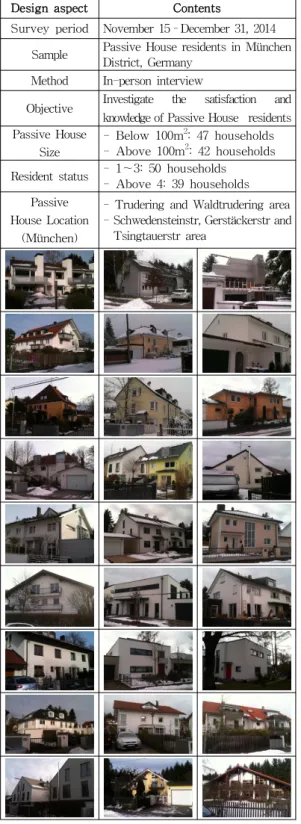
Design aspect Contents
Survey period November 15–December 31, 2014 Sample Passive House residents in München
District, Germany Method In-person interview
Objective Investigate the satisfaction and knowledge of Passive House residents Passive House
Size
- Below 100m2: 47 households - Above 100m2: 42 households Resident status - 1~3: 50 households
- Above 4: 39 households Passive
House Location (München)
- Trudering and Waldtrudering area - Schwedensteinstr, Gerstäckerstr and
Tsingtauerstr area
Table. 1 Overview of survey design 2. Survey Design
The objective of this study was to provide data for an empirical analysis through POE analysis. The sample comprisedPassive House residents in München, Germany. Germany was chosen because it holds the fundamental technologies of Passive House . In addition, Germany implements the Passive House standard guidelines. The questionnaire had 11 questions regarding the extents of satisfaction and recognition levels of Passive House residents. Four additional questions concerned the extent to which the respondents recognized the major functions of Passive House, particularly the energy-saving functions.
Table 1 provides a summary of the survey design.
3. Survey Method
There were 89 Passive House residents in München, Germany, who participated in the in-person survey, which was carried out after the respondents received detailed explanations during residential visits. The data were analyzed using SPSS1) for exploratory factor analysis of the measurement tools, reliability analysis, and correlation analysis. The factors were extracted using principal component analysis with Varimax rotation based on the assumption of mutual independence among the extracted factors.
1) The SPSS is a software package for statistical analysis. This study utilized SPSS version 20.
4. Results
4.1 Exploratory factor analysis of the questionnaire content
Ten questionnaire items were employed based on the principles2) of the German Passive House institute. The exploratory factor analysis found three factors: “Outside Block,” “Indoor Environment,” and “Indoor Sensible Temperature.” Among the total six questions on Outside Block (blocks air and light coming from the outside), one question was dropped. There were three items in the Indoor Environment index, and there were two items in the Indoor Sensible Temperature index.
4.2 Reliability Analysis
Reliability analysis was performed to assess the internal consistency of the measurement items. Cronbach’s α exceeded .60; which supported the credibility of the indexes (Van and Ferry)3) (Table 2).
4.3 Correlation of variables
The correlation results are shown in Table 3 regarding the independent variables (knowledge) and the dependent variables (satisfaction).
2) The basic principles of German Passive House are (1) thermal insulation, (2) Passive House windows, (3) ventilation heat recovery, (4) airtight structure, and (5) absence of thermal bridges.
3) Van de Ven, A. H and Ferry, D. L., (1980): Measuring and Assessing Organizations (Wiley, New York)
Division Outside Block
Indoor environment
Temperature of indoor Airtightness
of window 0.829 0.089 0.124
Thermal
bridge 0.777 -0.094 -0.028
Insulation of
window 0.665 0.212 0.331
Envelope
airtightness 0.595 0.075 0.262
Insulation of
envelope 0.591 0.382 -0.032
Comfort of
indoor air 0.122 0.736 0.164
Insolation 0.372 0.691 0.043
Artificial
lighting -0.101 0.641 0.054
Temperature
of summer 0.008 0.053 0.930
temperature
of winter 0.409 0.218 0.718
cronbach's α 0.775 0.632 0.700
Table. 2 Exploratory factor analysis, reliability analysis
Divis
ion variables 1 2 3 4 5 6 7
indep endent varia bles
function 1 energy
saving .540 1 environm
ent-
friendly .236 .614 1 financial
support .184 .273 .403 1
depen dent varia bles
outside
block .248 .243 .011 .203 1 environm
ent .275 .265 .153 .117 .370 1 temperat
ure of
indoor .099 .291 .321 .216 .399 .295 1 Table. 3 Correlation analysis results
4.4 Differences by general characteristics Regarding the extents of the respondents’
satisfaction and knowledge, differences were analyzed with respect to their general characteristics. Independent samples t-tests and analysis of variance were used to compare differences in means.
4.4.1 Size of dwelling
There was a statistically significant difference in satisfaction depending on the size of the house, where satisfaction was higher among the respondents whose houses were larger than 100 m2compared to the other respondents (Table 4).
Division group mean std.
deviation t-value p-value function
of Passive House
< 100m2 3.47 .94
-0.014 0.989
≥100m2 3.46 1.16
energy saving
< 100m2 3.98 .84
0.119 0.906
≥ 100m2 4.00 .89 environm
ent-friend ly
< 100m2 3.87 .87
0.061 0.952
≥ 100m2 3.88 .87
financial support
< 100m2 3.27 1.14
0.118 0.906
≥ 100m2 3.29 .87
outside block
< 100m2 4.17 .56
2.592 0.011
≥ 100m2 4.46 .47 environm
ent of indoor
< 100m2 4.09 .66
0.854 0.395
≥ 100m2 4.20 .57 temperatu
re of indoor
< 100m2 3.99 .76
1.765 0.081
≥ 100m2 4.26 .63
Table. 4 T-test by number of residents
4.4.2 Annual income
Satisfaction was higher (4.66) among the respondents whose annual incomes exceeded EUR 75,000 than among those with lower incomes (Table 5).
Division group mean std.
deviation t-value p-value
Function of Passive
House
< 50,000 3.55 0.95
1.915 0.154 50,000-75,000 3.24 0.99
≥ 75,000 3.77 1.19 total 3.48 1.04
energy saving
< 50,000 3.97 0.73
1.536 0.221 50,000-75,000 3.88 0.88
≥ 75,000 4.27 0.88 total 4.01 0.84
environm ent-frien
dly
< 50,000 3.76 0.87
0.971 0.383 50,000-75,000 3.88 0.88
≥ 75,000 4.09 0.75 total 3.89 0.85
financial support
< 50,000 3.31 1.17
0.818 0.445 50,000-75,000 3.15 0.99
≥ 75,000 3.50 0.80 total 3.29 1.01
outside block
< 50,000 4.16 0.58
7.799 0.001 50,000-75,000 4.19 0.49
≥ 75,000 4.66 0.36 total 4.30 0.54
environm ent of indoor
< 50,000 4.11 0.71
2.965 0.057 50,000-75,000 4.01 0.61
≥ 75,000 4.41 0.44 total 4.15 0.62
temperatu re of indoor
< 50,000 4.05 0.63
6.432 0.003 50,000-75,000 3.90 0.79
≥ 75,000 4.55 0.51 total 4.12 0.71
Table. 5 T-test by income
4.5 Satisfaction with the Passive House by function
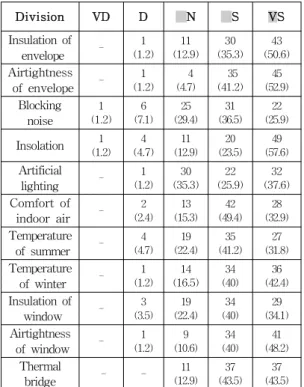
Between one and seven respondents were dissatisfied or very dissatisfied with their houses regarding their abilities to block noise or sunlight. However, more than 80%
of the respondents were satisfied or very satisfied with the functions of their passive houses (Table 6).
Division VD D N S VS
Insulation of envelope -
1 (1.2)
11 (12.9)
30 (35.3)
43 (50.6) Airtightness
of envelope - 1 (1.2)
4 (4.7)
35 (41.2)
45 (52.9) Blocking
noise
1 (1.2)
6 (7.1)
25 (29.4)
31 (36.5)
22 (25.9) Insolation 1
(1.2) 4 (4.7)
11 (12.9)
20 (23.5)
49 (57.6) Artificial
lighting - 1 (1.2)
30 (35.3)
22 (25.9)
32 (37.6) Comfort of
indoor air - 2 (2.4)
13 (15.3)
42 (49.4)
28 (32.9) Temperature
of summer - 4 (4.7)
19 (22.4)
35 (41.2)
27 (31.8) Temperature
of winter - 1 (1.2)
14 (16.5)
34 (40)
36 (42.4) Insulation of
window -
3 (3.5)
19 (22.4)
34 (40)
29 (34.1) Airtightness
of window - 1 (1.2)
9 (10.6)
34 (40)
41 (48.2) Thermal
bridge - -
11 (12.9)
37 (43.5)
37 (43.5) Table. 6 Satisfaction with passive houses from very
dissatisfied (VD) to very satisfied (VS), numbers of cases with percentages in parentheses
4.6 Awareness analysis for the Passive House
The results of the analyses of the respondents’
knowledge about Passive House showed that approximately 50% of the sample was familiar with the functions of passive house,
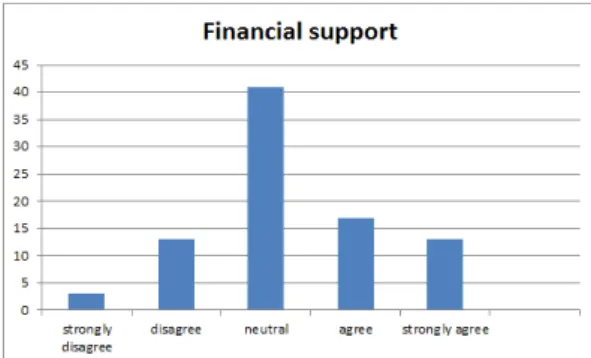
and approximately 75% of the respondents agreed with the energy savings aspect of passive house. In addition, about 66% agreed that Passive House are environmentally friendly. As explained above, German Passive House has been implemented according to the basic principles of passive house.
Fig. 1 Residents awareness for function
Fig. 2 Residents awareness for energy saving
Fig. 3 Residents awareness for environment-friendly
Fig. 4 Residents awareness for financial support
5. Conclusion
Passive housing has value for conserving energy and securing a pleasant living environment. Germany has the original technology. In South Korea, despite its value to efficiency, passive houses are uncommon because of their expensive construction costs and so on. This study performed a POE to analyze satisfaction among Passive House residents. The respondents were satisfied with the functional aspects of their passive houses. For example, they were satisfied with the ventilation, windows, doors, and thermal bridge. They also were highly satisfied with the houses’ abilities to block noise and sunlight/artificial light, provide sensible temperatures in summer and winter, and so on. The respondents’ knowledge was high as well, considering that about 50% to 70% had knowledge of the energy-saving functions, eco-friendly values, and other aspects of passive houses. In conclusion, German passive houses are efficient from the residents’ perspectives.
Acknowledgement
This work was supported by a Research Grant of Pukyong National University (2015).
Reference
1. Bundesministerium für Wirtschaft und Technologie,
“Energieforschung und Innovationen. - 6. Ener gieforschungsprogramm,” http://www.bmwi.de /DE/Themen/Energie/ Energieforschung-und- Inno vationen/6-energieforschungsprogramm.h tml, 2014/11/1.
2. Brüderle, Rainer, “The best energy is the energy we don’t consume,” The Security of Europe’s Energy Supply: Continuous Adaptation, (ed.) Laurent Ulmann, Paris: European Commission, 2011.
3. Independent, representative survey of 100 heating technicians by EUPD-Research, commissioned by BSW-Solar, www.solarwirt schaft.de/preisi ndexAverage, 2014/11/01.
4. Kim, M. S. et. al. “POE(Post Occupancy Evaluation) of the heating performance for the low-energy residential building”, Korea Institute of Ecologi cal Architecture and Environment 2013 Confere nce Proceeding, pp. 10-11, 2013.
5. International Energy Agency (IEA)(2013). Energy Policies of IEA Countries –Germany 2013 Review, Paris: OECD, 2013.
6. IEA, “Germany: Balances for 2012,” http://www.
iea.org/statistics/ statisticssearch/ report/?year
=2012&country=GERMANY&product =Balances, 2014/10/21.
7. Passive House Institute, http://www.passiv.de/en/
02_informations/02_passive-house-requirements/
02_passive-house-requirements.htm, 2015/11/19.
8. Van de Ven, A. H and Ferry, D. L., Measuring and Assessing Organizations, Wiley, New York, 1980
Appendix. POE Survey questionnaires
Questionnaires on residential experience in Passive House
Dear Sirs,,
I would like to ask you some questions to investigate the level of resident satisfaction.
The information which you would provide, would be used only for academic research.
Thank you very much for your cooperation.
Prof. Hae Jo Chung Pukyong National University, Busan, South Korea
Question
1.1 Size of your house? ______________ ㎡ 1.2 Number of resident _________
1.3 Price of your house? __________ EUR 1.4 annual income
▢ <25.000 ▢ 25.-50.000 ▢ 50.-75.000,
▢ ≥75.000 EUR
VD D N S VS
2.1 Insulation of envelope 2.2 Airtightness
of envelope 2.3 Blocking
noise 2.4 Insolation 2.5 Artificial
lighting 2.6 Comfort of
indoor air 2.7 Temperature
of summer 2.8 Temperature
of winter 2.9 Insulation of
window 2.10 Airtightness
of window 2.11 Thermal
bridge
Please tick off items in the following list.
VD = very dissatisfied D = somewhat dissatisfied N = neutral
S = somewhat satisfied VS = very satisfied
SD D N A SA
3.1 I know the function of Passive House.
3.2 I think that they can save energy in Passive House.
3.3 I think that Passive House is
Environment-friendly.
3.4 I think that the financial support for Passive House is enough.
SD = strongly disagree
D = disagree N = neutral A = agree
SA = strongly agree