한수지 50(4), 359-365, 2017
359
Copyright © 2017 The Korean Society of Fisheries and Aquatic Science pISSN:0374-8111, eISSN:2287-8815 Korean J Fish Aquat Sci 50(4),359-365,2017
Original Article
서 론
산소는생명유지에절대적으로필요하지만, 모든호기성생물 들은신진대사의부산물로인한원인이나공해물질, 화학약품, 광화학반응등에의하여하이드록실라디칼, 과산화수소, 수퍼 옥사이드라디칼및아질산염산화물과같은반응성이매우큰 활성산소로전환된다. 이렇게발생된활성산소는체내에서바 이러스나박테리아같은미생물에대항하기위해반드시필요 하지만반면에생체에치명적인산화스트레스를유발하기도한 다. 특히, 인체내에서발생하는산화스트레스는활성산소생 성과생체의항산화방어기전사이의불균형으로인해발생되 는데염증, 당뇨병, 다발성경화증, 심장병, 파킨슨병, 알츠하이 머병, 동맥경화증, 뇌졸중, 암과같은다양한병리학적상태에 직접적으로관련이있다고보고되고있다(Eshwarappa et al., 2015; Olugbami et al., 2015). 따라서, 그동안많은연구자들은 활성산소의효과적인제거를위하여항산화물질에대한연구를 진행해왔으며특히천연물유래항산화물질에대한연구에관 심을기울여왔다(Salimikia et al., 2015).
다시마는다시마과다시마속에속하는갈색의다년생해조류
로식이섬유, 요오드, 칼슘, 셀레늄등다양한기능성성분이보 고되어있으며중국, 일본, 한국아시아에서식품으로많이섭 취되고있다(Jin et al., 2013). 다시마속해조류에는주로 alginic acids, laminaran 및 fucoidan이다량함유되어있으며(Koo et al., 1995; Vishchuk et al., 2011), 항혈액응고작용및항암작용, 혈청콜레스테롤저하작용, 유해중금속의체내흡수방지및배 출기능등이알려져있다(Kim et al., 2014). 또한, 면역력증가 나라디칼소거활성이우수하여노화와성인병을예방에효과 가있다고알려져있다(Rupérez et al., 2002).
상황버섯은담자균류에속하는약용버섯으로한국, 중국, 일 본에서는오래전부터복통, 관절염, 염증, 위장장애, 비인슐린 의존성당뇨병, 림프계질환, 암및면역자극치료등에사용되 어왔다(Kim at al., 2004; Huang et al., 2011; Wu at al., 2013;
Reis et al., 2014). 또한, 상황버섯은다당류와방향족화합물 이풍부하며주요성분은 meshimakobnols A와 B, phelligridin G, hispidin, phelligridimer A, davallialactone, methyldavalli- alone, hypholomine B, interfungins A, inoscavin A, protocat- echuic acid, protocatechualdehyde, cdaaffeic acid, ellagic acid 등이함유되어있다고알려져있다(Nagatsu et al., 2004; Lee et
상황버섯 균사체로 발효한 다시마 추출물의 항산화 활성
김연숙·박표잠·정재현1*
건국대학교 생명공학과, 1한국교통대학교 식품공학과
Fermented Saccharina japonica with Phellinus linteus Mycelia Enhances its Radical Scavenging Activities
Yon-Suk Kim, Pyo-Jam Park and Jae-Hyun Jeong1*
Department of Biotechnology, Konkuk University, Chungju, Chungbuk 27478, Korea
1Department of Food Science and Technology, Korea National University of Transportation, Chungju 27478, Korea
To develop new functional materials, Saccharina japonica (S. japonica) was cultivated with Phellinus linteus (P.
linteus) mycelia by solid culture. S. japonica was fermented with P. linteus mycelia. The various radical scavenging activities of extracts of fermented S. japonica with P. linteus mycelia (FSPM) were investigated and compared to the antioxidant capabilities of unfermented S. japonica and P. linteus mycelia. The antioxidant activities of FSPM extracts were evaluated using ferric reducing antioxidant power (FRAP) and 2,2'-azinobis-(3-ethylbenzothiazoline- 6-sulfonic acid) (ABTS) radical scavenging activity. FSPM showed stronger free radical scavenging abilities than P. linteus mycelia or S. japonica alone. These results indicate that fermentation of S. japonica changes its chemical nature and could provide beneficial antioxidant effects.
Key words: Radical scavenging, Phellinus linteus, Fermentation, Saccharina japonica
This is an Open Access article distributed under the terms of the Creative Commons Attribution Non-Commercial Licens (http://creativecommons.org/licenses/by-nc/3.0/) which permits unrestricted non-commercial use, distribution, and reproduction in any medium, provided the original work is properly cited.
https://doi.org/10.5657/KFAS.2017.0359 Korean J Fish Aquat Sci 50(4) 359-365, August 2017
Received 14 August 2017; Revised 17 August 2017; Accepted 19 August 2017
*Corresponding author: Tel: +82. 43. 840. 3588 Fax: +82. 43. 852. 3616 E-mail address: [email protected]
김연숙ㆍ박표잠ㆍ정재현 360
al., 2008; Chen et al., 2012). 발효는오래전부터영양품질을 유지하고건강증진을위해사용되어온방법으로발효방법에 는곰팡이, 유산균및박테리아등다양한방법들이있다(Torino et al., 2013; Limón et al., 2015). 발효관련연구자들은발효방 법이생물공학제품의생산을위한유망한기술이며, 미래바 이오산업의중요한역할을할수있다고판단하고있다(Sugai- Guerios et al., 2015). 버섯은담자균류에속하는미생물로서식 용외에도약용식물과더불어민간요법이나한방의약에주로 쓰이고있기에본연구자는상황버섯균사체를이용한고체발 효방법을통하여발효후상황발효다시마의항산화활성에대 한분석을하였으며, 발효하지않은다시마및상황버섯균사체 와여러가지라디칼소거활성을비교하여발효후다시마의항 산화활성변화를확인하였다.
재료 및 방법
시약
실험에사용한 Folin-Ciocalteu’s reagent, ferric chloride (FeCl3), 1,1-diphenyl-2-picrylhydrazyl (DPPH), 2,2'-azino-bis(3-ethyl- benzothiazoline-6-sulfonic acid) (ABTS), potassium persulfate, 2,4,6-tripyridyl-S-triazine (TPTZ), linoleic acid, (4-pyridyl- 1-oxide)-N-tert-butylnitrone (4-POBN)는 시약은 Sigma-Al- drich Ltd. (St. Louis, MO, USA)로부터구입하였으며, 그외다 른용매는모두특급을사용하였다.
발효 및 추출
2011년 10월완도에서 5 kg의다시마를구입하여흐르는물 로 2-3회수세하여염을제거하였으며, 전기투석기를이용하여 염이 0.01% 이하인것을확인하였다. 현미를물에 12시간동안 담가두었다가물기를제거한후다시마무게의 3%가되도록 넣은후멸균하여식힌다음상황버섯균사체를접종한후 30℃
에 20일동안배양하였다. 배양이끝난발효물은동결건조하였 으며, 건조된다시마발효물 100 g에 1.0 L의증류수를넣어 2시 간동안끓여추출하였다. 필터페이퍼를이용하여건더기를제 거한후농축하고동결건조하여상황버섯균사체로발효한상 황발효다시마추출물(FSPM)을제조하였으며제조과정은 Fig 1에나타내었으며, 수율은 Table 1에나타내었다.
Electron spin resonance (ESR)를 이용한 DPPH 라디칼 소거능 측정
DPPH 라디칼소거능측정은 Nanjo et al. (1996)의방법에따 라메탄올에용해시킨 60 μM DPPH 60 μL와시료 60 μL를넣 어잘섞은후 2분간실온에서반응시킨다음 capillary tube에 옮겨 ESR spectrometer (Jeol Co.Ltd., Tokyo, Japan)에서측 정하였으며, 그측정조건은 central field: 3475 G, modulation frequency: 100 kHz, modulation amplitude: 2 G, microwave power: 5 mW, gain:6.3×10⁵, temperature: 298 K였다. ESR을 이용한 알킬(alkyl) 라디칼 소거능 측정
10 μL의 PBS, 10 μL의시료, 10 μL의 40 mM AAPH, 10 μL 의 40 mM 4-POBN을차례로첨가하여잘섞어준다음 37℃
항온수조에서 30분간반응시키고, capillary tube로옮겨 ESR spectrometer로 alkyl 라디칼발생량을측정하였다. 이때측정 조건은 central field:3475 G, modulation frequency:100 kHz,
Table 1. Extraction yields, various radical scavenging activities
Parameter Saccharina japonica Phellinus linteus FSPM
Yields (%, w/w) 34.10 2.15 62.20
DPPH radical scavenging (IC50, mg/mL) 0.775±0.052 1.482±0.181 0.736±0.031
Alkyl radical scavenging (IC50, mg/mL) 0.049±0.003 0.226±0.016 0.036±0.006
Hydroxyl radical scavenging (IC50, mg/mL) 7.745±0.252 5.464±0.256 0.326±0.018
FSPM, fermented S. japonica with P. linteus mycelia. a Values represent means±SD (n=3).
Fig. 1. Manufacturing process of Saccharina japonica fermentation with Phellinus linteus mycelia.
0 0.1 0.2 0.3 0.4 0.5 0.6
1 5 10
FRAP value
Concentration (mg/mL) S. japonica
P. linteus FSPM
a a
a
b c
d
e e
f
0 0.1 0.2 0.3 0.4 0.5 0.6 0.7 0.8 0.9
1 5 10
TEAC value
Concentration (mg/mL) S. japonica
P. linteus FSPM
a
b b
d c
e
f g
h
Wash the S. japonica Freeze drying of the S. japonica
Sterilization (121℃) Add the P. linteus mycelia Fermentation (30℃, 20 day) Extraction of fermentation products
Freeze drying of the extract
발효 다시마의 항산화 활성 361
modulation amplitude:2 G, microwave power:10 mW, gain:
6.3×10⁵, temperature:298 K였다.
ESR을 이용한 하이드록실(hydroxyl) 라디칼 소거능 측정
시료 20 μL에 0.3 M의 DMPO (5,5-dimethyl-1-pyrroline N- oxide) 20 μL, 10 mM의 FeSO4 20 μL 및 10 mM의 H2O2 20 μL를차례로넣은후, 잘섞어준다음, 반응혼합물을 capillary tube로옮겨 ESR spectrometer에서 hydroxyl 라디칼발생량을 측정하였다. 이때측정조건은 central field:3475 G, modula- tion frequency:100 kHz, modulation amplitude:2 G, micro- wave power:1 mW, gain: 6.3×10⁵, temperature:298 K였다. Ferric reducing antioxidant power (FRAP)을 이 용한 총 항산화력 측정
FRAP 측정은 Kim et al. (2012)의방법을사용하였다. 즉, 300 mM acetate buffer (pH 3.6), 40 mM HCl에녹인 10 mM TPTZ 및 20 mM FeCl3·6H2O를각각 10:1:1 (v/v/v)의비율로 혼합하여 FRAP 시약을제조하였다. 시료 0.15 mL과 3.0 mL의 FRAP 시약을혼합하고 37℃에서 5분간반응시킨후 593 nm 에서흡광도를측정하였다. 결과는 FeSO4를표준물질로하여 mM FeSO4 equivalent/mg extract로표시하였다.
ABTS 라디칼을 이용한 총 항산화력 측정
ABTS 라디칼을이용한항산화능의측정은 Re et al. (1999)의 방법에따라 7 m M ABTS 용액과 2.4 mM potassium persul- fate를혼합한다음암실에서 12-16시간동안반응시켜 ABTS 라디칼을생성하였다. 이를 414 nm에서흡광도가 1.5가되도 록증류수로조정한후 3.0 mL를취하고시료 1.0 mL를넣은
후실온에서 10분간반응시켜 414 nm에서흡광도를측정하였 다. 결과는 Trolox를표준물질로하여 mM Trolox equivalent/
mg extract로나타내었다. 통계분석
실험결과는각항목에따라평균치±표준편차(SD)를구하 였으며, 각군간의유의성의검증은 GraphPad Prism 5.0 ver- sion (GraphPad Software, La Jolla, CA, USA)을 이용하여 one-way ANOVA로검증하여 P값이 0.05 미만을유의한것으 로판단하였다.
결과 및 고찰
수율 및 ESR을 이용한 라디칼 소거 활성
발효하지않은다시마와상황버섯균사체, 상황버섯으로발 효한상황발효다시마의수율은각각 34.10%, 2.15%, 62.20%
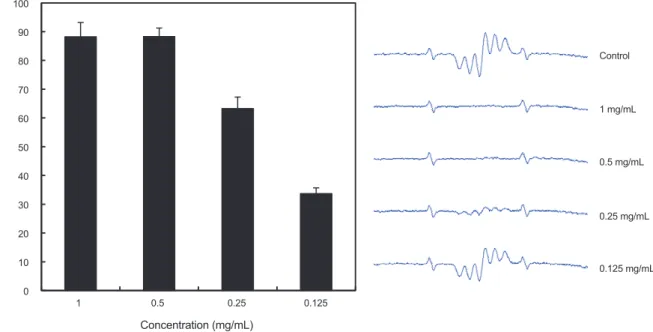
를나타내었으며, 발효하였을때수율이 2배정도높아지는것 을확인하였다. ESR을이용하여상황발효다시마의 DPPH 라 디칼소거활성을측정한결과를 Fig 3에나타내었다. 상황발효 다시마를 1.0 mg/mL, 0.5 mg/mL, 0.25 mg/mL 및 0.125 mg/
mL의농도에서 DPPH 라디칼소거활성을측정하였을때, 각각 88.2±5.0%, 88.2±3.6%, 63.2±4.1%, 33.6±2.2%의소거활 성을나타내었다. 또한, 발효하지않은다시마, 상황버섯균사체 및상황버섯으로발효한상황발효다시마의 DPPH 라디칼소거 활성을비교한결과를 Table 1에나타내었다. 50% 라디칼소거 활성농도인 IC50값으로나타낸결과상황발효다시마의 DPPH 라디칼소거활성은 0.736±0.031 mg/mL로발효하지않은다 시마(0.775±0.052 mg/mL)나상황버섯균사체(1.482±0.181 mg/mL)보다우수한것을확인하였다. 이때, 양성대조군인비
Fig. 2. Observation at the exterior (A) and interior (B) of fermented Saccharina japonica with Phellinus linteus mycelia.
(A)
(B)
0 10 20 30 40 50 60 70 80 90 100
1 0.5 0.25 0.125
DPPH radical scavenging activity (%)
Concentration (mg/mL)
Control
1 mg/mL
0.5 mg/mL
0.25 mg/mL
0.125 mg/mL
0 20 40 60 80 100 120
1 0.5 0.25 0.125 0.062 0.031
Alkyl radical scavenging activity (%)
Concentration (mg/mL)
Control 1 mg/mL 0.5 mg/mL 0.25 mg/mL 0.125 mg/mL 0.062 mg/mL 0.031 mg/mL
0 10 20 30 40 50 60 70 80 90
1 0.5 0.25
Hydroxyl radical scavenging activity (%)
Concentration (mg/mL)
Control
1 mg/mL
0.5 mg/mL
0.25 mg/mL
김연숙ㆍ박표잠ㆍ정재현 362
타민 C의 IC50값은 4.79±0.25 μg/mL을나타내었다.
또한, 상황발효다시마의알킬라디칼소거활성을측정한결 과매우우수한라디칼소거활성을나타내었으며 1.0 mg/mL, 0.5 mg/mL, 0.25 mg/mL, 0.125 mg/mL, 0.062 mg/mL, 및 0.031 mg/mL의 농도에서 각각 90.8±5.2%, 90.8±6.3%, 87.2±3.2%, 68.1±2.0%, 51.3±3.2%, 36.8±4.1%의 소거
활성을 나타내었다(Fig. 4). 상황발효다시마의 알킬 라디칼 소거능은 IC50값이 0.036±0.006 mg/mL로발효하지않은다 시마(IC50, 0.049±0.003 mg/mL)나 상황버섯 균사체(IC50, 0.226±0.016 mg/mL)보다우수한것으로나타났다. 양성대 조군인비타민 C의 IC50값의경우 5.70±0.32 μg/mL을나타 내었다.
Fig. 3. DPPH radical scavenging activity of FSPM extracts (A) and ESR spectra (B). Mean±SD is shown for triplicate experiments. DPPH, 1,1-diphenyl-2-picrylhydrazyl; FSPM, Fermented Saccharina japonica with Phellinus linteus mycelia; ESR, Electron spin resonance.
(A)
(B)
0 10 20 30 40 50 60 70 80 90 100
1 0.5 0.25 0.125
DPPH radical scavenging activity (%)
Concentration (mg/mL)
Control
1 mg/mL
0.5 mg/mL
0.25 mg/mL
0.125 mg/mL
0 20 40 60 80 100 120
1 0.5 0.25 0.125 0.062 0.031
Alkyl radical scavenging activity (%)
Concentration (mg/mL)
Control 1 mg/mL 0.5 mg/mL 0.25 mg/mL 0.125 mg/mL 0.062 mg/mL 0.031 mg/mL
0 10 20 30 40 50 60 70 80 90
1 0.5 0.25
Hydroxyl radical scavenging activity (%)
Concentration (mg/mL)
Control
1 mg/mL
0.5 mg/mL
0.25 mg/mL
Fig. 4. Alkyl radical scavenging activity of FSPM extracts (A) and ESR spectra (B). Mean±SD is shown for triplicate experiments. FSPM, Fermented Saccharina japonica with Phellinus linteus mycelia; ESR, Electron spin resonance.
(A)
(B)
0 10 20 30 40 50 60 70 80 90 100
1 0.5 0.25 0.125
DPPH radical scavenging activity (%)
Concentration (mg/mL)
Control
1 mg/mL
0.5 mg/mL
0.25 mg/mL
0.125 mg/mL
0 20 40 60 80 100 120
1 0.5 0.25 0.125 0.062 0.031
Alkyl radical scavenging activity (%)
Concentration (mg/mL)
Control 1 mg/mL 0.5 mg/mL 0.25 mg/mL 0.125 mg/mL 0.062 mg/mL 0.031 mg/mL
0 10 20 30 40 50 60 70 80 90
1 0.5 0.25
Hydroxyl radical scavenging activity (%)
Concentration (mg/mL)
Control
1 mg/mL
0.5 mg/mL
0.25 mg/mL
발효 다시마의 항산화 활성 363
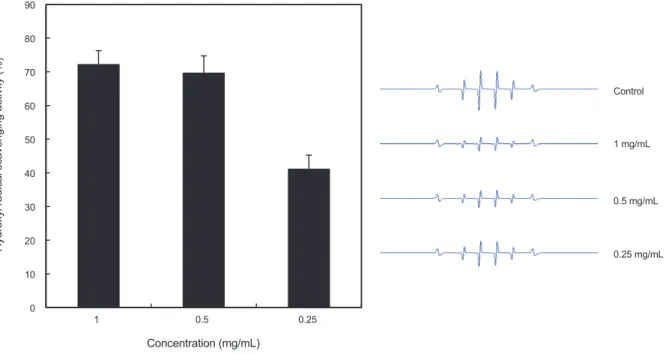
상황발효다시마의하이드록실라디칼소거활성을측정한결 과농도의존적으로라디칼소거활성이증가하였으며 1.0 mg/
mL, 0.5 mg/mL 및 0.25 mg/mL의농도에서각각 72.3±4.1%, 69.75±5.1%, 41.25±4.0%의소거활성을나타내었다(Fig. 5).
상황발효다시마의 하이드록실 라디칼 소거능은 IC50값이 0.326±0.018 mg/mL로발효하지않은다시마(IC50, 7.745±
0.252 mg/mL)나상황버섯균사체(IC50, 5.464±0.256 mg/mL) 보다높았으며특히발효후하이드록실라디칼소거활성이발 효전과비교하여훨씬우수하였다. 비타민 C를양성대조군으 로측정한결과 42.41±2.31 μg/mL의 IC50값을얻을수있었다. FRAP법을 이용한 총 항산화력
FRAP법은전자공여능력을통해항산화활성을검증하기위
해자주사용되는방법중하나이며표준물질로 FeSO4를사 용하여총항산화력을 FRAP value로표시하였다. 그결과 10
mg/mL의농도에서상황발효다시마, 다시마, 상황버섯균사체
의항산화력은각각 0.535±0.032 FRAP value, 0.335±0.059 FRAP value, 0.321±0.022 FRAP value를나타내었으며발효 후항산화력이증가된것을확인하였다(Fig. 6). 양성대조군인 비타민 C의경우 3.871±0.242 FRAP value의값을얻었다. ABTS 라디칼을 이용한 총 항산화력
Fig. 7은 ABTS 라디칼소거능을측정한결과이며표준물질 로 Trolox를사용하여총항산화력을 TEAC 값으로나타내었 다. 상황발효다시마를 1.0, 5.0, 10 mg/mL의농도로 ABTS 라
디칼소거활성을측정하였을때농도의존적으로항산화력이증 가하는것을확인하였으며특히, 10 mg/mL의농도에서측정하 였을때, 상황발효다시마의항산화력은 0.795±0.020 TEAC, Fig. 6. Antioxidant activity by FRAP value. FRAP, Ferric reducing antioxidant power; FSPM, Fermented Saccharina japonica with Phellinus linteus mycelia; Different letters (a-f) represent statisti- cally significant differences (P<0.05).
0 0.1 0.2 0.3 0.4 0.5 0.6
1 5 10
FRAP value
Concentration (mg/mL) S. japonica
P. linteus FSPM
a a
a
b c
d
e e
f
0 0.1 0.2 0.3 0.4 0.5 0.6 0.7 0.8 0.9
1 5 10
TEAC value
Concentration (mg/mL) S. japonica
P. linteus FSPM
a
b b
d c
e
f g
h
Wash the S. japonica Freeze drying of the S. japonica
Sterilization (121℃) Add the P. linteus mycelia Fermentation (30℃, 20 day) Extraction of fermentation products
Freeze drying of the extract
(A)
(B)
0 10 20 30 40 50 60 70 80 90 100
1 0.5 0.25 0.125
DPPH radical scavenging activity (%)
Concentration (mg/mL)
Control
1 mg/mL
0.5 mg/mL
0.25 mg/mL
0.125 mg/mL
0 20 40 60 80 100 120
1 0.5 0.25 0.125 0.062 0.031
Alkyl radical scavenging activity (%)
Concentration (mg/mL)
Control 1 mg/mL 0.5 mg/mL 0.25 mg/mL 0.125 mg/mL 0.062 mg/mL 0.031 mg/mL
0 10 20 30 40 50 60 70 80 90
1 0.5 0.25
Hydroxyl radical scavenging activity (%)
Concentration (mg/mL)
Control
1 mg/mL
0.5 mg/mL
0.25 mg/mL
Fig. 5. Hydroxyl radical scavenging activity of FSPM extracts (A) and ESR spectra (B). Mean±SD is shown for triplicate experiments.
FSPM, Fermented Saccharina japonica with Phellinus linteus mycelia; ESR, Electron spin resonance.
김연숙ㆍ박표잠ㆍ정재현 364
다시마는 0.721±0.026 TEAC 값을나타내었고, 상황버섯균
사체는 0.623±0.02 TEAC 값으로상황발효다시마의항산화
력이가장높게나타났다. 비타민 C를양성대조군으로사용하 여값을얻은결과 1.938±0.003 TEAC 값을얻을수있었다.
고 찰
그동안많은연구자들은 해조류에대한연구로후코이단의 분리정제및생리활성에대해진행하여왔다. 다시마로부터분 리한후코이단의항산화활성과 RAW264.7 대식세포및비장 세포를이용한후코이단의면역자극효과등이보고되어왔다 (Wang et al., 2008; Yoon wt al., 2011). 그러나버섯균사체를 이용한해조류의발효에관한연구는많이이루어지않은상태 이다.
특히, 상황버섯은생리활성을가진다당류를포함하고있고, 항암효과및산화스트레스에대한세포보호 효과등이잘알 려져있다 (Chen et al., 2014; Hsieh et al., 2014; Wang et al.,
2014). 버섯균사체를이용한발효방법은대사과정을통해생
물학적변화를일으키는유용한방법이다. 따라서, 본연구는상 황버섯균사체를이용하여다시마를발효시켰고발효를통하여 다시마에변화가있을것으로판단하고그변화는라디칼소거 활성에도영향을미칠것으로예측하였다. 여러가지방법으로 상황발효다시마의라디칼소거활성을측정하였으며발효하지 않은다시마및상황버섯균사체와항산화활성을비교평가하
였다. ESR을이용한여러가지라디칼소거능을측정한결과,
DPPH 및 alkyl 라디칼소거능에서상황발효다시마의활성이
발효하지않은다시마나상황버섯균사체보다높은활성을나 타내었으며특히 hydroxyl 라디칼소거능은상황발효다시마가 발효하지않은다시마나상황버섯균사체단독추출물보다훨 씬높은활성을나타내었다.
또한, FRAP 방법이나 ABTS 라디칼소거활성을이용한총 항산화력평가에서도상황발효다시마가발효하지않은다시마 나상황버섯균사체단독보다높은항산화력을나타내었다. 이 결과는버섯균사체를이용한발효를통하여다시마를효과적 인항산화물질로전환할수있으며, 이는상황발효다시마가부 가가치를지닌기능성식품으로사용될수있을것으로판단된 다. 그러나, 상황발효다시마의일차적인추출물을사용한항산 화효과를증명한실험으로아직은양성대조군인비타민 C보다 낮은활성을나타내는것을확인할수있었다. 하지만상황발효 다시마의생리활성물질에대한연구는부족한실정이며추가 연구가이루어져활성물질을찾는다면높은항산화활성을나 타내는물질을찾을수있을것으로판단된다.
사 사
2017년한국교통대학교지원을받아수행하였음.
References
Chen W, Feng L, Huang, Z and Su H. 2012. Hispidin pro- duced from Phellinus linteus protects against peroxynitrite- mediated DNA damage and hydroxyl radical generation.
Chem Biol Interact 199, 137-142. https://doi.org/10.1016/j.
cbi.2012.07.001.
Chen W, Shen Y, Su H and Zheng X. 2014. Hispidin derived from Phellinus linteus affords protection against acrylamide- induced oxidative stress in Caco-2 cells. Chem Biol Interact 219, 83-89. https://doi.org/10.1016/j.cbi.2014.05.010.
Eshwarappa RS, Iyer S, Subaramaihha SR, Richard SA and Dhananjaya BL. 2015. Antioxidant activities of ficus glom- erata (moraceae) leaf gall extracts. Pharmacognosy Res 7, 114-120. https://doi.org/10.4103/0974-8490.147225.
Hsieh MJ, Chien SY, Chou YE, Chen CJ, Chen J and Chen MK.
2014. Hispolon from Phellinus linteus possesses mediate caspases activation and induces human nasopharyngeal car- cinomas cells apoptosis through ERK1/2, JNK1/2 and p38 MAPK pathway. Phytomedicine 21, 1746-1752. https://doi.
org/10.1016/j.phymed.2016.12.012.
Huang HY, Chieh SY, Tso TK, Chien TY, Lin HT and Tsai YC. 2011. Orally administered mycelial culture of Phelli- nus linteus exhibits antitumor effects in hepatoma cell- bearing mice. J Ethnopharmacol 133, 460-466. https://doi.
org/10.1016/j.jep.2010.10.015.
Jin W, Zhang W, Wang J and Zhang Q. 2013. The neuroprotec- Fig. 7. Antioxidant activity by ABTS radical scavenging. TEAC,
Trolox equivalent antioxidant capacity; ABTS, 2,2'-azinobis-(3- ethylbenzothiazoline-6-sulfonic acid); FSPM, Fermented Saccha- rina japonica with Phellinus linteus mycelia; Different letters (a-h) represent statistically significant differences (P<0.05).
0 0.1 0.2 0.3 0.4 0.5 0.6
1 5 10
FRAP value
Concentration (mg/mL) S. japonica
P. linteus FSPM
a a
a
b c
d
e e
f
0 0.1 0.2 0.3 0.4 0.5 0.6 0.7 0.8 0.9
1 5 10
TEAC value
Concentration (mg/mL) S. japonica
P. linteus FSPM
a
b b
d c
e
f g
h
Wash the S. japonica Freeze drying of the S. japonica
Sterilization (121℃) Add the P. linteus mycelia Fermentation (30℃, 20 day) Extraction of fermentation products
Freeze drying of the extract
발효 다시마의 항산화 활성 365
tive activities and antioxidant activities of the polysaccha- rides from Saccharina japonica. Int J Biol Macromol 58, 240-244. https://doi.org/10.1016/j.ijbiomac.2013.04.009.
Kim MK, Kim IH and Nam TJ.2014. Saccharina japonica ex- tract protects against carbon tetrachloride-induced hepato- toxicity in rats. Korean J Fish Aquat Sci 47, 204-210. http://
doi.org/10.5657/KFAS.2014.0204.
Kim SH, Song YS, Kim SK, Kim BC, Lim CJ and Park EH.
2004. Anti-inflammatory and related pharmacological activi- ties of the n-BuOH subfraction of mushroom Phellinus linte- us. J Ethnopharmacol 93, 141-146. http://doi.org/10.1016/j.
jep.2004.03.048.
Kim YS, Lee SJ, Hwang JW, Kim EK, Kim SE, Kim EH, Moon SH, Jeon BT and Park PJ. 2012. In vitro protective effects of Thymus quinquecostatus Celak extracts on t-BHP-induced cell damage through antioxidant activity. Food Chem Toxi- col 50, 4191-4198. http://doi.org/10.1016/j.fct.2012.08.015.
Koo JG, Jo KS, Do JR and Woo SJ. 1995. Isolation and purifi- cation of fucoidans from Laminaria religiosa and Undaria pinnatifida in Korea. J Korean Fish Soc 28, 227-236.
Lee YS, Kang YH, Jung JY, Kang IJ, Han SN, Chung JS, Shin HK and Lim SS. 2008. Inhibitory constituents of aldose re- ductase in the fruiting body of Phellinus linteus. Biol Pharm Bull 31, 765-768. http://doi.org/10.1248/bpb.31.765.
Limón RI, Peñas E, Torino MI, Martínez-Villaluenga C, Due- ñas M and Frias J. 2015. Fermentation enhances the con- tent of bioactive compounds in kidney bean extracts.
Food Chem 172, 343-352. http://doi.org/10.1016/j.food- chem.2014.09.084.
Nagatsu A, Itoh S, Tanaka R, Kato S, Haruna M, Kishimoto K, Hirayama H, Goda Y, Mizukami H and Ogihara Y. 2004.
Identification of novel substituted fused aromatic com- pounds, meshimakobnol A and B, from natural Phellinus linteus fruit body. Tetrahedron Lett 45, 5931-5933. http://
doi.org/10.1002/chin.200446210.
Nanjo F, Goto K, Seto R, Suzuki M, Sakai M and Hara Y. 1996.
Scavenging effects of tea catechins and their derivatives on 1,1-diphenyl-2-picrylhydrazyl radical. Free Radic Biol Med 21, 895-902. https://doi.org/10.1016/0891-5849(96)00237- Olugbami JO, Gbadegesin MA and Odunola OA. 2015. In vitro 7.
free radical scavenging and antioxidant properties of ethanol extract of Terminalia glaucescens. Pharmacognosy Res 7, 49-56. http://doi.org/10.4103/0974-8490.147200.
Re R, Pellegrini N, Proteggente A, Pannala A, Yang M and Rice- Evans C. 1999. Antioxidant activity applying an improved ABTS radical cation decolorization assay. Free Radic Biol Med 26, 1231-1237. https://doi.org/10.1016/S0891- 5849(98)00315-3.
Reis FS, Barreira JCM, Calhelha RC, van Griensven LJID, Ćirić A, Glamočlija, J, Soković M and Ferreira ICFR. 2014.
Chemical characterization of the medicinal mushroom
Phellinus linteus (Berkeley & Curtis) Teng and contribution of different fractions to its bioactivity. LWT Food Sci Tech- nol 58, 478-485. https://doi.org/10.1016/j.lwt.2014.04.013.
Rupérez P, Ahrazem O and Leal JA. 2002. Potential antioxidant capacity of sulfated polysaccharides from the edible marine brown seaweed Fucus vesiculosus. J Agric Food Chem 50, 840-5. https://doi.org/10.1021/jf010908o.
Salimikia I, Yazdinezhad AR, Golfakhrabadi F and Esfahani HR.
2015. In vitro antioxidant and free radical scavenging activ- ity of four Alkanna species growing in Iran. Pharmacognosy Res 7, 100-104. https://doi.org/10.4103/0974-8490.147218.
Sugai-Guerios MH, Balmant W, Furigo A Jr, Krieger N and Mitchell DA. 2015. Modeling the Growth of Filamentous fungi at the Particle Scale in solid-state fermentation sys- tems. Adv Biochem Eng Biotechnol 149, 171-221. https://
doi.org/10.1007/10_2014_299.
Torino MI, Limon RI, Martinez-Villaluenga C, Makinen S, Pi- hlanto A, Vidal-Valverde C and Frias J. 2013. Antioxidant and antihypertensive properties of liquid and solid state fermented lentils. Food Chem 136, 1030-1037. https://doi.
org/10.1016/j.foodchem.2012.09.015.
Vishchuk OS, Ermakova SP and Zvyagintseva TN. 2011.
Sulfated polysaccharides from brown seaweeds Saccha- rina japonica and Undaria pinnatifida: isolation, structural characteristics, and antitumor activity. Carbohydr Res 346, 2769-2776. https://doi.org/10.1016/j.carres.2011. 09.034.
Wang J, Zhang Q, Zhang Z and Li Z. 2008. Antioxidant activity of sulfated polysaccharide fractions extracted from Lami- naria japonica. Int J Biol Macromol 42, 127-132. https://
doi.org/ 10.1016/j.ijbiomac.2007.10.003.
Wang ZB, Pei JJ, Ma HL, Cai PF and Yan JK. 2014. Effect of extraction media on preliminary characterizations and antioxidant activities of Phellinus linteus polysaccharides.
Carbohydr Polym 109, 49-55. https://doi.org/10.1016/j.carb- pol.2014.03.057.
Wu SJ, Liaw CC, Pan SZ, Yang HC and Ng LT. 2013. Phellinus linteus polysaccharides and their immunomodulatory prop- erties in human monocytic cells. J Functional Foods 5, 679- 688. https://doi.org/10.1016/j.jff.2013.01.011.
Yoon YD, Lee ES, Park JP, Lim MR, Lee JW, Kim TH, Na MK and Kim JH. 2011. Immunostimulatory effect by aqueous extract of Hizika fusiforme in RAW264.7 marcrophage and whole spleen cells. Biotechnol Bioproce 16, 1099-1105.
https://doi.org/10.1007/s12257-011-0177-5.