https://doi.org/10.5423/RPD.2018.24.4.348
Research in Plant Disease pISSN 1598-2262, eISSN 2233-9191 www.online-rpd.org
The Korean Society of Plant Pathology
This is an open access article distributed under the terms of the Creative Commons Attribution Non-Commercial License (http://creativecommons.org/licenses/
by-nc/4.0/), which permits unrestricted non-commercial use, distribution, and reproduction in any medium, provided the original work is properly cited.
Note Open Access
Development of a Multiplex Reverse Transcription-Polymerase Chain Reaction Assay for the Simultaneous Detection of Three Viruses in Leguminous Plants
Chung Youl Park
1,2, Hyun-Geun Min
1, Hong-Kyu Lee
1, Rameswor Maharjan
3, Youngnam Yoon
3*, and Su-Heon Lee
1,4*
1
School of Applied Biosciences, Kyungpook National University, Daegu 41566, Korea
2
Present Address: Seed Testing & Research Center, Korea Seed & Variety Service, Gimcheon 39660, Korea
3
Crop Production Technology Research Division, NICS, RDA, Miryang 50426, Korea
4
Institute of Plant Medicine, Kyungpook National University, Daegu 41566, Korea
A multiplex reverse transcription-polymerase chain reaction (mRT-PCR) assay was developed for the detec- tion of Clover yellow vein virus (ClYVV), Peanut mottle virus (PeMoV), and Tomato spotted wilt virus (TSWV), which were recently reported to infect soybean and azuki bean in Korea. Species-specific primer sets were designed for the detection of each virus, and their specificity and sensitivity were tested using mixed primer sets. From among the designed primer sets, two combinations were selected and further evaluated to esti- mate the detection limits of uniplex, duplex, and multiplex RT-PCR. The multiplex RT-PCR assay could be a useful tool for the field survey of plant viruses and the rapid detection of ClYVV, PeMoV, and TSWV in legumi- nous plants.
Keywords: Clover yellow vein virus, Multiplex RT-PCR, Peanut mottle virus, Primer combinations, Tomato spotted wilt virus
Soybean (Glycine max) and azuki bean (Vigna angularis) are considered the most economically important among legu- minous crops and are cultivated worldwide. They occupy an important place in Korean diet and cuisine. Legumes have high nutritional value, as they are rich sources of calories, certain minerals, and vitamins (Iqbal et al., 2006). In particular, fermented soybean foods are known to have many health benefits. To date, 12 viruses, Alfalfa mosaic virus (AMV), Bean common mosaic virus (BCMV), Clover yellow vein virus (ClYVV), Cowpea mosaic virus (CPMV), Cucumber mosaic virus (CMV), Soybean dwarf virus (SbDV), Soybean mosaic virus (SMV), Soybean yellow common mosaic virus (SYCMV), Soybean
yellow mottle virus (SYMMV), Peanut mottle virus (PeMoV), Peanut stunt virus (PSV), and Tomato spotted wilt virus (TSWV), have been reported to infect in soybean and azuki bean in Korea (Kim, 2006; Lee et al., 2013, 2015; Nam et al., 2009, 2012). Among these 12 viruses, three viruses, ClYVV, PeMoV, and TSWV, were recently reported to infect soybean, and two viruses, PeMoV and TSWV, were reported to infect red bean (Lim et al., 2014; Shin et al., 2014; Yoon et al., 2018).
Previous studies have reported that the infection rate of SMV was the highest among these viruses. In Korea, BCMV had a consistently high rate of infection in red bean (Yoon, 2017). However, recently, there has been an increase in the infection rates of SYMMV and SYCMV in soybean (Cho et al., 2013; Seo et al., 2014). Factors such as the dissemination of new seed varieties and changes in climate cause unpre-
*Co-corresponding authors Y. Yoon
Tel: +82-55-350-1264 Fax: +82-55-352-3059 E-mail: [email protected] S.-H. Lee
Tel: +82-53-950-5763 Fax: +82-53-950-6758 E-mail: [email protected]
Received September 17, 2018
Revised November 1, 2018
Accepted November 2, 2018
dictability in the distribution and severity of viral infections.
Therefore, new, more rapid detection methods are needed.
In 2011, two combinations of primer sets, combination 1:
AMV, SYCMV, and SYMMV and combination 2: SMV, SbDV, and PSV, were developed by the Rural Development Admin- istration (RDA), Korea, for the simultaneous detection of six soybean-infecting viruses (Patent Code No. 1012503880000, http://www.kipo.go.kr). However, an RNA-based multiplex polymerase chain reaction (mPCR) has not yet been devel- oped for the simultaneous detection of ClYVV, PeMoV, and TSWV. mPCR allows for rapid and low-cost detection owing to its ability to simultaneously detect multiple target patho- gens in a single reaction (Asano et al., 2015; Yao et al., 2014).
Therefore, this study was undertaken to develop an mPCR assay for the simultaneous detection of ClYVV, PeMoV, and TSWV from leguminous plants.
Sample collection and processing. A ClYVV-infected soy- bean sample was used as a positive control, and this sample was registered in GenBank (KF975894). A PeMoV-infected soybean leaf sample (KJ664838) and a PeMoV-infected azuki bean leaf sample (LC201922) were used as PeMoV positive controls. TSWV-positive leaf samples of soybean (MF417648) and azuki bean (not registered) were provided by the Na- tional Institute of Crop Science, RDA, Korea. All virus-infected
samples were collected from a field in Korea.
Total RNA was extracted from all samples using an Easy Spin
TM(DNA-free) Total RNA Extraction kit (Intron, Daejeon, Korea) by following the manufacturer’s protocol. The con- centration of the total RNA extracted was measured using a NanoDrop ND-1000 spectrophotometer (NanoDrop, Wilmington, DE) and estimated to range from 88.84 ng/µl to 407.12 ng/µl. First-strand cDNA was synthesized us- ing SuperiorScript III Reverse Transcriptase (Enzynomics, Daejeon, Korea) and random N25 primers according to the manufacturer’s instructions. Reverse transcription-PCR (RT- PCR) was then carried out using cDNA as a template.
Primer design. Primers specific to ClYVV, PeMoV, and TSWV were designed based on the complete genome se- quences available on GenBank. The genomic sequences of three ClYVV isolates (NC002600, KF977830, and AF023848), two PeMoV isolates (NC003536 and AB011819), and three TSWV isolates (JF960235, KT717693, and KP008134) were first downloaded from GenBank. These sequences were then aligned with those of 134 other Potyvirus species, following which primers were designed from the conserved regions.
Sequences of TSWV isolates were also aligned with those of 11 Orthotospovirus genera, following which the primers were designed from the conserved regions. In total, five
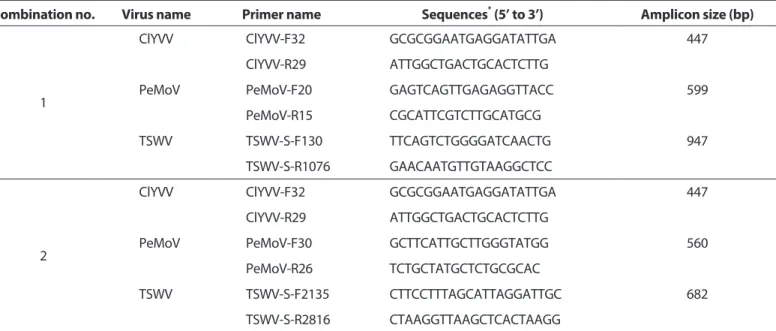
Table 1. Oligonucleotide sequences for the two different primer combinations used for the detection of the three viruses
Combination no. Virus name Primer name Sequences
*(5’ to 3’) Amplicon size (bp)
1
ClYVV ClYVV-F32 GCGCGGAATGAGGATATTGA 447
ClYVV-R29 ATTGGCTGACTGCACTCTTG
PeMoV PeMoV-F20 GAGTCAGTTGAGAGGTTACC 599
PeMoV-R15 CGCATTCGTCTTGCATGCG
TSWV TSWV-S-F130 TTCAGTCTGGGGATCAACTG 947
TSWV-S-R1076 GAACAATGTTGTAAGGCTCC
2
ClYVV ClYVV-F32 GCGCGGAATGAGGATATTGA 447
ClYVV-R29 ATTGGCTGACTGCACTCTTG
PeMoV PeMoV-F30 GCTTCATTGCTTGGGTATGG 560
PeMoV-R26 TCTGCTATGCTCTGCGCAC
TSWV TSWV-S-F2135 CTTCCTTTAGCATTAGGATTGC 682
TSWV-S-R2816 CTAAGGTTAAGCTCACTAAGG
*
All primers for each virus were designed within the conserved regions: nuclear inclusion A (NIa) protease for ClYVV; cylindrical inclusion (CI),
6K2, NIa-Viral protein genome (VPg) protein for PeMoV; nucleocapsied (NC) protein for TSWV.
species-specific primer sets of ClYVV and PeMoV and eight species-specific primer sets of TSWV were designed.
Evaluation of primer sets. First, the specificity of the de- signed primer sets was tested by uniplex RT-PCR. One microliter of cDNA from each virus and 2×Prime Taq™
Premix (Genet Bio, Daejeon, Korea) were used to carry out each uniplex PCR. PCR cycling conditions were as follows:
initial denaturation at 95°C for 10 min, 35 cycles of denatur- ation at 95°C for 30 s, annealing at 55°C for 30 s, and exten- sion at 72°C for 1 min, followed by a final extension at 72°C for 5 min. The sizes of the PCR products were finally analyzed using agarose gel electrophoresis (2% agarose). The newly designed species-specific primers successfully amplified their targets in the uniplex RT-PCR. The RT-PCR amplicons were purified using the Expin Combo GP mini prep kit (GeneALL, Seoul, Korea), and each viral sequence was confirmed by bi-directional sequencing. For the selection of primer set combinations for multiplex RT-PCR, various primer sets were tested on the basis of target size. Duplex and multiplex RT- PCR for the detection of ClYVV, PeMoV, and TSWV were then carried out using the PCR components and cycling condi- tions mentioned previously. The cDNA of each virus was mixed and made up one, and then used as a positive control.
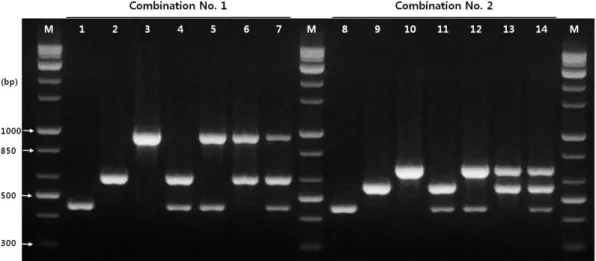
Test results showed that the two combinations of primer sets successfully amplified the target sizes, and no non-specific bands were observed when the resulting amplicons were
analyzed by agarose gel electrophoresis (Table 1, Fig. 1).
Second, the sensitivity of the two combinations of primer sets was tested using 10-fold serial dilutions of the cDNA and subjecting these to uniplex, duplex, and mul- tiplex RT-PCR. The results of the sensitivity test using the first combination were as follows: i) uniplex RT-PCR: ClYVV, PeMoV, and TSWV were detectable up to 10
-2, 10
-2, and 10
-4dilutions (Fig. 2A); ii) duplex RT-PCR: PeMoV+ClYVV, ClYVV +TSWV, and PeMoV+TSWV were detectable up to 10
-2, 10
-4, and 10
-3dilutions (Fig. 2B); and iii) multiplex RT-PCR:
ClYVV+PeMoV+TSWV was detectable up to 10
-3dilution (Fig.
2C). The sensitivity of the second primer set combination was at least 10-fold higher than that of the first primer set combination in the uniplex and duplex RT-PCR, whereas it was 100-fold lower than that of the first primer set combina- tion in multiplex RT-PCR (data not shown). Therefore, the first primer set combination was selected for the detection of the three viruses using multiplex RT-PCR in this study.
The multiplex RT-PCR assay developed and validated in this study can, therefore, be used as a rapid and sensitive method for detecting ClYVV, PeMoV, and TSWV in soybean and azuki bean plants. In Korea, soybean is one of the most important cultivated crops, which is why viral diseases in soy- beans are being continuously investigated. The multiplex RT- PCR developed based on the information generated by this study could contribute to rapid detection of plant viruses in field surveys.
Fig. 1. Simultaneous detection using the finally selected primer combinations for the three viruses (Clover yellow vein virus, ClYVV; Peanut mottle virus, PeMoV, and Tomato spotted wilt virus, TSWV) by multiplex PCR. Lane M: 1kb DNA ladder (BioFACT, Daejeon, Korea), Lane 1 and 8: 447 bp for ClYYV; Lane 2 and 9: 599 and 560 bp for PeMoV; Lane 3 and 10: 947 and 682 bp for TSWV; Lane 4 and 11: ClYVV+PeMoV;
Lane 5 and 12: ClYVV+TSWV; Lane 6 and 13: PeMoV+TSWV; Lane 7 and 14: ClYVV+PeMoV+TSWV.
Conflicts of Interest
No potential conflict of interest relevant to this article was re- ported.