Effectiveness of Smoking Cessation Using Motivational Interviewing in Patients
Consulting a Pulmonologist
Gajin Lim, M.D., Inki Park, M.D., Sungjae Park, M.D., Sookhee Song, M.D., Hyeok Kim, M.D., Ph.D. and Suhyun Kim, M.D.
Department of Internal Medicine, Seoul Medical Center, Seoul, Korea
Background: We aimed to investigate the role of the physician in practice and the factors that influence the success rate of smoking cessation.
Methods: This study retrospectively analyzed 126 adult smokers who had visited the outpatient department of pulmonology, and received motivational interviewing with or without supplement drugs. The findings include continuous smoking abstinence rate, which was evaluated at 6, 12 and 24 weeks, and the factors associated with continuous abstinence for 6 months or longer.
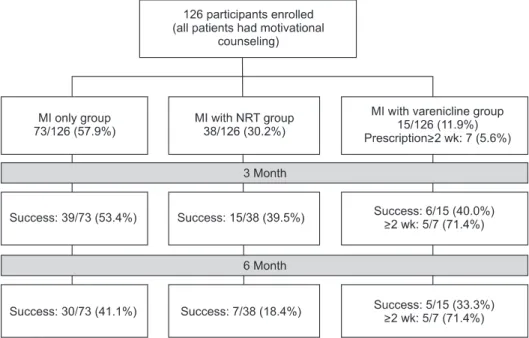
Results: The patients with only motivational interviewing accounted for 57.9%, while the nicotine patch therapy was applied to 30.2%; and varenicline was prescribed to 11.9%. The smoking cessation success rates of at 6, 12, and 24 weeks were 55.6%, 47.6%, and 33.3%, respectively. However, even in the failure group at six months, tobacco consumption was decreased under 10 cigarettes per day in 42.1% (53/126). In multivariate logistic regression analysis, degree of Fagerstöm Test for Nicotine Dependence (p=0.034; odds ratio, 3.607; 95% confidence interval [CI], 1.102–1.807), the absence of smoking-related lung disease (p=0.008; odds ratio, 4.693; 95% CI, 1.497–14.707), and education level (p=0.001; odds ratio, 181.420; 95% CI, 8.414–3,911.502) were the predictors of successful smoking cessation.
Conclusion: An improved continuous smoking abstinence rate can be obtained by motivational interviewing, regardless of the association with pharmacotherapy.
Keywords: Smoking Cessation; Tabacco Dependence; Motivational Interviewing
Introduction
Tobacco smoking is an important contributor to respiratory disease, including chronic obstructive pulmonary disease (COPD) and lung cancer, cardiovascular disease, and cancers of various organs. Tobacco smoking also negatively affects several other respiratory diseases, including pneumonia and pulmonary tuberculosis
1. Therefore, smoking cessation is a practical way to prevent and treat smoking-related disease. In Korea, the adult male smoking rate was 66.3% in 1998; how- ever, increased interest in health and a smoking cessation pro- motion policy, resulted in a reduction in this figure to 47.7% in 2008. However, that has been at a standstill since 2008, with 47.3% in 2011
2. The reason for the high smoking rate among males, despite the well-known harmfulness of smoking, is attributable to addiction caused by nicotine contained in ciga- Copyright © 2014
The Korean Academy of Tuberculosis and Respiratory Diseases.
All rights reserved.
Address for correspondence: Suhyun Kim, M.D.
Department of Internal Medicine, Seoul Medical Center, 156 Sinnae-ro, Jungnang-gu, Seoul, Korea
Phone: 82-2-2276-7808, Fax: 82-2-2276-7820 E-mail: [email protected]
Received: Mar. 14, 2014 Revised: Apr. 4, 2014 Accepted: Apr. 9, 2014
cc It is identical to the Creative Commons Attribution Non-Commercial License (http://creativecommons.org/licenses/by-nc/3.0/).