• 검색 결과가 없습니다.

Fiber Laser Welding in the Car Body Shop - Laser Seam Stepper versus Remote Laser Welding -

N/A
N/A
Protected

Academic year: 2021

Share "Fiber Laser Welding in the Car Body Shop - Laser Seam Stepper versus Remote Laser Welding -"

Copied!
6
0
0

로드 중.... (전체 텍스트 보기)

전체 글

(1)

Journal of KWJS Vol.31 No.4(2013) pp17-22

Fiber Laser Welding in the Car Body Shop

- Laser Seam Stepper versus Remote Laser Welding -

Berthold Kessler* ,

*IPG Laser GmbH, Burbach, Germany

†Corresponding author : [email protected]

(Received August 9, 2013 ; Revised August 22, 2013 ; Accepted August 23, 2013)

A bstract

The excellent beam quality of high power fiber lasers are commonly used for remote welding applications in body job applications. The Welding speed and productivity is unmatched with any other welding technology including resistance spot welding or traditional laser welding. High tooling cost for clamping and bulky safety enclosures are obstacles which are limiting the use.

With the newly developed Laser stitch welding gun we have an integrated clamping in the process tool and the laser welding is shielded in a way that no external enclosure is needed. Operation of this laser welding gun is comparable with resistance spot welding but 2-times faster.

Laser stitch welding is faster than spot welding and slower than remote welding. It is a laser welding tool with all the laser benefits like welding of short flanges, weld ability of Ultra High Strength steel, 3 layers welding and Aluminium welding. Together with low energy consumption and minimum operation cost of IPG fiber laser it is a new and sharp tool for economic car body assembly.

Key Words : LSS (Laser Seam Stepper), Fiber laser, Welding, Car body, Automotive industry

1. Introduction

For today’s high volume production in the automotive industry, resistance spot welding and laser remote welding are well established.

These technologies are presenting pro’s and con’s. For laser remote welding the main advantage is the significant cycle time reduction due to almost complete elimination of idle times and the advantages of laser welded seams. For resistance spot welding an advantage is the integrated clamping technology, which comes nearly for free. IPG Laser GmbH has combined these advantages in the new Laser Seam Stepper Gun LSS1.

The Laser Seam Stepper is able to clamp the welded parts before welding like in resistance spot welding and then it starts a laser stitch weld with several 10mm length with an oscillating

pattern. The laser welding and the beam path of the laser is located inside the hollow structure of the clamping tool so no external shielding of the laser process is needed. An integrated exhaust system is caring for the welding smoke and fumes.

One Stitch weld of the Laser Seam Stepper is replacing two welding spots of traditional resistance spot welding obviously with increased torsion stiffness. While the cycle time for one resistance spot weld and one laser stitch weld is the same there is a factor two time saving with the laser seam stepper.

Laser Remote Welding is 5-8 times faster than resistance spot welding and shows unbeatable economic benefits for compact parts with many welds in the body job. The Laser Seam Stepper is able to replace resistance spot welding guns in the body job and can be used in mixed installations

특집논문: 차량 경량화를 위한 고에너지 융합기술

(2)

Fig. 1 Large area scanner (one mirror scanner mounted on linear motor slide), work area (3m x 1.4m x 0.4m /x,y,z) of stationary large area scanner

1)

(a) Fiber laser: speed: 7m/min

(b) CO

2

-laser: 3.6m/min

Fig. 2 Weld nuggets of overlap welds. Material:

mild steel DC04 sheet thickness:1mm, laser power: 4.5kW

Part:

Rear seatback with 45 weld seams

Welding time 12.1 Sek. 18.0 Sek.

Fiber laser CO

2

laser

Fig. 3 Rear seatback welded with CO

2

- and ytterbium fiber laser, laser power in both cases 4.5kW (laser and resistance spot) in traditional welding

lines of big car body structures.

1.1 Laser Remote Welding

Laser Remote Welding means the welding with big focal length and generation of relative movement between laser beam and work piece by tilting the beam instead of moving the laser optic or the part with the welding speed.

There is a need for high beam quality in remote welding. First lasers in the Body in white application were CO 2 -lasers with stationary scanning units. With the improvement of beam quality of solid state lasers like the fiber laser it is also possible to work with smaller scanners which are mounted on standard 6axis robots.

Both system are in production today and are showing very high productivity. Typical laser powers are 4-6kW welding speeds in the range of 4-10m/min. Stationary Scanners can serve a work area of max. 1.4m x 3m with a focal length of the scanner of 1.6m (Fig. 1)

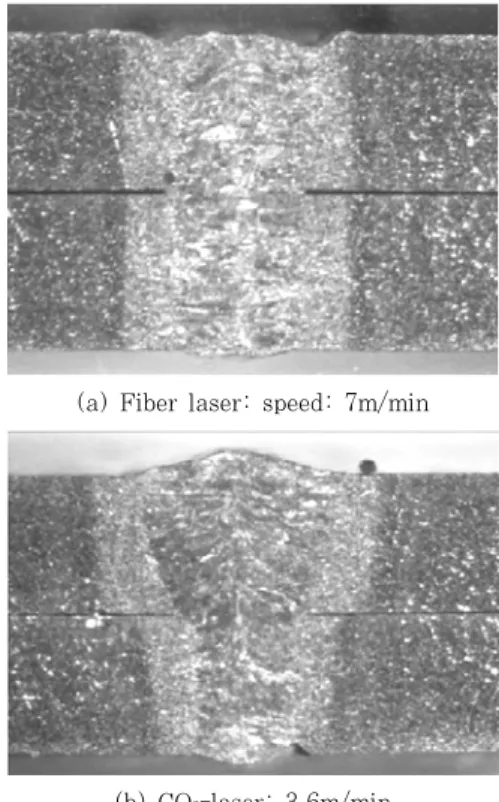
Fig. 2 is showing typical weld nuggets of large area scanner with CO 2 -lasers and fiber lasers.

It shows that with fiber laser the max. possible welding speed is much higher. The reason for this behavior is the different absorption mechanism of the laser radiation at 10.600µm (CO 2 -Laser) and the 1070nm (IPG Ytterbium Fiber Laser).

With the longer wavelength of the CO 2 -Laser there is a plasma shielding effect which makes the upper part of the seam wider and so reduces the penetration capability.

In real part welding the processing time of the Ytterbium fiber laser is 30% less than for a CO 2 -Laser welded part (Fig. 3).

With introduction of High Power Solid State lasers with beam quality equal or better than 8mm mrad a development of robot based scanner welding has started. The beam quality of these lasers is good enough for work distances of 0.5m or more and with the flexible fiber beam guiding system standard industrial robots could be used to move the scanner in different positions.

It is also possible to move the scanner with

the robot at a constant speed over the welded

part and use the robot mounted scanner to

(3)

(a)

(b)

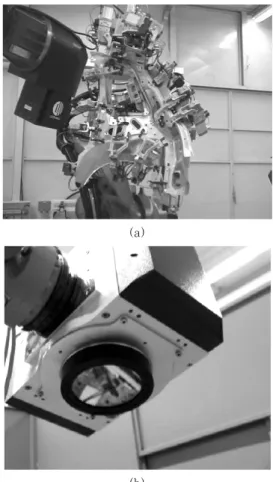
Fig. 4 (a) Robot integrated scanner solution

2)

, (b) Robot mounted scanner (x,y,z working area: 100,200,+/-100mm)

Fig. 5 Clamping tool for laser remote welding with hydraulic support pins for exact cero gap clamping of all welds at the same time

drop the weld seams when the seam appears in the working area of the scanner. This so called welding on the fly is compensating the disadvantage of smaller working area of robot mounted scanners and are increasing the workspace to the full size of the robot working area. The programming of these systems is supported by software packages which are helping to optimize the track of the robot and are synchronizing the movement of robot and scanner.

Nevertheless programming of new parts and operating of these devices can only be done by skilled operators, because two different controllers one for robot and one for the scanner have to be handled. A working solution with only one controller is shown in Fig. 4. This is a robot with integrated tilting mirrors for fast lateral and a z-movement inside the robotic arm. The controller of this robot is operating both the mechanical axes of the robot and the movement

of the optical components.

In Laser Remote Welding there are mainly overlap joints to weld. For a high quality weld the joining parts should be clamped in that way that there is no or only minimal air gap between the welded parts. Clamping tools which are able to guarantee the cero gap for all weld position at the same has to be used.

In Fig. 5 a hydraulic clamping tools which is standard in this application field is shown in open situation. For clamping the lid is closed and the laser beam is getting access thru the holes in the lid.

For safety reasons Laser Remote Welding needs a complete enclosure of the welding area with the need to shuttle parts into a cabin.

The weld cycle can only be started when the laser cabin is completely closed and the electrical safety circuit is closed again. Depending on scanner technology and laser power laser cabins with double wall structures and integrated optical sensors has to be used. This is adding additional cost to a laser remote welding solution and reduces flexibility of utilization.

1.2 Laser Seam Stepper LSS1

The Laser Seam Stepper or Laser Stitch welding

Gun is a tool which can replace directly the

resistance spot welding technology. The Laser

Seam Stepper is available as Stepper for parts

with only single sided access or as C-Gun

(4)

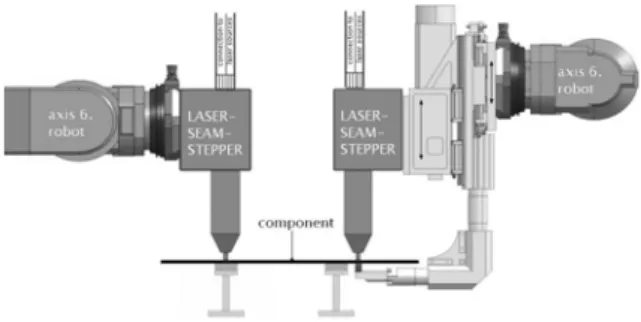
Fig. 6 Laser-seam-stepper (left: seam stepper;

right: seam stepper C-gun)

which is perfect solution for flange welding (Fig. 6).

The laser seam stepper is replacing resistance spot welding process, featuring the simplicity of clamping tools and production facilities with the advantages of laser welding.

Laser welding for the production of sheet metal components in body in white offers the following advantages:

• Higher process speed (shorter cycle times) • Increased component strength by longer

seams with higher torsion stiffness • Shorter Flanges

• Single Sided access

• Efforts and costs comparable to today’s modern resistance welding systems

• Constant welding results with high quality • In partially penetrated welds there is no

ditch in the backside

Fiber laser welding with a suitable welding tool provides the opportunity to accomplish all these objectives.

As shown in Fig. 7 the Laser-Seam-Stepper (LSS1) is generating a linear movement of the laser beam with an overlaying oscillating pattern. For safety the laser beam is guided thru a hollow rectangular pressure-piece which is pressing the parts together and which is also caring for laser safety. The laser beam can only be released by a sensor signal from the bottom side of the pressure piece. The LSS1 can only be used in almost flat geometries.

Minimum applicable curvature is depending on

the length of the pressure piece. For 40mm welding the curvature should not smaller than 2m.

Laser welding with or without oscillation (+

/ - 1 mm) can be produced within the range determined by the housing (standard = 40 mm).

The easiest application is a module mounted for example on the 6 th axis of an industrial robot (30 kg handling capacity). The robot moves the module to the required welding position. In this position it is placed onto the component only by robot force. Below the component, within the range of the welding seams, a fixed lower tooling is used as counter force or support (Fig. 6 on the left).

During a typical stepping operation (40 mm welding seam, 50 mm free space, 40 mm welding seam, etc), a laser welding seam can be placed with a welding velocity of approx. 30 mm /s every 1.3- 1.5 seconds (Fig. 7). Including the movement of the LSS1 a weld cycle replacing two spots is ready in 2.5s.

The Laser-Seam-Stepper with C-Gun (LSS1C) is mounted on a servo motor driven traversing unit. This is similar to a resistance welding gun with compensating module (Fig. 6 on the right).

This version allows an industrial robot (80 kg handling capacity) to move the LLS1C into a welding position and to close with a programmable force.

A module of the system compensates for tolerances regarding the position and geometry of the components. All joining forces (0.5 - 3 kN) applied in the system are performed within the laser welding tool only, the robot is not required for these joining forces. During a typical stepping operation a laser seam can be placed every 1.7- 2 seconds.

Features of the laser welding tools LSS1 with a compact IPG fiber laser are:

• The Stepper needs only robot with payload of 30kg.

• The basic version enables the system to

(5)

Same strength

30 spots = 75s 15 steps = 37s

Laser 2-times faster than spot welding

Fig. 7 Resistance spot welding vs. laser welding with LSS-C-Gun(For the same connection strength: 4 spots equals 2 stitches. With LSS1 needs only half time is required)

Useable for different materials

• Steel (Coated / Uncoated)

• High strength and hot formed steel

• Aluminium

• Titanium

Fig. 8 Benefits-different materials

Saving of floorspace

4 Laser-stepper with 2 fiber lasers are replacing 8 spot welding guns

Fig. 9 4 LSS-C-Gun with 2 IPG fiber laser are repacing 8 resistance spot welding guns for the same work load

weld linear seams with a maximum length of 40 mm.

• Optionally a weaving function (3-30 Hz) can be switched on in order to spread the welding seam (2 mm).

• Laser sources are very compact fiber laser systems with powers between 1 and 4kW and a total efficiency of more than 30 %.

Typical laser size for body-in-white application is 2kW.

• The fiber laser is maintenance free.

• LSS1 is a save laser system and can be used without complex laser protection housings.

• The LLS1C can join the sheet metal plates to be welded with a defined force in the area of the welding seam. This process reduces the normally high clamping effort during laser welding.

• Seam length and all all other welding parameters are configurable in the software and can be controlled from a fieldbus interface.

Typical applications for this system are body- in- white assembly lines (Fig. 9) which are equipped today with many resistance welding guns.

The intention of the is to replace two welding spots with a typical distance of approx. 30 mm by one laser step seam of approx. 30-40 mm.

For example in case of 30 resistance spot welds the cycle time is approx. 75 seconds. If spot welding is replaced by laser welding in the manner described, only 15 laser weld seams are required. The cycle time can be reduced

down to only 37 seconds in total. The means a factor of two in productivity and big reduction of needed production system. This is leading to floor space saving and to a reduction of investment even if the single LSS1 is more expensive than a single spot welding gun.

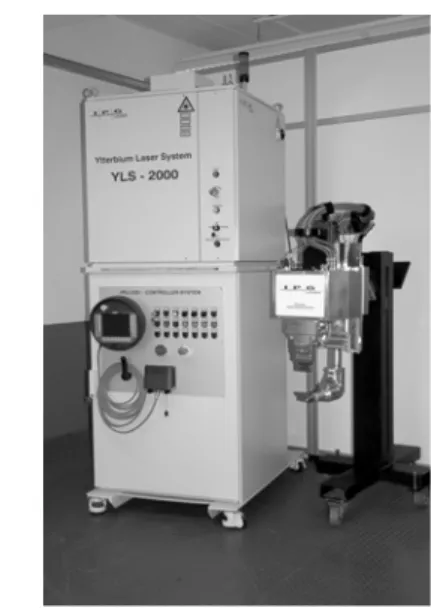
The LSS1 Seam Stepper System of IPG Laser is a very compact and highly integrated system which is using the features of the IPG fiber laser in a perfect way. It shows that the laser is now coming much closer to the shop floor than any time before. With a foot print of about 1 square meter and a height of about 2m this laser welding system has the laser, a safety controller, the movement controller and a water chiller already integrated (Fig. 10).

Electrical consumption with the typical 2kW

laser is less than 10kW for the entire system.

(6)

Fig. 10 LSS system consist of welding tool and integrated laser-controller cabinet. (footprint less than 1sqm)

2. Summary

A comparison of the laser welding technologies in body-in-white is a comparison against the today standard technology resistance spot welding.

The remote welding is a very fast replacement for spot welding with 5 to 8 times saving in welding time. There is almost no dull time any more in the welding machines because of very rapid jump from one weld to the next. So the laser beam source and the welding machine is used up to 80% duty cycle. Even if investment cost is very high for single remote welding cell the productivity and little operation cost are showing big cost reduction compared to spot welding.

Remote welding is an economic tool for compact parts with at least 20 better 40 welds.

With the introduction of high brightness solid state lasers like the fiber laser much higher welding speed can be realized compared to CO 2 -Laser Remote Laser Welding. Robot mounted Scanner systems are increasing the flexibility in use.

The Laser stitch welder or Laser Seam Stepper is 2 times faster than spot welding and can be used if there are two spots close together that they can be replaced by one oscillated linear seam. LSS1 systems

• Are powered by small fiber lasers (1-3kW) • Can directly replace resistance spot welding • Don’t need laser safety enclosure or special

clamping

• Are showing economic advantages compared to res. spot welding

• Medium technology (easy to operate)

The LSS1-System is an additional tool for body-in-white welding. It can’t replace all resistance spot welding applications, because of limitation of use in curved parts. The LSS1 needs the same environment as the res. spot welding so mixed installations are possible.

The fiber laser is not only replacing other lasers from existing applications like remote welding.

With the high beam quality and the compact size it is also generating new tools for joining and replacing traditionally technologies. The LSS1 is a new generation of laser tools which are adapted to the needs of production. With the little energy consumption and little total cost of ownership it is an economical solution in modern car production

References

1. Zimmermann, Kurt Introducing Laser Remote Technology SEF in-house Seminar 3/2009

2. Kessler, B. “Fiber Laser Spot Welding Gun versus

Resistance Spot Welding” Conference: “Fügen im

Karosseriebau 2010”, Bad Nauheim, April 2010

수치

Fig.  1  Large  area  scanner  (one  mirror  scanner  mounted on linear motor slide), work area  (3m  x  1.4m  x  0.4m  /x,y,z)  of  stationary  large area scanner 1)
Fig.  5  Clamping  tool  for  laser  remote  welding  with hydraulic support pins for exact cero  gap  clamping  of  all  welds  at  the  same  time
Fig.  6  Laser-seam-stepper  (left:  seam  stepper;
Fig.  9  4  LSS-C-Gun  with  2  IPG  fiber  laser  are  repacing  8  resistance  spot  welding  guns  for the same work load
+2

참조

관련 문서

In order to quantitatively examine the characteristics of the butt welding, the welding quality of the cut section, stain-stress behavior and the hardness of

That is, the expansion of material by high temperature and distortion by cooling during welding process is caused by tensile and compressive residual stresses in welding

1) Welding the different metal STS304 and SS400 was successful, and the expansion experiment by Gas Tungsten Arc Welding brought about the cutting face in tensile test is shown

3.9 Bead and cross section profiles of welds in LASER welding. Bead

Thus, the tool material was developed to apply welding about high melting materials and optimize friction stir welding condition in the present study.. 3.3

Welding the base metal, the produced heat transfer to the welding zone that makes

For this reason, in this study, comparing the traditional manufacturing process and relatively high temperature of exhaust gas heat and CO2 laser

In Chapter 2, In order to reduce and prevent welding deformation of T-joints, we will consider the minimum thermal deformation condition by changing the welding