Kor. J. Hort. Sci. Technol. 28(3):469-475, 2010
Composition Analysis between Kohlrabi (Brassica oleracea var. gongylodes) and Radish (Raphanus sativus)
Seung-Hyun Choi1, Dong-Kul Ryu1, Suhyoung Park2, Kyoung-Gu Ahn3, Yong-Pyo Lim4, and Gilhwan An1,4*
1Department of Food Science and Technology, Chungnam National University, Daejon 305-764, Korea
2National Institute of Horticultural & Herbal Science, Suwon 440-706, Korea
3Joeun Seeds, Goesan-gun 367-833, Korea
4Plant Molecular Marker and Food analysis Research Center, Chungnam National University, Daejon 305-764, Korea
Abstract. The major deterring factor of radish consumption is bitter and pungent tastes caused by glucosinolates.
Recently kohlrabi was introduced in Korea and mainly cultivated in Jeju Island during winter. Since the texture and taste of kohlrabi are similar to radish, the kohlrabi is expected to substitute radish. This study was done to compare compositional quality between kohlrabi and radish. The kohlrabi contained less reducing sugars, cellulose and pectin than the radish. The kohlrabi had harder texture than the radish. The total amino acid content in the kohlrabi was 2.7-fold higher than that in the radish. Especially hydrophilic amino acids including aspartate, glutamate and arginine, were about 3-fold higher in the kohlrabi, suggesting that the kohlrabi was more palatable than the radish. The total contents of glucosinolates in the radish in inner and outer section were higher than those in the kohlrabi by 12.4- and 28.5-fold, respectively. In a sensory test, the kohlrabi was evaluated less bitter and pungent than the radish. The kohlrabi contained more glucoraphanin, an anticancer compound, than the radish. Furthermore, the sweetness of the kohlrabi was evaluated higher than that of the radish, though kohlrabi contained less reducing sugars, probably due to high contents of hydrophilic amino acids. In conclusion, the kohlrabi was evaluated as more favorable in taste and contained more functional compounds than the radish, and thus it can be a good replacement vegetable for radish.
Additional key words: amino acid, bitterness, glucosinolate, pungency, sensory evaluation
*Corresponding author: [email protected]
※ Received 19 October 2009; Accepted 18 January 2010. This study was carried out with the support of Research Cooperative Program for Agricultural Science & Technology Development (Project No. 20090101-081-109-001-04-00) of RDA and Technology Development Program (Project No. 607003-05-3-SB120 and 308023-03-1-HD-110) of the Ministry of Food, Agriculture, Forestry and Fisheries, Republic of Korea.
Introduction
Kohlrabi was cultivated from north-western coast of Europe in the 16th century. It is now produced in Europe, North America, several parts of Asia (India, China and northern Vietnam). There are several kohlrabi varieties with various colors; white, purple, and green. Kohlrabi is known as a good source of vitamin C and potassium. Recently, kohlrabi was introduced in Korea and its consumption is slowly increasing. Kohlrabi is mainly produced in Jeju Island during winter to produce a high quality vegetable.
The inflated stem part of kohlrabi is similar to radish in texture, color and taste (Grubben, 2004). Radish is a cruciferous crop, cultivated from BC 400 in China, Korea, Japan, Europe and America. Korean and Japanese radish contains 80% more glucosinolates than Europe and America radish (Diana et
al., 1985). The taste of summer radish is strongly bitter or pungent and thus the consumption is low as a raw vegetable.
The pungent and bitter flavor of radish is mainly due to a high content of dehydroerucin, a kind of glucosinolate (Visentin et al., 1992).
Dietary fibers, including pectin and cellulose, are beneficial to human health and can be supplied only from plants (Terry et al., 2001). Reducing sugars, including glucose, affect the sensory quality of vegetables by providing a sweet taste.
Cruciferous plants, including cabbage, Chinese cabbage, and broccoli, are important sources for anticancer “nutraceutical”
compounds, e.g., β-carotene, vitamin C, fibers (including pectin and cellulose), calcium, lutein, and zeaxanthin (Divisi et al., 2006), glucosinolates (Hayes et al., 2008), and phenolics (Harbaum et al., 2007). Vegetables with texture like kohlrabi and radish and large quantities of dietary fibers including
cellulose are helpful to control body weight (Liu et al., 2003).
Research for functionality of vegetables has showed that consumption of vegetables prevents cardio-vascular diseases, cancers and etc. (Terry et al., 2001). The cruciferous plants contain large quantities of glucosinolates and their function is dependent on the chemical structures. The function of isothiocyanates, the glucosinolate hydrolysate by myrosinase, is also affected by the structure (Mithen et al., 2000). There are 120 glucosinolates and they are grouped into aliphatic-, aromatic- and indole-glucosinolates. Especially, many aliphatic- and aromatic-glucosinolates are known for higher anticancer activity (Fahey et al., 2001). Sulforaphane, (the hydrolysate of glucoraphanin) the most famous isothiocyanate, is contained in broccoli and increases the activity of phase II enzymes causing decreases in cancer incidence (Fahey et al., 1997;
Kaaber et al., 1992). It also inhibits cell cycle of human colon cancer cell and activates apoptosis (Gamet et al., 2000).
In this study, the sensory panel test was performed to compare the eating quality between kohlrabi and radish.
Based on the panel test, components affecting texture, taste, and health function were analyzed to determine the quality of kohlrabi and compared to radish.
Materials and Methods
Plant materials
The kohlrabi (‘Worldcol’ kohlrabi, Joeun Seeds, Seoul) was planted in August, 2008 and harvested in December, 2008. The radish was purchased in a local store produced at Seongsan area of Jeju Island sowed in September, 2008 and harvested in February, 2009. The outer green part and inner white part were analyzed. The tissue samples were freeze-dried for analyses of glucosinolates and crispiness.
For other analyses, fresh samples were used.
Analysis for reducing sugar
The contents of reducing sugar were measured by the method with DNS (3, 5-dinitrosalicylicacid) (Miller, 195915).
One g of homogenated sample was centrifuged at 22,300
× g for 3 min. The supernatant was diluted with distilled water (1 : 10, sample : water by vol) and an equal volume of DNS solution (300 μL) and the diluted supernatant (300 μL) were mixed. The sample solution was incubated for 15 min at 100℃ and cooled in ice. After addition of distilled water (900 μL) the absorbance were measured at 540 nm (Cary 100, Varian, Walnut Creek, CA). Glucose was used for standard curve.
Analysis for pectin
The content of water-insoluble pectin was measured by
the method of Manabe (Manabe and Naohara, 1986). The homogenated samples (1 g) were centrifuged and the pre- cipitates were washed twice with 1 ml of 95% EtOH (v/v) with 1 mL of acetone, and dried for 48 h. One mL of water was added in the dried sample, boiled on a hot plate for 1 h, and cooled on ice. After centrifugation (22,300 × g, 5 min, 4℃), 6 mL of 12.5 mM sodium tetra borate dissolved in sulfuric acid (95%, v/v) was added to the supernatant.
The sample solution was boiled for 5 min and cooled on ice for 5 min. After addition of 100 μL of 0.15% (w/v) NaOH, the sample solution was mixed for 5 min and kept at 24℃ for 20 min. The absorbance at 520 nm was measured for pectin. Quantification was done by using standard cuve of pectin (Fluka, Denmark).
Analysis of cellulose
One g of homogenated sample was centrifuged. Five mL of sodium acetate buffer (pH 5) containing cellulase (Sigma, Denmark) was added to the precipitates. The buffer solution was incubated at 37˚C for 20 h. After reaction, the solution was centrifuged (29,000 × g, 5 min) and the supernatant was used for the measurement of reducing sugar by DNS method (Kim et al., 1986).
Analysis of free amino acids
Five g of fresh tissue samples were mixed with 10 mL of distilled water and homogenized with a PolytronⓇ (PT-MR 2100, Kinematica AG, Switzerland). One volume of the mixture was mixed with 4 volumes of trichloroacetic acid (5%, v/v). After centrifugation (9,800 × g, 15 min), 0.5 mL of the supernatant was mixed with 2 mL of 20 mM HCl (The Korean society of food science and nutrition, 2000).
The samples were analyzed by an amino acid analyzer (L-8900, Hitachi High-technologies, Tokyo, Japan) with an ion exchange column (Hitachi HPLC packed column #2622PF, 4.6 × 60 mm).
Analyses for hardness and crispiness
The center of the tissue samples were used for hardness analysis. The samples (5 mm thick) were analyzed by a Texture Analyzer (TA-TX plus, Surrey, UK) with the probe (P/5 probe, 5 mm diameter). The test speed was 0.5 mm・s-1, the post test speed, 2.0 mm・s-1, and the distance were 10 mm.
Samples were tested in triplicate. Hardness was calculated from the force-distance graph (Lee and Chung, 1999). For crispiness analysis, the 3-point bending experiment by the Texture Analyzer with a probe (P/2 probe, 2 mm diameter) was used. The size of the freeze-dried samples was 1 (wideness)
× 5 (length) × 1 (thickness) cm. The conditions for crispiness were test speed at 0.4 mm・s-1, post test speed at 1 mm・s-1,
and distance at 3 mm. When the sample is broken by the probe, the breaking of tissue layers gives a peak per a layer in force-distance graph. The total number of peaks indicates the crispiness of the sample (Choi et al., 2000).
Analysis of glucosinolates
The freeze-dried samples were ground with a mortar and pestle. The powder (0.5 g) was mixed with 1 mL of methanol (70%, v/v) and incubated in a water bath at 70℃ for 10 min. After cooling and centrifuging (28,500 x g, 5 min), the supernatant was transferred to a new tube. This process with the precipitate was repeated twice and the supernatants were combined together. The supernatant mixture was mixed with 0.5 mL of 50 mM barium acetate and 0.5 mL of 50 mM lead acetate. After centrifugation (2,000 x g, 10 min), the supernatant was loaded onto a small ion-exchange column.
The column was prepared by loading 300 μL formic acid activate Sephadex DEAE-A25 (GE Healthcare Biosciences Ltd, Bjorkghan, Sweden), and washed with 1 mL of distilled water. After sample loading, 250 μL of sulfatase (Type H-1, sulfatase from Helix pomatia) (Sigma, St Louis, MO, USA) was added onto the column and incubated for 16 h. Desul- foglucosinolates were eluted by 1 mL of distilled water. The samples were filtered (PVDF filter, 0.22 μm, Millipore, Bedford, MA) and analyzed with a HPLC system (Waters 2695, Waters, Milford, MA) with the column (Zorbax Eclips XDB C18, 4.6 x 150 mm, Agilent Technologies, Palo Alto, CA). The mobile phase solvents were water and acetonitrile.
The gradient system of acetonitrile was 2% acetonitrile at 0-5 min, and 25% acetonitrile at 45 min. The flow rate was 0.4 mL・min-1 and column temperature was maintained at 30℃. The desulfoglucosinolates were detected at 229 nm by a UV-visible detector (PDA 996, Waters, Milford, MA).
Sinigrin is the only available glucosinolate standard and thus it was used for quantification as the external and internal standard. Data were corrected for UV response factors compared to sinigrin for different types of glucosinolates (ISO Norm, 1992).
Identification of desulfoglucosinolates
HPLC/MS analyses were performed using the HPLC system (Agilent 1200 series, Agilent Technologies) with the C18
column (Zorbax Eclips XDB C18, 4.6 x 150 mm) linked to the mass spectrometry (MS) module (Applied Biosystem 4000 Q TRAP, Applied Biosystems, Darmstadt, Germany). The mobile phase solvents were 5 mM ammonium acetate in water and acetonitrile. The HPLC gradient conditions were the same as described above. Electro Spray Ionization (ESI)-MS was performed in positive ion mode. The conditions for ESI-MS were Ion spray voltage at 4,500 volts, temperature at 600℃,
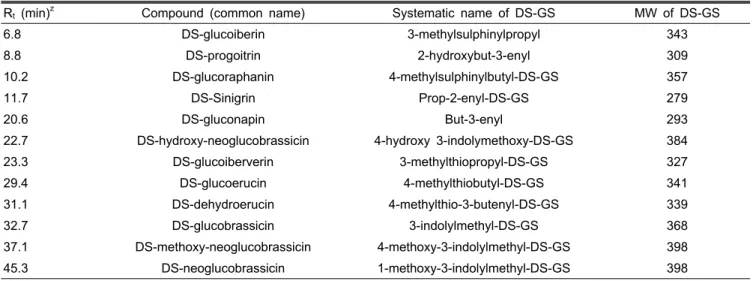
ion source gas pressure at 50 psi, curtain gas pressure at 20 psi, declustering potential at 50 v, and enhanced potential at 10 v. Data were collected using mass scan from 100-500 m/z. For mass measurement, Na or K attached molecular weights were used (Table 4). Usually during MS processing, compounds are bound to Na or K present in buffers used, and thus MS data give +Na or +K molecular weight values.
Sensory Evaluations
The sensory panel test was performed to determine the acceptance of the kohlrabi and the radish by using 1-5 point measurement. The 30 panel members were recruited from Chungnam National University. Sweetness, bitterness, palata- bility, hardness, crispiness and overall preference were asked to be measured. Samples were proposed to panels by giving 3-digit sample numbers. Samples for sensory evaluation were prepared at the size of 1 × 5 × 1 cm after freeze-drying.
Statistical Analysis
Statistical analyses were performed by SPSS 14.0 (Statistical Package for Social Sciences, SPSS Inc, Chicago IL). The significance of the difference between the kohlrabi and the radish were analyzed by one-way ANOVA
Results and Discussion
The nutritional, textural and functional components of kohlrabi were analyzed and compared with radish. The contents of reducing sugar in the kohlrabi and radish were 21.34 mg・g-1 fresh weight and 35.04 mg・g-1 fresh weight, respectively (Table 1). However, the sweetness in the sensory test was higher in the kohlrabi than the radish (Table 2).
Since certain amino acids give sweet taste (Shallenberger, 1993), these results might be due to the higher contents of the amino acids in the kohlrabi than in the radish (Table 3). The bitter and pungent flavors are known to limit con- sumption of the radish. The bitter taste might come from flavonoids (e.g. quercetin and catechin), glucosinolates (sinigrin and progoitrin) and amino acids (arginine, valine, leucine and methionine) (Adam and Carmen, 2000). The results in this study indicated that glucosinolates were one of the major factors causing reluctance of radish consumption.
The contents of cellulose and pectin in the radish were higher than those in the kohlrabi (Table 1). However, the hardness of the kohlrabi was higher than that of the radish (Tables 1 and 2). Cellulose and suberin are important factors affecting hardness of plants (Lene et al., 2007). The content difference of cellulose between the kohlrabi (163.72 mg・g-1 fresh weight) and the radish (166.98 mg・g-1 fresh weight) was relatively small (3 mg・g-1). Therefore, the factors other
Table 1. The contents of reducing sugar, cellulose, pectin, hardness and crispiness in the kohlrabi and the radish.
Reducing sugar (mg・g-1 fw)
Cellulose (mg・g-1 fw)
Pectin (mg・g-1 fw)
Hardnessz (N)
Crispinessy (Peak no.) Kohlrabi 21.34 ± 0.09x 163.72 ± 0.97 2.09 ± 0.03 4816.55 ± 417.37 1.28 ± 0.49
Radish 35.04 ± 0.14 166.98 ± 0.60 2.78 ± 0.01 3163.76 ± 64.35 1.50 ± 0.48
Significance ** * ** ** nsw
zFresh sample used.
yFreeze-dried sample used.
xValue ± standard deviation.
wNot significant.
*,**: Significant at p ≤ 0.05 and p ≤ 0.01.
Table 2. Sensory preference scores of the freeze-dried kohlrabi and radish.
Sweetnessz Bitterness &
pungencyz Palatabilityz Hardnessz Crispinessz Overall preferencez Kohlrabi 2.87 ± 0.93y 1.90 ± 0.96 2.73 ± 1.01 2.83 ± 0.69 2.97 ± 0.96 2.93 ± 0.98 Radish 2.27 ± 1.08 2.80 ± 1.29 2.53 ± 0.97 2.43 ± 0.67 2.70 ± 1.05 2.47 ± 0.86
Significance * ** nsx * ns ns
zScore : 1-5; low - high.
yValue±standard deviation.
xNot significant.
*,**: Significant at P ≤ 0.05 and P ≤ 0.01.
Table 3. The contents of free Amino acid in the kohlrabi and the radish.
Aspartic acid (μg・g-1 fwz)
Threonine (μg・g-1 fw)
Serine (μg・g-1 fw)
Glutamic acid (μg・g-1 fw)
Glycine (μg・g-1 fw)
Alanine (μg・g-1 fw)
-ABAy (μg・g-1 fw)
Valine (μg・g-1 fw)
Kohlrabi 450.04 101.01 192.02 458.06 380.22 147.46 20.14 272.71
Radish 149.33 56.35 43.27 174.01 267.59 20.49 20.81 99.05
Isoleucine (μg・g-1 fw)
Leucine (μg・g-1 fw)
Tyrosine (μg・g-1 fw)
-ABAx (μg・g-1 fw)
Lysine (μg・g-1 fw)
Histidine (μg・g-1 fw)
Arginine (μg・g-1 fw)
Total free amino acid (μg・g-1 fw)
Kohlrabi 65.15 24.66 23.66 379.30 32.71 32.53 1036.98 3630.01
Radish 59.15 14.31 NDw 107.91 ND ND 320.58 1341.03
zFresh weight.
yAlpha aminobutyric acid.
xGamma aminobutyric acid.
wND: not detected.
than cellulose and pectin, e.g. suberin, might cause the hard texture of the kohlrabi. The freeze-dried radish was crispier than the freeze-dried kohlrabi but statistically not significant in both mechanic and sensory tests (Tables 1 and 2).
The total content of free amino acids in the kohlrabi (3630 μg・g-1) was higher by 2.7-fold than that in the radish (1341 μg・g-1) (Table 3). The kohlrabi contained more essential amino acids, such as threonine and valine. This result indicated that the kohlrabi was nutritionally better than the radish. Moreover, the kohlrabi contained more hydrophilic amino acids including glutamate, aspartate, arginine than the radish by 3-fold (Table 3), suggesting palatable taste. Though not significant, the palatability of the kohlrabi was higher than that of the radish in the sensory evaluation (Table 2).
Since glucosinolates are important functional compounds in Brassica plant, their contents were investigated. Before quantification, the identification of glucosinolates in the kohlrabi and the radish was performed.
In the kohlrabi, glucoerucin is the main glucosinolate, which was more than 50% of total glucosinolates (Table 5). In the radish, the total glucosinolate content was 7- and 9- fold higher than that in the kohlrabi (Table 5). The major glucosinolate in the radish was dehydroerucin (Table 5) that causes pungent and bitter taste (Visentin et al., 1992). This result also indicated by the more bitter taste of the radish than the kohlrabi (Table 2). In both plants, more glucosinolates were present in the inner section than the outer one (Table 5). The taste of the outer section also was more bitter than that
Table 4. Quantification of desulfoglucosinolates (DS-GS) in the kohlrabi and the radish by LC-ESI-MS.
Rt (min)z Compound (common name) Systematic name of DS-GS MW of DS-GS
6.8 DS-glucoiberin 3-methylsulphinylpropyl 343
8.8 DS-progoitrin 2-hydroxybut-3-enyl 309
10.2 DS-glucoraphanin 4-methylsulphinylbutyl-DS-GS 357
11.7 DS-Sinigrin Prop-2-enyl-DS-GS 279
20.6 DS-gluconapin But-3-enyl 293
22.7 DS-hydroxy-neoglucobrassicin 4-hydroxy 3-indolymethoxy-DS-GS 384
23.3 DS-glucoiberverin 3-methylthiopropyl-DS-GS 327
29.4 DS-glucoerucin 4-methylthiobutyl-DS-GS 341
31.1 DS-dehydroerucin 4-methylthio-3-butenyl-DS-GS 339
32.7 DS-glucobrassicin 3-indolylmethyl-DS-GS 368
37.1 DS-methoxy-neoglucobrassicin 4-methoxy-3-indolylmethyl-DS-GS 398
45.3 DS-neoglucobrassicin 1-methoxy-3-indolylmethyl-DS-GS 398
zDenotes retention time (min).
Table 5. The contents of glucosinolates in the kohlrabi and the radish.
Glucoiberin (μmol・g-1 dwz)
Progoitrin (μmol・g-1 dw)
Glucoraphanin (μmol・g-1 dw)
Sinigrin (μmol・g-1 dw)
Gluconapin (μmol・g-1 dw)
Hydroxy- neoglucobrassicin
(μmol・g-1 dw)
Glucoiberverin (μmol・g-1 dw)
Inner section
Kohlrabi 0.31 ± 0.01y 0.08 ± 0.00 0.25 ± 0.03 ND 0.07 ± 0.00 0.05 ± 0.01 0.36 ± 0.02
Radish ND ND ND 0.21 ± 0.02 0.09 ± 0.00 0.02 ± 0.00 ND
Significance ** **
Outer section
Kohlrabi 0.21 ± 0.01 ND 0.21 ± 0.01 ND 0.08 ± 0.00 0.06 ± 0.01 0.35 ± 0.01
Radish NDx ND 0.08 ± 0.00 2.11 ± 0.45 ND 0.10 ± 0.00 ND
Significance ** **
Glucoerucin (μmol・g-1 dw)
Dehydroerucin (μmol・g-1 dw)
Glucobrassicin (μmol・g-1 dw)
Methoxy- Neoglucobrassicin
(μmol・g-1 dw)
Neoglucobrassicin (μmol・g-1 dw)
Total glucosinolate (μmol・g-1 dw)
Inner section
Kohlrabi 1.41 ± 0.15 ND 0.06 ± 0.01 0.03 ± 0.00 0.47 ± 0.03 3.08 ± 0.24
Radish 0.21 ± 0.01 22.48 ± 1.35 0.21 ± 0.01 0.11 ± 0.01 0.08 ± 0.00 23.41 ± 1.38
Significance ** ** ** ** **
Outer section
Kohlrabi 2.12 ± 0.05 ND 0.06 ± 0.00 0.02 ± 0.00 0.38 ± 0.01 3.49 ± 0.05
Radish 0.23 ± 0.01 30.20 ± 0.55 0.49 ± 0.01 0.39 ± 0.01 0.08 ± 0.01 33.68 ± 0.90
Significance ** ** ** ** **
zValue±standard deviation.
yDry weight.
xND: not detected.
**The average difference between 2 plants was significant at p ≤ 0.01.
of the inner section (data not shown), suggesting glucosinolates were one of the factors causing bitter taste (Adam and Carmen, 2000). The outer parts of the radish and kohlrabi contained 51%
and 13% more glucosinolates than the inner parts, respectively (Table 5). Glucosinolates are produced from amino acids including tryptophan, tyrosine, phenylalanine, isoleucine, leucine, valine, alanine and methionine (Grubb and Abel, 2006). Even though the kohlrabi contained more amino acids than the radish (Table 3), the kohlrabi contained less glucosinolates
than the radish (Table 5).
Several reports have indicated that the health-beneficial components of Brassica plants are fibers, vitamin C (Divisi et al., 2006), and glucosinolates (Hayes et al., 2008). The major glucosinolate in the kohlrabi was glucoerucin (Table 5). At certain conditions, glucoerucin is changed to glucoraphanin or its isothiocyanate form, sulforaphane (Iori et al., 1999).
Sulforaphane is a well known anticancer compound in Brassica family (Fahey et al., 2001). However, the function of glu-
coerucin itself is not well understood. The radish contained more indole glucosinolates including glucobrassicin and methoxy- neoglucobrasscin (Table 5), which activate phase I system and may cause increased cancer incidence (Bjeldanes et al., 1991). Furthermore, the content of glucoraphanin in the kohlrabi was significantly higher than that of the radish (Table 5), indicating that kohlrabi is more functional than radish. The overall preference of the kohlrabi was slightly higher than that of the radish. As a conclusion, the kohlrabi is considered as a good vegetable containing a flavor-rich taste and functional due to glucoraphanin. We believe that kohlrabi can be a good candidate vegetable to substitute radish.
Literature Cited
Adam, D. and G.C. Carmen. 2000. Bitter taste, phytonutrients, and the consumer. Am. J. Clin. Nutr. 72:1424-35.
Bjeldanes, L.F., J.Y. Kim, K.R. Grose, J.C. Bartholomew, and C.A.
Bradfield. 1991. Aromatic hydrocarbon responsiveness-receptor agonists generated from indole-3-carbinol in vitro and in vivo:
comparisons with 2, 3, 7, 8-tetrachlorodibenzo-p-dioxin. Proc.
Nat. Acad. Sci. 88:9543-9547.
Choi, Y.H., E.K. Yun, and M.Y. Kang. 2000. Comparison of some characteristics relevant to yukwa (fried rice cookie) made by different processing conditions. J. East Asian soc. Dietary life. 10:55-61.
Diana, G.C., M.E. Daxenbichler, and C.H. Van Etten. 1985. Glu- cosinolates in Radish Cultivars. J. Amer. Soc. Hort. Sci. 110:
634-638.
Divisi, D., D.S. Tommaso, S. Salvemini, M. Garramone, and R.
Crisci. 2006. Diet and cancer. Acta. Biomed. 77:118-123.
Fahey, J.W., A.T. Zalcmann, and P. Talalay. 2001. The chemical diversity and distribution of glucosinolates and isothiocyanates among plants. Phytochemistry 56:5-51.
Fahey, J.W., Y. Zhang, and P. Talalay. 1997. Broccoli sprouts:
an exceptionally rich source of inducers of enzymes that protect against chemical carcinogens. Proc. Natl. Acad. Sci.
94:10367-10372.
Gamet, P.L., P. Li, S. Lumeau, G. Cassar, M.A. Dupont, S.
Chevolleau, N. Gasc, J. Tulliez, and F. Terce. 2000. Sulforaphane, a naturally occurring isothiocyanate, induces cell cycle arrest and apoptosis in HT29 human colon cancer cells. Cancer Res. 60:1426-1433.
Grubb, C.D. and S. Abel. 2006. Glucosinolate metabolism and its control. Trends Plant Sci. 11:89-100.
Grubben, G.J.H. 2004. Vegetables. In: Plant resources of tropical Africa 2. PROTA, Wageningen, Netherlands.
Harbaum, B., E.M. Hubbermann, C. Wolff, R. Herges, Z. Zhu, and
K. Schwarz. 2007. Identification of flavonoids and hydroxycinnamic acids in pak choi varieties (Brassica campestris L. ssp. chinensis var. communis) by HPLC-ESI-MSn and NMR and their quan- tification by HPLC-DAD. J. Agric. Food Chem. 55:8251-8260.
Hayes, J.D., M.O. Kelleher, and I.M. Eggleston. 2008. The cancer chemopreventive actions of phytochemicals derived from glucosinolates. Eur. J. Nutr. 47:73-88.
Iori, R., R. Bernardi, D. Gueyrard, P. Rollin, and S. Pilmieri. 1999.
Formation of glucoraphanin by chemoselective oxidation of natural glucoerucin: a chemoenzymatic route to sulforaphane.
Bioorg. Med. Chem. Lett. 9:1047-1048.
ISO Norm. 1992. Rapeseed - determination of glucosinolates content - Part 1: Method using high-performance liquid chromatography.
ISO 9167-1. p. 1-9.
Kaaber, L., K. Kaack, T. Kriznik, E. Brathena, and S.H. Knutsen.
2007. Structure of pectin in relation to abnormal hardness after cooking in pre-peeled, cool-stored potatoes. LWT-Food Sci. Technol. 40:921-929.
Kim, D.W., O. Bobleter, and G. Bonn. 1986. Enzymatic hydrolysis of cellulose and plant biomass. Kor. Chem. Eng. Res. 24:53-62.
Lee, J.M. and H.J. Chung. 1999. Physicochemical and sensory characteristics of snack using cham shwi (Aster acaber). Kor.
J. dietary cult. 14:49-55.
Liu, S., W.C. Willett, J.E. Manson, F.B. Hu, B. Rosner, and G.
Colditz. 2003. Relation between changes in intakes of dietary fiber and grain products and changes in weight and develop- ment of obesity among middle-aged women. Am. J. Clin.
Nutr. 78:920-927.
Manabe, M. and J. Naohara. 1986. Properties of pectin in Satsuma mandarin fruits (Citrus Unshiu Marc). J. Jpn. Soc. Food. Sci.
Tech. 33:602-608.
Miller, G.L. 1959. Use of dinitrosalicylic acid reagent for deter- mination of reducing sugar. Anal. Chem. 31:426-428.
Mithen, R.F., M.Dekker, R. Verkerk, S. Rabot, and I.T. Johnson.
2000. The nutritional significance, biosynthesis and bioavailibility of glucosinolates in human food, The chemical diversity and distribution of glucosinolates and isothiocyanates among plants.
J. Sci. Food Agric. 80:967-984.
Shallenberger, R.S. 1993. Taste chemistry. Blackie Academic &
Professional. New York Agricultural Experiment Station, Cornell Univ. Geneva, New York, USA.
Terry, P., E. Giovannucci, K.B. Michels, L. Bergkvist, H. Hansen, L. Holmberg, and A. Wolk. 2001. Fruit and vegetables, dietary fiber, and risk of colorectal cancer. J. Natl. Cancer.
Inst. 93:525-533.
The Korean Society of Food Science and Nutrition. 2000.
Handbook of experiments in food science and nutrition.
Hyoil, Seoul, Korea.
Visentin, M,, A. Tava, R. Iori, and S. Palmieri. 1992. Isolation and Identification of trans-4- (Methylthio) -3-butenyl Glucosinolate from Radish Roots (Raphanus sativus L.). J. Agric. Food Chem. 40:1687-1691.
무와 비교한 콜라비의 성분분석
최승현1ㆍ류동걸1ㆍ박수형2ㆍ안경구3ㆍ임용표4ㆍ안길환1,4*
1충남대학교 농업생명과학대학 식품공학과, 2국립원예특작과학원 채소과, 3조은종묘, 4충남대학교 식물분자마커 및 식품성분분석센터 (*교신저자)
초 록. 무의 소비에 있어서 주된 문제점은 glucosinolate에 의한 쓴맛과 매운맛이다. 최근에 무의 문제점을 보완할 수
있는 콜라비가 한국에 도입되어 제주도에서 월동재배가 이루어지고 있다. 두 작물의 식감과 맛이 비슷하여 품질을 비교 분석하였다. 콜라비의 환원당, cellulose, pectin의 함량은 무보다 낮았다. 식감은 콜라비가 무보다 더 단단한 것으로 나타났으며, 아미노산의 함량은 콜라비가 무보다 약 2.7배 정도 높았다. 특히 aspartate, glutamate, arginine과 같은 수용성 유리 아미노산의 함량이 무보다 콜라비에서 3배 정도 높게 나타났다. 총 glucosinolate 함량은 콜라비가 무의 내부 보다 12.4배, 외부 보다 28.5배로 각각 낮았다. 관능평가에서 콜라비의 쓴맛과 매운맛이 무보다 적게 나타났다. 항암성분으로 알려진 glucoraphanin은 무 보다 콜라비에 더 많이 함유되어 있는 것으로 나타났다. 콜라비의 환원당 함량이 무에 비해 적음에도 불구하고 관능평가에서 무보다 콜라비가 더 달다는 결과가 나왔다. 이는 무보다 콜라비가 더 많은 수용성 유리 아미노산을 함유하기 때문일 것이라 생각된다. 결과적으로 콜라비는 맛과 기능적인 면에서 무보다 높게 나타나 소비가 증가될 것으로 예상된다.
추가 주요어 : 아미노산, 쓴맛, glucosinolate, 매운맛, 관능평가