Korean J Community Living Sci 26(3) : 565~573, 2015 http://dx.doi.org/10.7856/kjcls.2015.26.3.565
강원도 일부지역 여중생에서 스트레스 수준에 따른 식행동 비교분석
박 용 현ㆍ이 지 윤
1)ㆍ정 은ㆍ김 복 희
†조선대학교 식품영양학과ㆍ조선대학교 교육대학원
1)A Comparative Analysis of Eating Habits of Female Middle School Students in Gangwondo, Korea, According to Stress Levels
Yonghyun ParkㆍJi-yoon Lee
1)ㆍEun JeongㆍBok-hee Kim
†Dept. of Food and Nutrition, Chosun University, Gwangju, Korea Graduate School of Education, Chosun University, Gwangju, Korea
1)1)
ABSTRACT
This study examines the relationships between stress and eating habits of adolescents based on the assumption that adolescents require large amounts of nutrients and that eating habits affect their physical development, academic achievement, and emotional development. For this purpose, 213 adolescents in Gangwondo, Korea, were surveyed. Many studies have reported that stress causes changes in eating habits and affects health status. Based on the dietary action guide scores according to stress categories, eating instant foods less was significant (p<0.001), eating fast foods less was significant (p<0.05), and have soft drinks less was significant (p<0.001).
The results suggest the importance of balanced nutrition based on the formation of right dietary habits for adolescents. Good nutrition can be determined through right knowledge of nutrition and dietary habits, and right dietary habits can improve health and physical development as well as mental and emotional stability. The analysis did not compare other regions, and therefore any generalization of the results should be made with caution. However, the results offer important insights into stress among adolescents for their effective counseling.
Key words: eating habits, stress, dietary action guide, adolescents
I. 서론
현대인의 질병의 절반 이상이 스트레스와 관련이
있으며, 복잡하고 다양한 현대사회를 살아가면서 연 속적인 긴장 등으로 인하여 부정적인 반응을 일으키 는 정신적, 사회적인 스트레스를 받고 있다(Lee 2000).
This study was supported by the 2014 research fund of Chosun University.
접수일: 2015년 7월 8일 심사일: 2015년 7월 29일 게재확정일: 2015년 8월 5일
†Corresponding Author: Kim Bok-Hee Tel: 82-62-320-7721 E-mail: [email protected]
This is an Open-Access article distributed under the terms of the Creative Commons Attribution Non-Commercial
License (http://creativecommons.org/licenses/by-nc/3.0) which permits unrestricted non-commercial use, distribution,
and reproduction in any medium, provided the original work is properly cited.
생활환경과 관련이 있는 스트레스는 올바르지 못한 생활습관으로 인하여 정신적인 스트레스를 유발시키 는 심리적 장애를 일으키기도 하고, 신체적으로는 고 혈압, 당뇨병과 같은 만성질환을 유발시키기도 한다 (Park et al. 2000).
최근 연구결과에 따르면 스트레스가 사람의 식행 동에 영향을 미치며, 스트레스에 단기간 노출된 경우 에는 식욕저하가 일어나 영양소섭취량이 감소할 수 있으나, 스트레스에 만성적으로 노출될 경우에는 일 반적으로 영양소섭취량이 증가하며, 특히 설탕이나 지방의 함량이 높은 에너지가 농축된 식품을 많이 섭 취하게 되어 체중증가 및 각종 만성질환을 초래하는 등 스트레스 강도나 기간에 따라 영양소 섭취량이 증 가되거나 감소된다고 밝혀졌다(Ng & Jeffery 2003;
Torres & Nowson 2007).
특히 청소년기는 아동기에서 성인기로 넘어가는 시기로 신체적, 정신적으로 급격하게 변화되는 시기 로 심리적으로도 동요가 심한 시기이다(Hyun & Lee 2006). 청소년기의 좋은 영양상태는 올바른 식습관에 의하여 좌우되며, 바른 식습관은 적절한 건강을 유지 하도록 하여 신체 발육을 양호하게 할 뿐만 아니라 정신적, 정서적 안정유지에 중요한 역할을 한다. 성 인기 이후를 살아가는데 필요한 건강을 준비하는 시 기인 청소년기의 특수성과 영양의 중요성이 강조되 는 이 시기에는 더욱 적절한 식생활 관리가 필요하지 만(Kang & Choue 2010), 대부분의 청소년기 학생들 의 식사는 일반적인 식사형태보다는 간편성과 기호 에 편중하고 있으며(Ahn 1995), 아침 결식, 식사시간 전 간식, 야식, 탄산음료 등 식사대용의 기호식품 섭 취가 높아 생활패턴과 관련하여 심신양면의 문제가 제기되고 있으며, 이들의 올바른 식습관 형성이 어려 운 실정이다. 따라서 우리나라 청소년들이 스트레스 성 결식, 빈혈, 소화불량 등을 호소하며 영양상의 문 제점들이 지적되어지고 있다(Yoon 2001).
또한 현재 우리나라의 청소년들은 입시위주의 교 육과 과도한 경쟁의 조장으로 인하여 학업과 진학문 제로 과중한 스트레스에 노출되어지고 있다. 이러한 학업과 미래에 대한 부담감으로 스트레스 발생이 증 가되고, 정서적 불안정이 고조되고 있지만 스트레스
를 해소할만한 여유가 부족하여 정신적으로도 완숙 도가 떨어져 각종 심인성 장애 및 스트레스성 질환에 무방비상태로 놓여있으며, 사춘기 심리적 불안정으 로 바람직한 생활습관을 유지하거나 합리적인 식행 동을 보이기 어려운 실정이다(Park & Ahn 2001).
성인기의 스트레스가 식행동의 변화를 초래하게 되어, 건강상태에 영향을 미치게 된다는 연구는 많이 이루어져 있으나(Ng & Jeffery 2003; Torres &
Nowson 2007), 청소년기 특히 여중생의 스트레스와 식행동에 대한 연구는 부족한 실정이다. 이에 따라 본 연구에서는 여중생들의 스트레스 수준에 따른 식 행동과의 관련성을 조사하여 균형잡힌 영양소 섭취 가 중요한 이 시기의 청소년들에게 올바른 식습관 형 성에 이바지 하고자 한다.
Ⅱ. 연구방법
1. 연구대상 및 조사기간
여중생의 생활스트레스와 식습관 식생활 이행도와 의 상관관계를 규명하기 위하여 본 연구는 강원도 일 부지역 소재 중학교 재학 중인 여중생들을 조사대상 으로 하였다. 2010년 2월 동안 본 연구의 목적과 방 법을 각반의 담임선생님께 설명 드리고 각반의 담임 선생님의 지도하여 학생들에게 직접 기입하게 하여 실시하였으며, 220부 중 213부(회수율 96.8%)를 분 석하였다.
2. 일반 환경 요인 조사
스트레스 수준과 식행동에 영향을 미치는 것으로 알려진 일반 환경요인의 조사 내용은 대상자의 가족 구성, 아버지 학력, 어머니 학력, 한 달 가족수입 등 이 포함되었다.
3. 스트레스 척도 조사
청소년의 스트레스요인(Byeon 1995)은 학교생활 7문항, 가정생활 6문항, 교우관계 5문항, 자아영역 5 문항으로 이루어진 문항을 수정 보완하여 사용하였 고, Likert 5점 척도로(1-전혀 그렇지 않다, 2-그렇지 않다, 3-보통이다, 4-대체로 그렇다, 5-매우 그렇다),
Variables Total (N=213)
School grade
1st grade 73(34.3)
2nd grade 72(33.8)
3rd grade 68(31.9)
Family type Extended family 37(17.4)
Nuclear family 176(82.6)
Father’ education levels ≤ High school 124(59.2)
≥ University 87(40.8)
Mother’ education levels ≤ High school 148(69.5)
≥ University 63(29.6)
Family income (10,000won/month)
〈 200 37(17.4)
200-299 91(42.7)
300-399 45(21.1)
≥ 400 39(18.3)
Table 1. General characteristics of subjects (N(%))
점수가 높을수록 스트레스가 높은 것을 의미한다. 또 한 학생들의 생활 스트레스 총점을 계산한 후 백분위 수로 스트레스 정도를 구분하였으며, 그 중 55점 이 하를 하위 25%로 스트레스가 가장 적은군(Q1), 75점 이상의 점수를 상위 75%로 스트레스가 가장 많은군 (Q4)으로 분류하였다.4. 식습관 조사
식습관 조사 문항은 평소 식사량과 속도, 태도, 간 식의 횟수 및 종류 등을 조사하였고, 식생활지침 실 천도 조사는 ‘한국인을 위한 식생활지침’(Ministry of Health & Welfare 2009) 중 ‘청소년의 식생활지침’에 서 각 식품군을 매일 섭취하는지 3문항, 짠 음식과 기름진 음식을 적게 먹는지 3문항, 건강 체중을 바로 알고, 알맞게 먹는지 4문항, 물이 아닌 음료를 적게 마시는지를 묻는 3문항, 식사를 거르거나 과식하는지 3문항 위성적인 음식을 선택하는지를 묻는 2문항, 총 18문항으로 구성되어져 있다. 식생활지침의 세부지 침을 Likert 3점 척도로 아니다(1점), 보통이다(2점), 그렇다(3점)로 점수화 하였으며, 점수가 높을수록 식 생활지침 인지도와 실천도가 높은 것을 의미한다.
5. 통계처리
SPSS 17.0 K를 이용하여 통계처리를 실시하였다.
조사대상자의 성별, 가족구성, 가정환경같은 비연속 변수는 빈도와 백분율을 교차분석한 후 유의성은 χ2-test 로 검증하였다. 조사대상자의 스트레스 점수, 식생활 지침과 같은 연속변수는 평균과 표준편차를 구하였 으며, 조사대상자의 스트레스 백분위수에 따라 각각 의 변수들과의 차이를 알아 보기위하여 일원배치분 산분석(ANOVA)로 유의성 검증을 실시하였다. 본 연 구에 통계적 유의적 검증은 α=0.05수준에서 이루어 졌다.
Ⅲ. 결과 및 고찰
1. 일반적 환경 요인
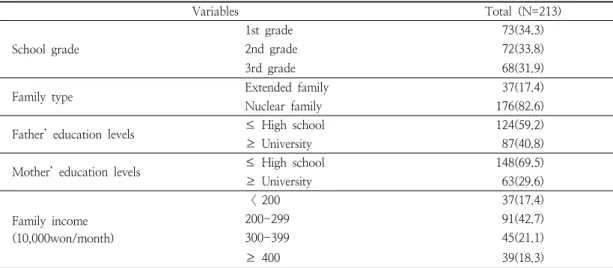
조사대상자의 일반 환경 요인은 Table 1과 같다.
1학년생 73명, 2학년 72명, 3학년 68명으로 총 213명 이다. 가족 구성은 대가족이 17.4%, 핵가족이 82.6%
로 가족구성은 핵가족이 대부분의 비율을 차지하였 다. 아버지와 어머니의 학력은 고졸이하가 각각 아버 지가 59.2%, 어머니가 69.5%였고, 대졸이상은 아버 지가 40.8%, 어머니가 29.6%로 고졸이하의 부모님을 둔 학생들이 많았다. 한 달 가족 수입은 200-300만원 이 91명(42.7%)으로 가장 많았다.
Variables Total (N=213) I’m tired because many classes, homework and tests.
1)3.36 ± 1.01
2)I’m annoyed because of the attitude of the teacher’s insincere teachings. 2.88 ± 0.99 I felt a tightness in the teacher’s prejudice and favoritism. 3.00 ± 0.94
I studied as much as results come out. 3.27 ± 1.03
I was open to academic performance, It had ignored the personalities 3.41 ± 0.98
I’m tired, when I had a self-study at school. 2.97 ± 1.09
I have difficulty in choosing study and career. 3.43 ± 1.08
Scholarship score
3)22.17 ± 4.16
I was unhappy when a parents’s relationship with the bad. 3.45 ± 1.24 I was angry when the discrimination between the brotherhood. 2.93 ± 1.36
Severe excessive interference of parents. 2.72 ± 1.15
I was upset when my parents do not understand me. 3.29 ± 1.21
My parents are pushing study too much. 2.66 ± 1.15
The family’s economic status is not good. 2.32 ± 1.11
Family relationship score 17.41 ± 4.98
I was upset because of fighting / arguing with friends. 2.45 ± 1.13 I usually get stressed out about the beating of friends. 1.70 ± 0.90 I was upset with indifference, bullying from friends. 1.73 ± 0.93
I was lonely because I didn’t have best friends. 1.64 ± 0.83
I get stressed out because of boyfriend. 1.87 ± 1.09
Friend relationship score 9.37 ± 3.52
I didn’t have a clear life goal is anxious. 2.80 ± 1.19
I was upset because of body image. 3.07 ± 1.12
I’m tired of being introverted personality. 2,51 ± 1.12
I become depressed when I felt the lack of the ability. 3.16 ± 1.14 I was upset when I do not have the ability to compare with others. 2.88 ± 1.18
Selt-esteem score 14.43 ± 4.15
1)
5-point likert scale(1: Never, 2: A little, 3: Noraml, 4: A lot, 5: A great)
2)
Mean ± SD
3)
Scholarship achievement score : 7∼35, Family relationship score : 6∼30, Friend relationship score : 5∼25, Selt- esteem score : 5∼25
Table 2. Score distributions of stress levels in subjects
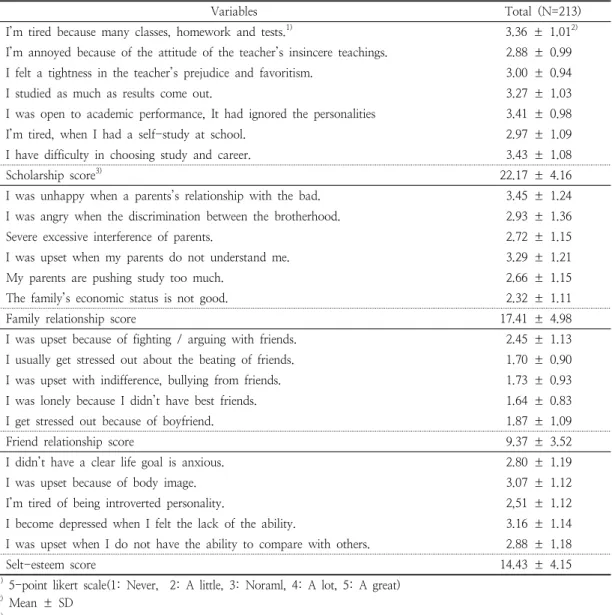
2. 스트레스 분포조사대상자의 생활 스트레스는 Table 2에 제시하 였다. 학업문제 영역에 대한 스트레스 정도는 전체 평균 22.17 ± 4.16점이었고, 세부 항목별로 ‘진학/진 로 선택’에 대한 스트레스 3.43 ± 1.08점, ‘성적으로 인격을 평가하고 공개할 때’가 3.41 ± 0.98점, ‘학업 량이 많아 힘들다’가 3.36 ± 1.01점 순으로 높게 나
타났다.
가족관계 영역의 대한 스트레스 정도는 전체 평균 17.41 ± 4.98점이었으며, 세부 항목별로 ‘부모의 불 화’로 받는 스트레스 점수가 3.45 ± 1.24점으로 가장 높았고, ‘자신을 이해하지 못해줬을 때’ 받는 스트레 스가 3.29 ± 1.21점 순으로 조사되었다.
교우관계에 대한 스트레스 전체 평균은 9.37 ±
Variables Total (N=213)
Amount of meal
Much 87(40.8)
Average 107(50.2)
Little 19( 8.9)
Time spent on eating
Fast 64(52.1)
Average 109(51.2)
Slow 40(18.8)
Usual eating attitude
Eating when hungry 47(22.1)
Binge eating 67(31.5)
Overeating when delicious 30(14.1)
Rarely eating 49(23.0)
Solve a hunger 20( 9.4)
Frequency of snacks
Almost not 46(21.6)
1-3/week 70(33.3)
4-6/week 27(12.7)
1/day 39(18.3)
≥ 2/day 30(14.1)
Dietary behavior problems
Unbalanced diet 50(23.6)
Skipping breakfast 39(18.3)
Overeating 40(18.9)
Eating out 9( 4.2)
Instant / fast food favorite 29(13.7)
Irregular meal times 45(21.2)
Table 3. Dietary behaviors of subjects (N(%))
3.52점 이었고, 세부 항목의 ‘친구와의 싸움/말다툼’에 의한 스트레스가 2.45 ± 1.13점으로 높게 조사되 었다. 자아영역의 전체 평균은 14.43 ± 4.15점 이었 으며, 세부 영역에서 ‘타인에 비하여 능력이 부족함을 느낄 때’가 3.16 ± 1.14점, ‘외모 및 신체상 때문’에 받는 스트레스가 3.07 ± 1.12점 순으로 조사되었다.
조사대상자들의 학업에 대한 스트레스가 다른 영 역에 비하여 높게 나타났으며, 익산지역 중학생들의 일상생활 스트레스 중 학교생활과 관련한 스트레스 가 가장 크다는 결과와 유사하였다(Lim & Kim 2002).
이는 청소년들의 일상생활이 주로 학교나 학원 등 학 업과 관련된 곳에서 이루어지므로 이들의 가장 큰 스 트레스원이라고 할 수 있을 것이며, 이들의 스트레스 정도를 낮출 수 있는 방법들이 연구되어져야 할 것이다.
3. 식습관 및 식생활 지침
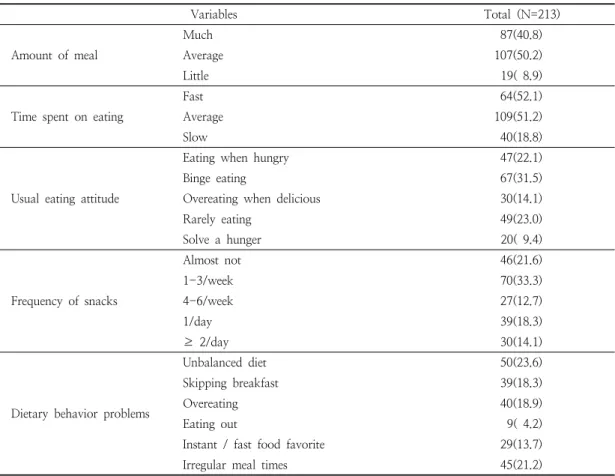
조사대상자의 식습관은 Table 3과 같다. 평소의 식사량은 적당하게 먹는다가 50.2%였고, 많이 먹는 다는 40.8%였다. 평소 식사속도로는 보통이 51.2%, 빨리 먹는 편이 52.1%, 천천히 먹는 편이 18.8%였 다. 평소 식사 태도는 폭식이 31.5%, 드물게 먹음이 23.0%, 배고플 때 먹음 22.1%로 조사되었다. 또한 간식의 섭취빈도는 1-3회/주가 33.3%로 가장 높았다.
식행동의 문제점으로는 편식이 23.6%, 불규칙한 식 사 시간 21.2%, 과식이 18.9%, 아침결식 18.3%, 인 스턴트식품 및 패스트푸드 선호 13.7%로 조사되었다.
다른 연구 결과에서도 우리나라 청소년들의 식생 활 문제로 잦은 결식과 외식, 패스트푸드 선호 등의 문제점을 보고하였다(Ha et al. 1997; Lee et al.
2000; Ro 2000). 이렇게 식생활에서 패스트푸드나 인
Variables Total (N=213)
Eating balanced diet. 2.26 ± 0.749
1)Choosing skill of good snack. 2.43 ± 0.727
Drinking 2 cups of milk every day. 1.81 ± 0.854
Eat less salty food. 2.00 ± 0.789
Eat less instant foods. 2.07 ± 0.771
Eat less fried or fast foods. 2.11 ± 0.766
Know the healthy weight for height. 2.29 ± 0.805
Moderate exercise. 1.89 ± 0.775
Appropriate weight loss methods. 2.47 ± 0.697
Watching TV and games are less than two hours a day. 1.95 ± 0.859
Drinking enough water. (2L/day) 2.25 ± 0.760
Eat less soft drinks. 2.37 ± 0.706
Does not drink of alcohol. 2.71 ± 0.597
It does not skip breakfast. 2.37 ± 0.829
Eating meals on time and slowly 1.97 ± 0.791
Do not overeating. 1.95 ± 0.769
Do not eat bad foods 1.89 ± 0.822
Check of nutrition labeling and expiration date 3.00 ± 0.000
Total score 38.78 ± 5.85
1)
Mean± SD
Table 4. Performance of the dietary action guide for adolescence in subjects
스턴트식품들을 자주 섭취할 경우 비만 및 성인병을유발할 위험이 많아지고 영양불균형도 초래하여 성 장에 좋지 않은 영향을 줄 것으로 사료된다.
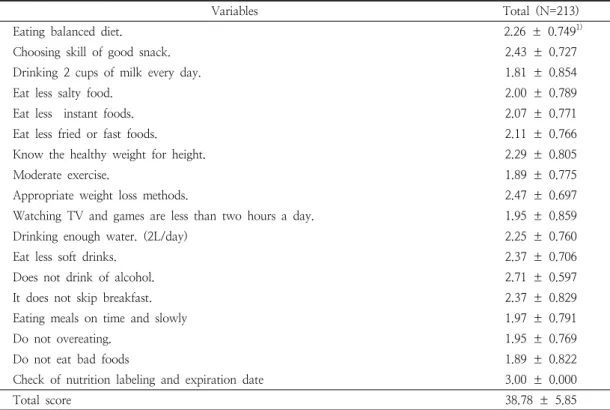
식생활지침 요인은 Table 4에 제시하였다. 조사대 상자들은 식품구입 시 영양표시와 유통기한을 확인 후 구입한다가 가장 높게 나타났으나, 우유섭취 실천도, 식사속도, 제시간에 식사하기, 불량식품 먹지 않기 이 행도는 비교적 낮게 나타났다. 2005년도 국민건강영양 조사(Ministry of Health, Welfare and Family Affiars
& Korea Centers for Disease and Prevention 2006)에 따르면 청소년의 식생활지침에 대한 실천율이 가장 낮 은 항목으로 매일 우유 2컵 마시기, 짠 음식 적게 먹기 로 조사결과 나타나 이 시기 학생들의 영양문제에 대 해 본 조사와 비슷하게 나타났다. 식생활지침은 올바 른 식생활을 위해 지켜야 할 중요한 지표로 주된 내용 으로는 질병예방과 건강증진에 필요한 식생활 실천방 안으로 식품의 선택 및 조리 방법과 신체활동, 건강체
중 등의 내용을 포함하고 있으므로 이를 토대로 학교 에서의 영양교육과 함께 가정에서의 영양교육이 이루 어질 수 있도록 할 필요가 있다고 사료된다.
4. 식습관과 스트레스
Table 5는 조사대상자들의 식습관에 따른 스트레 스 정도에 대한 조사결과이다. 평소 식사태도와 스트 레스와의 관계에서 스트레스를 가장 많이 받는 군 (Q4)에서 ‘폭식’이 41.5%로 스트레스를 덜 받는 군 (Q2)에 비하여 폭식의 습관이 유의하게 조사되었다 (p<0.05). 또한 통계적으로 유의한 차이는 없었으나, 스트레스를 많이 받는 군에서 아침결식, 불규칙한 식 사시간이 본인의 식행동의 문제점이라고 인식하는 정도가 더 높았다. 연구대상은 다르나 초등학생이나 대학생의 스트레스 정도에 따른 식사태도에서도 스 트레스가 높은 군에서 과식이나 식사량 증가 등 스트 레스 시 음식 섭취량에 변화가 있는 것과 비슷한 결
Variables Q1
1)(N=47)
Q2 (N=57)
Q3 (N=56)
Q4
(N=53) χ²
Amount of meal
Much 16(34.0) 19(33.3) 25(44.6) 27(50.9)
6.371
*Average 25(53.2) 33(57.9) 28(50.0) 21(39.6)
Little 6(12.8) 5( 8.8) 3( 5.4) 5( 9.4)
Time spent on eating
Fast 14(29.8) 15(26.3) 13(23.2) 22(41.5)
6.691
*Average 26(55.3) 32(56.1) 31(55.4) 20(37.7)
Slow 7(14.9) 10(17.5) 12(21.4) 11(20.8)
Usual eating attitude
Eating when hungry 11(23.4) 10(17.5) 11(19.6) 15(28.3)
21.798
*Binge eating 13(27.7) 12(21.1) 20(35.7) 22(41.5)
Overeating when delicious 4( 8.5) 9(15.8) 7(12.5) 10(18.9)
Rarely eating 12(25.5) 19(33.3) 15(26.8) 3( 5.7)
Solve a hunger 7(14.9) 7(12.3) 3( 5.4) 3( 5.7)
Frequency of snacks
Almost not 7(14.9) 15(26.3) 16(28.6) 8(15.1)
18.972
*1-3/week 21(44.7) 14(24.6) 20(35.7) 16(30.2)
4-6/week 6(12.8) 5(8.8) 9(16.1) 7(13.2)
1/day 10(21.3) 14(24.6) 6(10.7) 9(17.0)
≥ 2/day 3( 6.4) 9(15.8) 5(8.9) 13(24.5)
Dietary behavior problems
Unbalanced diet 17(37.0) 14(24.6) 13(23.2) 6(11.3)
20.331
*Skipping breakfast 7(15.2) 6(10.5) 10(17.9) 16(30.2)
Overeating 6(13.0) 12(21.1) 12(21.4) 10(18.9)
Frequent eating out 1( 2.2) 4( 7.0) 2( 3.6) 2( 3.8) Instant / fast food favorite 4( 8.7) 10(17.5) 10(17.9) 5( 9.4) Irregular meal times 11(23.9) 11(19.3) 9(16.1) 14(26.4)
1)
Q1: stress levels < 25%, Q2: stress levels 25-50%,Q3: stress levels 50-75%, Q4: stress levels ≥75%
*
p<0.05
Table 5. Dietary behaviors of subjects by stress levels (N(%))
과를 보였다(Shin 1999; Kwon & Lee 2004).
조사대상자들의 스트레스 정도에 따른 식생활지침 이행도 평가 점수 분포에 대한 결과는 Table 6에 제 시하였다. 스트레스를 더 많이 받을수록 ‘짠음식을 적게 먹는다’의 이행도가 유의하게 낮았고(p<0.05),
‘인스턴트 음식을 적게 먹는다’의 이행도 역시 스트레 스를 더 많이 받을수록 낮은 것으로 조사되었으며 (p<0.001), ‘패스트푸드 섭취를 적게 먹는다’의 이행 도도 같은 결과를 보였다(p<0.05). 또한 식생활지침 이행도 전체 점수에서도 스트레스 정도가 높을수록 이행도가 유의하게 낮은 것으로 조사되었다(p<0.001).
이러한 결과는 스트레스를 받을 경우 당도가 높고 기름진 음식을 선택한다는 연구(Zellner et al. 2006)
와 유사한 결과를 보였으며, 식행동은 스트레스 등 심리적으로 부정적으로 나타나게 하며 이는 영양상 태에도 부정적인 결과를 보였다는 연구결과와 유사 하였다(Kim et al. 1993). 또한 본 연구 결과 스트레 스가 식사시간의 불규칙, 영양상태의 균형을 깰 수 있는 식행동 성향 등을 보인다고 한 연구 결과와 일 관성 있게 나타났다(Han & Cho 1998). 스트레스 정 도가 높을수록 잘못된 식습관을 가질 가능성이 높으 며, 이는 건강상의 문제를 일으킬 수 있으므로 청소 년기의 바른 식습관 형성을 위한 교육이 필요하겠다.
청소년의 신체발달과 정신건강의 안녕을 위하여 바 람직한 방향으로 나아갈 수 있도록 하는 사회에서의 다각적인 노력이 필요할 것으로 사료된다.
Variables Q1
1)(N=47)
Q2 (N=57)
Q3 (N=56)
Q4
(N=53) p
Eating balanced diet 2.2 ± 0.8
2)2.3 ± 0.7 2.4 ± 0.7 2.2 ± 0.7 0.496 Choosing skill of good snack 2.6 ± 0.6 2.3 ± 0.8 2.5 ± 0.7 2.3 ± 0.7 0.097 Drinking 2 cups of milk every day 1.9 ± 0.8 1.8 ± 0.8 1.8 ± 0.9 1.8 ± 0.9 0.876 Eat less salty food 2.1 ± 0.7 2.0 ± 0.9 2.2 ± 0.8 1.8 ± 0.7 0.021 Eat less instant foods 2.3 ± 0.6 2.1 ± 0.8 2.2 ± 0.8 1.7 ± 0.7 0.001 Eat less fried or fast foods 2.3 ± 0.7 2.2 ± 0.8 2.2 ± 0.7 1.8 ± 0.7 0.012 Know the healthy weight for height 2.4 ± 0.8 2.3 ± 0.8 2.3 ± 0.8 2.2 ± 0.8 0.732
Moderate exercise 2.1 ± 0.7 1.8 ± 0.8 1.8 ± 0.8 1.9 ± 0.8 0.249
Appropriate weight loss methods 2.6 ± 0.6 2.4 ± 0.8 2.6 ± 0.6 2.4 ± 0.7 0.220 Watching TV and games are less
than two hours a day 1.9 ± 0.8 2.2 ± 0.9 1.8 ± 0.8 1.9 ± 0.9 0.171 Drinking enough water (2L/day) 2.5 ± 0.7 2.2 ± 0.8 2.1 ± 0.7 2.3 ± 0.8 0.150 Eat less soft drinks 2.6 ± 0.6 2.5 ± 0.7 2.4 ± 0.7 2.0 ± 0.8 <0.001 Does not drink of alcohol 2.8 ± 0.5 2.7 ± 0.7 2.8 ± 0.5 2.7 ± 0.6 0.522 It does not skip breakfast 2.4 ± 0.9 2.5 ± 0.7 2.4 ± 0.8 2.1 ± 0.9 0.082 Eating meals on time and slowly 2.0 ± 0.8 2.1 ± 0.8 2.1 ± 0.9 1.7 ± 0.7 0.099
Do not overeating 2.2 ± 0.7 2.0 ± 0.74 1.9 ± 0.8 1.8 ± 0.8 0.083
Do not eat bad foods 2.2 ± 0.8 2.0 ± 0.9 1.9 ± 0.8 1.6 ± 0.7 0.002 Check of nutrition labeling and
expiration date 3.0 ± 0.0 3.0 ± 0.0 3.0 ± 0.0 3.0 ± 0.0 -
Total Score 40.9 ± 5.2 39.1 ± 5.7 39.4 ± 5.6 35.9 ± 5.8 <0.001
1)
Q1: stress levels < 25%, Q2: stress levels 25-50%,Q3: stress levels 50-75%, Q4: stress levels ≥75%
2)
Mean ± SD
Table 6. Performance of the dietary action guide for adolescence in subjects by stress levels
Ⅳ. 요약 및 결론
본 연구는 강원도 양구군에 거주하는 중학생 213 명을 대상으로 일반 환경 요인, 식습관과 식생활 지 침 이행도와 스트레스와의 관련성을 조사 연구 하였 다. 생활 스트레스를 기준으로 4가지로 구분하여 각 각의 요소와의 비교 분석하였다.
1. 조사대상자들의 가족구성은 핵가족이 82.6%였 고, 부모의 학력은 양쪽 모두 대졸이상보다 고졸이하 가 많았다. 한 달 가족 수입으로 200-300만원 사이가 42.7%로 가장 높았다.
2. 조사대상자의 생활 스트레스 정도는 학업문제 영역에 대한 스트레스 정도는 전체 평균 22.17 ± 4.16점이었고, 가족관계 영역의 대한 스트레스 정도 는 전체 평균 17.41 ± 4.98점이었으며, 교우관계에
대한 스트레스 전체 평균은 9.37 ± 3.52점이었고, 자 아영역의 전체 평균은 14.43 ± 4.15점으로 학업에 대한 스트레스가 큰 것으로 조사되었다.
3. 조사대상자들은 식생활지침 이행도에서는 식품 구입 시 영양표시와 유통기한을 확인 후 구입한다가 가장 높게 나타났으나, 우유섭취 실천도, 식사속도, 제시간에 식사하기, 불량식품 먹지 않기 실천도는 비 교적 낮게 나타났다.
4. 조사대상자의 스트레스와 식습관과의 관계에서 스트레스를 가장 많이 받는 군(Q4)에서 폭식의 정도 가 41.5%로 스트레스를 덜 받는 군(Q2)에 비하여 폭 식의 습관이 유의하게 높게 조사되었다(p<0.05). 스 트레스가 높을수록 식생활지침 이행도 전체 점수가 유의하게 낮은 것으로 조사되었다(p<0.001).
본 연구의 조사지역이 한 지역으로 제한적이었다 는 한계와 다른 지역과의 다양한 비교 하지 못하였으
나, 본 연구 결과 청소년의 스트레스와 식행동과의 상관관계를 분석하므로 식행동 및 식습관은 심리적 인 요인과 밀접한 연관이 있음을 알 수 있었으며, 청 소년들에게 올바른 식습관 형성을 위한 기초자료로 제공될 수 있을 것으로 사료된다.