Introduction
Cervical cancer is the fourth most common malignant tumor among women worldwide, with almost 0.6 million cases and 0.3 million deaths per year, and is a major public health problem affecting middle-aged women
1). Despite of advances in early screening methods, the incidence of cervical cancer is still high, particularly in some low- and middle-income countries
2). Despite of considerable advances in treatments for cervical cancer, the clinical application is limited by surgery-related complications, disease recurrence, and therapy-related side effects. It is well known that Chemotherapy (CT) is usually accompanied by adverse events, including hematologic and gastrointestinal toxicity
3,4). Conventional symptomatic therapy to reduce adverse events is commonly used, but the effect is not significant.
Herbal medicine (HM) has been widely used in cancer treatment for a long time because of its efficacy and low
toxicity. In vitro and in vivo studies on cervical cancer indicated that crude extracts or bioactive compounds from HM inhibited proliferation and induced apoptosis
5). A meta-analysis of RCTs also suggested that HM improved quality of life in cancer patients
6). In addition, HM has a good effect on cancer symptoms and reducing side effects
7). Numerous studies have reported the effectiveness of HM as an adjuvant therapy for cancer
8), but there is no systematic review and meta-analysis on the efficacy of HM in patients with cervical cancer.
This study aimed to observe the effect of HM combined with CT on tumor response, quality of life, and reduction of CT toxicity in patients with cervical cancer.
Material and Methods
1. Data sources and search strategy
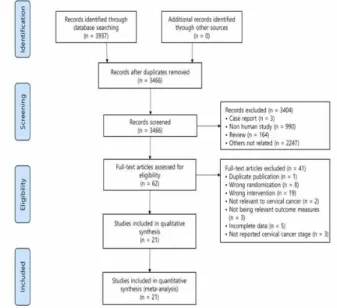
The search was conducted in the following ten electronic databases to October 2019: Pubmed, Cochrane
Efficacy of Herbal Medicine as an Adjunctive Therapy of Chemotherapy for Cervical Cancer: A Systematic Review and Meta-analysis
Seung Yun Oh
#, Mi Suk Kim
1#, Jong Cheon Joo*, Yung Sun Song
1*
Department of Sasang Constitutional Medicine, College of Korean Medicine, Wonkwang University,
1 : Department of Third Medicine of Korean Medicine, Professional Graduate School of Korean Medicine, Wonkwang University
This study aimed to evaluate the efficacy of herbal medicine (HM) combined with chemotherapy (CT) for cervical cancer. Ten electronic databases including Pubmed, Cochrane library, Embase, Korean databases, and Chinese medical databases were systematically searched up to October 2019. All randomized controlled trials with HM combined with CT to treat cervical cancer were included. A total of 21 trials were included for analysis. Compared to the control group, HM combined with CT group significantly increased tumor response (complete and partial response) (risk ratio [RR] = 1.24, 95% CI: 1.15–1.33, p < 0.00001) and Karnofsky performance score (standardized mean difference [SMD] = 1.71, 95% CI: 1.41–2.01, p < 0.00001). Also, HM combined with CT group remarkably reduced CT toxicity. In Conclusion, our study suggests that HM might be a potential option for cervical cancer to enhance curative efficacy and reduce CT toxicity.
keywords : Chemotherapy, Herbal medicine, Cervical cancer, Systematic review, Meta-analysis
* Corresponding author
Jong Cheon Joo, Department of Sasang Constitutional Medicine, Wonkwang University Jeonju Korean Medicine Hospital, 99, Garyeonsan-ro,
Deokjin-gu, Jeonju-si, Jeollabuk-do, Rep. of Kore
·E-mail : [email protected] ·Tel : +82-63-270-1073
Yung Sun Song, Department of Rehabilitation Medicine of Korean Medicine, College of Korean Medicine, Wonkwang University, 460, Iksan-daero,
Iksan-si, Jeollabuk-do, Rep. of Korea
·E-mail : [email protected] ·Tel : +82-63-850-5114
·Received : 2020/09/24 ·Revised : 2020/10/13 ·Accepted : 2020/10/15
ⓒ The Society of Pathology in Korean Medicine, The Physiological Society of Korean Medicine
pISSN 1738-7698 eISSN 2288-2529 http://dx.doi.org/10.15188/kjopp.2020.10.34.5.255
Available online at https://kmpath.jams.or.kr & http://jppkm.org
# Both authors contributed equally to this work
The risk of bias in included studies is shown in Fig.
2. All studies were described as randomized, and 11 studies
10,14,18-22,25,26,29,30) used random number tables. None of the studies described the allocation concealment. All studies had high risk of bias in blinding of participants and
personnel, because they did not use placebo in control group. All studies were unclear on blinding of outcome assessment and selective reporting outcome. Other bias was also evaluated as unclear in all studies due to insufficient information.
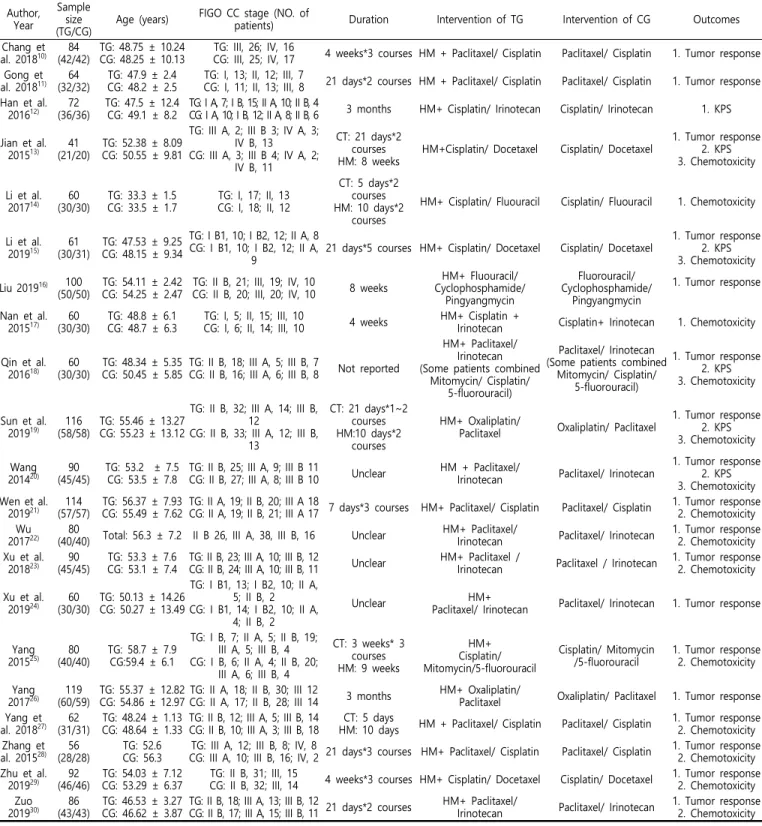
Table 1. Characteristics of included studies Author,
Year
Sample size (TG/CG)
Age (years) FIGO CC stage (NO. of
patients) Duration Intervention of TG Intervention of CG Outcomes
Chang et al. 2018
10)
84 (42/42)
TG: 48.75 ± 10.24 CG: 48.25 ± 10.13
TG: III, 26; IV, 16
CG: III, 25; IV, 17 4 weeks*3 courses HM + Paclitaxel/ Cisplatin Paclitaxel/ Cisplatin 1. Tumor response Gong et
al. 2018
11)
64 (32/32)
TG: 47.9 ± 2.4 CG: 48.2 ± 2.5
TG: I, 13; II, 12; III, 7
CG: I, 11; II, 13; III, 8 21 days*2 courses HM + Paclitaxel/ Cisplatin Paclitaxel/ Cisplatin 1. Tumor response Han et al.
2016
12)
72 (36/36)
TG: 47.5 ± 12.4 CG: 49.1 ± 8.2
TG: I A, 7; I B, 15; II A, 10; II B, 4
CG: I A, 10; I B, 12; II A, 8; II B, 6 3 months HM+ Cisplatin/ Irinotecan Cisplatin/ Irinotecan 1. KPS
Jian et al.
2015
13)
41 (21/20)
TG: 52.38 ± 8.09 CG: 50.55 ± 9.81
TG: III A, 2; III B 3; IV A, 3;
IV B, 13 CG: III A, 3; III B 4; IV A, 2;
IV B, 11
CT: 21 days*2 courses HM: 8 weeks
HM+Cisplatin/ Docetaxel Cisplatin/ Docetaxel
1. Tumor response 2. KPS 3. Chemotoxicity
Li et al.
2017
14)
60 (30/30)
TG: 33.3 ± 1.5 CG: 33.5 ± 1.7
TG: I, 17; II, 13 CG: I, 18; II, 12
CT: 5 days*2 courses HM: 10 days*2
courses
HM+ Cisplatin/ Fluouracil Cisplatin/ Fluouracil 1. Chemotoxicity
Li et al.
2019
15)
61 (30/31)
TG: 47.53 ± 9.25 CG: 48.15 ± 9.34
TG: I B1, 10; I B2, 12; II A, 8 CG: I B1, 10; I B2, 12; II A,
9
21 days*5 courses HM+ Cisplatin/ Docetaxel Cisplatin/ Docetaxel
1. Tumor response 2. KPS 3. Chemotoxicity
Liu 2019
16) 100 (50/50)
TG: 54.11 ± 2.42 CG: 54.25 ± 2.47
TG: II B, 21; III, 19; IV, 10
CG: II B, 20; III, 20; IV, 10 8 weeks
HM+ Fluouracil/
Cyclophosphamide/
Pingyangmycin
Fluorouracil/
Cyclophosphamide/
Pingyangmycin
1. Tumor response
Nan et al.
2015
17)
60 (30/30)
TG: 48.8 ± 6.1 CG: 48.7 ± 6.3
TG: I, 5; II, 15; III, 10
CG: I, 6; II, 14; III, 10 4 weeks HM+ Cisplatin +
Irinotecan Cisplatin+ Irinotecan 1. Chemotoxicity
Qin et al.
2016
18)
60 (30/30)
TG: 48.34 ± 5.35 CG: 50.45 ± 5.85
TG: II B, 18; III A, 5; III B, 7
CG: II B, 16; III A, 6; III B, 8 Not reported
HM+ Paclitaxel/
Irinotecan (Some patients combined
Mitomycin/ Cisplatin/
5-fluorouracil)
Paclitaxel/ Irinotecan (Some patients combined
Mitomycin/ Cisplatin/
5-fluorouracil)
1. Tumor response 2. KPS 3. Chemotoxicity
Sun et al.
2019
19)
116 (58/58)
TG: 55.46 ± 13.27 CG: 55.23 ± 13.12
TG: II B, 32; III A, 14; III B, 12
CG: II B, 33; III A, 12; III B, 13
CT: 21 days*1~2 courses HM:10 days*2
courses
HM+ Oxaliplatin/
Paclitaxel Oxaliplatin/ Paclitaxel
1. Tumor response 2. KPS 3. Chemotoxicity
Wang 2014
20)
90 (45/45)
TG: 53.2 ± 7.5 CG: 53.5 ± 7.8
TG: II B, 25; III A, 9; III B 11
CG: II B, 27; III A, 8; III B 10 Unclear HM + Paclitaxel/
Irinotecan Paclitaxel/ Irinotecan
1. Tumor response 2. KPS 3. Chemotoxicity Wen et al.
2019
21)
114 (57/57)
TG: 56.37 ± 7.93 CG: 55.49 ± 7.62
TG: II A, 19; II B, 20; III A 18
CG: II A, 19; II B, 21; III A 17 7 days*3 courses HM+ Paclitaxel/ Cisplatin Paclitaxel/ Cisplatin 1. Tumor response 2. Chemotoxicity Wu
2017
22)
80
(40/40) Total: 56.3 ± 7.2 II B 26, III A, 38, III B, 16 Unclear HM+ Paclitaxel/
Irinotecan Paclitaxel/ Irinotecan 1. Tumor response 2. Chemotoxicity Xu et al.
2018
23)
90 (45/45)
TG: 53.3 ± 7.6 CG: 53.1 ± 7.4
TG: II B, 23; III A, 10; III B, 12
CG: II B, 24; III A, 10; III B, 11 Unclear HM+ Paclitaxel /
Irinotecan Paclitaxel / Irinotecan 1. Tumor response 2. Chemotoxicity
Xu et al.
2019
24)
60 (30/30)
TG: 50.13 ± 14.26 CG: 50.27 ± 13.49
TG: I B1, 13; I B2, 10; II A, 5; II B, 2 CG: I B1, 14; I B2, 10; II A,
4; II B, 2
Unclear HM+
Paclitaxel/ Irinotecan Paclitaxel/ Irinotecan 1. Tumor response
Yang 2015
25)
80 (40/40)
TG: 58.7 ± 7.9 CG:59.4 ± 6.1
TG: I B, 7; II A, 5; II B, 19;
III A, 5; III B, 4 CG: I B, 6; II A, 4; II B, 20;
III A, 6; III B, 4
CT: 3 weeks* 3 courses HM: 9 weeks
HM+
Cisplatin/
Mitomycin/5-fluorouracil
Cisplatin/ Mitomycin /5-fluorouracil
1. Tumor response 2. Chemotoxicity
Yang 2017
26)
119 (60/59)
TG: 55.37 ± 12.82 CG: 54.86 ± 12.97
TG: II A, 18; II B, 30; III 12
CG: II A, 17; II B, 28; III 14 3 months HM+ Oxaliplatin/
Paclitaxel Oxaliplatin/ Paclitaxel 1. Tumor response Yang et
al. 2018
27)
62 (31/31)
TG: 48.24 ± 1.13 CG: 48.64 ± 1.33
TG: II B, 12; III A, 5; III B, 14 CG: II B, 10; III A, 3; III B, 18
CT: 5 days
HM: 10 days HM + Paclitaxel/ Cisplatin Paclitaxel/ Cisplatin 1. Tumor response 2. Chemotoxicity Zhang et
al. 2015
28)
56 (28/28)
TG: 52.6 CG: 56.3
TG: III A, 12; III B, 8; IV, 8
CG: III A, 10; III B, 16; IV, 2 21 days*3 courses HM+ Paclitaxel/ Cisplatin Paclitaxel/ Cisplatin 1. Tumor response 2. Chemotoxicity Zhu et al.
2019
29)
92 (46/46)
TG: 54.03 ± 7.12 CG: 53.29 ± 6.37
TG: II B, 31; III, 15
CG: II B, 32; III, 14 4 weeks*3 courses HM+ Cisplatin/ Docetaxel Cisplatin/ Docetaxel 1. Tumor response 2. Chemotoxicity Zuo
2019
30)
86 (43/43)
TG: 46.53 ± 3.27 CG: 46.62 ± 3.87
TG: II B, 18; III A, 13; III B, 12
CG: II B, 17; III A, 15; III B, 11 21 days*2 courses HM+ Paclitaxel/
Irinotecan Paclitaxel/ Irinotecan 1. Tumor response
2. Chemotoxicity
CC, cervical cancer; TG, treatment group; CG, control group; HM, herbal medicine; CT, chemotherapy; AEs, adverse events; KPS, Karnofsky performance scale; NK, natural
killer; ALT, alanine transaminase; AST, aspartate transaminase; BUN, blood urea nitrogen; Cr, creatinine; SCC-Ag, squamous cell carcinoma antigen; TSGF, tumor supplied
group of factors; EORTC QLQ-C30, the European organisation for research and treatment of cancer quality of life questionnaire; VAS, visual analogue scale; SF-36, short
form-3